







Abstract
This study investigates how the digital capabilities of engineering project teams form and evolve in the project context, alongside the key antecedent conditions driving this process. Grounded in dynamic capabilities and sociotechnical systems theories, a mixed-methods approach (process tracing and fsQCA) is employed. The research reveals a sensing–seizing–reconfiguring coevolutionary mechanism and identifies three equifinal configurational paths to high capability: social-dominated, technology-dominated, and sociotechnical-synergistic. By extending these theories into temporary organizations, the findings offer managers granular, context-specific strategies for agile resource orchestration and sociotechnical alignment.
Keywords
Introduction
Under the dual drivers of high-quality development and digital transformation, the construction industry is undergoing profound changes. Project delivery is evolving from the traditional linear and fragmented model to an integrated, collaborative, and data-driven digital delivery model, which is seen as a key path to achieving digital transformation goals (Naji et al., 2024). In this context, governments and enterprises worldwide are vigorously promoting the deep integration and application of digital technologies, such as building information modeling (BIM), the Internet of Things (IoT), and big data, gradually forming a new project digital delivery scenario centered on digital technologies. This aims to become the core engine for improving resource allocation efficiency in the industry and optimizing collaborative effectiveness throughout the entire process (Abioye et al., 2021). However, as the fundamental units of value creation in the industry, construction projects generally face a practical dilemma characterized by the contradiction between high technological investment and low-efficiency output. This phenomenon indicates that the success of digital transformation does not solely depend on the advancement of the technical system; more critically, it hinges on whether the social system (i.e., organizations and teams) can effectively adapt to the work paradigm changes brought about by technological embedding (Wang et al., 2022). Construction project teams, as the core carriers for executing project digital strategies and allocating resources, are not only the adopters of digital technologies but also the critical hubs connecting the construction site with digital models. Whether they can effectively manage the systemic complexity of project digitization to achieve the dynamic adaptation of social and technical elements and the agile orchestration of resources has become crucial for reshaping project management logic and realizing the value of digital technologies (Wijayarathne et al., 2024).
In project practice, the digital transformation of construction projects often begins with the top-down rigid deployment of digital resources at the enterprise level. This implementation model not only traps project teams in a path dependency of passive adoption—lacking proactive adaptation to work paradigm changes and process reconfiguration—it also results in a systematic disconnect between digital models and engineering practices. Further observation reveals that even under similar digital infrastructure and platform support conditions, there are still significant differences in the digital performance of different project teams. This structural contradiction between technical system upgrades and lagging social system adaptation confirms a shift in the competitive advantage of project teams. This advantage no longer relies solely on what static digital assets they possess, but crucially on their ability to effectively orchestrate and transform digital resources to bridge the sociotechnical adaptation gap (Argote, 2012; Sousa-Zomer et al., 2020). Digital capability is widely recognized as a key dynamic capability for organizations to remain competitive in the digital age (Ritter & Pedersen, 2020; Saputra et al., 2024). It not only relates to the adoption and utilization efficiency of digital technologies, it also encompasses the team's perception of digital contexts, data-driven collaborative decision-making, and the overall competence to drive digital innovation (Khin & Ho, 2019). Therefore, how to effectively resolve the aforementioned structural contradictions and drive the dynamic generation and enhancement of team digital capabilities has become a core practical challenge that must be directly addressed in the digital transformation of the construction industry.
The enhancement of digital capabilities in construction project teams is deeply embedded in the unique contexts of the construction industry such as its temporariness, complexity, and high degree of cross-organizational collaboration (Luo et al., 2017). However, existing theoretical understanding and empirical research on digital capabilities mainly stem from stable organizations like the manufacturing industry (Warner & Wäger, 2019; Yi et al., 2022), and the theoretical frameworks developed are difficult to directly apply to the highly dynamic, temporary organizational contexts of project digital delivery. Although research has begun to focus on the digital capabilities of construction project teams, most results still exhibit clear limitations. On the one hand, digital capabilities are often treated as antecedent variables influencing project performance, quality, and so forth, whereas the dynamic formation mechanisms of digital capabilities as an outcome variable are overlooked. On the other hand, the methods either remain limited to linear causal analysis or, even when adopting a configurational perspective, focus only on the outcomes of capability generation, failing to reveal the process of capability formation itself and its multiple concurrent causal paths (Hua et al., 2024; Li et al., 2024; Sang et al., 2021). Existing research exhibits significant shortcomings in the contextual applicability of its theories, its causal perspective, and the depth of analysis of capability generation mechanisms, leading to a severe lack of understanding of the complex causal mechanisms underlying the enhancement of digital capabilities in construction project teams. Therefore, treating team digital capabilities as an outcome variable by using project cases to reveal its dynamic formation process and multiple antecedent configurations has become an urgent task in current research.
To address the aforementioned research gaps, this study centers on dynamic capabilities theory (DCT), utilizing its sensing–seizing–reconfiguring process logic to reveal the dynamic evolutionary mechanisms of capability enhancement. Simultaneously, sociotechnical systems theory (STS) is introduced as a complementary perspective to analyze the deep synergistic relationship between the social and technical subsystems, thereby addressing the shortcomings of a single perspective in explaining microlevel element interactions. Based on the theoretical integration of both, this study constructs an integrated analytical framework of context–resource action–capability. Using a mixed-methods approach combining process tracing and fuzzy-set qualitative comparative analysis (fsQCA), this study systematically explains the complex causal mechanisms behind the enhancement of construction project teams’ digital capabilities in the context of project digital delivery by revealing the internal processes and identifying multiple paths. This study aims to answer the following core research questions: (R1) What are the dynamic processes and key antecedents of enhancing construction project teams’ digital capabilities? (R2) What are the multiple antecedent configurations that lead to high-level digital capabilities in teams?
Literature Review and Theoretical Foundation
Literature Review on Digital Capabilities of Construction Project Teams
Construction project teams, as the core execution units of project management, are project-based organizations temporarily formed by heterogeneous members. They need to integrate resources and make collaborative decisions within a limited timeframe (Di Vincenzo & Mascia, 2012). In the context of digitalization, the operations of such teams rely heavily on digital technologies and platforms. Their management capabilities gradually evolve into digital capabilities, becoming key elements in driving project value creation (Ngo & Hwang, 2022; Wijayarathne et al., 2024). Depending on the level of project involvement, construction project teams can be divided into two categories: (1) the broad collaborative network that covers the entire life cycle and (2) the narrow on-site management team that focuses on the construction phase (Kwofie et al., 2015; Sun et al., 2018). Due to the high concentration of digital technologies and the complexity of multiparty collaboration, the construction phase becomes an ideal setting for observing the interaction of sociotechnical elements and the evolution of capabilities. This study focuses on the core management teams during the construction phase. Based on the core-periphery structure theory—although the peripheral labor workforce exhibits high mobility—the management collective (e.g., project managers, chief engineers, and digital directors) that undertakes the execution of digital strategies, resource orchestration, and core decision-making constitutes the behavioral subject of capability evolution. The capability building of this core team not only directly determines the overall project performance but also provides an important theoretical reference for understanding the evolution of broad team capabilities throughout the entire life cycle.
The concept of digital capability is rooted in the resource-based view (RBV) and dynamic capabilities theory (DCT) (Annarelli et al., 2021), and a mature theoretical system focusing on long-term strategic asset accumulation has been formed at the permanent enterprise level. Existing research mainly focuses on the corporate level, such as in manufacturing, emphasizing that digital capability is a dynamic adaptive capacity based on digital technologies, which drives systemic change through resource integration (Annarelli et al., 2021). In terms of structural dimensions, scholars have proposed various frameworks such as analytical, connective, and intelligent capabilities (Lenka et al., 2017); digital sensing, capturing, and transforming capabilities (Warner & Wäger, 2019); and digital sensing, operation, and resource collaboration capabilities (Yi et al., 2022), reflecting the multidimensional and context-dependent nature of this concept. Research on influencing factors has extensively explored antecedents such as the availability of digital technologies (Vilkas et al., 2024), digital strategy (Warner & Wäger, 2019), resource orchestration (Zhao et al., 2025), organizational learning (Lee et al., 2025), leadership (Gyamerah et al., 2025), policy support (X. Zhu et al., 2023), and environmental change (Warner & Wäger, 2019). Overall, at the construction enterprise level, digital capability is typically viewed as a long-term accumulated strategic asset, focusing on establishing stable digital infrastructure and accumulating knowledge systems to form a sustained competitive advantage (Atuahene et al., 2023; Braun & Sydow, 2019).Compared to permanent enterprises that view digital capability as a long-term accumulated strategic asset, the digital capability of construction project teams manifests more as an immediate response and dynamic reconfiguration capability under temporary constraints. Deeply embedded in the specific context of temporariness, time boundedness, and task orientation, the underlying logic of capability generation in project teams differs fundamentally from that at the enterprise level. Constrained by strict project schedules and complex on-site uncertainties, it is difficult for project teams to accumulate capabilities through long-term routine evolution like permanent enterprises; instead, they must rapidly break down cross-organizational information barriers within a limited life cycle (Davies & Brady, 2016). Therefore, a team's digital capability manifests more as an immediate response, representing the dynamic potential to rapidly sense changes and configure digital resources to solve complex on-site problems within a constrained timeframe (Leiringer & Zhang, 2021).
Regarding the antecedents and functioning mechanisms of the digital capability of construction project teams, existing literature provides preliminary empirical support but still exhibits clear limitations in revealing complex causality and dynamic generation processes. Existing research primarily explores the barriers to BIM implementation or the critical success factors for digital delivery, revealing that the emergence of capabilities is driven by multidimensional factors. In the technical dimension, data interoperability among software platforms is the cornerstone of collaboration (Ozturk, 2020); in the organizational dimension, mandatory standards from owners act as an external driving force (Cavka et al., 2017); in the team dimension, the cross-organizational climate of trust directly moderates the actual efficacy of technology (Oraee et al., 2017). Although some scholars have preliminarily defined the team's capability framework across the dimensions of sensing, interconnecting, and analyzing (Hua et al., 2025), most studies remain confined to testing the independent effects of static factors or merely treat digital capability as an antecedent variable affecting performance (Sang et al., 2021). Such research based on a linear paradigm not only neglects the dynamic evolutionary process of the capability itself as an outcome variable but also fails to reveal how multiple antecedent conditions collectively drive the enhancement of capabilities through complex synergistic interactions.
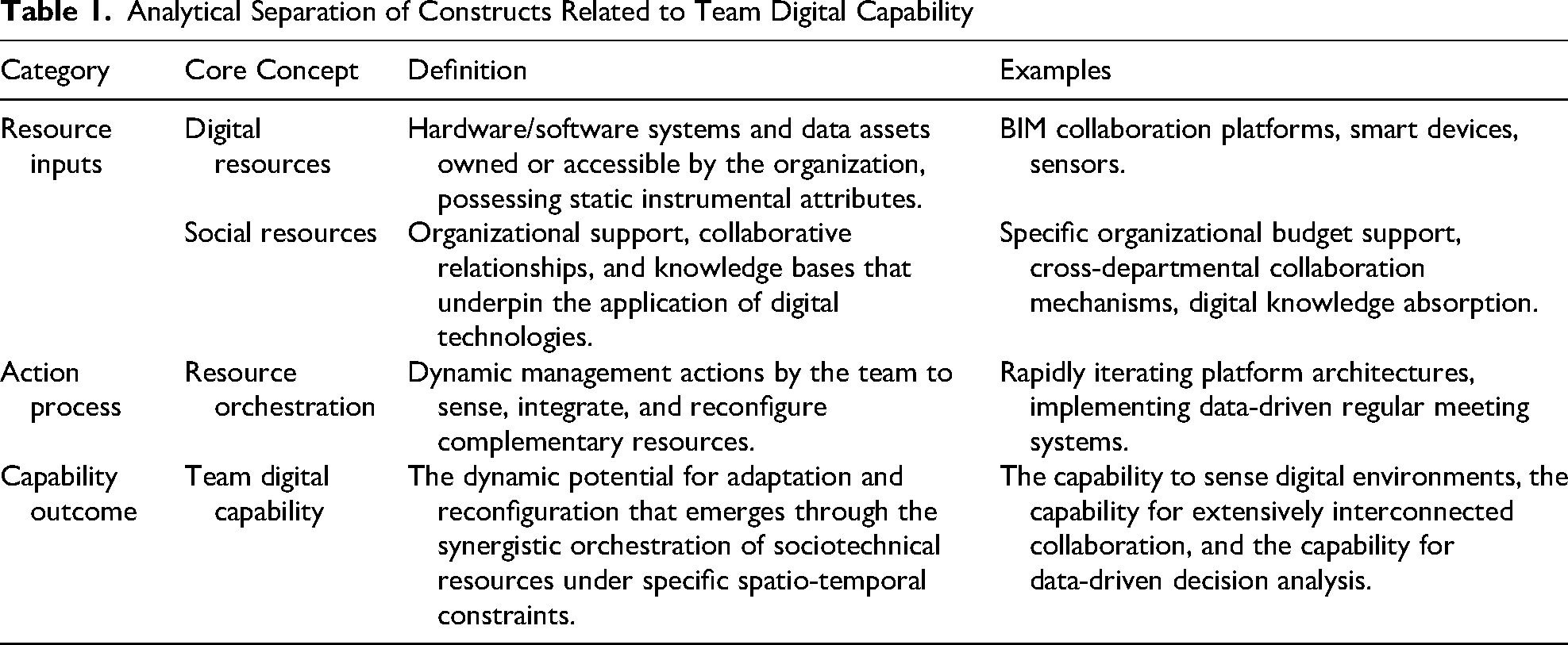
Therefore, to systematically reveal the dynamic generation process and complex synergistic mechanisms of capabilities, precisely defining its connotation becomes the logical starting point of this study. Previous research has often conflated digital capability with digital adoption or digital skills. In fact, digital adoption focuses on the organization's introduction of hardware and software systems, which belong to static resource input; digital skills refer to individuals’ proficiency in specific technologies. In contrast, the digital capability of construction project teams is not a mere accumulation of technical assets but an emergent team property for cross-organizational collaboration and coping with complex contexts. Accordingly, this study strictly defines the concept within the context of project digital delivery as the integrated dynamic capability of a construction project’s core management team. Specifically, it involves acutely sensing internal and external environmental changes utilizing digital resources, making data-driven collaborative decisions to seize opportunities, and proactively conducting adaptive reconfiguration of business processes and resource allocation. To further enhance theoretical rigor, this study conducts a strict analytical separation of the core constructs (Table 1), clearly delineating the conceptual boundaries among resource inputs, action processes, and capability outcomes.
Analytical Separation of Constructs Related to Team Digital Capability
Expansion of Dynamic Capabilities Theory and Integration of the Sociotechnical Perspective
DCT was first proposed by Teece et al. (1997), defining it as the ability of organizations to integrate, build, and reconfigure internal and external resources to respond to changing environments and maintain competitive advantage (Teece et al., 1997). This theory breaks away from the static perspective of the RBV and emphasizes the dynamic evolution of capabilities through continuous adjustments. Teece (2007) further established a three-dimensional framework centered on sensing–seizing–reconfiguring, systematically explaining the process mechanisms by which organizations adapt to dynamic environments (Teece, 2007), driving a crucial shift in the theory from a macro-strategic framework to actionable management practices (Chen et al., 2023). In the context of digital transformation, this theory has evolved into a key tool for analyzing how organizations respond to the uncertainty of technological changes and achieve value transformation (Yeow et al., 2018).
Although DCT was initially developed to explain the sustained competitive advantage of permanent enterprises over long periods, in recent years, project management scholars have advocated shifting its level of analysis down to temporary project organizations (Davies et al., 2016; Spanuth et al., 2020). Unlike the long-term routine evolution of permanent enterprises, construction project teams exhibit significant temporality, time boundedness, and cross-organizational collaboration (Luo et al., 2017). These unique attributes make it difficult for teams to form capabilities through gradual accumulation; instead, they must rely on the rapid integration of digital technologies, processes, and knowledge resources within a limited timeframe (Jia et al., 2024). Therefore, in the context of this study, the classic sensing–seizing–reconfiguring framework of DCT no longer points to the long-term accumulation of strategic assets. Instead, it transforms into a specific mechanism for teams, under limited spatio-temporal constraints, to utilize digital resources for breaking rigidity of plans, enabling agile improvised responsiveness to on-site uncertainties, and achieving rapid resource orchestration (Braun & Sydow, 2019; Sydow & Braun, 2018). Although existing research has preliminarily explored the role of dynamic capabilities in the digital transformation of the construction industry, research on the pathways and mechanisms for building and enhancing capabilities in temporary teams is still insufficient (Wijayarathne et al., 2024).
Furthermore, although the sensing–seizing–reconfiguring framework of DCT establishes the process foundation for capability enhancement, its explanatory power regarding the antecedent conditions and their deep interactive mechanisms driving this process remain to be supplemented. To this end, this study introduces STS as a complementary analytical perspective and an antecedent deconstruction framework. The core proposition of STS asserts that the optimization of organizational effectiveness depends on the joint optimization and coevolution of the social subsystem (personnel, relationships, collaboration) and the technical subsystem (tools, processes, platforms) (Cherns, 1976). Because DCT's definition of resource elements is relatively abstract, the introduction of STS clearly deconstructs the diverse elements driving capability generation, elucidating that the effective embedding of technological systems must be aligned with adjustments to the social structure (Pasmore et al., 2019; Oraee et al., 2017). This integration effectively addresses the shortcomings of a singular DCT perspective in explaining the interactions among antecedent elements.
Based on the aforementioned theoretical integration, this study constructs an integrated context–resource action–capability analytical framework, achieving a logical nesting of the two classic theoretical frameworks. Specifically, this framework adopts the sensing–seizing–reconfiguring mechanism of DCT as the overarching process logic, wherein the uncertain context of the project triggers the team's sensing of change. Relying on the social and technical elements deconstructed by STS and their dynamic orchestration (i.e., resource actions), this framework provides elemental support and practical paths for seizing and reconfiguring. Ultimately, this dynamic process drives the emergence of capabilities. This framework effectively integrates the processual evolutionary perspective of DCT with the configurational logic of multielement synergy in STS, providing a solid theoretical foundation for systematically analyzing the mechanisms of capability generation and configurational paths.
Research Methods and Design
Method SelectionS
The core objective of this study is to deeply reveal the process mechanisms and systematically identify concurrent causal relationships. A single research method has inherent limitations. Therefore, this study adopts a mixed-methods design combining process tracing and fsQCA based on the pragmatist paradigm (Cherryholmes, 1992), to achieve an integrated analysis of both the depth of mechanisms and the breadth of paths. To bridge the epistemological differences between the two methods, this study introduces the perspective of critical realism, conceptualizing causal mechanisms as generative tendencies rather than linear determinism (Bhaskar, 2013). That is, it acknowledges that antecedent elements possess inherent causal powers to produce outcomes, but such latent powers can only be activated and transformed into actual results within specific contextual configurations.
Research question 1 (RQ1) focuses on the process mechanisms of capability enhancement, which is a typical how and why question that requires in-depth case tracking of causal chains over time. Process tracing reveals the process mechanisms between independent and dependent variables by analyzing key events and decisions within a case, making it suitable for opening the causal black box (Beach, 2020; George & Bennett, 2005). Given the current limited understanding of the formation process of digital capabilities in construction project teams, this study integrates the perspectives of dynamic capabilities and sociotechnical systems. It adopts a theory-building process tracing approach and causal inference logic (Beach, 2017), aiming to extract the process mechanisms of capability formation and enhancement from typical cases, thus providing solid empirical evidence and theoretical explanations for the research question.
Research question 2 (RQ2) focuses on multiple antecedent configurations, addressing the issues of multiple concurrent causal relationships and equifinality in the co-evolution of social and technical elements. The fsQCA method, based on set theory and Boolean algebra, excels at identifying the synergistic effects of multiple antecedent conditions and equifinal paths (Ragin, 2009). Unlike traditional regression methods that focus on the independent effects of independent variables, fsQCA examines how combinations of conditions jointly lead to outcomes, which perfectly aligns with the configurational analysis needs of this study (Du & Jia, 2017). In this study, the function of fsQCA is to transcend the idiosyncrasies of a single case and identify the contextual conditions under which the aforementioned process mechanisms operate from a configurational perspective. This approach systematically elucidates the multiple paths driving high-level team digital capabilities and the interactive relationships among their antecedent conditions.
The combination of process tracing and fsQCA effectively overcomes the limitations of a single method, achieving complementary advantages (Beach, 2018; Schneider & Rohlfing, 2013). Specifically, through in-depth case analysis, process tracing focuses on revealing the internal causal mechanisms and process logic driving capability generation. In contrast, fsQCA utilizes multicase comparison to identify the specific contextual configurations in which these mechanism operate, thereby verifying the robustness of the process tracing conclusions and expanding upon multiple equifinal paths. Therefore, the mixed-methods design of this study not only addresses the two research questions separately but also—through the interaction between methods—generates a more comprehensive and profound theoretical understanding of the complex phenomenon of team digital capability enhancement.
Research Design
This study follows the exploration–testing–expansion logic (Creswell & Clark, 2017) and adopts a sequential mixed-methods design, with process tracing used first and fsQCA used later (Schneider & Rohlfing, 2013). The aim is to go beyond the simple addition of quantitative and qualitative methods, achieving value through their integration. Specifically, the study begins with an exploratory analysis using theory-building process tracing to reveal the dynamic process and underlying causal mechanisms of team digital capability enhancement from typical cases, identifying the key antecedent conditions and their interactions that constitute the mechanism. Next, fsQCA is used for multicase comparison to test the generalizability of the causal mechanisms revealed by the process tracing analysis and systematically identify the multiple antecedent configurations that drive high-level capabilities. Finally, through mutual verification, supplementation, and interaction of the evidence from both methods, the study provides a comprehensive and in-depth explanation of the research questions. The research process is shown in Figure 1.
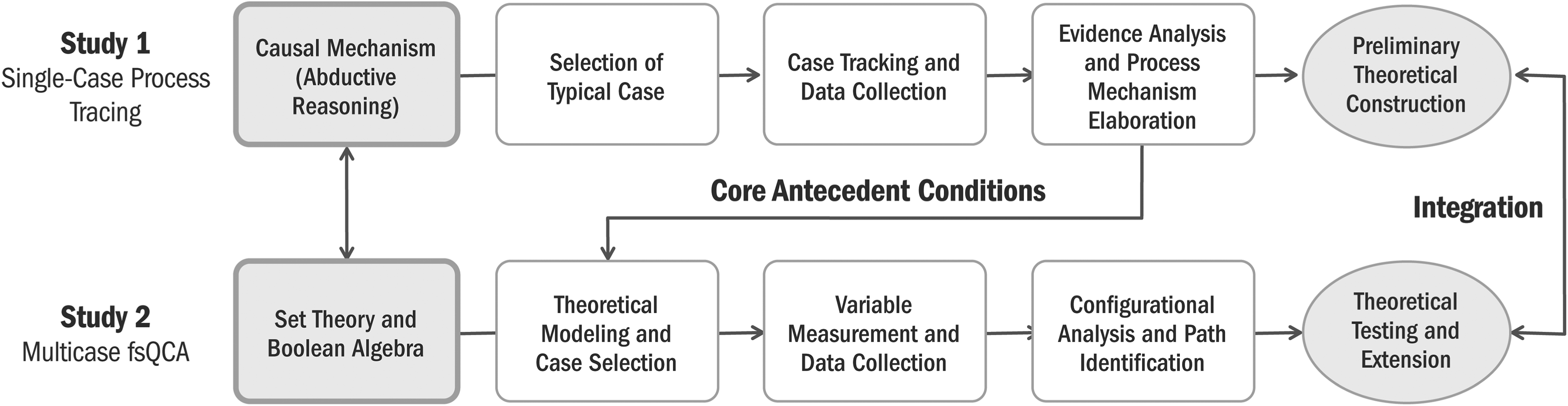
Research process.
This study selects cases based on the principle of theoretical sampling. In the process tracing analysis phase, the project of a certain building by the China State Construction Engineering Corporation (CSCEC) Fourth Bureau was chosen as the tracking case due to its high representativeness in digital integration. In the fsQCA analysis phase, the aim was to test and expand the process tracing findings through multicase comparison. Therefore, 21 cases were selected from collaborative projects to form the analysis sample, ensuring the robustness and generalizability of the conclusions.
In terms of data collection, the process tracing part strictly follows the triangulation principle (Yin, 2009), collecting qualitative data through multiple channels such as interviews, field observations, project archives, and news reports. The fsQCA part, based on literature and prior qualitative research, designs survey questions and collects data using a standardized questionnaire validated through a prestudy to ensure the reliability and validity of the data.
In the data processing and analysis phase, process tracing adopts a theory-building analytical approach (Ylikoski, 2015), systematically organizing case facts to inductively derive the process mechanisms of team digital capability formation. The fsQCA analysis follows a standard process, including data calibration, necessity analysis, configuration sufficiency analysis, and robustness testing, aiming to reveal the multiple equifinal paths leading to high capabilities.
Case Study Process Tracing Analysis
Case Selection
Given the complex dynamic nature of the digital delivery process in construction projects and the exploratory need for theoretical construction (from 0 to 1) in this study, adopting a single-case process tracing, compared to a multiple-case study, can precisely reveal the causal chains and internal mechanisms of capability generation.
Guided by this strategy, this study selects the project of a certain building by the CSCEC Fourth Bureau as the tracking case. The specific reasons are as follows: First, the project is highly representative and cutting edge. As a provincial-level pilot for intelligent construction, its high assembly rate and core characteristics of green, intelligent, and information-driven make it a representative example of the advanced direction in the industry’s digital transformation. Second, the project features a high level of digital integration. Its core Intelligent Cloud-Based Construction Factory System has achieved full-process digital delivery, providing an ideal research field to observe capability evolution. Third, it meets the requirement of data accessibility. The project, due to its advancement, has attracted sustained government, industry, and media attention, generating rich secondary data and facilitating field research and in-depth interviews. This ensures the feasibility of data triangulation and provides a safeguard for the reliability and validity of the study.
Research Framework and Data Analysis Process
Construction of the Integrated Analytical Framework
Based on the perspectives of DCT and STS, this study constructs an integrated context–resource action–capability analytical framework. Building on the core proposition of the static RBV that heterogeneous resources form the basis of capabilities (Barney, 1991), the framework shifts the focus to the dynamic configuration process of social and technical resources. Specifically, the framework treats the project digital delivery context as an external driving force that prompts organizational responses. Resource action is defined as the key practice where teams use their sensing abilities to seize and reconfigure resources from both the social subsystem (e.g., relationships, knowledge) and the technical subsystem (e.g., platforms, equipment), thereby enhancing their digital capabilities. Overall, the causal chain constructed by this framework reveals the process of the coevolution of the sociotechnical system.
Data Collection
Data collection began in early 2023 and was carried out in two phases to track the project. The first phase (project preparation period) involved remote interviews with the project manager and core management members, focusing on team formation, preparation of the intelligent construction platform, and initial capability-building measures. The second phase (construction period) included semistructured interviews, focus group discussions, and field observations, which deeply tracked the team's challenges, coping strategies, and capability evolution in digital practices. The study completed a total of 21 interviews, with a duration of 1,060 minutes, approximately 97,000 words of transcribed text, and a 2,000-word field research report. To ensure the reliability and validity of the data, the study simultaneously collected 107 pieces of secondary data, such as project archives and news reports, and cross-validated the primary data using the triangulation principle. All data were entered into a case database for independent analysis and comparison by research team members to ensure objectivity.
Process Theory Analysis Process
This study follows the theory-building process tracing paradigm and the logic of abductive reasoning, identifying causal mechanisms through iterative iterations between empirical data and the theoretical framework. To ensure scientific rigor, a four-person analysis team comprising professors, industry experts, and graduate students was established. The specific process is as follows:
The first step involved constructing a factual chain of events. To achieve this, the analysis team systematically processed and chronologically reconstructed the interview and archival data, extracting over 280 empirical evidence nodes without predefined theoretical labels. From these, 15 representative key pieces of evidence were selected to fully reconstruct the sequence of critical events from the project preparation phase to the construction phase, thereby constructing an objective case fact chain. The focus of this step is to reconstruct observable sequences, providing an empirical foundation for subsequent inferences.
The second step focused on evidence identification and construct mapping. By adopting a strategy that combines theoretical presumptions with empirical emergence, the analysis team extracted 10 causal process observations with diagnostic value from the fact chain. To ensure reliability, an investigator triangulation strategy was employed. Discrepancies were resolved through independent evidence extraction and expert focus group discussions, ensuring accurate mapping from empirical evidence to theoretical constructs.
The third step involved causal mechanism inference. Based on the extracted causal process observations, abductive logic was used to infer the generative mechanisms hidden behind the events; that is, to explain the underlying logic of how resource actions translate into capabilities through sociotechnical interactions. During this process, anomalous evidence inconsistent with the preliminary theoretical framework was treated as a window for theoretical refinement. Meanwhile, key antecedent conditions were extracted from the causal chain, providing a direct qualitative basis for subsequent variable selection in fsQCA.
Case Causal Mechanism Analysis
To deeply reveal the dynamic process of team digital capability enhancement, this study uses the context–resource action–capability analytical framework to conduct process tracing of a typical case across two key stages: construction preparation and full-scale construction. The analysis shows that capability enhancement follows the evolutionary path of sensing–seizing–eeconfiguring and is essentially a process of the coevolution of the sociotechnical system. Specifically, in the construction preparation stage, the focus is on foundational resource allocation, where capabilities are initially built through the deployment of platform equipment and tools, the establishment of collaborative relationships, and the acquisition of digital knowledge. The full-scale construction stage then shifts to systemic integration and reconfiguration, driving deep systemic reconfiguration through optimizing technological integration, institutionalizing collaboration mechanisms, and internalizing knowledge systems. The study further reveals that digital, relational, and knowledge resources do not evolve in isolation, but rather, through the interactive coupling between the social and technical subsystems, jointly drive capability leaps. The following sections will analyze the process mechanisms of the actions related to these three types of resources and ultimately integrate and reveal the underlying logic of their coevolution.
Digital Capability Enhancement Relies on Digital Resource Action
During the construction preparation phase, the project team deployed digital platforms and smart devices. Regarding the platform, the technical team completed the system setup, with core modules including “Command Center, BIM Collaborative Management, Resource Management…Monitoring System, Cloud-based Construction Management,” and conducted tests to verify module stability and integration (E2). (Note: Hereinafter, E1, E2, etc., represent the empirical evidence codes extracted from the case fact chain.) Regarding smart devices, the project “deployed a cluster of intelligent equipment, such as hoisting robots, around the cloud-based construction factory, and employed intelligent construction technologies like the hoist visualization system” to achieve full coverage of the digital construction scenario (E3). During the full-scale construction phase, the team continued to advance the optimization and integrated application of digital resources. At the platform level, the technical team “collected feedback from the frontline of the project and quickly iterated the system architecture of the platform… improving the platform's response speed, simplifying the operation process, and making the platform more user-friendly and efficient” (E4). At the smart device level, “new systems such as the hoist visualization system, high formwork monitoring system, and unloading platform monitoring system were added” (E5). Additionally, the team “introduced advanced technologies to enhance data processing capability and analysis accuracy,” driving the realization of “data-driven decision-making” (E6).
The evidence shows that digital resources have evolved from instrumental embedding to deep coconstruction, systematically driving the formation of team digital capabilities. The deployment of digital resources during the construction preparation phase reflects opportunity capturing. Prior to this, the team identified the necessity and feasibility of digital investment through continuous sensing of industry technology trends and policy requirements. The integration of digital platform modules (E2) constructed a standardized digital work environment, prompting the team's cognition and collaboration modes to transform into data-driven models, laying the foundation for perceptual capabilities. The introduction of smart equipment (E3), with its remote sensing and automated operational capabilities, empowered the team to achieve fine control and efficient responses to complex construction scenarios. The core mechanism during the full-scale construction phase is continuous reconfiguration. The iterative process of the platform, based on feedback (E4), reflects the interaction of tool optimization and organizational learning, which facilitates broader member participation in digital practices and strengthens collaborative and interconnected capabilities. The upgrade of data processing technologies (E6) drove a fundamental shift in decision-making from experience-based reliance to data-driven analysis. The systematic integration of multiple technologies (E5) transformed digital resources from isolated tools into enablers of systemic decision-making. In complex construction projects, digital resources exhibit nonlinear, dynamically continuous reconfiguration characteristics, highlighting the essential principle of the coevolution of technology application and capability building in the digital transformation of traditional industries.
Digital Capability Enhancement Relies on Relational Resource Action
During the construction preparation phase, the project team systematically built two types of relational resources: organizational support and team digital collaboration. In terms of organizational support, the management ensured the resource base by “setting up a dedicated digitalization fund in the project budget… and equipping key positions with mobile terminal devices” (E8). Regarding team collaboration, the team “held regular platform work reports to ensure project progress transparency and efficient problem-solving, and relied on technical exchange meetings to help the team master new technologies and resolve collaboration conflicts” (E7). As the project moved into the full-scale construction phase, relational resources continued to deepen. On the organizational support side, the project relied on “monthly digital coordination meetings chaired by the project leader” to report progress based on platform data from all parties and ensured that “all members received the same version of project information in a timely manner” by “having all stakeholders update platform data in real time” (E9). On team collaboration, the project held “regular online and offline coordination meetings, established a multilevel communication mechanism, and relied on the BIM system to share key information in real time,” which helped “enhance information transparency and promote the formation of efficient collaboration” (E10).
Relational resources, through the interaction of organizational support and team collaboration, provide the critical social foundation for digital capability enhancement. The construction preparation phase is characterized by opportunity capturing, aiming to establish the foundation for transformation and address resistance. Initially, the team perceived that traditional collaboration models were insufficient to meet digitalization requirements, leading to cognitive conflicts and trust barriers. Organizational support, through resource investment (E8), provided material guarantees, whereas platform reporting and technical exchanges helped establish initial trust (E7), encouraging the team to accept digital work methods and laying the foundation for the development of perceptual capabilities. The full-scale construction phase shifts toward continuous reconfiguration, directly empowering capability enhancement. Institutionalized reporting and data synchronization mechanisms (E9) expanded the scope of situational awareness through transparency; collaborative practices based on BIM (E10) shifted cross-department communication from post-event resolution to pre-event coordination, enhancing interconnection and responsiveness. The consensus and trust formed through collaboration reduced communication and execution barriers for data-driven decision-making, facilitating the internalization of analytical decision-making capabilities. The study shows that relational resources, through the organization–collaboration interaction mechanism, not only support the application of technology but also drive the systematic generation and enhancement of digital capabilities within the coevolution of the sociotechnical system.
Digital Capability Enhancement Relies on Knowledge Resource Action
During the construction preparation phase, the project team acquired digital knowledge through a systematic learning mechanism. Through technical discussions and experience sharing, the team “reflected on and summarized past digital achievements to support the preparation for this project's digitalization and development” (E1). At the same time, by relying on “training in platform operation, data analysis, smart construction technologies, etc.,” team members “gained a comprehensive understanding of digital technology operation processes and problem-solving methods,” and “documented project practice experiences and uploaded them to a cloud database for efficient knowledge sharing and instant learning” (E11). As the project entered the full-scale construction phase, knowledge activities shifted toward practical internalization and system construction. The project emphasized creating a learning atmosphere, where team members “learned from each other and improved their capabilities through diverse channels, such as formal and informal training, the ‘mentor-mentee’ system, and technical experience exchange meetings” (E13). Through the learning-by-doing mechanism, the team “continued to reflect and summarize, gradually accumulating customized operational experience and knowledge templates for the project,” and later “evaluated the entire process, extracted best practices and lessons learned, and promoted the continuous optimization and innovation of digital knowledge for future projects” (E12).
Knowledge resources, through the processes of systematic acquisition, understanding, application, and internalization, lay the cognitive foundation for the enhancement of team digital capabilities. The construction preparation phase is characterized by opportunity capturing, with a focus on establishing a common knowledge base. The team recognized that their digital knowledge reserves were insufficient to meet the demands of digital practices, leading to a strong demand for learning. Training and experience exchanges (E1, E11) helped the team develop an understanding of digital technologies and a willingness to accept them, providing the cognitive prerequisites for capability development. The full-scale construction phase reflects continuous reconfiguration, with the core focus on internalizing knowledge through practice and transforming it into capability. The customized experience formed through “learning-by-doing” (E12) drove the transformation of general knowledge into targeted practical capabilities, enhancing the team's technical adaptability and problem-solving effectiveness. The knowledge-sharing mechanism further facilitated the externalization of tacit knowledge, building a transferable digital capability system. The case study shows that knowledge resources, through the learning–practice–absorption cycle, not only support the application of technology but also facilitate a cognitive leap from passive acceptance to proactive innovation, reflecting the coevolution of cognitive, social, and technical dimensions in digital capability building.
Dynamic Process Mechanism of Digital Capability Enhancement
Based on the process tracing analysis of the CSCEC Fourth Bureau's building project, this study finds that the enhancement of team digital capabilities is not driven by a single factor in a linear manner but is instead a dynamic evolutionary process driven by the collaborative interaction of three types of resources: digital, relational, and knowledge resources. This process follows the evolutionary logic of sensing–seizing–reconfiguring, presenting a phased characteristic that transitions from situational awareness and foundational resource allocation during the construction preparation phase to resource integration and system reconfiguration during the full-scale construction phase. Specifically, in the early stages, the team built initial capabilities by identifying digital opportunities and allocating key resources, whereas later, through resource reconfiguration and the deepening of collaborative mechanisms, the team achieved a systemic leap in digital capabilities.
In this dynamic process, the three types of resources collectively form the core support for capability evolution. Digital resources (digital platforms, smart devices), as the technological foundation, provide a standardized, visualized, and data-driven work environment through continuous deployment, integration, and iteration, driving the team’s shift from experience-driven to data-driven practices. Relational resources (organizational support, team digital collaboration) provide support at the levels of funding, systems, communication, and trust, promoting information sharing and process transparency through institutionalized collaboration and cross-department coordination mechanisms and fostering a culture of continuous interaction. Knowledge resources (digital knowledge absorption) provide the cognitive and innovative foundation for the team through training, experience summarization, and knowledge-sharing mechanisms, ensuring that technical understanding deepens and is converted into practical capabilities.
More importantly, these three types of resources do not evolve independently within the sociotechnical system but instead form a dynamic collaborative mechanism through continuous interaction. Digital platforms and smart devices create data-driven practical scenarios for collaboration and learning, while relational resources, through institutionalized coordination and trust mechanisms, ensure the stable operation of the technical system and the flow of knowledge. In turn, the accumulation of these knowledge resources promotes technological iteration and collaborative optimization. This interactive mechanism profoundly reflects the dynamism, evolutionary nature, and contextual dependence of capability building. Therefore, the evolution of team digital capabilities is essentially the result of the mutual promotion and coevolution of the social subsystems (relationships, knowledge) and the technical subsystem (digital) through interaction.
Based on the above findings, this article constructs the dynamic process model of team digital capability enhancement (Figure 2). This model reveals that the formation of team digital capabilities is a complex adaptive process, starting with environmental perception, driven by resource interaction, and resulting in system reconfiguration. This model not only deepens the understanding of the micro-mechanisms of capability generation but also provides key antecedent conditions and theoretical support for subsequent multicase configurational analysis. To further test the robustness of this mechanism and reveal the multiple paths of capability formation in different contexts, the next section will use the fsQCA method to conduct cross-case comparative analysis.
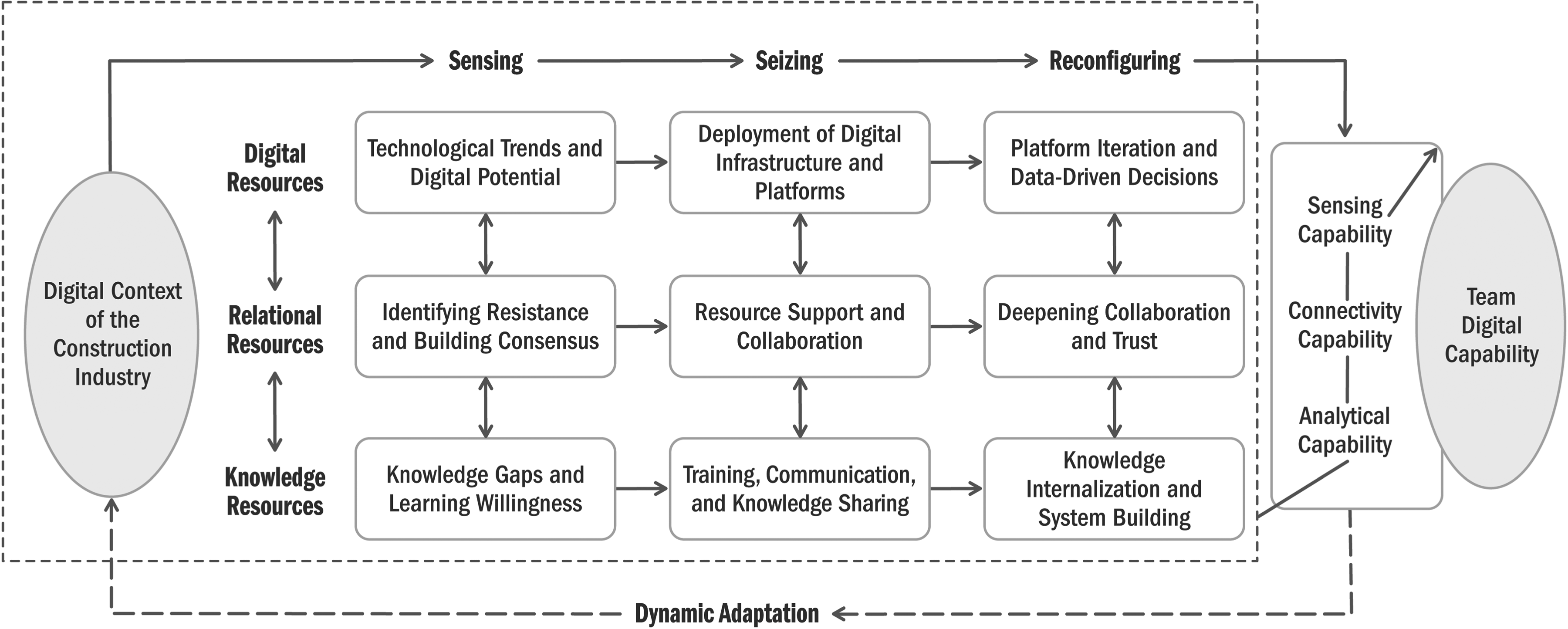
Dynamic process model of team digital capability enhancement.
Multicase Qualitative Comparative Analysis
Model Construction and Data Sources
Based on the five key antecedent conditions identified in the single-case process tracing analysis—digital platforms, smart devices, organizational support, team digital collaboration, and digital knowledge absorption—this study constructs a configurational model (Figure 3) and empirically tests it using fsQCA. The effectiveness of the fsQCA method depends on the sufficient diversity of the sample cases in terms of both outcomes and conditions (Ragin, 2009). To achieve this, the study strictly follows the principle of theoretical sampling and selects 21 cases from construction enterprises that have established long-term research collaborations with the research team to form the analysis sample. This sample size meets the fsQCA method's recommendation for medium numbers of conditions (k = 5) (Marx et al., 2013), and the sample exhibits significant diversity in terms of project type, geographic distribution, and degree of digitalization, ensuring that the research results can capture complex concurrent causal relationships.
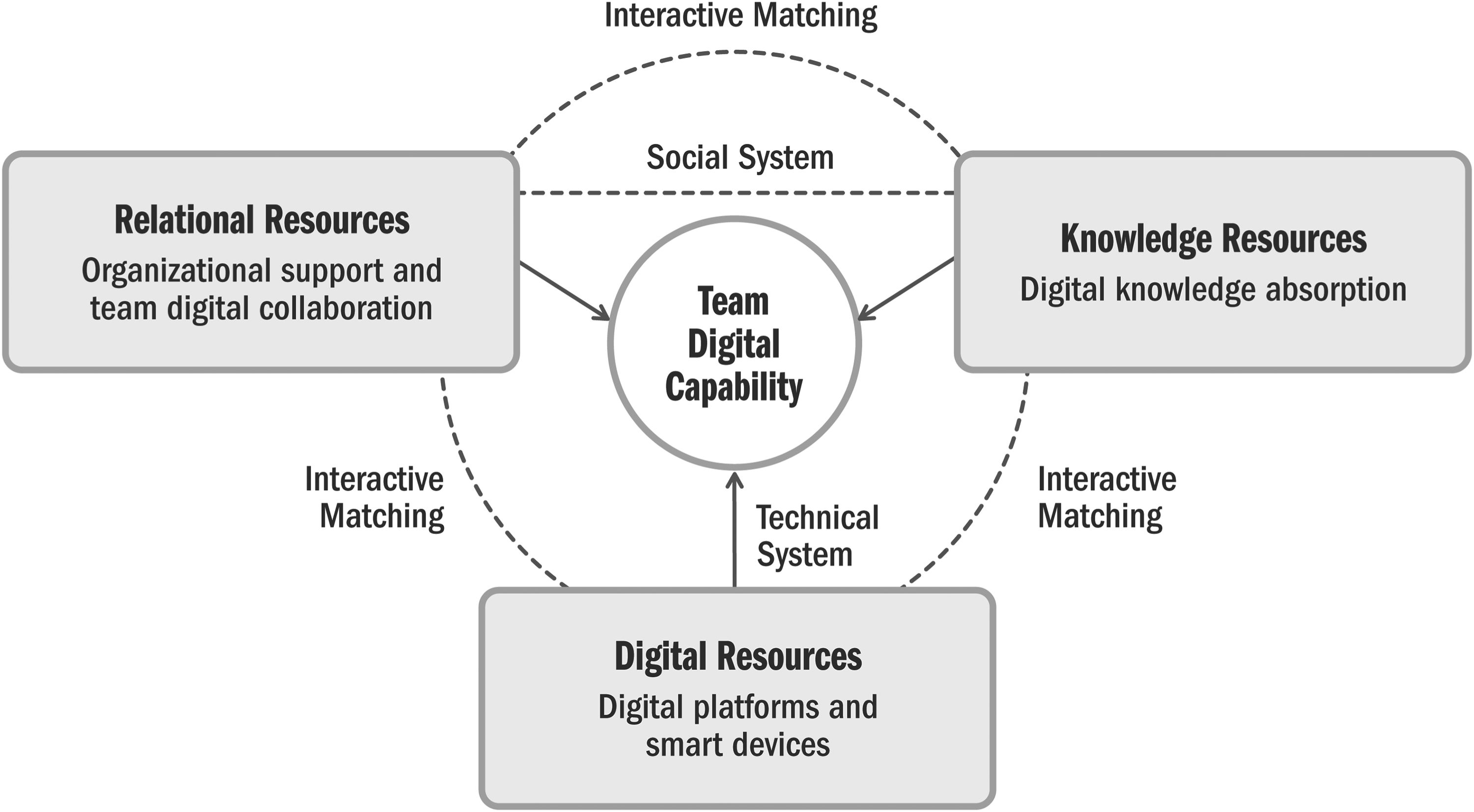
Configurational model of antecedents to team digital capability enhancement.
Variable Measurement and Data Calibration
Variable Measurement
The subjects of this study are the core management personnel of the project teams, including project managers, engineers, and technical leaders. Variable measurement was conducted using a questionnaire scoring method to collect data. To ensure the content validity of the measurement tool, this study followed a rigorous procedure of scale adoption and contextual adaptation. First, mature scales related to each construct were extensively reviewed and referenced. Second, combining typical qualitative evidence from the single-case process tracing analysis, the initial items were contextually adapted to the project. Subsequently, three senior scholars in the field of construction management and two project managers with rich experience in digital construction were invited to conduct multiple rounds of rigorous evaluation and revision on the theoretical representativeness and semantic clarity of the items. Ultimately, five measurement items were designed for each variable (Table 2), and measured using an 11-point Likert scale, ranging from 0 to 10 (Preston & Colman, 2000). Additionally, before the formal survey, a pilot survey involving 50 management personnel was conducted to further optimize the items. The pilot survey data were not included in the final empirical analysis.
Design of Variable Measurement Items
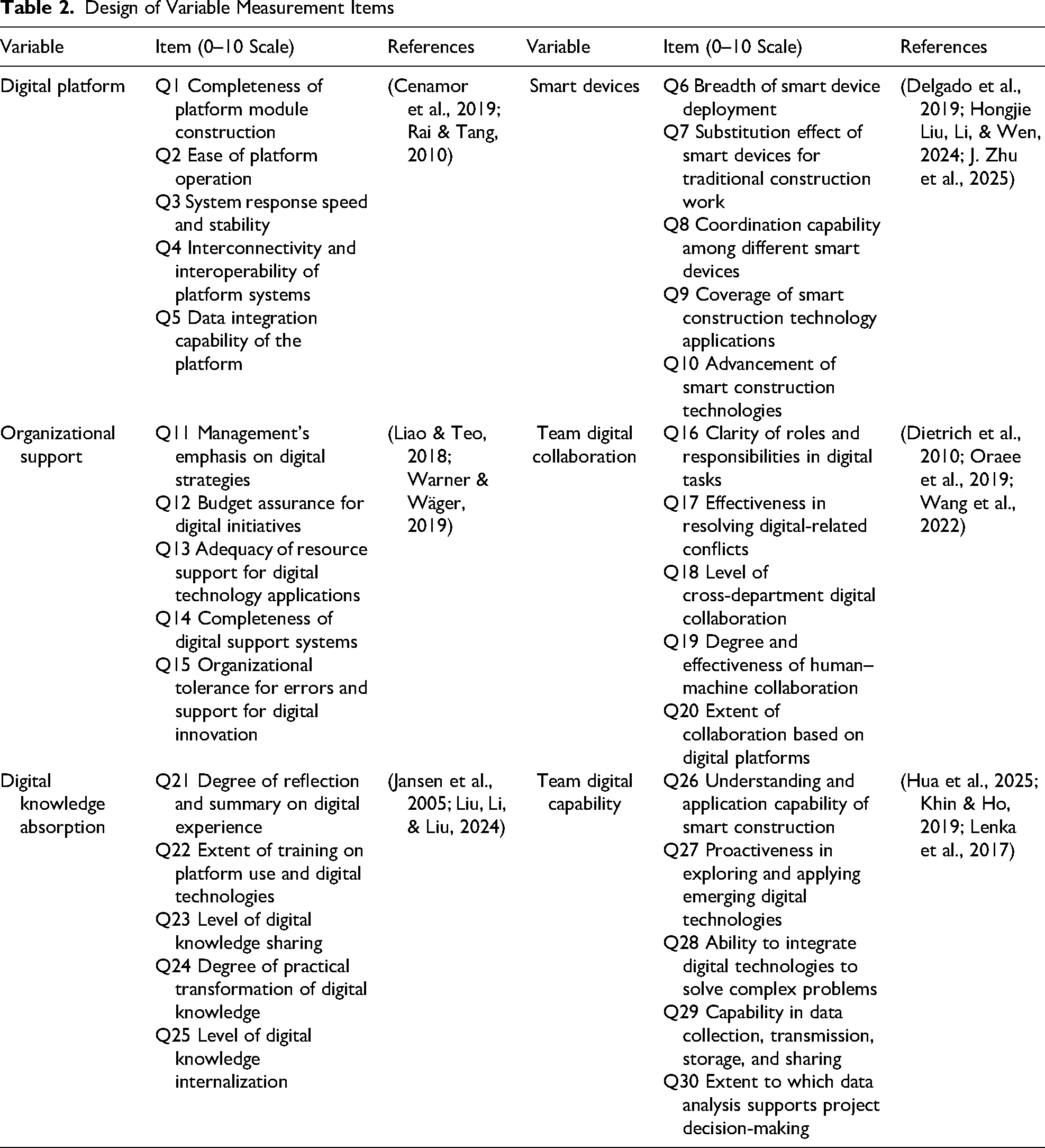
The formal survey lasted 2 months, resulting in the collection of 105 valid questionnaires (covering 21 projects, with an average of five respondents per project). The confirmatory factor analysis (CFA) results based on the formal sample showed that the fit indices of the six-factor measurement model were good (x2/df = 1.86, RMSEA = 0.065, CFI = 0.942, TLI = 0.935), indicating that the scale possesses a stable factor structure. The standardized factor loadings of all items were significantly higher than 0.7; the Cronbach's α coefficients and composite reliability (CR) values of all variables were higher than 0.8, the average variance extracted (AVE) values were all greater than 0.6, and the square root of the AVE for each variable was significantly greater than the correlation coefficients between variables. The measurement tool demonstrated good reliability, convergent validity, and discriminant validity. Furthermore, given that the unit of analysis in this study is the 21 project teams, we used the within-group interrater agreement index (
Data Calibration
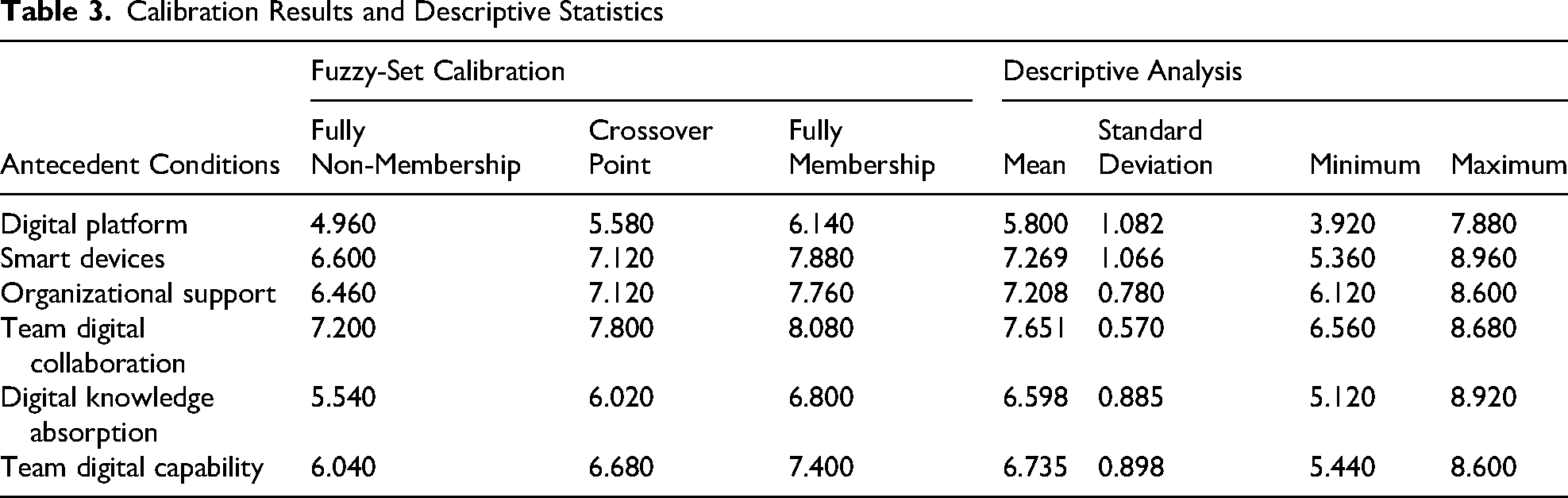
This study uses the direct calibration method to convert the data into fuzzy set membership scores (Ragin, 2009). Based on the concentration and low dispersion of the sample data distribution, the 75%, 50%, and 25% percentiles were selected as calibration anchors to better distinguish subtle differences between cases (Fiss, 2011). Additionally, membership scores of exactly 0.5 were adjusted to 0.499 to eliminate analysis ambiguity (Crilly et al., 2012). The calibration results and descriptive statistics are shown in Table 3.
Calibration Results and Descriptive Statistics
Empirical Analysis and Results
Necessity Condition Analysis
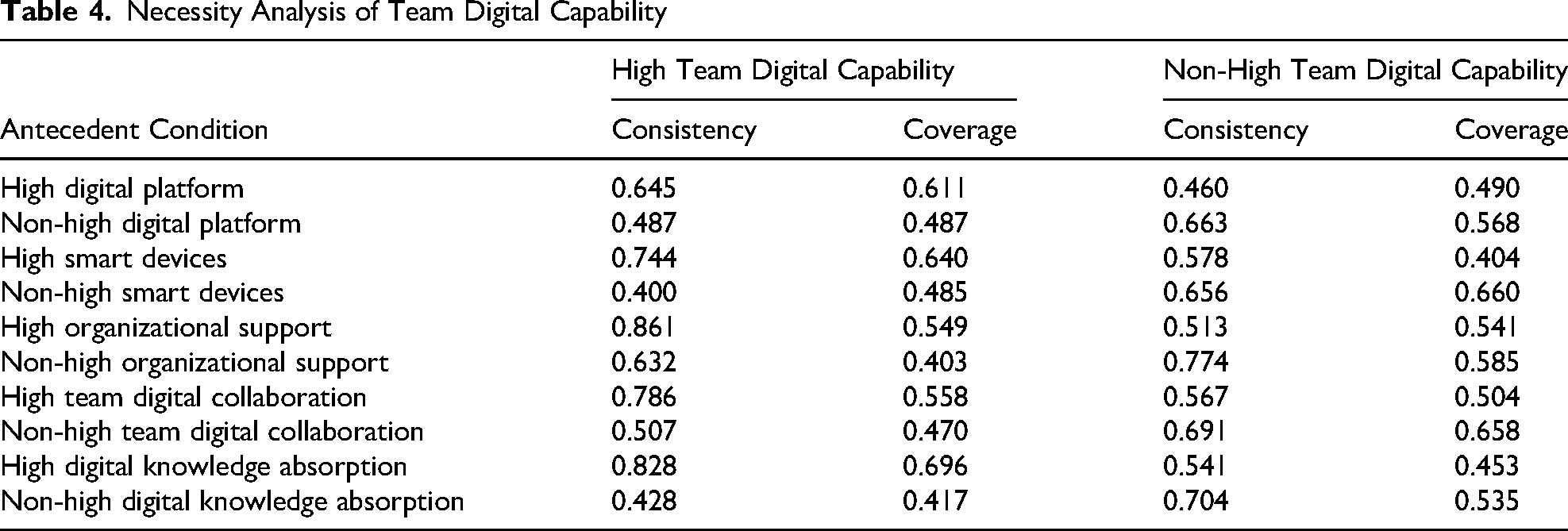
Before conducting the fsQCA configurational analysis, this study tested whether each antecedent condition was a necessary condition for the occurrence of the outcome variable. A consistency higher than 0.9 indicates that the condition is always present when the outcome occurs and can be considered a necessary condition (Ragin, 2009). Using fsQCA 3.0 software, the necessary conditions for high-level and non-high-level team digital capabilities were analyzed (Table 4). The results show that the consistency of all individual antecedent conditions did not exceed 0.9, meaning that no single condition can be considered a necessary condition.
Necessity Analysis of Team Digital Capability
Sufficiency Analysis of Condition Configurations
Using fsQCA 3.0 software, the sufficiency analysis of condition configurations was conducted, setting the consistency threshold at 0.8 (Cheng & Jia, 2016), the frequency threshold at 1 (Schneider & Wagemann, 2012), and the proportional reduction in inconsistency (PRI) consistency threshold at 0.75 (Greckhamer, 2016). The analysis generated complex, intermediate, and parsimonious solutions. Core and peripheral conditions were distinguished based on their occurrence in the solutions. The results (Table 5) show that there are four configurational paths for high-level team digital capabilities (A, B1, B2, C), with an overall solution consistency of 0.873 and coverage of 0.585, indicating that the configuration is overall reliable and explains 58.5% of the cases. The results not only tested the sociotechnical system's collaborative mechanism and the interactive relationships of digital, relational, and knowledge resources—it also revealed the differentiated configuration paths of resource elements, highlighting the multiple concurrent causal relationships and contextual dependence. Based on the depth of collaboration between the social and technical subsystems and the dominant logic, the configurations were summarized into three patterns. The first is the social-dominated pattern (A), which operates with organizational support as its core. The second is the technology-dominated pattern (B), centered around digital platforms or smart devices; this includes the platform-dominated subtype B1 and the equipment-driven subtype B2. Finally, the sociotechnical-synergistic pattern (C) is driven by a multicore approach involving digital platforms, organizational support, and knowledge absorption.
Configurational Analysis of High-Level Team Digital Capability
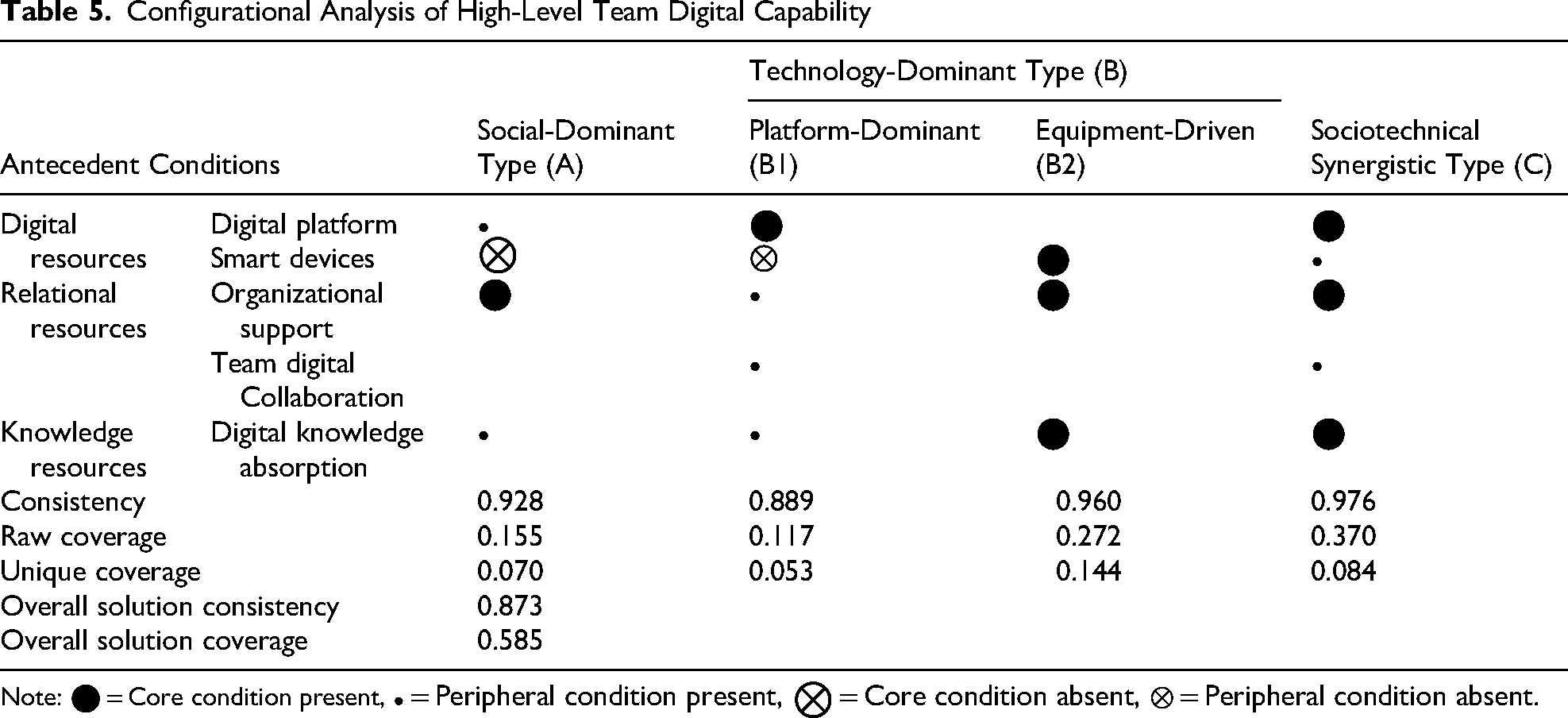
Note: ⬤ = Core condition present, • = Peripheral condition present, ⊗ = Core condition absent, ⊗ = Peripheral condition absent.
Configuration A features high organizational support and non-high smart devices as core conditions, with high digital platforms and high digital knowledge absorption as peripheral conditions. The mechanism behind this configuration is that organizational strategy and resource investment provide the foundation and support for the application of technology and knowledge learning, thereby driving capability enhancement. A consistency of 0.928 shows that this path is highly reliable, but the raw coverage is relatively low (0.155), indicating that this path is suitable for specific contexts such as organizationally driven digital transformation pilot projects. For example, in a large exhibition center project, the management strongly promoted the use of BIM and provided special support, but the collaborative processes were not yet institutionalized, reflecting the characteristics of early-stage digital transformation driven by the organization. Configuration B1 features high digital platforms and non-high smart devices as core conditions, with high organizational support, high team digital collaboration, and high digital knowledge absorption as peripheral conditions. The mechanism behind this configuration is that it heavily relies on the direct empowerment of business processes by digital platform functions, while concurrently drawing on the auxiliary support of social elements—such as organizational support, team collaboration, and knowledge absorption—to jointly drive the realization of high-level digital capability. This path has a consistency of 0.889, indicating reliability, but the raw coverage is the lowest (0.117), suggesting that this path is not the mainstream model and is often found in pilot projects at the early stages of digital transformation. For example, a large commercial mall project made full use of the BIM platform for management but failed to establish matching sustained organizational support and deep collaboration mechanisms. This indicates that the continued deepening of digital capabilities might face bottlenecks.
Configuration B2 is centered on smart devices, organizational support, and knowledge absorption, reflecting the equipment-driven logic. Through the application of smart devices supported by organizational resources and operational knowledge training, it significantly improves the automation and precision of construction operations, thereby enhancing digital capability. The consistency is 0.960, indicating high reliability; the relatively high raw coverage (0.272) and unique coverage (0.144) reveal that this path is both important and unique in current practice. For example, a high-end commercial complex project adopted the Tianchan robotic system for construction but did not deeply integrate the management platform, with collaboration only revolving around the equipment. This path is particularly applicable to projects with high automation needs such as prefabricated buildings.
Configuration C features high digital platforms, high organizational support, and high digital knowledge absorption as core conditions, with high smart devices and high team digital collaboration as peripheral conditions, reflecting the deep integration and positive feedback loop between the social and technical subsystems. Organizational support and a learning culture provide sustained momentum for the in-depth application of the platform, whereas the platform further solidifies collaborative processes, consolidates knowledge, and facilitates systematic capability enhancement. This path has an exceptionally high consistency (0.976) and the highest raw coverage (0.370), along with a significant unique coverage (0.084), making it the mainstream path in the current environment. For example, a smart ecological island project—through the integration of the smart construction management system, smart construction site system, and EIM digital twin platform—connected the IoT and smart monitoring devices to achieve full-process data interconnection and dynamic supervision. The project team, relying on systematic platform training and data-driven decision-making, significantly enhanced its digital capabilities.
Robustness Check
This study conducted robustness checks on the configurational paths of high-level team digital capabilities using multiple methods (Du & Jia, 2017; Schneider & Wagemann, 2012). First, the consistency threshold was increased from 0.8 to 0.85; second, the calibration anchors were adjusted to the 85th, 50th, and 15th percentiles; and, third, the PRI consistency threshold was increased from 0.75 to 0.80. The new configurations generated by these three adjustments all satisfied the criterion of being subsets of the original configurations, indicating that the configurational results of this study possess good robustness.
Conclusion and Discussion
Research Conclusions
This study adopts a mixed-methods approach combining process tracing and fsQCA to reveal the mechanisms behind the enhancement of digital capabilities in construction project teams from both process and configurational perspectives. The study shows that the enhancement of digital capabilities is a dynamic adaptive process driven by the co-evolution of social and technical systems, following the sensing–seizing–reconfiguring logic, and exhibiting the complex characteristics of multiple concurrent causal relationships. The main conclusions are as follows:
Based on the single-case process tracing analysis of the CSCEC Fourth Bureau's building project, it was found that the enhancement of team digital capabilities is essentially a sociotechnical system coevolution process that follows the sensing–seizing–reconfiguring logic. This process does not proceed in a linear fashion but is driven by the interactive dynamics of digital resources (digital platforms and smart devices), relational resources (organizational support and team digital collaboration), and knowledge resources (digital knowledge absorption) across stages in the project context. These resources collectively drive the evolution of capability from initial construction to a systemic leap. This mechanism reflects the dynamism, evolutionary nature, and contextual dependence of capability building, revealing the microprocess logic behind team digital capability generation. Furthermore, it provides providing the theoretical foundation for the subsequent multicase fsQCA analysis, including the identification of key antecedent conditions and configurations.
Through the fsQCA analysis of 21 cases, this study not only tested the sociotechnical synergy core mechanism proposed by the single-case process tracing analysis, it also further revealed the multiple concurrent causality and equifinality characteristics that were not fully captured by process tracing. This expands the types of configurational paths driving capability enhancement and their applicable contexts. The analysis shows that there is no single necessary condition, but four differentiated configurational paths were identified: social-dominated (A), technology-dominated (B), including platform-dominated B1 and equipment-driven B2), and sociotechnical-synergistic (C). Among them, configuration C has the highest consistency and coverage, representing the optimal path driven by multiple cores of digital platforms, organizational support, and knowledge absorption; configuration B2 shows the differentiated value of equipment-driven approaches in highly automated fields, such as intelligent construction; and configurations A and B1 reflect effective but limited transitional models driven by a single core element in the early stages of transformation or under resource constraints. The study demonstrates that the enhancement of team digital capabilities can be achieved through diverse resource combinations between the social and technical subsystems, providing a configurational system-based explanation for understanding the digital transformation of the construction industry.
Theoretical Contributions
Through a mixed-methods approach combining process tracing and fsQCA, this study systematically reveals the sociotechnical system's coevolution process and the multiple antecedent configurations of team digital capability driven by the sensing–seizing–reconfiguring logic. This study deepens the understanding of how capabilities are generated and how paths are chosen in the digital transformation of the construction industry, with its main theoretical contributions reflected in the following three aspects:
First, this study deepened the explanatory dimensions of DCT in the context of temporary project organizations. Existing research has mostly focused on the long-term strategic asset accumulation of permanent enterprises, presupposing that capability building heavily relies on long-term organizational routines. This study breaks away from this path dependency assumption; grounded in the time-boundedness and cross-organizational collaboration of construction projects, it reveals the specific mechanisms by which teams achieve capability generation within a limited life cycle. The research shows that, unlike the routine-based gradual evolution of permanent organizations, the digital capability of project teams manifests as the dynamic potential to utilize digital resources for breaking rigidity of plans to achieve agile improvised responsiveness under dual constraints. This finding not only responds to the discussions on project dynamic capabilities (Davies et al., 2016), it also confirms that DCT is the core mechanism for temporary teams to overcome the dual constraints of resources and time to achieve the agile orchestration of digital resources, thereby effectively expanding the application boundaries of the theory.
Second, this study revealed the pluralistic governance logics of sociotechnical interactions within the project context, enriching the configurational explanatory mechanisms of STS. Existing research often relies on linear analysis, which struggles to systematically reveal the concurrent interactions and equifinal paths in the formation of digital capabilities (Hua et al., 2025; Li et al., 2024). This study identifies three configurational paths and clarifies their applicable contexts. Specifically, the social-dominated type reveals a compensatory logic that relies on strong organizational governance to offset the lack of spontaneous collaboration during the initial stages of temporary teams where trust is absent. The technology-dominated type demonstrates a technological governance logic that utilizes digital platforms or smart devices as core carriers to enforce the optimization of traditional collaboration. Finally, the sociotechnical-synergistic type reflects an idealized synergistic governance model characterized by the deep integration of the social and technical subsystems. This finding breaks through the implicit assumptions of a single optimal solution and technological determinism found in previous studies. From a configurational perspective, it clearly elucidates how temporary organizations choose differentiated adaptive paths based on their own social capital and technological foundations, thereby providing granular processual and configurational evidence for understanding the interactions between hard technology and soft society in complex project environments.
Third, and finally, this study provided a methodological demonstration for investigating complex management phenomena. Existing research mostly relies on single-method approaches, which struggle to simultaneously reveal the dynamic process of capability evolution and systematically identify the collaborative and equifinal mechanisms of antecedent conditions, thus limiting the systematized understanding of the complex causality behind team digital capabilities. This study adopts a mixed design of process tracing and fsQCA, achieving a cross-level integrated analysis of process mechanisms (how) and configurational paths (what), breaking through the limitations of traditional linear regression or single-method approaches in analyzing complex causal mechanisms. The combination of the two methods forms a methodological triangulation, significantly enhancing the internal validity of the theoretical findings and the robustness of the conclusions. This provides a valuable methodological paradigm and reference for exploring the causal mechanisms of complex management phenomena within the context of temporary projects.
Managerial Implications
The findings of this study offer practical guidance for project managers navigating digital transformation. Specifically, the managerial implications of this research are reflected in the following three aspects:
First, project managers should avoid the technological determinism trap and emphasize the synergistic alignment of sociotechnical elements. The process tracing analysis results and configuration C indicate that the enhancement of digital capabilities in engineering project teams is essentially the result of the coevolution of the social and technical subsystems. Therefore, when advancing digital transformation, managers are advised to avoid focusing solely on isolated investments in technological tools and instead emphasize systematic, synergistic planning. For example, while introducing the BIM platform or smart construction equipment, they should simultaneously implement dedicated budgets, fault-tolerance mechanisms (organizational support), and high-frequency cross-departmental regular meeting systems (team collaboration). This cultivates a collaborative culture commensurate with the technological system, ensuring the mutual reinforcement and symbiosis of all elements.
Second, organizations must implement differentiated configurational adaptation strategies based on team resource endowments and contextual constraints. The three types of configurational paths revealed in this study provide actionable path selections for project teams under different conditions. For teams in the early stages of transformation, facing resource constraints, or where cross-organizational trust has not yet been established, it is recommended to adopt the social-dominated strategy (configuration A). This strategy relies on strong administrative governance and dedicated resource allocation from management to consolidate the digital foundation and overcome initial startup difficulties. In specific contexts with high automation demands, such as smart construction, teams can rely on the technology-dominated (equipment-driven) strategy (configuration B2) to achieve the rapid substitution of business processes.
Third, practitioners need to strengthen the dynamic configuration and interaction mechanisms of key resources. The process tracing analysis shows that digital, relational, and knowledge resources must undergo continuous reconfiguration and interaction to be transformed into sustainable digital capabilities. This implies that static resource possession is insufficient to cope with the complex and volatile on-site project environment. Therefore, managers should focus on the dynamic configuration and collaborative intervention of core resources. For digital resources, an iterative mechanism based on frontline feedback should be established to continuously optimize platform architecture and system interoperability. For relational resources, cross-departmental coordination and collaboration processes should be institutionalized, leveraging data transparency to build trust and enhancing team responsiveness through empowerment. For knowledge resources, fragmented tacit experience should be externalized through a learning-by-doing mechanism to establish an experience repository oriented toward digital asset archiving. Through this continuous dynamic reconfiguration, project teams can maintain agile adaptability and responsiveness in the face of environmental changes.
Limitations and Future Research
Drawing on the perspectives of DCT and STS, this study focuses on revealing the role of the integration and configuration process of sociotechnical resources in enhancing team digital capabilities. However, other factors, such as digital leadership, digital talent development, and policy support, may also influence capability building. Future research could introduce the upper echelons theory or institutional theory for further in-depth exploration. While this study centers on the overall team unit, it has not delved deeply into the microinteraction mechanisms between team members and intelligent technologies (such as AI and robots) in digital tasks. Future studies could adopt ethnographic methods, behavioral experiments, or other approaches to explore the black box of team interactions, focusing on the fine-grained paths of human–machine collaboration in capability formation. Additionally, the theoretical construction of causal mechanisms in this study relies on a single-case process tracing design within a specific cross-sectional timeframe. This inherently limits the broad generalizability of the proposed claims, and caution should be exercised when extrapolating these findings to different project contexts. Future research could integrate methods such as digital tracking data, longitudinal tracking designs, or agent-based computational simulations to dynamically test and model the causal mechanisms proposed in this study. This would help reveal the evolution trajectories and boundary conditions of team digital capabilities in different contexts.
Footnotes
Acknowledgments
This work was supported by the Humanities and Social Science Fund of the Ministry of Education of China (Grant No.24YJA630081), National Natural Science Foundation of China (Grant No.72072126), and Chongqing Municipal Construction Science and Technology Project (City Science Document No. 2023-3-13).

Funding
The authors disclosed receipt of the following financial support for the research, authorship, and/or publication of this article: This work was supported by the Humanities and Social Science Fund of the Ministry of Education of China (Grant No.24YJA630081), National Natural Science Foundation of China (Grant No.72072126), and Chongqing Municipal Construction Science and Technology Project (City Science Document No. 2023-3-13).
Declaration of Conflicting Interests
The authors declared no potential conflicts of interest with respect to the research, authorship, and/or publication of this article.