







Abstract
The aim of this work was to study the structure and particle size of copper based composite materials reinforced with a high content (15–35 wt-%) of silicon carbide and prepared by mechanical alloying in the high energy planetary mill. Raw materials consisted of grinded copper chips with a size of <5000 μm and reinforcing particles with an initial size of 10 μm. Duration of milling was 20–80 min. It was shown that the formation of Cu–(15–25 wt-%)SiC composites occurred successfully. With an increase in the silicon carbide content of above 25 wt-% (48 vol.-%), the efficiency of mechanical alloying was decreased. The average size of composite particles was ∼20 μm.
Introduction
Cu is one of the most commercially applied metals. The improvement of the mechanical and operational properties of Cu materials is, therefore, a topical problem. The most promising way of improving the characteristics of Cu is developing composite materials. The Cu based composite materials reinforced by ceramic particles of SiC are characterised by a unique combination of low values of a coefficient of thermal expansion and high heat conducting.1– 3 Therefore, the composites can be employed for electric packaging in conditions of thermal fatigue. Mechanical alloying is one of the modern and effective methods of powder metallurgy, and it is a main stage of composite production.4– 8 However, this method is relatively expensive. To reduce the production costs of the materials prepared by mechanical alloying, it would be desirable to use cheap scrap materials instead of Cu powders. The objective of this work was to study the structure and particle size of Cu matrix composites strengthened by SiC and prepared by mechanical alloying using Cu chips.
Materials and methods
Grinded Cu chips (99·95 wt-%Cu) and SiC particles with sizes of <5000 and 10 μm respectively were used as initial materials. The SiC content amounted to 15–30 wt-% (33–54 vol.-%). Powder mixture was milled in a high energy planetary mill with quasi-cylindrical milling bodies in argon; the processing time was 20–80 min. Besides, intense water cooling was used. The weight ratio of grinding body/powder was 4∶1. The particle size of composite powders was determined with a laser particle sizer Analysette 22 NanoTec. The microstructure of composites was examined with an optical microscope under bright field illumination. For this purpose, the powders were cold pressed to make a preform and then hot pressed at 450–500°C and 500 MPa.
Results and discussion
At the initial stage of mechanical alloying, composite formation occurs according to the general scheme,9 which includes deformation and bending of large Cu particles and the capture of free SiC particles into a newly formed cavity. The subsequent combination of deformation and fracture of these particles ends in welding of the layers between each other. Thus, formed granules of the composite material have a layered structure composed of the Cu based matrix and dispersed SiC particles distributed in the matrix. The typical structure of this material is shown in Fig. 1.
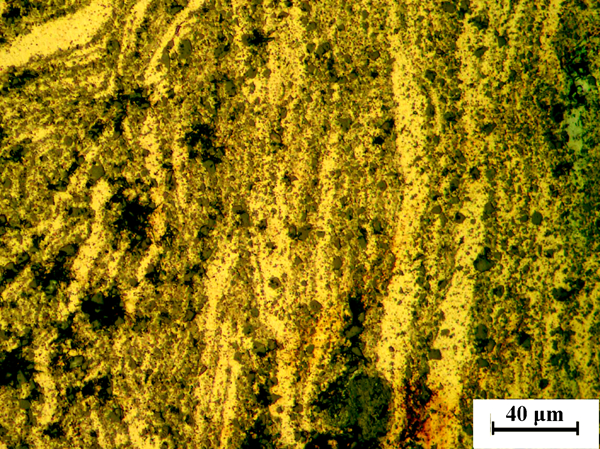
Layered structure of Cu–20SiC material processed for 20 min
The effect of milling time on the average particle size of Cu–SiC composite is shown in Fig. 2. After the first 20 min, there is a considerable refinement of all powders; the maximum size of particles did not exceed 200 μm. Later, the average size of particles for 15 and 25%SiC varies insignificantly. The structure of these materials after 60 min processing (Fig. 3a and c respectively) is practically identical and contains inhomogeneities. Coarse light areas of Cu are visible here. On the contrary, the particle size for 20%SiC decreases during the period from 20 to 40 min and then increases. The characteristic of this curve conforms to the processes occurring during mechanical alloying: fracture of particles and their subsequent welding. The structure of this Cu–20SiC material is more homogeneous (Fig. 3b). Therefore, it is possible to conclude that mechanical alloying of Cu chips with 20%SiC gives the most satisfactory results from a microstructural view point. The average particle size of the powders after 60 min milling was ∼20 μm.
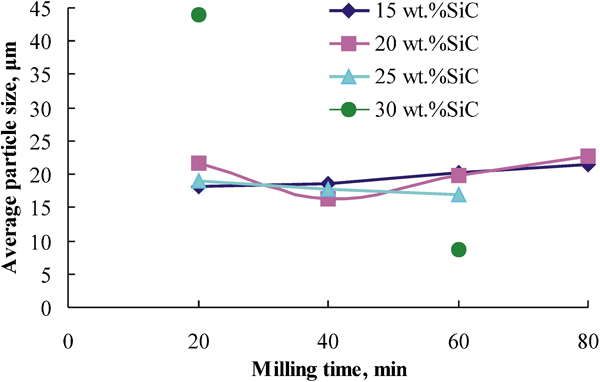
Effect of milling time on average particle size of Cu–SiC composite
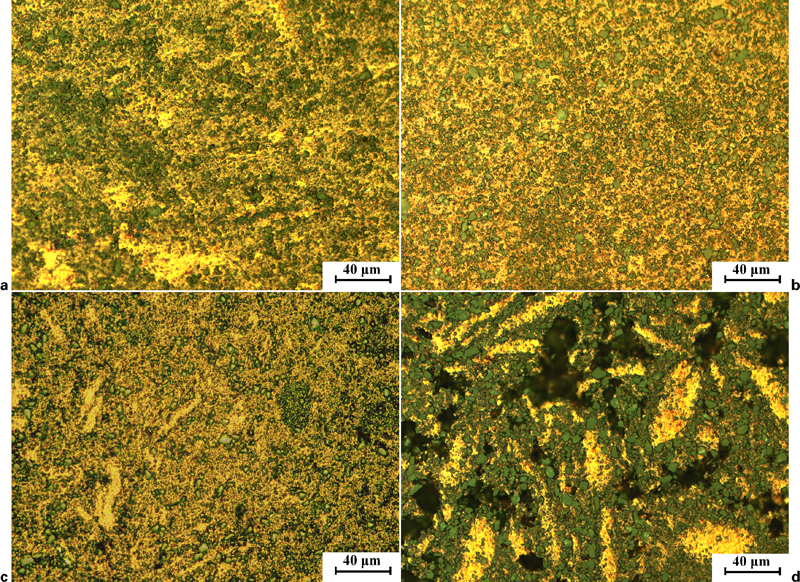
Structure of Cu based materials containing a 15 wt-%, b 20 wt-%, c 25 wt-% and d 30 wt-%SiC after 60 min milling
Cu–30SiC stands out against a background of all materials. After 20 min processing in the planetary mill, its particle size is appreciably larger in comparison with those of other materials. Further intensive powder refinement is observed; at the same time, the welding stage is lacking. It is confirmed by the structure of this material presented in Fig. 3d. The image shows coarse particles of Cu surrounded with SiC particles. Generally, the structure is strongly inhomogeneous. It means that the formation of composite particles is hindered. The decrease in the average particle size of Cu–30SiC material is probably due to considerable refinement of the ceramic particles obstructing Cu welding. Thus, with an increase in the SiC content of above 25 wt-% (48 vol.-%), the efficiency of mechanical alloying decreases.
Conclusions
It was shown that the formation of Cu–(15–25 wt-%)SiC composites proceeded successfully, giving the most satisfactory results for Cu–20 wt-%SiC composite. The average size of composite particles was ∼20 μm. With an increase in the SiC content of the composite of above 25 wt-% (48 vol.-%), the efficiency of mechanical alloying was decreased.
Footnotes
Acknowledgements
Particle size analysis was performed in Belgorod State University Joint Research Centre BelSU ‘Diagnostics and Investigations of Nanostructured Materials’.