







Abstract
Microwave irradiation was performed using compacted Ti powder in three types of atmosphere, namely, Ar gas, N2 gas and air. The temperature increased slightly in the early stage of microwave irradiation and then remained almost unchanged. Thereafter, abrupt temperature rise and drop occurred. The temperature then remained almost unchanged in the late stage of microwave irradiation. The time from which the abrupt temperature rise and drop occurred was varied by the atmosphere. The maximum temperature in microwave irradiation in Ar gas was near the melting point of Ti, while those in N2 gas and air were beyond this melting point. Although a TiO2 layer was formed near the upper surface of the compacted powder after microwave irradiation, α-TiN and TiN were produced in its interior. The microwave heating behaviour and microstructure of the compacted powder after microwave irradiation depended on the atmosphere and the amount of air contamination in it.
Introduction
The application of microwave heating has been long recognised in a variety of areas, such as rubber vulcanisation, paper drying, food processing and pharmaceutical fields. Microwave heating allows an instantaneous volumetric (a more rapid) heating in comparison with the conventional heating, such as electrical/resistant and fuel heating methods. As a result, it allows a reduction in energy consumption and an increase in productivity.
Metal bulk is an excellent reflector of microwave energy and, in general, is not heated significantly by microwaves. Therefore, few applications have been conducted so far on heating metal bulk. The authors reported that it is feasible to heat thin Au and Cu films by microwave irradiation.1,2 On the other hand, Roy et al. reported first in 1999 that compacted metal powders could be heated and sintered by microwave irradiation.3 Recently, there has been much interest in the microwave heating of metal powders.4– 23 In the application of such a technique to Ti powder, it has been reported that TiN is produced by heating the Ti powder in N2 gas with a microwave.24,25 However, there are only few reports on the microwave heating of Ti powder in Ar gas and air, and the heating behaviour of Ti powder is not well understood.
In general, the surface of a Ti powder particle may be covered by an oxide film because its affinity for oxygen is very high. In core–shell structures consisting of a conductive material (core, metal) and a dielectric material (shell, oxide film), effective permittivity depends on shell thickness.15– 17 On the other hand, by assuming the compacted powder to be a composite consisting of powder particles and a gas (or vacuum) occupying the vacant spaces between powder particles, it is presumed that the effective permittivity of the compacted powder depends on the atmosphere used in microwave irradiation. However, these microwave heating phenomena are not well understood.
In the present study, microwave irradiation was performed using compacted Ti powder in three types of atmosphere, namely, Ar gas, N2 gas and air, and then the microwave heating behaviour was examined.
Experimental
A 2·45 GHz, 1·8 kW microwave generator was used as the microwave source. The distribution of the microwave field was complex because of the multimode microwave cavity (section: 164×295 mm; height: 335 mm). Ti powder (purity: 99·9 mass-%; particle size: <45 μm; Wako Pure Chemical Industries Ltd, Osaka Japan) and TiO2 powder (purity: 99·9 mass-%; mean particle size: 5 μm; Wako Pure Chemical Industries Ltd) as a reference were used.
Figure 1 shows secondary electron (SE) image of the as received Ti powder. In the X-ray diffraction (XRD; X'pert Pro MPD, PANalytical Co. Ltd, Almelo, The Netherlands) pattern of the as received Ti powder, only Ti peaks appeared.
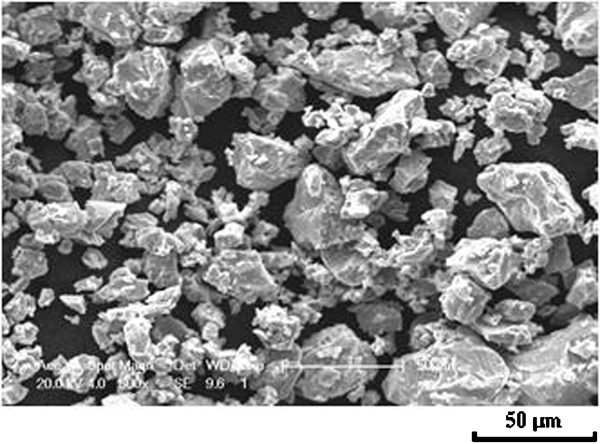
Image (SE) of as received Ti powder
Figure 2 shows the X-ray photoelectron spectroscopy (ESCA1000; Shimadzu Co. Ltd, Kyoto, Japan) spectra of the as received Ti powder. Depth analysis was carried out every 10 s of sputtering time. Near the surface of a Ti powder particle, the peaks of TiO2 (Ti2p3/2 = 458·5 eV and Ti2p1/2 = 464·2 eV) appeared. On the other hand, the overlapped peaks of metallic Ti (Ti2p3/2 = 453·8 eV and Ti2p1/2 = 459·9 eV) and Ti oxide were observed in the spectra in the interior of a Ti powder particle. At a sputtering time of 120 s, only Ti peaks were detected. Thus, a thin Ti oxide having a nanometre order thickness was detected on the surface of a Ti powder particle. This suggests that the small amount of Ti oxide is the reason why the XRD pattern is free from Ti oxide.
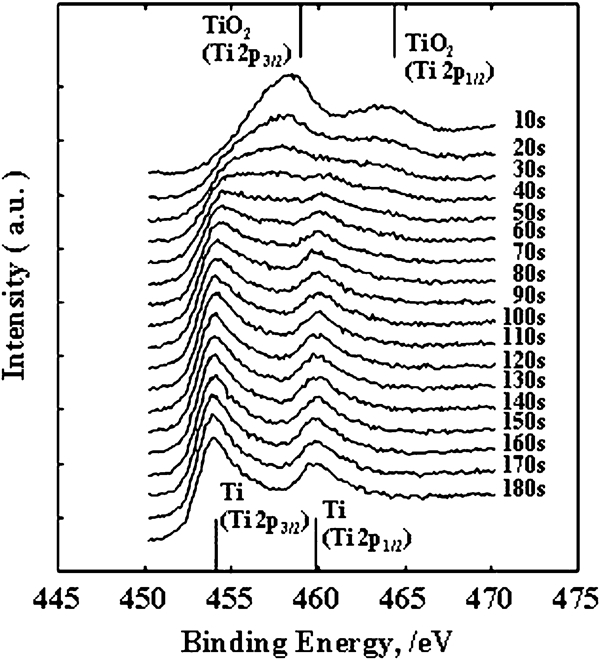
X-ray photoelectron spectroscopy spectra of as received Ti powder
Ti (0·4 g) and TiO2 (0·2 g) powders were compacted on a quartz substrate (10×13×1 mm) having a low dielectric property, followed by microwave irradiation at an incident flux of 563 W for 600 s. Microwave irradiation was performed in three types of atmosphere, namely, Ar gas, N2 gas and air. The flowrates of the Ar and N2 gases were both 20 L min−1. The temperature of the compacted powder was measured using a quartz fibre type radiation pyrometer (IR-FL3; Chino Co. Ltd, Tokyo, Japan). The microwave cavity was shielded to prevent the entrance of light. The phases of the upper surface and interior (polished with emery paper) of the compacted Ti powder after microwave irradiation were identified by XRD analysis. The fractured surface (flexural fracture) of the compacted Ti powder after microwave irradiation was examined using an environmental scanning electron microscope (XL-30 ESEM; FEI Co. Ltd, Hillsboro, OR, USA) and an energy dispersive X-ray spectrometer (EDX) equipped with the ESEM.
Results and discussion
Figure 3 shows the temperature changes of compacted TiO2 (Fig. 3a) and compacted Ti (Fig. 3b) powders during microwave irradiation in Ar gas. The compacted TiO2 powder was little heated by microwave irradiation in each atmosphere. The radiation pyrometer used in the present study was unable to measure temperatures lower than 373 K because of the detection limit of the sensor. This is why no temperature change is displayed. On the other hand, the compacted Ti powder was heated by microwave irradiation. Because the quartz substrate having a low dielectric property is heated slightly by microwave irradiation, the temperature rise is caused by the heating of the compacted Ti powder. As shown in Fig. 3b, the temperature increased slightly in the early irradiation stage and then remained almost unchanged. After an irradiation time of ∼150 s, abrupt temperature rise and drop occurred. The temperature then remained almost unchanged in the late stage of microwave irradiation. The maximum temperature was near the melting point of Ti (1943 K).
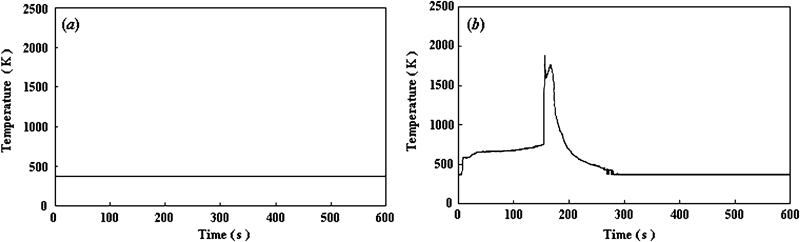
Temperature changes of a compacted TiO2 and b compacted Ti powders during microwave irradiation in Ar gas
When microwave irradiation is carried out on the compacted Ti powder, some of the microwaves penetrate into the interior of the powder particles, although most of the incident microwaves are reflected. The depth of penetration, that is, the skin depth, which was calculated from the well known expression21 using the angular frequency of microwaves, the real part of the permeability for nonmagnetic metals and the electrical conductivity of Ti (1·85×106 Ω−1 m−1),26 was 7·47 μm. This suggests that the microwaves penetrate into the interior of the Ti powder particles through the surface oxide film. The penetration behaviour of microwaves into a compacted powder was explained by computer simulation.27 It was also verified experimentally that microwaves penetrate into the centre of the compacted Cu powder with dimensions of 10×6×40 mm.28 The thickness of the compacted Ti powder used in the present study was ∼1·8 mm. From these results, most Ti particles in the compacted powder are expected to be heated by microwave irradiation. According to the core–shell model, the efficiency of microwave absorption increases with increasing shell thickness.15– 17 However, the surface oxide film of the as received Ti powder was very thin (Fig. 2), and the compacted TiO2 powder was little heated by microwave irradiation, as shown in Fig. 3a. It is found from these results that the temperature rise shown in Fig. 3b is caused by the heating of metallic Ti.
Figure 4 shows the SE images of the fractured surface of the compacted Ti powder after microwave irradiation in Ar gas. Near the upper surface of the compacted powder (Fig. 4a), fine irregularities were observed. In the EDX analysis of its fractured surface, the peaks of Ti and O were detected. This suggests that Ti oxide is formed near the upper surface of the compacted powder. In the middle of the compacted powder (Fig. 4b), which was located at a depth of 0·9 mm from the upper surface, sintering was achieved, while few fine irregularities were observed. In the EDX analysis of its fractured surface, the peaks of Ti, N and O were detected. However, the intensity of the O peak was significantly small. The fractured surface, such as Fig. 4a, was observed in the region from the upper surface to a depth of ∼100 μm, while that in Fig. 4b was observed in a deeper region.
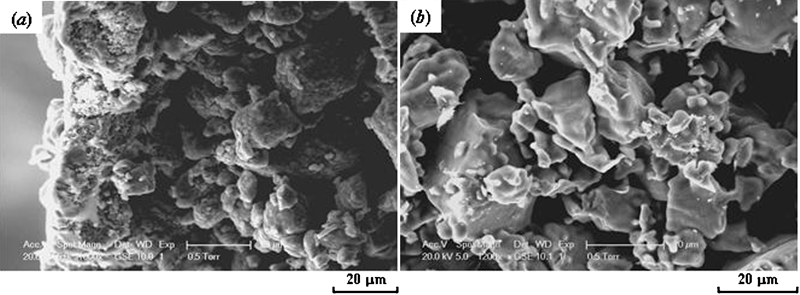
Images (SE) of fractured surface of compacted Ti powder after microwave irradiation in Ar gas
Figure 5 shows the XRD patterns of the as received Ti powder and the upper surface and middle of the compacted Ti powder after microwave irradiation in Ar gas. In the as received Ti powder, only Ti peaks appeared, as mentioned above. In the XRD pattern of the upper surface of the compacted Ti powder, only TiO2 peaks were detected. It is found from Figs. 4a and 5b that the TiO2 layer having a thickness of ∼100 μm is formed near the upper surface of the compacted powder. On the other hand, in the middle of the compacted powder, the overlapped peaks of Ti and Ti–N solid solution (α-TiN), which appeared as a broad peak, and TiN (intermetallic compound) peaks, were detected. The peaks of TiO2 disappeared. This may be caused by the existence of a small amount of TiO2.
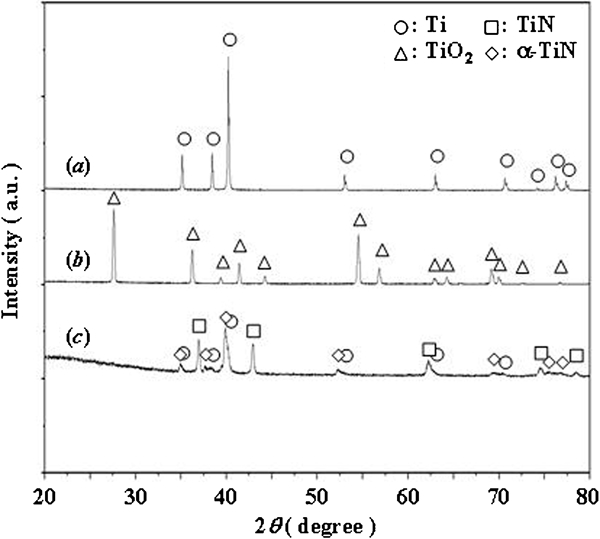
Patterns (XRD) of a as received Ti powder and b upper surface and c middle of compacted Ti powder after microwave irradiation in Ar gas
A reaction mechanism is proposed as follows


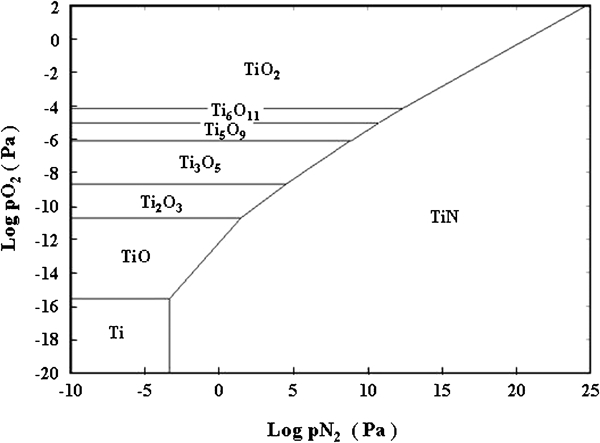
Relationships among equilibrium phases, pO2 and pN2 at 1943 K
Figure 7 shows the temperature changes of the compacted Ti powder during microwave irradiation in N2 gas (Fig. 7a) and air (Fig. 7b). In microwave irradiation in N2 gas, the temperature change was similar to that in Ar gas, although abrupt temperature rise and drop shifted to the left (short irradiation time) and the maximum temperature was beyond the melting point of Ti. In microwave irradiation in air, abrupt temperature rise and drop occurred in the early stage of microwave irradiation. The maximum temperature was equal to that in N2 gas. Thus, the time from which abrupt temperature rise and drop occurred was varied by the atmosphere used in microwave irradiation. This suggests that the effective permittivity of the compacted Ti powder depends on the gas occupying the vacant spaces between the powder particles.
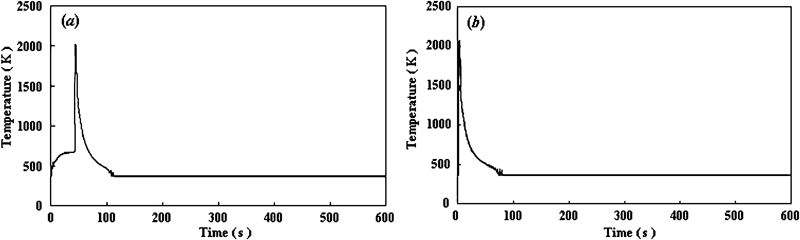
Temperature changes of compacted Ti powder during microwave irradiation in a N2 gas and b air
The SE image of the fractured surface of the compacted Ti powder after microwave irradiation in N2 gas was similar to that in air. Figure 8 shows the SE images of the fractured surface of the compacted Ti powder after microwave irradiation in air. Near the upper surface of the compacted powder (Fig. 8a), fine irregularities were observed, as well as in Fig. 4a. In the EDX analysis of its fractured surface, the peaks of Ti and O were detected. This suggests that the Ti oxide layer is mainly formed near the upper surface of the compacted powder. In the middle of the compacted powder (Fig. 8b), a cleavage fracture was observed. In the EDX analysis of its fracture surface, the peaks of Ti, N and O (very low intensity) were detected. These results suggest that both sintering and nitriding took place during microwave heating. The fractured surface in Fig. 8a was observed in the region from the upper surface to a depth of ∼200 μm, while that in Fig. 8b was observed in a deeper region.
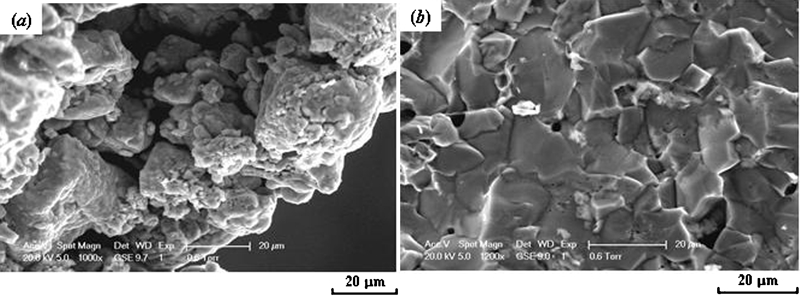
Images (SE) of fractured surface of compacted Ti powder after microwave irradiation in air
Figure 9 shows the XRD patterns of the compacted Ti powder after microwave irradiation in N2 gas and air. In the XRD pattern of the upper surface of the compacted powder after microwave irradiation in N2 gas (Fig. 9a), both TiO2 and TiN peaks were detected. The formation of TiO2 is due to the fact that a small amount of air is contaminated in the microwave cavity purged by N2 gas. On the other hand, in the middle of the compacted powder (Fig. 9b), the highly overlapped peaks of Ti and α-TiN, and TiN peaks were detected. Thus, in microwave irradiation in N2 gas, nitriding was enhanced as compared with microwave irradiation in Ar gas. This is because pN2 in N2 gas is significantly high. In the XRD pattern of the upper surface of the compacted powder after microwave irradiation in air (Fig. 9c), only TiO2 peaks appeared. Thus, the thickness of the TiO2 layer formed by microwave irradiation in air was higher than that in Ar gas. This is because pO2 in air is very high. In the middle of the compacted powder (Fig. 9d), the overlapped peaks of Ti and α-TiN, and TiN peaks were detected. The peaks of TiO2 disappeared. This may be caused by the existence of a small amount of TiO2.
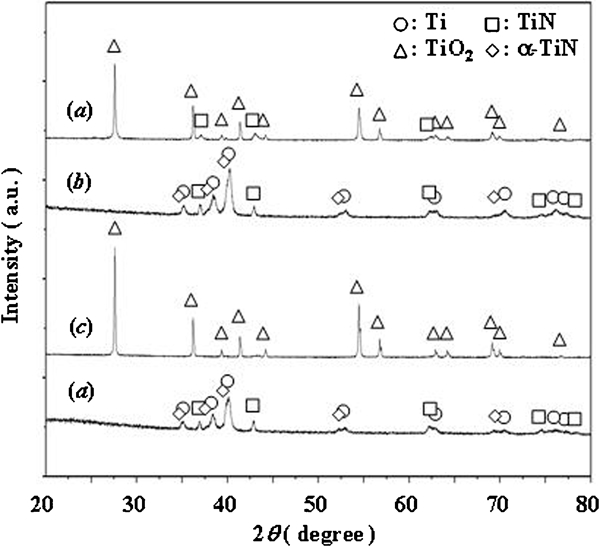
Patterns (XRD) of compacted Ti powder after microwave irradiation
As shown in Fig. 6, in general, TiO2 is formed even in the interior of the Ti particles by heating using an ordinary atmospheric furnace (in air). Assuming heating at high pO2, from reactions (1) and (2), the following are obtained

 . From the results of the analysis by HSC chemistry 5 in Outokumpu Research, the value of KR at 1943 K was determined to be 7·16×1011. The value of
 for heating in air using an ordinary atmospheric furnace (1·32×10−2) is significantly low compared with KR = 7·16×1011. Therefore, TiN transforms into TiO2 in reaction (3) during subsequent heating even when TiN is first formed. Thus, the formations of α-TiN and TiN on heating in air may be regarded as one of the peculiarities of microwave heating. In microwave irradiation in air, a thick TiO2 layer is formed near the upper surface of the compacted powder. Under this condition, it is difficult for air to penetrate into the compacted powder during microwave heating. Furthermore, an abrupt temperature drop occurs immediately after TiN formation at an elevated temperature as shown in Fig. 7b. As a result, TiN may be kept without reaction (3). This is the reason why the formations of α-TiN and TiN in the interior of the compacted powder were achieved by microwave irradiation in air.
Since reaction (2), that is, the formation of TiN, is exothermic, the larger the amount of TiN formed by microwave heating, the larger the amount of heat generated for the TiN reaction. As mentioned above, the formation of TiN was enhanced by microwave irradiation in N2 gas and air. This is the reason why the maximum temperature for microwave irradiation in N2 gas and air was higher than that in Ar gas.
It was reported that the compacted powder having a low porosity and a decrease in effective permittivity due to sintering result in a decrease in the rate of microwave heating.13,21 It is considered that an abrupt temperature drop, which occurs after an abrupt temperature rise, is caused by both sintering and the formation of Ti compounds (oxide and nitride).
Thus, it was feasible to produce α-TiN and TiN at a very short time (∼100 s) by the microwave irradiation of the compacted Ti powder in not only N2 gas but also air. The formations of α-TiN and TiN were enhanced by microwave irradiation at high pN2. However, no N diffusion at the centre of a large size Ti particle was achieved because of a short heating time. It is expected that a Ti free material, which consists of α-TiN and TiN, can be produced when microwave irradiation is performed using finer Ti powder particles at high pN2. On the other hand, when the amount of air contamination in the atmosphere used is made as small as possible, the microwave heating of Ti powder particles without oxidising and nitriding followed by sintering may be achieved.
Conclusion
Ti powder was compacted on a quartz substrate having a low permittivity, followed by microwave irradiation in three types of atmosphere, namely, Ar gas, N2 gas and air (frequency of microwaves: 2·45 GHz; incident flux of microwaves: 563 W; irradiation time: 600 s). The microwave heating of the compacted Ti powder was anomalous. The temperature increased slightly in the early stage of microwave irradiation and then remained almost unchanged. Thereafter, abrupt temperature rise and drop occurred. The temperature then remained almost unchanged in the late stage of microwave irradiation. The time from which the abrupt temperature rise and drop occurred was varied by the atmosphere used in microwave irradiation. The maximum temperature in microwave irradiation in Ar gas was near the melting point of Ti, while those in N2 gas and air were beyond this melting point. In each atmosphere, a TiO2 layer was formed near the upper surface of the compacted powder. This is because a small amount of air is contaminated in the microwave cavity purged by Ar and N2 gases. In the middle of the compacted powder, Ti–N solid solution and TiN were formed by microwave irradiation in each atmosphere. This is because O2 gas in the compacted powder is drastically consumed during the oxidation process. As a result of this O2 gas consumption, partial pressure of N2 gas in the interior of the compacted powder increases significantly, resulting in nitriding. It is difficult for air to penetrate into the compacted powder during microwave heating because of the thick TiO2 layer formed near the upper surface of the compacted powder, and an abrupt temperature drop occurs after nitriding. Thus, microwave heating behaviour and microstructure of the compacted powder after microwave irradiation depended on the atmosphere and the air contamination in it.