







Abstract
Numerous lean alloy systems are now available to the PM parts manufacturer as potential lower cost solutions without sacrificing part performance. More recently, steels containing 0·3 and 0·5% prealloyed molybdenum have been introduced which can be tailored with reduced Ni and/or Cu additions to meet specific properties for use in press and sinter applications or as quench and temper grades. These reduced Mo prealloys complement the already familiar 0·85 and 1·5%Mo grades to provide a full range of prealloyed molybdenum steels. Another method to reduce susceptibility to market pricing has been through incorporating manganese, which is historically inexpensive yet highly beneficial to steel properties. Combining Mn with moderate levels of Mo in specially designed alloy grades provides a lean alternative to Ni and Cu containing hybrid alloy steels. This study will examine these lean alloys and explore where there may be opportunity to use them in place of traditional PM grades.
Medium and high performance low alloy PM steels traditionally contain high levels of Mo, Ni and Cu when used in the as sintered condition.1 The best known examples of this are the iron powder based diffusion alloyed steels containing 0·5%Mo, 1·5%Cu and either 1·75 or 4%Ni (all compositions are weight percentages). Use of these alloys results in components with good strength and excellent toughness (for a PM steel), although hardness and yield strength are relatively low for the overall alloy content. Component manufacturers value these highly compressible powders during compaction and in thermal processing (sintering and heat treatment), where a variety of atmospheres can be used due to the low oxygen affinity of the alloy. Before 2003, the consistently low alloy prices for Mo, Ni and Cu made diffusion alloyed steels an excellent choice for many components. Recent price pressures, however, have forced a re-assessment of alloy selection for these applications. Additionally, environmental concerns in Europe with elemental Ni additions and the recyclability of copper-containing steels have become issues. This has resulted in the use of non-traditional PM alloying elements and the development of leaner alloy systems.
In response to price fluctuations, both powder and part manufacturers have been striving to reduce the dependence on these volatile elements. One method to achieve this goal is to reduce the alloy content to the minimum required to meet the part requirements. Powder grades with lower molybdenum content have been introduced to provide increased flexibility.2,3 Additionally, Ni and Cu contents can easily be tailored in both binder-treated and regular premixes to assist manufacturers in lowering alloy content. Removal of alloy content and the corresponding reduction in physical properties, however, may not be allowed based on the mechanical property requirements of the part. In this case, alternative alloying elements become necessary.
A newly developed Mn-containing alloy system, Ancorbond FLM, combines the benefits of manganese and moderate amounts of molybdenum to produce cost-effective alternatives to high alloy hybrid and diffusion-alloyed PM steels.4,5 This alloy system has been designed for conventional sintering temperatures and is suitable for as sintered, sinter-hardened, and induction-hardened applications.6 This Cu-free and Ni-free alloy reduces price volatility and minimises recyclability and environmental concerns. The objective of the current work is to demonstrate the performance of Mn-containing alloys and the feasibility of using leaner alloys to achieve desired properties.
Experimental procedure
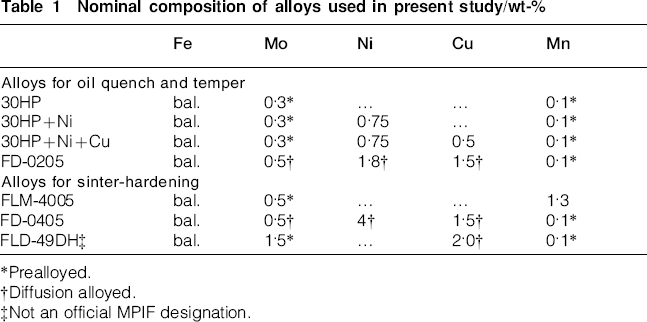
Commercially available alloys used in this study are listed in Table 1. All mixes were prepared with 0·75 % EBS wax and 0·6% natural flake graphite. Transverse rupture strength bars, dogbone tensile bars, and unnotched Charpy impact bars were compacted to 7·0 g cm−3 green density to determine mechanical properties of each mix.
Nominal composition of alloys used in present study/wt-%
*Prealloyed.
†Diffusion alloyed.
‡Not an official MPIF designation.
All test bars were sintered in a continuous belt furnace at 1120°C (2050°F) for 15 min in a mixed atmosphere of 90 vol.-% nitrogen and 10 vol.-% hydrogen (90/10). As sintered properties were evaluated using a cooling rate of 0·7 K s−1 from 650 to 315°C. Sinter-hardened properties were achieved using an accelerated cooling system producing a cooling rate of 1·6 K s−1. Oil quenching and tempering was performed by austenitising at 900°C (1650°F) for 45 min in synthetic disassociated ammonia, followed by quenching in a 65°C (150°F) circulating oil bath. All sinter-hardened and oil quenched samples were tempered at 205°C (400°F) for 1 h prior to testing. All sintered carbon contents were measured to be within 0·54±0·02%.
To determine quenched and tempered fatigue properties, rectangular blanks (10×10×75 mm), compacted to 7·0 g cm−3, were sintered and then machined into oversized cylinders with a 9·62 mm diameter and a 75 mm length. The cylindrical bars were then quenched and tempered under the conditions previously mentioned. The final sample dimensions and surface finish were equivalent to specifications provided in MPIF Standard 56,7 and conforming to ASTM E466 – 07.8 After machining to size, the cylindrical axial fatigue bars were stress relieved at 177°C (350°F) for 1 h prior to testing. All tests were performed at a frequency of 60 Hz and stress ratio of −1. The fatigue endurance limit (FEL) was estimated based on the applied stress to achieve a runout, similar to performing a staircase method. The runouts were defined as 2×10⁶ cycles with no failure.
Results and discussion
The as sintered properties of all alloys are listed in Table 2. The lean alloy properties based on 30HP are improved with small additions of Ni and Cu. The heavily alloyed diffusion grades, however, are superior to the leaner alloys in the as sintered condition. While the manganese steel, FLM-4005, has comparable tensile strength with the diffusion alloys, it has much lower impact properties as a result of not having Ni at particle boundaries. This effect is also apparent in FLD-49DH where the alloy content is high yet lacks Ni to promote toughness; therefore it has similar as sintered impact strength to FLM-4005.
As sintered mechanical properties
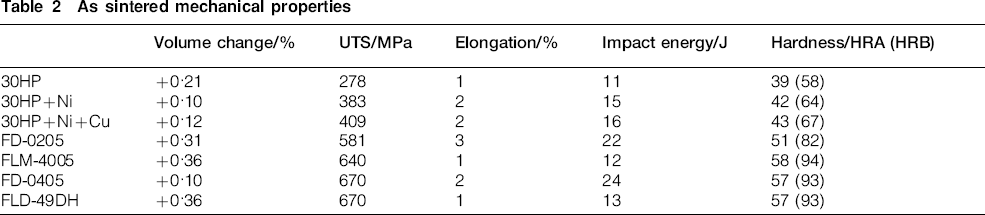
Table 3 provides the mechanical data for the alloys after heat treating or sinter hardening. It is evident from the results provided that heat treating the lean alloys greatly enhances their performance. The addition of Ni significantly boosts properties in both the as sintered and heat treated states. There is, however, little benefit in combining Cu with Ni for heat treating applications as it provided marginal performance improvement. FD-0205HT has the best heat treated properties, as expected given its 3·8% alloy content.
Mechanical properties
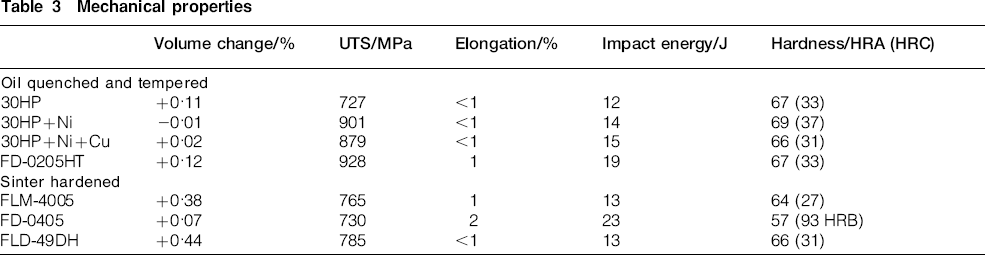
The sinter hardened values in the table are interpolated at a density of 7·0 g cm−3 from plotting sintered density versus physical property. The ductility and impact properties of the Mn alloy are similar to those of the Ni-free diffusion alloy FLD-49DH, whereas the Ni-containing FD-0405 has much higher values. Nickel is known to improve toughness in PM steel, so these results are not surprising. The apparent hardness of the manganese containing alloys rivals that of the high alloy sinter-hardening FLD-49DH following both conventional and accelerated cooling. The iron based diffusion alloy FD-0405 has considerably lower hardness, especially with faster cooling rates.
The ultimate tensile strengths (UTS) are plotted in Fig. 1. The as sintered tensile strength increases with increasing alloy content. The lean alloys are inferior to the diffusion alloys in the as sintered condition and therefore are not recommended for use in this state. The UTS of the manganese alloy is, however, better than FD-0205 and comparable with that of FD-0405 and FLD-49DH at conventional cooling rates. Following heat treating (right), the lean alloys based on 30HP with at least 0·75%Ni exhibit competitive tensile strength with FD-0205.
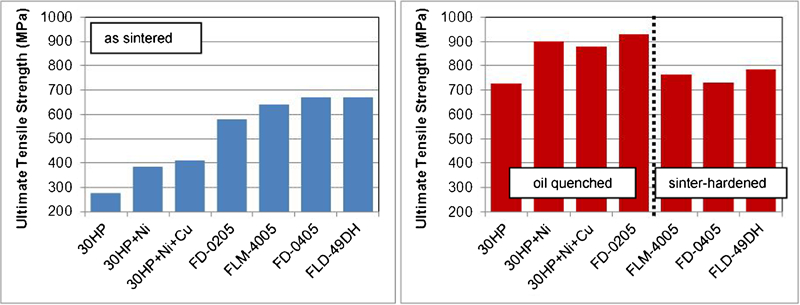
UTS values in as sintered, oil quenched or sinter-hardened and tempered condition
Where sinter-hardening is a viable processing option, the sinter-hardened alloys provide moderate UTS levels in comparison to the quench and tempered lean alloys. This is due to the difference in cooling rates, with oil quenching having a greater cooling rate to promote a fully hardened structure. FLM-4005, being the leanest sinter-hardening option, demonstrates superior UTS over FD-0405 and is comparable with FLD-49DH, suggesting it would be capable of providing suitable properties at reduced alloy content and potentially lower cost.
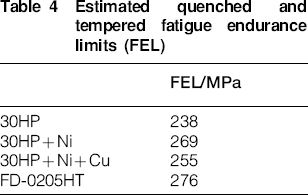
Axial fatigue trends for selected heat treated compositions are represented in Fig. 2. Through adding 0·75%Ni to 30HP, a 13% increase in fatigue limit is realised. Additions of Cu, however, markedly reduced the heat treated fatigue limit (Table 4) and supports prior research on Fe–Cu–C fatigue results.9,10 By comparison, the FEL for FD-0205HT, with 3·5% more alloy content, is approximately 17% greater than 30HP alone, but only 3% better than 30HP with 0·75%Ni. Therefore, this alloy can be reduced by 1%Ni, 1·5%Cu and 0·2%Mo, have similar hardenability, and be within 3% of the measured FEL when heat treated. Interestingly enough, the FEL for both FD-0205HT and 30HP with only 0·75%Ni exceed that of FD-0405HT found in MPIF Standard 35.1 This suggests the total alloy content can be reduced, still achieving acceptable fatigue performance, and meeting demand for cost reduction.

Axial S-N fatigue trends of quenched and tempered 30HP and FD-0205HT
Estimated quenched and tempered fatigue endurance limits (FEL)
Microstructures of lean and alternative alloys
Figure 3 shows the microstructure of 30HP+0·75%Ni with a sintered carbon content of 0·54%. The as sintered core of the particles (Fig. 3a), is primarily divorced pearlite whereas areas close to Ni rich regions and nearest the pore network are fine pearlite. The quenched structure (Fig. 3b), is predominantly martensite with Ni rich regions (indicated by the white areas) dispersed throughout. These Ni rich regions help promote toughness in the structure.
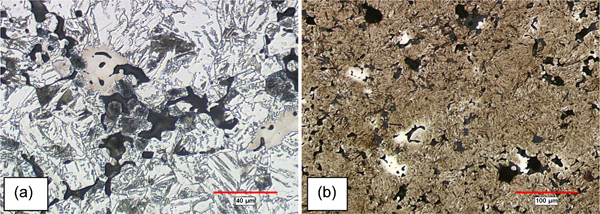
Microstructure of 30HP+0·75%Ni+0·6%C etched with 2% nital–4% picral: a as sintered; b quenched and tempered
The microstructure of the Mn containing alloy is presented in Fig. 4. The as sintered morphology (Fig. 4a), consists of divorced pearlite in the core of larger particles with fine pearlite and partially bainitic and martensitic regions nearest the pore network and throughout small particles. The martensitic regions etch tan-colored, whereas the bainitic regions are white and gray. The amount of martensite increases dramatically when sinter-hardened, though the structure is not fully hardened, as seen in Fig. 4b. As with most hybrid alloy systems, the martensite content is highest in the vicinity of the pore network, thereby strengthening the connections between prior iron particles.
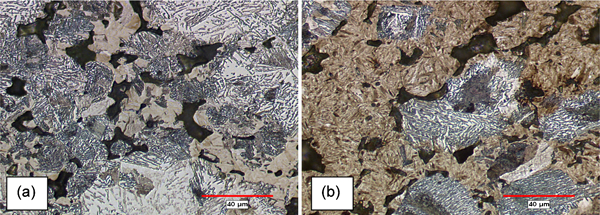
Microstructure of FLM-4005 (1·3%Mn, 0·5%Mo, 0·6 wt% gr) etched with 2% nital–4% picral: a as sintered; b sinter hardened
Conclusion
It has been shown that lean alloys based on as little as 0·3% prealloyed Mo are capable of providing sufficient properties for applications where current alloy contents are underutilised and cost outweighs the material performance. Heat treating these alloy grades through conventional oil quenching and tempering promotes a substantial increase in both static and dynamic properties, as is commonly found with a martensitic microstructure. Additions of Cu were found to be detrimental to heat treated fatigue behaviour, although marginal improvements in static quenched properties were observed with additions of both Ni and Cu. Furthermore, this work demonstrated that a composition as lean as 0·3%Mo+0·75%Ni+0·6%gr has competitive heat-treated fatigue performance when compared with FD-0205HT.
It is therefore proposed that the total alloy content found in popular oil quenched alloys could be reduced and still provide acceptable fatigue performance, while meeting demand in alloy cost reduction. Manganese containing alloys (Ancorbond FLM) have been considered due to their cost effectiveness and reduced price volatility relative to the current material. Sinter hardening was effective in these alloys, and although the structures were not fully hardened, substantial improvements in strength and hardness were observed. Therefore, several lean alloy options are available to parts makers to meet part performance and manufacturing demands. The selection of an alloy, however, depends on specific processing capabilities and desired properties.
Footnotes
Acknowledgements
The authors wish to thank Michael McGuire for collecting the data and Barry Diamond for contributing the photomicrographs presented within the manuscript. This paper is based on a presentation at Euro PM 2011 organised by EPMA in Barcelona, Spain on 9–12 October 2011.