







Abstract
The EU REACH regulation shifts the responsibility (burden of proof) for collection, evaluation and assessment of ‘chemical’ materials data from the authorities to the industry. As a result, all members of the PM supply chain must contribute to the protection of human health and the environment with regard to all substances they produce, distribute or use. The basic principle is: ‘No data, no market’. In view of this increased responsibility of individual companies, it is important for those with hazardous substances in their portfolio to consider which should be retained in the long term and which ones can be phased out. For sintered parts manufacturers, finding viable solutions to the implementation of REACH that are acceptable to the market requires effective communication with partners along the supply chain. Nickel is a substance of particular concern to PM parts manufactures and the implications of controlling dust exposure are considered.
The regulation (EC) 1907/2006 (REACH), which came into force on 1 June 2007, applies directly in every member state of the European Community as well as Iceland, Liechtenstein and Norway and requires no conversion into national law. It does not apply in Andorra, San Marino or Switzerland. REACH replaces a large number of existing regulations and directives and radically impacts fundamental chemical legislation. Not every company is equally affected: obligations depending on the role(s) an enterprise has in the chain (manufacturer, importer, Only Representative, downstream user, formulator) and the type of products produced, distributed or imported. REACH requirements affect the processes of a company in many areas simultaneously: quality management, IT, health, safety and environment (HSE), product portfolio, materials portfolio, liability, documentation, communication. The present article is written from the view of the manufacturer of sintered parts and thus covers only one small part of the REACH requirements.
Role of the sintered parts manufacturer
Under REACH the sintered parts manufacturer has the role of a Downstream User (DU). According to article 3 (13)1 a DU is ‘Any natural or legal person established within the Community, other than the manufacturer or the importer, who uses a substance, either on its own or in a preparation, in the course of his industrial or professional activities. A distributor or a consumer is not a downstream user.’ A manufacturer of sintered parts which mixes powders acts in the role of a DU, in ‘elaborating mixtures’ (of preregistered/registered substances). However, a manufacturer that uses these in-house mixtures only on the company premises to produce PM parts incurs no additional obligations from this role as formulator. If in-house powder mixes contain materials classified as dangerous, and if these mixes are transported on public roads, then the supply of a safety data sheet (SDS) as well as appropriate labelling of the container is required.
The manufacturer of sintered parts should make certain when ordering powder, additives and process media, that these originate from companies within the EU and/or that the invoice is issued within the EU. If this is not possible, then the manufacturer of sintered parts can also fall into the role of Importer with the associated REACH obligations, in particular the requirement of registration. In this case, in principle, the import should take place via a sales office within the EU or via the manufacturer's Only Representative, based in the EU. Appropriate regulations regarding the appointment of an Only Representative appear in article 8 (3) of the REACH regulation.1
The manufacturer of sintered parts is a producer of articles. An article according to Article 3 (3)1 is an object which during production is given a special shape, surface or design which determines its function to a greater degree than does its chemical composition. Packaging as such is, according to Article 3 (3), also an article.2
REACH obligations of parts manufacturers
The obligations of a DU depend on the exact activities it carries out with a substance or a mixture. The role as a DU manufacturer of sintered parts has the following obligations. (Obligations that apply to Product and Process Oriented Research and Development (PPORD) are not considered.)
carcinogen category 1A or 1B, in accordance with appendix I, section 3·6 of regulation (EEC) 1272/20083
mutagen category 1A or 1B, in accordance with appendix I, section 3·5 of regulation (EEC) 1272/2008
toxic to reproduction category 1A or 1B, in accordance with appendix I, section 3·7 of regulation (EEC) 1272/2008
persistent, bio-accumulative, toxic (PBT materials), in accordance with appendix XIII of the REACH regulation1
very persistent, very bio-accumulative (vPvB), in accordance with appendix XIII of the REACH regulation.
Substances with Equivalent level of Concern (ELOC) are substances that may have serious effects on human health and/or on the environment, according to scientific findings, and whose effects are as worrying, as those of SVHCs. Materials of this category are determined in accordance with the procedure of article 59 of the REACH regulation.1 Examples of such materials are substances with endocrine effects, e.g. substances that act similarly to (environmental) hormones and disturb the hormonal system of humans and animals.
If the concentration of an SVHC candidate in the article is >0·1 wt-%, the customer must be informed immediately, regardless of whether such information has been requested (article 33).1 The minimum requirement is to communicate the name of the substance and information for safe use of the product. A special format is not prescribed. This duty to supply information is independent of the production volume. To final consumers this information must be provided on request within 45 days after the inclusion date of the substance in the SVHC list.
If the concentration of the SVHC is >0·1 wt-% and the consumption per year >1 t, then the European Chemical Agency (ECHA) in Helsinki must be notified no later than 6 months after the entry date into the SVHC-list (article 28 (5)),1 via IUCLID5 and REACH IT. Notification is not required if the substance is already registered for the specific use involved (article 7 (6))1 or if the manufacturer or importer can exclude exposure to humans or the environment during normal or reasonably foreseeable conditions of use, including disposal (article 7 (3)).1
Additionally, the registry of nominated substances for inclusion on the SVHC list must be monitored, so that in case of inclusion of a substance, all necessary information is available to fulfil the substitution requirement and/or to submit notification within the prescribed period. The SVHC list and materials nominated for the list can be seen on the REACH web site (ROI: Registry of Intentions).
With respect to the SVHC list dated 20 June 2013, manufacturers of sintered parts could be concerned by the presence of boric acid, borates and Cr(VI) compounds. Boric acid and borates are ingredients of soldering powders in concentrations of >0·1%. In some cooling fluids the concentration of boric acid is up to 5·5%. Galvanised zinc layers may be treated by black or yellow chromating and here it should be checked that the passivation layer is free from Cr(VI) compounds. A conversion to Cr(VI)-free alternatives, as e.g. blue or thick-film passivation, should have already been completed, since various other legislation (e.g. the 2000/53/EC End of Life Vehicle Directive as well as the directives RoHS 2002/95/EG and RoHS 2011/65/EU for the Restriction of the use of certain Hazardous Substances in Electrical and Electronic Devices) limited the use of Cr(VI) compounds before the REACH regulation came into force.
In the future, manufacturers of PM parts may be affected if cobalt enters the SVHC list.
The substances listed in Annex XIV may not be placed on the market and may not be used as substances or in mixtures or in articles. Authorisation can be granted for particular uses within the relevant supply chain (Article 56).1 Provisions concerning substances subject to authorisation apply without volume threshold. The inclusion of a substance in Annex XIV means that, practically speaking, it is to be banned from the EU. Authorisations are granted by the European Commission for a limited time, if according to Article 60 (2)1 the risk to human health or environment arising from the use of the substance is adequately controlled (‘Adequate control route’). Another route to authorisation, according to Article 60 (4),1 is to demonstrate that the socio-economic benefits outweigh the risks arising from the use of the substance on human health or the environment, and that there are no alternative substances or technologies that are economically and technically viable (‘Socio-economic benefit route’).1
An authorisation can be submitted up to 18 months before the ‘sunset date’. After the sunset date, the use and placing on the market of a substance is permitted only if an authorisation is granted. Where a DU considers its use as confidential or the supplier has no interest in considering this particular use in its application, the DU can, as a last resort, apply for authorisation himself; however, the time required and the costs are substantial. It is estimated that an application for authorisation, including the Chemical Safety Report (CSR), Socio-Economic Analysis (SEA), analysis on alternatives and substitution plan, typically takes about 24 months (a CSR is always required regardless of the volumes considered4). The fee for application for authorisation can be found in the Fees Regulation (EC) 340/2800. For a mid-sized company5 the fee for authorisation is €40 000 plus the fees for the substance and use, each €8000.
When authorisation is granted there remains the requirement of minimisation: the holder of the authorisation must ensure that exposure is reduced to the lowest level that is technically and practically feasible (Article 60 (2)).1 It is also necessary to examine possible substitutes to assess their impact.
The uses for which authorisation has been granted are set out in Section 15·1 of the SDS. The DU that uses an authorised substance must notify the Agency within 3 months of the first supply of the substance (Article 66).1 To take appropriate measures in good time, it is advisable to follow the list of nominated substances for Annex XIV on the ECHA website.
To the authors' knowledge, there are currently no causes for concern for manufacturers of sintered parts that arise with regard to Annex XIV, predicted that CrVI containing coatings have been substituted bey CrVI-free alternatives (as of June 2013).
Restrictions may apply to certain uses of substances or capture all uses (a banned substance). If all uses are restricted a substance can no longer be included in Annex XIV. The condition for introducing new restrictions on substances, either on their own, in mixtures or in articles, is an unacceptable risk to human health or the environment, arising from the manufacture, use or placing on market, which needs to be addressed on a Community-wide basis (Article 68 (1)).1
All uses of a substance that are not restricted are permitted. However, substances listed in Annex XVII may be subject to authorisation. While the authorisation process is in process the defined restrictions must be considered. Restrictions also apply to product and process oriented research and development (PPORD) but not for scientific research and development (SR&D).
A variety of substances with restrictions are used by manufacturers of sintered parts on their own, in mixtures or in articles. If a substance by itself or in a mixture is included in Annex XVII it must be noted in section 15·1 of the SDS. For substances with restrictions it is necessary to determine whether the specific use is prohibited. The compliance of the business with each restriction must be examined and documented.
For example, the restrictions for nickel are defined in item 27 of Annex XVII. Nickel may not be used in articles intended to come into direct and prolonged contact with the skin if the rate of nickel release from the parts of these articles is >0·5 μg cm−2/week. The purpose of this restriction is to protect consumers against nickel allergies, which may be caused by prolonged contact with nickel releasing products such as in jewellery, buttons, zippers and rivets in garments.7
Further information concerning future restrictions on uses or banned substances appears in the ‘Registry of current restriction proposal intentions’ on the ECHA website.
As a rule, DUs have no obligation to register. However, according to Article 7 (1),1 the producer or importer of articles must submit a registration for any substance on its own or in a mixture contained in those articles, if the substance is present in said articles in quantities totalling >1 t/year and the substance is intended to be released under normal or reasonably foreseeable conditions of use. This registration obligation does not apply to substances that have (even outside the supply chain) already been registered for that use (Article 7 (6)).1 Registered uses are listed with the help of the descriptor system on the ECHA website under ‘Registered substances’. In the SDS the description of identified uses can be phrased freely but ideally the descriptor system should also be used for this purpose.
The information on substances in articles as well as the information about safe use of the product should be provided as product safety information or similar but not as an SDS. According to Article 31,1 SDSs are not allowed for articles.8
Manufacturers of sintered parts who produce oil-impregnated bearings are obliged to register only if the supplier of the oil has not already considered the present use. However, it is in the interest of oil producers to keep the list of identified uses as wide as possible so that all established uses are covered. Registration numbers are communicated in Section 3 of the SDS, provided that the relevant substances have already been registered.
SDS can be requested by the DU in accordance with Article 31 (3),1 even if a solid or liquid mixture is not classified, under the following circumstances:
an ingredient meets the criteria for classification as hazardous
an ingredient is persistent, bio-accumulative and toxic (PBT) or very persistent and very bio-accumulative (vPvB)
the mixture contains a substance in a concentration of ≥1 wt-% for which there are Community workplace exposure limits.
It is not guaranteed that all the existing restrictions on use are listed in section 15·1 of the SDS or in the safety information (SI). Note also that the supplier is obliged to supply an updated SDS or SI for 12 months after the last delivery.11
A reference to waiving in an extended Safety Data Sheet (e-SDS) means that the supplier has waived a well founded testing procedure; this has the consequence for the user that the described conditions of use must be strictly adhered to. If the substance goes into an article, it must be ensured that the substance is not released during its life cycle and that exposure is negligible. From January 2012, the SDS has been obliged to meet the requirements of Annex II of the REACH Regulation, which was amended by Regulation (EU) 453/2012 in terms of form and content, as well as the implementation of the Classification, Labelling and Packaging (CLP) classification for substances and mixtures.
According to the Occupational Safety Act and the Regulation on Hazardous Materials, under duty of care the SDS must be checked for errors and deficiencies. The recipient of a SDS must ensure, to the greatest extent possible, that the SDS is technically correct and complete. The DU is responsible for informing the supplier if there are grounds to question the adequacy or appropriateness of RMMs presented in the SDS for identified uses (Article 34b).1
For substances where a Chemical Safety Report (CSR) was created an e-SDS must be provided. A CSR will be created for substances that meet the criteria for classification as dangerous or PBT or vPvB and are produced or imported in quantities of ≥10 t/year. An e-SDS is a SDS with attached exposure scenario (ES), i.e. the set of conditions, including operational conditions and RMMs, that describes how the substance is manufactured or used during its life-cycle and how the manufacturer or importer controls, or recommends that the DU controls, exposure of humans and the environment. Each ES may cover one or several specific processes or uses, as appropriate (Article 3 (37).1 Depending on the classification and volume of a substance the period to provide an ES can extend to the third registration period in 2018, when an ES may be submitted only for registered substances.
An ES is not required to be developed for mixtures.12 The creator of a SDS for a mixture may attach the ES of the lead substance for classification of a mixture to the SDS. Alternatively, when compiling the SDS, relevant information from the ES can be implemented in the appropriate sections of the SDS of the mixture (Article 37 (2)).1
When a DU receives an e-SDS, it must consider whether the existing ES covers the relevant uses. If its own use is not covered, the DU has the right to make its use known to the manufacturer, importer, DU or distributor who supplies the substance, on its own or in a mixture, with the aim of making this an identified use. In making a use known, the DU must provide sufficient information to allow the supplier to prepare an ES, or if appropriate, a Use and Exposure category, for use in the manufacturer's, importer's or DU's CSA (Article 37 (1,2)).1 For registered substances, the manufacturer, importer or DU must extend the CSA to include the new use within one month of receiving the request (Article 37 (3)).1 It is advisable that the DU informs each supplier verbally in advance about the request, since the time-window of one month is barely sufficient to take the necessary steps to include the new use in the CSA.
Where the manufacturer, importer or DU, having assessed a use, is unable to include it as an identified use, for reasons of protection of human health or the environment, he must provide the Agency and the DU with the reason(s) for the decision in writing without delay. A supplier may no longer supply customers with the substance, on its own or in a mixture, without listing the uses advised against (Article 37 (3)).1 A DU wanting to keep a specific use secret can create its own CSR within 12 months of receiving the SDS, if the substance is already registered (Article 37 (4)).1 The DU is requested to report the new use to the ECHA within a period of 6 months (Article 38 (1)). There is no need to create a CSR or to notify the ECHA if the substance is used in volumes <1 t/year.
As part of the on-site operational risk assessment, in accordance with the Hazardous Substances directive, the data given in the SDS, and where applicable, the ES, must be considered, to derive a suitable RMM for the site and to check the effectiveness of these measures. Supporting data for the assessment of the effectiveness of a RMM for inhalable exposure can be found in the SDS in Section 8, ‘exposure controls/personal protection’, in the form of control parameters such as OEL (occupational exposure limit) and DNEL (derived no effect level) and in the ES, Section 6·1, ‘RMM related to human health for workers or consumers’. The DNEL is the derived level of exposure below which no effects on human health are expected to occur.
The ES can in principle cover particular uses not specifically mentioned in the ES. If the conditions of use differ from those listed in the ES, scaling tools can be used to show that, by varying the individual parameters (volume, concentration, temperature, frequency), this use is effectively covered within the terms of the ES.
The compliance check on a RMM required by Article 37 (5) does not replace measurement of the exposure for different uses. Workplace measurements, e.g. for inhalable exposure, are required, regardless of full compliance with the conditions of use, including RMMs, that are set out in the SDS.
The flow chart in Fig. 1 shows the sequence of actions that can be taken upon receipt of an e-SDS to perform a compliance check on proposed uses.
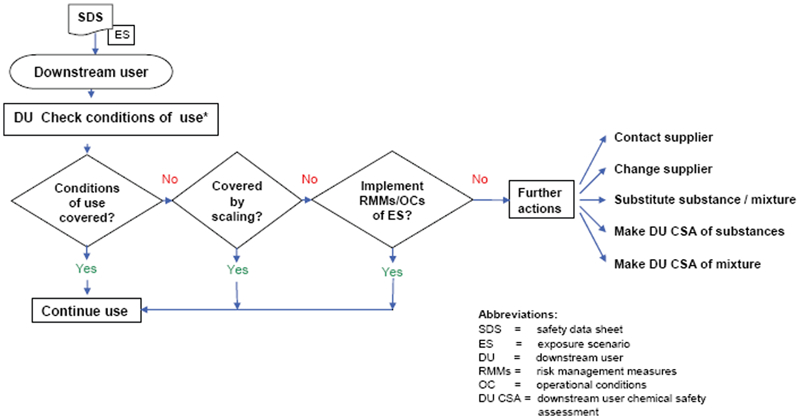
Flow chart to perform compliance check on uses13
Risk characterisation in the context of CSR focuses on comparison of the exposure to humans with the DNEL. If the DNEL is maintained, there is no risk to human health and therefore no further measures are required.
The producer of sintered parts is required1 under Article 34 to communicate to a supplier new information on hazardous properties or any other information that might call into question the appropriateness of the RMMs stated in the SDS for identified uses.
In Germany, the Arbeitsplatzgrenzwert (AGW) is a legally binding OEL for employers. The DNEL for inhalable and respirable dust may be used as an aid to assess whether the implemented RMMs are sufficient, provided that no AGW is available. If the AGW is stricter than the DNEL, the company must comply with the AGW. If the DNEL is stricter than the AGW, then the level of the AGW is reviewed by the Ausschuss für Gefahrstoffe (AGS: Committee on Hazardous Substances). If no AGW is available, then the DNEL serves as a benchmark, which must be taken into account during the on-site risk assessment and effectiveness check.14
Nickel in PM parts production
A major challenge for sintered parts producers is the use of nickel powder where there is a risk of inhalable exposure. The Generic ES 9 (GES) of nickel metal is regularly revised. To accommodate not only estimated exposure values, but also real, process-related data from the industry in the ES, it is recommended that producers of sintered parts submit the results of their workplace measurements to the EPMA, which passes anonymised data to the Nickel Institute for onwards transmission to the appropriate consortium.
In the current GES 9 the estimated exposure for nickel for the process ‘mixing of nickel and other metallic powders’ (scenario 9·1) is 0·1 mg m−3 for the inhalable fraction of nickel metal. Real data from industry, however, indicate that this estimate is too low if no additional RMMs to reduce dust have been implemented. This will be corrected in the next revision of the GES 9.
In Europe the typical nickel content for sintered parts is between 1·75% and 4%. In high alloyed steels the Ni content is typically 12%, and in high temperature and/or corrosion resistant alloys nickel can be present in concentrations >50%. Nickel can be present in elementary bonded form in diffusion alloyed or bonded grades, or in solid solution in pre-alloyed powder grades. When considering dust exposure, it is irrelevant in which form nickel is present in the powder mix: elementary, i.e. 100%Ni, or pre-alloyed, e.g. 1·9%Ni. The reason for this is that no toxicological studies on the effects of nickel in solid solution are available. In most cases, the particle size of nickel is considered to be the critical parameter in terms of inhalation exposure.
Classification of nickel metal
The classification of nickel metal powder (CAS 7440-02-0) is as follows:
H351: suspected of causing cancer, category 2
H372: causes damage to organs through prolonged or repeated exposure, category 1
H317: may cause an allergic skin reaction, category 1
H412: harmful to aquatic life with long lasting effects, chronic category 3.
Nickel metal is listed in Annex XVII, item 27 as a substance with restrictions on uses. Generally PM part producers are not affected by the listed restrictions on uses, as discussed above.
Aerodynamic diameter and ‘real’ particle size
The aerodynamic diameter

The typical particle size distribution of carbonyl nickel used in the PM industry shown in Fig. 2 suggests that about 92% of all nickel particles are inhalable and 1·5% of the particles are respirable. The sizes of the two fractions may vary slightly between powder lots.
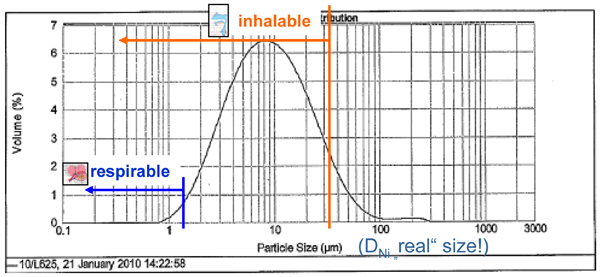
Particle size distribution of carbonyl nickel 123 (Vale)
Exposure levels for inhalable and respirable fractions
In the ES for PM uses, the DNEL for nickel metal is 0·05 mg m−3 for inhalable dust (10% of the AGW of 0·5 mg cm−3 valid in Germany until 2004) and 0·01 mg m−3 for the respirable fraction (no AGW available to date). In 2009, the Scientific Committee on Occupational Exposure Limits (SCOEL) suggested a considerably lower OEL of 0·01 mg m−3 Ni for the inhalable fraction (2% of the former AGW).15 However, recent findings from tests on rats showed no evidence that respirable nickel particles produced cancer, although they were toxic.16 With regard to these experiments, in June 2011 SCOEL recommended an OEL of 0·005 mg m−3 Ni for the respirable fraction.
Currently, no valid AGW is available in Germany. New limits are in discussion and the AGS is proposing a limit for the respirable fraction of 0·002 mg cm−3 Ni. At what stage binding limits will be available at the German national (AGW) and European (OEL) level is not clear at the present time.
The status of current threshold limit discussions at German and European level is summarised in Table 1.
National and European occupational exposure limits for nickel metal
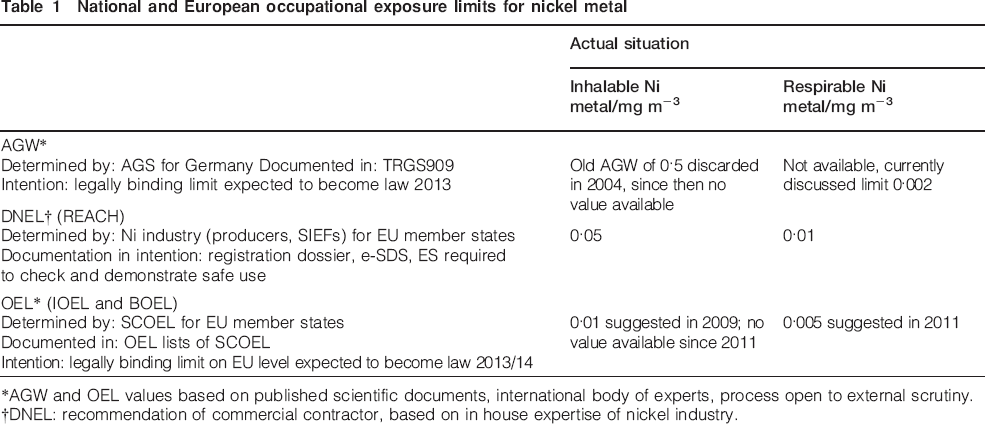
*AGW and OEL values based on published scientific documents, international body of experts, process open to external scrutiny.
†DNEL: recommendation of commercial contractor, based on in house expertise of nickel industry.
The lowering of the limits for nickel dust is not a result of REACH. Efforts to reduce the limits began in 2004, before the REACH regulation entered into force. The development of exposure limits for other listed elements under examination by the AGS,17 for which currently no valid AGW is available (e.g. cobalt, tungsten, molybdenum, titanium and manganese), also needs to be monitored.
Nickel dust measurements in workplace
Workplace measurements should be based on personal exposure (not individual stations) and performed over the duration of one shift, typically eight hours. Both the inhalable dust and the respirable dust need to be determined as an 8 h average value. The total dust and nickel dust exposure should be determined for all uses described in GES 9 for PM (see chapters 1·9 to 6·9). The measurements should be carried out by a properly accredited company.
It is important to choose an appropriate measurement method. The initial recommendation of the Nickel Producers Environmental Research Association (NiPERA), in collaboration with the Institute of Occupation Medicine (IOM), was to use the modified eight-stage Marple Cascade Impactor. This method was, however, proven unsuitable for monitoring the processes of PM part producers by in-house measurements performed at GKN Sinter Metals. The amount of dust collected in 8 h was found to be too small to ensure a statistically valid result in gravimetric analysis. Another method of personal measurement, PGP-GSP 3·5 for the inhalable fraction and PGP-FSP 2 for the respirable fraction, developed by the German Institute of Occupational Health and Social Accident Insurance (IFA), was instead adopted. These dust sampler heads can be operated at a flow rate of 10 L min−1, which increases the confidence level of the measured values.
Measured values for the inhalable and respirable fractions of nickel are summarised in Figs. 3 and 4. The documented values were obtained in 2011 at the European sites of GKN Sinter Metals for nickel metal, before introducing additional RMMs for dust reduction were implemented.
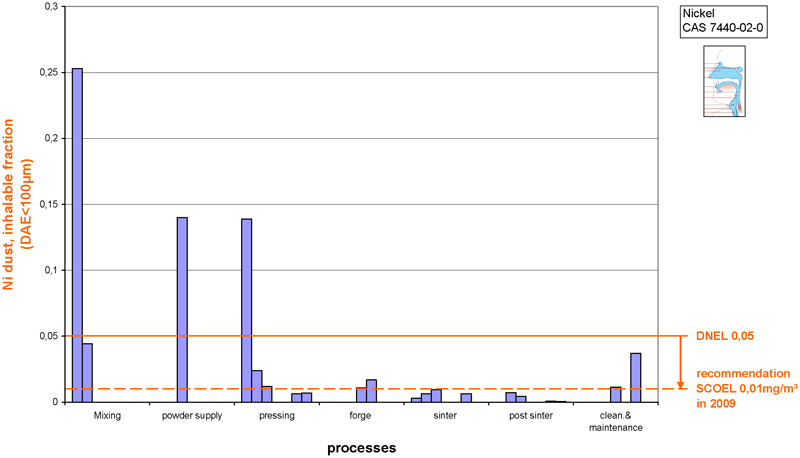
Results of personal dust measurements of inhalable fraction of nickel metal carried out at GKN Sinter Metals
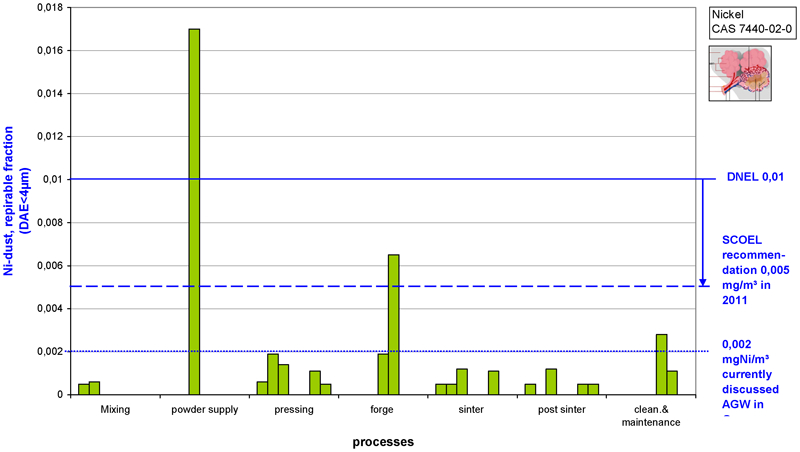
Results of personal dust measurements of respirable fraction of nickel metal carried out at GKN Sinter Metals
It can be seen in Fig. 3 that the measured values for parts of the powder mixing process and the powder compaction are well above the DNEL of 0·05 mg m−3. This indicates that without implementing additional RMMs, safe use of nickel cannot be demonstrated for these processes. Safe use is demonstrated if the risk characterisation ratio (RCR = [Ni]/DNEL) is <1, where [Ni] is the measured nickel value.
It can be concluded from the measurements that GKN Sinter Metals complies with the former AGW of 0·5 mg m−3 for the inhalable fraction of nickel metal for all manufacturing processes. The DNELs established in the ES for the processes of powder mixing and powder compaction with respect to the inhalable and respirable fraction of nickel dust are challenging. It is easier to prove safe use for the respirable fraction of nickel powder than for the inhalable fraction. The implementation of the RMMs advised in GES 9 is essential.
Measures to reduce nickel dust in workplace
Using the following RMMs, the nickel dust concentration can be minimised in the workplace of PM part producers:
intensive wet cleaning
enclosures around mixers/powder presses
additional central and local exhaust ventilation
automated folding of empty big-bags, using an extruder in a closed container with extraction
sealing and LEV for all powder pouring processes.
The costs of implementing these measures are potentially enormous. If on a national (AGW) or European (OEL) level limits below the DNEL need to be enforced, then temporary use of respiratory protective equipment (FFP3 masks are recommended) for operations with the highest dust exposure will be obligatory.
In addition nickel dust exposure in the workplace can be reduced by decreasing the nickel content of the alloy or by complete substitution of the nickel. The development and establishment of suitable nickel-reduced or even nickel-free alloy systems, which may possess their own risks and hazards, takes time. The development of OELs of candidate alloying elements to replace nickel, such as chromium, manganese and silicon, must be considered. The substitution of nickel may, besides, require new furnace technology, as sintering temperatures and atmospheres will need to be adapted to the sintering behaviour of the new alloying elements.
In parallel, efforts are being made by powder manufacturers to improve powder preparation techniques (e.g. agglomeration, bonding), to reduce dusting of nickel containing powder grades.
To monitor the effectiveness of implemented RMMs, in-house dust measurements are useful. An additional benefit of purchasing appropriate in-house dust measuring equipment is that it enables the evaluation of powder developments having the aim of dust reduction. To this end, GKN Sinter Metals has installed the Respicon dust-measurement instrument produced by Hund Wetzlar. The Respicon is a combined gravimetric/photometric device to measure the inhalable, thoracic and respirable dust fractions. The instrument includes an optical measuring chamber for scattered light in each filter stage for the direct measurement of the dust concentration over time. A microbalance with a sensitivity of 0·01–0·001 mg is employed to weigh the collected dust from each filter. Chemical analysis can be performed on the dust collected on the filters if desired.
Socio-economic analysis
In the SEA report it is assumed that nickel exposures >0·05 mg m−3 for the inhalable fraction will carry no risk for human health. Considering that in most workplaces about 10% of the total aerosol is in the respirable fraction, it can be assumed that the respirable value of 0·005 mg m−3 will carry no risk to human health.19 The conclusions of the SEA report20 suggest that on the basis of available evidence, there is no demonstrable substantial benefit in the reduction of the OEL for nickel to 0·01 mg m−3 (inhalable fraction) proposed by SCOEL. The examined costs to comply with the proposed OELs are out of proportion to the potential health benefits that workers exposed to nickel dust might receive.
The costs estimated to comply with the proposed OEL<DNEL for the PM industry sector are estimated as €7736/t, which would lead to the highest proportional price increases of any of the industry sectors considered in the report.21 However, it is unlikely that the SEA report will be considered by the European authorities when fixing the OEL. The reason for this is that SEA is normally taken into account only for substances classified as carcinogens, which is not currently the case, at least for the respirable fraction of nickel metal. As a consequence, for the respirable fraction of nickel metal, an indicative OEL (IOEL) is anticipated. SEA is considered only when determining binding OELs (BOEL).22
Communication in the supply chain
REACH requires communication along the supply chain in both directions, to the supplier and to the purchaser. It is advisable for producers of PM parts to require suppliers and subcontractors (e.g. for heat treating, machining, coatings, etc.) to make a commitment to be REACH compliant. This commitment should include an agreement to perform the following duties:
in accordance with Article 5,1 substances on their own, in mixtures or in articles supplied, with respect to volumes and classification, shall be duly registered in good time with consideration of the uses of the company being supplied. The supplier/subcontractor is required to communicate information about the status of the registration, especially if it is foreseen that the substance cannot be registered in due time
according to Articles 31 and 32,1 an up-to-date SDS and safety information (SI) must be provided
to inform the PM parts producer if a request for authorisation was granted or denied, and as soon as possible if substitution of a substance/mixture is required
to inform the PM parts producer if SVHC candidates, with respect to the latest update of the SVHC list, are present in the supplied articles or packaging in concentrations >0·1%, and to submit information about safe use of the article
In a REACH standard letter the purchaser of PM parts needs to be informed:
of the presence of SVHC candidates in the delivered article in concentrations >0·1%, with reference to the most current status of the SVHC list
of conformity in terms of substances listed in Annexes XIV and XVII and, where applicable, of the activities required for the substitution of suspect substances, on their own or in a mixtures
of collaboration with trade associations with the aim that all uses of PM technology are considered in a harmonised way in registration dossiers
of compliance in terms of required registration and notification at the ECHA if substances are intentionally released from articles.
Inventory list of substances
The compilation of inventory lists of substances and volumes is not required by the REACH regulation.23 However, to meet the obligations mentioned above, the presence of these lists is a recommended tool. All raw materials, additives and operating materials (i.e. powder, powder additives, material for plastic infiltration and coatings, including all media which are in contact with the produced articles during production such as sizing oils, cooling fluids, cleaning agents, quenching media and corrosion inhibitors) must be captured for each legal business entity. Compiling data on volume per year for each substance as a three year average value is required to find out if, for example, a SVHC candidate needs to be notified at the ECHA.
The inventory lists of GKN Sinter Metals include the following information (not necessarily complete: it is also possible to include additional information):
name and article number of the product/substance for clear identification
identification of the received product as a substance, a mixture, an intermediate or an article
identification of the producer, supplier or subcontractor
yearly consumption as an average value of the last three years for each supplier
country of origin of the invoice (EU or non-EU)
date of the latest issue of the SDS available
classification of the substance/mixture
occupational exposure limits, e.g. DNEL, PNEC, AGW, OEL in accordance with the SDS
constituent substances classified as hazardous, CAS, EINECS, EG, registration number if available, classification and concentration
compliance check in terms of the intended use compared with identified uses listed in the SDS or if available in the ES
comparison of implemented RMMs on-site compared with advised RMMs in the SDS
definition of the role in the supply chain the company has for each product (DU or importer)
is the substance/mixture intentionally released from the articles produced?
any substances included in the product listed in the SVHC list or in Annex XIV; information about concentration levels
is a substance included with restrictions on uses (Annex XVII)? does this affect the intended use?
is substitution of the product required?
notes regarding the contents and key points arising from direct communication with the supplier
which REACH obligations will need to be implemented in practice as result of the points mentioned above.
It is doubtful whether, in the long term, individual lists of substances are the most appropriate tool to control, document and prove REACH compliance, as a huge number of substances connected to a wide variety of uses must be observed. Other legislation besides REACH must be considered, for example:
ROHS I and II: Directive 2002/95/EC and 2011/65/EC
Waste Electrical and Electronic Equipment (WEEE): Directive 2002/96/EC for electric and electronic devices
End of Life Vehicles (ELV): Directive 2000/53/EC
US Conflict Mineral Law, July 2010 (Dodd-Frank Act)
ecological and environment protection requirements, e.g. life cycle assessment (LCA) and recycling, reuse, recovery (RRR).
Additionally, keeping up to date with the continual updates and expansions to the legislation makes compliance checks very complex. Software to check and prove legal compliance is available on the market. However, it is not yet clear whether these packages can successfully cover all requirements.
REACH enforcement
Within the scope of REACH-en-Force 1, in the period 2009–11 approximately 2400 companies have been inspected in Europe, of which 440 were located in Germany. The focus of REACH-en-Force 1 was the monitoring of the pre-registration and registration obligations for manufacturers and importers of substances and the ensuring the presence of REACH compliant SDSs.24
In 2009, deviations were found in 20% of all inspected companies in Germany. In 2010–11 this number was only 8%. The controlling authority has come to the conclusion that the industry has made efforts towards and is willing to comply with the regulation. However, the following criticisms were made:
REACH is given too little attention by some companies
some SDSs only partially meet requirements for REACH compliance
internal company networks between purchasing, production, occupational health and safety and environmental protection need to be improved with regard to REACH
companies rely too heavily on technical and/or organisational tools: communication about hazards and risks within the company and the supply chain must be improved.25
As part of REACH-en-Force 2, the REACH and CLP duties of DUs which produce formulations are being inspected. Enforcement started in 2011 and 180 reviews were due to be completed by the end of March 2012. REACH-en-Force 3 was planned to commence in 2012 with the aim to review the collaboration of the enforcement authorities with customs.26
It has been claimed that enforcement activities in the member states differ in intensity and frequency. Both interpretation of the legal text and the guidelines for enforcement show differences in practical implementation. Both the industry and the enforcement authorities are currently in a process of learning. Procedures, communication tools and IT systems must be developed to ensure that REACH is implemented successfully. Where uniform enforcement cannot be realised owing to differences in country specific organisation and jurisdiction, harmonisation should be pursued to achieve identical conditions for companies in all member states. This is one of the main tasks of the Enforcement Forum of the REACH and CLP legislation, which was set up by ECHA.27
For manufacturers of PM parts, close collaboration with national and international organisations and authorities (FPM, WSM, WVM, EPMA, Nickel Institute, BAuA, BG, etc.) is required for timely identification of risks and, last but not least, to represent the interests of our branch of industry.
“Things are never as they are.
They are always what you make of them”
Jean Marie Lucien Pierre Anouilh (1910–87)
Footnotes
Acknowledgements
This paper is an edited translation of ‘REACH: Risiken, Herausforderungen und Chancen für Hersteller von Sinter-Formteilen’, published in Vol. 28 (2012) of Pulvermetallurgie in Wissenschaft und Praxis, ed. Hans Kolaska. The content of the paper was presented at the Hagener Symposium in November 2012, organised by the Fachverband für Pulvermetallurgie. The views expressed represent the experience and the understanding of the authors and are not necessarily comprehensive and correct.