Abstract

EPMA elects new President
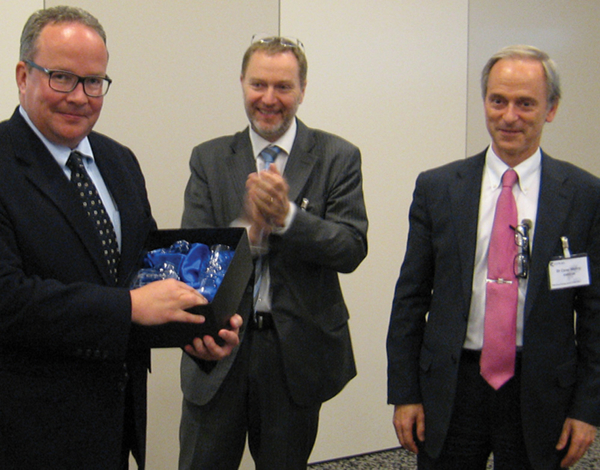
Philippe Gundermann of Aubert et Duval was elected EPMA President at the Association's twenty-fourth annual General Assembly held in Munich on 3 May. He will serve initially for three years, succeeding Ingo Cremer (Cremer Thermoprozessanlagen GmbH), whose six years as President bridged a time of economic turmoil in Europe that, despite recent improvements, continues to influence EPMA and the industry. Mr Cremer provided the 30 member companies present with a review of events over his period of office, after which Mr Gundermann presented his vision for the future. Jonathan Wroe, EPMA's Executive Director, gave an update of EPMA's activities over the past twelve months. He reported that the EPMA has a stable membership base and had produced a better than anticipated, positive financial result in 2012 (www.epma.com).
The EPMA Council was re-elected with two changes: Dr Rainer Link (GKN Sintermetals) replaces the retiring Volker Arnhold and Jody Turin (Bodycote AB) joins the Council as the new representative for the HIP sector. Peter Kjeldsteen (Sintex A/S) was elected as Treasurer.
Aubert et Duval is a member of the Eramet Group with PM activities that include the gas atomisation of steel and alloy powders, including tool and high speed steels and the supply of powders and forged semiproducts (www.auberduval.com).
EPMA launches Additive Manufacturing Group
The European Powder Metallurgy Association has also announced the launch of a sectoral group focusing on additive manufacturing (AM) within the European PM industry. The newly formed group will assist and support the future application of AM with metal powders, a new and growing industry sector in which many leading companies are based in Europe.
The launch is a result of discussions between members EPMA active across the AM supply chain. The European Additive Manufacturing Group (EAMG) will have four principal objectives:
to increase awareness of AM technology, with a special focus on metal powder based products
to enable the benefits of joint action, for example through research programmes, workshops, benchmarking and exchange of knowledge
to improve understanding of the benefits of metal based AM technology by end users, designers, mechanical engineers, metallurgists and students
to assist in the development of international standards for the AM sector.
The two founding Co-Chairmen of the group will be Ralf Carlström of Höganäs AB, Sweden and Claus Aumund-Kopp from Fraunhofer IFAM, Germany. The Chairmen will coordinate activities in areas including conferences and workshops, promotion activities, technical research programmes, training and standardisation work. It is anticipated that the EAMG will hold meetings regularly and will be open to companies and organisations across the supply chain.
For companies to get the most from EAMG, including access to various services such as benchmarking and industry-led projects, it will be necessary for them to be members of the EPMA.
For further information on EAMG, contact: Dr Olivier Coube, EPMA Technical Director, tel. +33 4 42 12 47 44, email
Additive manufacturing standards approved
The first two standards to be approved through a Partner Standards Development Organization (PSDO) cooperation agreement between ASTM International Committee F42 on Additive Manufacturing and ISO Technical Committee 261 on Additive Manufacturing have now been approved. The two standards are:
ISO/ASTM 52921: 2013 E, ‘Terminology for additive manufacturing – coordinate systems and test methodologies’ (originally published as ASTM F2921-11)
ISO/ASTM 52915: 2013 E, ‘Specification for additive manufacturing file format (AMG)’, Version 1.1 (originally published as ASTM F2915-11).
The purpose of the PDSO, signed in September 2011, is to eliminate duplication of effort while maximising resource allocation within the additive manufacturing industry. The agreement covers: fast tracking the adoption process of an ASTM International standard as an ISO final draft international standard; formal adoption of a published ISO standard by ASTM International; maintenance of published standards; and publication, copyright and commercial arrangements.
The next meeting of ASTM Committee F42 will take place on 10–11 July 2013 in Nottingham, UK, in conjunction with the International Conference on Additive Manufacturing.
Further information from: Pat Picariello, ASTM, tel. +1 610 832 9720, email
Trends in additive manufacturing
ARC has issued a strategy report examining trends in additive manufacturing (3D printing). The report contends that it is important to understand that additive manufacturing is actually a group of technologies, with a very wide range of build materials, sharing a common philosophy that it may be more efficient to make things by building up materials than by cutting them away.
The year 2012 was, says the report, a breakout year for additive manufacturing, with system suppliers achieving record revenues and the first real penetration of additive manufacturing into the consumer market. At the other end of the spectrum, there has been a steady progression in the development of systems intended for industrial or professional usage. Against this backdrop, many leading manufacturing companies are now evaluating additive manufacturing both for the fabrication of prototypes and production parts. The strategy report aims to identify domains, industries, and applications for which additive manufacturing can add value to industrial companies; to provide an overview of the different additive process types, including their respective strengths and weaknesses; and to evaluate the constraints of the market.
Further information on the report at www.arcweb.com/strategy-reports/2013-04-26/trends-in-additive-manufacturing.aspx.
OM Group divests cobalt and nickel interests
OM Group has announced the finalisation of agreements to dispose of its Advanced Materials business. The transactions include the sale of the downstream portion of the business, including its cobalt refinery assets in Kokkola, Finland, to a joint venture to be held by Freeport-McMoRan Copper & Gold Inc., Lundin Mining Corporation and La Generale des Carrieres et des Mines (Gecamines). The divestiture of its cobalt business is part of the Group's strategy to exit its legacy commodity businesses and to focus on technology-based businesses, including markets such as automotive systems, electronic devices, aerospace, general industrial and renewable energy. The recent purchases of Vacuumschmelz with its speciality magnetics business and Rahu Catalytics form part of this strategy.
For more information, visit www.omgi.com.
Nanoscale powders for infrared diagnostics
Research at the University of Pittsburgh has reported light emitting gold–copper alloy nanoparticles having potential applications in medicine and other areas. A group led by Professor Jill Millstone has developed alloys with novel properties –including near-infrared (NIR) emission – that can be tailored by control of their size, shape, and surface chemistry. NIR is an important region of the light spectrum owing to the human body's relatively low absorption of light at this wavelength. Use of NIR emitters offers the potential to visualise cells, and ultimately parts of the body, for applications such as minimally invasive diagnostics. The nanoparticles are said to offer emissions up to 100 times more intense than current emitters and so may also have potential for targeted therapeutic treatment of tumours.
The work has also shown for what is said to be the first time a continuously tunable composition for nanoparticle alloys; the approach uses small organic molecules to stabilise the alloys to prevent separation of the components. In addition to NIR luminescence, similar nanoparticles are likely to have a wider range of imaging and catalytic applications.
The work is reported in a paper, ‘Photoluminescent gold–copper nanoparticle alloys with composition-tunable near-infrared emission’, published in the 10 April issue of Journal of the American Chemical Society. Further information from Professor Jill Millstone, Department of Chemistry, University of Pittsburgh, email
Thermal spraying for aerospace coatings
The stringent requirements of the aerospace industry demand high quality thermal spray coatings, combining accuracy, repeatability and defined service properties. Vector Aerospace is an industry leader in the global aerospace maintenance, repair and overhaul market with repair facilities in Canada, the USA, France, the UK, South Africa and Australia. Vector operates an engine repair service facility at its Fleetlands – Gosport site where it repairs and overhauls engines for Rolls-Royce, Pratt and Whitney and Honeywell.
As acquired in 2000, the facility included a sound attenuated thermal spray booth, robot, tilt and turn turntable, plasma and arc spray systems. The system was originally designed to produce aerospace certified coatings, including wear resistant and thermal barrier coatings (TBCs). Vector installed a new extraction system to meet the latest environmental requirements. Thermal spray specialist Metallisation was involved in the re-commissioning of the system and has continued to provide ongoing support through its annual calibration service and its bi-annual servicing.
Vector Aerospace has recently purchased an automatic powder flame spray system from Metallisation, to complement its existing facilities. The new flame spray system enables the company to produce abradable coatings and to enhance its engine repair service. The MK74-PC unit is fully automated, mass flow and PC controlled and has distributed I/O to maximise reliability and repeatability. The thermal spray cell primarily incorporates the Metallisation PS50M mass flow controlled plasma system and ARC 140/S250 automatic system. The tilt and turn turntable provides an additional two axes to the six-axis robotic manipulator, ensuring that all areas of the component are accessible for coating.
In a typical metal spray application 0·004–0·008in (100–200 μm) of Ni/Al bond coat would be sprayed at around 50 μm per pass using the arc spray system. A topcoat of up to 0·014in (350 μm) chromium carbide alloy would then be applied at around 100 µm per pass, to provide wear resistance to the engine component, using the plasma system. Abradable coatings have a thin bond coat of Ni/Al arcspray coating applied before a Ni/graphite 85/15 topcoat is applied with the new MK74-PC powder flame spray equipment. The 74-MC pistol can apply a wide range of coatings for thermal barriers, wear resistance and as a dielectric. This pistol utilises an oxyacetylene gas mixture, and so is capable of spraying ceramic coatings, as well as the full range of metal powders.
Further information from Stuart Milton, Metallisation, tel. +44 (0) 1384 252 464 or www.metallisation.com.
Mixed outlook for tin consumption
The ITRI China International Tin Forum, hosted by ITRI China in Kunming on 23–25 April, attracted 260 delegates from 30 countries and benefited from the support of Yunnan Tin and sponsorship from the other main Chinese producers. The meeting took place at a time when financial markets have been particularly unsettled and tin and other commodity prices have been falling. However, in a keynote speech Gao Wenxiang, General Manager of Yunnan Tin Group, noted that while the industry had been buffeted by wind and rain ‘we will definitely see rainbows’.
The fundamental reason for confidence in the future of the industry in China, and worldwide, was the prospect of continuing economic growth. Mr Gao noted that China's refined tin production and consumption had doubled over the past decade, but there had been no growth in mine production and economic resources were limited, concluding that ‘it is absolutely obvious that the supply of tin mines in China is far behind its own market requirement’. The challenge of limited domestic tin resources was also referred to by Pan Wenju, Vice Chairman of the China Non-Ferrous Metals Association (CNIA), who called for international joint ventures to improve resource security, as well as increased tailings treatment and recycling of end of life products.
Speakers from the world's other major producing countries also discussed production challenges. Agung Nugroho, Corporate Secretary of PT Timah said that lack of control of small-scale mining was a major issue – pointing out that while Timah controlled 90% of all mining leases in Indonesia, private smelters accounted for 71% of the country's exports last year. Rosa Elena Reategui of Minsur reported that the depletion of reserves at the company's San Rafael mine in Peru was likely to result in a sharp drop in production from 2017 while Bolivian expansion projects were well behind schedule. However, Minsur was building up its production in Brazil (2013 forecast output: 5200 t of refined tin) and would start up a large tailings project, Bofedal II, in Peru in 2016.
The main negative feature, covered by several speakers in the conference, was the impact of miniaturisation and the trend away from wave soldering on electronics solder volumes. Valentijn van Velthoven of Alpha Asia said that a forecast cyclical recovery in electronic equipment production could result in 6–7% industry growth rates in 2014–15, but area growth in printed circuit board production (which the company had found correlated closely with solder sales) might only be 1% per year. Jasbir Bath of IPC also reviewed the impact of miniaturisation and changing assembly technologies, but pointed out the likely positive impact of increased use of lead-free alloys in telecoms, automotive and medical applications (which are collectively estimated to account for 34% of the market) in the coming years. There was also a prospect of a move from voluntary to mandatory restrictions on lead use in the China consumer products market from as early as July 2014.
Other positive views on the outlook for tin usage in China came from Zhang Wencan of the China Metal Packaging Association and Guo Yinghui, Vice General Manager of YTC's chemicals division. Mr Zhang said that although the Chinese tinplate industry suffered from over-capacity and quality problems, further investment in new larger plants would add another 3 Mt to annual capacity in the next five years – which might be bad for tinplate prices and profit margins but good for tin demand. Mr Guo forecast a strong growth in demand for inorganic tin chemicals, as a result of rapidly growing PVC production and a likely rise in the market share of tin stabilisers as they replaced lead, cadmium and metallic salts.
Further information from: Peter Kettle, Manager, Statistics and Market Studies, ITRI Ltd, tel. + 44 (0) 1727 871347, email
Nanotechnology directory
The Nanotechnology Knowledge Transfer Network (NanoKTN), one of the UK's primary knowledge-based networks for Micro- and Nanotechnologies, has launched its 2013 version of the UK Nanotechnology Health, Safety and Environment (HSE) Directory.
Now in its fourth year, the UK HSE Directory has 54 entries, covering a wide range of organisations and individuals having expertise in topics ranging from toxicity testing through to regulation and standards. The directory aims to assist researchers and industry to find the most appropriate advice for work undertaken in the field. The comprehensive range of organisations in the Directory includes UK Government (and agencies), research institutes and networks that have a declared public interest in this area. The range of services listed covers basic toxicology research, measurement and characterisation through to product testing and waste monitoring.
The 2013 UK Nanotechnology HSE Directory is available free and can be downloaded at http://tinyurl.com/l59e3cw, although access is restricted to NanoKTN members and prior registration is therefore required at www.nanoktn.com.
Advances in physical security
The protection of critical infrastructure is of national importance. Countering terrorism and malicious attack involves sectors including: transport, communication, energy, food & water and government buildings and facilities, including military installations. The protection of commercial properties is also important: loss and crime prevention and resistance to vandalism has been estimated to cost the UK economy £12·6bn, with more than half of all burglaries related to non-residential buildings.
This meeting, to be held at Port Talbot, UK on 21 November 2013, organised by the Defence, Safety and Security Committee of IOM3 in association with Tata Steel, will focus on the design, manufacture, testing and standardisation of physical security products such as security doors, enclosures and barriers and hostile vehicle mitigation protection. Domestic systems, electronic entry systems and surveillance equipment will not be covered.
Further information at www.iom3.org/events/aps.
Correction
An editing error occurred in the paper ‘Digital radiographic inspection technique for production friendly quality assessment of PM parts’ by Maxim G. Ponomarev et al., published in the last issue of the journal (pp. 92–95). We regret the error and wish to make clear that the work reported formed part of the AutoInspect EU programme. It was not associated with the DIRA-Green programme, as was incorrectly suggested in the opening sentence of the paper. The online version of the paper has been amended to reflect this change.
Retiring President, Ingo Cremer (left), with Philippe Gundermann and Cesar Molins