






Abstract

JPMA, the Japan Powder Metallurgy Association, has produced its 2012 annual report, which includes statistics for the Japan and Asian PM industries.
Shipments of iron powder for PM applications totalled 109 972 t, an increase of 3·7% relative to 2011. Total iron shipments were almost unchanged at 207 195 t (2011: 209 252 t). Copper shipments decreased relative to 2011: shipments for PM applications were 4848 t, down 6·3%, whereas overall shipments were 6952 t, a decrease of 6·7%.
Shipments of other powders are reported for the 2011/12 fiscal year. Aluminium shipments were 409 t, an increase of 8·0% over 2010/11, stainless steel powder shipments were 2841 t, almost unchanged, and shipments of MIM powder rather surprisingly decreased by 6% to 389 t.
Production of machine parts (PM structural parts) was 95 020 t in 2012, an increase of 4·7% on 2011, according to METI figures. Of this total, production for automotive applications amounted to 87 691 t, an increase of 5·8%. JPMA comments that production in the early part of the year was boosted because of Japanese government tax reductions for ecologically friendly vehicles. However, this incentive ceased in September and the outlook is less favourable, although the weak yen is expected to assist exports. According to JPMA's 2011 statistics, some 53% of PM automotive parts were for engine applications, 24% for drive train applications and 13% for chassis applications. The principal areas of growth highlighted are high precision variable valve timing (VVT) applications, where advanced PM design can reduce the number of parts in a component, and powder pressed cores for hybrid electric vehicles.
Bearing production was 6386 t, almost identical to 2011. As with structural parts, PM bearing production for automotive applications was 3993 t, an increase of 3·7%. The majority of automotive bearing usage was in electrical applications (55%), with engine bearing applications making up 13% of the total, body applications 11% and chassis applications 7% (again JPMA 2011 figures). JPMA comments that PM bearings for fuel pumps of petrol engines, where high corrosion resistance is a key requirement, are expected to show strong increase in production in future.
Production of PM fiction materials and electrical contacts both decreased relative to 2011, by 13% to 634 t and by 17% to 64 t respectively.
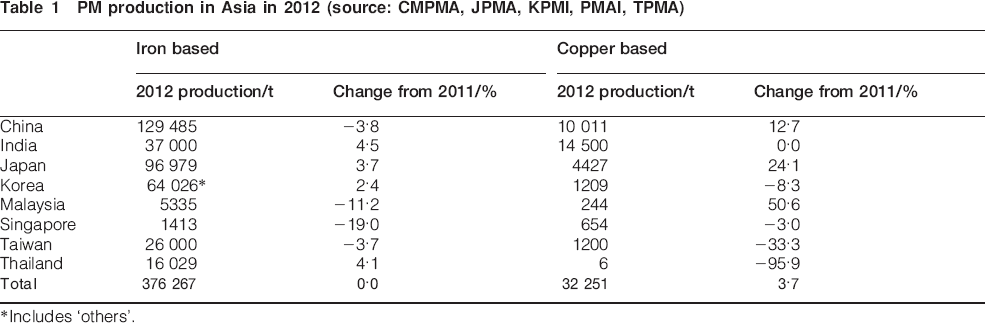
The JPMA report also gives PM production information for Asia in 2012, as summarised in Table 1. Overall, production of iron based parts remained almost unchanged totalling 376 000 t. Production of automotive parts remains dominant, comprising ∼90% of total production in Japan, Korea and Thailand, 80% in India and 60% in China and Malaysia. Electrical motor parts make up significant proportions of the outputs of Singapore (50%), Malaysia (36%) and China (30%). Parts for industrial machines also make up 24% of Taiwanese production, almost one-third of which is for applications other than those listed above.
PM production in Asia in 2012 (source: CMPMA, JPMA, KPMI, PMAI, TPMA)
*Includes ‘others’.
Further information at: www.jpma.gr.jp.