







Abstract
The properties of porous Ti disc aerators for water treatment were investigated. It is shown that the addition of 5–15 wt-% of a finer (100–160 µm) sponge titanium powder to the coarser (630–1000 µm) base powder can increase the tensile strength of the discs obtained by a factor of two. This allows weight savings of 44% to be obtained at comparable strength levels for discs 188 mm in diameter. The discs produced from mixed powders also produce finer bubbles and have lower permeability, which can lead to energy savings through reduced pump power consumption.
Porous tube and disc aerators are used at water treatment and sewage biochemical treatment plants to saturate water with air or an ozone–air mixture. The process of oxygen dissolution in water is controlled by the degree of gas phase dispersion, i.e. by the size and number of bubbles. The smaller the bubble size, the greater is the area of the phase boundary and the lower the floating rate of the bubbles, hence gas/water contact time increases. Comparative studies of porous powder materials used in aerators1,2 have shown that the use of non-spherical powder in PM aerator manufacturing can reduce bubble size or (preserving the size) increase porosity and permeability, thereby increasing the saturation efficiency, if other factors (initial powder porosity and particle size) are equal. When corrosion resistance, pore surface biofouling resistance and resistance to aerator clogging are considered, porous powder based materials, in particular sponge titanium powder, are promising materials.1–4
Although porous titanium aerators have been successfully regenerated after 15 years of operation, 5 in some cases relatively low initial mechanical strength of the porous elements of sponge titanium powder has been revealed and these aerators have proved to be unsuitable for further use after regeneration. Moreover, intermittent water hammering in the air system was found to cause cracks in some porous aerators after a few years of service. To attempt to overcome these problems, properties of porous aerators produced from sponge titanium powder, with and without reinforcing additives, has been investigated.
Materials and research methods
Sponge powder of the technically pure titanium grade TPP was selected as materials for the study. The powder was obtained by milling of titanium sponge – the product of hydride–calcium or magnesium thermal reduction of titanium oxide. Titanium powder grade TPP-5 with a particle size range of 630–1000 μm was used as the base material. In accordance with the results of previous studies, 6 the finer titanium powder grade TPP-8 (100–160 μm) was added as the second component. The grades TPP-5 and TPP-8 were identical in chemical and phase composition and microstructure, and were obtained via titanium sponge mechanical grinding followed by sieving into fractions. Additions of 5, 10, 15, and 20 wt-% of TTP-8 powder were made to the TTP-5 base. The working mixture was prepared by mechanical mixing in a blending machine, e.g. a ‘drunken barrel’ for 2 h, with a 10 vol.-% addition of ethyl alcohol. Discs of diameter 188 mm were pressed in a mould at 80–90 MPa: type 1 discs from the TPP-5 base powder and type 2 disks from the TTP-5+TTP-8 mixture.
After pore size, permeability coefficient and aeration measurements, rectangular plates of dimensions 54×10×4 mm were cut from the discs, using electric erosion machining to avoid damage and distortion of the pore structure, for tensile testing. Sintering was performed in vacuum at 1150°C for 1 h, conditions that have previously been found to be optimal for the initial working mixture. At least five specimens of each type were produced and tested and the properties reported are average values.
Structural properties were determined using the methods described previously. 7 The specimen surfaces were investigated by scanning electron microscopy and their microstructures subjected to metallographic analysis. Tensile strength was measured with a universal testing machine (Instron 1196). The measurement error did not exceed 1%. Full scale tests of aerator samples were performed on the installation described previously, 1 a rectangular basin with transparent walls of volume 0·5 m3. The aerator under study was installed at the bottom of the basin, to which the compressed air was supplied (Fig. 1). The air pressure was regulated via a reducer and its value was recorded using a standard pressure gauge. Air flow through the aerator was recorded by a standard rotameter. During the tests, the water was poured above the aerator so that the immersion depth of the porous disc of the aerator was at least 0·35–0·4 m.
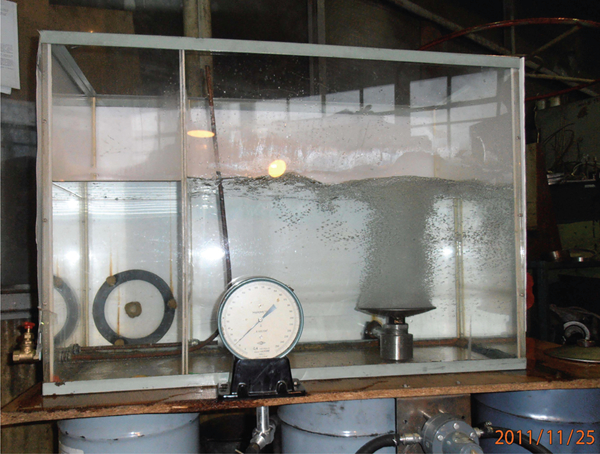
General view of installation for study and testing of porous aerators
Results and discussion
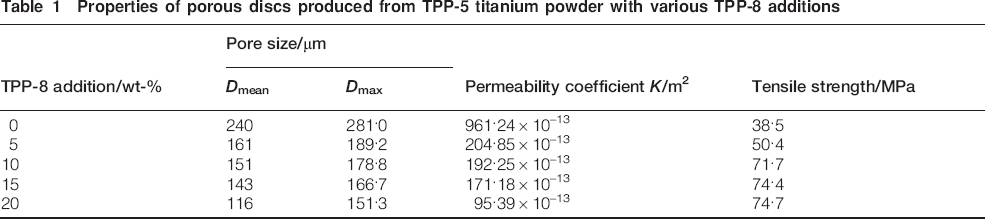
The results of the physical and mechanical property measurements of the aerator specimens are given in Table 1. It can be seen that the addition of 10–15% grade TPP-8 to the working mixture based on TPP-5 produces a two-fold increase of the mechanical strength. At the same time, pore size decreases by a factor of 1·6–1·7, and permeability coefficient decreases by a factor of 5–6.
Properties of porous discs produced from TPP-5 titanium powder with various TPP-8 additions
Micrographs of the rupture surfaces of the specimens produced from TPP-5 and TPP-5 with a 15% addition of TPP-8 are shown in Fig. 2.
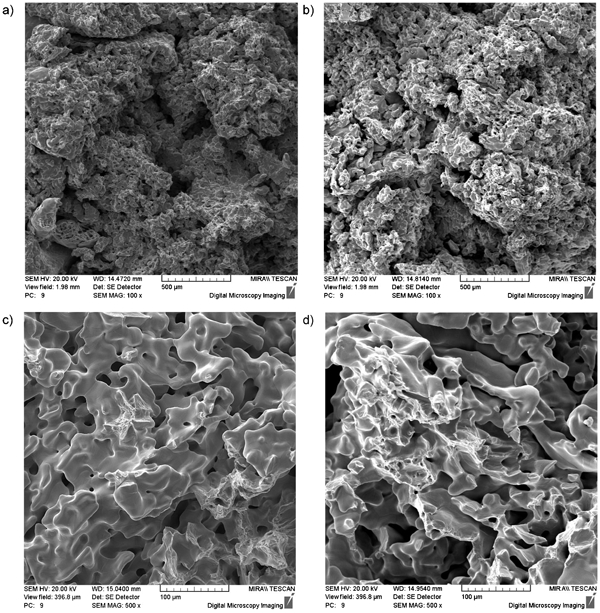
Rupture surfaces of specimens from porous aerator discs produced from TPP-5 (630–1000 µm) sponge titanium powder with and without additions of TPP-8 (100–160 μm) powder: a,c no addition; b,d 15 wt-% TPP-8 addition
It can be seen that, despite the apparent similarity of the rupture structures of both materials due to the sponge structure of the TPP powder particles (Fig. 2a and b ), higher magnification reveals the presence of finer 100–160 μm particles on the surfaces of the coarser TPP-5 particles (upper left corner, Fig. 2d), whereas when there was no addition (Fig. 2c) only the surface of similar coarse particles were observed. Comparison of Fig. 2c and d clearly indicates that the extent of the interparticle contacts in the material obtained from a mixture of powders is significantly greater than that for materials produced from the coarser powder alone. This observation explains the strengthening effect of the fine powder additions. Moreover, the advanced surface morphology obtained with the bimodal powder mixture, in which finer particles are attached to the coarser particles, produces greater reductions in the size of gas bubbles generated during aeration, compared with what might have been expected as a result purely of the direct reduction of pore size.
The air bubbles generated in water by porous discs of aerators produced from titanium powder grade TPP-5 alone and from TPP-5 with a 15% addition of the finer TPP-8 are shown in Figs. 3 and 4 respectively. It can be seen that finer powder addition reduces the sizes of bubbles observed on the surface of the aerators (1–2 mm, compared with 3–5 mm on the disc produced from the coarse powder alone). This is associated not only with the slightly smaller pore size of the TPP−5+TPP−8 discs, but also with the effect of the wetted perimeter on bubble size. 1 The wetted perimeter in the material obtained from a mixture of coarse and small titanium particles is obviously larger than that from the coarse powder alone. An image analyser connected to a computer and CorelDRAW software was used to estimate the size of the bubbles. The technique was initially tested during the parametric determination of a liquid particle lying on the surface of textured titanium and then used to calculate wetting angle. 8
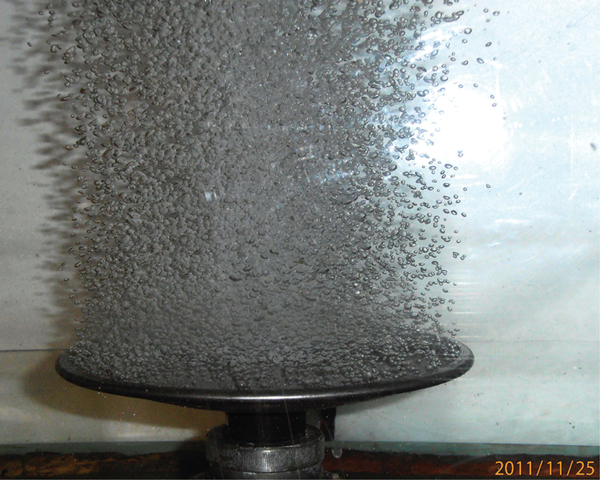
Air bubble formation in water on surface of porous discs of aerators obtained from titanium powder grade TPP-5 (particle sizes of 630–1000 µm) at nominal air flow of 2·4 m3 h−1
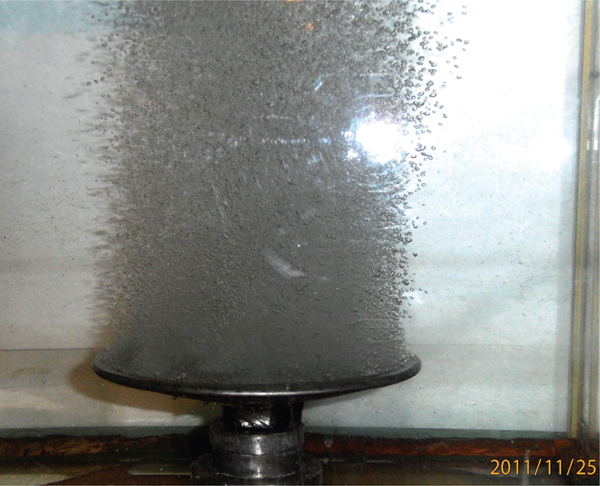
Air bubble formation in water on surface of porous discs of aerators obtained from titanium powder grade TPP-5 (particle sizes 630–1000 µm) with the addition of 15% fine titanium powder grade TPP-8 (particle sizes 100–160 µm) at nominal air flow of 2·1 m3 h−1
In addition to the reduction in bubble size obtained following addition of finer powders to the TPP-5 base material, another positive, though perhaps counter-intuitive, result is to lower the permeability. Thus, while the intensity of aeration is almost equal (Figs. 3 and 4), the air supply to the aerators can be reduced, reducing the electric power consumed by the blower pump, which has economic and environmental benefits.
Another significant practical benefit may be drawn from the study. The twofold increase in strength of the disc obtained from the bimodal size mixture of titanium powders, while maintaining the operating pressure limit, allows reduction in the thickness of the disc and consequently, if other dimensions are maintained, reductions in its weight. For example, the mass of a porous disc of an aerator obtained from titanium powder grade TPP-5, with a diameter of 188 mm and a thickness of 4·5 mm, is 0·260 kg, whereas the mass of a similar disc with the addition of 15% titanium powder grade TPP-8, having an equal strength, is 0·145 kg, a weight (and materials) saving of 44%.
Conclusion
The properties of porous aerators obtained from a milled sponge (630 −1000 m) titanium powder and a mixture of this powder with 5–20% additions of a finer titanium powder were studied.
The bubbles generated on the surface of porous discs produced from the powder mixture were much smaller in size (1–2 mm) than those generated on the disc from the coarser powder grade alone (3–5 mm).
The discs from the powder mixture demonstrated lower permeability combined with almost the same intensity of aeration. This allows a reduction in the air supply to the aerators, hence reducing the electric power consumption of the blower pump, which has not only economic, but also environmental benefits.
It has been established that increased strength obtained by the use of mixtures of titanium powders of different size distributions can reduce the thickness of the porous disc by 4·5–2·5 mm, compared with the baseline case, without loss of strength. Thus, the mass of a disc having a diameter of 188 mm can be reduced from 0·260 to 0·145 kg and the number of porous discs obtained from 1000 kg of titanium powder will be 6897, compared with only 3846 in the baseline case.
Footnotes
Acknowledgement
This is an edited version of a presentation at Euro PM 2012, organised by EPMA in Basel, Switzerland on 10–12 October 2012.