






Abstract

CMU additive manufacturing initiative
Pittsburgh based Carnegie Mellon University (CMU) has embarked on an 18 month programme with industry to develop 3D printing technology for metal components as a higher volume manufacturing process. With a $1·9m grant from the US National Additive Manufacturing Institute in Youngs- town, OH, CMU Professor Jack Beuth will lead a research team to develop tools to improve powder-bed additive manufacturing processes for applications that include jet engine parts and medical implants. With colleagues Fred Higgs and Anthony Rollet at CMU and Ola Harrysson of North Carolina State University, Beuth has been working to control and understand the microstructure and mechanical properties of products made by two powder based additive manufacturing processes: the EOS laser sintering process and the Arcam electron beam melting process.
‘At this time, high-quality results are only guaranteed if powders from the additive manufacturing machine manufacturers are used. For those processes to become high volume manufacturing processes, a wider range of powder options is needed’, Beuth said. The team is charged with determining how to tailor the additive manufacturing process to allow use of a wider range of powders. The team includes 12 industry partners representing powder manufacturing, aerospace, medical devices, electronics and other industries. CMU has purchased new metal based additive manufacturing equipment to further the research.
Further information from: Professor Jack Beuth, Carnegie Mellon University, Mechanical Engineering, Pittsburgh, PA 15213, USA, email
Airbus–NPU cooperation
Airbus and North Western Polytechnical University (NPU), Xi'an, China have signed a cooperation agreement to explore further applications of 3D printing technology in the commercial aviation sector. Under the agreement, NPU will manufacture test specimens of titanium alloy parts for Airbus using its laser solid forming technology. The specimens will be manufactured according to Airbus specifications and will be measured and assessed by Airbus.
Airbus is exploring the use of 3D printing technology to manufacture individual parts or even larger airframe structures for its line of aircraft. The company is also working towards spare part solutions with this technology, which is considered ideal to provide cost-effective, out-of-production aircraft parts on demand. The design innovations allowed by 3D printing could, says Airbus, result in components that are up to 55% lighter than those produced using traditional manufacturing methods. 3D printing also potentially offers greater manufacturing flexibility and a reduction in the manufacturing environmental footprint as well as low volume run capability and prototyping.
Further information at www.airbus.com.
RR–Birmingham joint research centre
The University of Birmingham and Rolls-Royce have extended their collaboration, to establish a joint High Temperature Research Centre (HTRC) at Ansty Park, near Coventry, UK. The 5800 m2 centre is funded through a £40m investment by Rolls-Royce, matched by a £20m government grant through the Higher Education Funding Council for England's UK Research Partnership Investment Fund.
The HTRC, to be operated by the university, will specialise in casting, design, simulation and advanced manufacturing research, and will focus initially on the key design and manufacturing aspects of investment casting relating to aerospace and other industrial sectors. It will also work in education and research with other partners in the UK and internationally. The new facility offers the opportunity for the University and Rolls-Royce to build upon their existing relationship with the Manufacturing Technology Centre (MTC), also located at Ansty Park, which specialises in a broad range of technologies including joining, HIP and additive manufacturing.
Ric Parker, Director of Research and Technology at Rolls-Royce, commented that the initiative symbolises the company's determination to work with top-class universities as part of its University Technology Centre network. ‘The HTRC further strengthens our strategic partnership with the University of Birmingham and will focus on the development of turbine investment casting technologies, which are critical to the future success of Rolls-Royce products. This Centre will concentrate our research on one of the hottest and most challenging components in our engines.’
Further information from: Kara Bradley, University of Birmingham, tel. +44 (0) 121 414 5134, email
Lightweight Materials Innovation Institute
The American Lightweight Materials Innovation Institute (ALMMII), the newest centre in the US National Network of Manufacturing Innovation, has been co-founded by EWI (formerly the Edison Welding Institute), the University of Michigan and The Ohio State University. Due to begin operation in spring 2014, ALMMII is based in the Metro Detroit area and will aim to develop advanced lightweight metal manufacturing technology for translation to industrial scale applications. In addition to the three founding institutions, the ALMMII consortium includes more than 50 companies, universities, non-profit research institutions, and workforce development intermediaries.
According to a White House announcement, the goal of the new institute will be ‘to expand the market for and create new consumers of products and systems that utilise new, lightweight, high performing metals and alloys by removing technological barriers to their manufacture’.
The ALMMII team was selected through a competitive process led by the US Department of Defense under the Lightweight and Modern Metals Manufacturing Innovation (LM3I) solicitation issued by the US Navy's Office of Naval Research. The Institute will receive $70m in Federal funding, matched by another $78m from the consortium partners.
Further information at http://tinyurl.com/k7fv9ec.
Aerospace AM market survey
The aerospace sector is often identified as offering significant growth opportunities for additive manufacturing (AM), particularly for complex, high value metal parts. A new report (SMP-APO-0214) from SmarTech suggests that AM revenues for aerospace could grow to $805m by 2019, and reach $1·2bn by 2023.
According to the survey, AM has the potential to improve supply chain paradigms, minimise replacement part inventories, and streamline production processes. In its report, SmarTech attempts to identify profitable opportunities in aerospace, to provide a framework for understanding new developments in the industry. The three sectors of the aerospace industry – commercial aviation, military aircraft, and spacecraft – are considered individually. The report also contains 10 year forecasts on AM equipment, materials, software, services, and opportunities in the aerospace sector.
Further information from: SmarTech Inc., PO Box 4353 Charlottesville, VA 22905, USA, email
Global PM database marks tenth anniversary
In the ten years since its creation by EPMA, JPMA and MPIF, the ground-breaking online Global PM Database, GPMD, has been refined and extended to include the non-ferrous PM and MIM sectors, in addition to ferrous press and sinter materials. Coverage now consists of nearly 4000 lines of high quality data and the site has over 10 000 registered users worldwide, from a wide range of industry sectors.
Additional information has in March been added covering strain controlled fatigue data for:
the pre-alloyed steel grade FL-05M1/FL-4405 (0·85Mo–0·20Mn) with a 0·5% elemental carbon addition, in both the as-sintered and quenched and tempered conditions
the ‘hybrid’ material FLN2-4405, based on the same pre-alloyed steel grade, but with elemental additions of both 0·5%C and 2%Ni, in the as-sintered condition
the pre-alloyed steel grade FL-5305 (0·50Mo–0·20Mn–3·0Cr) with a 0·5% elemental carbon addition, in the sinter-hardened and tempered condition.
The data are displayed in a user-friendly manner, viewable in both tabular and graphic formats. The database is intended to be of particular interest to design engineers in a range of industries. Access is free on logging in at www.pmdatabase.com.
Book note: Introductions to nanoparticles and nanomaterials
‘Nanoparticles – nanocomposites – nanomaterials: an introduction for beginners’ by Dieter Vollath (Wiley–VCH, 320pp., ISBN 978-3-527-33460-5, £32·50/€39) is a well written entry point to the subject that I am sure many experienced materials scientists will find informative, as well as the ‘beginners’ identified in its title. It is presented as a textbook, with boxed text to provide further details and sample problems for those seeking in-depth knowledge. The scientific level of the book is directed at students in colleges. However, it will certainly serve as a resource for anyone who wants to learn more about nanoparticles and nanocomposites, or who requires the introductory background to seek out more elaborated scientific papers or books.
This book describes the unique aspects of nanomaterials including their magnetic, optical, electrical and mechanical properties, in contrast to conventionally used families of materials. Each chapter is introduced with a short description of the scientific background, which helps readers to understand and follow the information that follows. In this context, the chapters on nanorods, nanotubes and two-dimensional materials such as graphene, are important. An important feature is that the properties are always connected to technological applications. The most important methods for characterisation are also covered.
The 204 figures are well chosen and well integrated with the text. This is especially valuable in the chapter dealing with characterisation, where electron micrographs give an insight into the structure of the particles with atomic resolution. The book is highly recommended for anyone interested in new technological developments in this area, even for those without a deep background in science.
At the same time, a new edition has been issued of Vollath's ‘Nanomaterials: an introduction to synthesis, properties and applications’ (Wiley–VCH, 2nd edn, 386pp., ISBN 978-3-527-33379-0, £75/€90). The content has been updated significantly, although revisions to the existing text have restricted the increase in overall page extent. The book is illustrated with 400 figures, most of them in colour. Aimed at students, but also at engineers, the book is intended as a survey of the properties and applications of nanomaterials, with theoretical background included as necessary. Discussion of each phenomenon or property is introduced by an explanation of the basic principles, and the re-writing and expansion of these introductory sections is a particular feature of the new edition. Chapters cover magnetic, optical, electrical, and mechanical properties (with specific attention paid to nanocomposites), also synthesis of nanoparticles, characterisation and the properties and applications of nanotubes and nanorods. As might be expected, the chapter on graphene and related materials has also been significantly expanded.
The book is clearly written, to the extent of being understandable by non-native speakers, and has a strong claim to have established itself as the standard reference for introductory courses on nanomaterials.
Institute for Materials Science and Welding, TU Graz, Austria
2013 JPMA Awards
JPMA has announced its development prizes for innovation in PM for 2013.
In the New Design category, Diamet Corp. was recognised for three components. First, an oil-impregnated bearing for the idling speed control system of small motorcycle motors. Idling control systems are widely used in four-wheeled vehicles and large motorcycles but lower cost systems are required for smaller machines. The new oil-impregnated Fe–Cu–Sn PM bearing allows the system to be reduced in size and saves costs by net shape production. The sintered material has low friction and sufficient strength to allow pinch fixing.
Second, a transmission joint for an electric power steering motor (Fig. 1). To increase transmitted torque to the steering shaft and ease of assembly, the new joint design has legs exhibiting high bend strength and hardness. The relatively low strength of the legs has previously led manufacturers to favour forged over sintered parts in these applications. Leg strength was improved by materials selection, uniform density distribution following pressing, and optimised heat-treatment conditions, and the PM design enabled 15% weight reduction by decreasing the thickness of the flange. Reduced scatter of the leg height by optimising production conditions made it possible to eliminate machining of the tapered chamfers.
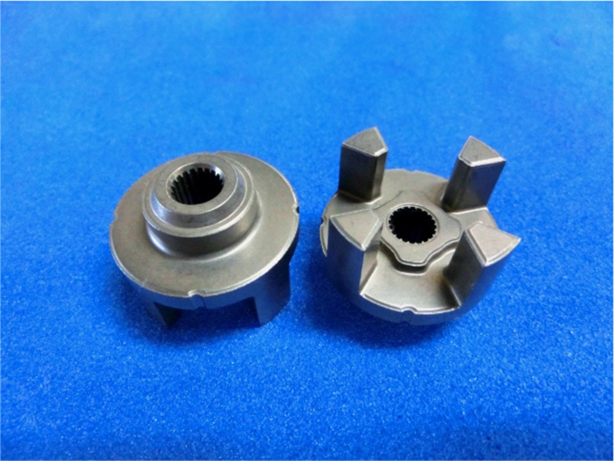
Transmission joint for power steering motor
Third, a quieter-running electric oil pump rotor for use in hybrid electric vehicles. Quieter running was achieved by a tooth profile that reduced contact noise and vibration during engagement. Rotors with the new tooth profile exhibited 25% noise reduction and 5% higher efficiency compared with the previous pump rotor designs.
Fine Sinter Co. Ltd was recognised for a lightweight shock absorber piston for use in a motor cycle. The design (Fig. 2) features a complex, thin walled structure with large convex and concave internal surfaces parallel to the compaction direction. This provides challenging requirements for mould design and mould material strength. The thinner portion of the part is vital to ensure effective damping and to reduce lower spring loading, which facilitates weight and costs savings.
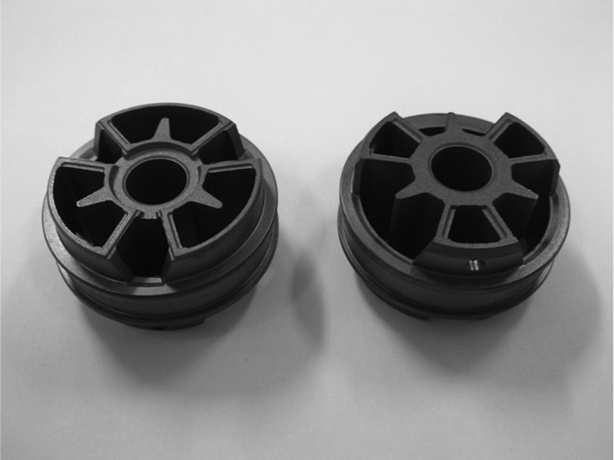
Lightweight shock absorber piston
Porite Corp. received an award for the motor bearing of a battery cooling fan in hybrid and electric vehicles. Previously, ball bearings have been used in brushless motors to meet lifetime criteria. However, the new oil-impregnated bearing satisfies the requirements of low noise and durability. Process optimisation made it possible to achieve 1 μm coaxial tolerance between the upper and lower sliding surfaces, improving sliding performance and wear resistance and reducing clearance noise. The part was adapted from a Nakanige bearing by enlarging the outside diameter of the press-fitting area and adding a counter boring at the rotor.
Sumitomo Electric Industries Ltd was recognised for a parking lock part in the transmission system of a plug-in hybrid vehicle. The tapered component is 50 mm in length and required significant machining when produced by from wrought material. The PM design tailors the density of the taper to ensure adequate strength at the centre of the length. Use of a high compressibility Fe–Mo–Cu–C low alloy steel, with carefully choice of lubricant and lubricant addition, allowed increased density and smooth ejection to be achieved.
NTN PM Corp. received the sole award in the new materials section for a low temperature sintering Fe–Cu–Sn powder used to produce the oil seal for a variable valve timing device. Resin parts have traditionally been used to provide good sealability and sliding and wear resistance. PM provides the opportunity to achieve higher dimensional accuracy, reducing leakage at start-up, but difficulties were initially encountered with dimensional scatter and warping. The new low-sintering material decreased these problems, and addition of free graphite to the part provided solid lubrication. Use of a metal seal also allowed sizing to improve tolerance which improved sealing surface flatness by 40%.
In the process development section, Sumitomo Electric Industries Ltd was recognised for two products. First, a low cost iron based soft magnetic composite core for the boost converter of a motor drive system in a hybrid electric vehicle (Fig. 3). Composite cores are smaller and lighter than conventional laminated steel cores, but face cost pressures in expanding their range of application. Cost savings were achieved by use of cheaper fine pure iron powder, shape optimisation, improved compaction and the development of a laser irradiation technology to produce non-conducting areas on the reduce surface of the core to reduce eddy current losses. Second, a segregation-free mixed free-cutting powder to improve machinability of a pinion and ring gear for a toe-corner of the rear wheel to expand and contract the actuator of a FF car. High precision gears with optimised tooth profiles were achieved via redesign and improved die manufacturing methods.
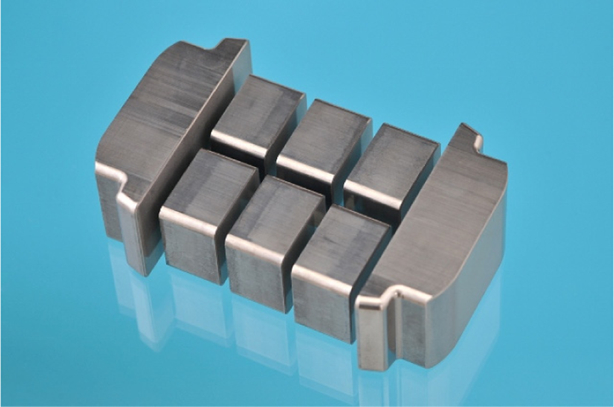
Soft magnetic composite core for hybrid vehicle
Two awards were made in the ‘effort’ category. NTN PM Corp. was recognised for an oil-impregnated sintered bearing with hydrodynamic grooves on the bore for a super-thin cooling fan motor. The trend is for thinner bearings and heavier impeller parts, leading to increased stresses on the bearing. The new design was optimised for die pressing and was found to have good oil film forming ability and non-contact support, a low noise and high reliability.
Hitachi Chemical Co. Ltd was recognised for a high strength starter planetary gear for idling stop systems. High durability is required in such applications because of the frequency of engine stop/start and high dimensional accuracy to reduce the press-fit stress into the bore of the gear and increase the pull-out stress. The newly developed gear achieved a density of 7·4 g cm−3 in a single high pressure compacting step, using high performance lubricant to improve ejection. Sintering conditions were optimised to reduce deformation during sintering and to maximise the amount of nickel rich austenite phase, to obtain high plastic deformation during sizing onto the inner diameter. Dimensional accuracy was improved by 60% and tensile strength was improved by 16% relative to the conventional 4%Ni material. Elimination of the quenching and machining requirements reduced cost overall.
Further information from: Japan Powder Metallurgy Association, Tamagawa Bldg, 2-16, Iwamoto-cho 2-chome, Chiyoda-ku, Tokyo 101-0032, Japan, email