Abstract

Additive manufacturing update
The objective of Horizon (AM) is to take promising AM techniques from R&D through to viable production processes, able to create components with complex geometries that cannot currently be cost effectively manufactured. These new processes have potential to provide innovations in low drag, high performance wing designs and lighter (as little as 50% the mass of conventional counterparts), more efficient engine systems.
The programme will focus initially on using AM to create near net shape parts, reducing the time and material wastage associated with machining of metal forgings. With material wastage as high as 90% for some machined parts, a significant reduction will also provide major environmental benefits.
The fuel nozzle is described by GE as the most advanced part it has ever made, which would be too complex to make using conventional processes. To meet the demands of production for Leap, which is in development for the Airbus A320neo and Boeing 737 MAX as well as Comac's C919, the flow of fuel nozzles is scheduled to grow from 1000 in 2015 to more than 40 000 per year by 2020. The Auburn site will have the capability to take on additional components. Development of these AM components, which are also expected to feature in larger numbers on the GE9X engine in design for Boeing's 777X, will remain at GE Aviation's Additive Technology Center in Cincinnati, Ohio.
Further information at www.ge.com.
Advanced AM is allowing
Titanium aluminide has a density 50% that of the nickel alloys typically used for LP turbine blades, giving a reduction in weight of the entire LP turbine of 20%. The weight and associated fuel consumption savings more than compensate for the higher materials costs. The EB melting approach also avoids the cracking that can be experienced when casting aluminides, which have low room temperature ductility.
3D printed LP turbine blades for Leap, GEnx, GE90 and GE9X jet engines
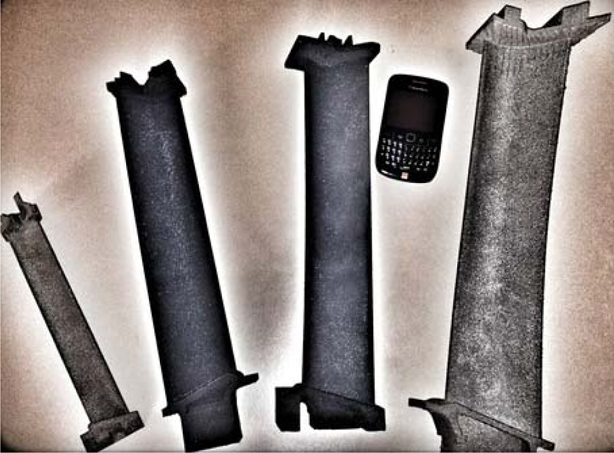
GE will shortly begin testing 3D printed blades for the GEnx engine at its test facility in Peebles, OH. The parts will also go inside the GE9X, a new jet engine GE is developing for Boeing's next-generation long haul plane, the 777X. Further information at www.avioaero.com.
EOS already offers comprehensive quality assurance processes for its AM systems upstream and downstream of the manufacturing process. Modular online process monitoring extends this assurance, ensuring greater transparency during what is a complex building process. With 14 years of experience in quality control of laser machining processes in the automotive, aerospace and metalworking industry, plasmo can offer powerful monitoring algorithms that are appropriate to the very high process dynamics of AM.
Further information from www.plasmo.eu or www.eos.info/.
New ATSM AM standards
A proposed ASTM standard, WK46188, ‘Practice for metal powder bed fusion to meet rigid quality requirements’, describes the operation and production control of powder bed fusion machines and processes to meet rigid quality standards in, for example, aerospace and medical applications. The proposed standard has been accepted as a Joint Group project between ASTM International Committee F42 on Additive Manufacturing Technologies and ISO TC261 on Additive Manufacturing. Additive manufacturing machines, historically designed for the rapid prototyping industry, are now being employed to make safety critical components. The document seeks to define the critical parameters for successful powder bed fusion and how to ensure component repeatability. The proposed requirements will be applicable to production components and mechanical test specimens using powder bed fusion with both laser and electron beams.
A further proposed standard, ASTM F3049, ‘Guide for characterizing properties of metal powders used for additive manufacturing processes’, has the objective of identifying existing metal powder standards to measure or characterise properties that may be appropriate for AM powders. A companion standard, ASTM WK43112, ‘Guide for evaluating mechanical properties of materials made via additive manufacturing processes’, is also in development. ASTM F3049 was developed by Subcommittee F42·05 on Materials and Processes, whereas ASTM WK43112 is under the jurisdiction of Subcommittee F42·01 on Test Methods.
ASTM F3091, ‘Specification for powder bed fusion of plastic materials’, lays out procedures to specify end use properties for polyamide parts produced using laser sintering. Properties include mechanical, tolerance, surface finishing and post-processing. Also developed by Subcommittee F42·05, it details information that feedstock providers need to provide to manufacturers. Criteria for part acceptance and rejection are provided, and information on testing is given.
For more news in this sector, visit www.astm.org/sn-metals or www.astm.org/sn-quality.
High performance ferrous powders
The NanoSteel Company has introduced a range of ferrous powders designed to extend steel's capabilities in near net shape wear parts for highly abrasive environments. These alloys feature hardness in excess of 1400 HV and wear resistances below 10 mm3 volume loss in ASTM G-65 characterisation. Their spherical powder morphology results in improved packing factors and flowability, allowing the production of high density parts under tight dimensional control. The new powders are said to enable the production of extreme hardness wear parts through a wide variety of consolidation processes, including additive manufacturing, without the need for subsequent heat treatment.
In a recent trial of a die insert application, reports NanoSteel, the material demonstrated six-fold higher wear resistance than AISI A11 tool steel under the severe conditions experienced during consolidation of a ceramic powder, while maintaining a mirror surface finish. The significantly longer life cycle of the die insert part increased operational efficiency in conditions requiring higher wear resistance than current tool steels. According to Harald Lemke, vice president and general manager of engineered powders, ‘early production trials demonstrate that the nanostructure of the alloys provides compaction capability for more complex geometries while keeping cycle times down to minutes. This performance greatly improves the economics of producing wear parts.’
Further information at www.nanosteel.com or email
Nano-particles boost lubricant performance
Adding particles 1–100 nm in diameter to oil, grease and lubricants has created a fiercely competitive business, although many innovations designed to reduce friction and improve wear protection do not achieve commercial exploitation. Nanol Technologies, based in Finland, is combining chemistry, nanotechnology and 30 years of fundamental research, in a unique start-up culture, to produce commercial additives that can reduce wear by creating a protective surface layer of copper ions. The resulting extension in the lifetime of components and the lubricants reduces costs and energy consumption. Surface activation by friction is a key feature of how the lubricants achieved reduced wear and enhanced performance.
The approach of combining an entrepreneurial working culture and chemistry expertise seems to be delivering results and the company already has sales offices in Finland, Germany and Russia, with applications in sectors including shipping, railways, marine engineering, mining, and heavy industry. Production is outsourced to Harjavalta, West Finland, to a Finnish speciality chemicals producer, CrisolteQ, a pioneer in recovering and recycling valuable elements and metals for the chemical industry. Nanol and CrisolteQ work together as strategic partners.
Most current lubricant additives are based on zinc dialkyldithiophosphates (ZDDPs) and organic fatty acid derivatives. ZDDPs contain phosphorus, which poisons exhaust gas catalysts, whereas organic fatty acid derivatives used as friction modifiers are quickly depleted. The Nanol products are not based on conventional nanotechnology. The additive is homogeneous, containing copper nanoparticles dispersed in a stable colloid, and there are no health and safety concerns. The key step in forming the nano-film is surface activation, to promote a redox reaction that reduces copper ions in the additive, to deposit copper on the metal surface. The additive also has the capability to repair the nano-film to ensure robust performance.
According to Dr Aubrey Burrows, the company's Senior Adviser, the new technology ‘not only differs chemically and mechanistically, it also opens the door to formulate a new generation of lubricants with enhanced performance’.
Further information from: Johan von Knorring, CEO, Nanol Technologies Oy, email
Steel raw materials improvement report
The World Steel Association (worldsteel) has published a wide ranging technical report on raw materials improvement in the steel industry. The report, which is the result of a project undertaken by worldsteel member companies and with the cooperation of raw materials and equipment suppliers, addresses the key challenges faced by the steel industry in the management of raw material quality.
The study provides a broad assessment of raw materials reserves across the world and an analysis on the use of different quality raw materials with related technologies. A special focus was put on the use of lower-grade raw materials and various beneficiation technologies that can improve efficiency in iron-making processes. The report can assist steel producers outline their strategies for raw materials management and procurement.
The report comprises three sections: iron ore, coal/coke and iron-making technology. The section on the raw materials gives both a global and regional overview of the current availability of raw materials. Furthermore, it provides information on the processing technologies for each material. The iron-making technology section provides an overview of the processes and good practices.
The book is available in a pdf format for purchase on worldsteel.org.
Graphene market survey
New research by IDTechEx in the report ‘Graphene markets, technologies and opportunities 2014–2024’, by Dr Khasha Ghaffarzadeh, suggests that graphene markets will grow from around US$20m in 2014 to more than US$390m in 2024, at the material level. The market is likely to be split across many application sectors; each attracting a different type of graphene manufactured using different means. The market today remains dominated by research interest but it is predicted that the composition will change as other sectors such as energy storage and composites grow. The value chain will also transform as companies will move up the chain to offer intermediary products, capturing more value and cutting the time to market and uncertainty for end-users.
Interest in graphene remains strong, says IDTechEx, and academic investment continues to pour in. For example, the EU has committed €1bn over a decade to research on graphene and other 2D materials, whereas the Korean and UK governments have respectively committed at least US$40m and £24m in the past two years. At the same time, several graphene companies have floated on the public markets, fetching large valuations. In the absence of a ‘killer application’, commercialisation is focusing on substitution. Functional inks are technologically the lowest hanging fruit for graphene suppliers. These inks offer low temperature processing, compatibility with several printing processes, and also ruggedness. Graphene must, however, identify sectors where metallic inks/pastes grossly overshoot the market requirements or where carbon pastes just undershoot. The main target applications are RFID and smart packaging. Energy storage is an attractive target market. Graphene may deliver value in supercapacitors owing to its high surface-to-volume ratio, although technical hurdles that prevent utilisation of the full surface and in-plane conductivity remain. Several products have also been launched to target the Li ion market, an attractive sector thanks to its sheet size. The transparent conductive film market is also a large and growing market. ITO films remain the dominant solution but new entrants and drivers such as growing needs for ultra-low sheet resistance, mechanical robustness and lower prices provide opportunities. The composite sector is also large and fragmented with many needs. Here, graphene can deliver value as an additive in the form of nanoplatelets.
Further information from
Crab shell biosorbents aid metal recovery
The STOWURC (Sustainable Treatment of Waste Using Recycled Chitosans) consortium plans to use crab shells to remove and capture metals from surface treatment effluent streams. Chitosan, the product of interest, is a natural polymer produced from chitin, the polymer naturally formed in crab shells (and other crustacea) and fungi cell walls. Chitin and chitosan are of particular interest because of their biocompatibility. They are also biodegradable and non-toxic with high adsorption and chelating abilities, and cannot currently be commercially synthesised.
Brown crabs, the commonest fished crabs in UK waters, provide the raw shells from which the biosorbent is produced. Approximately 30 kt of crabs are landed in the UK each year and the flesh removed, leaving 4 kt of shells to be disposed of annually. A crab shell contains 20–30% chitin, to remove which acid is applied to crushed shells to dissolve the calcium carbonate, followed by an alkaline treatment to remove the proteins and fat, resulting in a fine particulate. To produce chitosan, a further acid treatment is applied to the chitin polymer. The greater the level of deacetylation, the more efficient the chitosan is at removing metals from solution.
Laboratory tests have indicated that relatively pure chitosan flakes from the crab shells are more efficient than purchased chitosans: >60% of Cu can be removed from solution using untreated crab shells, >70% using chitin and >99% using chitosan. The speed at which the metal uptake occurs ranges from 5 min to 4 h, with the refined materials being the fastest to achieve this. In the current climate, making use of chitosan from crab shells offers an economically viable approach. Using shells for chitosan production adds value to a waste material, adding a financial incentive to divert the material from landfill. Additionally, the simple introduction of the biosorbent to the effluent and the high metal recovery efficiency (shown to remove >99% of metals in lab tests) potentially offers a cost effective alternative to ion exchange resins and other effluent treatment methods.
The project will continue with the aim of optimising metal recovery by electroplating, and assessing means to regenerate the chitosan for continued use. Further information at www.stowurc.co.uk. Members of the consortium, which is partially funded by the UK Technology Strategy Board, are: Kynance Cornish Crab, Chestech, Invotec, C-Tech, Env-Aqua, the Surface Engineering Association and the Institute of Circuit Technology.
Naturally sourced bioabsorbents for waste water treatment