






Abstract
The PM World Congress returned to North America in 2014, attracting more than 1500 delegates from 32 countries to Orlando, FL on 18–22 May. The World Congress on PM and Particulate Materials ran alongside the 9th Tungsten, Refractory and Hardmaterials Conference and inaugural Additive Manufacturing with Powder Metallurgy (AM | PM) Conference. Organised by MPIF and APMI, with support from EPMA, JPMA, APMA and the Refractory Metals Association, the congress took place in the slightly surreal surroundings of the Walt Disney Dolphin Hotel.
The massively parallel Congress technical programme consisted of 92 sessions and special interest programmes, for which Program Committee co-chairmen, Brian James, formerly of Hoeganaes Corp., and Russ Chernenkoff of Metaldyne, were justly honoured during the opening ceremony. Together with the 27 sessions of the Refractory conference and the 13 sessions of AM | PM, delegates had the opportunity to view almost 500 presentations and posters over the three and a half days of the technical programme. The AM | PM event, which is likely to have a future life as an independent conference drawing in interests outside the traditional PM community, in the same manner that MIM conferences have done, provided further evidence of the increasing focus of these technologies. Important issues for the wider commercialisation of AM, such as standardisation, materials specifications and quality assurance, and process control, coupled with models to predict microstructure and property development, were well represented. It is evident that these aspects are already being extensively addressed in sectors such as defence and aerospace. A session on non-powder-bed approaches such as direct metal printing and cold spray served as a reminder of the range of technologies available to AM components, not all of which require powder as feedstock. The increased deposition rates potentially offered by direct metal printing, for example, address a real concern affecting the industrial adoption of powder bed AM in the aerospace sector.
The keynote speaker in the opening plenary session, chaired by MPIF CEO, James Trombino, was Bob Lutz, former vice chairman of General Motors Corp. While his presentation focused on general aspects of the automotive industry, Lutz was upbeat about future opportunities for PM, on the basis of the belief – familiar to readers of his books – that internal combustion engines will continue to power most vehicles for the foreseeable future – with electric vehicle making limited progress outside well defined geographical areas and market segments. At the industry luncheon, Bob Dowding, of the US Army Research Labs, received the inaugural PM Industry Vanguard Award for his outstanding contribution to the expansion of powder metal applications. John R. Engquist (consultant, JENS Solutions LLC) and Zhigang (Zak) Fang (University of Utah, Salt Lake City) were inaugurated into the APMI fellowship.
Global reviews
A regular feature of World Congresses is the session reviewing the global position of the PM industry. Richard Pfingstler, President of MPIF, reviewing the state of the
North American shipments of copper and copper-base powders increased by an estimated 4% in 2013 to 15 300 t, stainless steel powder shipments grew 3·5% to 6900 t, and nickel powder consumption rose by an estimated 5% to 5200 t.
Pfingstler stated that 2013 was a good year for the PM parts business, supported by North American light-vehicle production that topped 16 million units. Although the trend toward smaller engines with fewer cylinders is reducing the potential market for PM parts, all-wheel-drive systems, start–stop systems, new diesel engines, and more complex, lighter gears all represent opportunities, as do value-added parts such as sprockets. The average PM content in a US light vehicle was an estimated 20·2 kg in 2013, compared with 19·9 kg in 2012. PM press builders had in 2013, he said, enjoyed a resurgence as parts makers invested to expand capacity and increase their capability for complex designs and higher-performance parts. Tooling companies also reported gains for the year. The projection for 2014 was for similar modest growth in PM parts and powder shipments as in 2014.
In other PM sectors, said Pfingstler, tungsten alloy heavy metal sales began to soften at the end of 2013, especially the defence and tooling markets, although aerospace and medical products registered gains. Overall, there was felt to be more excess capacity in 2013 than 2012 and shipments of tantalum, niobium, and molybdenum were lower. In particular, tantalum and niobium product suffered from weak demand due to structural changes in consumer electronics. The metal injection moulding (MIM) market continued to enjoy robust growth, North American shipments in 2013 increasing substantially to an estimated 1140–1450 t and estimated sales being US$300m–350m. Markets, in order of importance, were firearms, medical/dental, general industrial, automotive, and electronics. Automotive fuel injection and turbocharger parts appear promising for MIM, with potential for next generation aerospace engine components. Continued growth was forecast for 2014.
In addition to growth for near net PM-HIP components for the oil and gas, energy and other sectors, use of HIP to densify MIM parts continues to develop, he said. Over half of MIM firearms and medical parts are hipped and densification of MIM aerospace parts is a growing market; it is anticipated that this will become a requirement for high performance AM parts. A boron–gadolinium stainless steel with high neutron absorption, used to store spent nuclear fuel, has also emerged as a promising HIP application.
Pfingstler noted the growth of the AM sector, comparing it to that of MIM at a comparable stage. There are an estimated 100–200 metal printers installed in the US: custom manufacturing and prototype services, captive installations doing development work and R&D activity at government and university laboratories. Current markets include medical/dental, aerospace, automotive, moulding, and jewellery. Cobalt–chromium and titanium alloys are the most heavily used materials for AM, followed by stainless steels, Inconel, and tool steels. Excluding titanium, the bulk of gas-atomised powders for this market is estimated as less than 45 t annually.
MPIF's technology assessment programme to reduce dimensional variability in ferrous PM parts and processes and the activities of the Center for PM Technology (CPMT) in assessment of strain-based fatigue for PM materials and PM gears were noted. Industry trends mentioned included: the introduction of a high density lubricant–binder system that is said to increase green strength to more than double that of standard lubricants; leaner, more-cost-effective alloys; machinable stainless steels; enhanced data collection in high temperature (>1150°C) automated sintering furnaces, to meet customer demands; and vacuum impregnation of PM parts with an inorganic sealant that can withstand heat treatment without a detrimental effect on corrosion resistance.
EPMA President, Philippe Gundermann, reviewed developments in the
Similar trends to other regions were reported outside the pressed and sintered parts market. Sales for the MIM sector topped €250m in 2013, representing growth of over 10%; the market is dominated by stainless steels (∼50% by weight), followed by low alloy steels (∼25%). Automotive components make up a higher share of European MIM than in other regions, said Gundermann, and parts makers tend less to develop their own feedstock and de-binding processes than in the USA. The European MIM supply chain is dominated by single companies in the powder, feedstock and moulding equipment sectors respectively. PM-HIP output also grew by more than 10%, to 13 800 t in 2013, also dominated by stainless steel followed by tool and high speed steel grades. Powder consolidation represents about 25% of total HIP tonnage in Europe. The trends is toward larger units, now handling loads over 30 t, and for faster cycle times which have been halved to 12 h by the application of uniform rapid cooling. He noted that the cost of HIP relative to energy and materials costs in Europe has decreased by 65% in the past two decades. Revenues for metal AM had grown by about 40% to €18m in Europe in 2012 and this strong growth was expected to continue in 2014, assisted by the strong position across the supply chain occupied by European companies. The European AM Group founded in 2013 now has 30 members.
Gundermann concluded by commenting on the excellence of the PM supply chain in Europe, in which strong competition has led to innovation in the equipment sector in particular, and the strength of the R&D network which links academic, independent RTD suppliers and industry R&D centres.
JPMA President, Mamoru Moritani, then provided an overview of
Growth in automotive production was reported to be the main factor behind the strong growth in China and India, whereas in Japan and Korea developments focused on complex and innovative parts. Moritani noted that Indonesia had issued its first production figures in 2013, for an in house PM parts plant, and that production was expected to increase significantly to support newly established automotive production facilities. The average mass of PM parts in Japanese automobiles fell slightly to 9·0 kg in 2013 from 9·2 kg in 2012, a change attributed to pressure to reduce vehicle mass.
Turning to the MIM market, he stated that sales had been US$470m in Asia, with China accounting for US$230m and Japan US$110m and strong growth in India. Tablet and smart phone components were said to be an important component of this growth.
Moritani also mentioned JPMA's activities in developing a standard on rotating–bending fatigue of stainless steel and titanium MIM components, due for publication in 2014. JPMA will also launch a new website with an extended English language section in late 2014 or early 2015. Finally, the establishment of the APMA (Asia PM Association) conference series was noted. Held in years when there is no World Congress, the third conference will be in Kyoto on 18–20 October 2015, after previous events in Korea and China.
PM Design Excellence Awards
During the Congress, presentations were made for MPIF's 2014 Design Excellence Awards. The winning parts were on display in the exhibition as part of an impressive showcase of PM's capabilities, with contributions from EPMA and JPMA and a special display of AM parts (Fig. 1).
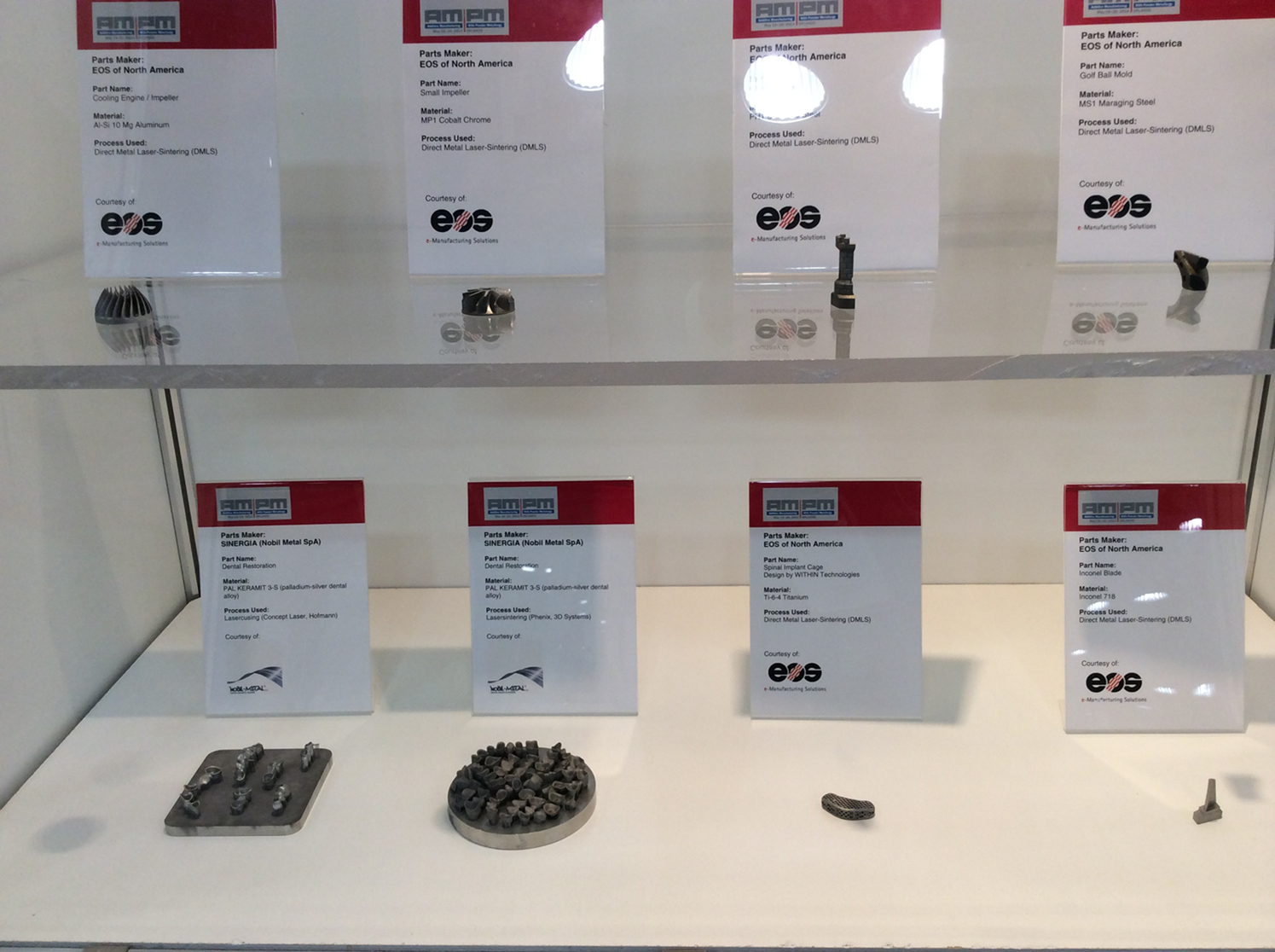
Additive manufactured parts on display in the AM parts showcase
The Grand Prize in the Automotive – Engine category (Fig. 2) was Indo-US MIM Tec Pvt. Ltd, Bangalore, for four MIM parts in a device to control fuel flow in gasoline direct injection pumps. Three of the parts are of 440C stainless steel and the fourth of 17–4 PH. The extremely complex geometry of the blank discharge check, with inter-crossing of holes, required tooling with six side cores, three of which move at different timings. The customer, Stanadyne, achieved cost savings of 35%, and pump performance was improved by modifications to the hole geometry to enhance flow dynamics, resulting in a 10–20% improvement in fuel economy.
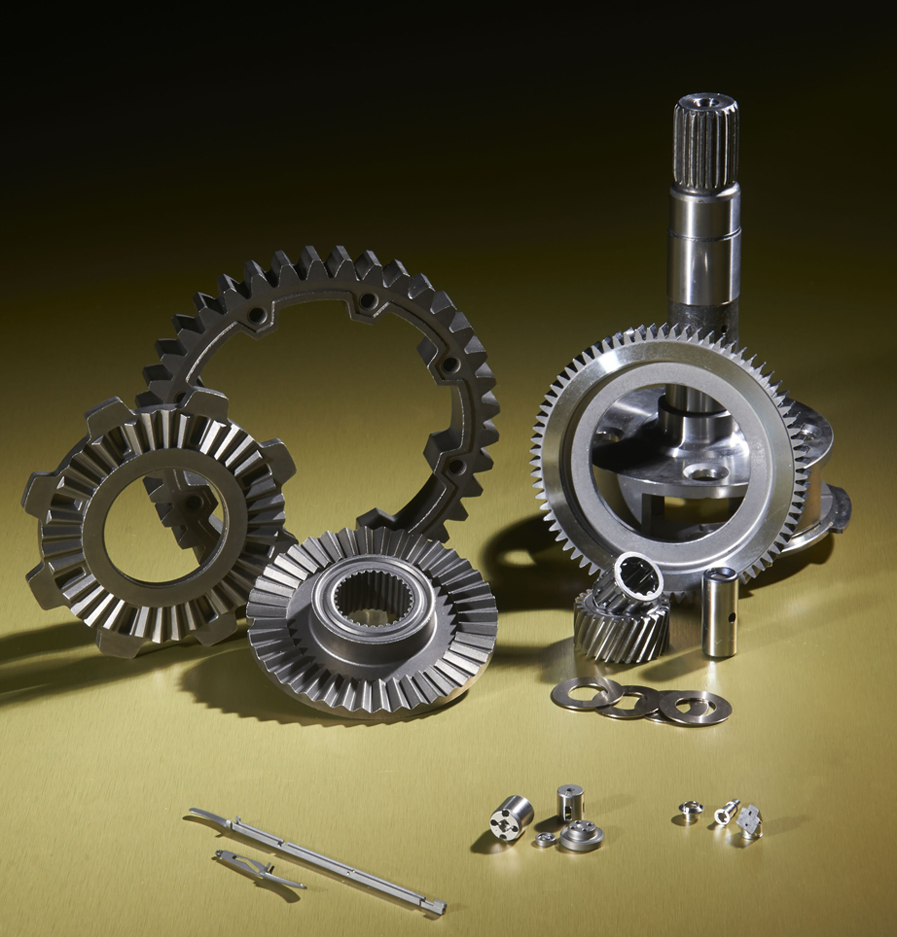
Grand Prize winners in 2014 MPIF PM design awards
Keystone Powdered Metal Co., St Marys, PA received the Automotive – Transmission prize for a planetary carrier assembly. The 32-part assembly is used in the HF35 transmission that goes into Lincoln MKZ, Ford C-Max, and Ford Fusion hybrid vehicles. The spider and carrier plate are compacted then sinter-brazed before being joined to the shaft. The helical pinion gears are sinter forged to full density using tools that must rotate and exactly match the gears’ 24·5° angle. It is believed to be the first time such a gear has been used in an automotive transmission application and the customer, Ford, realised estimated cost savings of 25%.
Capstan, Wrentham, MA won in the Lawn & Garden/Off-Highway category for copper-steel parts for a disengagement mechanism of a snow-blower system that allows the user to pivot the unit in place by disengaging one of the wheels. These two parts combine for 11 pressing levels, requiring precisely timed tool motions at ejection, along with sophisticated robotics, for crack-free removal from the lower punches. The parts are formed to net shape, and specially developed sintering fixtures ensure that flatness and level-to-level relationships are maintained.
FloMet LLC, DeLand, FL won the Medical/Dental prize for two 5 mm tines, one fixed, one moving, for a thermal tissue fusion and dissection system made by ConMed. The system uses direct thermal energy and pressure to seal, transect, dissect, and coagulate tissue. Fabricated by MIM from 17–4PH stainless steel, the tines overcame challenges including the fixed tine's length and thin-rib requirements, as well as the need for straightness over its entire length for functionality with mating components. Innovative tooling and thermal processing were employed to produce the components in as-assembled condition with only minimal secondary operations.
A three-piece assembly made by FloMet for Shure won in the Electronic/Electrical category. The nozzle interface, outer nozzle, and metal collar go into high-end sound-isolating earphones that enable user-customisable frequency responses. The 316L MIM parts met the cost demands of the professional audio market and maintained the cosmetic surface critical in consumer products with a clear exterior. Die casting and machining could not provide the precision needed at reasonable cost, nor the required material performance.
Awards of Distinction (Fig. 3) were made in the same categories. Cloyes Gear & Products, Paris, AR won the Automotive – Transmission award for a ball ramp actuator comprising a sector gear and fixed ring, made for Magna Powertrain. The actuator applies torque to the front wheels in the BMW X-Drive transfer case. Warm compacted from a hybrid low alloy steel, the parts replaced forged components used in an earlier transfer case design, providing 35% cost savings.
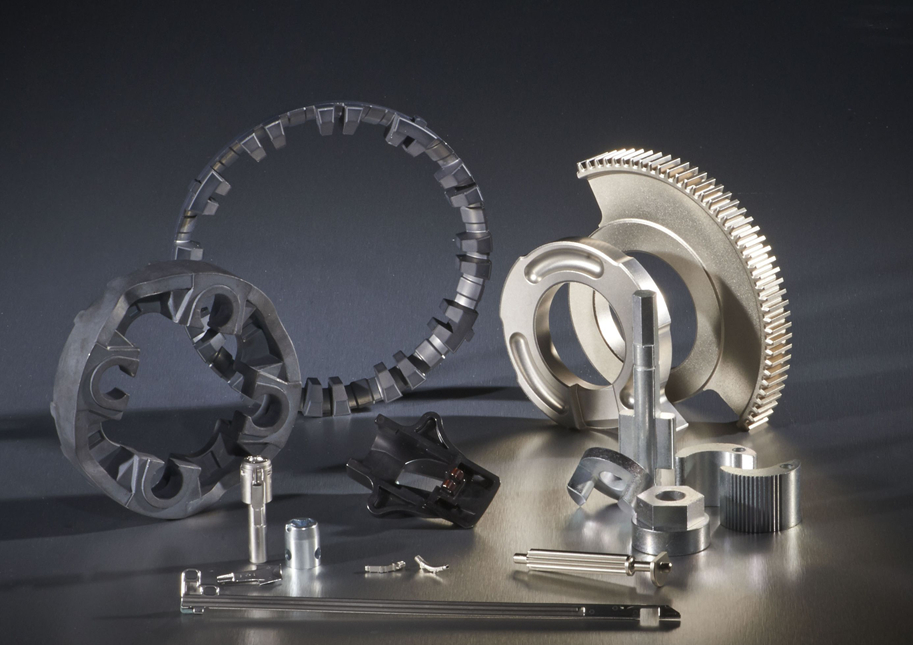
Award of Distinction winners in the 2014 MPIF PM design awards
Indo-US MIM Tec won three awards: Automotive – Chassis for a spur gear made for Magna Closures; Hardware/Appliances for three parts that are assembled into the quick-change mechanism of a Dremel multi-tool; and Medical/Dental for a sound tube for a hearing aid made by Phonak. The MIM gear, made from 4605 low alloy steel, is used in the rear-door assembly of SUVs to enable opening in the event of loss of automatic control. It replaced a gear that was machined and had the pin welded on, achieving cost savings of 30%. The multi-tool mechanism allows the exchange of any tool bit within seconds. Its MIM parts are net shape, with a few secondary operations to achieve close tolerances. The highly complex geometry of the shaft, with three holes intercrossing at 120°, required six side cores per moulding cavity. The sound tube is fabricated via MIM from 316 stainless steel. A complex part providing 20% cost savings, it achieves its features in the as-sintered condition, with only glass bead blasting performed as a secondary operation.
Lovejoy Powder Metal Group, Downers Grove, IL was awarded in the Lawn & Garden/Off-Highway Category for a parking/emergency brake piston for hydraulic transmissions used in zero-turn-radius lawn maintenance equipment. Made from FC-0208 copper steel, the piston is compacted using two upper and three lower punches plus a die shelf; it is sintered to net shape, requiring no secondary machining.
This sinter-hardened steel retainer weight made by Hitachi Chemical Co. Ltd, Chiba, won one of the three awards in the Hand Tools/Recreation category. The part operates in the transmission of large motorcycles, controlling the on/off position of the clutch. Dimensional accuracy in this thin, large-diameter shape was achieved by process optimisation and use of steam treatment. Redesign of a previous PM part achieved a 17% weight reduction. Advanced Forming Technology, Longmont, CO, was awarded for a 4605 steel MIM lock hood for a muzzle-loading rifle made for Smith and Wesson. The large U-shape is produced sufficiently undistorted to be coined to final tolerance via a sintering and staging approach using an ‘active’ setter made of a feedstock having a similar shrink rate to the hood. MPP Ridgway, Ridgway, PA was awarded for a bathtub drain tool made for ezXtractor. The tool is an assembly of five PM parts made from FN-0405 modified nickel steel. The design has the benefits of PM technology while reducing complexity for easy assembly with two circlips and two dowel pins. The parts are produced to net shape, machining of two grooves for the clips being the only secondary operation.
Smith Metal Products, Center City, MN, was awarded in the Medical/Dental category for a MIM 17–4PH stainless steel shaft assembly used in a novel surgical instrument for passing sutures through difficult-to-reach tissue. This instrument is single-use, requiring a precise fabrication process that could be scaled up to deliver high volumes at low cost. The process involves molding the 17·5 cm shaft in two parts, laser welding, then performing finish machining, ID reaming, heat treating, sand blasting, and passivation to achieve the tightly tolerances.
Further information on the awards and World Congress proceedings, to be published in CD format, visit www.mpif.org.