






Abstract
The sound absorption behaviour of an open celled aluminium foam fabricated by investment casting method was examined and correlated with the pore size, sample thickness and backing air gap depth in the present study. The foam shows low sound absorption coefficients at relatively low frequencies or with relatively thin sample thickness due to its 90% or higher open porosity. As frequency or sample thickness increases, the sound absorption is significantly enhanced. Furthermore, if the sample is backed with an air gap, the approximate periodical resonant absorption peaks emerge from the background and shift towards low frequencies with increasing the gap depth. It is also found that the present aluminium foam has even better absorption performance than polyurethane foam, with almost the same pore parameters as the former. The observation on the pore surface and further experiments demonstrate that the difference is attributed to rougher pore surface of the aluminium foam that makes the sound wave loss increase through enhanced friction between the air and the surface.
Introduction
Sound absorption behaviour of rigid skeleton porous materials including metal foams is not a new topic for both the scientific and engineering fields. Several metal foams have been tested, and their sound absorption behaviours are well documented in recent years.1–5 For metal foams made by melt foaming or liquid infiltration, it is clear that the sound absorption capacities depend not only on the overall porosities but also on the small apertures or interstices connecting the pore walls, which has been proven to be even more significant.2,4,6 In view of these results, it is believed that metal foams without these secondary structures may be inferior in sound absorption behaviour.6 However, both experimental and theoretical studies have demonstrated that open celled metal foams with strut structures do have very high sound absorption in a quite wide frequency range. For example, an open celled Al foam presents the sound absorption coefficients approximate to unity in the frequency range of 2500–4000 Hz, although they do not have obvious voids or cracks in the cell walls.2 Metal foams with strut structures have very high open porosity, usually higher than 90%, and excellent permeability, which makes them promising candidates for a number of applications including sound absorption. It is therefore necessary to identify the sound absorption behaviour of this kind of metal foam in a wider frequency range and its relationships with structures and surroundings so as to give guidelines for the expected applications. For this purpose, the sound absorption experiments were conducted using open celled aluminium foam fabricated via an investment casting process, and some results and relevant analysis are presented in the present paper.
Experimental
Processing technologies of open celled aluminium foam samples
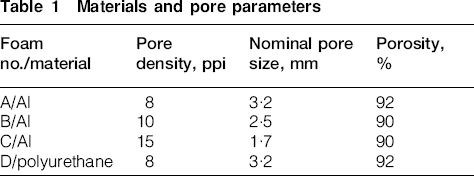
The process is similar to that used in producing Duocel7 foams. Open celled polyurethane foams were used as precursor materials. Plaster slurry with appropriate composition and viscosity was first prepared. Then, it was poured into a block of polyurethane foam contained in a stainless steel mould. After the plaster slurry was naturally dried and hardened, the mould was heated to 250–300°C to remove the polyurethane foam, leaving a porous framework in the mould. Molten Al was then poured into the mould and penetrated into the interstices of the porous framework under pressure. After it solidified, the resulting composite was water sprayed to remove the plaster from the Al ingot. At this stage, the Al foam inheriting the original polymer foam finally formed. The typical pore morphology is shown in Fig. 1, and the physical parameters of samples used in the present study are listed in Table 1, in which the porosity of foams was determined by

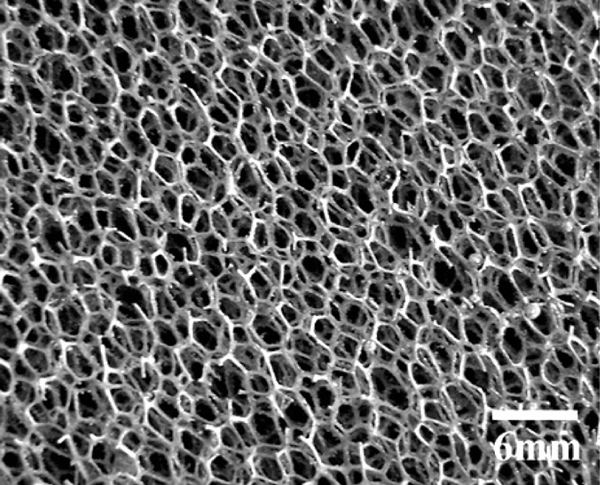
Pore morphology of open celled Al foam used in present study
Materials and pore parameters
Experimental methodology
There are several methods in measuring sound absorption coefficient of materials, in which the impedance tube method is probably the most widely used one in scientific research due to its quick, easy and accurate features. The sound absorption coefficient in this measurement can be calculated by the standing wave ratio method or transfer function method. The transfer function method was adopted in the present study, and the measuring fundamental is schematically shown in Fig. 2. The impedance tube used in the present study is 29 mm in diameter, and the frequency range is 500–6400 Hz. Al foam samples to be measured are mounted at one end of the tube and a loudspeaker at the other end. Between them, there are two microphones separated by 2 cm. The round edge of the samples was wrapped with rubber belt to guarantee tight sealing between the sample and the tube inner surface. The sample and air gap thicknesses were changed in the range of 10–40 and 0–60 mm respectively. In the measurements, a planar incident wave is generated by the loudspeaker, and the resulted sound pressures at the two microphones are simultaneously measured, by which the sound absorption coefficient is determined through calculating a complex transfer function using a two channel digital frequency analyser. The detailed measuring method can be found in Ref. 8.
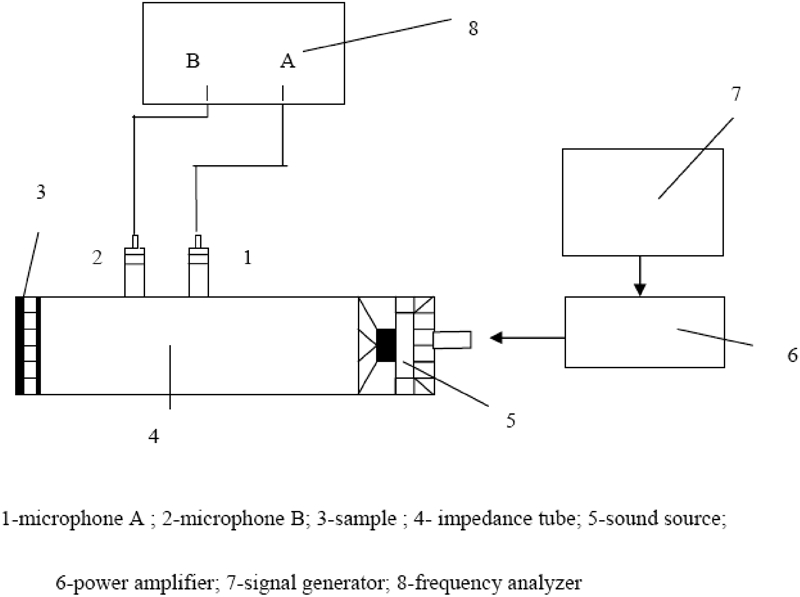
Schematic of impedance tube apparatus
Results and discussion
Comparison of sound absorption between open celled Al foam and polyurethane foam
Figure 3 shows the changes of sound absorption coefficients with frequency for one Al foam and polyurethane foam. Unexpectedly, the Al foam exhibits higher absorption capacity than polyurethane foam particularly at high frequencies, although they have almost the same pore size and porosity. As will be seen in the following sections, the two foams actually have very different pore surface that should be responsible for the difference.
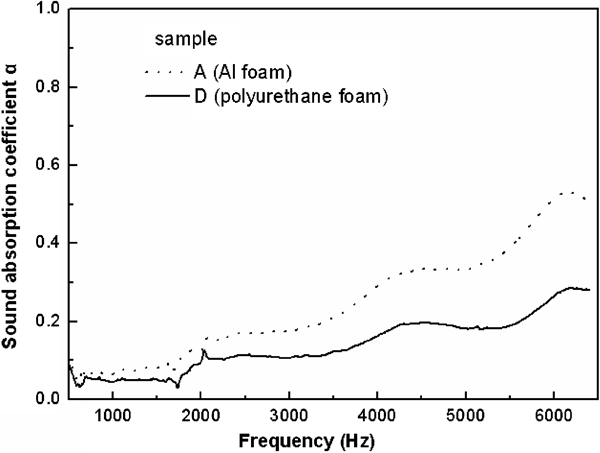
Comparison of sound absorption behaviours between open celled Al foam and polyurethane foam
As mentioned above, sound propagation in rigid framed porous media has been well understood, and relevant theories have been established to describe the physical mechanisms of sound wave dissipation in the materials.9–14 It is concluded that there is a coherent correlation between sound absorption coefficient and flow resistance, the latter is obviously related to the macroscopic pore structures.4
The main factors influencing the air flow resistance of the present open celled Al foams featured with ligament network include pore size, pore surface roughness and sample thickness because all the samples have almost the same porosity, pore shape, pore connectivity and tortuosity. By comparing the pore structures of the two foams, it is found that the present Al foam has an irregular pore contour and quite rough pore surface, as shown in Fig. 4. This pore structure is apparently beneficial to increased flow resistance and friction between the fluid and the pore surface. In order to verify this phenomenon, a flow resistivity test was carried out, as shown in Fig. 5. The flow resistivity of the sample A is higher than that of sample D, which leads to higher sound absorption coefficient of sample A.
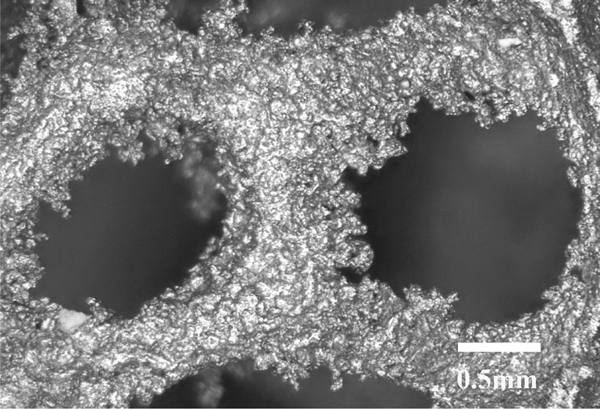
Surface morphology of pores of present Al foam
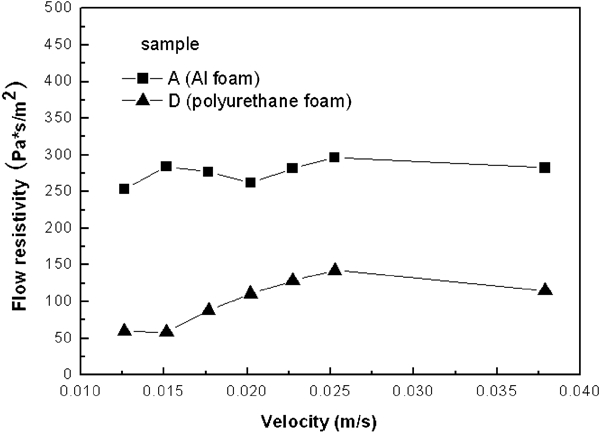
Flow resistivity of samples A and D
Effect of pore size
From Fig. 6, it can be found that the open celled Al foams with strut structure do have dissimilar sound absorption behaviour to other metal foams. It is clear that the pore size has no significant influence over the sound absorption coefficient when the sample thickness is relatively thin, although smaller pores can more or less lead to increased absorption. As the air gap depth increases, the low frequency absorption is improved, and even several resonant peaks arise in a separation of about 2500 Hz when the air gap is big enough, which has not been seen in other metal foams.1–6
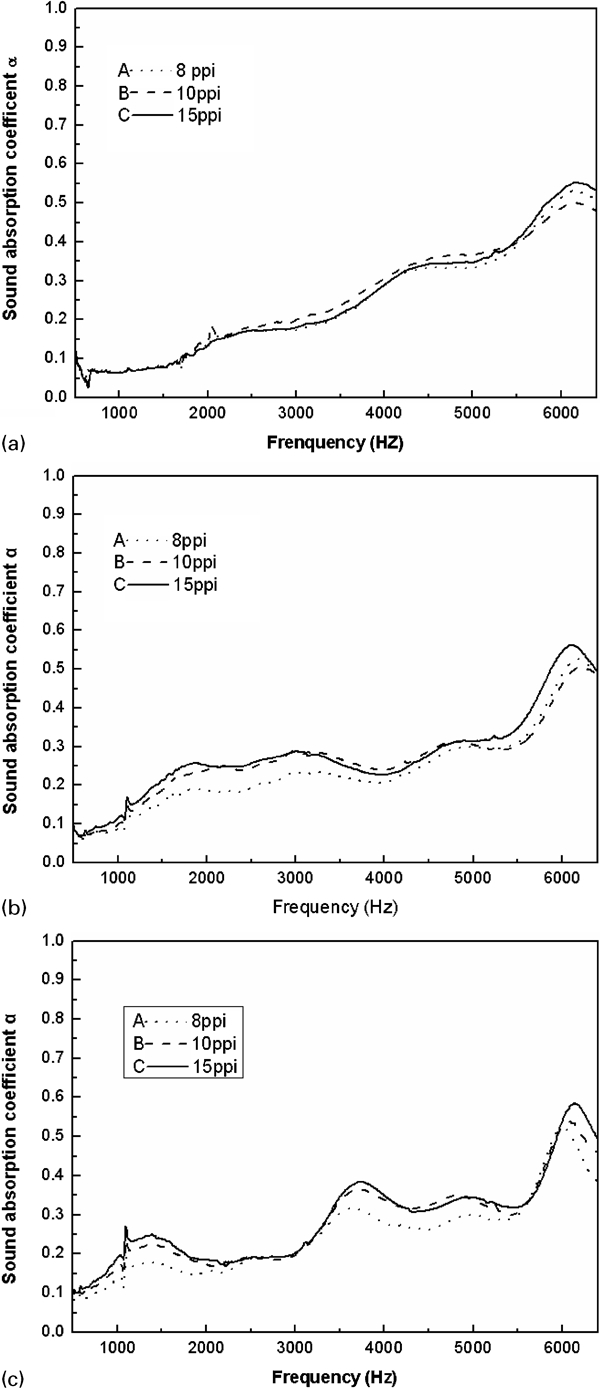
Sound absorption behaviours of open celled Al foams with thickness of 10 mm backed with air gap of a 0 mm, b 30 mm and c 60 mm respectively
Cummings and Beadle14 investigated the acoustic properties of fully reticulated plastic foams that have similar pore morphology to the present open celled Al foam and proposed the following empirical formulates to calculate the flow resistance of the foams


In addition to the structural parameters, the acoustic absorption behaviour of a material also depends on the frequency of sound waves. At high frequencies, an adiabatic process will take place that causes heat loss due to friction between the fluid and the pore surface when the sound wave crosses the irregular pores, whereas at low frequencies, the sound energy is dissipated by heat exchange.15 Porous materials can be regarded as a composite composed of two phases, i.e. the skeleton and the fluid filled in the space. For the propagation of sound wave in air, the heat exchange is not significant because of relatively low thermal conductivity of air, and thus, the sound absorption coefficient at low frequencies is very low.
Effect of thickness
Figure 7 shows the changes of sound absorption coefficient with frequency for varied sample thicknesses without air gap between the specimen and the rigid wall. Aside from elevation of sound absorption curves, increasing sample thickness can also lead to significant improvement of absorption behaviour in the whole measuring frequency range. For example, when the sample thickness reaches 40 mm, there appears a quite wide and high absorption plateau in 1500–3000 Hz, where the absorption coefficient is ∼0·7. As frequency further increases, an even higher and wider absorption peak arises, and the highest value is very close to 1. This behaviour will undoubtedly contribute to the optimisation of overall sound absorption performance of open celled metal foams.
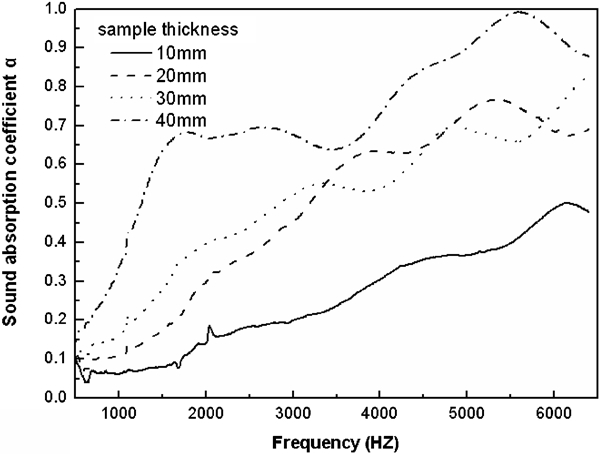
Effect of specimen thickness on sound absorption behaviour of foam B
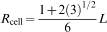
Recently, Lu et al. proposed a model based on a tetrakaidecahedral unit cell to predict the static flow resistance of an open celled FeCrAlY foam.16 The longitudinal flow resistance σ is expressed by

Effect of air gap depth
It has been well understood that the air gap plays a very important role in modifying the sound absorption behaviour of metal foams.2,4,9 It makes the absorption background rise and resonant absorption peak shift towards low frequencies. For the present open celled Al foam, however, the effect of air gap on the thin samples, for instance 10 mm in thickness, is not obvious, while on the relatively thick samples, for instance 30 mm or over, is not only significant but also unique. It is manifested in the following two aspects:
as the depth of air gap increases, the resonant absorption peaks gradually emerge and becomes most prominent in the thickest sample,
if evaluated by the first resonant peak, the thickest sample shows the highest absorption coefficient, as shown in Fig. 8.
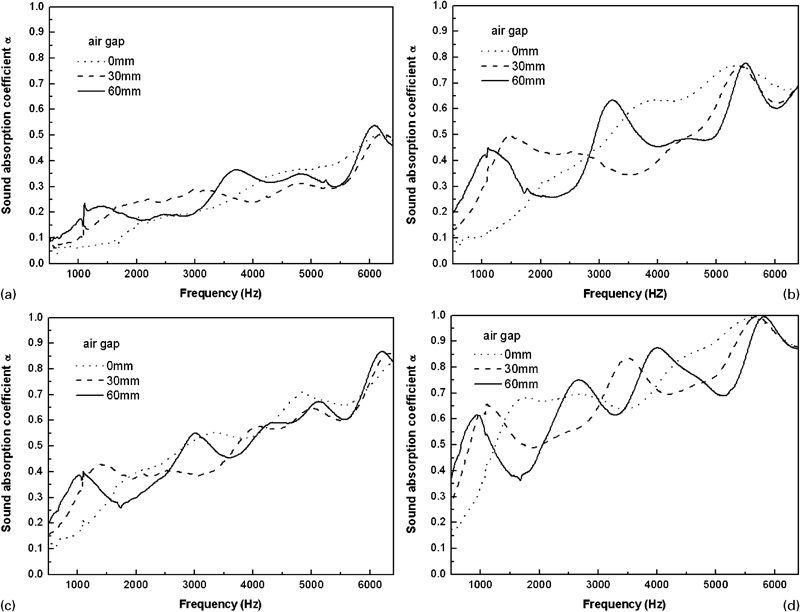
Effect of air gap on sound absorption behaviour of foam B with different specimen thickness of a 10 mm, b 20 mm, c 30 mm and d 40 mm respectively
For the present Al foam, however, there is another change arising in the sound absorption curves, i.e. the approximate periodical absorptive resonant peaks appear as the sample thickness and the air gap depth increase. According to Lu et al.,17 the introduction of air gap will change the resonance modes of the specimen–tube system, and the resonant frequency fr is described by (Ref. 18)

Although absorptive resonant peaks are fairly narrow, the presence of the air gap behind the foam allows for flexibility in selecting the frequency at which the peak absorption occurs.
Conclusions
The sound absorption behaviour of the open celled high porosity Al foams manufactured by the investment casting method has been studied. It is found that the absorption performance of the foams have much improved sound absorption capacities with increasing frequency. Relatively small pores and great foam thickness are beneficial to sound absorption when the foams are secured directly to a rigid backing, which is consistent with the formulation of Lu et al. No apparent correlation between sound absorption and pore density is observed, which may be attributed to the limited parameter range explored. More pore density samples test data are needed to establish more definite trend. The sound absorption performance of the foams can be significantly enhanced, particularly at low frequencies, by introducing an air gap behind the foam. With an air gap, the thick foam samples exhibit the best absorption capacities. The location of the peak shifts towards lower frequencies with increasing air gap depth. There is a coherent correlation between sound absorption coefficient and flow resistance. The present Al foam can be a competitive candidate for noise control applications.
Footnotes
Acknowledgements
This work is supported by the National Basic Research Program of China (grant no. 2006CB601201), the National Natural Science Foundation of China (grant no. 50871107) and Science and Technology Program of Anhui Province, China (grant no. 07010302211).