







Abstract
There is a novel steel invented in which the structure consists of extremely fine platelets of bainitic ferrite dispersed in a matrix of carbon enriched retained austenite. The resulting large density of interfaces makes the alloy very strong in its transformed condition. The authors report the first fatigue tests on this system, by measuring the life of parallel gauged samples tested using cyclic loading in tension, with maximum stresses in the range 1·2–1·6 GPa. A comparison of the results against published data indicates that the performance of the steel is consistent with the behaviour of other strong steels, in spite of the fact that it is produced using an air melting technique.
Introduction
It is now possible to routinely and cheaply generate a very high density of interfaces in steel, resulting in strength which can be controlled in the range 1·6–2·5 GPa with a hardness of about 650–700 HV, depending on the transformation conditions. The structure, which is obtained by the solid state transformation of austenite at low homologous temperatures (180–250°C), consists of plates of bainitic ferrite, which are just 20–40 nm in thickness, dispersed in a residue of carbon enriched retained austenite (Fig. 1).1,2
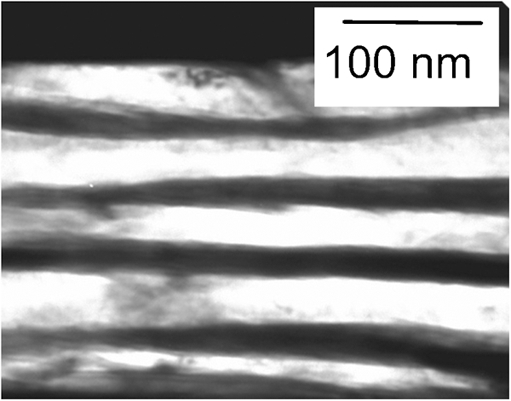
Transmission electron micrograph showing fine plates of bainite in alloy studied here following transformation at 200°C for 3 days: darker regions represent intervening austenite
There is an interest in developing these steels for the manufacture of shafts, which have a high surface integrity but which are subjected during rotation to alternating stresses, making the fatigue performance of the material an important design parameter. The purpose of the present work was to determine, for the first time, the fatigue behaviour of the nanostructured steel.
Methods
There are many variants of the alloy system that have been shown to be capable of producing the bainite described above; the one which is the focus of the present work contains a modest addition of cobalt in order to accelerate the transformation, since cobalt increases the free energy difference between austenite and ferrite.3,4 The material used was produced as a 25 kg experimental air melt supplied by Corus (London, UK), rolled to ∼45 mm thick plate. A block 40×50×100 mm was homogenised in a vacuum furnace at 1200°C for 2 days, followed by furnace cooling to room temperature. The chemical composition of the alloy is

Cylinders of 10 mm in diameter, machined from the homogenised steel, were placed in a furnace at 500°C; the furnace was purged with argon throughout the heat treatment. The temperature was then raised to 900°C over a period of 30 min and held at that temperature for 15 min, after which the samples were transferred into an oven at 200±0·1°C for 10 days to generate the fine bainite with a hardness of 680±3 HV50. After heat treatment, the blanks were machined into push–pull type fatigue samples with the final dimensions of 4·5 mm diameter, 12 mm gauge length and a 9 mm radius, leading on to the grips which had 20 unified fine threads. Such samples expose a greater volume of material to tensile stress than rotating bend specimens and, hence, are better able to discover the role of inclusions. The gauge length was polished to give a 0·25 μm finish. The gauge length was masked, and the threads of the samples were shot peened using glass beads in order to prevent failure in the specimen grips.
Fatigue testing was conducted on an Instron 8800 testing machine, controlled by Instron LCF v7·2 Fast Track2 software. The loading was at a frequency of 0·25 Hz, with each 4 s cycle consisting of four steps, each of 1 s duration: a hold at the minimum tensile stress, followed by a linear ramp to the maximum stress, hold at that stress and a ramp down to the minimum stress. This is often said to be a trapezoidal 1–1–1–1 s profile. The ratio of the minimum to maximum stress was maintained at R = 0·1.
Results
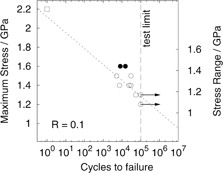
Figure 2 summarises the outcomes and compares against the previously reported tensile strength;5,6 the 0·2 proof strength and elongation were reported as 1·45 MPa and 4·6 respectively.
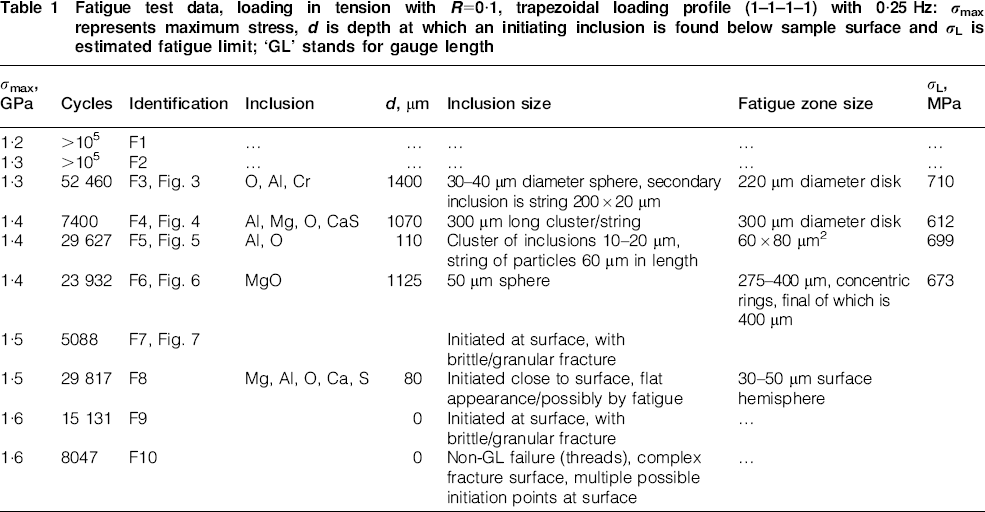
Fractography revealed that failure initiated from inclusions except for samples tested at the highest of stresses, where cracks apparently began from the polished surface. The origins of fracture can be seen in Figs. 3–7, and the complete set of results is summarised in Table 1. The inclusions were identified using energy dispersive X-ray analysis as oxides, high in aluminium or magnesium; calcium sulphide was also observed.
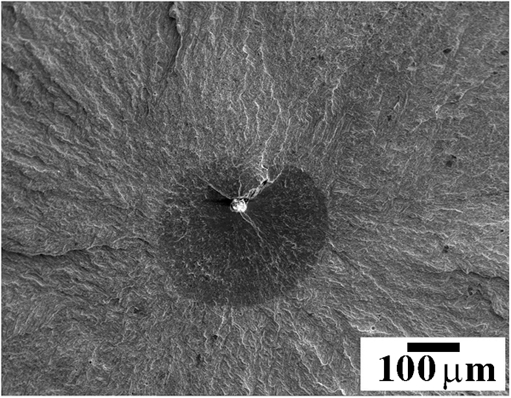
F3, 1·3 GPa (52 460 cycles), fracture initiation from centre of sample: inclusion is identified as alumina
F4, 1·4 GPa (7400 cycles), circular fatigue crack which grew from string of inclusions before onset of gross fracture
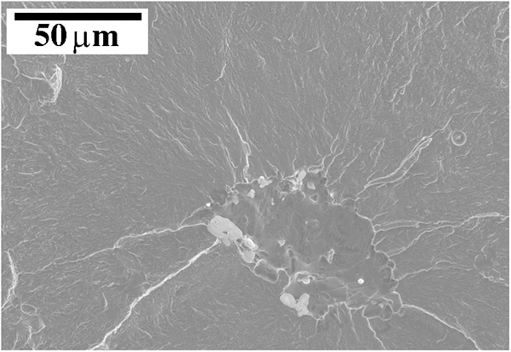
F5, 1·4 GPa (29 627 cycles), irregularly shaped cluster of inclusions
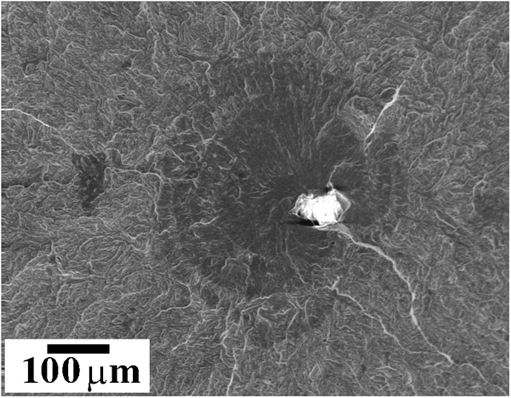
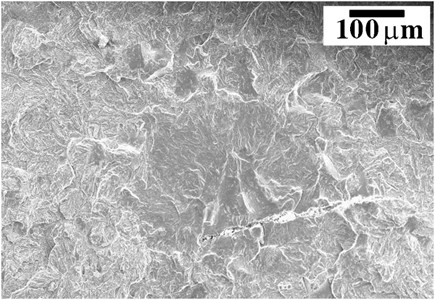
F6, 1·4 GPa, fracture surface, showing river lines leading to initiation site and illustrating size of inclusion, which is likely to be MgO, as indicated by microanalysis
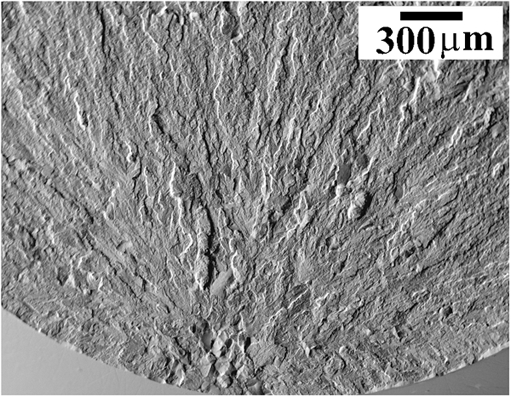
F7, 1·5 GPa, fracture initiated at or in close proximity of surface, with no inclusion identified as culprit
Fatigue test data, loading in tension with R = 0·1, trapezoidal loading profile (1–1–1–1) with 0·25 Hz: σmax represents maximum stress, d is depth at which an initiating inclusion is found below sample surface and σL is estimated fatigue limit; ‘GL’ stands for gauge length
Classic ‘white area’ or ‘fish eye’ fracture patterns characteristic of fatigue fracture 8 can be seen in samples tested at maximum stresses σmax of 1·3 and 1·4 GPa in Figs. 3 and 6. For the samples tested at σmax = 1·5 and 1·6 GPa, the fracture surfaces appeared much more brittle, making it very difficult to discern any area of fatigue crack growth.
The results are summarised as an S–N curve in Fig. 2. Regression analysis of the data, excluding the samples tested again at the greatest stress (i.e. excluding the filled circles in Fig. 2), permitted the estimation of the fatigue life as defined for the authors’ purposes to be the maximum cyclic stress for which the samples must survive 10 7 cycles: this stress was found to be σmax = 855 MPa, which may represent a conservative estimate given that two of the samples survived 105 cycles at 1·2 and 1·3 GPa without failure.
A strong correlation has been observed between the fatigue limit and the hardness over a range of steels and microstructures9,10 (Fig. 8). The linear trend in their results breaks down at high hardness values, with a maximum fatigue limit of 900 MPa at hardness of ∼600 HV. The linear relation between the fatigue limit and hardness has also been shown for values below 400 HV, independent of microstructure or steel type.
11
This might be expected, given that the resistance to plastic deformation, as measured by hardness indentations, determines also the resistance to the plasticity required to initiate and propagate fatigue.
11
Fatigue data analysed by Murakami
12
led to the proposal of a ‘defect free fatigue limit’ σw0, which can be calculated from the tensile strength σU or the hardness (HV)

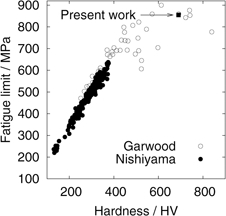
Correlation of fatigue life with hardness; data represented by black dots are due to previous studies9,10 for variety of steels in normalised and quenched and tempered conditions: in some cases, reported Rockwell hardness (C scale) values have been converted to Vickers hardness using empirical equation 21
Figure 8 shows that the present steel, consisting of fine bainite and retained austenite, has a high fatigue limit, which compares well with the other data.9,10 On the basis of equation (1), the present alloy should have a ‘defect free’ fatigue limit of σw0 = 1·1 GPa.
Given that the fatigue limit correlates with the hardness, which is a coarse measure of properties, it is not possible from the present work to isolate the specific influence of retained austenite. Wenyan et al. 14 studied carbide free bainitic steel samples containing retained austenite fractions 0·08–0·23 and found that the threshold stress intensity increased and the crack propagation rate decreased, as the fraction of retained austenite was increased. This is in spite of the fact that the samples with less austenite were stronger. In general, the opposite effect is expected since the crack growth increment per cycle should be inversely proportional to the cyclic yield strength because the crack tip opening displacement will be smaller when the yield strength is large. This reinforces the conclusion 14 that the austenite is beneficial to fatigue performance. Although the detailed mechanism is not understood, it is possible that the stress or strain induced transformation of austenite is responsible for the improved properties. 15 On the other hand, a high strain hardening rate accompanying the transformation of austenite may be detrimental if this reduces the ability of the material to accommodate plastic strain.16,17 The role of austenite therefore deserves further study.
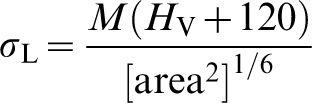
The level of cleanliness with respect to non-metallic inclusions has naturally been correlated against fatigue performance by many researchers. However, the problem is difficult since the occurrence of infrequent and large inclusions depends also on the volume sampled by the stress. Inclusions in general may be regarded as stress concentrations through a variety of mechanisms, including the loss of coherence with the matrix and when the particle itself fractures and introduces a sharp crack. The inclusion size, approximate shape and position within the sample are recorded in Table 1. It has been proposed18,19 that the fatigue limit σL is related to the hardness and effective area of the inclusion as follows
Conclusions
A nanostructured steel containing slender plates of bainitic ferrite in a matrix of high carbon retained austenite has been studied under fatigue loading using tensile specimens in order to uniformly stress a significant volume of material. The tests were performed at high stresses whose maximum values were between 1·2 and 1·6 GPa. The performance of the steel is generally consistent with published work on iron alloys of similar hardness. A fatigue limit of ∼855 MPa is estimated assuming no failure in 107 cycles, based on extrapolation of data in which the maximum number of cycles permitted was 105. Samples tested at lower loads survived 105 cycles, which possibly makes the extrapolation a conservative estimate of the fatigue limit.
As is well known, the fatigue life depends upon the cleanliness of the steel, which, in the present work, was made as an air melt. It is assumed therefore that the fatigue performance of the nanostructured steel should be better when it is manufactured using clean steelmaking technologies.
Footnotes
Acknowledgements
The authors are grateful to Rolls-Royce plc for funding this research and to Professor L. Greer for the provision of laboratory facilities at the University of Cambridge.