







Abstract
Behaviour of 10–100 μm sized Ag and Ti metal particles was studied by employing laser light scattering microscopy while increasing the temperature at different rates. Differential area ω was defined as 2(Amax−Amin)/(Amax+Amin), and its significance as strain variation response is established. The ω versus dT/dt curves of Ag and Ti were exponential in nature, with positive and negative slopes respectively. The role of smallness of the metal particles vis-à-vis defects was considered. Systematic variation of surface activity Sa with rate of heating is noticed. A plausible reasoning is offered to explain the experimental results qualitatively.
Keywords
Introduction
For the first time, variable temperature laser light scattering microscopy studies were made on small metal grains of Al, Cu and Ag (at deep defocus condition) in a small temperature range (ambient to 60°C), and the results were interpreted in terms of expansion, influenced by voids.1 Detailed investigations were carried out on submillimetre sized grains of Au (99·999 pure) metal and Pb–Sn alloy, in an extended temperature range (ambient to 200°C), at different heating rates, while keeping the temperature constant at elevated levels.2 Studies were made on 10–100 μm sized Ag and Ti metal particles in extended temperature range (they are small grains; however, the word ‘particle’ is used purposefully, in order to differentiate between these small grains and the grains that are encompassed by grain boundaries in a crystalline material). Experimental study and the results are briefly presented in the present report. The variable temperature laser light scattering microscopy is relatively inexpensive. However, it offers high magnification microscopy advantages.1 The experimental technique was similar to oblique incidence reflection microscopy.3
Materials and methods
Sigma-Aldrich (St Louise, MO, USA) made high purity (99·999) Ag and commercial grade flaky Ti (SD Fine Chemicals Ltd, Mumbai, India) particles of 10–100 μm size were used in the present study.
A hot stage, with zero thermal expansion in vertical upward direction (briefly called V+ZET), was employed to heat the metal grains. Assembly and normalisation of V+ZET were reported elsewhere,4–6 but a brief discussion is made here. A heavy mild steel metal block (200×80×20 mm) was coupled with a 400 W flat heater. Electric current was fed to the heater via a servo voltage stabiliser and autotransformer. The block was then rested on a pair of 150 mm long metal pipes, which were separated by another set of pipes. Thermostatic water was pumped continuously through the pipe system in order to eliminate the temperature induced dimensional changes in the pipe system. Thin, identical mica sheets further acted as thermal barriers between hot and cold surfaces of the block and its supports. The performance of V+ZET was evaluated with the help of a travelling microscope and thermocouple based temperature sensors (to measure the temperatures), by making several observational runs on the surface over a temperature range of 20–200°C.
Fused silica optical flat was used as sample holder; linear thermal expansion coefficients of fused silica,7 Ag7 and Ti8 are 0·4×10−6, 19·2×10−6 and 8·4×10−6 K−1 respectively. In order to suppress the back ground scattering, amorphous MnO2 was employed in the form of thin layer. Reflection coefficients9 of carbon black and Ag are 0·003 and 0·93 respectively, in the visible spectrum. The coefficient of reflection of MnO2 may be equal or very close to that of carbon black.
A 670 nm, 10 mW laser beam falls (at an oblique angle) on the experimental grain placed on silica optical flat (situated on the V+ZET) and undergoes scattering, while a part of it enters the microscope, after travelling a distance of 80 mm (forward focal length of the large working distance objective).1 In order to prevent drift of the focal plane (caused by thermal expansion of the body of microscope), a beam path cooler (an elaborate copper sheet made heat shield fitted to a trolley that moves on a track with circulating water) was coupled with V+ZET. The cooler absorbs heat and thereby stabilise the images at high temperatures. Similar to previous studies,4–6 the present study was also conducted over a temperature range of ambient to 200°C, at atmospheric pressure (in air) and in clean room conditions. Control systems for heating, cooling and laser, as well as temperature display systems, were situated outside the clean room in order to minimise the variations in surrounding atmosphere during thermal treatment.
The Ag and Ti metal particles employed in the present study are well known for their high reactivity in atmospheric conditions.23,28 Therefore, it is essential to understand the surface chemistry of these metals. Corrosion/tarnish of Ag by S and the subsequent Ag2S layer on pure Ag in dry air at room temperature is a very common phenomenon.35 However, the time periods, during which such a process takes place and also the thickness of sulphide layer, are important to consider. McMahon et al.36 conducted time lapse experiments on Ag nanoparticles (with 60–70 nm diameter), to test the amount of tarnish formed on Ag under ambient (air and room temperature) laboratory conditions. They have estimated the growth rate of tarnish on nanoparticles to be 3 nm/day, which is 7·5 times higher than the bulk Ag (Ref. 36 and references therein). These estimates suggest that the sulphide formation on the 10–100 μm sized Ag particles (employed in the present study) during the experimental time period 0–4 h, might be very minute and therefore could be ignored.
Oxide layer formation in the superficial zone is a common phenomenon for both metals. However, the interaction of O with Ag is a complex phenomenon, and crucial questions such as adsorbing states of O on Ag surface and the extent to which the atomic and molecular adsorptions occur24 need attention. The thickness of readily formed oxide layer is ∼100 nm at room temperature, which is thermodynamically stable up to 150°C. Above that temperature (at atmospheric pressures), the so formed Ag2O decomposes entirely.23
Owing to its noble metal nature, Ag exhibits smaller vacancy formation energies. Such a property was suggested to be the reason for adsorption of on-surface O, which considerably facilitates the formation of surface Ag vacancies.25
Penetration of O into Ag bulk is only enhanced at higher temperatures (>500°C),24 which ultimately leads to the Ag lattice expansion.26 Owing to temperature range employed in the present study (ambient to 200°C), such a possibility may be ruled out.
The usage of fresh particles (from the stock) in every heat run and the clean room conditions reduces the possibility of silver sulphide formation. More refined experimental methodology is underway in order to rule out such possibilities.
Similar to Ag, when Ti is exposed to ambient air at room temperature, a very thin (5–10 nm) passive oxide film is spontaneously formed on its surface.27,28 The passive nature is so severe that it acts as a protective shield that prevents further oxidation of Ti in different conditions and medium, as such remains amorphous.29,30 The oxidation kinetics, which is very fast in the beginning, decreases gradually with time within the first 10–20 min. Moreover, the amorphous state converts to a crystalline film only above 276°C, followed by an increase in specimen weight as a result of oxidation (O from air) observed after 280°C. Furthermore, it is interesting to note that the O desorption is a complex process.31 For desorption to occur (in the range of 10–400°C), the TiO2 evacuation at high temperature followed by O adsorption at relatively low temperature is required. The amounts of O desorbed from the so formed oxide were minute of surface coverage, suggesting that the adsorption sites are probable surface defects.
Separate experiments were made on Ag and Ti particles. They were heated slowly on V+ZET, and a series of photomicrographs were recorded at different temperatures and rates of heating. Measurements were made from such photographs.
Results and discussion
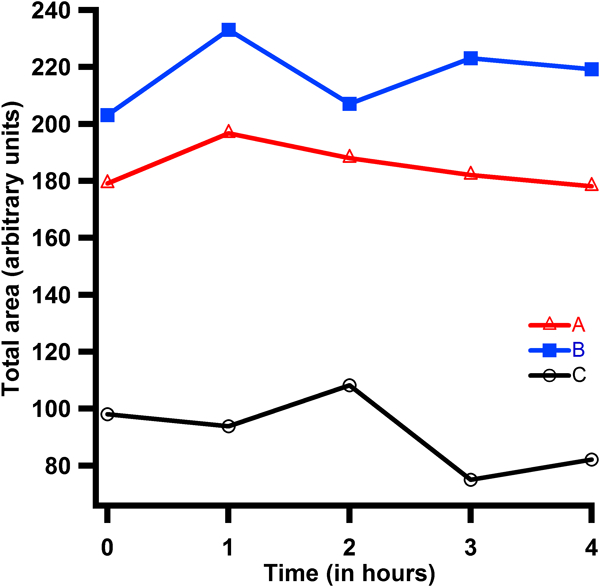
In order to compare the behaviour of submillimetre sized metal grains, it was necessary to create identical heat treatment conditions to all the grains investigated. Instead of making several experimental runs for such purpose, images of particles present in the (same frames of) photo film, recorded in any given heat run, were chosen and analysed. Figure 1 shows one particle (labelled C) of three such Ag particles (labelled A, B and C) at four different temperatures. It may be noted that these photographs were obtained with scattered laser light and thus drastically differ from the ‘conventional’ photographs. The bright patch-like areas of the images were labelled ‘bright patches’, briefly BPs. The BPs were understood to be formed due to specularly reflecting microfacets of particles.10 The areas of BPs were measured; the representative results obtained in the case of grain C are shown in Fig. 2. Dissociation of a facet (BP) into several facets and their recombination was noticed.2,10 Such processes are also evident in Fig. 2. The total area of (images of) grains A, B and C at different temperatures was also evaluated by summing the areas of different BPs; the results are shown in Fig. 3. A flaky particle of Ti, subjected to the similar treatment is shown in Fig. 4.
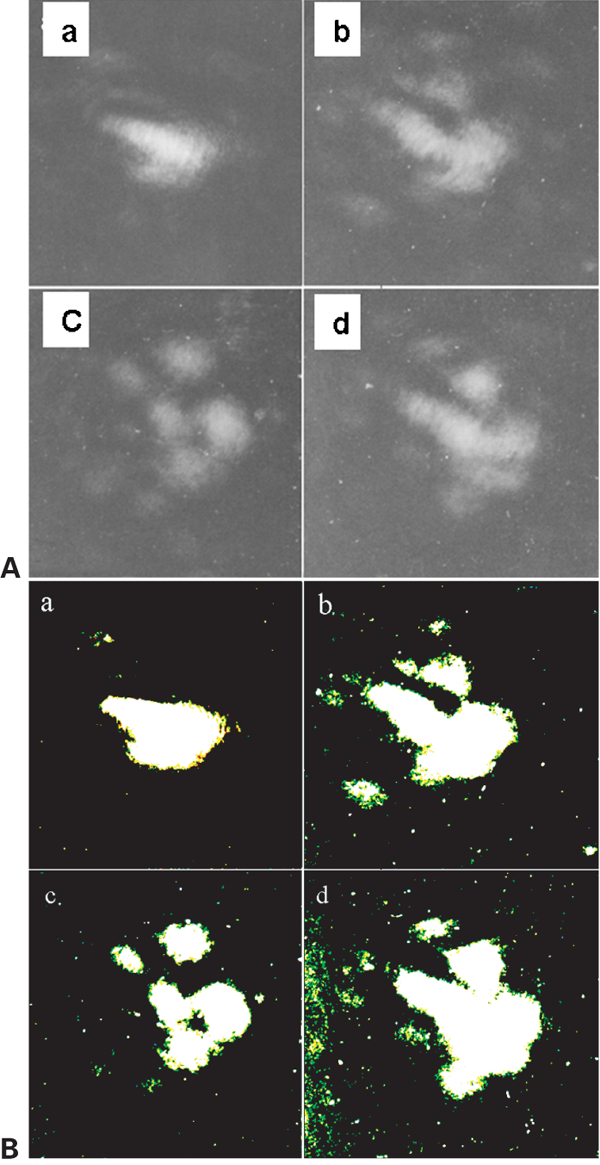
(A) laser light scattering images of Ag grain C and (B) same images (shown in Fig. 1A) after contrast enhancement ×500
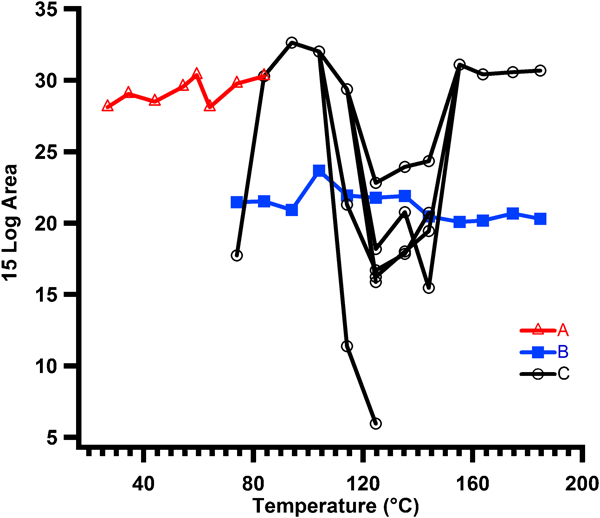
Areas of BPs of Ag grain C, measured at different temperatures in case of Ag
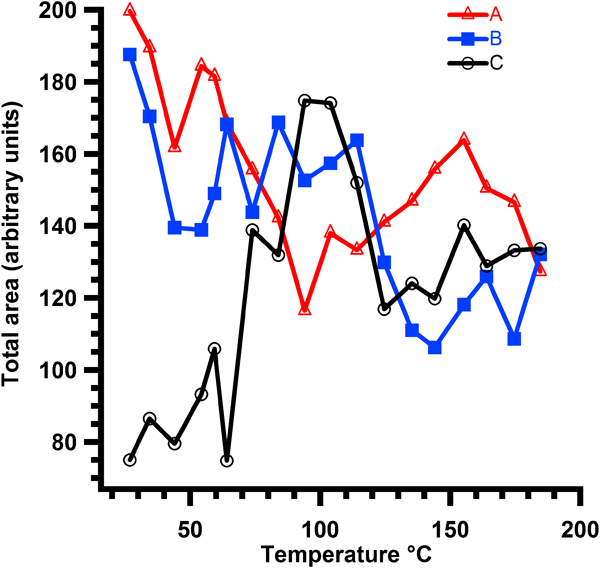
Total areas of Ag grains A, B and C at different temperatures
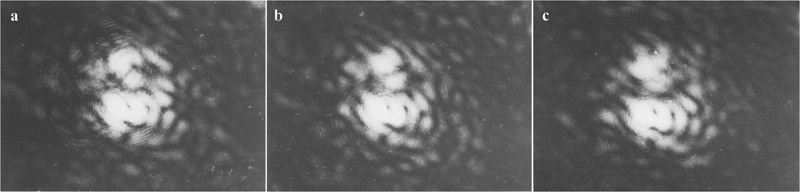
Laser light scattering images of Ti at three different temperatures ×500
The dissociation and recombination process was labelled2 as surface activity SA. In view of the high reactivity of Ag and Ti, it may argued that the O adsorption–desorption process occurring at the surface level might be responsible for such a surface activity. However, such a possibility may be ruled out due to the passive nature of the oxide films (discussion made in materials and methods section) of these two metals similar to other passive metals, such as Al, Zn and Au.34 Any closed surface always encloses a certain volume. As such, modifications appearing on the surface of a small grain should essentially be due to some or other activity occurring in the volume of grain. Such activity essentiality arises due to the smallness of the grain; in the case of bulky grains, such requirement may seldom exist. The surface activity SA was proposed to be given by an empirical relation2

The curves A, B and C show both downward and upward trends for some time; curve C exhibits a huge, broad peak. It probably means that the metal particles exhibit contractions and expansions of volume (with no specific preference) as the temperature increases. In a temperature range, for example 160–180°C, curve C increases while curve A decreases and curve B exhibits a combined behaviour. As such, the upward and downward variations in the curves cannot be attributed to any instrumental (thus spurious) effects and are intrinsic in nature.
In order to examine the behaviour of Ag particles at constant elevated temperatures, experiments were made on another set of three particles. The temperature remained constant over a period of 4 h, after reaching a specified temperature (110°C). It was noticed (Fig. 5) that, even at constant thermal pressure, the particles remained dynamic, exhibiting surface activity and variations in AT. Variation in surface activity with rate of heating is shown in Figs. 6 and 7, in the case of Ag and Ti respectively, and it is evident (even though the variation deviates from complete linearity) that the concept of SA outlined above may have a strong basis, in terms of defect substructure and its influence on the surface of particle.
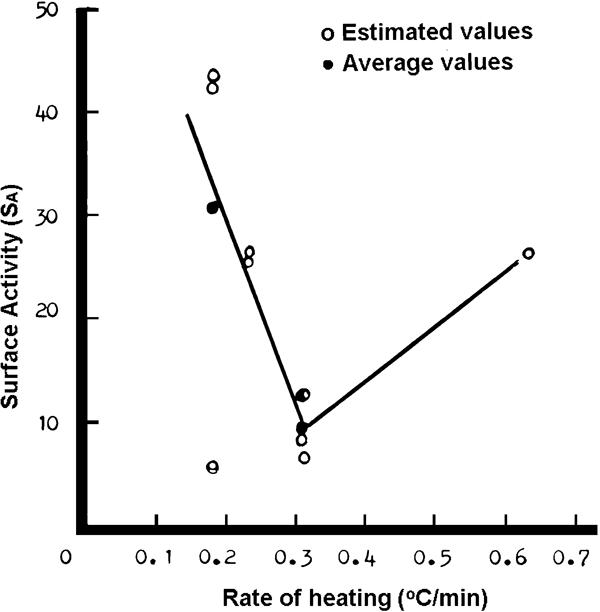
Variation in surface activity SA with rate of heating dT/dt, in case of Ag
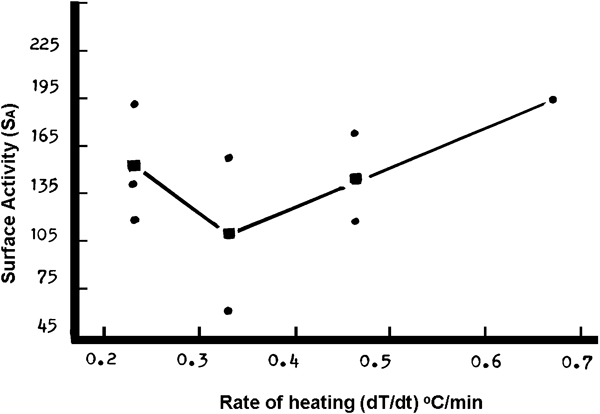
Variation in surface activity SA with rate of heating dT/dt, in case of Ti
Using the maximum Amax and minimum Amin total areas of Ag metal particles, recorded at different temperatures, a factor ω is defined



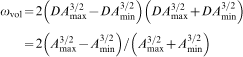
In the case of Ag, variation of ω with the rate of heating dT/dt is seen to be exponential in nature (Fig. 8). The upper exponential curve in Fig. 8 represents ωvol versus dT/dt. Similarity between the two curves illustrates the utility of ω. The ω versus dT/dt curve of Ti is shown in Fig. 9. The exponential curves A and B are due to ω versus dT/dt and ω/ai versus dT/dt respectively, ai being initial AT at room temperature. The exponential curve
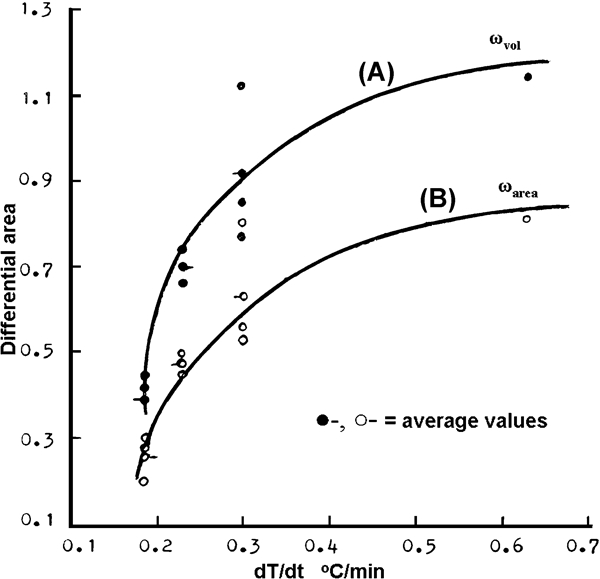
Relation between (i) dT/dt and ω (curve A) and (ii) dT/dt and ωai (curve B) in case of Ag
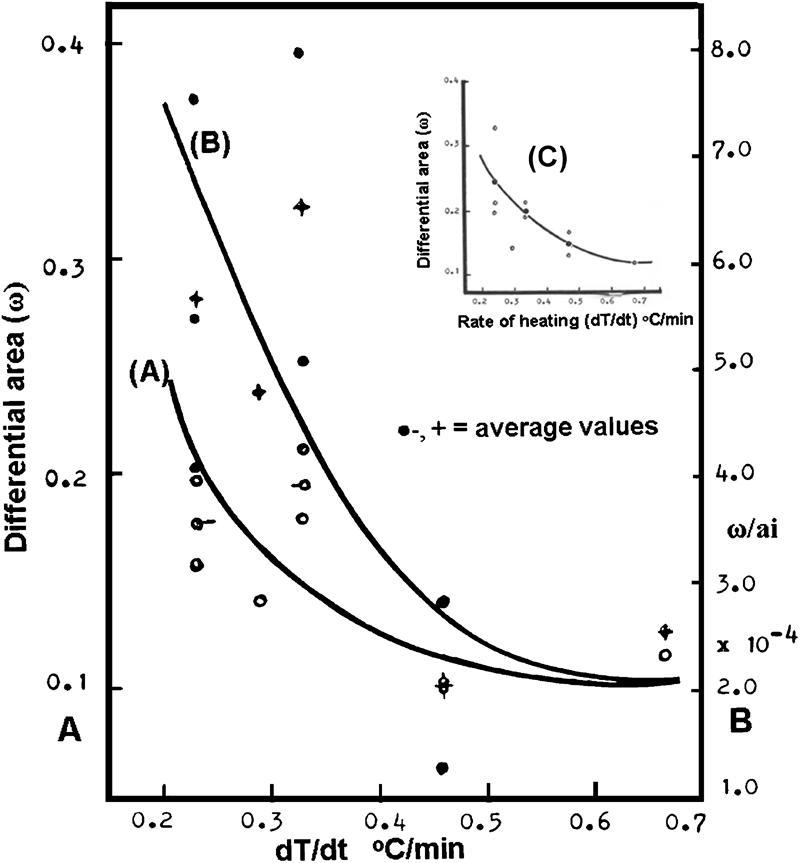
Case of Ti: relation between rate of heating and ω in temperature range 30–180°C
The relation between ω and dT/dt may be written as


If Vi and Vf are volumes of a small metallic sphere at temperatures To and T1 respectively and γ is the coefficient of thermal expansion, then classical equation for thermal expansion12 is


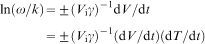

Therefore, it may be stated (based on equation (11)) that the non-linearity in ω is due to the contributions of (or competition between) the different components of Vx whose level of activity may be temperature dependent. The dependence of internal stress on temperature,14 the void–void and void–matter interactions15,16 may be mentioned as some of the examples of factors that contribute to the non-linearity. Non-linearity was also noticed in the case of irradiated and strained bulk metals, and the high defect concentration was stated to be responsible for such behaviour.17–19 In the case of the microcrystalline metals, the X-ray peak broadening, promoted by inhomogeneous strain, has been attributed20 to the dislocation storage, dislocation densities and dislocation clusters.
It may be stated that, first, the ratio Vx/Vo = 0, when the material is completely free from imperfections of any kind, and second, Vx/Vo = 1, when the concentration of imperfections (voids, etc.) is so high that material can be classified as highly porous. Obviously, the first and second states can be realised with relative ease, when Vo is quite small. Therefore, it may be asserted that the size of the metal particles might have played an important role in the present results. This is not a mere speculation, in view of the properties exhibited by nanomaterials21 and small metal clusters.22 If the defect substructure of a given metal particle could be established, for example through X-ray techniques, and then subjected to variable temperature laser light scattering microscopy, then the relation between ω and the defect substructure could be investigated in a rigorous way. However, such an experimental study could be extremely difficult, if not impossible. Under such circumstances, a few logical speculations might be useful, as have been done here. Looking at the scope of the study, a mention may be made that it finds application in the areas of passive (non-interactive) evaluation of materials, when they are in the form of particles with submillimetre or micrometre dimensions that have definite defective substructure (the advantage with such materials is that their thermomechanical properties could be tailor made for one time application).
Conclusions
The non-linearity is more pronounced in submillimetre sized grains (even if they are non-irradiated) due to the smallness of volume, where the influence of voids and other defects may be quite considerable, which is evident from the present study. It seems that the purity of a material has to be defined, as a sum of chemical and physical purity, if the size of the material (grain) is of the order of submillimetre or less. It is also obvious that (high) chemical purity alone may be insufficient for the description of grain behaviour, under varying temperature conditions (interestingly even from the viewpoint of laser light scattering). The relation between rate of heating and differential total areas [(Amin−Amax)/(Amin+Amax)], which is the thermal volume strain variation, seems to connect the behaviour of different 10–100 μm sized particles of a given metal. This aspect shall be further examined in the case of grains of other metals in the forthcoming studies.
Footnotes
Acknowledgements
The study reported in the present paper is part of a project funded by DRDO, Government of India, New Delhi (project no. ERIP/ER/0102083/M/01). Laboratory assistance by P. Sitarama Rao is acknowledged. Professor Prasad passed away just after the communication of this paper. PBSK dedicates the paper to Professor Prasad.