






Abstract

Comments regarding the papers ‘On preventing HAZ cracking in laser welded DS Rene 80 superalloy’ by Osoba et al. and ‘The hot ductility of Nb/V containing high Al, TWIP steels’ by Kang et al.
In the first paper,1 Osoba et al. describe welding experiments on a Ni base superalloy in which they explore various treatments to reduce cracking in the heat affected zone (HAZ). It is a regret that one of the authors has overlooked the comments2 made on a previous publication on the same subject in MST. The comments related to the origin of cracking in conditions in which incipient melting occurs.
In the previous response2 it was proposed that the Ni base alloy had been cast in a conventional manner, with the result that it would certainly contain a substantial population of bifilm cracks. These are cracks introduced into the liquid alloy by the folding in of the surface oxide during casting. Principally as a result of their content of aluminium, the Ni base superalloys are well known for the presence of an oxide film even during vacuum casting, since the conventional industrial vacuum is relatively poor, and vigorously ‘gettered’ by Al at Ni alloy casting temperatures to create a tenacious alumina film. When folded into the melt during pouring, the fold is necessarily formed ‘dry side to dry side’, so creating an unbonded interface in the liquid which acts as a crack. The outer faces of the double film, or bifilm, are in perfect atomic contact with the melt as a result of growing atom by atom from the liquid. They are now known to be the substrates for the precipitation of many second phases and intermetallics during solidification. The appearance of these phases, often cracked, has led to widespread use of the phrase ‘brittle intermetallic’. In general, of course, intermetallics are extremely strong and would be expected to be extremely resistant to fracture. The ‘fractures’ therefore are the opened unbonded interfaces in their substrates.
Thus it is to be expected that Ni base alloy castings will contain bifilm cracks frozen into the solid as a result of the surface turbulence of the casting process. The oxide bifilms are pushed by the advancing dendrites during freezing, and so tend finally to come to rest in grain boundaries. As a result of their extreme thinness (usually measured in nanometres) their presence is usually not suspected, and is often difficult to discern. The excellent and varied evidence for their presence has been reviewed elsewhere.3
The reason for the opening of cracks and the associated loss of properties that accompanies incipient melting of phases in the HAZ is the presence of the bifilm in the boundaries. Second phases tend to precipitate on the exterior interfaces of bifilms as favoured substrates, leading to the apparent presence of cracks in the centres of such particles as seen in Figs. 4 and 5 of the authors’ paper.1 On melting, the expansion accompanying the phase change will cause the matrix to deform plastically, since very large forces will be involved as a result of the new arrival of this effectively incompressible volume. However, on remelting the contraction of the phase will not be expected to lead to a reversal of the deformation of the matrix, but simply to the far easier opening of the bifilm as a result of the non-bonding across its internal interface.
The crack shown in Fig. 4 has probably opened in this way. However, on closer study of Fig. 5 the small regions of remelting are unlikely to have caused the opening of the crack as described above. In this latter case the crack was almost certainly already opened, either in the original form of the metal as received by the authors, or because of strains from the welding process.
It seems, therefore, the superalloy material that the authors investigate is effectively pre-cracked, as are all current Ni base alloys (and many other metals and alloys), whether available as wrought plate or sheet, or as castings in the form, for instance, of turbine blades.3 This regrettable situation is not necessary. Good metal handling and casting technology is currently now understood and developed, and if applied would be expected to provide superalloys and many other metals and alloys with unprecedented benefits.4
In the second paper5 the authors compare high aluminium TRIP steels melted and cast into 50 kg ingots in a laboratory vacuum induction melting furnace. It is unfortunate that this laboratory production route is one of the worst that could be chosen. The fall from the lip of the melting crucible into the moulds is of the order of 1 m, so that velocities on impact will be in the region of at least 4 m s−1. This high velocity, together with the high aluminium composition of the melt, will guarantee the inclusion of alumina bifilms in such a concentration as to dominate the properties produced by this process.
A better experimental result would have been achieved by melting in air (allowing of course for some loss of certain elements by oxidation) followed by pouring from the lip of the melting crucible directly into a mould, initially tilted to be nearly horizontal, placed as close as possible to the lip to reduce the turbulence of the gravity casting process to a minimum. Better still, of course, would have been to avoid the use of gravity for casting, using a counter-gravity method. Such methods are not difficult to set up and yield dramatically improved metallurgical products.
In view of the behaviour of bifilms, in which they appear to form universal favoured substrates for intermetallics, it is likely that the observed AlN precipitates have actually formed not on grain boundaries, but on the unobserved oxide bifilms in the grain boundaries. The action of these hidden cracks would be expected to impair the hot ductility properties exactly as described by the authors. Occasional precipitates elsewhere in the matrix may be explicable because of the presence of bifilms trapped elsewhere in the advancing dendrite mesh. The improvement noted after hot rolling probably follows from the limited amount of closing of bifilms, even though it seems that bifilms in general are resistant to ‘welding’ across their unbonded interface.
The properties as measured by the authors represent those of a heavily fractured microstructure which, perhaps fortuitously, will be largely unrepresentative of the industrially produced TRIP steels that are continuously cast. The industrial scale processing has the benefit of several minutes between pouring into the ladle and transferring to the casting area for entrained oxide damage to detrain prior to casting. Furthermore, although by no means perfect, conditions of transfer into the continuous casting unit are reasonably carefully controlled. Thus the continuous cast versions of this steel will be expected to be relatively free from bifilm cracks and preferred substrates for the precipitation of AlN.
Department of Metallurgy and Materials, University of Birmingham, UK
Response by Osoba et al.
In our paper,1 we report the occurrence of heat affected zone (HAZ) cracking in laser beam welded DS Rene 80 superalloy. In his comments, Professor Campbell suggests that the HAZ cracks observed are a result of the presence of (alumina) oxide film, referred to as ‘bifilms’, based on the hypothesis proposed in a previous paper.2 We would like to state that we found no evidence in our work to support crack formation by the suggested oxide bifilm hypothesis:
We performed detailed microstructural studies of the DS Rene 80 superalloy used in our work using electron microscopy and spectroscopy, including TEM analyses of nano-size particles formed along the grain boundaries in the alloy prior to welding. No evidence was found of alumina oxide film along the grain boundaries. Some intergranular microconstituents observed in the material are reported elsewhere. 6 6,7
Aside from the fact that no oxide films were observed in the alloy, we found no evidence of the ‘cracked’ intergranular intermetallic second phases, which Professor Campbell states often form on oxide bifilms.
Furthermore, it is suggested that the cracks reported in the HAZ of welded specimens were probably present in nascent form in the as received material prior to welding. The cracks were not observed in the as received material nor were they observed in the material after subjecting it to various pre-weld heat treatments.
It is well established in the literature that a major cause of weld HAZ cracking in structural engineering alloys, including nickel base superalloys, is grain boundary liquation, which is often caused by non-equilibrium liquation reaction of intergranular phases.8–10 Formation of a continuous intergranular liquid film along grain boundaries normally produces loss of material strength and ductility, which can result in intergranular cracking if sufficient thermal and shrinkage tensile stresses are developed across such a liquated grain boundary during the weld cooling cycle. The HAZ liquation cracks that form in this way are often associated with resolidification products. The microstructural features associated with the HAZ cracks observed in our work are consistent with those formed by the widely accepted and reported liquation cracking mechanism. The HAZ cracks in the welded DS Rene 80 alloy are closely associated with liquated grain boundaries caused by constitutional liquation of second phase precipitates, including the main strengthening phase of the material, γ′ precipitates. Resolidification products were observed along the crack paths, as shown in Fig. 4 of the published paper,1 which is reproduced above (Fig. 1).
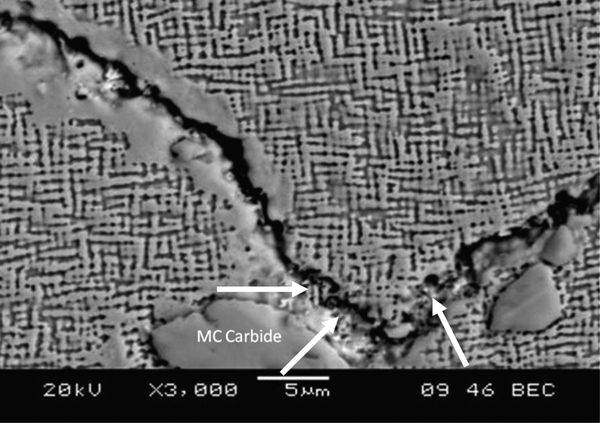
High magnification SEM image of HAZ intergranular liquation crack in DS Rene 80 (published as Fig. 4 of Ref. 1)
The formation of the re-solidification products, which in some regions occurred almost across the HAZ crack (as shown by the arrows in Fig. 1), is indicative of a crack caused by fracture of a liquated grain boundary. In contrast, this is not consistent with the suggested case, where the crack could be presumed to simply be an opening of a previously closed ‘dry side to dry side’ of an entrapped oxide bifilm. As stated earlier, the observations made in our work are rather in agreement with the classical HAZ liquation cracking mechanism. Based on the widely accepted liquation cracking mechanism, we studied and analysed how the extent of the HAZ cracking varies with pre-weld heat treatments in the superalloy. The knowledge gained was subsequently used to develop a new pre-weld heat treatment that we reported resulted in a nearly crack free HAZ in the laser welded DS Rene 80 superalloy. The valuable achievement made in minimising the HAZ cracking in the superalloy is based on the understanding that the HAZ cracks observed in the material were caused by the fracture of liquated grain boundaries and not due to the opening up of entrapped oxide bifilms.
Department of Mechanical and Manufacturing Engineering, University of Manitoba, Canada
Kang et al. respond
Professor Campbell is an ardent promoter of bifilms as the most overlooked de facto cause of fracture in as cast metals and alloys. It is difficult to see how bifilms feature in the fracture processes in our paper,5 which were also discussed in another recent MST publication by ourselves,11 which was previously criticised in a similar manner by Professor Campbell12. We find no evidence for these bifilms in these papers, but do have evidence for AlN precipitation at austenite boundaries, which have been known for many years to be a favoured precipitation site. We also have a bank of evidence to show that particles at the solid state boundaries can lead to intergranular failure without the need for bifilms.
When we read Professor Campbell's criticism there was some doubt as to whether he was referring to this paper5 or to a subsequent paper now available online.13 There are indeed some misconceptions that he makes which need correcting. First, the paper is not, as he states, on the hot ductility of TRIP (transformation induced plasticity) steels, which are ferrite containing. In fact, our paper5 addresses the hot ductility of TWIP (twinning induced plasticity) steels, which are austenitic. Whereas high Al, TRIP steels have been successfully cast, high Al, Nb/V TWIP steels have given problems in commercial casting and indeed another high Al, TWIP steel has been chosen to avoid cracking.14 Furthermore, the tensile tests were not carried out on the 50 kg vacuum melted ingot, but on small tensile specimens taken from this cast and remelted. We are not able to say what difference remelting makes to the arguments in favour of bi-films. The solution to porosity in these small 1 cm diameter samples, cannot possibly be ‘pouring from the lip of the melting crucible directly into a mould, initially tilted to be nearly horizontal placed as close to the lip to reduce the turbulence of the gravity casting process to a minimum’, as he suggests.
As mentioned above, we have just published a paper on high Al TRIP steels13 and welcome Professor Campbell's comments when he has had time to thoroughly read it. In this case, for the 1Al containing TRIP steel, we would be prepared to consider his theory on bifilms being responsible for the poor ductility, but not for the 0·05 and very high (1·5) Al steels.