







Abstract
This paper presents the details of the detection of an unexpected (enigmatic) phase resulting from heat treatment of a tribocoating labelled PS304. This coating, consisting of chromium oxide powder in a Ni–Cr base powder and lubricated by silver metal and fluorides of barium and calcium, provides a plasma sprayed lubricious multitemperature wear and oxidation resistant surface layer for challenging wear applications. Primarily based on X-ray diffraction structural analysis, a chromium disilicide compound has been identified to form as a result of the heat treatment of the coating. A source of the significant strengthening of the coating by the heat treatment process is explained on the basis of the formation of the disilicide compound and its properties. The strengthening effect of fugitive silicon present in such trace levels is recognised for the first time as having a potential for use in many tribocoating systems as a cost effective and efficient strengthening approach.
Introduction
The objective of this communication is to report the structural characterisation of an unplanned, yet critical phase that contributes to the strength and wear performance of a versatile coating for application over a wide range of temperatures. Of special interest for use of these coatings are applications in space vehicles, turbocharger waste gate shafts, high temperature furnace parts, etc., which need to operate with no liquid lubrication at high temperatures. The coating designated as PS304 was developed at the NASA Glenn Research Center1 and applied by a powder fed plasma spray process. The constituents of PS304, by design, derive the wear resistance from chromium oxide (20 wt-%), low temperature (<450°C) solid lubrication from silver and high temperature (>450°C) lubrication from salt additions of BaF2 and CaF2 (10% together) all contained in an oxidation resistant matrix of Ni–(20–30)Cr powder carrier (60 wt-% of total mix).2–4 Optimisation of the deposit characteristics involved composition adjustments and heat treatment to obtain the highest coating strength at acceptable adhesion strength levels. The as sprayed coatings tended to have poor strength and fractured in the coating layers during tests with various substrates3; significant improvement in coating strength could, however, be obtained by heat treatment for several hours at temperatures above 450°C.3 Higher coating strengths enabled better coating integrity in the pull tests, resulting in a transition of failure mode to a peeling from the substrate.5 The mechanism of the strengthening of the coating as a result of these heat treatments was not yet completely understood. Preliminary microstructural analysis by scanning electron microscope (SEM) and energy dispersive spectroscopy (EDS) revealed that the strengthening could come from a Cr rich dark precipitate; a Si peak was also identified in the EDS of the precipitates, suggesting that this precipitate may contain an unknown Si constituent as well. The only source of Si in the powder mix was at a trace level from the fused silica addition to the Ni–Cr powder as a flow and fusion enhancer during atomisation.3
The focus of the present work was to identify the structural characteristics of this unexplained Si containing phase, which forms during heat treatment and contributes to the observed significant increase in strength of the coating.
Experimental
Samples
A commonly used material for the journal bearings coated with PS304 is Ni base superalloy Inconel 718. For this reason, this material was selected as a substrate in our experiments. Discs of the superalloy were plasma spray coated with PS304. Samples of discs coated with PS304 were tested in the as coated state as well as in the coated and heat treated condition (at 650°C in air for 100 h). PS304 in powder form was also tested as a benchmark for comparison.
X-ray diffraction
X-ray diffraction was used to identify new phases and compounds that developed during the processing stages. Cu Kα radiation (λ = 0·1542 nm) was used to scan the samples. The step size was 0·030°.
Results and discussion
Structural analysis with X-ray diffraction
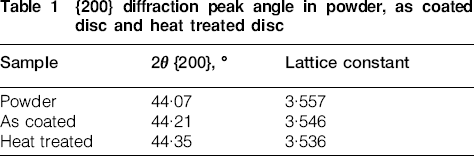
X-ray diffraction scans of the PS304 powder, the as coated and the coated plus heat treated discs are shown in Fig. 1. The large number of coexisting phases (especially in the heat treated sample) and the partial overlap of many peaks make a quantitative Rietveld analysis all but impossible. Furthermore, phases that are present in minute amounts can be seen only when using root scale. However, the scans still provide valuable information on the coatings, especially when individual phases are analysed. The Ni–Cr {200} peak position in the PS304 powder, the as coated disc and the coated and heat treated disc are compared in Table 1. A significant shift in the diffraction angle of these peaks occurs. When compared to the {200} peak of pure Ni (44·509°) given in the alICDD powder diffraction data file 04-0850,6 all the Ni–Cr peaks appear at a lower 2θ angle, as expected from the effect of Cr dissolved into Ni.7 The shift of the peaks closer to pure Ni diffraction angles indicates a decrease in the Cr content during the plasma spray process, with further decrease as a result of the long heat treatment. From an approximate calculation, based on relationship between the lattice parameter and Cr content provided in the literature,7 the Cr content in the Ni–Cr phase is ∼28 wt-% in the powder, decreases to 22 wt-% in the as coated sample and drops further to 14·5 wt-% in the heat treated sample.
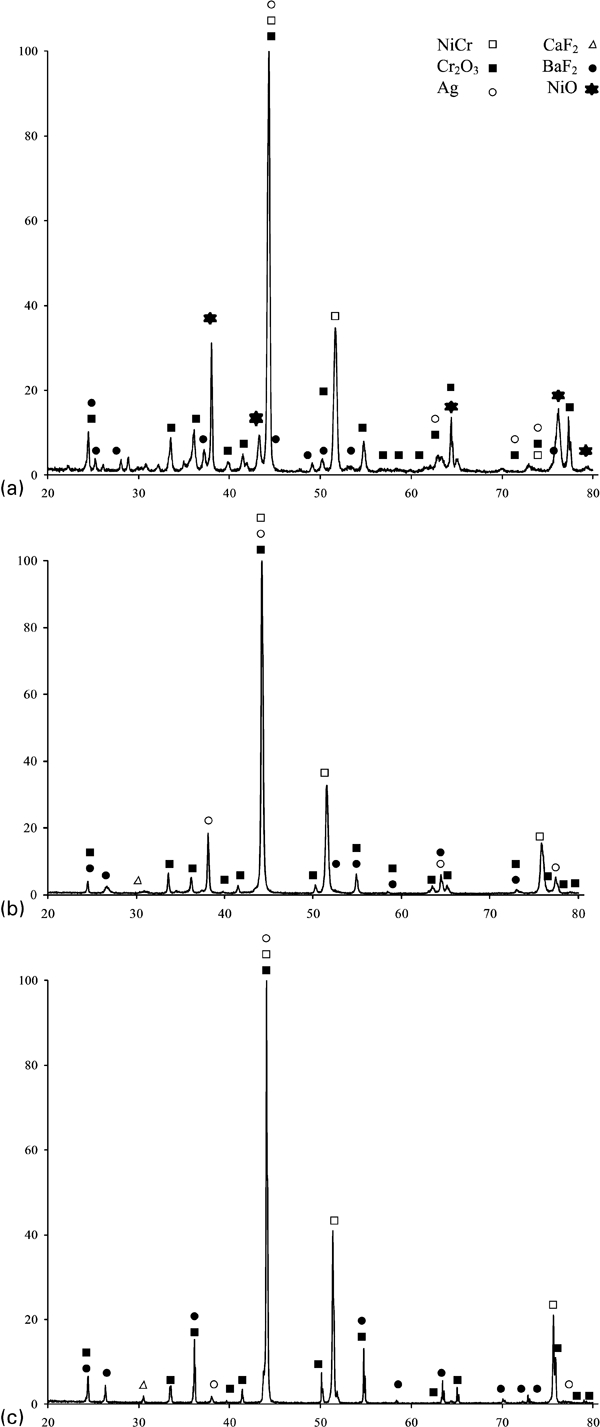
X-ray scans of PS304 powder (bottom), as coated (middle) and heat treated (top)
{200} diffraction peak angle in powder, as coated disc and heat treated disc
Comparisons with microstructures
The decrease in Cr level in the Ni–Cr phase during the coating process at first appeared to be from Cr loss as a result of the high reactivity of Cr. However, the presence of a Cr enriched precipitate seen in the heat treated microstructure analysed in EDS3 points to a drop in Cr level in the Ni–Cr matrix. This is in agreement with expected change in the lattice spacing data in Ni–Cr7 and also is qualitatively evident from the comparison of the peaks of Cr2O3 that remain at the same 2θ position for all samples. In addition, microscopy and EDS of heat treated PS304 coating further revealed dark Cr–rich precipitates embedded in the Ni–Cr matrix.3 Energy dispersive spectroscopy analysis of these precipitates detected Si as well. While the presence of Cr is evident as enrichment from partition by diffusion of Cr from the matrix, the presence of Si in the precipitate is intriguing. Si was not intentionally added, and the only source of Si appears to be from very small quantities of Si in the form of fused silica added to commercial Ni–Cr powder as a flow enhancer during atomising to produce spherical powders.3
Discussion
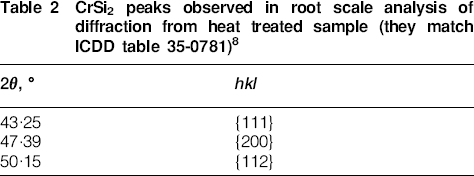
The apparent depletion in Cr of the Ni–Cr matrix, observed here by X-ray diffraction, is consistent with the formation of Cr rich dark etching precipitates in the Ni–Cr matrix noted in microstructural observations and deemed Cr rich by EDS observations in the earlier paper.3 The EDS observation of the Si and Cr rich precipitates observed in the microstructure3 pointed to the possible reaction of Cr with the Si flow enhancer, resulting in the formation of a hard intermetallic. The X-ray scans of all the samples were examined with respect to possible Cr–Si compounds. Root scale was used to be able to observe weaker peaks (Fig. 2). Of the possibilities compared with the ICDD database of crystallographic data, the spectrum for CrSi2 (PDF 35-0781)8 was found to be a good match. Peaks of the CrSi2 phase were clearly identified in the heat treated samples (Table 2). Because of the large number of phases, there is only one peak that is not shared at all with other phases in the coating (around 2θ = 43°). This peak is present in the heat treated disc but not in other samples. The higher strength of the heat treated coatings suggests that the presence of silicides in the second phase precipitates may contribute to the significant strengthening effect from the precipitates. This possibility of such strengthening is indeed supported by the observation of a high hardness (in the Vickers range of >10 GPa) of the CrSi2 intermetallic seen in the literature.9 Further studies are underway to evaluate quantitatively the effects of the concentration and volume fractions on the strengthening effects of Si in this coating. Si is commonly added as a microslagging, bond enhancing and melt flow improvement additive in many coatings. However, its strengthening effect is apparent only in this example of PS304 coating and warrants further detailed study.
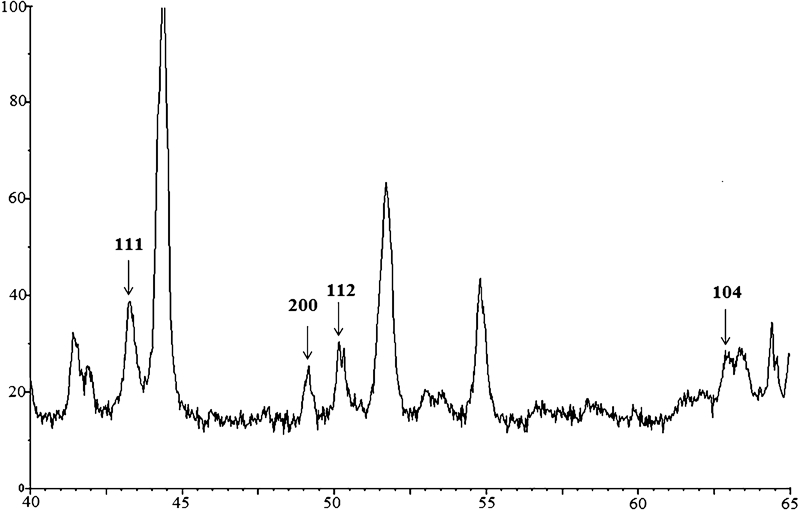
Diffraction results of heat treated sample shown in root scale to enhance visibility of weak peaks: arrows mark CrSi2 peaks; other peaks belong to major phases in coating
CrSi2 peaks observed in root scale analysis of diffraction from heat treated sample (they match ICDD table 35-0781)8
Conclusions
Unusual or unexpected Si containing precipitates seen in heat treated PS304 plasma sprayed high temperature tribological coatings have been analysed using X-ray diffraction. The significant strengthening effects of the heat treatment prompted a need for the understanding of the origin and characteristics of the precipitates. This work has revealed that Cr rich precipitates bearing Si contain clearly a chromium disilicide compound. The high hardness of the compound appears to contribute to the observed strengthening of the coating. Considering the practice of only trace levels of addition in many coatings, Si may have a cost effective and significant role to play in the strengthening of many plasma sprayed surface coatings.
Footnotes
Acknowledgements
The authors wish to acknowledge the highly skilled support of Brian Edmunds, NASA Glenn Research Center, and P. Thannhauser, Western Michigan University.