






Abstract

Electrodeposition of ceramic materials and composites
Electrodeposition is widely recognised as an essential tool in surface engineering. There has been tremendous recent progress in the ability to deposit advanced ceramic materials and composites by new electrochemical methods. Electrodeposition of ceramic and composite films is currently under investigation for various applications, in areas as diverse as catalysis, fuel cells, supercapacitors, protection of metals, biomedical implants, quantum dots, ferroelectric, magnetic and piezoelectric devices, biosensors, photonic crystals, electronic devices and batteries.
I. Zhitomirsky

Two methods1 have been developed for the electrodeposition of ceramic films: electrolytic deposition and electrophoretic deposition (Fig. 1). In electrolytic deposition method, ceramic particles are produced in electrode reactions from solutions of metal salts and form a solid deposit at the electrode surface. Electrophoretic deposition is achieved via the electrophoretic motion of charged particles in a suspension and film formation at the electrode under an applied electric field. This method requires the fabrication of stable suspensions, containing well dispersed charged colloidal particles.
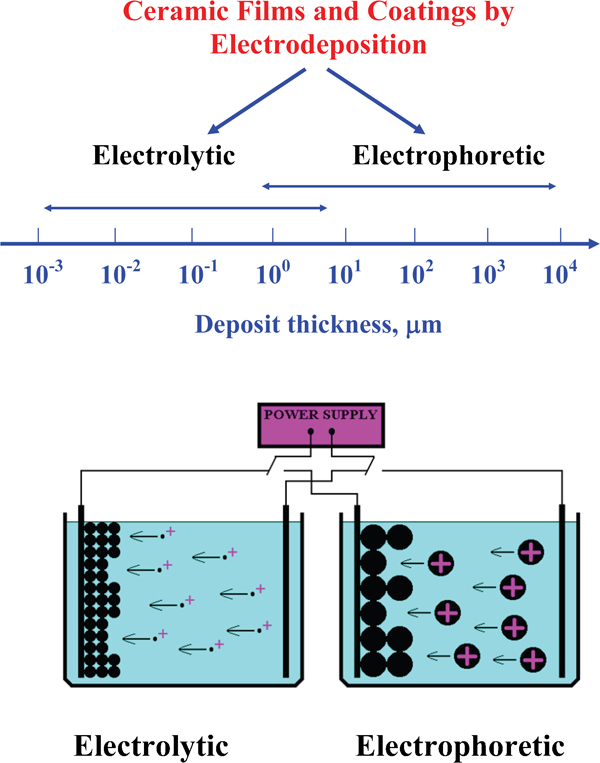
Electrolytic and electrophoretic deposition of ceramic films
Research into electrolytic deposition of oxide materials has seen a massive escalation since cathodic electrodeposition technique was applied to CeO2 and Cu2O. 2 2,3 Various electrochemical strategies have been developed for the electrolytic deposition of oxide materials, including electrogeneration of base, cathodic reduction or anodic oxidation methods. 1 1,4 The feasibility of cathodic and anodic electrosynthesis of individual oxides, complex oxide compounds and composites has been demonstrated. Currently, many investigations are focused on the fabrication of thin films of manganese dioxide for electrochemical supercapacitors and batteries, titanium dioxide for biomedical applications, zinc oxide for application in solar cells, and cerium oxide and silicon oxide for corrosion protection of metals.
A number of advances have recently contributed to the use of electrolytic deposition for the fabrication of nanostructured ceramic materials, and considerable attention has been given to the electrodeposition of ceramic coatings for biomedical applications. Numerous investigations have been conducted to date on the fabrication of hydroxyapatite coatings for the surface modification of biomedical implants. The codeposition of ceramic materials with metals and polymers has created opportunities in the preparation of novel hybrid nanomaterials and nanostructures that cannot be obtained by other methods. Electrolytic deposition of hydroxyapatite was combined with electrosynthesis of Ag for the fabrication of composite coatings with antimicrobial properties. It was shown that other functional materials such as proteins can be incorporated in the hydroxyapatite coatings. Electrochemical methods have been developed for the fabrication of metal/metal oxide nanomodulated structures. Electrosynthesis of metal oxides was combined with electrodeposition of polymers for the fabrication of novel nanocomposites. Another approach is based on the use of charged polymer–metal ion complexes. Oxide nanoparticles were obtained by electrosynthesis in situ in a polymer matrix. The particle size was controlled on the scale of 2–10 nm by the variation of ion or polymer concentration in the solutions.
Electrolytic deposition has emerged as an important technique for depositing porous films for a variety of applications, such as electrochemical supercapacitors and sensors. This versatile technique has attracted considerable attention for the fabrication of epitaxial films. There has been tremendous recent progress in the ability to produce nanofibers and photonic crystals by electrodeposition using various templates. The codeposition of ceramic materials with organic dyes has created opportunities in the preparation of novel hybrid nanomaterials and nanostructures for application in photovoltaic devices.5 Electrolytic deposition has aroused considerable interest for the development of chiral surfaces, which can find new applications in enantioselective catalytic synthesis of drugs.6 Especially interesting is the electrodeposition of compositionally modulated superlattices for the fabrication of novel quantum devices.7
Electrolytic deposition is a relatively new technique in ceramic processing, which has generated significant enthusiasm. The major impetus for the development of electrodeposition of ceramics is application of this method in nanotechnology. However, there are several challenges that have to be overcome before wide ranging industrial adoption of this technique. Electrolytic deposition can be used for the fabrication of relatively thin or porous films. Cracking, attributed to drying and sintering shrinkage, is another technological problem. A promising approach to address these problems is the codeposition of ceramic materials with polyelectrolytes.
Among the most important challenges is the deposition of stoichiometric complex oxides with advanced ferroelectric, magnetic, piezoelectric and memory properties. A successful strategy, demonstrated in several articles, relies on the use of complex precursors. Another challenge involves the control of composition of oxide and metal–oxide composites. Scientists need to design novel precursors and chelating agents for the composition control of electrolytic deposits. There are also challenges concerning the surface roughness and quality of thick electrolytic films for electronic applications. Further progress in electrolytic deposition is able to meet the needs for atomic layer control of compositionally modulated oxide and metal–oxide films.
Electrophoretic deposition strategies8 – 11 have been gaining ground in many technologies including fuel cells, supercapacitors, piezoelectric devices, protective coatings, biomedical implants and solar cells. Investigations were focused on the development of charging additives, dispersants and binders for the electrophoretic deposition of ceramic particles and composites. Advanced bath compositions were developed for the electrophoretic deposition of composites. Impressive progress has been achieved in the development of composites containing ceramic nanofibres, nanowires and carbon nanotubes. It was shown that electrophoretic deposition is an important tool for the fabrication of polycrystalline films with controlled crystalline texture, patterned films, multilayer and functionally graded composites. However, there are technological problems, which are related to the sintering of ceramic coatings. High temperature sintering of ceramic deposits on metallic substrates usually results in shrinkage and cracking. Other difficulties are related to the high temperature oxidation of the substrates and chemical reactions at the substrate/metal interface.
A new wave of interest in the electrophoretic processing of ceramic materials was related to the development of polymer–ceramic composites. Polymers offer the advantage of solution processing of composites at room temperature. Many investigations are focused on the use of cationic and anionic polyelectrolytes. Composite materials were obtained containing hydroxyapatite, bioglass, titania, silica and other materials for the application in biomedical implants. Figure 2 shows SEM image of a hydroxyapatite–chitosan coating on nitinol wire for biomedical applications. The high magnification image of the coating (Fig. 3) shows needle shape hydroxyapatite nanoparticles. The interaction of the nanoparticles with chitosan resulted in their preferred orientation, similar to the orientation of hydroxyapatite nanoparticles in natural bones. These results pave the way for the fabrication of advanced bone substitute materials by electrophoretic deposition.
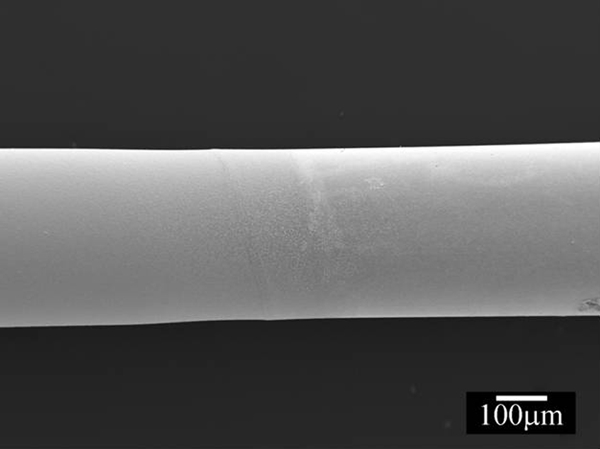
Hydroxyapatite–chitosan coating on nitinol wire
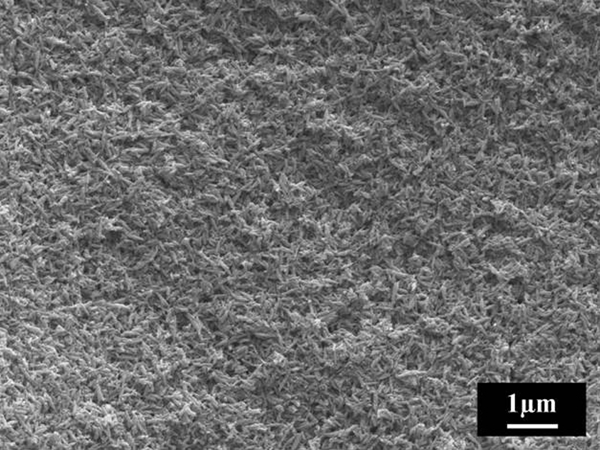
Microstructure of hydroxyapatite–chitosan coating
The recently developed electrophoretic techniques provide capabilities for the fabrication of multilayer and functionally graded composites for biomedical applications. The hierarchical organisation of structural features across several length scales is one of the challenging aspects of the electrophoretic deposition of bone substitute materials. Electrophoretic deposition has been utilised for the fabrication of composites, containing iron oxide, zinc oxide and manganese oxide in a chitosan matrix for applications in biosensors. Significant interest has been generated in the electrophoretic deposition of zinc oxide, titanium oxide and other semiconductors together with polymers for the fabrication of solar cells.
Many investigations were focused on kinetics of electrophoretic deposition and microstructure investigations with only marginal interest in the surface science aspects of particle dispersion and charging. One of the major challenges in electrophoretic deposition of nanoceramics is the development of efficient dispersants and understanding the fundamental mechanisms of the dispersant adsorption and electrode reactions. The electrophoretic deposition of multilayer and functionally graded composites for biomedical and electronic applications is an exciting area of future research. The fabrication of advanced composite materials requires the development of common dispersants and binders for codeposition of different materials. Successful applications of electrophoretic deposition require a strong improvement in methodology to ensure reproducibility and better understanding of the structure–property relationship and deposition mechanisms.
Fundamental research and development in the field of electrochemistry of ceramic and composite materials have been increasing every year, as seen by the ongoing increase in number of scientific publications and new applications of electrochemical methods. It is expected that electrochemical techniques will play an increasingly important role in surface engineering.