







Abstract
Cu–Ni alloys were electrodeposited by the brush plating technique from sulphate/citrate electrolyte at various pH values. The effects of pH on composition and surface morphological properties of alloys were investigated by X-ray fluorescence and atomic force microscopy. The Cu content increased in the composition of Cu–Ni alloy at electrolyte pH 2. The deposition mechanisms of Cu, Ni and Cu–Ni were investigated by cyclic voltammetry. The lower electrolyte pH leads to the higher reduction current density. The corrosion behaviours of the deposits at different pH values were investigated by Tafel analysis and electrochemical impedance spectroscopy. The corrosion studies indicate that the Cu–Ni alloy exhibits better corrosion resistance at higher pH values than at lower pH values. The surface roughness decreases with increasing solution pH and this observation was confirmed by atomic force microscopy measurements.
Introduction
Electrodeposition 1 1,2 of Cu–Ni alloy has attracted widespread interests because of their physical, chemical and mechanical properties. Cu–Ni alloys are commonly used in various sea water applications such as valves, fittings condenser and heat exchanger tubes. In addition, these alloys possess good machinability, and excellent thermal and electrical properties and are particularly resistance to biofoulings. Application of this alloy in industrial practice has since made a number of researchers contribute their work to investigate Cu–Ni alloy with emphases on their structural, compositional and morphological characteristics. The influence of electroplating parameters on alloy composition and structure has been extensively studied, and mechanism for alloy formation has been proposed earlier. 3 3,4 Electrochemical behaviours of Cu–Ni alloys were extensively studied.5 – 7 The effects of amino acid on corrosion resistance of Cu–Ni alloy were reported by Badway et al.6 Their studies indicate that the corrosion inhibition was 85% in alloy with the lower nickel content. In electrodeposition process, the bath pH has a significant effect on crystalline structure, deposit morphology, corrosion behaviour and current efficiency. 8 8,9 The aim of the present study is to investigate the influence of electrolyte pH on the composition, corrosion and morphology of the brush electrodeposited Cu–Ni alloy.
Experimental
The electrodeposition of Cu–Ni alloy films was carried out by the brush plating technique 10 10,11 and the electrolyte solution consists of 10 g L−1 CuSO4, 84 g L−1 NiSO4 and 59 g L−1 tri-sodium citrate. The depositions were performed at 4 V for 20 min on copper substrate and graphite stylus acts as anode. The depositions were carried out at various solution pH values ranging from 2 to 6. The pH of the electrolytic bath was adjusted to appropriate values by adding H2SO4 and KOH solutions. The cyclic voltammetric (CV) studies were carried out for different pH solutions as well as for the individual metal solutions with a scan rate of 10 mV s−1. For CV studies, platinum is used as a counter electrode, saturated calomel electrode is the reference electrode and the copper substrate is the working electrode. X-ray fluorescence system was used to identify the composition of Cu–Ni alloy films. The corrosion behaviours of the coatings were investigated by Tafel analysis and electrochemical impedance spectroscopy techniques using Parstat 2273 instrument. The Tafel analysis was carried out in 3·5 wt-% NaCl solution using three-electrode assembly. Platinum electrode was used as a counter electrode, the reference electrode was saturated calomel electrode (SCE) and deposited alloys were used as working electrodes. Electrochemical impedance measurements were done using the same three-electrode assembly as used for the Tafel analysis in the frequency range 100 kHz to 100 mHz with an amplitude potential of 5 mV. The surface morphologies of the deposits were characterised by atomic force microscopy using a molecular imaging atomic force microscope.
Results and discussion
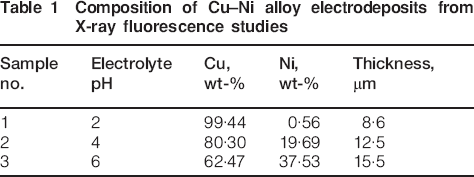
X-ray fluorescence analyses were carried out for Cu–Ni alloy deposits obtained from the electrolyte pH 2, 4 and 6. The relationship between the electrolyte pH and composition of deposits is shown in Table 1. As a general rule, the variation of pH values should have little effect on the composition of alloys deposited from the electrolyte containing the metal as a simple ion and should have larger effect on the composition of alloy deposited from electrolyte in which parent metal were present as complexes.12 The addition of acid to the electrolyte, the stability of the copper-citrate complex will reduce. Therefore, the efficiency of copper complex reduction at lower pH values was high. Because of easy break of complex, the Cu content increases from 62·47 to 99·44 wt-% and the Ni content decreased from 37·53 to 0·56 wt-% with a decrease in the solution pH from 6 to 2. The copper content decreases in the Cu–Ni alloy composition with increasing electrolyte pH.12 The thicknesses (Table 1) of the Cu–Ni alloy coatings were increased with increasing electrolyte pH. This is due to the fact that the higher hydrogen evolution occurs at the lower electrolyte pH which leads to a decrease in the efficiency of the metal reduction.
Composition of Cu–Ni alloy electrodeposits from X-ray fluorescence studies
Cyclic voltammetric studies
The CV studies were carried out for sulphate/citrate electrolyte in the potential range −1·6 to +1·0 V. The curves of the individual metal components, Cu and Ni are presented in Fig. 1 and those recorded for the Cu–Ni alloys are shown in Fig. 2. Figure 1a shows the CV for Cu and the anodic peak A1 was observed at 0·2 V(SCE) and it is related to the CuO formation as per the following reaction13

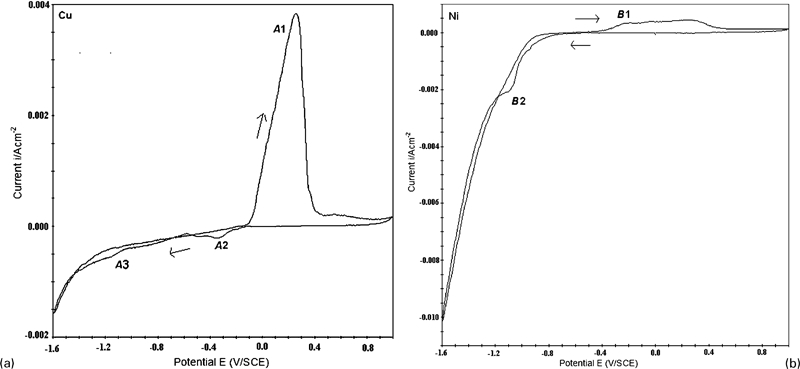
Cyclic voltammetry curve for individual a Cu and b Ni system
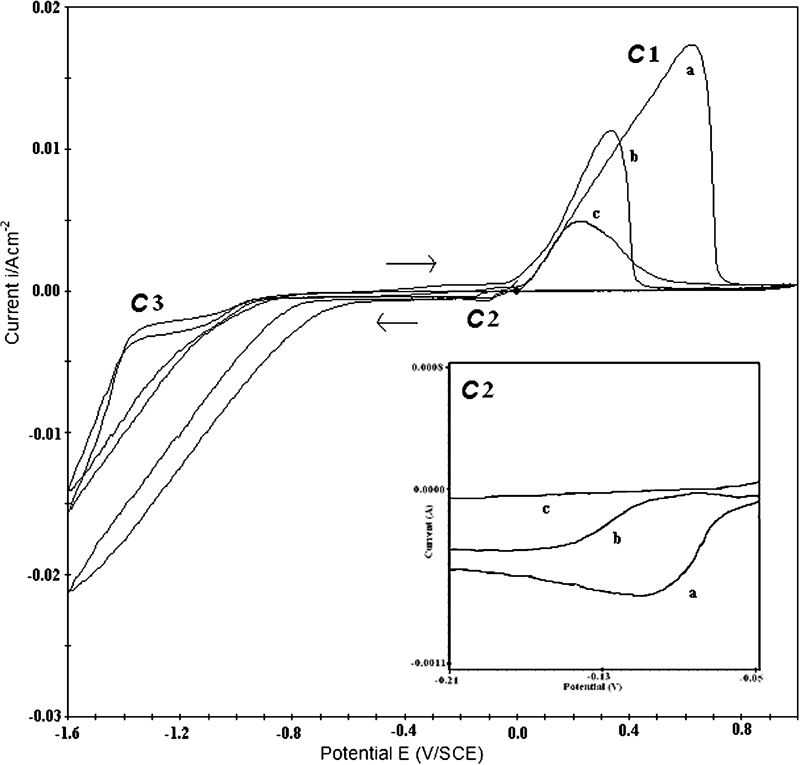
Cyclic voltammogram of Cu–Ni alloy deposits from sulphate/citrate electrolyte: a pH 2; b pH 4; c pH 6
Ni shows the anodic peak B1 at 0·2 V (Fig. 1b) which can be related to NiO formation13

The CV recorded for the Cu–Ni alloys deposited at pH 2, 4 and 6 shows similar behaviour except more reduction current (Fig. 2). When the electrolyte pH decreased from 6 to 2, the hydrogen ion concentration is increased, so more the hydrogen evolution will occur at electrolyte pH 2. The more hydrogen evolution leads to the higher current at electrolyte pH 2. The Cu–Ni alloy shows the one anodic peak C1, obviously related to the CuO as well as NiO and this can be seen in Fig. 1. There is no separate peak for the CuO and NiO, because the oxidation potentials of CuO and NiO are very close which leads to the overlay of two peaks, so only one oxidation peak can be obtained. In the cathodic region, two peaks are observed at C2 and C3. The peak C2 is related to the reduction of Cu and C3 is related to the reduction of Cu–Ni alloy. There is a characteristic cross over between the current during cathodic and anodic sweep, which suggests the presence of nucleation and growth process. These features are common for the CV curve at pH 2, 4 and 6 and the only difference is in the deposition current which gets decreased in the order of pH 2, 4 and 6. The anodic peak is at 172 mV for pH 6 and it gets shifted to 614 mV for the solution with pH 2. On the other hand, the variation of solution pH affects the intensities of reduction peaks C2 and C3. The intensity of C2 decreased and C3 increased with increasing solution pH. This suggests that the formation of Cu–Ni alloy phase increases and copper phase decreases at pH 6. This result agrees with that obtained by X-ray fluorescence analysis.
Based on our studies, the alloy formation can be described by the following equation

Tafel analysis
The corrosion behaviours of the Cu–Ni alloy deposited at various solution pH were investigated in 3·5 wt-% of NaCl solution (Fig. 3). The corrosion current Icorr, corrosion potential Ecorr, corrosion rate and polarisation resistance Rp were calculated by using Tafel analysis and are listed in Table 2. The Icorr decreases exponentially for Cu–Ni alloys deposited at electrolyte pH from 2 to 6 and shifts the corrosion potential to less negative values. The Icorr value of Cu–Ni alloy deposited at pH 2 is 17·8 μA cm−2 and it decreases to 11·07 μA cm−2 for the Cu–Ni alloy deposited at pH 6. The Ecorr values shifted from −330 to −256 mV cm−2 for Cu–Ni alloy deposits when the electrolyte pH is increased from 2 to 6.
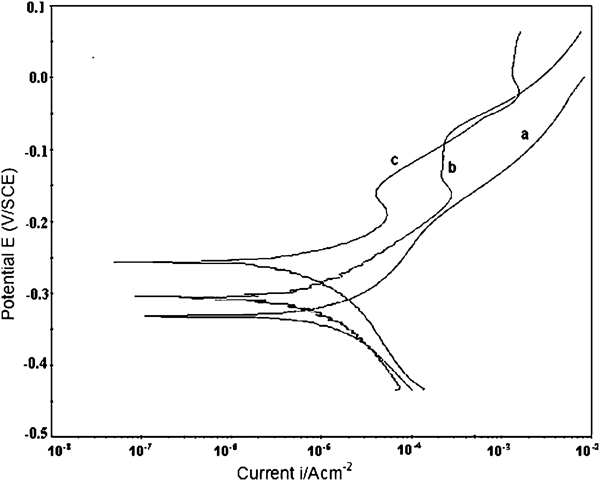
Tafel curve for Cu–Ni alloy deposits at a pH 2, b pH 4 and c pH 6 in 3·5 wt-% NaCl solution
Corrosion resistance data for Cu–Ni alloy deposits at different pH values

On the other hand, the corrosion rate for Cu–Ni alloy deposited at pH 6 was very low compared with Cu–Ni alloy deposited at pH 2 and 4. The polarisation resistance of Cu–Ni alloy also showed the same trend like corrosion rate. In the anodic region of Tafel plot, the formation of passivation can be seen when the electrolyte pH increases. This is due to the increase in nickel content in the deposits, when the electrolyte pH is increased from 2 to 6. This leads to the formation of NiO passive layer deposits. In general, the formation of passive layer always leads to the better corrosion resistance. From this study, it is suggested that the Cu–Ni alloy deposited at pH 6 has better corrosion resistance than the other deposits.
Electrochemical impedance spectroscopy studies
The impedance data of Cu–Ni alloy deposited at pH 2, 4 and 6 are presented in Fig. 4. The interception of real axis in the Nyquist plots at higher frequency is ascribed as electrolyte bulk resistance Rs and at lower frequency the interception of the real axis is ascribed to the charge transfer resistance Rct. The Nyquist plots showed single semicircle for deposits at all pH values. This is due to short exposure time. The double layer capacitance Cdl and charge transfer resistance Rct values were determined from electrochemical impedance spectroscopy measurement and summarised in Table 2. The Cdl value for Cu–Ni alloy deposited at pH 2 was 13·47 mF cm−2 and it decreases to 570·8 μF cm−2 for the deposits at pH 6. The charge transfer resistance values increased from 786 to 9194 Ω cm−2. In principle, higher value of Rct and lower value of Cdl indicates better corrosion resistance of coatings. Therefore, these values suggest that the Cu–Ni alloy deposited at pH 6 has a better corrosion resistance.
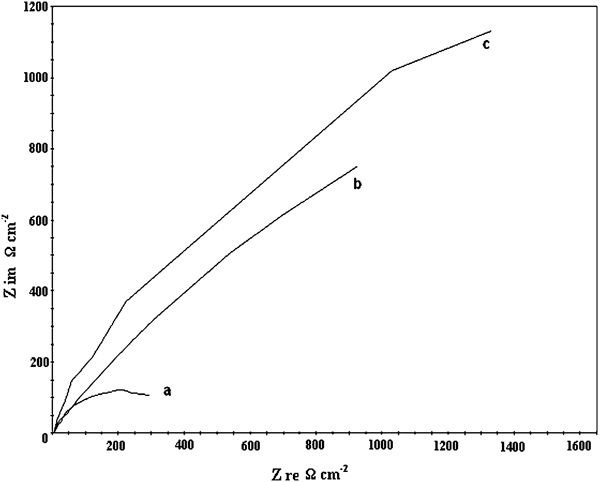
Nyquist diagrams of Cu–Ni alloy deposits at a pH 2, b pH 4 and c pH 6 in 3·5 wt-% NaCl solution
Morphology studies
Figure 5 depicts atomic force microscopic images showing surface morphology of the Cu–Ni alloy obtained at pH 2, 4 and 6. It indicates that the surface of the films deposited at pH 6 (Fig. 5c) appeared to have a uniform distribution of granular shaped grains with crack free and very smooth surface. The average grain size varied between 40 to 80 nm. The average surface roughness Ra of the sample is 0·08 μm. For the film deposited at pH 4 (Fig. 5b), the surface morphology slightly disturbs the uniform distribution with agglomeration. The average grain size ranges from 100 to 150 nm and Ra value is 0·11 μm. For the deposits at pH 2 (Fig. 5a), the surface morphology was uneven and more roughness is observed. The average grain size ranges from 250 to 300 nm and Ra value is 0·21 μm. It can be concluded from these results that average distributed grains with agglomeration of Cu–Ni alloy deposits are obtained at electrolyte pH 6 compared with other deposits at lower electrolyte pH. The smaller grain improves strong binding with adjacent grains and this will produce compact and smooth films of alloy coatings. The lower grain size and roughness facilitate compact and smooth Cu–Ni alloy coatings and this enhances the corrosion resistance properties of coatings.
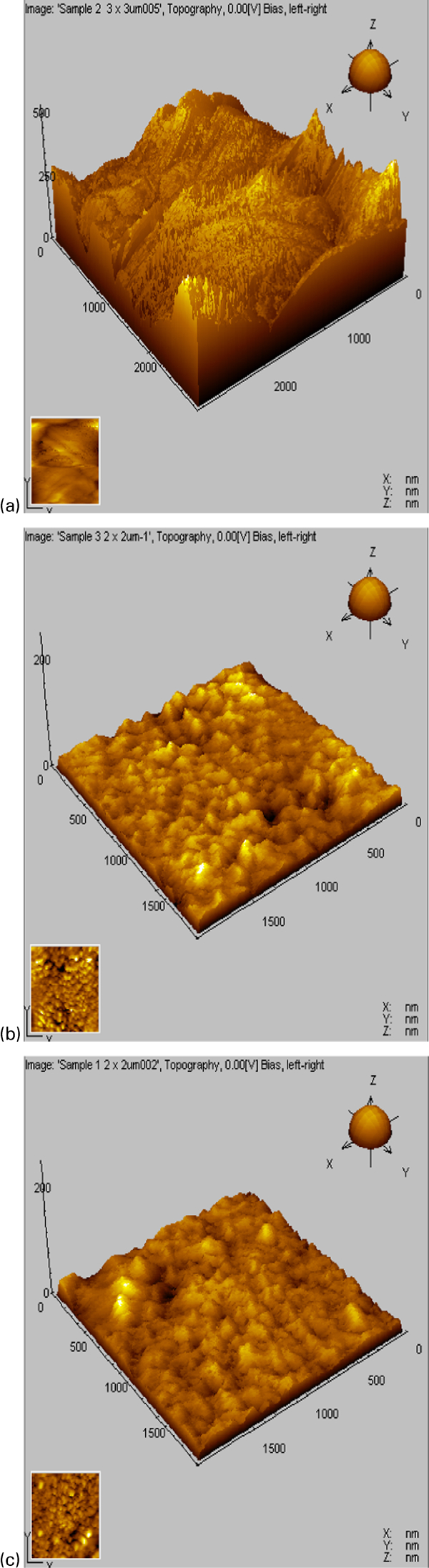
Surface morphology of Cu–Ni alloy deposits at a pH 2, b pH 4 and c pH 6
Conclusion
The effects of solution pH on Cu–Ni alloy electrodeposition from sulphate/citrate electrolyte and the composition, corrosion, morphology and mechanism of the deposits were investigated. Composition analysis showed that the nickel content increases up to 37·53 wt-% in alloy deposits with increasing electrolyte pH. Cyclic voltammetry studies clearly shows the formation of Cu–Ni alloy system. Tafel analysis and electrochemical impedance spectroscopy on all deposits indicate that the Cu–Ni alloy deposited at pH 6 exhibited better corrosion resistance behaviour compared to other deposits. Polarisation studies indicate that Rp increases up to 2·9 Ω cm−2 and Icorr reduces to 11·07 μA cm−2 when pH is increased from 2 to 6. Furthermore, the high Rct (9194 Ω cm−2) obtained from Nyquist plots also confirms the above fact. Our studies indicate that the nickel rich Cu–Ni alloy deposits exhibit better corrosion behaviour than the other deposits. Surface morphology of the alloy deposited at pH 6 indicates very smooth and uniform deposits.
Footnotes
Acknowledgements
This research was supported by DRDO fund under grant no. ERIP/ER/0502128/M/01/1049.