







Abstract

Background
There are many reasons for the progression towards greater levels of automation in our industry. Among these are the drive for increased efficiency, reduction in manpower cost, greater consistency and reproducibility of results. All of these are important goals, but perhaps the most fundamental reason often is safety. Where molten metal activities are concerned, removing the need for the operator also eliminates the risk.
A sign at Tata Steel proclaims: ‘The most important thing you can do at work today: return home safe to your family’. That statement emphasises the paramount importance of workplace safety to all of us.
Tata Steel Research and Development operates pilot plant facilities for process research and product development at its Teesside Technology Centre. The main melting unit is a 7 t electric arc furnace with secondary steelmaking facilities including ladle arc heating and vacuum tank degassing. Casting options include a vertical with bending continuous casting machine (Fig. 1 and Fig. 2) as well as pit side and ingot casting options, and a small twin roll strip caster.
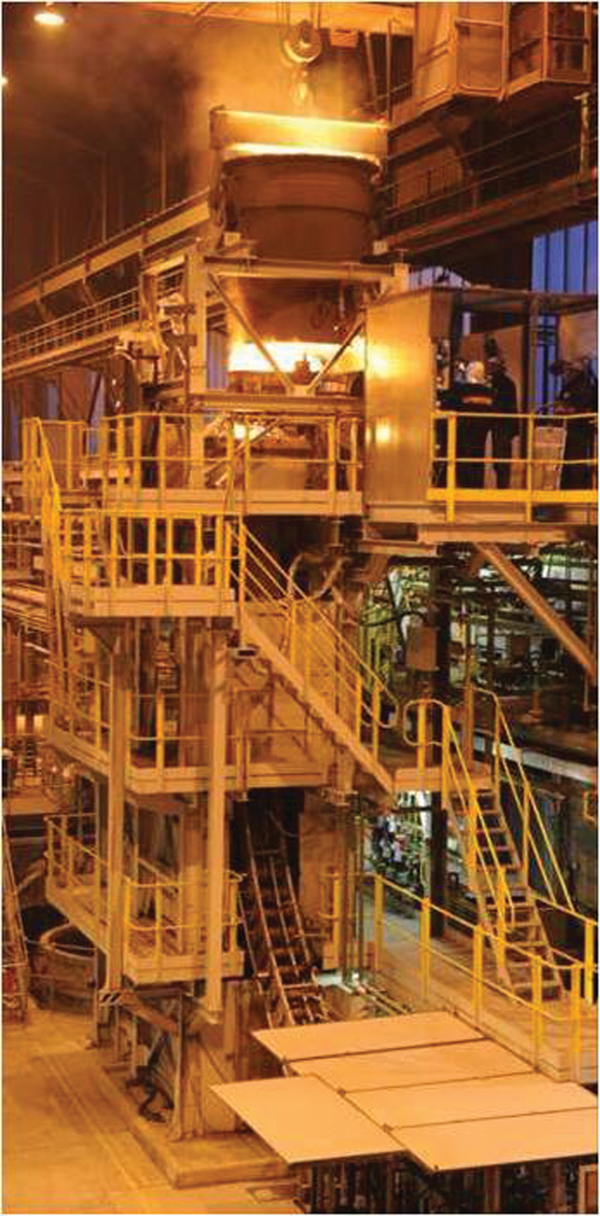
Pilot caster at TTC. Operators are now remote from ladle and tundish
The pilot caster was installed in 2007 on the site of a previous much simpler vertical casting machine. The melt size was also increased from 3 t steel ladles with stopper rod control and no secondary steelmaking, to much larger 7 t ladles with twice the diameter, slide gate operation and added freeboard for vacuum treatment. One effect on caster operation was that an already small and crowded casting platform became a much more congested working area. The basic caster details are given in the table.
Technical challenge
Sometimes safety and technical challenge go hand in hand. A steel spillage from a leaking nozzle, safely dealt with in another part of the plant, made us realise that if a similar incident had occurred in the confined area of the casting stage of the pilot casting machine, the outcome may have been different. The space for safe evacuation of personnel is much smaller and, since many operations were controlled manually, up to four people would have needed to move in a similar direction at the same time.
The challenge laid down by the Director of Process Research, was to make the casting area an unmanned space, before operations recommenced. This involved several changes any one of which could constitute a trial programme in its own right, on top of already planned moves to submerged pouring and commissioning work on new section sizes. In this case, all aspects had to come together and work without manual intervention.
Changes required
The main changes involved included:
change from crane to ladle stand support of casting ladle
change from stopper controlled to slide gate ladle and remote operation
new ladle shrouding arrangement
automated tundish stopper control, rather than manual
automated mould fill and strand startup, rather than manual start
commission new billet and mini-slab section size and 100% submerged casting
new mould powder feed system (pneumatic control) rather than oil lubrication
hydraulically controlled emergency tundish and ladle shut-off systems
emergency back-up water system improvements
modifications to PLC control to operate all the above systems
construction of operators’ enclosure remote from mould with camera and PLC autocontrols
automated spray control for secondary cooling.
Several aspects are used on production casters, but the combination of all of these represented a unique challenge, particularly when implemented all together. Moreover, part of the reason for manual control of some operations in the past is linked to the fact that some commercially available solutions, justifiable for high tonnage ‘24/7’ operations, can be excessively expensive or inflexible for pilot plant research patterns of operation.
Solutions developed combine some known technologies and others developed or adapted ‘in-house’. At the same time, the caster operations were assessed by a formal Process Hazard Review overseen by ABB. This highlighted the need for separation of control systems to ensure that independent safety back-ups are always available even in circumstances such as total plant power failure, or loss of PLC control.
Implementation
Safety challenges surrounded design and operation of hydraulic, automated, emergency ladle and tundish shut-off systems linked to alarm trips from process control measurements, but with independent back-ups should power or PLC control fail. The caster control console was moved to a protected operator’s enclosure constructed a few metres away from the casting position. Figure 2
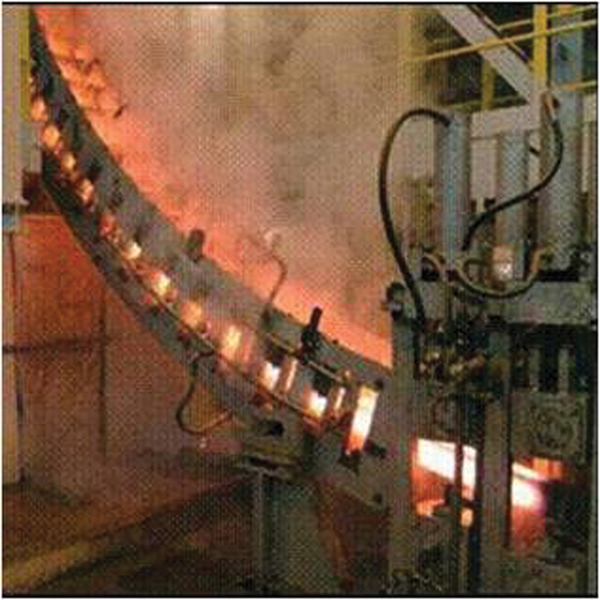
Casting in progress
In the opening seconds of a cast, tundish fill relies on having some observation of steel level. The tundish fills rapidly and must be carefully controlled. The chosen solution relies on use of remote cameras and filters (Fig. 3). Cameras were also set up to give views on the casting mould to check on steel level, the meniscus and mould powder coverage. Choice of camera and settings required research and careful development. These cameras must perform adequately both in the opening moments when the steel flow is intensely bright with no slag or cover powder present and yet react fast to give a clear image later when the surface is covered by ‘black powder’. Reaction time to control the caster at start of cast is a few seconds and response rate of the cameras must be rapid enough that the screen is not blanked out during this period by overexposure.
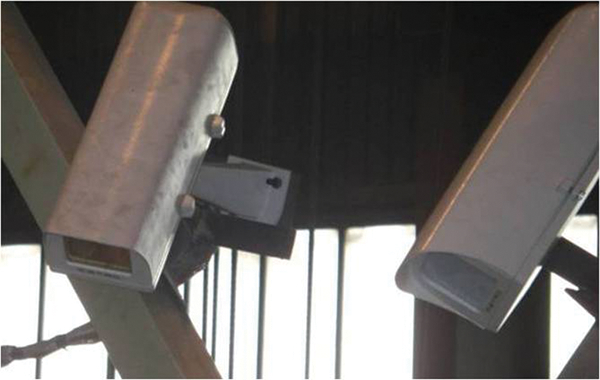
Cameras for viewing tundish and mould
Camera views form part of the caster operator’s information at the control console and help judge whether to make a direct intervention to remotely change parameters such as increasing powder feed or to over-ride the automatic system and initiate emergency strand shut-off, if it appears that the automated system trips are slow to respond. Laser alignment and camera views are also used to judge slide gate opening for initial tundish fill, although ultimately it is hoped to introduce a load cell based weight control loop.
The most critical aspect is obtaining a stable start to the cast; particularly in the first few seconds while the mould fills to a level at which detectors begin to sense and control the flow automatically to match the chosen casting speed. Owing to the constraints imposed by the small mould sizes, level detection has to be radiometric. While the system is good at controlling steady state operation, the rate of response during mould fill gave cause for concern. The combination of system time lag, and hysteresis in the stopper control resulted in cases where slow flow control response was followed by overcompensation. This mould level ‘hunting’ is similar to that which can be encountered on production casters. In the early casts, instances of mould overflow did occur due to this. The rapid mould fill could be too quick for the emergency shut-off to compensate. With the previous manual control, the mould operator was able directly to observe the mould and have a ‘feel’ for the stopper response and such problems were avoided. In this case, a fully automated response was required. Tuning the mould level control loop gain settings and stopper actuator brought improvements, but did not fully resolve the problem. The key was to re-engineer the stopper mechanism with higher precision and introduce high temperature bearings which eliminated the hysteresis. This also brought additional benefits of improved mould level stability throughout casting.
The move to unmanned casting also required automated and reliable mould powder feeding. For the pilot scale, conventional feeders were considered too bulky. The system adopted uses a fluidised powder feed originally designed for conveying flour to mixers in the food industry (Fig. 4).
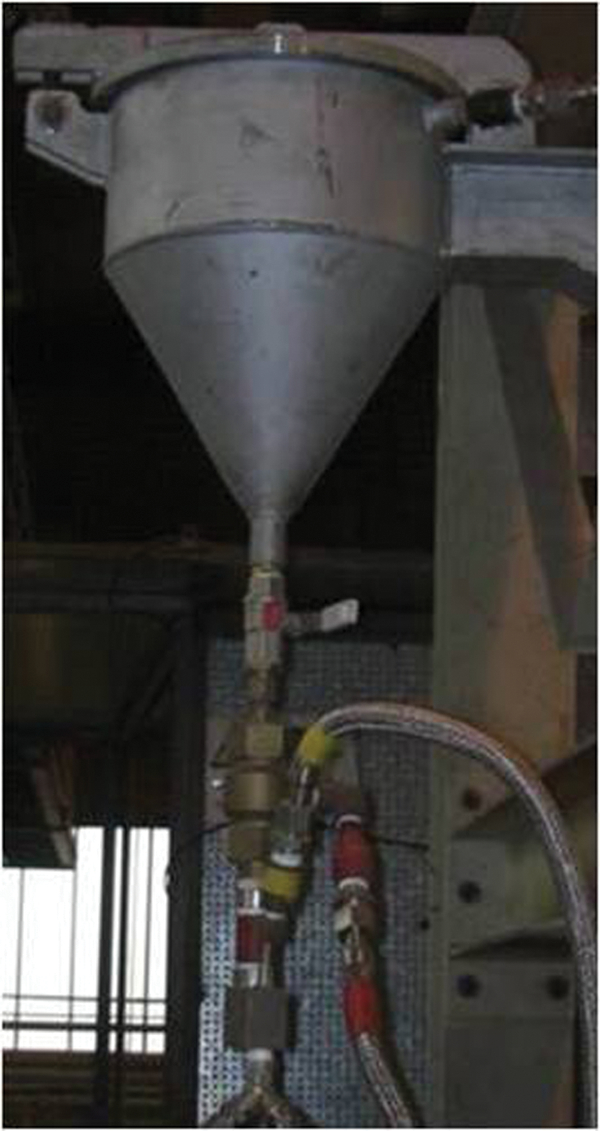
Mould powder feed unit
These changes and also, the emergency shut-off systems were checked in a series of offline trials with liquid steel followed by several dummy casting runs and simulation of all envisaged failure modes. However, although ‘cold’ tests could demonstrate and test the logic of the revised PLC and process control operations, the final proof of rates of response could only be shown by live casts with liquid steel.
Hot recommissioning followed. It has now been demonstrated that all the above systems are working and optimisation of process parameters is continuing. Start of cast has been automated further, moving on from remote push button startup on ‘visual’ mould fill to 100% autostart.
Outcome
Following successful implementation of these changes, not only has a safer operating environment been achieved, but the operational performance has also improved significantly, especially aspects related to mould level control and surface quality.
This increased level of confidence in the caster control is supported by successful casting across the range of conventional steels including excellent quality when casting more difficult grades such as peritectic qualities, through to successful casting of grades considered extremely difficult to cast continuously such as highly alloyed bainitic steels and grades with severe casting difficulty such as TWIP steels.