






Abstract
The history of the development of human civilization mirrors the evolutionary innovations and habits of microorganisms. Escape from environmental extremes within caves (cryptoendolithic habitats) has given way to a predominantly surface-dwelling (epilithic) civilization. Humans, like microorganisms, extract minerals and elements from rocks — a form of biological rock weathering — which are fashioned into houses and other technology — a type of biomineralization. During the last century, humans have developed new microbial capabilities including travel from continent to continent in aircraft (spores) and the ability to produce toxins to kill other organisms. The biomineralizing, spore-forming, rock-inhabiting human biofilm will eventually expend its nutrients, unless, in a remarkable departure from the microbial world, humans on other planetary bodies return resources to their progenitor biofilm. Alternatively, as with microorganisms, the human biofilm will be forced to adapt to live in a nutrient-depleted world at much lower productivity or biomass than at present. Comparing humans with microbes, rather than other primates, yields a much more faithful interpretation of the development of our civilization and might provide new ways to model, mathematically and sociologically, the development of society.
Introduction
Attempts to understand the history of humanity and its future have been a pervasive goal of historians and political philosophers. Most of these enquiries are constructed on efforts to understand human behaviour and how these behaviours influence the development of society (Boucher2003; Cahn 2005). Although these may yield insights into why people have acted in particular ways at particular times in history, they depend upon a coherent, consistent and predictive understanding of human behaviour, which has been notoriously difficult.
Another approach to investigating the history of our society is to examine the social organization of an organism that we consider to show similarities to humans. In this way, we might try to understand why society has developed in certain ways and whether there is any inevitability about these developments, underpinned by basic biological factors. To choose primates, our closest living relatives, might seem logical (Lancaster 1975; Stanford 2001). However, two problems with other primates are that they are not as numerous as humans and they do not manipulate their environment on a grand scale. Although on an individual level they share many similarities with human beings, if it is the history of society, a collected mass of humans, that we are interested in, they are not necessarily useful.
A more faithful model for understanding the way in which humans and their societies have progressed, and one I shall discuss in this paper, might be the microbial world. Microorganisms manipulate their environment on a huge scale (Madsen 2008). Like humans, they are numerous, and so they equate in some degree to the large populations of humans that have emerged since the beginnings of civilization. I discuss the capabilities and habits of microorganisms, drawing parallels to human society with a focus on technological developments. The microbial world highlights inevitable trends in the development of human civilization and its interaction with the environment.
Human habitation and the lithosphere
Like the microbial world, humans and their societies have been inseparably linked to the Earth's lithosphere — living on, within, and using the resources that come from, the Earth's crust. It is not surprising, therefore, that if one traces how humans emerged from their primitive state to the present-day, major types of human habitation have parallels to the microbial world.
Many microorganisms, to escape the extremes of Nature, such as desiccation and ultraviolet radiation, live inside rocks that provide them with some protection compared with communities living on the exterior (Campbell1982; Büdel and Wessels 1991; Bell1993; Cockell et al.2002). These ‘cryptoendolithic’ (hidden inside rocks) habitats (Friedmann 1982), which have been most thoroughly investigated in the polar regions and in hot deserts, represent a quite ancient means of protection, even if some of the organisms that inhabit them are not. Before microorganisms evolved sunscreen compounds and anti-desiccant molecules that they could secrete to protect themselves, rocks would have provided the earliest types of naturally available shelter.
Humans too, in their early stages, sought the shelter of rocks. Cave dwellings protected them from the physical extremes of the outside world, and particularly during the night, predators. Even today, in north China, people inhabit caves, like microbes apparently preferring the more stable environmental conditions within them compared to free-standing houses (Yoon1990). To some people, the natural fractures and cavities in the Earth's crust might appear a primitive means of escaping the Earth's extreme environments, but they do not require special effort and are available free for the taking to any organism, on the microscopic or macroscopic scale, that can find a use for them.
As humans developed early technology, including fire to ward off predators, clothes to protect against the worst extremes of the environment, some of them presumably took up residence in less capacious rock dwellings or spent more time near the surface, perhaps using caves only for the winter. More exposed early housing arrangements became possible. In the microbial world, many organisms are found to inhabit cracks in the surface of rocks. These ‘chasmoendoliths’ are often more exposed than their more deeply hidden cryptoendolithic counterparts (Broady 1981). As solar radiation and other extremes can impinge more easily into many surface cracks and cavities, they can potentially be home to organisms that are more extreme tolerant than the cryptoendoliths.
With sufficient innovations, microorganisms are able to take on the full panoply of environmental threats in the outside world. UV-screening compounds, anti-desiccation compounds and mucilaginous sheaths (all of these analogous to clothes) are just examples of the innovations that allowed the microbial world to conquer exposed surface habitats. These developments allowed them to become ‘epilithic’ — able to cover the exposed surface of rocks, without recourse to protected habitats and cavities (Wessels and Büdel 1995).
Human society, perhaps early on, was epilithic. If our origins derive from retreating forests and humans came from the trees into the savannah, then humans were epilithic from the earliest stages, passing back into cryptoendolithic and chasmoendolithic habits in some extreme areas of the world where the climate was more inclement. The discovery of microbial ‘mats’ (thick biofilms) and stromatolites (surface concretions of microbes and minerals) in the early fossil record suggests that the microbial world, too, from its earliest stages, had epilithic representatives (Schopf et al. 2007).
It is tempting to think of a logical sequence from cryptoendolithic to chasmoendolithic to epilithic growth in development, corresponding to an increasing ability to tolerate and thwart environmental extremes; but in human society, as with microorganisms, probably all three of these states were represented early on, with a generally increasing epilithic habit as the means to cope with environmental extremes in different areas of the world improved. In general, as the technical sophistication and size of human societies increased, so they took on a more predominantly epilithic character. Today, as with microorganisms, members of humanity can be found that fit all of these habitat classifications.
Many microorganisms use local minerals, lying around in the environment, to build natural structures that provide protection. Stromatolites trap sediment and small rock grains into their biofilmlike structure which provides protection from extremes such as ultraviolet radiation (Tewari and Seckbach 2011). This early type of biomineralization represented a departure from merely using the existing cavities and fractures in rocks to actively gathering rocks to build shelters. The earliest stone and mud houses built by humans represented the transition of our own civilization to primitive biomineralization. Like mineral-covered stromatolites in the earliest Precambrian, the rivers, lakes and coastal regions of the Earth become slowly covered with geometrically regular rock and mud formations near water bodies where food was abundant and within which people dwelled.
At some point in the distant past, a human first took a stone or other implement and hacked at the side of a cave or dug into the ground to expand the size of their dwelling. That remarkable moment, now lost in history, marked another transition. At this point, humans paralleled the microbial capability of ‘euendolithic’ growth (Golubic et al. 1981; Cockell and Herrera 2008) — the active boring into rocks to access new space and resources. This transition was probably a step-by-step change, for it was only when the first humans truly artificially constructed an underground cavern and lived within it could it be claimed that humans were euendolithic in the exact sense of the word. Nevertheless, the mere interest in breaking down minerals as a means to increase living space was a departure from the passive opportunity-seeking nature of living inside or on rocks, or gathering rocks lying around to biomineralize houses. Rather, it unveiled humanity's propensity to seek actively to alter the lithosphere to improve living conditions in a manner quite identical to microorganisms.
Microbial capabilities of the human biofilm
There are many natural capabilities of humans that match our microbial counterparts. Some of these biological capabilities include our ability to move — motility in the microbial world — which, as with microorganisms, greatly increases our ability to spread the extent of our biofilmlike tendencies.
Humans have the ability to communicate and adjust their behaviour accordingly. Although much is made of the capacity for language, microorganisms also speak to one another using chemical compounds. They can sense when they are alone or when they are surrounded by neighbours. This ‘quorum sensing’ gives them the ability to socially organize, which leads to collective complexity (Gera and Srivastava 2006). It may even be that microbes can use sound and light to communicate with each other (Reguera2011), although they cannot communicate sufficiently, nor do they have sufficient intelligence, to predict the effects of their collective action on the environment in advance (although, this collective predictive capacity is not something that is eminently obvious in humans either).
But to follow logically my previous discussion on our relationship with the Earth's crust, consider some of the rock-dwelling characteristics that humans have developed that have a marked similarity to the microorganisms and have shaped the history of our civilization.
From a very early stage, people realised that rocks contain minerals and elements of use. Historians categorize these emerging recognitions in phrases such as ‘the Stone Age’, ‘the Bronze Age’, and ‘the Iron Age’, even ‘the Nuclear Age’. Each of these ‘Ages’ represents a new stage of sophistication in the use of rocks, or the purification of materials from rocks (Gräsland 2005). Since the very beginnings of microbial evolution, microorganisms have been extracting metals and other elements from rocks. When microorganisms first exuded protons, organic acids or chelating compounds to remove nutrients from the Earth's crust, they entered into their Stone Age. We do not know when these first capabilities emerged; it is possible that similarly to humans, microorganisms on the early Earth began by scavenging easily available resources that had already been weathered from rocks in physical and chemical reactions. Similarly, in the case of early human history, rocks and other minerals of use that had become naturally exposed were gathered.
At some point in their early evolution, microorganisms became capable of extracting vital elements from rocks directly. Many oxidize and reduce iron, which provide not just a source of energy to them, but a source of iron as a nutrient and these activities often result in the formation of biominerals (Ghiorse and Ehrlich 1992). When these innovations emerged, the microbial world entered its ‘Iron Age’.
For microorganisms and humans, the common parallels in these technical developments are both driven by a simple common problem — there are limited elements and materials available that are in a form appropriate for immediate use. Most materials useful to us are bound into the rocks. The earliest evolutionary challenge faced by both microorganisms and humans was finding ways to manipulate and extract vital elements and materials from the Earth's crust to sustain themselves and their communities.
There is no great value in running through every type of mineral or element we can think about that has a use, because the point is the same. Microorganisms have been found to extract all manner of elements from the rocks that humans also have learned to acquire. Gold, silver, phosphate, nitrates, sulphur compounds and so forth are removed from the lithosphere by microbes (Ehrlich and Newman 2009) and humans using various, different, metabolic and industrial pathways, respectively. Each of these developments can be mapped to a specific time in human history when people sought each mineral and found an industrial process to release them from the rocks. Even our emergence into the ‘Nuclear Age’ is very broadly analogous to microbial capabilities in manipulating and changing the oxidation states of uranium (Suzuki and Banfield 1999).
The timing of these events may lack exact parallels. For humans, the Iron Age came after the Stone Age (although very early humans may well have been using meteoritic iron at the same time as their development of early stone implements) (Hunter–Duvar 2010), whereas the microbial Stone Age may have been caused by their need to extract iron and other metals from the rocks in the first place. Even the oxidation and reduction of uranium may have been a very early development that resulted from their ability to oxidize and reduce a range of metals. For humans, the difficulty in extracting different minerals and the historical requirement to wait for the discovery of some of them (such as uranium) defined sequential phases of technological development.
Despite obvious differences in the chronology of these developments, we may summarize these stages by simply observing that the human ability to mine and exploit minerals and resources from the rocks is merely another form of biological rock weathering (Gorbushina and Krumbein 2005) and in essence has no dissimilarities to the microbial leaching and removal of these same resources from the rocks. Indeed, ironically, human society increasingly calls on the microbial world to help us accomplish these objectives. For example, in the process of biomining (Schippers et al. 2010) microbes are today caged into vats and slavishly fed their basic nutrients in exchange for non-stop work to provide their human masters with rare resources such as copper and gold which they can sell at a handsome profit.
What about the uses of these elements? Like microorganisms, humans burn some of it, such as coal, oil and other organic material, to realise their energy needs. But much of it people manipulate into objects of various kinds. In the earliest stages of society, iron and bronze were used to build axes and shields and to improve houses and their various intricacies. So too, microorganisms biomineralized rock constituents into exquisite crystals and coverings which made their habitats more elaborate than the early stromatolites and their roughly gathered mineral grains (Banfield 1997).
Humans used some minerals, such as certain iron minerals, to build compasses that allowed navigation, in the same way that some microoorganisms use crystals of iron oxides to navigate. The use of minerals in this way transformed humanity into a sea-faring species with inevitable implications for our expansion (Gurney 2005), just as harnessing magnetic fields for navigation almost certainly had profound implications for the distribution of the magnetotactic bacteria with this capability (Blakemore 1982).
It became apparent to the earliest people that no single individual could carry out all the rock weathering and biomineralizing functions required to maintain a society. Inexorably, society tended towards greater specialisms, as it continues to do today. Iron-mongers were required to extract and biomineralize iron. Stonemasons could locate minerals and form them into required sections for buildings and civil infrastructure, and carpenters became remarkably adroit at manipulating and using dried plant biomass. Specialization resulted in people trained to carry out particular transformations, the division of labour (Smith 1776). Thus, society emerged into a layered, hierarchical biofilmlike structure (Costerton 2007), with each profession or layer providing resources to the next segment of society, in the same way as microorganisms might oxidize iron, whose product is useful to another microorganism that is lacking in iron as a nutrient. Specialization, as human and microbes discovered by accident, hugely increases both the geological transformations that are possible by the collective and its resistance to external stresses and disruption, thus improving its survival potential. The division of labour in this way increases the capacity of society, like microbial biofilms (Parsek and Fuqua 2004) to adapt to changing environments and unexpected circumstances.
It is this transition into a flexible societal structure whose individuals are split into an increasing number and sophistication of transformations matched to particular environments that explain, like the microbial world, the increasing ubiquity of humans on the Earth. For example, where iron predominates, iron-cycling microbes play an important role in their communities; so too do iron-mongers become important in societies where cheap iron is available. In extreme polar regions, humans who can transform skins into clothing become binding members of the community; microbes capable of growth and survival in the cold become dominant in their polar communities.
However, like microbes, this interconnectedness does not always encourage harmony and there is an increasing realization that some microbes can cheat and gain advantages with little cost (Velicer2003), reflecting the same problems that human societies have in apportioning responsibility for costs in society, particularly for public goods (Batina and Ihori 2005).
Rock weathering, biomineralization, specialization in geological transformations, and the ability to live unhindered epilithically allowed humanity to evolve into a globally-encompassing ubiquitous biofilm. But the parallel developments with the microbial world have by no means reached their zenith. During the last one hundred years, society has recapitulated an astonishing number of other microbial developments that have been pivotal in the course of human technical history, just as they have played a role in the spread of microbial life. It is to these relatively recent developments that we must now turn our gaze.
Recent developments in the human biofilm
The creation of ever more complex and sophisticated sets of artefacts by human society represents increasingly diverse manifestations of biomineralization. On a detailed level, one can find many differences with microbes. For example, microbes do not use computers (although some iron-reducing bacteria synthesize nanowires which are thought to be used to pump electrons onto metal surfaces — a form of electronic wire; Reguera et al. 2005). But absurd comparisons on detail do not negate the general trend of humanity to find ever more variegated ways to fashion elements and minerals derived from rocks into devices to improve the reach and efficiency of human society, just as the microbial world has done over the last three billion years or more. It is this ability to biomineralize extracts from rocks into ploughs and plasma-screen televisions which has been one of the defining capabilities in the development of the human biofilm. The effectiveness with which we do it continues to increase in magnitude.
I have already touched upon our ability to move around in our environment similarly to some microorganisms — not a technical development, but a biological fact. However, microorganisms went beyond their systems of motility that allowed them to get from soil grain to soil grain or from rock to rock. They innovated means to build spores, or resting states, which give them great resistance to environmental extremes (Nicholson et al. 2000). Spores provide protection from ultraviolet radiation, desiccation and cold temperatures. The influence of these, and other resting states, on the global pervasiveness of microbes is profound, for these spores are distributed, and survive, high in the atmosphere, travelling from one continent to another.
When the first, perhaps horse-drawn, carriage was constructed, humanity built its first spore. Protected to some degree from outside extremes, the carriage provided an enclosed space in which people could move from one place to another faster than they could by walking or running. The nature and sophistication of sporulation has expanded in the last century. Humans are now capable of building aircraft that transport them high in the atmosphere (Jenkinson et al. 1999). These large spores carry many people at once, but in essence recapitulate the microbial spore-forming ability, transporting people over continental distances within complex layered shells. They travel alongside microbial spores (Griffin 2004), taking the same globally-encompassing journeys. On land, our trains, although more limited in vertical extent than aircraft, similarly are structures of sporulation that expand the ability of humans to move rapidly from place to place in temporarily shielded capsules.
It is only during the last one hundred years that the human biofilm has achieved the remarkable versatility and abilities that microorganisms achieved many billions of years before. Our abilities to manipulate our environment, biomineralize elements and minerals into technological contraptions, and survive in extreme environments are the most marked characteristics to be honed during this recent period of development.
War
The course of human history, as with the course of microbial history, has been defined by war within our species and with other species. Humans fight one another for control of valuable resources, including energy supplies and metals, and they fight other species to gain control of land and change habitats in ways that make them more equable for human habitation. The constancy of war as a backdrop to human development has been startling. No technological or even social development has yet succeeded in cowing its tendencies. If anything, technology has provided the means to exacerbate its destructiveness (Sebald and Bell 2004). Perhaps the reason for this is the fact that resources in the Earth's crust are limited. Where resources are limited, but desired by everyone, then people are likely to fight, regardless of whether they also have other reasons to fight, such as over religious disagreements.
Microbes too, despite the vastness of the Earth in comparison to their individual micrometre-scale size, are often limited for some given nutrient. They too have been drawn to fight to get what they need to grow and develop as a community (Baba and Schneewind 1998). This has been as constant to their history as ours and no evolutionary innovation or method of microbial community organization has brought peace to the microbial world.
The methods they have used to engage in warfare range from defensive adaptations, such as forming biofilms, through to the production of agents to engage in offensive war. Toxins innovated by microorganisms for this purpose include the whole extraordinary diversity of antibiotics and many other compounds as yet undiscovered (Davies 1990), that in principle, parallel the endless quest of humans for offensive methods, conventional, chemical and biological to either kill or incapacitate enemies (Spiers 2010). Many of the compounds used by microorganisms may have begun life with different functions, later being selected for uses in warfare, just as many compounds developed by humans have spun from the chemical and pharmaceutical industries. Like the use of rock weathering microbes in biomining, it is something of an irony that many lethal microorganisms have been employed by humans for use in biological warfare.
Succession
As environmental conditions change in habitats so different microorganisms dominate those habitats through successional changes. Successional changes can be induced by severe ecological disturbances, which displace existing dominant organisms and vacate niches so that new colonists can take their place and dominate until conditions are changed again (Sousa 1979). Extraordinary successional changes are likely to have been induced by new evolutionary developments throughout the history of life on Earth. For example, the innovation of oxygenic photosynthesis in the Archean over 2·5 billion years ago, would have displaced anaerobic microorganisms from many surficial habitats (Lovelock and Margulis 1974), resulting in the eventual dominance of photosynthetic microbes and aerobic microorganisms that feed off the organic carbon they produce.
In the same way, human communities have risen to dominance following certain technical innovations or disturbances that disrupt the status quo. The examples of these changes in civilizations are legion. In terms of environmental perturbations, the best analogies are to be found during war. An attempt by a microbial community to expand its range when resources permit it to expand may be thwarted by adverse environmental conditions that lie outside its optimum operating range, allowing another species of microbe to successfully compete in the environment and so dominate locally in that habitat. The attempt by Nazi Germany to use its hugely superior resources and technical innovations to conquer Russia in 1941 was thwarted by the Russian winter which the German army could not adapt to, in contrast to the Russian army, which had mastered survival in cold conditions (Baxter 2010). It was, in essence, a battle between a resourceful mesophilic army (adapted to moderate temperatures) against a less well equipped, but psychrotolerant army (cold-tolerant), to use the microbial lexicon. The latter was able to retain dominance of its habitat and prevent the fall of Moscow when conditions during the winter of 1943 were advantageous to the more psychrotolerant community.
The growth of the biofilm
In the natural environment, the growth of microbial populations is highly complex and depends upon a competing series of factors that involve competition for resources and space, environmental extremes, adaptations of particular organisms to fluctuating environmental conditions and so on. The same is true of human populations (Gallant 1990). However, like microbes, the general characteristics of microbial growth, either when considering individuals or communities, can be well defined and follow the scheme shown in Figure 1. Populations or individuals have a lag phase, when cell numbers are low and the organisms are adapting or optimizing their metabolism for specific conditions. These changes may involve modifying metabolic pathways to make use of the particular resource available that supplies energy and nutrients for growth and reproduction. Similarly, the human biofilm has experienced a lag phase as it acquires the optimum metabolic state to extract and consume resources from the Earth's crust to sustain the next phase of exponential growth.
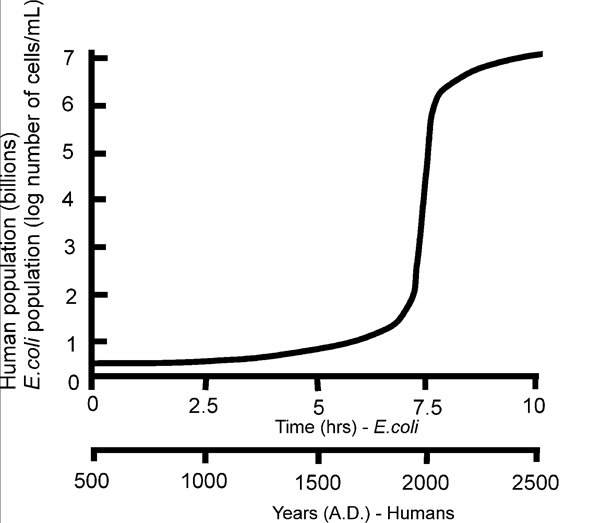
The growth of humans and microbes.
Ultimately, the growth of any organism must be restricted by a lack of some vital resource that prevents continued exponential growth, resulting in a stationary phase. Stationary phase may represent some indefinite steady state of a population, or if disease intervenes, the population can suffer a crash. Human populations suffer from crashes as disease intervenes in some existing population at any stage during its growth cycle (such as the Black Death in 14th Century Europe; Gottfried 2010). However, at the present time, the population of humanity appears to have reached a classical carrying capacity (Daily and Ehrlich 1992) where some vital resources on the planetary scale may limit its further growth and the density is sufficiently high in many countries to make it susceptible to a rapid spread of disease.
The future of the human biofilm
What is the future of the human biofilm? There is something of inevitability in what we can predict by observing our microbial kith and kin. A potential future course is that the biofilm, because of its huge biomass, will run short of nutrients and, as many of the nutrients are leached out of the biofilm and are unrecoverable, it will wither and reduce its activity and productivity. Its continued existence will depend upon an ability to achieve a lower productivity under nutrient-depleted conditions. Increased specialization, refined methods of nutrient acquisition and more involved biomineralization will greatly increase its ability to survive by improving the efficient use of remaining resources. Our recent entry into a more environmentally aware phase of our history probably represents the first inklings of this transition.
A second, but by no means mutually exclusive option, is the acquisition of resources to feed the biofilm from elsewhere. It is from this possibility that humanity may make its most remarkable departure from the parallel history that it has shared with microorganisms. The exploration and settlement of space, particularly by commercial enterprise, has made possible the potential acquisition of resources from other planetary bodies (Lewis 1997; Hudgins 2003). Spacecraft enable humans to travel to these other destinations, explore them, understand their resource potential, and plan for their exploitation.
Now to this point, it is quite plausible that humans have not diverged with microorganisms. The possibility of lithopanspermia, the transfer of organisms from one planet to another within rocks ejected by asteroid and comet impacts, has been a matter of discussion (Clark 2001; Horneck et al. 2001). It is one of the motivations to seek life on Mars — the possibility that during the early history of the Earth and Mars, when conditions on both planets were probably quite similar, and when there was life on the Earth, life could have been transferred between the planets by the asteroid and comet impact events that occurred at that time. If a transfer of life has already occurred, then even our space programmes are a recapitulation of past microbial activity.
But the difference between microorganisms and humans is the potential that humans have to acquire extraterrestrial resources and bring them back to the Earth to feed the biofilm that gave rise to the spacefaring branches of humanity. It is the application of human intelligence to space settlement with the objective of diverting endless space resources (Lewis1997) to a resource and nutrient depleted biofilm on the Earth which represents a completely new type of intervention in biogeochemical cycles. It would be the only time that human intelligence would cause human society to behave in a way that significantly diverges from the behaviour of microbial communities. However, whether humanity will apply its intelligence in this way, or whether humans will in fact, consistent with the rest of their history, recapitulate microbial history by withering and dying back to a more limited biofilm, is a question that humans will be forced to answer.
Conclusion
Since the emergence of life on Earth approximately 3·5 billion years ago, complexity, at least seen from the point of view of the transition from single-celled organisms to diverse multicellular ones, seems to have increased. However, when the biological complexities of individual organisms are ignored, both humans and their societies bear remarkable similarities in their behaviour and capabilities to microbial communities. The close association, specializations and intimate links between human activities make the microbial biofilm a faithful analogy for human society and its technological progress. When we view our society in this way, it becomes easier to understand the inevitable course of our past history and our ineluctable future relationship with the Earth.
The similarities between microbial biofilms and our civilization might have more than passing intellectual interest. Alikeness in resource use, diseasespread, population development and specialization of human and microbial biofilms might lend themselves to comparable mathematical and sociological modelling approaches, offering new ways of understanding both our past and our future.
Notes on contributor
Correspondence to: Charles S. Cockell, School of Physics and Astronomy, Room 1502, James Clerk Maxwell Building, King's Buildings, University of Edinburgh, Edinburgh EH9 3JZ, UK. Email:
Footnotes
Acknowledgements
I thank Dana Kapitulcinova and Sophie Nixon for useful review comments.