






Abstract
This paper investigates the opportunities for further collaboration between the natural and social sciences. From 81 systematically identified and reviewed papers published in scientific journals, it became clear that complex situations that depend on human behaviour as well as natural processes require natural–social science collaboration. The creation of a community of collaborative natural–social science research, that learns from and can contribute to best practice across the sciences, is advocated to support natural– social science collaboration. Across disciplines, it became clear that such a community should deal with (1) difference between paradigms in the current sciences; (2) creation of skills and competences of the involved scientists; (3) scarcity of institutions sympathetic to collaborative research; and (4) the internal organization of collaborative projects.
Introduction
The interaction between humans and their environment is influenced by both the human psyche and the context. Neither a limited psychological nor a technological approach to such interaction can successfully capture it. This makes applied problems very complex, integrative issues, which require a comprehensive analysis across technical and social dimensions. In turn, these issues require collaboration between natural and social sciences (Walsh et al. 1975). For example, environmental (Forsyth 1998; Hicks et al. 2010) and sustainable (Veldkamp et al. 2009) developments are increasingly considered to be a collaborative effort that requires input from both the natural and the social sciences. Such collaboration extends to the many topics where technology meets society, e.g. sustainable production (Phillipson and Lowe 2008; Veldkamp et al. 2009) and environmental development (Strang 2009). As a result, dedicated programmes have been established to train collaborative scientists (Spelt et al. 2009).
The collaboration between the social and the natural sciences remains a challenging endeavour. Nevertheless, natural—social science collaboration has been successfully applied. For example, the cockpit of a fighter airplane not only needs to be engineered, but it should also facilitate a pilot's mental functioning during high stress (Wickens and Hollands 2000, 3), and in nursing, dealing with patients adds the distinctly social nurse-to-patient interaction to the practice of medicine (Nowotny et al. 2003). Recently, the collaboration between natural and social sciences has become more broadly recognized to apply to complex societal issues (e.g. in the field of risk analysis; see Thompson et al. 2005). For example, to control food safety risks (Fife-Schaw and Rowe 2000; Hansen et al.2003; Fischer et al.2006; Bergsma et al.2007; Nauta et al.2008), or to investigate new technologies in food (Ronteltap et al. 2007, 2011), collaboration between the social and the natural sciences is required.
One of the challenges natural—social science collaboration is facing is that these disciplines in both have been moving towards specialization since their conception (see e.g. Leahey and Reikowsky 2008). With accumulating knowledge in specialized disciplines, the universal scientist who is leading in multiple fields has become increasingly rare. Specialization currently holds a lot of rewards in the scientific community. Most Nobel prizes are awarded for specialization within single disciplines. Many, if not most, influential journals publish specialized research, and many grant and accreditation boards are organized along mono-disciplinary lines. This not only limits universal scientists’ development but also creates barriers against collaboration between practitioners in the sciences (Leahey and Reikowsky 2008).
For natural—social science collaboration to be successful, research structures should accommodate such collaboration. This has attracted high level attention in the academies of science on both sides of the Atlantic (e.g. Committee on Facilitating Interdisciplinary Research and Committee on Science Engineering and Public Policy 2004; de Boer et al. 2006). However, there is currently no overview of how this natural—social science collaboration is accommodated in scientific practice across several disciplines, and what are the critical factors for success or failure in such practical settings. The aim of this paper is to provide such an overview of the status of the natural—social science collaboration for societally relevant issues based on a review of the scientific literature. Therefore the research objectives of natural—social science collaboration and the opportunities and barriers for natural—social science collaboration must be identified.
Methods
To investigate the current scientific practice on natural—social science collaboration, a systematic review was conducted of the published literature. A systematic review was done to provide a replicable and transparent procedure. The search was conducted in the Web of Science (http://apps.isiknowledge.com), a commercial online listing of the journals in the ISI database, for natural sciences (1945—present), social sciences (1956—present) and arts & humanities (1975—present). This database was chosen because it explicitly includes both natural and social sciences and includes papers dating back several decades.
Considering the main aim of this paper, to explore natural—social science collaboration for societally relevant issues, a search expression for the identification of relevant papers was constructed that combines these issues in one single Boolean expression. To be relevant, a paper had to contain a reference 1) to a natural science, 2) to a social science, 3) to some kind of collaboration and it had to 4) reflect on a societally relevant issue. The construction of the specific syntax with the search terms was iterative. Once a combination of search terms was tried, the full list of papers was checked against seminal papers known to the authors. The abstracts of about 20 papers were scanned to see whether there was an acceptable proportion of relevant papers. Based on these findings, the search terms were broadened, limited or adjusted, until we decided on the final operationalization of the four blocks of search terms.
Each of these four blocks is operationalized in more detail below.
Natural and social sciences (blocks 1 and 2)
The search terms for natural sciences and social sciences were extracted from the subcategories of both these categories in Scopus (www.scopus.com), another database for academic papers. Scopus was selected for this aim as Web of Science does not readily provide subcategories.
Nonetheless, Web of Science was selected for the main search as it provides a more extensive back record, which would provide additional information missing from Scopus.
Collaboration (3)
A variety of labels was used to denote the collaboration between different scientific disciplines as there is a continuing debate around the specific naming of types of collaboration between sciences (Lattuca2003; Rogers et al.2005; Blevis and Stolterman 2009; Spelt et al. 2009). The present paper aims to look at the practice of collaboration. To avoid the debate on definitions, all forms of collaboration were included, as well as the term collaboration itself. Additionally, from this point onwards ‘collaboration’ will be used for all types of collaboration.
Social or societal relevance (4)
Social or societal relevance was included by adding a broad search term that includes any word with ‘soci’ as the first two syllables.
Combining the four blocks above, the final search expression was entered into the search function of Web of Science (Table 1). The search was further limited to control for quality of publications (Table 1, shaded row), by limiting the document type to peer-reviewed journal papers. To keep focus on the societal domain, nursing (predominantly a social science) and medicine (predominantly a natural science) were excluded, as their inclusion would have added an unwieldy number of papers with little information for the specific context of this paper. No time limit was set. For practical purposes, the dataset was further limited to English literature.
Search term natural social science collaboration in societally relevant issues
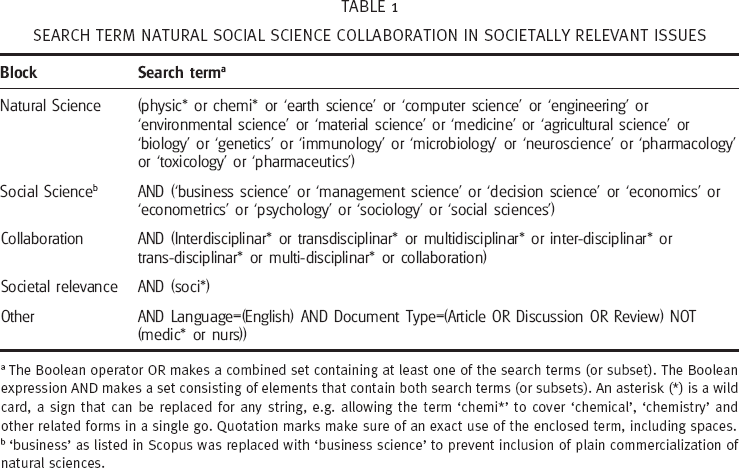
a The Boolean operator OR makes a combined set containing at least one of the search terms (or subset). The Boolean expression AND makes a set consisting of elements that contain both search terms (or subsets). An asterisk (*) is a wild card, a sign that can be replaced for any string, e.g. allowing the term ‘chemi*’ to cover ‘chemical’, ‘chemistry’ and other related forms in a single go. Quotation marks make sure of an exact use of the enclosed term, including spaces.
b‘business’ as listed in Scopus was replaced with ‘business science’ to prevent inclusion of plain commercialization of natural sciences.
Subsequently, the abstracts of the identified papers were downloaded. A quick scan was conducted on the abstracts. Papers were excluded if the abstract suggested they were about natural—social science collaboration in the context of library sciences (e.g. indexing, or study of the relative value of impact factors); if they were mono-disciplinary (for example if only a reference was made to economic possibilities of a product, but the paper was in fact about interdisciplinary work between chemistry and biology). Finally, papers whose abstracts suggested an unlikely relation to social or natural science were also discarded at this stage.
Based on the research aims, the structure of a concept coding scheme was developed. Then 10 papers were randomly selected and read in detail. Based on the emerging themes from these papers, the code scheme was further developed (bottom up) in detail (see Appendix). Closed and open codes were specified. Open codes were categorized post hoc into a limited number of categories for further analysis.
The main topics in the coding scheme were:
Paper identification (e.g. title, publication year)
Disciplines involved (e.g. economics, physics)
Study approach (e.g. position or experimental paper)
Objective of the study (e.g. environmental problem)
Opportunities and barriers related to collaboration (e.g. paradigm differences).
The final search was conducted on 26 January 2011 by entering the search expression from Table 1in Web of Science.
Results
The search resulted in 247 eligible papers (list of all papers available on request from corresponding author). Based on the abstracts, 143 papers were excluded. Fourteen papers were excluded because they were about library sciences. Fifty-one reported on research limited to natural sciences and 73 reported on research limited to social sciences. Three additional papers were excluded: two were about entrepreneurial universities (Fairweather 1994; Martinelli et al. 2008) and one was about the position of man in nature (Tinyakova 2007). In other words, the topic of these three papers was not related to collaboration between scientific disciplines. So after the quick scan, a set of 100 papers remained.
The full text of these 100 papers was requested from the Wageningen University and Research Centre Library (the host institution of the authors), through the interlibrary service or by emailing the corresponding author of the paper.
Of the 100 requested papers, six papers could not be retrieved. After reading the 94 retrieved papers in-depth, another 13 were excluded on the same grounds as the quick scan criteria, although the abstract had not given enough indication for quick scan exclusion: two because they were related to library cataloguing, two because the described collaboration was within social sciences, eight papers were excluded because they described no collaboration between disciplines after all, and one because it was a meta-level position paper about the sciences in general, and not about collaboration (Figure 1).
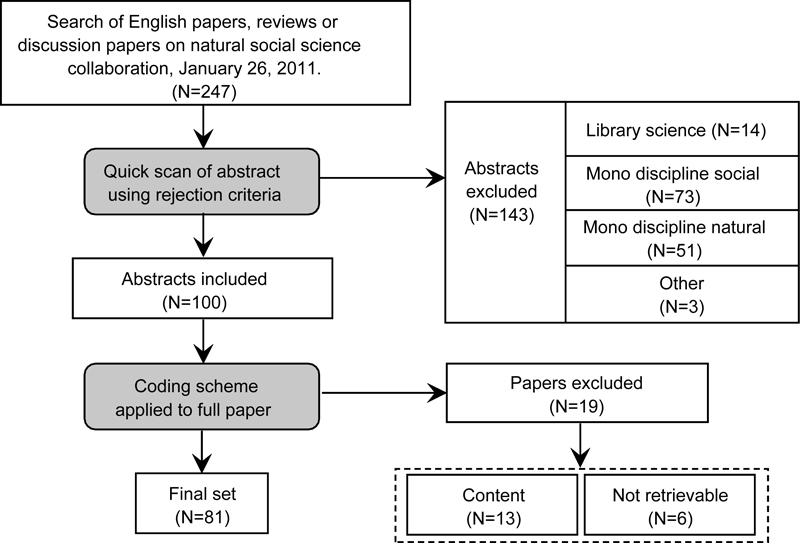
Papers included and excluded.
In the final set of 81 papers, the first publication dated back to 1975 (Walsh et al. 1975). While this paper was much earlier than the others, the insights shown were in line with those in later papers, therefore, the paper was not treated in any different way from other papers. There seems to be an increasing trend in number of publications of natural—social science collaboration over the last 35 years with the highest number of papers in 2008 (Figure 2).
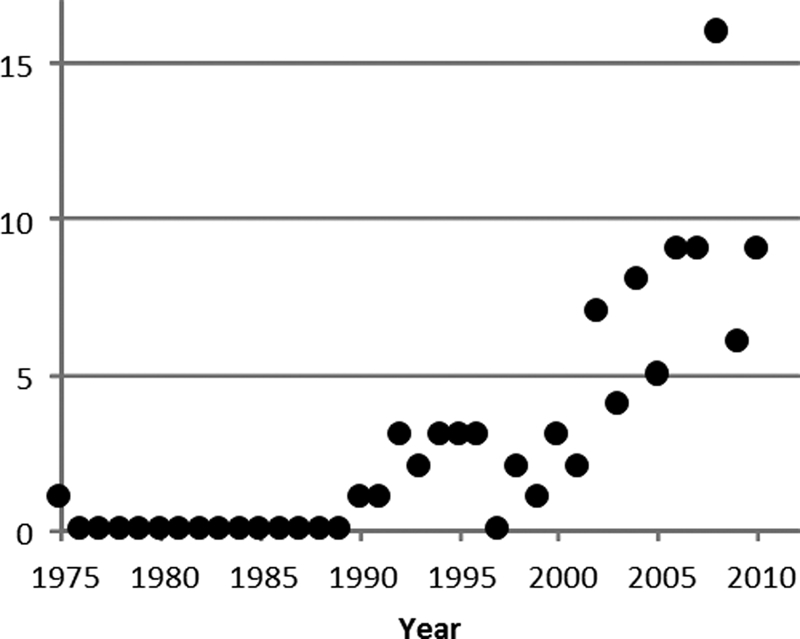
Papers (post 1975) reviewed.
The papers were published in 71 different journals. One journal (Environmental Conservation) published four of the papers in the data set, two journals (Interdisciplinary Science Reviews and Conservation Biology) published three papers, and three journals (Ecology and Society, Geoforum, Risk Analysis) published two papers each. Of the 262 different authors, eight were co-authors on two papers and all other 254 authors appeared once.
Environmental science was present in 24 papers (30 per cent), in most of which it was identified as an interdisciplinary field. The most frequently involved social sciences were economics, psychology, sociology, and political science. The most frequently involved natural sciences were biology, physics, and engineering. The social sciences were referred to without specification in 24 papers, and the term natural science was used without specification in 18 papers. Additional sciences identified as humanities (anthropology, geography and law) were also observed. The included papers listed expertise from at least one social and one natural science, although many papers had more than two involved disciplines. Social scientists, natural scientists, scientists based in interdisciplinary institutes and mixed teams all contributed about equally to the literature (see Table 2 for a complete overview).
Summary table of disciplines involved
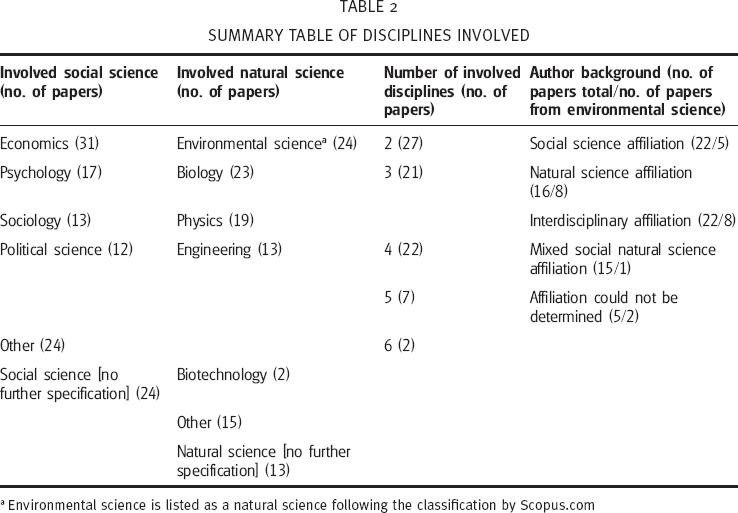
a Environmental science is listed as a natural science following the classification by Scopus.com
The most frequently mentioned collaborations were between economics and biology (11), economics and physics (9), economics and environmental science (9) and psychology and physics (5). Also collaborations between unspecified social science—natural science (7) and unspecified social science with biology (9), physics (6) and environmental science (5) appeared frequently.
The terminology for collaboration was mixed. Forty-two papers used interdisciplinary, 13 multidisciplinary, 10 transdisciplinary, and four used both interdisciplinary and multidisciplinary (Table 2). Little to no reference was made to the continuing debate on the term used for the collaboration (except for Barry et al. 2008).
The majority of papers (48, i.e. 60 per cent) were discussion papers. Of the other papers, 11 reported an experiment. Seven presented the description of a case where natural and social scientists had collaborated. Seven papers presented the deliberations and reflections on experiences and lessons learned by the authors while being involved in collaboration between natural and social sciences. Six papers reported on the development and interpretation of complex mathematical multi-agent models using theories and insights gained through collaboration between natural and social sciences. About one paper out of three (26) reported empirical data (Francis1994; Mason et al.2007).
There was limited evaluation of the success of the collaboration. One paper confirmed the efficacy of the collaboration by tracking the changes in coastal management by local fishermen over a number of years (Agbayani et al. 2000). Two papers used a case study to show the efficacy and need for collaboration between the natural and social sciences (Blackstock et al. 2005; Evely et al. 2008). Four papers evaluated the quality of the training of scientists with collaborative skills (Frischknecht2000; Scialfa et al.2004; Baker and Little 2006; Borrego and Newswander 2008). In the remaining 74, no clear evaluation of the need for and added value of the collaboration was reported.
Research objectives in social–natural sciences collaborations
Thirty-six out of 81 papers aimed at understanding the collaboration itself. In nine cases, collaboration was aimed at the development of a course. In addition, 33 were papers in which the collaboration was a means to try and solve a specific issue, and the remaining had other aims, namely to describe the establishment of an integrative analysis system covering both natural and social sciences (Fuller and Moran 2001), to celebrate the 25th anniversary of a natural—social science journal (Thompson et al. 2005) or the opening of a natural—social science institute (Ceci and Williams 2003).
Environmental issues (such as the creation of sustainable coastal fish management systems; Arnason 2009) are by far most frequently discussed in the study set (32 out of 81, including eight papers that did not mention environmental science as a contributing science). These researchers argue that collaboration is needed between natural and social sciences because there is an increasingly intricate interweaving between the socio-economical context that drives the people living in the environment and their impact on the biophysical environment (e.g. Machlis 1992; Miller 1994; Bawa et al. 2004; Medd and Chappells 2007).
Multi-agent models in ICT and mathematics are also frequently mentioned. The rationale for involving social scientists is that these multi-agent models have become complex to a level where they start to exhibit behaviour that is better understood by social science models than analysis of the computer syntax (e.g. Mason et al.2007; Clifford 2008).
Barriers and opportunities
Barriers against natural—social science collaboration and ways to improve the collaboration were both mentioned in many papers (45 and 52, respectively). In total, 72 instances of barriers were mentioned and 46 opportunities for collaboration. Roughly, we can distinguish four groups of barriers and opportunities (Table 3).
Listing of barriers and opportunities in natural–social science collaboration
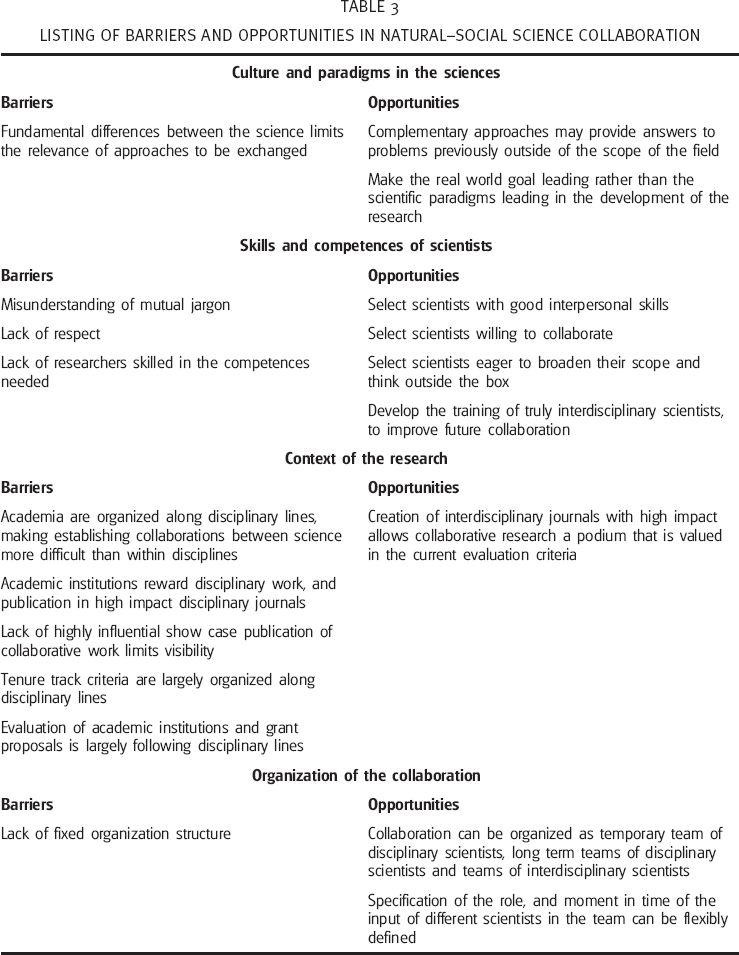
Paradigms in the current (mono-disciplinary) sciences
Skills and competences of the scientists involved
Institutional context of the research
Organization of collaborations.
Paradigms in the current sciences
There are many perceived fundamental differences between the natural and social scientific paradigms (Kuhn 1962). Such paradigmatic differences were mentioned in 20 papers (six environmental science papers). Natural sciences often take an in-depth approach to a small question, where social sciences tend to have a broader approach (Winchester 1992). Natural science models and theories tend to have higher predictive power while social theories and models tend to be better in describing phenomena (Evely et al. 2008). Natural sciences tend to use quantitative research more often than the social sciences (Czech2002). In the natural sciences, replication of results is seen as essential, while it is frequently perceived to be impossible to replicate results in the social sciences (Miller 1994). Natural sciences tend to adopt a positivist, reductionist approach looking for the ‘Truth’, while in the social science, a more relativistic, holistic or social constructivist approach is taken (Fuller and Moran 2001; Le Coze 2005; Borrego and Newswander 2008).
These perceived differences lead to barriers as this prevents relevant interpretation of the results and approaches from natural sciences in the social sciences, and vice versa. On the other hand, because of these differences, collaboration may help to broaden the research, allowing the solution to problems beyond the scope of their own approaches (Clifford 2008). To overcome discussions about paradigms, it is suggested to look for shared goals in research, rather than emphasize paradigmatic differences (Thompson et al. 2005). Indeed in one paper, it is argued that disciplines lose meaning outside of the academic institutions, and that collaboration in real world problems should take that into account (Liu et al. 2010).
Six papers argued that the best, if not the only way, to overcome differences between the sciences is by creating new interdisciplinary sciences with natural and social science sub-disciplines (e.g. Peereboom and Bouwer 1993).
Skills and competences of the scientists involved
Collaboration between social and natural sciences is complicated because specialized scientists tend to lack knowledge about other domains. Misunderstanding of each other's jargon can lead to confusion (Fischer et al. 2005). Failure to recognize their own and other blind spots can lead to unrealistic expectations of the results provided by the other discipline (Machlis1992; Miller 1994). Lack of mutual respect between the scientists involved may frustrate collaboration. Lack of respect may stem from scientists considering their science as the central way to discover the truth, and therefore dominant in any collaboration (Miller 1994) or from the frustration of scientists that empirical findings are not seriously adopted by policy makers (Hammond 2004). Researchers who aim to understand each other's worth (Machlis1992) and have a level of modesty about the remit of their own science (Giller et al. 2008), can successfully overcome this.
Opportunities for collaboration occur when researchers are willing to adapt and have a strong interpersonal focus (Walsh et al. 1975) and are interested in engaging in discussions with others (Jacobson and Robinson 1990). Additional opportunities for improved collaboration are present when researchers are looking to broaden their horizon (Blackstock et al. 2005) and look forward to step outside their own field (Jensen et al. 1995). Careful selection of scientists who are both competent and willing to participate in natural—social science collaboration is considered essential (Borrego and Newswander 2008).
Eight papers argued that training truly interdisciplinary scientists would create a new breed of scientist that is exceptionally suited to think outside the box and reflect on the whole system (e.g. Frischknecht2000; Baker and Little 2006).
Institutional context of the research
Today's research is largely organized along disciplinary lines. Most universities are organized according to discipline, and within these disciplinary divisions, the specializations of individual scientists follow the paradigms of the discipline (Jacobson and Robinson 1990; Blackstock et al. 2005). Publication in high impact journals is rewarded, especially in those within the author's own discipline (Jacobson and Robinson 1990; Blackstock et al.2005). A problem within natural—social science collaboration literature is that there is currently a lack of highly influential showcase publications that emphasize the value of collaborative approaches (Machlis 1992; Frischknecht2000; Clifford 2008). Having such publications would help to make the case for collaborative research. The creation of interdisciplinary scientific journals with high impact may provide an opportunity to work within this system for collaborative effort (Thompson et al. 2005). In the domain of environmental science, where journals that publish collaborative research have on average even higher impact factors compared to journals limiting themselves to disciplinary research (Hicks et al. 2010), it is shown that this is possible.
Many of the parameters on which academic institutions and grant proposals are evaluated by accreditation boards do not value interdisciplinary collaboration on an equal level as disciplinary research (Medd and Chappells 2007). The higher appreciation of disciplinary specialization is also reflected in tenure track criteria (Peereboom and Bouwer 1993).
Organization of the collaboration itself
There appears to be only few fixed structures in place that support the organization of collaboration. From the reviewed papers, three approaches to establishing successful natural—social science collaboration teams emerge. One approach is the creation of a temporary team of disciplinarily scientists that collaborate in a single project (e.g. Fischer et al. 2005; Hartshorn et al. 2005). The benefit of this approach is that such a team is able to implement the most recent insights from the disciplines in the collaboration. The downside is that a lot of time has to be invested in overcoming initial and potential misunderstandings stemming from the differences in disciplines. A second approach is the establishment of long-term teams or the creation of fully integrated interdisciplinary institutes consisting of disciplinary scientists that will collaborate over many projects (Kluge et al. 2008). This limits the need to invest time and effort in preventing misunderstanding, but on the other hand, since the scientists are spending a lot of their time doing interdisciplinary research, their standing and contact with the own discipline will be less strongly developed, making such teams less aware of the newest insights in disciplinary research. The third approach is the establishment of true interdisciplines (Newing 2010), where in its extreme form, the scientist conducts both natural and social science studies, eliminating all misunderstanding but at the cost of being even further removed from the newest insights in disciplinary research. From the reviewed papers, there is no evidence that any approach results in better projects.
The organization of collaboration within a single project can differ. In some projects, a temporary collaborative team is formed ad-hoc to solve specific problems (Borrego and Newswander 2008), in other projects, the relevant scientists are involved at relevant moments when they arise (Hartshorn et al. 2005), or predefined collaboration moments are planned from the start to bring partial results together at planned moments during the project (Ceci and Williams 2003; Fischer et al. 2005).
Discussion
The current review identifies two types of objectives for natural—social science collaboration: (1) The understanding and management of issues where society and the natural world interact (most dominantly environmental science and risk analysis). (2) Understanding complex natural systems through social science frameworks (e.g. multi agent models). The current review highlighted four areas that require particular attention when developing natural—social science collaboration: (1) differences in paradigms between the sciences, (2) skills and competences of the involved researchers, (3) the institutional context of the collaboration and (4) the organization of the collaboration.
Environmental science currently has a strong publication record, with multiple journals accepting natural—social science collaboration. This is in line with the claim of environmental science as being a collaborative social— natural science. Other examples of collaborative natural—social science disciplines, such as risk analysis, with a focus on the interface between society and a natural phenomenon or a technology, have developed similar arguments and publication opportunities.
Successful natural—social science collaboration requires ways to deal with differences between disciplines, skills and competences of the researchers involved, the institutional context of the research and the organization of the research project.
Differences between disciplines are here to stay. Interpreting these as insurmountable bastions of good science will effectively prevent any kind of collaboration. Successful collaboration places the goal of managing a complex issue above disciplinary traditions. Acceptance that the goal is too complex to be solved within the own discipline is essential for this decision. It is of interest that a basic natural science such as chemistry is hardly present in the studied papers. Based on the current review, we cannot determine whether this is because the research goals in these fields are unlikely to benefit from natural—social science collaboration, or that other reasons limit the participation of these sciences. On the other hand, the dominance of applied sciences within the technology and engineering fields in this search may imply that the classification of natural science is over-simplistic, and that it may be better to distinguish between science, technology, engineering and mathematics (e.g. Bybee 2010). Such a recognition of the applied sciences as being those most supported by collaboration spanning multiple disciplines has been in focus for a long time already (Simon 1970). The sciences of engineering and technology are problem-rather than paradigm-focused, which allows or even demands thinking out of the box, and the recognition of the need for collaboration beyond the trodden paths.
It seems that there are only relatively few scientists who have the competences to operate in this domain. Further training of scientists to gain these competences, or even become interdisciplinary scientists, remains necessary. In environmental sciences, the training of interdisciplinary scientists is the favourite approach. Additionally, not every scientist is (nor should be) suited to be involved in natural—social science collaboration. It is essential that the involved scientists are intrinsically motivated, have good interpersonal skills and are willing to broaden their scope.
Within a discipline, there tends to be agreement on what good research is, how to approach research and how results should appear. While this provides a clear structure, it also limits the adoption of collaboration. A scientist involved in natural—social science collaboration is likely to be in an environment where disciplinary sciences are more highly valued. This may create problems for establishing a scientific career within academia. Over the last decades, the creation of interdisciplinary platforms and high impact journals aimed at publishing high level collaborative research has led to (some) opportunities to operate collaborative programmes within the current structure. A challenge lies with the scientists conducting natural—social science collaboration research in creating a body of highly influential showcases to justify this work within the current system.
The organization of natural—social science collaboration requires special attention, as there are few fixed organizational structures facilitating this type of research. Three approaches seem equally suitable to organize future interdisciplinary collaboration while taking care of the pitfalls. One approach aims at training truly interdisciplinary scientists who have basic knowledge in the disciplines involved and who are specialized in collaboration skills. A second option is the creation of interdisciplinary institutes, where scientists from different disciplines work together for a prolonged period of time, bringing more in-depth knowledge to the collaboration, as well as developing interaction skills and some basic knowledge of the others’ domains. The third option is the creation of temporary teams of disciplinary scientists, who conduct a single project or series of projects. This last type of organization is argued to bring most specialist information to the problem, but to bring the least experience in collaboration. All three approaches have resulted in successes, and there is no clear consensus on which should be favoured.
Across the literature, there is a remarkable agreement between the authors about opportunities and barriers related to natural—social science collaboration. The results of the review of published papers align with and support the comments elicited in reviews on conducting interdisciplinary research by several national academies of science (e.g. Committee on Facilitating Interdisciplinary Research and Committee on Science Engineering and Public Policy 2004; de Boer et al. 2006). This agreement supplements and supports the expressed concerns and approaches towards collaborative research in such committees with observations from a broad range of practitioners.
There are some limitations to the current review. First of all, the straightforward classification into natural and social sciences is likely to be too simplistic. The need to exclude medicine and nursing, and subsequent problems with categorizing environmental science, are indicators that this is indeed the case. The choice for a repeatable structured search thus came with a cost. The limitation to peer reviewed journal papers identified through Web of Science may have created a bias towards established journals, and therefore relevant papers from more recently started and less established journals, or journals that report on less established approaches may have been missed. Lead by a priori criteria the review included a sample of 81 papers. This modest sample size makes strong quantitative conclusions difficult. Limitation of the number of papers through the choice of search terms is necessary to make a review feasible. For this reason, papers that did not explicitly address societal issues were excluded. This may have limited the search by excluding certain domains, e.g. many of the papers from human—computer interaction, or policy development. While this choice may have limited the scope, the review nevertheless includes papers from 71 different journals. This indicates that while the sample may be somewhat opportunistic, there is a broad coverage across publication and domains, and the results across the sample of papers (co)authored by 262 different authors align with, and support findings from earlier expert groups.
Several additional observations were made. While there is a lot of discussion about the definition of collaboration as interdisciplinary, multidisciplinary or transdisciplinary (e.g. Lattuca 2003; Rogers et al. 2005; Blevis and Stolterman 2009; Spelt et al.2009), in the reviewed papers, terminology usage is pragmatic. None of the papers report any barrier emerging from the specific definitions used. The composition of the author-teams writing about natural—social science collaboration is about equally distributed across scientists from natural science departments, social science departments, interdisciplinary departments and teams spanning several departments and disciplines. This suggests that no single party has claimed this type of collaboration, making it a truly collaborative scientific endeavour. An interesting observation is, however, that temporarily mixed author-teams of natural and social scientists were hardly present within the environmental sciences. This is an indicator that environmental science seems to be creating its own, enclosed collaborative paradigm.
A large number of the reviewed papers is about the process of collaboration. This may imply that there is currently more discussion about conducting collaborative research than actual research being conducted. Alternatively, it may imply that much of the natural—social science collaborations are not recognizable as such in the published literature. This is worrisome, in the light of creating a body of showcase projects, as these ‘hidden’ projects are unlikely to become such a showcase. Additionally, we noticed that a considerable number of papers lacked information necessary to interpret the quality of the reported research, or to repeat the study by not reporting on research questions, or study design, by lacking a justification of data collection or information sources used, and by the absence of a logical reasoning or analysis. Ten papers in the sample did not contain any of these indicators. Although strict adherence to all of these criteria may not always be possible or indeed desirable for the complex real life situations reported, the lack of reporting of even the most minimal quality controls makes it hard to judge the quality and contribution of these papers to the scientific debate. To create a body of showcase papers, the best work of the projects involved should be readily recognizable as a high quality, scientifically relevant natural—social science collaboration.
There has been a longstanding call for collaboration between the social and the natural sciences to manage complex societal issues. From the current review, it is concluded that this call is answered across several domains. While many barriers remain, the reviewed papers also identify many suggestions how to overcome these barriers and how to facilitate high quality collaborative research. If we manage to keep an open mind and create a collaborative atmosphere, natural—social science collaboration may continue to grow into a respected scientific endeavour.
Notes on contributors
Arnout R H Fischer, Wageningen University, Social Sciences; Marketing and Consumer Behaviour. Hollandseweg 1, 6706 KN Wageningen, The Netherlands. Tel +31 317 483053, Fax +31 317 484361, http://www.mcb.wur.nl/UK/Staff/Post/Fischer
Corresponding author: Email:
Amber Ronteltap, Wageningen University and Research Centre. Social-Sciences: LEI, Hollandseweg 1, 6706 KN Wageningen, The Netherlands. Tel +31 317 484432 or +31 70 3358330, Fax +31 317 484490. Email: Amber
Hilde Tobi, Wageningen University, Social-Sciences; Research Methodology Group. Hollandseweg 1, 6706 KN Wageningen, The Netherlands. Tel +31 317 485946 or 484343. Email:
Footnotes
Acknowledgements
This project was funded through the CEFIC-LRI (Long-range Research Initiative).