






Abstract

Mutio (or Muzio) Oddi of Urbino is not a name that sells books. Raphael and Galileo are undeniably marketable. Perhaps in the wake of Alexander Marr's highly accomplished book things will change. But I doubt it, even though Oddi emerges as thoroughly deserving of attention both in himself and as a representative of a crucial phase in the foundations of what we can still handily call the Scientific Revolution.
Even after repeated recent challenges to the notion of a canon in the arts and sciences, we still tend to see a few giants as defining their age. ‘The Age of Michelangelo’, ‘The Age of Shakespeare’ and ‘The ‘Age of Newton’ would not be exceptional titles for books or TV programmes. Yet these giants can hardly be taken as typical or representative, even if we now see them as defining their age. It is often the less highly ranked protagonists who embody in themselves the mainstream of advanced activity in their particular fields, particularly if they cross what we now define as discrete fields of artistic, technological and scientific endeavour.
There seem to me to be two categories of these representative figures. The first are what I call the ‘wonderful lunatics’, those who do not recognise the limits of what is possible in trying to embrace some kind of overarching mastery of the world under their purview. I am thinking of someone like the Hugenot potter, surveyor, engineer, and theorist of the body of earth, Bernard Palissy. His great ceramic grottos and intensely detailed ‘rustic’ dishes and bowls, based on life casts of animals and fired in his infernal kilns, served as microcosmic manifestations of the ‘womb of the earth’ from which all life emerged. The tapestry of his rich life contains many of the threads that coloured the arts and ideas of his time. He deserves a novel or an opera.
In Britian – though I realise this will ruffle a few feathers – Erasmus Darwin, grandfather of Charles is a good candidate. Physician, natural philosopher, poet of nature's botanical rapture, speculator on evolution, political radical and founder member of the Lunar Society in Birmingham, Erasmus wonderfully embraces many avant-garde tendencies of his time without being remembered for any signal discoveries that, to use a cliché, diverted the course of history. Leonardo da Vinci can also be classified as one of these ‘wonderful lunatics’, if not among those now assigned to the second rank of their age.
In the second category are the remarkable all-rounders, who do a bit of this and a bit of that at genuinely professional levels, but do not achieve any one thing in a way that marks them down as an immortal. Baldassare Peruzzi, a contemporary of Raphael, stands as a good example in the visual arts. A painter, architect, engineer, stage designer and perpectivist, Peruzzi achieved great renown in his lifetime, but is now largely known only to those his visit his beguiling Villa Farnesina in Rome. Yet Peruzzi, as an aspiring doctoral candidate and putative author of a monograph might claim, provides an ideal ‘window’ through which to look at all the arts of design in his time and their underlying theory. Art history, which rose to prominence in the era of the monograph, has probably done better by such lesser figures than the history of science, which for the most part became established a professional academic discipline in the era when social studies set the most fashionable historical agendas.
Oddi shares aspects of his life with both Palissy and Peruzzi. Like Palissy, he pursued a picturesque career in unstable times. Palissy died in the Bastille in 1600, having been arrested after the death of his protector, Marie de Medicis. Like Cellini and Caravaggio, the young Oddi had a tendency to get into scrapes. He was on one occasion prosecuted for swimming naked, and later fled to Venice after wounding one of the adminstrators who was overseeing Oddi's work on one of the Duke of Urbino's architectural projects. Oddi spent three years in the state jail of his native and beloved Urbino, apparently on suspicion of having aligned himself with the enemies of Francesco Maria II della Rovere. He was then dispatched into what became twenty- five years of pained exile. While incarcerated, he wrote two treatises on scientific instruments having made his own paper and confected ink from soot – at least, so we are romantically told by one of his biographers. Oddi became a skilled complainer about the iniquities of life.
He shared with Peruzzi his training as a painter, in his case under that most svelte of draughtsman and colourists, Federigo Barocci of Urbino. It is said that the curtailing of Oddi's career as painter was caused by deficiencies in his eyesight, but his later engagement with architectural design, surveying and mathematical instruments does not bear witness to any feebleness of vision, physical or mental. His progression from painter to mathematician may well have gained its own independent impetus.
Oddi provides a telling example of the move of intellectually inclined practitioners of the arts and trades into professions that involved high-level mathematics, above all geometry. In this he went much further than Peruzzi, and at least as far as Piero della Francesca, whose paintings and geometrical treatises he would have known in Urbino. Oddi became part of what Marr calls the ‘mathematical community’, consisting of aficionados of the mathematical arts and sciences who networked via friendships, letters, publications, the devising and making of instruments, gifts and collecting. They often operated under the aegis of aristocratic patrons for whom mathematical pursuits became a marker of elegant ‘virtuosity’.
Marr identifies eleven subject-headings under which Oddi taught his skills to a range of pupils from aristocrats to professionals: mathematics, Euclid, military architecture, perspective, geometry, sundials, arithmetic, mechanics, drawing, algorithms and the sphere. He could also have taught civil architecture, of which he was a noted practitioner. His aim was less to produce virtuosos in abstract mathematics for its own sake than to enrich mathematics and the practical arts together in the service of society, particularly its higher echelons. He was an example of what Leonardo called the matematici – those who investigated the mathematical foundations of the world, and who increasingly in the Renaissance practised the designing and making of things to augment nature's God-given order. We do not have a word for these varied mathematical polymaths. Perhaps we might call them ‘mathematickers’. A good number of them indulged in architectural design. In Britain, Christopher Wren and Robert Hooke were supreme representatives of such ‘mathematickers’.
Oddi, in spite of his falling foul of his mentor, the Duke of Urbino, and his long employment in exile as a teacher in Milan and military architect in Lucca, is an Urbinate figure par excellence. Visitors to this most evocative of small Renaissance hill towns now see it as an Montefeltro enclave, frozen in the aspic of Duke Federigo, immortalised in the profile portrait by Piero della Francesca, whose shades together roam the great Palazzo Ducale – just as the precocious ghost of the boy Raphael haunts the small city that clings to the skirts of the palace. In reality, the great international contribution of Urbino to Renaissance learning was the conjoined practice of mathematics and instrument-making in the second half of the 16th century. Under Federigo Commandino, Guidbaldo del Monte (mentor of Galileo) and Bernardino Baldi, Urbino hosted a distinctive school of mathematical scholarship and innovation.
The city's ‘Workshop for Mathematical Instruments’ was renowned in Italy and beyond. Baldi called it ‘the workshop of the world’. It was a trade that combined high manual skill with mathematical precision, and was characterised by high stylishness. Some of the most luxurious products destined for aristocrats’ studioli might not unfairly be described as the equivalent of executive toys. The instruments, whether armillary spheres or compasses, were the perfect products of disegno, the visual art of ‘designing’ that was in divine partnership with the organising structures of nature. The Urbino workshop was founded by Simone Barocci, brother of Federigo the painter and son of the clock and instrument-maker Ambrogio. The links across the areas of intellectual and practical endeavour were familial, personal and intellectual in equal measure.
Oddi's attachment to the patria from which he was exiled penetrated every dimension of his life. The Milan of Cardinal Federigo Borromeo, who was creating the Ambosiana as a crucible of the arts and learning, satisfied the professional dimension at least. Oddi obtained a teaching post in the Palatine School, and mingled with a cosmopolitan world of ‘mathematickers’, military and civil. Lucca to which he surprisingly moved in 1625 as the engineer of fortifications, was a very different place, full of horseflies, mosquitoes and bad wine, and, even worse, ‘not a single person knows the principles of mathematics’. Oddi testified that even the beautiful women provided little compensation, ‘because my days are old’. Yet Lucca provided the opportunity to build the grandest geometrical structures imaginable, including ‘a great bastion, two curtain walls, two half-bastions, a counterscarp and a covered walkway’.
No Italian city boasts a finer set of surviving fortifications than Lucca, and they present a breathtaking parade of functional geometry, aggressive plasticity and all'antica stylishness. Oddi's work in Lucca is the most striking, large-scale visual testimony to his mathematical making, and it strangely neglected by Marr, who may have taken Oddi's repeated complaints about bastion building too seriously. We should remember that Michelangelo complained greatly about having to paint the Sistine ceiling.
Oddi's own published writings on instruments are ingenious and mathematically sharp, without establishing anything radically new. He published On Solar Clocks [Sundials] in 1614, On the ‘Surveyor’ (the squadro, a clever cylindrical device) in 1625, and The Making and Use of the Polimetric Compass (a kind of sector) in 1633. The first two of these had been drafted in prison. They were quite modest in production, mainly illustrated with rather basic woodcuts and written in the vernacular, as was becoming increasingly common across Europe. Remarkable records of the second of his books, Dello Squadro survive, and resolve the kind of questions that we are rarely able to answer securely about costs, size of print run and distribution. Here and elsewhere the extensive documentation of Oddi's life presents us with a fineness of texture that is rare for any figure of the period.
The cost of producing the book in Milan was over 425 lire (somewhat more than his official teaching salary of 50 scudi per annum in Milan). Most of the expenses went on paper. About 380 copies were printed, and were distributed to listed recipients in his network of contacts, both as gifts and for selling on. Unsold copies were returned to Oddi. With the exception of the German merchant, intellectual and collector Peter Lidner (of whom more shortly) the list of people who received one or more copies comprised Italian patrons and ‘mathematickers’. This rather constrained enterprise is hardly a striking illustration of the international printing industry as the internet of its age.
The title pages of the books illustrated appropriate devices and also served as allegories of Oddi's life, or rather of the state of affairs about which he was complaining at the time of publication. The book on the sqaudro shows the cylindrical surveying device – with its four slits for sighting distant features – accompanied by the motto RECTA EX OBLIQUIS (right from oblique, or, more figuratively, straight from bent). This seems indicative of the author's dogged determination not to be deflected by the slings of fortune and the plots of ill-wishers. The first edition of his book on sundials illustrates a horizontal dial with a gnomon that does not receive the sun, which is masked by an opaque cloud. This signifies, as Oddi explained, that his traducers were obscuring the truth from the Duke. In the second edition, after his belated return to Urbino, the clouds of calumny have largely dispersed but the sun of ducal patronage is shown as setting on Oddi's life.
There is a sense that Oddi is not only something of a self-fashioning stoic hero typical of ambitious Renaissance intellectuals, of whom the astronomer Tycho Brahe is one of the most demonstrative, but also sees his life as a kind of lived allegory. In Vasari's Lives of the Artists the main biographies all serve overtly exemplary purposes, acting like moral fables that instruct us of some general truth. The allegorical view of life became a two-way street, serving as a way of giving import to biography as a genre but also in turn affecting how protagonists viewed and even lived their lives. Oddi never played down the inherent drama of his own misfortune and his stoic resolution, redeemed little and late by the lifting of his exile after Francesco Maria's death.
Released from his contract by the city of Lucca in 1636, Oddi returned to Urbino where he purchased the Casa Santi, the not inconsiderable town house in which Raphael was born. It was to accommodate Oddi's notable collection of books and treasured objects, which included a codex a drawings by Raphael himself. He intended it to serve after his death as a source of inspiration for the youth of the city. His acquisition of the ‘Raphael's house’ served as the final symbol in the allegory of his life. He died in 1639, not much more than three years after his longed repatriation. Again, he is someone ripe for fictional treatment.
This sense of a lived allegory infused what is the most remarkable work of art associated with Oddi. This is the remarkable painting of the interior of a kunstkammer now known as the Lidner Gallery following the exemplary researches of Marr and Michael John Gorman. In some ways it is typical of the Flemish 17th-century genre of imaginary interiors that present a known or imaginary collections of wondrous things in artful and meaningful arrays within very grand salons. The Lidner in question is Peter, the German merchant who studied with Oddi and became his most steadfast supporter and patron – and a retailer for his books. Painted in the 1620s, we know not by whom, this allegorical interior is now a spectacular case study in its own right.
Lindner Gallery
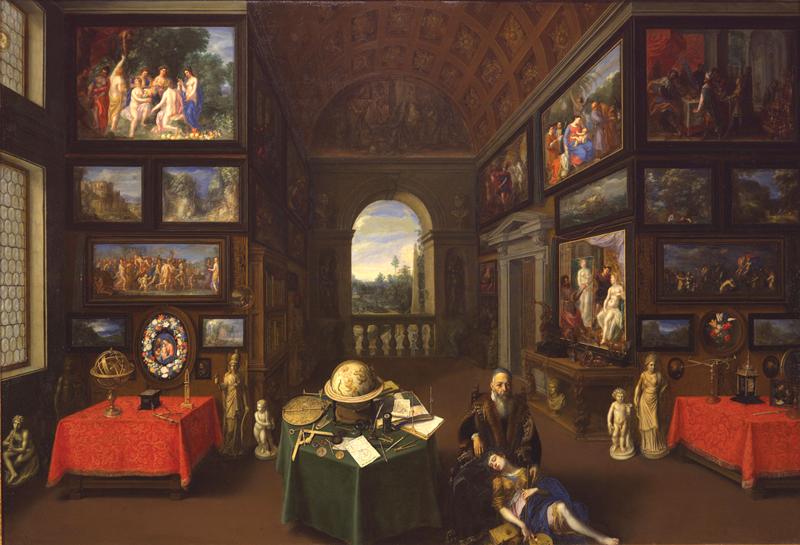
We now know more about its overall meaning and the intricate details of its iconography than for any comparable painting. A female figure representing painting, with mahlstick and palette, slumbers securely at the feet of an elderly man personifying disegno, probably identifiable as the aged Federigo Barocci. The octagonal table beside them is topped by a complex jumble of mathematical instruments, medals, treatises, prints, an astrolabe and a celestial globe. Closest to disegno is a neatly contrived perspective device of an apparently novel kind, with which a draftsman has rendered an architectural view of precisely the kind of interior space occupied by the participants and the mathematical clutter. I wonder if the perspectograph was devised by Federigo Barocci and made by his bother, Simone. Flemish paintings of learned and religious subjects line the walls. Oddi himself is not only present as the subject of one of the medals but also as the genius loci of the whole ensemble. The shared aspirations of Oddi and Lidner as ‘mathematickers’ are deeply infused throughout the ideal gallery – as explained in wholly convincing detail by Marr.
For us the gallery painting does more than signal the shared ideals of the German patron and Urbinate mathematician. It provides vivid visual testimony, as Marr's subtitle declares, to ‘the mathematical culture of late Renaissance Italy’, and beyond. What characterised this culture, as manifested at its very highest level by Galileo and Huygens, was the intersection of the most advanced mathematics with the physically observable and recordable orders of nature. The uncomfortable grit of how physical systems actually behave was eroding old certainties about the abstract rules that had been seen as governing natural forces. The new investigations went hand in hand with the new mathematics and with the invention of new tools for the testing of nature. Oddi himself did not forge any radically new mathematics, and the tools he explicated were ingenious rather than revolutionary, but his keen finger rested precisely on the pulse of the new bloodstream of the precise sciences. It is good to make his acquaintance.
University of Oxford, UK M
Disasters – be they of a natural or a human-made ilk – present a peculiar problem for policy-makers, scholars, and publics. On the one hand, their occurrence and impact is almost invariably difficult (if not impossible) to foresee. On the other hand, their random and accidental nature has complicated the consideration of the appropriate policy responses and the allocation of funds for their management. These challenges have confronted humanity with the need to rethink the notions and practices of security governance. The demand for a shift in perspective has emerged not only as a result of the end of the Cold War, which brought an end to the comfortable bipolarity of security thinking, but also the beginning of the ‘global war on terror ‘, which drew attention to the asymmetrical leverage of various non-state actors. While significant on their own such changes do not require a qualitative and fundamental realignment of our thinking about risks and their governance.
What underpins the demand for a conceptual overhaul of the notion and practices of security is the turbulent reality of discontinuous change characterizing catastrophic risks. In other words, it is the shifting relationship between socio-political and ecological systems that has significantly altered the conditions for securing. Addressing this quandary is at the heart of Vaclav Smil's discerning study. As he points out, in a global context marked by contingency, the difficulty emerges from the purely cognitive problem of imagining discontinuities. In particular, mainstream approaches to the security management of disasters have been premised on a cognitive model aimed at the elimination of risks rather than adaptation to their occurrence. Security-seeking in this context has insisted on the need to attain safety and avoid harm at any cost.
Underpinning this conceptualization of the relationship between disaster and human vulnerability is a pervasive strategic culture resting on the belief that (human) socio-political systems, such as states, are both detached from (natural) biophysical ones and in control of the natural space that they inhabit. Such an understanding of security governance has obfuscated the fact that human societies inhabit complex spaces, which present different kinds of challenges and opportunities. Moreover, the strategic culture of risk-elimination – perhaps paradoxically – presents socio-political systems simultaneously as the causes of and the solution to insecurity. As Smil demonstrates, the prevailing cognitive model of security-seeking through riskelimination produces a wide range of contradictory evidence and incompatible arguments.
In order to introduce some clarity into this complex field of observation, Smil challenges the dramatism underpinning the dominant division of risks into existential and endurable ones. Instead, he proposes a three-stage distinction between ‘(1) known catastrophic risks, whose probabilities can be assessed owing to their recurrence; (2) plausible catastrophic risks, which have never taken place and whose probabilities of occurrence are thus much more difficult to quantify satisfactorily; and (3) entirely speculative risks, which may or may not materialize’ (p. 9). Such a categorization is not intended to aid with forecasting when, where, and how which of these disasters might occur in the next half a century. Instead the aim is to draw attention to the reality that even when catastrophic trends ‘may seem obvious’ the multitude of drivers that animates them ‘shifts constantly’, which makes ‘the resulting mix beyond anyone's grasp’ (p. 248).
Consequently, rather than proposing a model for foreseeing the surprises of the future, Smil's intention is to urge reflection upon the possible adaptations and coping strategies that will be needed for ensuring communities and ways of life in response to any of the three sets of security challenges that he outlines. In this respect, the book is not an attempt at prophesying an apocalyptic future but an encouragement of a thoughtful and imaginative consideration of ‘unpredictable discontinuities’ (p. 71). Thus, among the ‘known catastrophic risks’ Smil includes events ranging from the Earth's encounter with asteroids and other extra-terrestrial bodies, through volcanic mega-eruptions and virulent pandemics, to the transforming effects of war and terrorism. Regardless of the range of possible risks included in this category, Smil insists that from the ‘imaginable catastrophic human-made surprises, none is as worrisome as the accidental or deliberate use of nuclear weapons’ (p. 68). His apprehension is fueled by the growing number of countries relying on nuclear power for both peaceful and military purposes. Smil argues that such growth has increased the probability of nuclear accidents. Although their likelihood remains uncertain, their probability ‘may surpass by several orders of magnitude the likelihood of any known global natural catastrophe’ (p. 68).
Following this assessment, the list of ‘plausible catastrophic risks’ begins with an accidental nuclear war and includes the possibility of a pandemic caused by a previously unknown pathogen. The focus on plausibility draws attention to the ways in which the unintended and the accidental are accounted for in contemporary security strategies and disaster management mechanisms. Finally, while there is a discrete range of surprises that are conceivable, Smil suggests that there appears to be no end in sight for the inventory of ‘entirely speculative risks’. The catalogue of this class of risks includes all manner of fanciful suggestions extending from the sci-fi to the outright wacky. The reason is that their proponents are dealing with completely unknown futures, contexts and interactions. The contingencies of such threats seem to invite an infinite number of conjectures about prospective disasters. Speculation in this setting offers the closest to an approximation for the tentative realities of the unexpected.
In spite of such distinctions between these three different sets of catastrophic risks, Smil is quick to point out that all of them are addressed through a network of overlapping governance mechanisms at sub-national, national, regional and global level. This complex network is tasked with responding to disasters which are irreversible and, at the same time, their occurrence, while inevitable, is unknown. The relevant policy-making suggestion then is for the provision of a contextual range of responses to emergent threats. In fact, the seemingly surprising occurrence of disasters reminds us that the ‘necessity to live with profound uncertainties is a quintessential condition of our species’ (p. 246). Smil's proposition is that the attempt to eliminate risk has not only undermined human ability to adapt and respond to discontinuities, but the search for a total security has also made it impossible to live with and in insecurity.
As a result, the repudiation of the widespread normative and empirical uncertainties that mark the multidirectional transformations in global life has led the conceptualization of security and its governance to adopt a mindset of continuities that make it difficult to address randomness (such as the one suggested by catastrophic risks) and its complex interactions. Addressing unconventional threats therefore requires the development of novel analytical approaches for the management of vulnerability. Smil suggests that addressing natural or human-made catastrophic risks demands adaptive policy heterogeneity, which rests on the simultaneous maintenance of diverse strategies (as well as the willingness and ability to develop new ones) in response to the contingencies of unintended changes. This strategy includes the mitigation of risk but not the extinction of human vulnerability. In this respect, risks auger the prospect of danger, but also portend new opportunities that need not be eliminated.
The erudite examination of the catastrophic risks and vulnerabilities likely to impact human societies in the next fifty years undertaken by Smil provides a valuable point of departure for the assessment of the adaptations that are needed now. In other words, his account offers a much-needed overview of the security challenges and the governance tasks at hand. This achievement transforms Smil's book into a very helpful repository for anyone seeking to pursue the investigation of catastrophic risks further – at either policy, scholarly or popular level. The ability to provide an engaged and perceptive account of catastrophic risks makes this book valuable to all those working on and dealing with the shifting patterns of disasters and their management.
University of Western Sydney, Australia E