







Abstract
This paper explores part of the making of a cyberneticist. It examines Walter Pitts’ contribution to two of McCulloch's most celebrated publications, ‘A Logical Calculus of the Ideas Immanent in Nervous Activity’ and ‘How we Know Universals: the Perception of Auditory and Visual Forms’. What we find, in part, is that Pitts provided mathematical clarity and rigor to McCulloch's views on psychons and circular causality.
Keywords
Coincident with his move from Yale to the Illinois Neuropsychiatric Institute in the fall of 1941, Warren McCulloch's research shifted from staid neurophysiology to bold and speculative work in what would become cybernetics. One factor in this transformation is examined: Walter Pitts’ contribution to two of McCulloch's most celebrated publications, ‘A Logical Calculus of the Ideas Immanent in Nervous Activity’ and ‘How we Know Universals: the Perception of Auditory and Visual Forms’. Both of these papers were coauthored with Pitts at the height of his intellectual powers during his late teens and early twenties.
Reviewing these two articles in the context of McCulloch's and Pitts’ prior independent publications suggests the following conclusions. In ‘A Logical Calculus’, Pitts helped crystallize some of the key ideas that McCulloch had been entertaining for years. Before their collaboration, McCulloch had entertained the idea that mental life involves certain least psychic events that he dubbed ‘psychons’ and that these psychons might be formally described using some of the apparatus of propositional logic. Pitts was probably the one to have been able to formalize this view in their theory of nets without closed neural loops. McCulloch had also long speculated that closed loops of neurons had some role to play in the brain, hence in the character of the mind. These speculations had begun to receive some empirical support in McCulloch's neurophysiological research, but through his collaboration with Pitts what had been a vague and marginal part of McCulloch's thinking became decidedly clearer and moved to the centre of McCulloch's attention. Before collaborating with McCulloch, Pitts had developed an impressive method for mathematically characterizing the behaviour of closed loops of neurons. 1 It was natural enough, therefore, that Pitts attempt to treat closed loops of neurons using notation drawn from quantification theory (the logic of ‘all’ and ‘some’). To distil Pitts’ contribution to ‘A Logical Calculus’ into one brief sentence, one might say that he mathematized McCulloch's theory of psychons and showed how one might mathematically treat loops of neurons, thereby expanding the scope of the theory of psychons.
Later, in ‘How we Know Universals’, Pitts again provided a mathematical formulation for more inchoate ideas. He developed a general mathematical framework that constituted a theory of ‘abstracted universals’. This framework described how to develop mechanisms that could respond to the universal or ‘essential’ features of a thing, while setting aside irrelevant details. It provided a mathematic unity to disparate mechanisms for identifying a chord independent of the irrelevant detail of what pitches made it up and for identifying a shape independent of the irrelevant details of its size or position in the visual field.
From these observations, one might speculate that Pitts transformed some of McCulloch's creative ideas about the mind, such as his hunches about psychons, closed loops of neurons, and abstracted universals, into a more rigorous mathematical form which better suited the temperament of some of the other leading, mathematically inclined proto-cyberneticians, such as John von Neumann and Norbert Wiener. Moreover, it is possible that Pitts’ mathematical treatments of neuroscientific problems made neuroscience more attractive to von Neumann and Wiener.
McCulloch at Yale
In 1934, McCulloch began his first significant research project in Johannes Gregorius Dusser de Barenne's Laboratory for Neurophysiology in Yale's School of Medicine. 2 In this work, spatial and temporal patterns of electrical stimuli were applied to the exposed surface of animal brains in an effort to obtain reproducible motor responses in the arms, legs, and face. For over fifty years, it had been known that temporally separated pairs of electrical stimuli applied to single points on the motor cortex could facilitate muscular responses. So, for instance, if the cortex were stimulated twice at the same point, the muscular response to the second stimulus would be larger than the response to the first stimulus. By contrast, Dusser de Barenne and McCulloch had discovered a pattern of electrical stimulation that induced an extinction phenomenon. To simplify, they found that a first induced stimulus-response would prevent a second induced stimulus-response. After many years of smaller preliminary publications, Dusser de Barenne and McCulloch published their first substantial account of their findings in the second volume of the Journal of Neurophysiology in 1939.
The general features of Dusser de Barenne and McCulloch's account of the facilitation and extinction phenomena can be most easily appreciated by reference to their Figure 15, redrawn here as Figure 1. The time course of the motor responses (shown along the top of Figure 1), following an initial 5 s stimulus, consists of a roughly 20 s period of motor facilitation followed by a roughly 5 min period of motor extinction. To account for this, Dusser de Barenne and McCulloch postulated three factors (that appear top to bottom in the figure). First, there is electrical activity (action potentials) of the neurons in the stimulated region. The initial stimulus gives rise to a 1 s burst of electrical ‘afterdischarges’ having a facilitating effect on motor responses, followed by a much longer period of reduced electrical activity constituting an extinguishing factor. Second, there are changes in the cortical voltage associated with supposed changes in the thresholds for action potentials. Finally, having found that the time courses of electrical activity and voltage drifts did not account for the full duration of the extinction phenomenon, they explored the possible role of pH in extinction. This exploration was suggested by their independent investigations of the influence of pH on cortical function. They concluded that the electrical activity of afterdischarges lowers the pH of the cortex, which has an extinguishing effect on motor responses. Because it takes several minutes for the pH to return to its resting levels, this could account for the lengthy period of extinction.
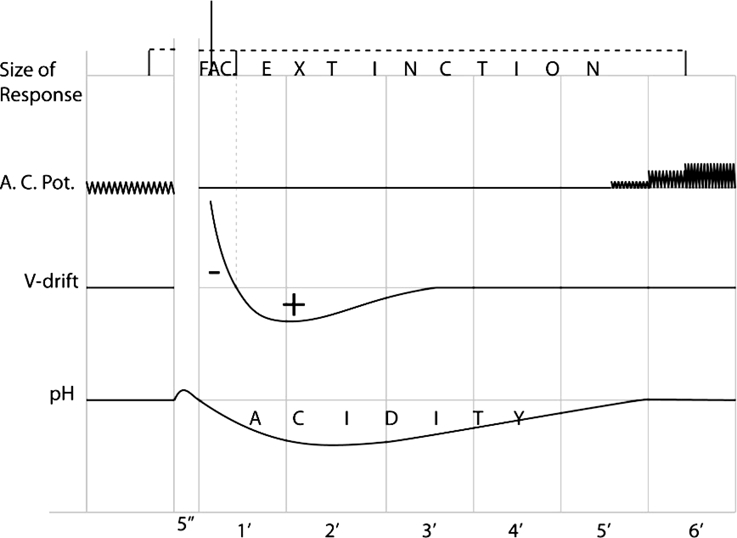
Time courses of processes in facilitation and extinction
Closed loops of neurons entered the picture in Dusser de Barenne and McCulloch's discussion section. Consider, first, what Dusser de Barenne and McCulloch took the phenomena to be (see Figure 2, a modified portion of Dusser de Barenne and McCulloch's(1939) Figure 10). The horizontal curve in the figure represents electrical activity at one point on the cortical surface over time. Notice the features of this curve, moving left to right along it. The break in the curve corresponds to a period of 5 s in which an electrical stimulation of 60 cycles per second was applied to the cortex. Thus, the left side of the line represents pre-stimulus electrical activity and the right side represents post-stimulus activity. The overall trend of the post-stimulus activity is that it declines, but there are other features that require explanation. Two black vertical lines have been added to Dusser de Barenne and McCulloch's record of the post-stimulus activity, thereby dividing the post-stimulus activity into regions A, B, and C. In region A, the electrical activity consists of a set of relatively high frequency waves. In region B, the electrical activity consists of a set of relatively less high frequency waves. Finally, in region C, the electrical activity becomes less patterned and more random. These were the phenomena as Dusser de Barenne and McCulloch understood them.

Electrical activity at a point on the cortical surface pre- and post-stimulus
Dusser de Barenne and McCulloch invoked two kinds of closed loops of neurons (cortical and subcortical) in order to explain the regular waves in regions A and B. They proposed that the periodic electrical fluctuations in region A were caused by waves of excitation cycling through numerous relatively short loops of neurons located within the cortex, where the periodic fluctuations in region B were the result of waves of excitation passing through relatively longer loops of cortical and subcortical neurons. Given that there are two sets of closed loops, they had to explain why the shorter frequency waves fade away before the longer frequency waves did. To do this, they assumed that each time electrical activity passes over a synapse, the synaptic threshold increases by a fixed amount. Thus, electrical activity in a closed loop would eventually cease when the thresholds rise sufficiently. In a fixed amount of time, a wave of excitation would cycle through a shorter cortical loop more times than it would through a longer loop with a subcortical component. Thus, the shorter loops would be damped more quickly than the longer loops. This explains why region A had the shorter frequency waves, where region B had the longer frequency waves. It also explains why the activity in region A fades before the activity in region B.
Turn now to McCulloch's second major project at Yale, the study of the functional organization of the brain. To appreciate this work, one must first distinguish it from the superficially similar, but perhaps more familiar, study of the localization of function. In the later sort of investigation, one attempts to determine what specific regions of the brain do. To determine the functional organization of the cortex, however, is to determine how the distinct functionally localized components interact. It is to determine which regions of the brain communicate with each other and what neuronal pathways they use for this communication. Thus, even though investigations of functional organization must presuppose the localization of functions, functional organization and functional localization are distinct.
During the late 1920s, in Frank H. Pike's Neurosurgical Laboratory at Columbia, McCulloch had used lesion methods to investigate the functional organization of the motor system. In Dusser de Barenne's lab, McCulloch applied the method of strychnine neuronography. This technique involved applying a dilute strychnine solution to the surface of the cortex with a small cotton swab, then recording the characteristic changes in electrical activity, ‘strychnine spiking’, of the poisoned nerve cells. Dusser de Barenne and McCulloch determined that localized application of strychnine causes electrical activity to follow the path from nerve cell bodies to axons, hence to the region of the brain that constitutes the target of the neurons in the strychninized portion of the cortex. Although Dusser de Barenne, McCulloch and their collaborators published roughly a dozen papers applying this technique to macaques and chimpanzees, those of greater interest here are the studies of the interaction between the cerebral cortex and the thalamus. 3 The principal conclusion of this work is that there are reciprocal connections between the cortical structure dedicated to sensation in one portion of the body and the thalamic structure dedicated to that portion of the body. In other words, Dusser de Barenne and McCulloch discovered that there were closed loops of neurons between the sensory cortex and thalamus.
In reviewing McCulloch's work at Yale, we find no discussions of psychons. Nor do we find any glimmer of formal logic or mathematical proofs. We do, however, find some brief treatment of closed loops of neurons in his work on facilitation and extinction and in his work on functional organization of the brain. This gives us a baseline for estimating Pitts’ impact on McCulloch's subsequent writings and lectures.
McCulloch at the Illinois Neuropsychiatric Institute
By the autumn of 1941, when McCulloch moved to Chicago, Pitts had already been there for some time. 4 Moreover, he had already been active in research on, among other things, the mathematical treatment of activity in neural circuits. This is work he had undertaken with the help of Alston Householder, who was a member of Nicolas Rashevsky's Committee on Mathematical Biology at the University of Chicago. This work displays both Pitts’ brilliance and his preparation for his collaboration with McCulloch on ‘A Logical Calculus’.
‘A Logical Calculus’
A review of this seminal paper makes relatively clear what Pitts contributed. 5 In the first section, we find some basic neuroanatomy and neurophysiology along with some more idiosyncratic discussions that were almost certainly McCulloch's doing. One idiosyncrasy in the section is a discussion of why signals pass in only one direction across synapses. A popular view at the time, and one that has come to be accepted as standard, was that one side of a synapse releases a neurotransmitter, whereas the other side binds the transmitter. McCulloch(1938), however, had conjectured that the asymmetry in action potential propagation was caused by the pattern of connections among neurons. 6 Second, section 1 contains an extensive discussion of excitation and facilitation phenomena, just the kind of phenomena that McCulloch had studied at Yale. Finally, section 1 also alludes to McCulloch's theory of psychons:
Many years ago one of us, by considerations impertinent to this argument, was led to conceive of the response of any neuron as factually equivalent to a proposition which proposed its adequate stimulus. He therefore attempted to record the behavior of complicated nets in the notation of the symbolic logic of propositions. The ‘all-or-none’ law of nervous activity is sufficient to insure that the activity of any neuron may be represented as a proposition. Physiological relations existing among nervous activities correspond, of course, to relations among the propositions; and the utility of the representation depends upon the identity of these relations with those of the logic of propositions. (McCulloch and Pitts, 1943, p. 117).
McCulloch was surely the one to have conceived the relationship between the firing of a neuron and the assertion of a proposition. This is reinforced by this passage from a largely autobiographical essay:
My object, as a psychologist, was to invent a kind of least psychic event, or ‘psychon’, that would have the following properties: First, it was to be so simple an event that it either happened or else it did not happen. Second, it was to happen only if its bound cause had happened — shades of Duns Scotus! — that is, it was to imply its temporal antecedent. Third, it was to propose this to subsequent psychons. Fourth, these were to be compounded to produce the equivalents of more complicated propositions concerning their antecedents.
In 1929 it dawned on me that these events might be regarded as the all-or-none impulses of neurons, combined by convergence upon the next neuron to yield complexes of propositional events.’ (McCulloch, 1988, pp. 8–9).
Section 1, therefore, is likely to have been predominantly McCulloch's work.
The second section of the paper, ‘The theory: nets without circles’, probably marks the point where Pitts began to contribute most substantively, where he was able to carry off McCulloch's vision of psychons embodied in formally described neurons. The section begins by stating certain assumptions regarding the properties of neurons and structures of neural networks:
The activity of the neuron is an ‘all-or-none’ process.
A certain fixed number of synapses must be excited within the period of latent addition in order to excite a neuron at any time, and this number is independent of previous activity and position on the neuron.
The only significant delay within the nervous system is synaptic delay.
The activity of any inhibitory synapse absolutely prevents excitation of the neuron at that time.
The structure of the net does not change with time. (McCulloch and Pitts, 1943, p. 118).
These were the basic neuroanatomical and neurophysiological assumptions that were formalized in networks of what have come to be called ‘McCulloch-Pitts neurons’. The most famous results of ‘A Logical Calculus’ are Theorems I and II, which relate networks to expressions in a formal language. An expression in this language asserts that a particular event, namely, the firing of neuron, happens at a particular time, hence McCulloch and Pitts dub them ‘temporal propositional expressions’ (TPE). Theorem I asserts, in essence, that every net with no loops can be described by a TPE; Theorem II asserts, in essence, that every TPE is a description of some net without loops. This explains how neural nets without circles relate to logical expressions.
To better appreciate the bearing of the theorems on McCulloch's theory of psychons, we need a simple example. Consider a simple neural network
 consisting of two neurons c1 and c2 that synapse onto a third neuron c3. These neurons might be connected in such a way as to have c3 fire at a given time exactly when c1 and c2 simultaneously fire one unit of time before. This is the neural network part of the story; the psychic side of the story begins with a TPE. An atomic TPE ‘Ni(t)’ asserts that neuron ci fires at time t. More complex TPEs for nets without loops are built up from the atomics with additional sentential logical notation borrowed from Carnap, 1937, and Whitehead and Russell, 1925. Thus, the complex TPE that describes our simple three neuron network is ‘N3(t)
 N1(t-1) ∧ N2(t-1)’, where the expression
 is the biconditional (if and only if), the ‘.'s indicate the scope of the biconditional (how to group items into units around the biconditional), and ‘∧’ is the symbol for conjunction (and). This expression describes the behaviour of the network, asserting that neuron c3 fires at time t exactly when c1 and c2 simultaneously fire at time t-1.
On the surface, Theorems I and II appear to provide an account that relates psychons to neurons. However, matters are not so simple. Our simple TPE asserts that a neuron fires at a particular time. ‘N3(t)
 N1(t-1) ∧ N2(t-1)’ asserts that neuron c3 fires at time t exactly when c1 and c2 simultaneously fire at time t-1. However, we may presume it is not McCulloch's idea that least psychic events describe the activities of individual neurons. People do not think very much about neurons, if at all. Rather than thinking about neural activities, people might think that there is, at a given time, a sensation of cold at this point on the skin and at that point on the skin. TPEs do not assert these sorts of things; they describe the patterns of activity among neurons. Apparently TPEs and Theorems I and II do not, by themselves, provide an account of how to relate perceptions or thoughts to neurons.
We obtain a better picture of how the theory of psychons works through an example McCulloch and Pitts provide. They note that if a cold object is briefly held to the skin, then a sensation of heat is produced, but if it is held to the skin for a longer period of time, then only a sensation of cold follows. To explain this, they postulate two receptor cells in the skin: a heat receptor c1 and a cold receptor c2. These are connected to neurons, c3 and c4, corresponding to sensations of heat and cold. They then proceed to develop TPEs for N3(t) and N4(t) that describe the behaviour of the neurons c3 and c4. In this example, it is not the work of Theorems I or II that warrants the association of the action of neurons c3 and c4 with the sensations of heat and cold. Instead, McCulloch and Pitts evidently have some implicit theory of the meaning of receptor neurons in the skin and how these receptor neurons contribute to the meaning of non-receptor neurons in the brain. The receptor neurons c1 and c2 mean what they do in virtue of their environmental triggers, where neurons c3 and c4 mean what they do in virtue of how they are connected to c1 and c2. The firing of neurons c3 and c4 correspond to thoughts of there being a sensation of heat or a sensation of cold at some time past. If we generalize this, we might suppose that McCulloch and Pitts believe that psychic events are what they are in virtue of their relations to sensory stimulation. Thoughts are defined in terms of particular configurations of sensory stimulations. Such a picture is not far removed from the sort of psychological view that Rudolph Carnap, for example, developed in his 1928 book, The Logical Structure of the World.
The third section of ‘A Logical Calculus’ was probably written by Pitts alone. In the first place, the mathematics of the section was radically more complicated than anything McCulloch ever used before or after. More importantly, there are theoretical affinities between the content of Pitts’ earlier publications and what was in ‘A Logical Calculus’. 7 The third section of the paper was an ambitious attempt to do with symbolic logic the kind of thing Pitts had already done with an alternative set of mathematical tools. As with Pitts’ earlier work, the project attempted, first, a logico-mathematical description of the temporal activity of given neural networks and, second, the construction of neural networks that would fit given logico-mathematical descriptions. Both projects allowed for networks of arbitrary amounts of looping in circuits. There is also a commonality of approach. In both instances, Pitts attempted to analyze complex networks as built up of special sorts of smaller units, so-called ‘third-order synapses’ in his earlier work; ‘cyclic sets’ in ‘A Logical Calculus’.
Pitts’ impact on McCulloch in this section was not to give him a bit of technical machinery with which to promote his ideas regarding loops of neurons. As has been noted on multiple occasions, Pitts’ approach breaks down very early in the third section. 8 However, McCulloch did not use or need the technical apparatus. He did not, for example, ever discuss the cyclic sets that Pitts developed. Instead, he at most took away a modest picture of the activity of closed loops of neurons. In the simplest case, one might have a single sensory receptor in the skin connected to a single cortical neuron in such a way that once the sensory receptor excites activity in the cortical neuron, the cortical neuron continues to self-activate through positive feedback. Because there is no apparent mechanism for counting the times the cortical neuron self-activates, the cortical neuron can be taken to make reference to an event in the indeterminate past. The picture is of a self-stimulating neuron whose TPE says ‘There is a time in the past at which neuron ci was active’. Bearing in mind our discussion of section 2 of ‘A Logical Calculus’, we can see that this TPE description of a neuron's activity might then be paired with a thought, such as ‘There is a time in the past at which there was a sensation of cold’. McCulloch and Pitts interpret the activity of such a neuron as a matter of abstraction. We find this interpretation in the final section of ‘A Logical Calculus’:
Moreover the regenerative activity of constituent circles renders reference indefinite as to time past. Thus our knowledge of the world, including ourselves, is incomplete as to space and indefinite as to time. This ignorance, implicit in all our brains, is the counterpart of the abstraction which renders our knowledge useful. (McCulloch and Pitts, 1943, pp. 129–31).
In later work, including ‘How we Know Universals’, these abstractions were called universals. What mattered to McCulloch was the simple idea that sensory stimulation could set up an electrical reverberation in a neural circuit and that his reverberation could be the neural correlate of knowing a universal. The correctness and detailed mechanics of the proofs regarding nets with circles were not necessary for this view. Correct or not, the struggle to formulate a precise theory of nets with circles probably drew more of McCulloch's attention to circular causality.
‘How we Know Universals’
The title of this 1947 paper can be puzzling. There is no paragraph or section of the article where Pitts and McCulloch explicitly define what they mean by a universal, then explain what they think it is to know a universal. Their account of these matters is merely implicit. To articulate the second issue first, Pitts and McCulloch believe that a person knows a universal when that person has a neural network that produces a single pattern of activation exactly when presented with any instance of that universal. In other words, to know a universal is to be able to respond to that universal, while ignoring irrelevant features of particular instances of that universal. Taking an example, to know a square is to have a neural network that responds with a given pattern of activation when presented with a square and not when presented with something other than a square. In other words, to know a square is to be able to respond to a square, while ignoring accidental features of particular instances of it, such as its size or position in the visual field.
We can understand how the challenge to develop neural networks that have this feature may be all the more pressing for Pitts and McCulloch if we recall from our discussion of the last section of ‘A Logical Calculus’ that they evidently take universals to be the product of a process of abstraction from particular instances. Although some philosopher might think there could be a universal we could describe as ‘A square at spatial co-ordinates x, y (at time t) in the visual field’, this is not what Pitts and McCulloch would count as a universal. For them, to be a universal is to be an abstraction from the particulars of space and time. So, for Pitts and McCulloch responding to some feature of the environment independent of the details of space and time could be of the essence of being a universal.
Rather than articulating these background assumptions of their project, Pitts and McCulloch observe in the second paragraph of their paper that brains recognize timbre and chord independent of pitch. Brains recognize shapes independent of size and position. How do they do this? How can a neural network produce a single pattern of excitation that corresponds to the same chord, when that chord is played one or two octaves apart? How can a neural network yield one and the same single pattern of activation for a shape, independent of the size and position of any particular instance of the shape?
Pitts and McCulloch actually sketch two mechanisms to address these questions. The first uses what they describe as the computation of an invariant by an average. Setting aside the mathematics and the neuroscience, we can view the process as proceeding in three stages. First, the brain takes an environmental stimulus into a pattern of electrical activity in some structure, such as Heschl's gyrus or striate cortex (Brodmann's area 17). Next, to each such pattern corresponding to an instance of a universal, it assigns some activation value (a number). Third, the brain computes the average of all these activation values, then uses the average to represent the universal. So, what all the instances have in common in the brain is that they all produce this average. It is because each particular figure produces the same average that we have an invariant, hence a method for computing an invariant by an average. Thus, to know the universal square is to have a neural network that responds with the appropriate average when presented with a square and not when presented with something other than a square.
Pitts and McCulloch describe their second method for finding universals among particulars as a ‘reflex mechanism’. In the concrete example they provide, it is a mechanism for centring the eyes on a figure. On its face, this may not look like an account of how we know universals, but instead a method for reducing the problem of recognizing a figure at any position in the visual field to the problem of recognizing the figure at a canonical position in the visual field. However, as Pitts and McCulloch view universals as abstractions from particulars, we can see how a method for neutralizing the effects of position on what a neural network responds to constitutes a method for knowing a universal that abstracts from the particulars of position.
Again, setting aside the mathematics and the neuroscientific detail, Pitts and McCulloch propose that, given a figure, the visual system first calculates a ‘center of gravity of brightness’ for the figure. (For two spots of light, the centre of gravity is halfway between the two. For two spots of light, with one twice as bright as the other, the centre of gravity is two thirds of the way toward the brighter spot.) The visual system then calculates the difference between this centre of gravity and the centre of the canonical view, then uses this to signal appropriate changes to the positions of the eyes. The neural network part of the system does not, however, simply send a single set of impulses to the eye muscles that immediately centres the figure in the visual field. Instead, the visual system uses constant feedback to reduce the distance between the centre of brightness and the centre of the visual field. Pitched in these broad terms, we can see a system of circular causality. Thus, the idea of feedback loops, which was only briefly mentioned in ‘A Logical Calculus’, was made an integral part of one mechanism for the perception of universals. 9
Digging deeper into the development of these theories, it is plausible that there was a division of labour in the theorizing and writing of ‘How we Know Universals’. After what looks to be an introductory section that could have been coauthored, Pitts gives us a mathematical treatment of transformations on manifolds. This is the overarching framework that unifies the treatment of the perception of a chord independent of pitch, the shape of a figure independent of its size, and the shape of a figure independent of its position in the visual field. For each of these three examples, McCulloch probably took the lead in describing the anatomical structures that plausibly play the roles described by the mathematical theory. McCulloch proposed that the mechanisms for chords independent of pitch were found lying along the length of Heschl's gyrus. The primary evidence for this lay in the fact that lower pitches were represented on one end of Heschl's gyrus, with increasingly higher tones represented toward the other end of the gyrus. Second, he proposed that the mechanisms for position invariance were implemented in the superior colliculus and, finally, that the mechanisms for size invariance lie primarily in layers I, II, III, and IV of Brodmann's area 17, with additional processing in area 18.
There is much more to be said to articulate and clarify what Pitts and McCulloch did in ‘How we Know Universals’. 10 A clear exposition of the whole of this dense paper would be a paper unto itself. Nevertheless, this additional exposition is probably not necessary for present purposes. For what we find from even our relatively brief examination is that Pitts took the lead in providing a very general mathematical formulation for describing and developing mechanisms for recognizing abstractions or universals. As with ‘A Logical Calculus’, this mathematics showed one way in which the neuroscience with which McCulloch was familiar admitted of rigorous formal development.
Conclusion
Through the window of ‘A Logical Calculus’ and ‘How we Know Universals’, we see Pitts’ influence on McCulloch in three areas. First, he probably provided the precise mathematical proofs relating neural networks to TPEs. The theorems did not provide the whole of the story relating psychons to neural networks, but were an important chapter in that story. Second, Pitts also understood enough about first-order languages that McCulloch and Pitts could at least propose, if not correctly prove, how one might relate neural networks with closed loops to expressions in a first-order language. These expressions, which were ‘indifferent to time’, provided McCulloch and Pitts with their first theory of how we know universals. This was their theory of universals construed as properties detached from reference to any particular event. Third, Pitts, among others, stimulated McCulloch to explore circular causality in greater depth than he had before. Before his collaboration with Pitts, McCulloch had speculated about the role of neuronal loops in mental life, but the formal work with Pitts gave the work greater urgency.
In ‘How we Know Universals’, Pitts provided a general mathematical description of mechanisms for responding to universals. This general mathematical theory described two apparently distinct types of systems. One was a neural network for responding to universals by representing each instance of it as an average of a response, so that the representation of the universal just was this average. A second was a neural network that used difference-reducing feedback to centre the gaze of the eyes on a figure. In this project, Pitts and McCulloch were incorporating the ideas of other cyberneticians into their own work, but also inserting mathematical rigour and a neuroscientific grounding.
These observations suggest an important role for Pitts in the emergence of cybernetics: Pitts constituted a bridge between the mathematicians and the neuroscientists. McCulloch had many creative, neuroscientifically-inspired ideas about the mind, such as his hunches about psychons, closed loops of neurons, and abstracted universals, as well as interests and aspirations in logic and mathematics. Pitts provided the final impetus to bring (most of) McCulloch's inchoate ideas to logical and mathematical fruition, thereby stoking McCulloch's interest in logic and mathematics. In addition, this work could have made neuroscience more intriguing to the computationally- and mathematically-oriented von Neumann and Wiener. In other words, Pitts may have had a crucial unifying effect on the nascent cybernetics movement.
Footnotes
1
3
4
For more discussion of Pitts’ life, see Smalheiser, 2000, and Lettvin, 1989,  .
.
5
For further discussion, see Piccinini,(2004), and Schlatter and Aizawa,().
6
7
9
Kenneth Aizawa is the Charles T. Beaird Professor of Philosophy at Centenary College of Louisiana. He is the author of The Systematicity Arguments (2003) and (with Frederick Adams) The Bounds of Cognition. He has published papers on connectionism, extended cognition, and the history of cognitive science.