







Abstract
The appropriation of scientific concepts by the humanities and the visual arts exemplifies what many feel are both the pitfalls and possibilities of interdisciplinary engagement. The principle of entropy, which C. P. Snow claimed could serve as a litmus test of the ‘two cultures’ divide, provides an excellent starting point for exploring how artists have employed scientific concepts far beyond their original contexts. As a case study in interdisciplinarity, the use of entropy in the visual arts is also a lens to consider the evolution of an artistic proposal from the 1960s known as ‘system aesthetics’. As an early challenge to the clean demarcation of art and science, system aesthetics was a precedent for what might be described as the emergence of an ecosystem aesthetics within contemporary art and design today.
Two cultures and second laws
In his 1959 lecture, The Two Cultures, C. P. Snow recounted the following experience:
A good many times I have been present at gatherings of people who, by the standards of the traditional culture, are thought highly educated and who have with considerable gusto been expressing their incredulity at the illiteracy of scientists. Once or twice I have been provoked and have asked the company how many of them could describe the Second Law of Thermodynamics. The response was cold: it was also negative. Yet I was asking something which is about the scientific equivalent of: ‘Have you read a work of Shakespeare's?’ (1998, 14–15)
Snow's anecdote has qualities of an Aesopian parable. Inevitability tinges the story, for no matter how many times the race is run we know the tortoise will win, the scorpion will sting the frog, and scientists and artists will stand at a divide. Snow's tale of two cultures has been retold many times and continues to be a part of our collective academic consciousness, but what was its moral? While some might claim that the current enthusiasm for interdisciplinary initiatives between the sciences and the arts serves as a remedy for the two cultures malady, it could also be seen as its most obvious symptom. Although institutionally such interdisciplinary initiatives are often energetic, their short-lifespans and sometimes jerry-rigged execution can serve to reinforce rather than challenge the disciplinary status quo. If these initiatives fail to bring about change or generate interest, then they risk being seen further confirmation of cultural incommensurability such that the moral of the story slides into one of fateful acceptance rather than aspiration — ‘Sorry’ the scorpion says as it stings the frog ferrying it across the river, ‘It's just my nature, after all’.
I am interested in Snow's use of the Second Law as a kind of cultural litmus test between the arts and sciences, especially given this particular law's later appropriation by artists in ways that Snow would have likely never foreseen. As a case study in (inter)disciplinarity, the Second Law also offers a lens to consider the evolution of an artistic approach known as ‘system aesthetics’, which stands not only as an example of how the conceptual delineation of art and science has been challenged in the past, but is also a precedent for what could be described as an ecosystems aesthetics within contemporary art and design.
Physicist P. W. Bridgman once claimed that, ‘There have been nearly as many formulations of the second law as there have been discussions of it’ (Bridgman 1941, 116). To the extent this has been true among physicists, it is equally so among artists and particularly when the Second Law is understood in terms of entropy. The entropic interpretation of the law takes interest in what is often described as a system's spontaneous tendency towards ‘disorder’ and lack of distinct configuration among its parts. The tendency towards increasing entropy is both empirical and fundamental in the universe, operating on even the most everyday of scales: the cup of hot tea will spontaneously cool as it reaches an equilibrium temperature with the room it sits within — the cup will never spontaneously warm itself up. The only way to decrease the entropy of the system is through an input of energy, through work that allows for a re-ordering or re-differentiation of a system's components.
By analogy, then, we might think of Snow's two cultures paradigm as a (conceptual) device that carries out semiotic work on our (intellectual) system by maintaining or furthering a separation of the arts and sciences that began back in the Enlightenment. Sociological and historical research has shed light on the considerable philosophical effort involved in keeping disciplines distinct and the role degrees, journals, professional affiliations, and other devices of specialization play in defining disciplinary expertise. In the absence of all the energy put into disciplining such boundaries, is it possible that the two cultures would comingle more naturally, entropically mixing into a more fluid and unified field of learning?
This question lets us consider the violence I might have already done to the Second Law and the scientific principle of entropy. For example, did I appropriately describe them above, as Snow challenged the artists and humanists to successfully do? If I did, was the valid description then undone by employing it as an analogy for the dynamics of academic disciplines, illustrating Snow's very point about widespread scientific illiteracy? Perhaps my tenuous analogy for visualizing the two-culture paradigm wasn't worth the risk of misleading you about the physical nature of energy and order. On what terms and in what forms can concepts claim to be appropriately applied? If those in the arts are to understand the Second Law, must it solely and strictly be in scientific terms, or are analogical uses outside of a concept's original context fair play? I would like to believe that Snow would have been fine with my entropic/sociological analogy if it could be assumed that we (as writer and reader) knew the Second Law well enough to train a critical eye on the places where the comparison makes a useful point and where it falls flat. The argument would be that the expansive meaning-making ability of analogical imagination only really works when we know enough about the foundations of the comparison in the first place.
Entropic transgressions
But what does it mean to know something well enough? What exactly did the artist Robert Smithson — who wrote quite extensively about entropy — know about the Second Law of Thermodynamics? Smithson's use of entropy as a creative potential within art raises significant questions about what ‘understanding’ means in a cross-cultural context. In his 1966 Artforum essay ‘Entropy and the New Monuments’ Smithson starts with both a straightforward description and a qualification:
In a rather round-about way, many of the artists have provided a visible analog for the Second Law of Thermodynamics, which extrapolates the range of entropy by telling us energy is more easily lost than obtained, and that in the ultimate future the whole universe will burn out and be transformed into an all-encompassing sameness. (1996a, 11)
A scientist might provisionally accept this as a lay characterization, although perhaps take issue the idea of energy being ‘lost’ or ‘obtained’. As Smithson's continues on in the essay, however, his ideas about entropy begin to go through their own dispersive expansion as he then claims, ‘Falseness, as an ultimate, is inextricably a part of entropy, and this falseness is devoid of moral implications’, continuing on the say how the film The Planet of the Vampires can be understood as ‘a movie about entropy’. In the interview/essay ‘Entropy Made Visible’, Smithson describes the Second Law in a way far past the limits of what Snow could have ever expected as a reply:
…for instance, soap is 99 44/100% pure, beer has more spirit in it, and dog food is ideal; all and all this means such values are worthless. As the cloying effect of such ‘values’ wears off, one perceives the ‘facts’ of the outer edge, the flat surface, the banal, the empty, the cool, bland after blank; in other words, that infinitesimal condition known as entropy. (Smithson 1996a, 13)
Having more and more to say about it during his career, clearly Smithson understood a great deal about entropy and the Second Law, it is just nothing recognizable as the same physical principle that Carnot, Clausius, and Boltzmann sweated over as they calculated the efficiency of heat engines or the statistical properties of molecular ensembles.
1
His usage may be the kind that, thirty years later, physicist Alan Sokal took such umbrage with when he played his influential prank on postmodernist scholars by publishing ‘Transgressing the Boundaries: Towards a Transformative Hermeneutics of Quantum Gravity’ in Social Text (1996). In a classic two cultures moment Sokal sought to embarrass the journal and point out the lack of scholarly rigor he believed pervaded postmodern humanities by publishing a paper that was nonsense by the standards of theoretical physics.
2
In Sokal's view it wasn't so much an issue of the appropriation of scientific concepts as it was defilement. As he (and Jean Bricmont) later describe it, famous intellectuals have:
repeatedly abused scientific concepts and terminology: either using scientific ideas totally out of context, without giving the slightest justification — note that we are not against extrapolating concepts from one field from another, but only the extrapolations made without argument — or throwing around scientific jargon in front of their non-scientist readers without any regard for its relevance or even its meaning. (Sokal and Bricmont 1999, x)
While Sokal's concerns over the absence of ‘justification’, ‘relevance’, ‘meaning’, and sufficient ‘argument’ during acts of conceptual appropriation are worth raising, they also point to unspoken assumptions about exactly what/who determines any of the standards he lists and the underlying motivations for appropriation in the first place. How can appropriation presume to make meaningful (if deviant) sense, as opposed to the complete nonsense that Sokal charged postmodern theorists in perpetrating?
Philosopher Brian Massumi has suggested that a scientific concept can be imported into the humanities such that, ‘it ceases to be systematically scientific but doesn't end up tamed, a metaphorical exhibit in someone else's menagerie’ (2002, 20). He bypasses the debate about the logical limits of associative strategies (like analogy and metaphor) by proposing a more open-ended understanding of how conceptual appropriation functions to make new sense:
It was said that a concept could be severed from the system of connections from which it is drawn and plopped into a new and open environment where it suffers an exemplary kind of creative violence. This is only half the story. A concept is by nature connectible to other concepts. A concept is defined less by its semantic content than by the regularities of connection that have been established between it and other concepts: its rhythm of arrival and departure in the flow of thought and language; when and how it tends to relay into a next concept. When you uproot a concept from its network of systemic connections with other concepts you still have its connectibility. You have a systemic connectibility without the system. In other words, the concept carries a certain residue of activity from its former role. (2002, 20)
There can be no rules governing authentic connectibility in the framework Massumi sets forth, and this is precisely the point: there is only the experiment itself and the uncertainty of trial and error as ideas are recontextualized in an attempt to generate new forms of understanding. For the same reasons we grant a word open opportunities for associative meaning in a poem, conceptual connectibility exists in spite of any formal or explicit mapping and extends in ways that cannot be decided straightforwardly or a priori. 3 This is important because the whole motivation for appropriation from the sciences is to create a very new context in the adopted field, not to simply fit a conceptual piece into a context that is already completely meaning-full. ‘However it plays out’, Massumi writes, ‘it is certain that the humanities project into which the concept has been imported will be changed by the encounter. This is the kind of shameless poaching from science I advocate and endeavor to practice: one that betrays the system of science while respecting its affect, in a way designed to force a change in the humanities’ 4 (2002, 20).
What becomes clear is that these different disciplinary cultures are characterized by different values. They abide by divergent standards of what theories and principles are meant to accomplish and how their success is understood. While the arts and humanities may privilege conceptual connectibility, the natural sciences may favor generalizability that is applicable only in explicit and specific forms. In this sense, the definition of what even constitutes a ‘discipline’, and what guides foundational practices, is likely vary across intellectual cultures as much as their use of concepts do. Arguably, it also raises the question of whether Sokal's stunt was symptomic not so much of a two-culture dichotomy, but instead of an underlying assumption that there is really just one authentic culture — the culture of science. 5 It is evident how the two-culture framework sets up conflict in which a commitment the notion of distinct cultures with incommensurable standards of meaning finds its mirror image in the insistence that there be one authentic culture/use of language. Both inevitably invite conceptual poaching and mutation, if not as a form of resistance, then just as a natural consequence of cultural evolution and diversification.
The premises underlying why and how one might use a concept cannot be taken for granted, and this brings our discussion back to the visual arts. Art historian Michael Corris has observed that:
One of the lessons to be drawn from a study of the art of the 1960s and 1970s is that when systems analysis, information theory and the like are utilised as resources for making art, it is generally done so in the spirit of a productive misreading. Similarly, such intellectual resources cannot be applied unproblematically to the practice of art for gaining a deeper understanding. (Corris as quoted by Skrebowski 2005)
Again we see that engaging with another culture of inquiry is not just a matter of understanding its principles on existing terms, but also a creative act of reinterpretation such that scientific theories might become a source of ‘productive misreading’, with cultural variation acting as a generative wellspring for open-ended translation, not simply transcription. If before we worried about the power of analogy to oversimplify a concept or become slippery in a way that obfuscates the concept's original meaning, then the possibilities raised through ‘productive misreading’ are those of unseen connections and fertile complexities born specifically from imperfect comparison. Interpretive excess and the complications of an ‘inauthentic’ understanding of a scientific idea operate in this case as potent, imaginative resource for artists. As Corris notes, the application of scientific theories to art is not unproblematic, and indeed participating in those ‘problems’ is likely an important part of the appeal that those theories hold for artists seeking speculative edges and new forms of understanding. 6
Systems then to ecosystems now
Among artistic movements in the late 1960s that Corris points to as adopting system concepts from science and engineering, there is one known as ‘system aesthetics’, eponymous of an Artforum essay written by Jack Burnham. The essay was a kind of manifesto for a post-formalist (and artistically post-modernist) aesthetic that sought to make sense of the increasingly mediated, networked, and industrialized culture of the 1960s. As Burnham described it:
The systems approach goes beyond a concern with staged environments and happenings; it deals in a revolutionary fashion with the larger, problem of boundary concepts. In systems perspective there are no contrived confines such as the theater proscenium or picture frame. Conceptual focus rather than material limits define the system. Thus any situation, either in or outside the context of art, may be designed and judged as a system. Inasmuch as a system may contain people, ideas, messages, atmospheric conditions, power sources, and so on, a system is, to quote systems biologist Ludwig von Bertalanffy, a ‘complex of components in interaction’, comprised of material, energy, and information in various degrees of organization. (1968, 32)
When Burnham claims that a systems approach is significant for grappling with ‘boundary concepts’, we see already a way in which his understanding of ‘systems’ functions differently from that of its original context. For example, while he argues that a characteristic advantage of a systems approach applied to art is that it has ‘no contrived confines’, from the scientific perspective usually well-established confines are a precondition for the analysis that researchers carry out (they want to know beforehand if, technically speaking, the system that they are investigating is an open, closed, or isolated system). What then — for the systems scientist — is a practical necessity to define the boundaries of inquiry, is actually interpreted as the unresolved aspect of most conceptual potential in the eyes of the systems aesthete! For artists working in the time of Burnham's original essay, movement out of the picture frame, theater, or gallery and into technological and biological realms that were traditionally ‘non-artistic’ was an attractive proposal — the systems approach offered just such a conceptual route. This supports Massumi's idea that the motivation for conceptual poaching from the sciences is the chance to catalyze change within another field, in this case the visual arts.
System aesthetics is relevant not only to the notion of two cultures, conceptual co-option, and connectibility discussed so far, but also for the novel way it reframes the entropic legacy of Robert Smithson relative to artistic strategies seeking to move beyond the arts/sciences dichotomy. While Smithson's exploration of landscape, materiality, and entropic transition articulated a strong systems sensibility, arguably it was still largely an aesthetic of ensembles spiraling towards dystopic compression, with any sense of order and human agency inevitably giving way to irreversible decay. Burnham's system aesthetics, in contrast, was not solely focused on increasing entropy within an isolated system, but instead pursued the possibility of artistic participation in the dynamics of systems that were permeable and characterized by exchange. In these systems, pockets of increasing order and structure could proliferate into a diversity of interleaving structures — organic, inorganic, and technological alike. 7 If the systems-inflected aesthetics of artists like Smithson favored a monochromatic, matter-in-motion focus on inorganic processes and minimal forms under physical forces, then Burnham's essay suggested a more vibrant and expansive understanding. Rather than life at a remove, the aesthetic envisioned systems in which human life had insinuated itself in every aspect of the world as both subjects and objects of creative agency. The ‘wearing off’ of values in Smithson's entropic vision was countered by Burnham's view that established a sense of value connected to the configuration of changing system relations and the role that humans might play as nodes within proliferating networks; it put forth the sense of a system ethics within the aesthetics.
In these ways, Burnham's system aesthetics was a predecessor of what might also be called an ecosystems aesthetics of today: eco from the Greek oikos — a ‘home, dwelling place, habitation’ of living creatures that are in unfolding exchange with the wider world. The systems of ecosystems are permeable, either ‘open’ (where both energy and matter exchange with an outside system), or ‘closed’ (where energy, but no matter, passes). The earth as oikos is an open system — receiving solar energy from the sun and in material exchange with the rest of the universe by way of meteorites and space ships. In contrast to Smithson's foreboding interest in the ever-increasing entropy of the total universe as an ‘isolated system’ in which neither matter or energy pass, an ecosystem aesthetics prioritizes the heterogeneity of smaller scale systems-within-systems in which entropy can decrease and new forms diversify. This kind of system sensibility evident in the work of contemporary artists such as Natalie Jeremijenko and her various urban/animal OOZ projects, in Mark Dion's orchestration of a massive fallen redwood tree into a permanent indoor terrarium called Neukom Vivarium (2006), and in Claire Pentecost's proposal for alternative systems of economic exchange Soil-erg (2012), based on ingots of composted soil. By making sense of how ‘the natural’ and ‘the cultural’ inextricably interweave in such projects, an ecosystem aesthetics might also be described as a kind of Anthropocene aesthetics because of how it engenders a sense of value as well as a critical evaluation, posing the question of how human activity can be a form of change with generative potential instead of assuming inevitable decay. 8 In this ecosystemic light, not only is the nature/culture dichotomy untenable and unproductive, but so is its well-established conceptual sibling, the dichotomy of reality/representation. For while Smithson celebrated crystallized landscapes, brute Newtonian physics, and saw art as something that could take into account ‘the direct effects of the elements as they exist from day to day apart from representation’ (1996c, 155), an ecosystems perspective sees the distinction between real and represented as contrived and reminiscent of the Aristotelian division between substance and form.
Because it manifests through energetic and material exchange, an ecosystem aesthetics acknowledges the tangible existence that representations have as signs, symbols, and information doing real work. Many of Simon Starling's projects articulate this sensibility and embrace the material and semiotic as two sides of the same transformative loop. His project One Ton II (2005), for example, is composed of five platinum print photographs of a platinum mine pit in South Africa; the title one ton refers to the amount of mined ore necessary to extract the exact amount of platinum materially necessary to print the five photographs themselves (Figure 1).
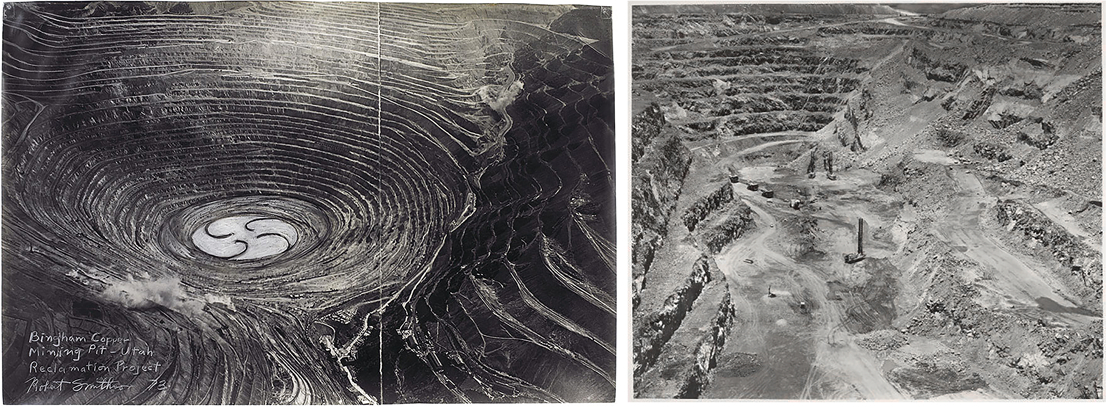
Systemic duality versus systematic continuity; for Smithson a possible reality filtered through representation, and for Starling a representation indexically tied to it material source: left, Robert Smithson's proposal Bingham Copper Mining Pit — Utah Reclamation Project (1973) © Holt Smithson Foundation/Licensed by VAGA, New York, NY (Wax pencil and tape on plastic overlay on photograph); right, an image of Simon Starling's One Ton II (2005) © Simon Starling, photo by Jens Ziehe, Berlin. Courtesy of the artist and Neugerriemschneider Berlin (5 handmade platinum/palladium prints of the Anglo American Platinum Corporation mine at Potgieterus, South Africa, produced using as many platinum group metal salts as can be derived from one ton of ore).
Such transformational balance is a foil to the reality/representation opposition as well as diffusive entropy. The contrast between Smithson and Starling is evident not only in the medium of images but also architecture. We need only to compare the forceful crushing of a building under loads of dirt in Smithson's Partially Buried Woodshed (1970), with Starling's proposal Rotary Cuttings (2005), which enacts a conservation of matter by cutting and swapping circular holes from walls on different floors of a building through a balanced swinging arm. Across much of Starling's work there is either a decreasing entropy or a dynamic equilibrium that is traced out.
9
He has commented that Smithson's entropic vision is seductive but also a,
tough dialectical approach to things…I suppose my project sets itself up in dialogue with that. It proposes an alternative model, one again that is perhaps linked to ecological notions or kicks against an entropic notion if you like — through its balance and circularity. (Kaiser 2006, C17)
10
Arguably, Starling's work is a critical and creative example of what artist Ana Rewakowicz has called art's role as an anti-entropic agent that ‘helps us to zoom in on both the foreground and background at the same time and provides a potential to capture energy that otherwise would be lost’ (2014). What becomes clear is that what is interesting for the artist engaging an ecosystemic perspective isn't a perfect literacy in (nor literalism to) nature's laws, but instead the rich possibilities that lie within the process of the inquiry itself, as poetic as it might also be scientific in its aesthetic.
Starling described his work as an ‘alternative model’, and indeed artists working in this vein seem to be engaged in a form of model-making that recognizes the configuring of a system as a gesture that manifests reality in representation, a specific and also provisional proposition within the wider undifferentiated buzz of everything. As art historian Matthew Hunter has noted, ‘models do not simply illustrate or instantiate abstract theories. Instead, they frequently depart in important ways both from the theories they ostensibly embody and the worldly targets they are used to explore’ (2010, 210). In this sense the model is a novel, creative, and motive amalgam that is part of the world's dynamic rather than simply a picture of it. 11 Putting aside concerns with ‘purity of expression’ or the ‘sublime’, an ecosystem aesthetics revels in transformation and complexity. With its embrace of transformation, objects quickly lose any naïve sense of autonomy and the objet d'art is replaced by a set of configurable parts that are continuously woven into a matrix that is as physical as it is virtual; the artwork is the articulation of the dynamic system itself.
Throughout the vibrant middle of things
If we accept the view that our universe is an isolated system of ever-increasing entropy, then one hypothesis consistent with the Second Law is that so many billions of years from now our star and all future stars will burn out; the universe as a whole will reach an entropic ‘heat death’. The cosmos will stop its seemingly relentless expansion and it will transition into a cold, disordered, and homogeneous state. An ecosystem aesthetics denies none of this far-future possibility and instead remains most present in the middle of the thing we are in — the active and complex middles of creation rather than the subatomic beginnings or the hyperbolic ends dominated by extreme scales and force. Royal Astronomer Martin Rees recently reflected on what he saw as the primary questions for this next century. He concluded that:
You want to not only synthesize the very large and the very small but we want to understand the very complex, and the most complex things are ourselves, midway between atoms and stars. We depend on stars to make the atoms we are made of. We depend on chemistry to determine our complex structure … The science of complexity is probably the greatest challenge of all, greater than that of the very small…and the very large…And it's this science which is not only enlightening our understanding of the biological world but also transforming our world faster than ever. And more than that, it's engendering new kinds of change. (2005)
Rees’ notion of complexity, the horizontal and emergent activity of things in the middle ‘engendering new kinds of change’, certainly recalls Burnham's system aesthetics and its interest in the interactivity of ‘people, ideas, messages, atmospheric conditions, power sources, and so on’ (1968, 32). For a contemporary ecosystem aesthetics, however, it is important to recognize additional dimensions of complexity and activity that the systems thinking of the 1960s didn't account for. Those extra dimensions find form in the recent work of theorists like Jane Bennett and an interest in what she calls vibrant materiality and ‘the capacity of things, edibles, commodities, storms, metals — not only to impede or block the will and designs of humans but also to act as quasi agents or forces with trajectories, propensities, or tendencies of their own’ (2010, viii). Similarly to the model-making ethos of an ecosystem aesthetics, Bennett's materiality rejects the modernist insistence on the nature/culture binary that Bruno Latour has observed ‘explained everything, but only by leaving out what was in the middle’ (1993, 47). This middle is exactly what both ecosystemic and material vibrancy seek to recapture by means of amalgamation and the collaging of causal chains. While biological phenomena and ecological analysis may play important roles in projects that engage such an aesthetic, it cannot be reduced to a form of so-called ‘bioart’ or ‘sci-art’ — terms that only serve to privilege and reaffirm the science/art binary. 12 In fact, the ecosystem aesthetic and its materiality has little interest in the two cultures discourse, preferring an emergent knowledge that is unbeholden to overly disciplined disciplines and their claims to authenticity. The strategy isn't so much one of productive misreading but perhaps productive rewriting that revises the typical script of nature/culture, art/science, substance/form so as to embrace a far messier reality of things and their transformational potential.
Vibrant materiality and the vitality it affords all things is also another way that ecosystem aesthetics moves upstream relative to Smithson's sense of energetic dissipation. For example, where Smithson claims, ‘there's only a certain amount of resources and of course there's an attempt to reverse entropy through the recycling of garbage’ (302), Bennett is wont to ask, ‘how, for example, would patterns of consumption change if we faced not litter, rubbish, trash, or “the recycling”, but an accumulating pile of lively and potentially dangerous matter?’ (2010, viii). This understanding of vibrancy traces a distinctly anti-entropic arc through the notion of systems and what it means to represent, participate, or perform among and within them. The conviction that matter matters so much is likely one of the crucial ways an ecosystem aesthetics distinguishes itself from Burnham's original conception of system aesthetics. For while Burnham claimed, ‘art does not reside in material entities, but in relations between people and between people and the components of their environment’ (31), nascent ecosystem aesthetics seems far more committed to the idea that the relations are embedded within (and are active throughout) materiality itself. 13 In this way it is an aesthetic that may also run parallel to the wider current of ‘new materialism’ in contemporary art and interests in object-oriented ontologies that aim to make more meaningful sense of the complication, specificity, and multiplicity of matter and its endless dynamic. Without this commitment to a materiality that extends beyond the worn divisions of the real and the representational, any aesthetic then risks sliding back into what artist herman de vries calls ‘metaphysics without the physics’ (Gooding 2006).
Such a perspective on ecosystem aesthetics brings us back full circle to the two culture paradigm by suggesting that the notion of ‘culture’ (much less simply ‘two’ of them) makes little sense because of the overriding significance it gives the human in exclusion to everything else. It poses an alternative path around the limits and low expectations ‘two cultures’ perpetuates about how we might make new, meaningful, and aesthetic sense of the world's complexity. In discussing the work of artist Tomás Saraceno, Bruno Latour commented that one of its virtues was that, ‘visual experience is not situated in any fixed ontological domain’, going on to say:
It is very important if you consider that all sorts of disciplines are now trying to cross the old boundary that has, until now, distinguished the common destiny of increasing numbers of humans and non-humans. No visual representation of humans as such, separated from the rest of their support systems, makes any sense today. This was the primary motive for Sloterdijk's notion of spheres, as well as for the development of actor-network theory; in both cases the idea was to simultaneously modify the scale and the range of phenomena to be represented so as to renew what was so badly packaged in the old nature/society divide. If we have to be connected with climate, bacteria, atoms, and DNA, it would be great to learn about how those connections could be represented. (2011)
Seen from long-standing traditions of academic expertise and cultural exceptionalism, the implicit transdisciplinary (and at times, extra-disciplinary) agenda within an ecosystem aesthetics will appear tenuous and unfocused, but perhaps entropy (once again) can offer an apt metaphor. For as chemical engineer and physicist Sharon Glotzer has noted, entropy is not really about increasing disorder but instead it is a ‘measure of possibilities’ (McApline 2012), its increase the spontaneous tendency towards more ways in which the parts of a system can be arranged. From this vantage, the significance of the Second Law doesn't lie within the entropic or anti-entropic per se, but in an ever-expanding sense of unknown potential. As Bridgman reminds us, there have been nearly as many formulations as there have been discussions of it, and that can be a valuable thing.
Notes on contributor
Andrew Yang is an associate professor at the School of the Art Institute of Chicago where he teaches across biology, sculpture, and the art/science/design interface. He received his PhD in Biology from Duke University where he studied the evolutionary ecology and his MFA from the Lesley University College of Art and Design.
Footnotes
Acknowledgements
I would like to thank Jan Avgikos as well as ISR's editors and their anonymous reviewers for constructive feedback on earlier drafts of this paper.
1.
2.
While this paper will often discuss the arts and the humanities as ‘one culture’ and one discipline relative to that of the sciences, it is important to acknowledge that the visual arts are typically not held to an identical standard of what is considered ‘scholarship’ as found in humanities, social sciences, or natural science fields. Arguably, the ‘Sokal Affair’ is a cultural dispute between particular natural scientists and ‘postmodernists’, which include not only those in the humanities, but even more especially sociologists of science (i.e. social scientists) whose views were seen as undermining scientific method and knowledge not only within academia, but also in public culture more widely. In this sense, my grouping of the arts, humanities, and certain veins of the social sciences as one culture is certainly an oversimplification, although from the perspective of scientific critiques like Sokal is suitable for the purposes of this discussion. For more on Sokal's view see Sokal and Bricmont 1999. For an extended discussion on the question of the ‘science wars’ including Sokal his and his critics, see Labinger and Collins ( ).
).
3.
In forms of conceptual borrowing, like analogy, it is often assumed that the context to which a concept is being imported is stable and well-characterized in a way that the imported concept will link meaningfully in the new context. However, Massumi's idea suggests that the purpose for the appropriation isn't based on how suitable it will be in the target context beforehand, but rather the possibility that the concept can act as an agent of change that might reconfigure the target context in the process, not simply fit into it. One breaks the egg to make something, but we don't know if it will be a cake mix or an omelet ahead of time. In the interview ‘Entropy Made Visible’ () with Alison Sky, Robert Smithson uses the breaking of an egg — that of Humpty Dumpty and the impossibility of putting him back together — to illustrate the idea of increasing entropy. Perhaps an artist's appropriation of entropy may be like pushing Humpty off the wall — embracing an increase of entropy means pushing theories and concepts off the ledge and allowing them to fall, breaking into pieces that can take on different configurations that create new and very different meanings from them that can only be discerned after the fact.
4.
5.
One can understand Sokal's concerns about cultural appropriation but also recognize that claims about ‘scientific understanding’ don't include the standards of ‘meaning’ in the more general sense. Jimena Canales's study of the Einstein/Bergson debate provides an interesting case study on this question of intellectual territory among disciplinary approaches as well as personalities; see Canales . Underlying the two-culture debate are, more fundamentally, issues of mutual respect between different approaches to knowing that ‘the academy’ has yet to find a meaningful way to address.
6.
See related discussions on the standards of evaluation and usage of science by artists in Yang 2011, .
7.
Although Burnham's system aesthetics drew from cybernetic theory and the proliferation of technological systems at that time, its tone was more circumspect and critical than it was celebratory; the power dynamic between art and science was a live question in the essay and its publication coincided with his time as a fellow at MIT's Center for Advanced Visual Studies (CAVS). Like Burnham, CAVS founder, Gyorgy Kepes, also shared concerns about the culture of technological control favored by the expanding military-industrial complex of the time, of which MIT was a center. For more on the tension between Kepes and Smithson over art in the context of technoscience see Martin .
8.
The topic of the Anthropocene is as extensive as it is diverse, its literature growing exponentially. Two projects that reflect some of what I have in mind regarding an Anthropocene aesthetics include Latour and Weibel's 2005 exhibition and book, Making Things Public: Atmospheres of Democracy, as well as the Haus der Kulturen der Welt's recent ‘Anthropocene Project’ and its associated exhibition and events: .
9.
In one project, for example, Starling captures solar energy in a battery during a river boat journey to aluminum mines used by the former Dutch colonists in Surinam, bringing the battery to Amsterdam to run an aluminum skiff down the city's canals to the museum where the boat is melted back down into a raw aluminum block. There is a transformation of both energy and matter that traces a historical and an economic trajectory — gathering and expending, making and breaking.
10.
In the same interview it is worth noting that Starling does comment that his projects typically do, ‘aspire to a state of closure. They model themselves on a scientific understanding of a closed system’, but continues on to say how, ‘the degree of closure varies quite radically from work to work. These systems are clearly a device or investigating other things and are not self-referential — they talk to their wider world’ (Kaiser , C7).
11.
In her examination of the work of painter-turned-camouflage researcher, Abbott Thayer, Hannah Rose Shell describes his practice of productive mimesis: ‘a process of concrete model building wherein the model is of a natural system that always requires embodied projection into that system. The self enters as creator, viewer, and invisible inhabitant of a remodeled world. Seeing becomes a way of remaking one's own relationship to one's environment’ (50). This articulation of model-making captures key features of the ecosystem aesthetic in which the subject and object are co-creators.
12.
13.
As Bennett notes, her vibrant materiality would appear to share characteristics with some ‘animistic’ traditions. One example of how ‘vibrancy’ might relate to animistic worldviews might be ‘tama’ — the energy or charge in all material things within the Shinto tradition. Analogies to ecosystem aesthetics seem available when one considers how the ‘tama’ of particular objects can — in philosopher Thomas Kasulis's formulation — create a ‘holographic entry point’ that marks out the internal relations between the material and the spiritual such that ‘the material world is at all times in all places spiritual, and the spiritual never exists without the physical’ (, 15). This stands in contrast to the philosophy of external relations typical of much network theory in which things as nodes exist autonomously and are connected by virtue of a something that bridges (but does not alter) the things themselves. The vibrant materiality of an ecosystem aesthetics might find kinship with Shinto's conception of the ‘tama’ that connects every material thing as a ‘part’ such that, ‘the part reflects the whole; the whole is in every part. To see this form of connectedness, the vantage point is not at a distance but through close examination of a single piece of evidence. This bit of evidence functions as a holographic entry point opening to a grasp of the whole’ (Kasulis 2004, 23).