







Abstract

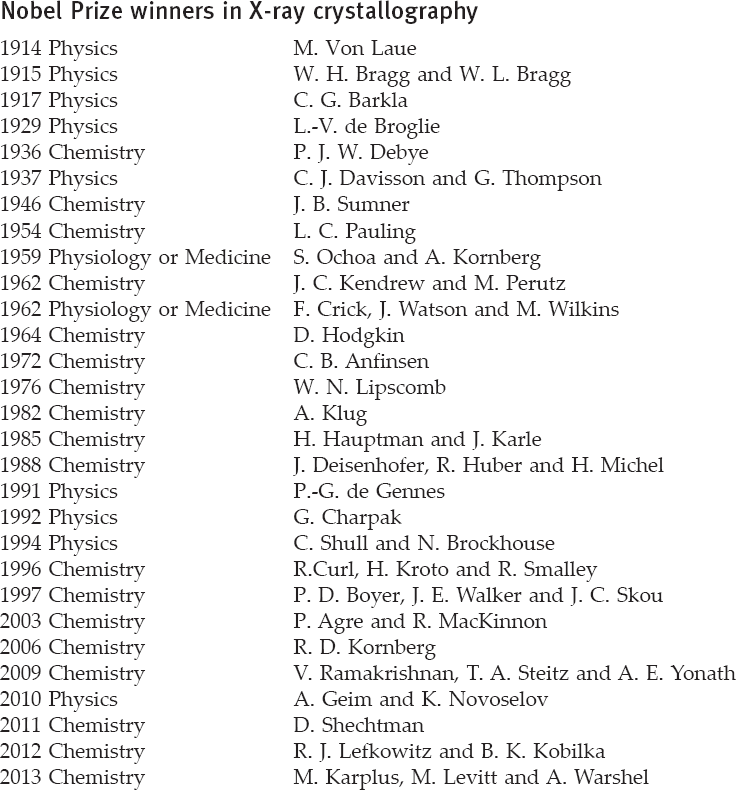
On 14 November 1915, Lawrence Bragg, then aged twenty-five and serving as an army officer on the Western Front, received a telegram informing him that he had won the Nobel Prize for Physics that year jointly with his father, William Bragg, for their work on using X-rays to determine the structure of crystals. For nearly a century thereafter Lawrence Bragg remained the youngest winner of the Prize until Malala Yousafzai received the Peace Prize in 2014 at the age of 17. This special issue of Interdisciplinary Science Reviews marks the centenary of the award to the Braggs for their role in making one of the key scientific discoveries of the twentieth century, evinced by the total of twenty-nine Nobel Prizes, listed below, so far given for work related to X-ray crystallography. That such a number have been awarded also illustrates the interdisciplinary nature of X-ray crystallography since Prizes have been given for both Chemistry and Physics, as well as, occasionally, for Physiology and Medicine. It was this Prize that Francis Crick, James Watson and Maurice Wilkins won for their proposing the double helical nature of DNA. Crick and Watson were at the time working at the Cavendish Laboratory in Cambridge under the direction of Lawrence Bragg and he played a significant role in the publication of their paper and in its subsequent reception.
Although for a full account of their lives and work, John Jenkin's Plutarchian biography should be read, this collection of essays aims, in part, to provide some snapshots (Jenkin, Thomson, Wilson, Brooks-Bartlett and Garman) of aspects of the lives of both Braggs and their colleagues and collaborators to provide an indication of why their work became and remains so influential. The other aim of these essays is to illustrate, via discussions of some very recent scientific research (Brooks-Bartlett and Garman, Catlow, Curry), how the scientific field they initiated maintains its formidable strength over a number of disciplines. Perhaps these twin themes are best linked together by noting the value of visualization (see Gooding 2004) which covers not only representations of the atomic structures of crystals and molecules (well exemplified by the wonderful images in Brooks-Bartlett and Garman, Catlow, Curry), but also in Lawrence Bragg's (and indeed in other members of the family) considerable artistic skill (illustrated by Thomson, Glazer). Such relationships immediately bring to mind the ‘Two Cultures’ debate that started in the early 1960s, in which Lawrence Bragg played a significant role. Hopefully the placing of papers drawn from both the sciences and the humanities within the same issue of Interdisciplinary Science Reviews might suggest that such cultural and disciplinary divides are more imagined than real.
Nobel Prize winners in X-ray crystallography
Footnotes
Acknowledgement
I am grateful to the Bragg Lecture Fund for assistance in the production of this special issue of Interdisciplinary Science Reviews.
Notes on guest editor
Frank A. J. L. James is Professor of the History of Science at University College London and the Royal Institution, UK. His main research concentrates on the physical sciences in the late eighteenth and nineteenth centuries and how they relate to other areas of society and culture, for example art, business, media, religion, technology, and the military. He edited the Correspondence of Michael Faraday, published in six volumes between 1991 and 2012, and a number of essay collections including ‘The Common Purposes of Life’ — a set of essays on the Royal Institution. His Michael Faraday: A Very Short Introduction was published in 2010 by OUP who the following year also published his sesquicentenary edition of Faraday's Chemical History of a Candle. His current research is on the practical work of Humphry Davy, including his work on nitrous oxide, agricultural chemistry, the miners’ safety lamp, analysis of ancient Roman pigments, and his attempts to unroll chemically the papyri excavated from Herculaneum. He has been President of the British Society for the History of Science, the Newcomen Society for the History of Engineering and Technology, and the History of Science Section of the British Science Association. He was chair of the National Organising Committee for the XXIVth International Congress for the History of Science, Technology and Medicine held in Manchester in July 2013. He was elected a Member of the Academia Europaea in 2012; he is also a Membre Effectif of the Académie internationale d'histoire des sciences and a Liveryman of the Worshipful Company of Scientific Instrument Makers. He has been a member of the editorial board of Interdisciplinary Science Reviews since 2002.