







Abstract
One of the basic performance characteristics of the seismic system is its sensitivity. An appreciation of the spatial variation of mmin is important for the correct interpretation of seismic data and the planning of future expansion of the seismic system. This paper will discuss the empirical evaluation of the system sensitivity applied to the data from two Australian mines. The method discussed here is reliant on enough seismic data being available and is per se not applicable to greenfields sites. A gridless method for the evaluation of mmin with respect to the distance to sensors is proposed as a stable and relatively easy first order approach to the evaluation of the system sensitivity that overcomes some of the problems of the other methods. This method is easy to understand and facilitate the conceptualisation of the influence of the sensor locations on the system sensitivity.
Introduction
One of the basic characteristics of the seismic system is its sensitivity. The sensitivity of the seismic system is defined in this paper as the minimum magnitude event that is reliably recorded by the system, and is designated by mmin. This is also referred to as the magnitude of completeness of the record (Sagar and Leonard, 2007; Wiemer and Wyss, 2000), as this is the magnitude above which all events are recorded and therefore, a complete dataset exists.
An appreciation of the spatial variation of mmin is important for the correct interpretation of seismic data. Planning of future expansion of the seismic system also requires an appreciation of the current achieved sensitivity, as this allows the planning of expansions to the system to be focused on the areas of interest.
Figure 1 illustrates the effect of the spatial variation of mmin over the mine. The figure shows what is generally referred to as the magnitude–time history plot (Hudyma et al., 2003). The scatter plot shows the magnitude of events over time, while the line shows the cumulative number of events with time. For the first period up to August 2006, the smallest events recorded were about ML = −2 with a mmin of about −1·5. After this period, there is a sudden increase in system sensitivity (drop in the smallest recorded event size) due to the fact that more sensors were installed to better cover the area of the highest seismic activity. Another sudden increase in the system sensitivity occurs around November 2007 when a few more sensors were added to the deeper levels. Between August 2006 and November 2007, there is a gradual reduction in the system sensitivity. This apparent reduction in the system sensitivity is not due to any change in the system configuration over time, but due to the mining progressively migrating deeper and ‘out of’ the array into areas not well covered by the array. This is illustrated in Fig. 2.
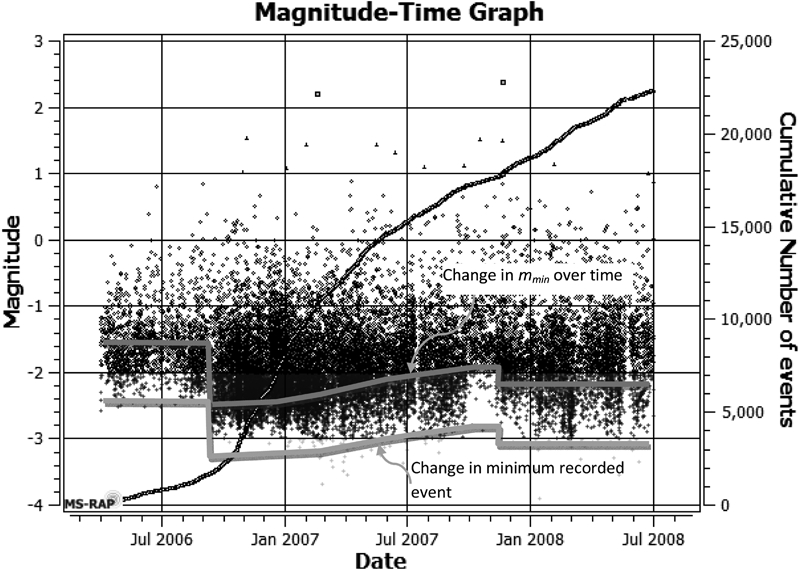
Magnitude–time graph for data from Australian mine
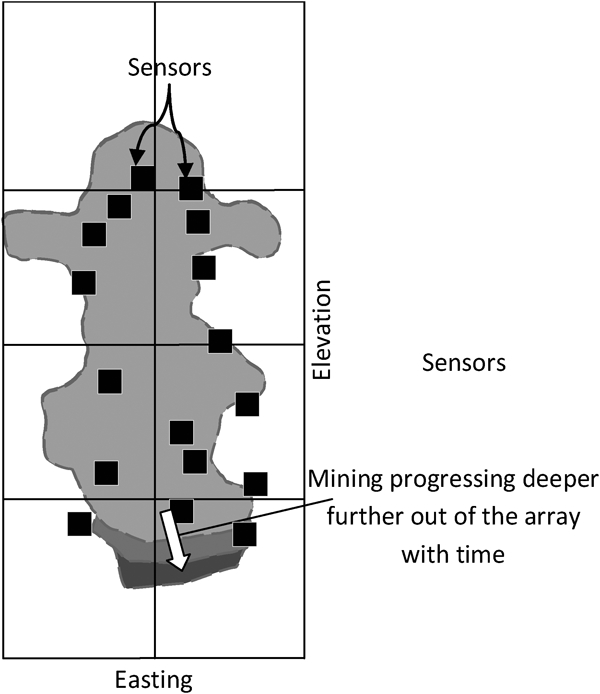
Illustration of mining front migrating out of seismic array and into areas of lower system sensitivity
This paper discusses the empirical evaluation of the system sensitivity applied to the data of two Australian mines. The method discussed here is reliant on enough seismic data being available and is per se not applicable to greenfield sites. For greenfield sites, the evaluation of the future system sensitivity will have to be based on theoretical methods only.
Although the method discussed here, being empirical, is only applicable to the dataset, associated volume and seismic system configuration at the time, it can be used for the first order design of system expansion.
Direct evaluation of mmin from seismic data
The value of mmin can be calculated over a volume based on the calculation of the mmin value from the frequency magnitude distribution (FMD) for subsets of data. The data are subsampled according to its location. Different spatial subsampling schemes can be used, the simplest of which is a grid based calculation. This is the method used by Wiemer and Wyss (2000) to map the mmin for earthquakes in areas of Alaska, USA and Japan.
A refinement of the simple grid based technique is described by Wiemer and Wyss (2000) for two-dimensional earthquake application. This scheme is not based on a fixed grid but distances between calculation nodes are determined by event density in the area. The variable grid size is necessary to achieve statistical significance of the dataset on which to base the calculation of mmin.
The simple fixed grid scheme was used in this work. For this, the mine volume is discretised into cubic celled grid with calculations performed on the data located in each grid cell. Figure 3 shows the recorded data in two section views for an Australian mine (referred to as Mine A). Also shown are the cells for which a value of mmin could be achieved. The whole volume of the mine was divided into 50×50×50 m cells, but only the cells for which reasonable values could be obtained are shown. A modest cutoff value of 50 events on which to base the mmin calculation was used in this case.
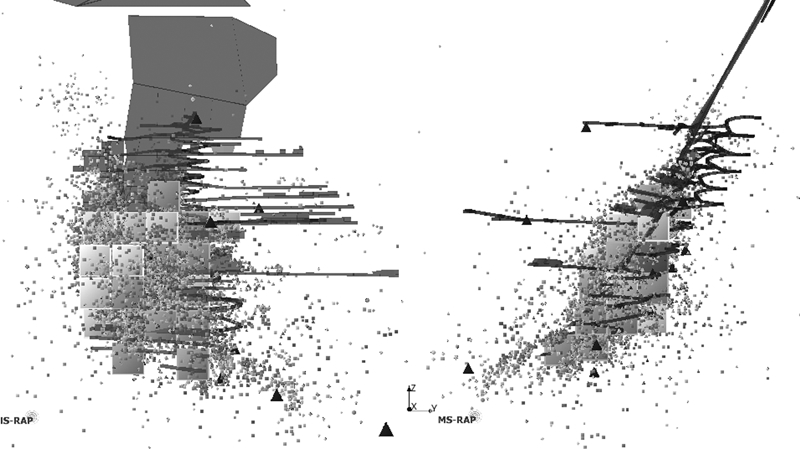
Results from grid based mmin calculation for Australian mine
The strong dependence of the method on the grid size that is used is illustrated in Fig. 4. The colour of the blocks represents a relative measure of the confidence in the mmin estimates within that block, and the darker colours relate to lower numbers of data points and therefore a lower confidence in the mmin calculation for that particular block. It should be noted that the rock mass to the west of the mine (increasing Y axis) is less seismically active than the east, which results in less data in this area. Although the sensitivity of the system compares well to the other areas, not enough data are available to obtain values for mmin based on the FMD in grids in this area. The size of the cells can be increased to allow for more events to be included in each cell. This occurs, however, with a reduction in the resolution of calculation.
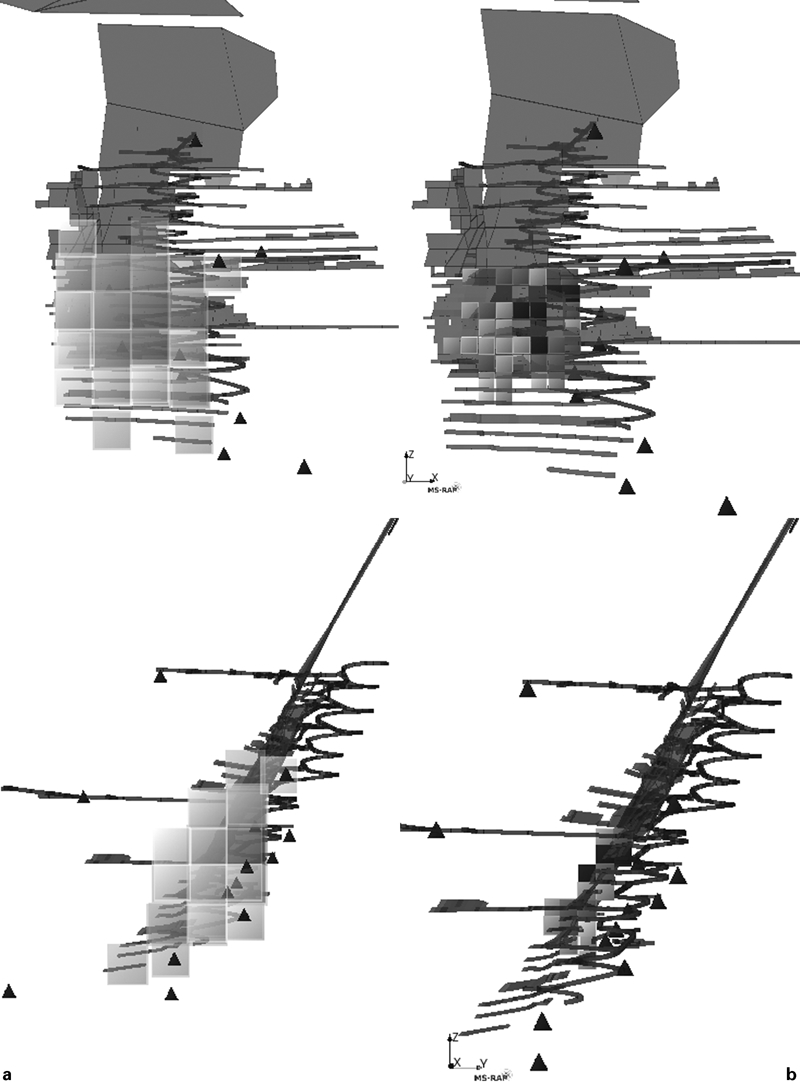
Results from grid based mmin calculation for Australian mine
Indirect method
The major drawback of the previous method is that it is limited to the areas of high data density. This problem can be overcome by establishing a relationship between a parameter of the system geometry and the mmin.
Two of the most important factors determining the sensitivity of the system are the distance to the sensors and the noise level at the different sensors. As a seismic wave radiates outwards, it attenuates with distance from the source. A sensor will only record the seismic wave if the amplitude of the wave is larger than the background noise level. The distance to the sensors has a first order influence on the sensitivity of the system.
A minimum of three, preferably four sensors are necessary to locate a seismic event. The minimum number of sensors to be used for locating events can be set in the system and in most Australian mines is set to four or five. Whether or not the event will be located will be determined by whether the fourth nearest or fifth depending on the setting, sensor to the source of the event, is within the range at which an event of a particular size will be detected by that sensor. The distance to the fourth sensor, or fifth sensor, is therefore a good parameter related to the system geometry that can be correlated with system sensitivity. The mines from which data are used in this study used a threshold of five sensors. As a result, the distance to the fifth sensor will be used here and is denoted by D5.
Correlation of grid based calculation of mmin with D5
A logical extension to the grid based assessment of mmin is to correlate these mmin values with the D5 value of each of the grid cells for which a mmin value were obtained. This will allow an extrapolation of the results to cells, for which mmin values could not be obtained.
Figure 5 shows the relationship between D5 for the grid cells shown in Fig. 4 and the mmin value obtained from the events located in those cells. Three zones are also indicated on the plot: the lower boundary below which the system does not record any events, the upper boundary above which the system records the events and a zone which defines the area between the two boundaries with some uncertainty in the value of mmin.
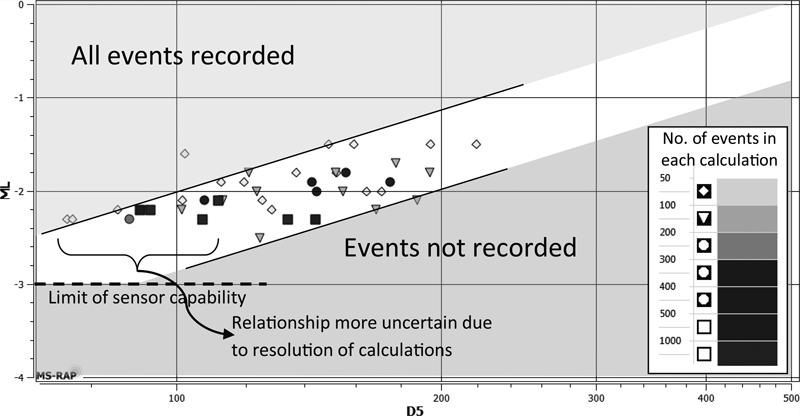
Relationship between D5 and mmin for 50×50×50 m grid cells shown in Fig. 4
Although this method allows us to obtain a relationship between the D5 and the mmin, it relies on a fair amount of subjective interpretation with resulting uncertainty. Each of the estimates of mmin in each grid is based on a limited number of data point and represents in total only a fraction of the data in the whole database. Further uncertainty is due to the wide resolution of the calculated grids. This uncertainty is more pronounced towards the smaller values of D5.
This method, although allowing for the extrapolation of the mmin assessment to areas not covered by the direct evaluation of mmin, still suffers from most of the problems associated with the direct method.
Gridless method for obtaining relationship between mmin for D5
Assuming a rock mass that is homogenous with respect to the seismic attenuation properties, the system sensitivity is not determined by the absolute location of the event but its location relative to the sensors. If this assumption holds, the event location in three-dimensional space becomes irrelevant and data can be analysed on the basis of its distance parameters, rather than its true three-dimensional location. Performing the mmin analysis on this basis, implies a superposition of data from different seismic sources with different seismic characteristics, including different values for the power law exponent, or b-value. Although important for the analysis of seismicity, the separation of seismic sources with different characteristics is irrelevant for the analysis of the system sensitivity.
Figure 6 illustrates this concept. If the FMD of sources 1 and 2 follow the Gutenberg–Richter (1944) relation, it follows that the combined distribution will also. The maximum value of mmin of the two sources will be the value of mmin for the combined source. Assuming a relationship exists between mmin and D5, sources at equivalent D5 will obtain similar values of mmin. Figure 6 illustrates the most used, and in the words of Lasocki (2008), ‘most over-used’, Gutenberg–Richter relation. The concepts are best illustrated by assuming this relation, but are not reliant on it.
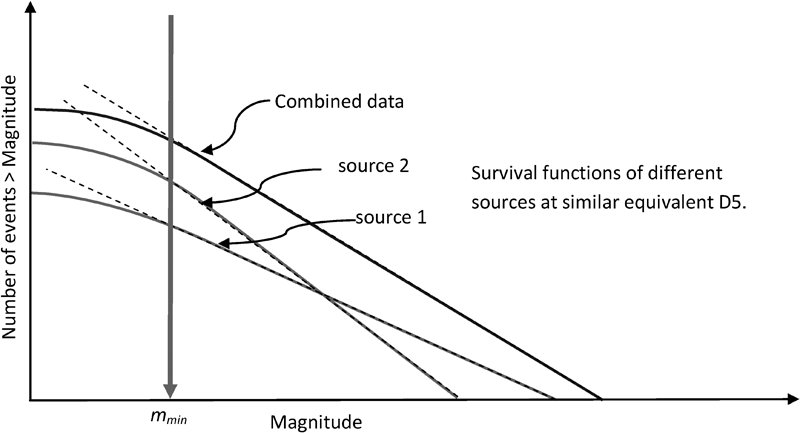
Illustration of superposition of magnitude frequency data from different seismic sources at similar D5
Figure 7a shows a scatter plot of ML versus D5 for all events recorded at Mine A. Figure 7b shows the FMD of the data with D5 value between 100 and 110 m. From this data, an estimate of mmin for the subset of data at D5 between 100 and 120 m can be obtained.
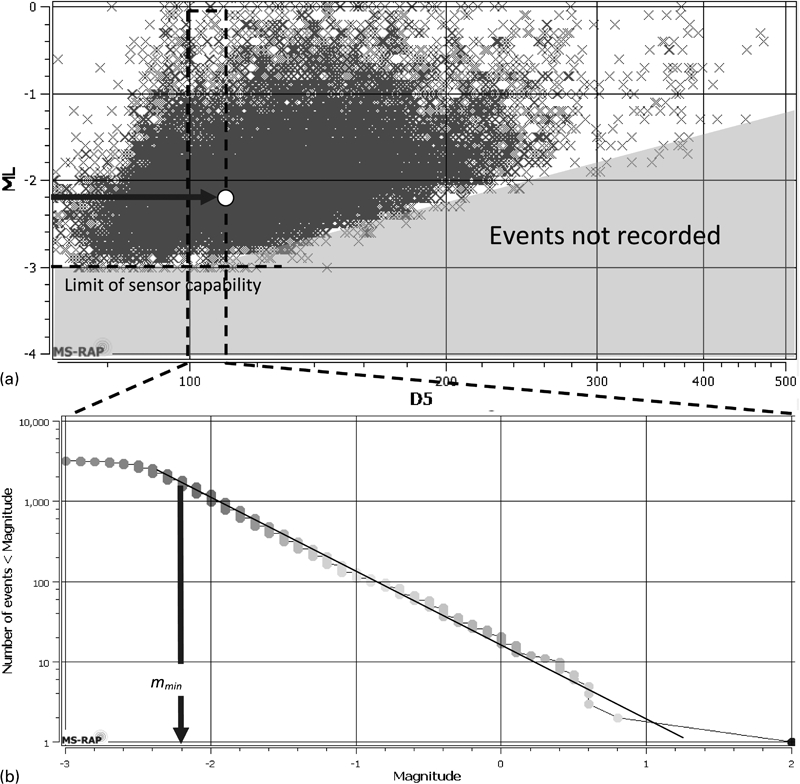
Relationship between D5 and mmin for whole events database of Mine A a with calculation of mmin for subsample of data with D5 between 100 and 110 m b
By performing a mmin calculation for subsets of data with a moving window of D5, the relationship between mmin and D5 is obtained as shown in Fig. 8. The original data are shown as ‘x’ in the figure. Also shown as ‘+’ are the estimates of mmin based on the 50×50×50 m grid cells, shown in Figure 4. The shape and colour scale of the markers of the results in of the estimates of mmin for windows of D5 show the number of data points, with magnitudes greater than mmin in each of the D5 windows used in the calculations. In contrast to the grid based mmin estimates, the largest part of the database was used in this method resulting in a stable estimate of the mmin–D5 relationship.
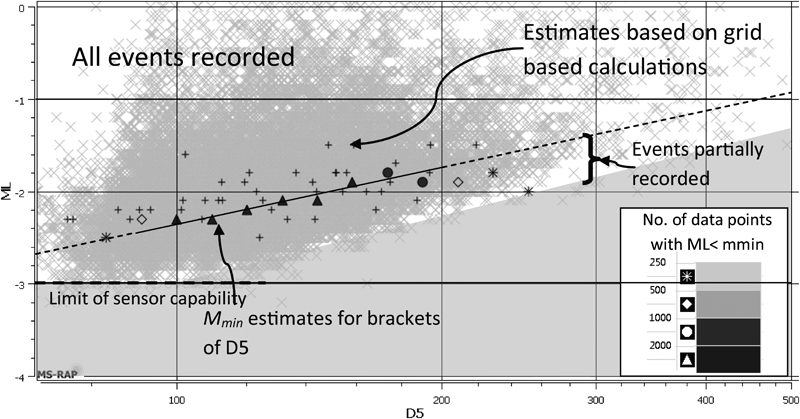
D5–magnitude plot for database events of Mine A with results of mmin calculations on windows of D5 data
A similar analysis was performed for another Australian mine (Mine B) and the resulting mmin–D5 relationship is shown in Fig. 9.
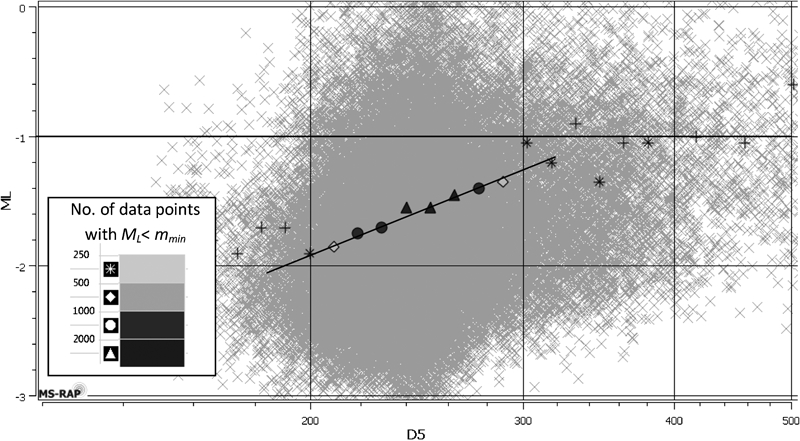
D5–magnitude plot for database events of Mine B with results of mmin calculations on windows of D5 data
Spatial assessment of mmin based on mmin–D5 relationship
Having established a relationship between mmin and D5, this can be used to evaluate the spatial variation of mmin. This is done by calculating the D5 value at a point in space, and through the mmin–D5 relationship, the expected mmin value is estimated at that point. For illustration, the sensitivity of a seismic system at Mine B is shown on a horizontal and vertical plane through the mine (Fig. 10). An extra cutoff was introduced at this point. This is the lowest magnitude that could be reliably recorded by the sensor, due to the sensor frequency response upper limit. Obtaining these cutoffs is outside of the scope of the current paper and readers are referred to Mendecki (1997). The introduction of these cutoffs is only necessary to safeguard against unrealistic low values of mmin where sensors are spaced very close. With the distributions of sensors used in mines, this is generally not a problem but should be included for prudence sake. The sensor density for the example shown in Fig. 10 was not dense enough to invoke this sensor lower limit. These cutoff values are shown in Figs. 7 and 8.
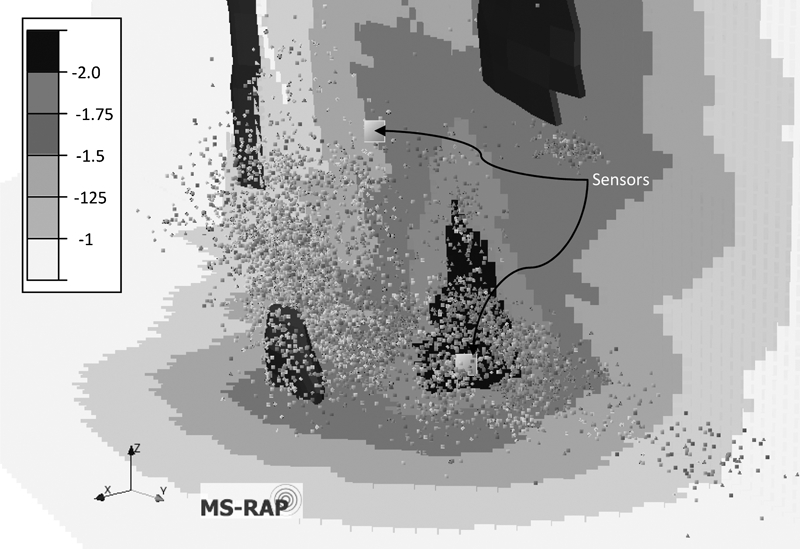
Contours of mmin at Mine B calculated from D5 and mmin–D5 relationship
D5 is a simple parameter that cannot capture the full complexity of the factors influencing the system sensitivity. Having said this, the good mmin–D5 correlations obtained indicate that it can be successfully used as a first order sensitivity assessment.
The D5 parameter has a physical meaning easy to understand and to visualise. It is, therefore, a useful parameter for conceptualising the influence of the addition or loss of sensors on the system sensitivity in an area. With easy ‘distance-to’ calculations, the conceptual design of future system expansions can be done.
The method for obtaining a relationship between mmin and D5 assumes a homogenous rock mass with respect to the seismic attenuation. If this assumption is not valid, the analysis can be performed on subsets of the data, applicable to different areas of the mine. For very complex rock masses, this method may not yield good estimates and more sophisticated methods must be employed.
Conclusions
The direct method of mmin estimate for cells in a discretised volume does not appear to provide any practical solution for the assessment of system sensitivity throughout the mine volume, as this method provides only a limited number of estimates in a few discrete locations in the mine. Correlation of these mmin estimates with the D5 parameter provides a way of extrapolating these results for the whole mine volume. Only a small proportion of the data are used in this method for the estimates of mmin with resulting uncertainty in the correlation.
The gridless method for the estimation of the mmin–D5 relationship provides good and stable results and is based on the largest proportion of the database.
After establishing the mmin–D5 relationship, this can, with simple ‘distance-to’ calculations, be used to assess the system sensitivity throughout the mine. D5 is a simple parameter that cannot capture all the complex factors influencing the sensitivity of the system. In spite of its limitations, it can successfully be used for first order assessment of seismic system sensitivity and future expansion design. The D5 parameter has a physical meaning easy to understand and to visualise, and is therefore a useful parameter for conceptualising the contribution of each sensor to the overall sensitivity in a specific area.
Footnotes
Acknowledgements
The ACG would like to sincerely thank the following mining operations who provided funding for this research through the Mine Seismicity and Rockburst Risk Management project at the Australian Centre for Geomechanics. Barrick Gold of Australia, Minerals and Energy Research Institute of Western Australia (MERIWA), Lionore Australia Ltd, BHP Billiton Nickel West, Perilya Limited, Lightning Nickel (Independence Group), Kirkland Lake Gold, Agnico-Eagle Mines Ltd, Kalgoorlie Consolidated Gold Mines, Allstate Explorations NL (Beaconsfield), Newcrest Cadia Valley Operations (Ridgeway), Harmony Mt Magnet Gold, Xstrata Copper (Kidd Mine), Oz Minerals (Golden Grove), Newmont Asia Pacific, AngloGold Ashanti Australia, Codelco Chile, LKAB Sweden, Xstrata Zinc (Brunswick Mining and Smelting), Reliance Nickel P/L (Consolidated Minerals Group), Xstrata Nickel (Cosmos Nickel Project) and Gold Fields Australia.
