







Abstract
Modelling of sulphide capacities of CaO–MgO–AlO1·5, MgO–MnO–AlO1·5 and CaO–MgO–MnO–AlO1·5 slag systems was investigated. The Reddy–Blander model was applied to calculate the sulphide capacities a priori with the knowledge of chemical and solution properties of oxide and sulphides for the above slag systems. The sulphide capacities were determined as a function of temperature (1500–1650°C), composition (0<
 <0·6) and basic oxides (CaO, MnO and MgO). Sulphide capacities of aluminates increased with increase in temperatures and decreased with the increase in alumina content in the slags. Very good agreement was observed between model and experimental data.
Introduction
The Reddy–Blander (RB) model for a priori prediction sulphide capacities of binary and multicomponent silicate melts using the model1 for polymeric silica chains was developed. They showed that sulphide capacities could be calculated a priori based on knowledge of the chemical and solution properties of oxides and sulphides.1– 6 In another publication,7 the model was extended to binary aluminate melts. They applied the model to ternary silicate melts containing FeO.8 In all systems, excellent agreement between the model and experimental data was observed. In this work, the RB model is extended to calculate the sulphide capacities of binary, ternary and multicomponent CaO–MgO–MnO–AlO1·5 aluminate slags.
Theoretical analysis
By using CaO–SiO2 as an example, the binary is divided into two regions: one basic and another acidic.
The sulphide equilibrium reaction in the melt is written as

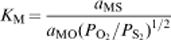

 and
and
 are the partial pressures of oxygen and sulphur respectively.
By combining equations (2) and (3), and Cs can be obtained as

Reddy–Blander model for basic binary:

The silicate melt is completely depolymerised with oxygen given by the dissociation of MO. Some oxygen anions will be left unattached in the solution since the molar ratio MO/SiO2 is >2. These anions (O2−) are called free oxygen. For this system, the model assumes that the only species in solution are one cation M2+ and three anions O2−, SiO44− and S2−. The latter is present in very small amounts. The solution is thus a simple ternary MO–M2SiO4–MS. Substituting AlO1·5 for SiO2 in the melts and the equation for Cs can be written as5

 is the average molecular weight of solution given by

Reddy–Blander model for acidic binary:

In this system, the anions are assumed to be randomly mixed. The CaO is completely consumed and allowing for the assumption that the concentration of O2− ions is negligible. The model assumes a lattice consisting of sulphur (monomer) and a distribution of polymers (aluminate polymeric ions). The volume fraction of S2− sites is given by
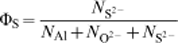
 is small compared to NAl, and as a result it can be neglected in the denominator. As discussed earlier,
 is also negligible. Equation (7) thus reduces to

 ), the solution is a mixture of polymeric species and monomer ions. The model equation for this region is

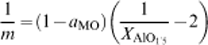
 ), the solution is mostly polymeric. The model equation for this region is

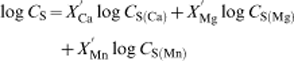
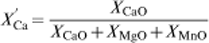
 is the equivalent cationic fraction of species i and can be calculated from the following equation
Results and Discussion
The model equations were used to calculate sulphide capacities for binary, ternary and higher order systems given a slag's temperature and composition. The model was used to calculate sulphide capacity of many systems, but only aluminate systems with available experimental data are reported in this work. Experimental results for sulphide capacities of binary CaO–AlO1·5 were obtained from Refs. 9 and 12–19.
Sulphide capacities of ternary slag systems
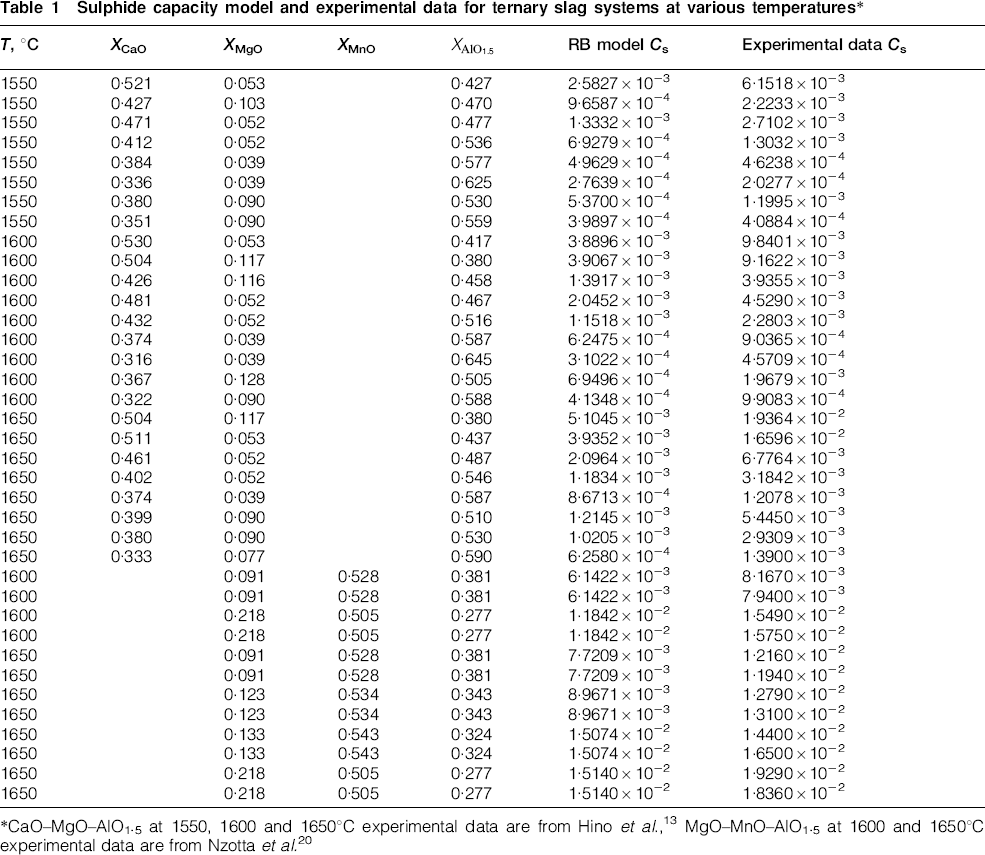
The sulphide capacities of ternary slag system experimental and model calculated data are presented in Table 1. The sulphide capacities of the ternary system CaO–MgO–AlO1·5 at 1550, 1600 and 1650°C as reported by Hino et al.13 are compared to model results in Fig. 1. The ternary system MgO–MnO–AlO1·5 was studied by Nzotta et al.20 at 1600 and 1650°C. Figure 2 compares reported experimental values to model results for the ternary MgO–MnO–AlO1·5. The liquidus data for basic sulphides (i.e. MgS) and also experimental sulphide capacities of MgO–MnO–AlO1·5 are not available. The available solid data for solid sulphides and activity of basic activity in aluminates were used in calculating the sulphide capacities as a function of temperature. The predicted sulphide capacities for CaO–MgO–AlO1·5 are slightly lower than the corresponding experimental data. The sulphide capacities of CaO–MgO–AlO1·5 decreases with the increase in composition of AlO1·5. But the decrease is much smaller for the MgO–MnO–AlO1·5 system. Effect of temperature on sulphide capacities of these ternary systems is not significant.
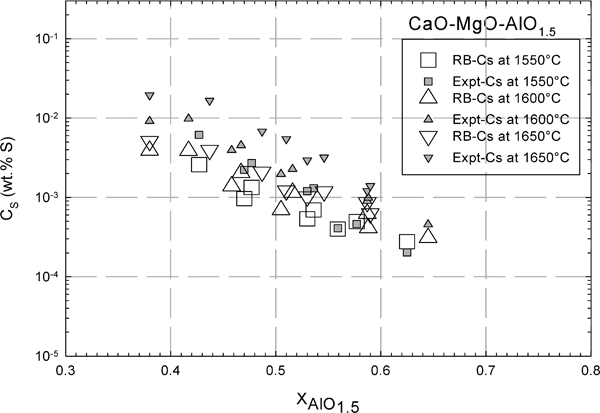
Comparison of available experimental data to model results of CaO–MgO–AlO1·5 at 1550, 1600 and 1650°C: experimental data are from Hino et al.13
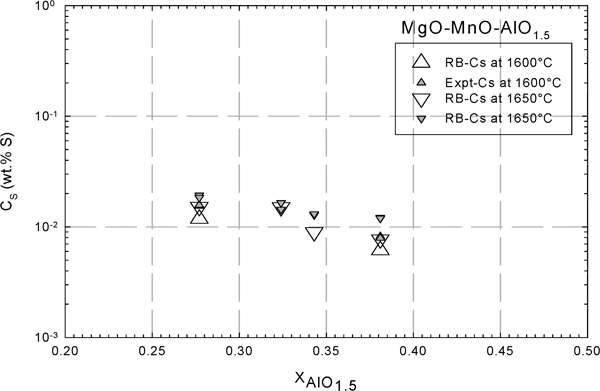
Comparison of available experimental data to model results of MgO–MnO–AlO1·5 at 1600 and 1650°C: experimental data are from Nzotta et al.20
Sulphide capacity model and experimental data for ternary slag systems at various temperatures*

Sulphide capacities of quaternary slag systems
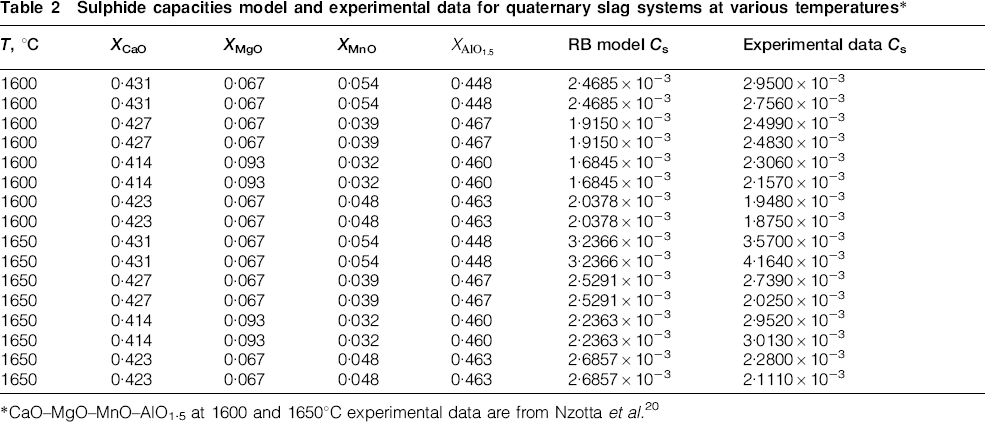
The sulphide capacities of the system CaO–MgO–MnO–AlO1·5 as measured by Nzotta et al.20 at 1600 and 1650°C are compared to model results in Fig. 3. The sulphide capacities of quaternary slag system experimental and model calculated data are presented in Table 2. A priori predicted sulphide capacities for this system match reasonably well with the experimental sulphide capacities of quaternary slags.
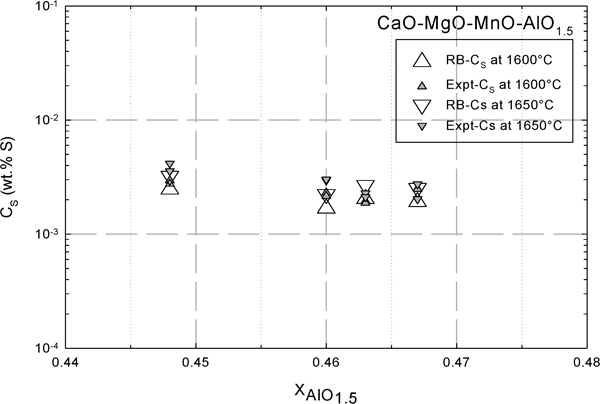
Comparison of available experimental data to model results of CaO–MgO–MnO–AlO1·5 at 1600 and 1650°C: experimental data are from Nzotta et al.20
Sulphide capacities model and experimental data for quaternary slag systems at various temperatures*

Conclusion
The RB model can be used to calculate sulphide capacities of any system a priori given the slag's temperature and composition. The model agrees very well with experimentally measured values. For molten metal desulphurisation, slag temperature and composition can be adjusted to obtain high sulphide capacity. Slags with high sulphide capacities can be used effectively and economically to absorb and retain sulphur from molten metal. The low sulphur steels can be used in more demanding applications.
Footnotes
Acknowledgements
The authors would like to acknowledge the financial support for this research by American Cast Iron Pipe Company (ACIPCO) and the National Science Foundation (NSF).