







Abstract
This article seeks to broaden our understanding of the phenomenon of global production sharing and to explore policy options for developing countries for engaging effectively in production networks, through a case study on the export production hub in the State of Penang, Malaysia. The findings uphold Penang as a unique example of marrying development strategy with emerging opportunities for global production sharing. The state government of Penang has not only attracted major multinational enterprises in the global electronics industry but also helped them become deeply rooted in the economy through a well-designed investment promotion and development strategy.
Keywords
Introduction
Global production sharing — the break-up of the production processes into separate stages, with each country specializing in a particular stage of the production sequence — has been an increasingly important facet of economic globalization over the past four decades. 1 This process of international division of labour opens up opportunities for countries to specialize in different slices (tasks) of the production process in line with their relative cost advantages. Global production sharing is heavily concentrated within industries that are commonly classified as high-tech and capital intensive, such as electronics, electrical goods and transport equipment. However, economic theory postulates that, in a labour abundant economy, tasks undertaken within global production networks tend to be relatively more labour intensive. Moreover, trade based on global production sharing, that is parts and components, and final assembly traded within global production networks, has been growing at a much faster rate compared to the traditional labour intensive products such as apparel, footwear and sport goods.
The purpose of this article is to broaden our understanding of the process of global production sharing and to explore policy options to enable developing countries to engage effectively in production networks as part of national development strategy through a case study on the State of Penang in Malaysia. Penang, with a history of over four decade as a major hub in global production networks, provides a valuable laboratory for a study of the interplay between government policies and the global sourcing strategies of multinational enterprises (MNEs) in determining developmental gains from global production sharing (UNCTAD, 2010; UNIDO, 2009). Of course, it is not possible to generalize from a single case, but a historical case study of this nature is valuable for understanding the determinants and the nature of the global spread of production networks and for informing policy makers in developing countries of critical issues that may occur in their attempt to reap gains from this form of international exchange.
The study is based on data and information pieced together from various secondary sources and a firm-level survey carried out in Penang during November/December 2010. The secondary sources include official documents of the Penang Development Corporation (PDC) and Invest Penang, the investment promotion arm of PDC; policy and performance reports of the government of Malaysia; firm-level information extracted from the unpublished returns to the Penang Industry Survey 2007 conducted by the Socio-Economic and Environmental Research Institute (SERI) of Penang (later renamed the Penang Institution); and the news clipping collection at SERI. As part of field research, face-to-face interviews were conducted with senior government officials and private sector economic facilitator organizations, representatives of chambers of commerce and industry, and senior managers of a sample of MNE affiliates. For the purpose of the firm-level interviews, we used a ‘purposively-selected’, rather than random, sample of firms. This was appropriate because the purpose was to collect detailed information, through close interaction with interviewers, for writing an analytical narrative, rather than for undertaking a statistical analysis of firms' performance (Patton, 1990). 2
The article is organized in seven sections. The first section is a stage-setting analytical overview of the process of global production sharing, patterns and determinants of network trade, and emerging opportunities for countries to specialize in line with their relative cost advantage. The second section provides an overview of the initial economic conditions in Penang. The third section discusses the policy context, key elements of policy reforms and the institutional setting in which export-orientated development strategy was implemented. The fourth section examines the evolution of the export hub against the backdrop of on-going changes in global production sharing over the past four decades. The fifth section looks at investment patterns. This is followed by a section that examines export performance and its economy-wide implications. The key findings and policy lessons are presented in the final section.
Global production sharing
Global production sharing is not an entirely new phenomenon. 3 What is new about the contemporary process of global production sharing is its wider and ever-increasing product coverage, and its rapid spread from mature industrial countries to developing countries. With a modest start in electronics industries in the late 1960s, international production networks have gradually evolved encompassing many developing countries and spreading to many industries such as automobiles, televisions and radio receivers, sewing machines, office equipment, electrical machinery, machine tools, cameras, watches, light-emitting diodes, solar panels, and surgical and medical devices. In general, industries that have the potential to break up the production process to minimize the transport costs involved are more likely to move to peripheral countries than heavy industries.
The expansion of global production sharing has been driven by three mutually reinforcing developments (Helpman, 2011; Jones, 2000; Jones & Kierzkowski, 2001, 2004). First, rapid advancements in production technology have enabled the industry to slice up the value chain into finer, ‘portable’ components. As an outcome of advances in modular production technology, some fragments of the production process in certain industries have become ‘standard fragments’, which can be effectively used in a number of products. 4 Second, technological innovations in communication and transportation have shrunk the distance that once separated the world's nations, and improved the speed, efficiency and economy of coordinating geographically dispersed production processes. This has facilitated, and reduced the cost of, establishing ‘service links’ needed to combine various fragments of the production process across countries in a timely and cost-efficient manner. Third, liberalization policy reforms across the world over the past four decades have considerably removed barriers to trade and foreign direct investment (FDI).
During the early phase of development (in the 1960s and 1970s), production sharing was basically a two-way exchange between the home and host countries undertaken by MNEs; parts and components were exported to the low-cost, host country for assembly and the assembled components were re-imported to the home country to be incorporated in the final product (Brown & Linden, 2005; Grunwald & Flamm, 1985; Helleiner, 1973). As production operations in the host countries became firmly established, MNE subsidiaries began to subcontract some activities to local (host country) firms, providing the latter with detailed specifications and even fragments of their own technology. Over time, many firms that were not part of original MNE networks have begun to undertake final assembly by procuring components globally through arm's length trade, benefitting from the ongoing process of standardization of parts and components. These developments suggest that an increase in production sharing-based trade may or may not be accompanied by an increase in the host country's stock of FDI, and hence focusing on MNEs as the sole agent of global production sharing leads to an underestimation of the importance of the phenomenon (Brown et al., 2004; Jones, 2000). However, there is clear evidence that MNEs are still the leading vehicle by which developing countries enter global production networks (Dunning, 2009; Lall, 2002; Ruwane & Gorg 2001; Wells & Wint, 2000).
As supply networks of parts and components have become firmly established, so producers in advanced countries have begun to move final assembly of an increasing range of products (for example, computers, mobile phones and other hand-held devices, TV sets and auotomobiles) to developing country locations (Krugman, 2008). A major development in the institutional setting for global production sharing that facilitated this process is the emergence of a new breed of MNEs, contract manufacturers (CMs), which undertake final assembly for original-manufacturing MNEs using parts and components procured from various producers (Appelbaum, 2008; Sturgeon, 2002). 5 Many original manufacturing MNEs in electronics and related industries have begun to rely increasingly on CMs as their ‘virtual assembly plant’, while increasingly focusing on competencies such as product design and sales promotion.
There is evidence that trade in parts and components and final assembly traded within global production networks (henceforth referred to as ‘network trade’) 6 have grown at a much faster rate than total world manufacturing trade over the past four decades. In a pioneering analysis of trade data for the OECD countries, Yeats (2001) found that parts and components accounted for 30 per cent of total trade in machinery and transport equipment 7 of these countries in 1996, compared to around 15 per cent in the mid-1980s. According to estimates by Ng and Yeats (2003), exports of parts and components from Asian countries increased more than fivefold over the period 1984–1996, compared to an approximately three-fold increase in exports of total merchandise. Following Yeats's approach, but with broader commodity coverage, Athukorala (2011) estimated the share of parts and components in total world manufacturing trade in 2007 at 32.1 per cent, up from 23.6 per cent in 1992. According to his estimates, total network trade (parts and components, and final assembly) accounted for over half of total manufacturing trade in 2007. A number of studies have used the input-output technique to measure the degree of dependence of manufacturing production and trade of selected countries on global production sharing (Dean et al., 2011; Hummels et al., 2001; Johnson & Noguera, 2012; Koopman et al., 2008). Hansen et al. (2001, 2005) have measured the extent of production sharing using trade flows between US multinational enterprises and their foreign affiliates. All these studies, regardless of the yardstick used, point to the growing importance of production sharing in world trade.
Global production sharing opens up opportunities for developing countries to participate in a finer international division of labour. The factor intensity of the given segments and the relative prices of factor inputs in comparison with their productivity jointly determine which country produces what components. It may be that workers in a given country tend to have different skills from those in other countries, and the skills required in each production block differ so that a dispersion of activity could lower marginal production costs. Alternatively, it may be that the production blocks differ from each other in the proportion of different factors required, enabling firms to locate labour intensive production blocks in countries where productivity-adjusted labour costs are relatively low. However, several preconditions need to be satisfied for a country to effectively participate in international production networks.
First, assembly processes within production networks require much more middle-level supervisory manpower (in addition to the availability of trainable low-cost unskilled labour) than traditional labour-intensive manufacturing. Under global production sharing, developed countries normally shift low-skill-intensive parts of the value chain to developing countries. But, the least skill-intensive activities in the developed country can be more skill-intensive than the most skill-intensive activities in the developing country (Feenstra & Hanson, 2003). Second, successful participation in global production sharing will not occur if the extra cost of service links — those costs involved in arrangements for connecting/coordinating activities into a smooth sequence resulting in the production of the final good — outweigh the gain from the lower cost of the activity abroad. These extra costs relate to transportation, communication and other related tasks involved in coordinating the activity in a given country with what is done in other countries within the production network. Third, the policy regime and the domestic investment climate need to be conducive for involvement in production sharing to succeed. The decision of a firm to outsource production processes to another country — either by setting up an officiated company or establishing an arm's length relationship with a local firm — entails ‘country risks’. This is because supply disruptions in a given overseas location could disrupt the entire production chain. Such disruptions could result from shipping delays, political disturbances or labour disputes (in addition, of course, to natural disasters). In many instances it is impossible to fully offset these risks simply by drawing up extensive contracts (Helpman, 2006; Spenser, 2005).
Finally, why should governments in developing countries pay particular specific attention to global production sharing as part of outward-orientated development strategies? There is no hard empirical evidence to address this issue. But the available evidence on emerging patterns of global production sharing, combined with the standard literature on gains from export-orientated development (for example, Dornbusch, 1992; Grossman & Helpman, 1993; Srinivasan, 1999), suggests that growth prospects would be greatly enhanced through engaging in this form of international exchange. As discussed, network trade accounts for a large and increasing share of world manufacturing trade compared to the traditional manufactured goods such as apparel and footwear. Thus there can be considerable gains from improved resource allocation in line with social marginal cost and benefits, and from economies of scale and scope that arise in wider markets. Participation in global production sharing also has the potential to yield growth externalities (spillover effects) through transfer of technology and managerial know-how, skill development and the effect of ‘atmosphere creation’. Engaging in global production sharing is an effective way of linking domestic manufacturing to dynamic global industries for electronics, electrical goods, medical devices and transport equipment, which are the incubators of new technology and managerial skills. Labour training in a given stage/segment of a production process not only helps in terms of moving up the value ladder within the given industry but also helps attract new investors in the related industries by creating a pool of skilled labour. Finally, participation in global production sharing is likely to have a favourable atmospheric effect: the creation of a Schumpeterian environment conducive to growth. The very nature of the process of global production is the continuous shaking-up of industry through the emergence of new products and production processes in place of old ones. Engagement in a manufacturing process involving a variety of goods and inputs could contribute more to growth than perpetual specialization in a narrow range of products.
Penang: Geography and history
Penang is a state of Malaysia located on the northwest coast of the Malaysian peninsula. It is divided into two parts: Penang Island (Pulau Pinang, in Malay), an island of 293 square kilometres located in the Strait of Malacca; and Seberang Perai (formerly Province Wellesley), a narrow hinterland of 753 square kilometres on the peninsula across a narrow channel bordered by Kedah in the east and north and by Perak in the south. Penang is the second-smallest among the 13 states in the area, but the eighth-most populous, at 1.52 million people (NEAC, 2010). In terms of natural resources relative to its population, Penang is the least favourably endowed of all Malaysian states.
Until recently, Penang was the only Malaysian state with an ethnic Chinese majority. According to the 2010 Population Census, the native Malay community (Bumiputera) accounted for 43.5 per cent of Penang's population, with Chinese and Indians accounting for 41.0 per cent and 10.0 per cent, respectively. However, the share of the Chinese population is still well over the national average or, indeed, the share in any other Malaysian state.
Penang's modern history began with the arrival in August 1786 of Captain Francis Light to set up an East Indian Company trading post. In the nineteenth century Penang became the first port of discharge of ships sailing from Europe and India to the Strait of Malacca. At Malaysia's independence in 1957, the economic status of Penang was better than that of the other Malay states and comparable to Singapore and Hong Kong. Trade-related infrastructure, including the Bayan Lepas airport and the Seberang Perai sea port, was better than in other parts of Malaysia. There were well-developed banking, insurance and freight-forwarding services, water supply, electric power, telecommunication services and transport facilities. Penang had a relatively well-developed network of small enterprises evolved around entrepot activities. Compared to the other Malaysian states, people in Penang were relatively well-educated; most of them had at least nine years of schooling, with a substantial number proficient in English (Tan, 2009).
The early years of independence shifted the focus of national economic and administrative development of Malaysia to Klang Valley and the new capital, Kuala Lumpur. Port Swettenham (renamed Port Klang) became the main port of the country. Penang's entrepot trade originating from Thailand, Burma and Indonesia also dwindled as each country developed its own ports. Indonesia's policy of ‘confrontation’ with Malaysia from 1963 to 1965 cut off lucrative trade with the Indonesian archipelago. The final blow to entrepot trade came with the revocation of its free port status (inclusion of Penang into the principal customs area of Malaysia) in 1967. Consequently, throughout the 1950s and 1960s, Penang's trade-dependent economy slid rapidly while the population was growing fast as a result of the postwar baby boom.
In the early 1960s, the state government of Penang attempted to avert the collapse of Penang's economy through a programme of import substitution industrialization. However, most of the domestic market-orientated industries set up at the time failed within a few years. Given its remote location within the Malaysian Federation and the small domestic market, Penang was not a viable location for import substitution activities. By the end of the 1960s, Penang's per capita income was 12 per cent lower than the national average. The unemployment rate had reached 9 per cent (16 per cent, when underemployment is considered) (Lim 2005; Singh 2011).
In this volatile climate, revitalizing the economy was the dominant issue of the May 1969 general elections. The newly formed Gerakan Rakyat Malaysia (Malaysian People's Movement Party), led by Dr Lim Chong Eu, won in Penang with an overwhelming majority by promising to revitalize the economy and create employment opportunities. This new political leadership ushered in an era of policy reforms, which set the stage for the emergence of the Penang export hub.
Policy reforms
In 1969, following the end of Penang's free-port status, the central government engaged Robert R. Nathan Associates, a US-based consultancy firm, to analyse opportunities and challenges facing Penang's economy and prepare a master plan for revitalizing the economy. After analysing Penang's development potential in light of the experiences of Japan, Taiwan, Hong Kong and South Korea, the Nathan Report recommended an export-led growth strategy, plugging Penang's economy into the global economy based on human resources, as the only viable strategy for Penang to avoid economic stagnation and chronic unemployment. The report proposed a shift of the focus of Penang's development strategy from Seberang Perai (capital of Province Wellesley) to Bayan Lepas because of better transport facilities and other logistics, and access to a large labour pool (Nathan Associates, 1970).
Lim Chong Eu embraced the Nathan Report as the blueprint for policy reforms (Lim, 2005: 9). He selected the electronics industry (broadly defined to include both electronics and electrical goods) as the priority sector, and the establishment of free trade zones (FTZs) as the vehicle for attracting electronics MNEs to set up production facilities in the state. The choice of electronics as the target industry was based on two considerations: employment generation potential (labour intensity of assembly process) and compatibility, as a ‘clean’ (less-polluting) industry, with Penang's role as a centre of tourism.
The reforms began with restructuring government machinery. A new statutory body, the Penang Development Corporation (PDC), was formed as the principal development agency (Singh, 2011). Its legal status as a statutory body gave the PDC flexibility in fulfilling national objectives in areas where government departments faced constraints. It provided an institutional mechanism for coordinating activities of the municipal administration and the state government. Dr Lim filled the key positions of the PDC with senior personnel from the federal administration who had been involved in the Penang master plan study. Of particular importance was the appointment of Chet Singh, an ethnic Indian economist from the Malaysian Civil Service, as the first general manager of the PDC. Singh played a pivotal role as Lim's right-hand man during the ensuing two decades in transforming Penang into an export-production hub.
Based on the Nathan Report recommendations, the PDC pioneered the establishment of FTZs in Malaysia. The first FTZ, in Bayan Baru (Bayan Lepas FTZ), opened in August 1972. It aimed to attract industries that required the movement of materials and products by air-transport, such as electronics, medical supplies and other precision and machining industries (Lim, 2005). A second FTZ opened eight years later, in Seberang Perai near the sea port, to serve firms producing bulk items — high weight-to-value products such as household electrical appliances — that depend on the shipping port and railways for the movement of materials and products. Subsequently the original Bayan Lepas FTZ was extended in three further phases. Near the FTZs, five industrial estates were set up for supportive and ancillary industries related to FTZ firms.
The PDC used FTZs and industrial estates as a means of focused infrastructural development to enable the successful global integration of the Penang economy. Two new townships, Bandar Bayan Baru and Bandar Seberang Jaya, adjacent to the two FTZs, were established to redress the social and economic imbalances between the rural and urban populations. In the new townships, surpluses obtained from the sale of medium-cost housing units were used to subsidize low-cost units. To link the two new townships, the Penang Bridge was opened in 1985 with the support of the federal government. The PDC subsequently embarked on a major urban development programme to meet the growing demand for civic, administrative and community amenities in the George Town city centre.
In its development planning, the PDC created a land bank through market acquisition of paddy fields and reclamation. The land bank applied a rule whereby, for every acre of industrial land, there should be four acres for development of housing, recreation, civic and social amenities and other related economic activities. Given land scarcity in Penang, the importance of land reclamation from the sea was recognized as far back as the early 1970s as the most economical way of obtaining land for development, as private land is expensive (Singh, 2011). In addition to facilitating infrastructural development, the land bank transpired to be a main source of revenue for the PDC. The financial autonomy gained as a result of this strategic move was vital for the PDC's success, because other Malaysian states soon followed Penang's example of establishing their own development corporations, thus creating intense competition for federal funding (Hutchinson, 2008).
From its inception, the PDC undertook investment promotion missions to various countries. The investment promotion campaign was designed with the help of Andy Ross, a consultant who had worked closely with Singaporean electronics firms for many years. Most of these missions, in particular those to California's Silicon Valley, Germany and Japan, were led by the chief minister. In its investment promotion campaigns, the PDC successfully delivered the message that the skills and adaptability of Penang's people could effectively complement the needs of high-tech industries (Todd, 1986).
When investors arrived in Penang, the PDC provided an efficient and speedy one-stop service for investment approval and facilitation. In addition, the PDC understood the importance of addressing the needs of investors already located in Penang: ‘the after sales service was just as, if not more, important than the initial promotional work’ (Singh, 2011: 614). Delegations led by the PDC chairman often called upon CEOs of companies that had set up plants in Penang to maintain close relationships and provide inputs to the evolving development of the investment promotion campaign. Over the years, the PDC's approach to investment promotion was shaped by interactions and close relations with the MNE affiliates in Penang.
Fostering links between branch plants of MNEs in Penang and local investors has been a key PDC priority (Hutchinson, 2008). Based on his close ties to the local business community, the chief minister encouraged MNE affiliates to procure components locally and forge subcontracting relationships with local firms. The PDC also encouraged, and provided institutional support to, MNE affiliates to initiate vendor development programmes to strengthen backward input linkages with local suppliers. At the formative stage the dualistic trade regime, under which local firms had to pay duties on imported inputs whereas foreign firms located in FTZs were exempted from those duties, was a major constraint on promoting subcontracting activities. This anomaly in the trade regime was redressed in 1986 by providing local firms with licensed manufacturing warehouse status (Rasiah, 1994).
In 1970, the PDC established an Industrial Training Institute with West German assistance to offer occupational training in areas such as auto mechanics and welding. This institute, in collaboration with the City Council of George Town, launched a ‘job-cum-training scheme’ under which unemployed school leavers were employed as temporary workers, permitting half-a-day work and the rest of the work day receiving technical training in basic electronics and electrical component assembly. These trainees were the first recruits of the new electronics factories in the early 1970s. Under this training programme, MNEs could install their equipment at the centre and train their workers there. This helped reduce start-up time for new factories.
By the late 1980s, when skill shortages began to hamper expansion of the electronics industry, the PDC joined with MNEs to establish the Penang Skill Development Centre (PSDC), which is run as a collaborative industry effort, with the state government acting as a facilitator only. The PDC agreed to act only as an ex-officio member of the management council because of the concern expressed by MNE managers at the planning stage that, ‘Corporate efforts between companies and governments have a long history of lofty visions and flashy openings, but only to wither away after a few years’ (PDC, 2003: 20). The PSDC began in 1989, with 32 courses for 559 participants. By 2011 the PSDC was offering over 400 courses to 7500 participants and had trained over 90,000 workers. At the beginning, the main focus was on creating a large pool of technicians to meet the immediate needs of rapidly expanding electronics firms, particularly just-in-time measurement and precision engineering skills. Over the years, the scope and breadth of the organization have expanded in line with the changing operational environment. The PSDC has attracted worldwide attention as an example of successful public-private partnership in human capital development (Athukorala, 2012, Box 2).
In the early 1970s, the PDC directly invested in import-substation ventures in several fields: electrical goods, agro-based industries, mushroom cultivation, precision engineering and shipbuilding. These projects failed commercially within a few years. As the Nathan Report correctly predicted, given its remote location within the Malaysian Federation and the small domestic market, Penang was not a viable location for import substitution activities. Once the new projects proved to be commercial failures the state government swiftly abandoned them, without trying to aid their survival with direct subsidies (Lim, 2005). This was in sharp contrast to the industrial policy in the rest of Malaysia, which continued to support many loss-making government-linked ventures Other than the short-lived, state-led industrialization attempts, the prime focus of economic policy in Penang remained committed to creating an enabling environment for private sector-led growth. As already noted, in its investment promotion campaign the state government did focus on electronics and electrical goods industries for legitimate considerations of employment potential and environmental impact, but there was no attempt to target specific product lines or potential investors within these industries. The policy emphasis was on supporting ‘all potential winners’. 8
Evolution of the export hub
The first MNE to set up an assembly plant in Penang was National Semiconductor (NS) from the United States. Chet Singh, the PDC's founding general manager, recalls his first encounter with National Semiconductor as follows:
The NS people arrived at PDC on a Friday evening in 1971. They had a lot of questions to ask which, in honesty, we were not able to answer immediately. I took a bold chance and asked them to let us have a copy of the questionnaire and promised that the information sought would be made available on Monday. I suggested that they enjoy a break at the beach as they had been travelling for over two weeks. We worked hard during the weekend and managed to hand over the very technical questionnaire back to them on Monday, all filled up. They were impressed and made a swift decision to come in. Filling in the NS questionnaire was an invaluable experience for us. We realized that other potential investors too would also require relevant information. So we prepared an investment guide based on the NS questionnaire and our answers. 9
National Semiconductor had set up its first overseas operations in Singapore in 1968 and came to Penang in search of an additional low-cost location because of rising labour and rental costs in Singapore. Its arrival was an auspicious start for the Bayan Lepas FTZ. Charlie Sporck, the CEO of National Semiconductor, had started his career at Fairchild Semiconductor, which is considered the US electronics industry's equivalent of ‘a sycamore tree with its wing seeds’ (Jackson 1997: 21). Two other semiconductor companies, Advanced Micro Devices (AMD) and Intel, founded by other ‘Fairchild children’, soon followed National Semiconductors to Penang. Coming to Penang was the first step in the global spread of both companies.
During 1972–75, five other MNEs set up assembly plants in Bayan Lepas FTZ: Osrum (a German automotive lighting manufacturer), Hewlett-Packard (a US electronics producer), Bosch (a German auto parts producer), Hitachi (a Japanese semiconductor producer) and Clarion (a Japanese auto parts producer). These eight MNEs, which drove the industrial transition in Penang, are known locally as the ‘Eight Samurai’.
Emergence of ancillary industries
Following the arrival of the Eight Samurai, a network of ancillary industries began to emerge to meet their requirements: stamped metal components, automation equipment, gigs and fixtures, machine tools and molded rubber products. The MNE–SME partnerships became more prominent over time, resulting in the growth of a large pool of local tooling and equipment manufacturing firms. At the beginning these supporting industries were dominated by SMEs from Japan, Singapore and Taiwan. Subsequently, local firms began to emerge. Former MNE employees created most of the local firms. For instance, former Intel employees established Globetronics, Shinca, Shintel and Unico, and former Motorola employees set up Loshita and BCM Electronics. Some other local firms, such as Eng Teknologi and LKT Engineering, emerged as an outcome of a vender development programme launched by Intel and other MNEs (Athukorala, 2012, Box 3; Lai, 2005; Lim, 1991).
By the mid-1980s an export cluster with a sizable number of branch plants of major electronics and electrical MNEs and a network of supporting industries was well-established in Penang. Penang had become the world's largest exporter and the third-largest assembler of semiconductors after the US and Japan. The international media dubbed Penang Asia's ‘Silicon Island’ (Todd, 1986). However, during the first decade of industrial transition, electronics firms in Penang were almost exclusively engaged in simple downstream assembly processes in the semiconductor manufacturing chain. Only a few companies, such as Intel and AMD, had started testing facilities. Four-fifths of the workforce in the 1970s and 1980s was engaged in jobs requiring few or no skills (Narayanan & Cheah, 1993).
In the mid-1980s, intense competition from Japanese firms resulted in increasing automation in electronics assembly in Penang. A number of MNEs and local firms adapted multi-product single-line production processes, which emphasize zero defects and low inventory levels, pioneered by Toyota. Intel and other MNE affiliates formed in-house automation groups and identified potential local tooling and other component suppliers as strategic partners. By the late 1990s most electronics factories had fully automated and integrated assembly and testing faculties (Lai, 2005).
Ancillary industries that evolved around the major electronics firms expanded rapidly, adding to network cohesion during this period. Plastics, machine tools and chemicals were added to the product mix in the early 1990s (Rasiah, 1994). Some Penang firms became suppliers to other high-tech firms, operating both locally and overseas, in addition to supplying their MNE partners. Starting as small backyard workshops, some of these firms achieved the status of original equipment manufacturers (OEM), with substantial R&D and design capabilities (Athukorala, 2012, Boxes 4 and 5).
From semiconductors to consumer electronics and computer peripherals
The next phase of expansion began in the late 1980s with the arrival of consumer electronics and computer peripherals. Until the late 1980s there were no firms involved in consumer electronics assembly, except Motorola, which was producing two-way radios, mobile car phones and cordless telephones. From the late 1990s a number of MNEs, including Sony, Sanyo, NEC and Dell, established assembly plants for consumer products, such as car stereos, sound-recording equipment, calculators, telephones and computers. Most consumer electronics companies are Japanese-owned, while some have Taiwanese, Singaporean and Malaysian equity.
In the area of computer peripherals assembly, most significant was the arrival of disk drive firms, starting in 1988. Between 1988 and 1991, most major players in this industry, including Seagate, Maxtor, Hitachi Metals, Control Data, Applied Magnetic and Conner Peripherals, set up assembly plants in Penang (McKendrick et al., 2000, Chapter 9).
Major foreign-owned contract manufacturing companies in the hard disk drive industry came to Penang in the late 1980s and early 1990s. Several Singapore-based entities came between 1989 and 1990 to provide manufacturing services in printed circuit board assembly (PCBA). Several US-based companies came in the early 1990s to provide contract-manufacturing services in PCBA and flex circuit board assembly (FCBA). The development of locally-owned contract manufacturing companies took place in the early 1990s. By the mid-1990s, most of these companies in Penang were implementing turnkey operations, carrying out broad assembly and test, system assembly and test, and supply-based management.
Recent structural changes
Over the past two decades, the Penang export hub has undergone notable structural transformation driven by domestic cost pressure — mainly increasing wages and rents as a result of land scarcity — and on-going changes in patterns of global production sharing (SERI, 2010). There has been a significant contraction in final assembly of consumer electronics and electrical goods as an outcome of competitive pressure from China (Athukorala, 2009). Companies like Sony, Dell and NEC have significantly scaled down their operations in Penang. At the same time, firms in the disk drive industry have shifted relatively more labour intensive segments in the production process to other low-cost locations in the region, in particular Thailand and the Philippines. However, for two reasons this structural shift has not resulted in a'hollowing out’ of the Penang export hub, as some observers have inferred simply by looking at those companies that are leaving or scaling down their operations.
First, electronics firms involved in component design, assembly and testing restructured their operations by moving into high-value tasks in the value chain, while shifting simple low-end assembly activities to other low-cost locations. This process has been greatly aided by the deep-rooted nature of their production bases in Penang backed by a pool of skilled workers developed over the past three decades. A number of large electronics MNEs have shifted regional and also global headquarter functions to Penang. Most MNEs that have shifted final assembly of consumer electronics and electrical goods to China perform the related trading and service activities from Penang. Some of them now use their Penang affiliates as an integral part of their global training and skill enhancement programmes. For instance, Osrum, Motorola and Altera have regional R&D hubs in Penang. Intel, AMD and Agilent now engage in supplying global shared services within their global networks. Intel Malaysia is now responsible for the group's global shared services. AMD has its global shared services and design centre in Penang. Intel has one of its three global R&D design centres there.
Motorola's largest R&D facility for the development and manufacturing of all Motorola two-way communication devices is located in Penang (NEAC, 2010, Part 1: Appendix 4). Penang plays a pivotal role in Fairchild's global production networks by manufacturing new products and packages, acting as a technical service centre for global customers, and providing leadership and management support for back-end manufacturing, and administrative and engineering services. Altera's largest design centre is in Penang. Engineers represent 94 per cent of its current Penang workforce, and they account for 60 per cent of its worldwide engineering staff. Western Digital recently announced that it would build a US$1.2 billion R&D and manufacturing facility in Penang. STEC, a leading global provider of solid-state technologies and solutions for OEMs, built a facility with complete design, manufacturing and logistics capabilities in the Bayan Lepas FTZ in 2007.
Second, while the electronics industry is still the main engine of growth in Penang, in recent years the production base has begun to diversify into a number of electronics-related dynamic product lines. These include medical services and equipment, light-emitting diodes (LED) and photovoltaic design and development.
International players in the LED industry have made significant inroads into the Penang export hub. The MNEs with production plants in Penang include Osrum Opto Semiconductors, Philips Lumileds, Rubicon Technology, Globetronics, and Dsem and IntraMas. Osrum, which came to Penang in the early 1970s to assemble general lighting, now ranks second in the world in the LED industry and the largest LED production plant outside Germany is in Penang. Phillips Lumileds, which has assembly and testing operation in Penang, ranks fifth in the world LED industry. SILQ, a joint venture of Semileds Corporation (an LED manufacturer in the league of Lumileds and Osrum) and IQ Group Berhad, is involved in LED packaging, modules and final LED lighting in Penang. Two local contract manufacturers, Globetronics and CS Opto, have made significant inroads in the LED industry in recent years, benefitting from the emergence of local LED final product design houses. The LED industry in Penang is poised to grow, driven by increased LED penetration rates in mobile handsets, notebooks, LCD (liquid crystal display) televisions, automotive and general lighting.
In the medical services and equipment industry, B. Braun GMBH, a German medical and pharmaceutical company (which has been in Penang since 1980), has embarked on a two-year factory expansion programme that will increase its production capacity by 131 per cent and increase production by 50 per cent. In recent years a number of newcomers have entered the industry: Cardinal Health, St Judes, Accellent, Small Bone Innovation, and Symmetry Medical. Cardinal Health (a ‘Fortune 18’ company) is one of the largest healthcare services providers in the world, supplying pharmaceuticals and products. It chose Penang because of accessibility to the major markets of China and Japan, ease of communication, a strong legal system protecting intellectual property and ease of integration for expatriates. Symmetry Medical is the largest contract manufacturer of orthopaedic devices in the world. It is currently building its regional design and development centre in Penang.
Investment trends and company profiles
In 1975 there were seven branch plants of MNEs (henceforth referred to as foreign affiliates or foreign firms) employing around 2000 workers in the Bayan Lepas FTZ (Warr, 1987). By the mid-1980s the number of firms had increased to 52 and they employed 23,454 workers (PDC, 1987). Two decades later, the 2005 Malaysian Manufacturing Census counted 203 foreign firms employing 215,517 workers (Table 1).
BRANCH PLANTS OF MULTINATIONAL ENTERPRISES OPERATING IN PENANG, 2005
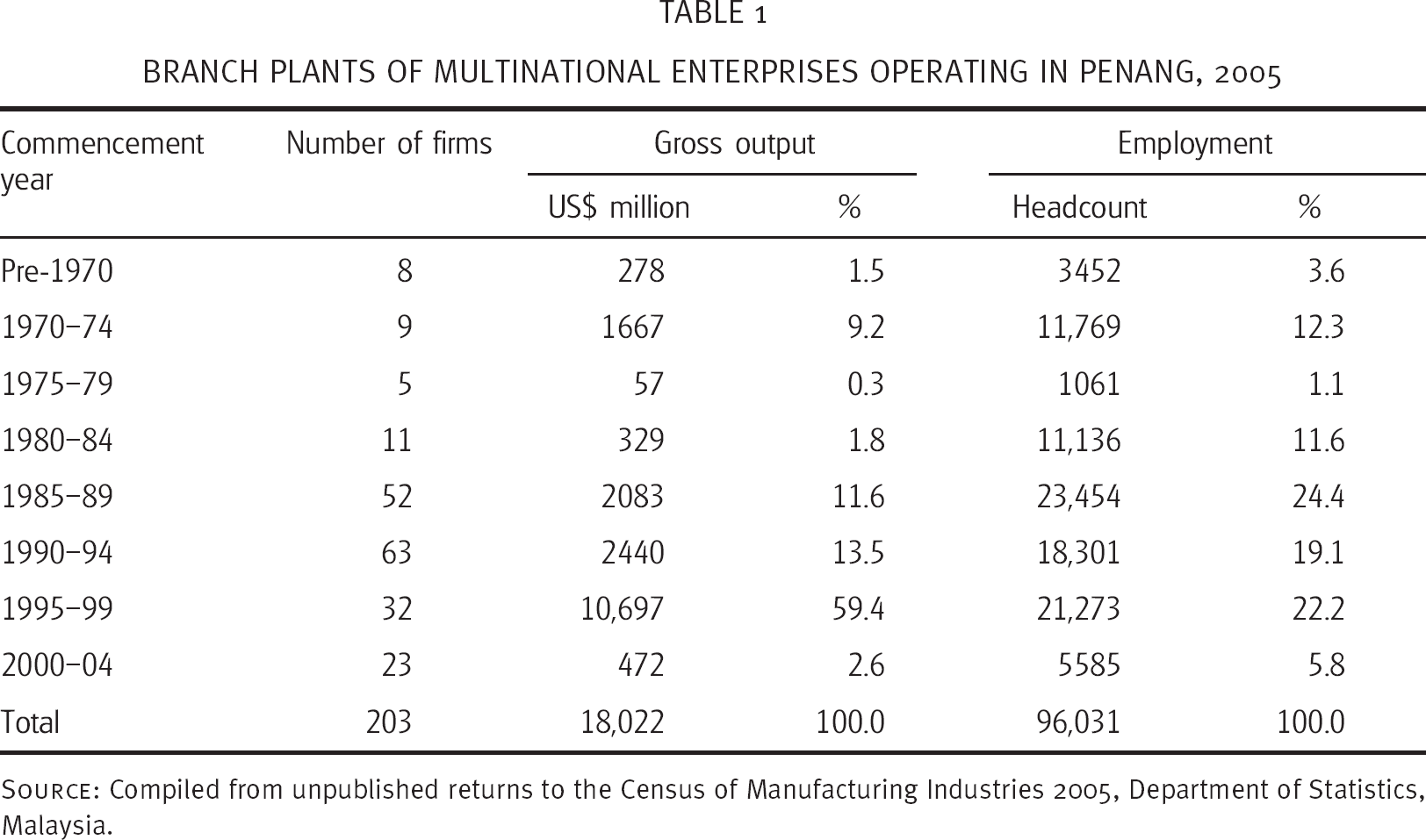
The data on the age distribution of these firms are basically consistent with the growth trajectory discussed in the previous section. Following a modest start in the 1970s, there was a rapid expansion of MNE entry until approximately the mid-1990s. There has been a notable decline in the number of firms commencing commercial production over the past 10 years. This reflects the gradual erosion of Penang's attractiveness for low-end activities in the electronics value chain and final assembly of consumer electrical and electronics products as a result of increasing domestic wages (see below) and the emergence of alternative low-cost investment locations within the region.
In 2007, MNE affiliates (foreign firms) accounted for over 85 per cent of total sales turnover and over 72 per cent of total employment in the manufacturing sector in Penang, even though they accounted for only about one-fifth of the total number of firms in operation (SERI, 2008). The top 11 per cent of foreign firms in size accounted for 82 per cent of total sales and 68 per cent of total employment. The employment headcount of the top 25 foreign firms varies from 896 to 10,304, with the majority clustering at a median of around 3000 workers (Table 2). These firms accounted for over 75 per cent of total manufacturing employment in Penang. US-based MNEs are the dominant players, followed by Japanese and German MNEs.
PROFILE OF TOP 25 MNE AFFILIATES OPERATING IN PENANG, 2008
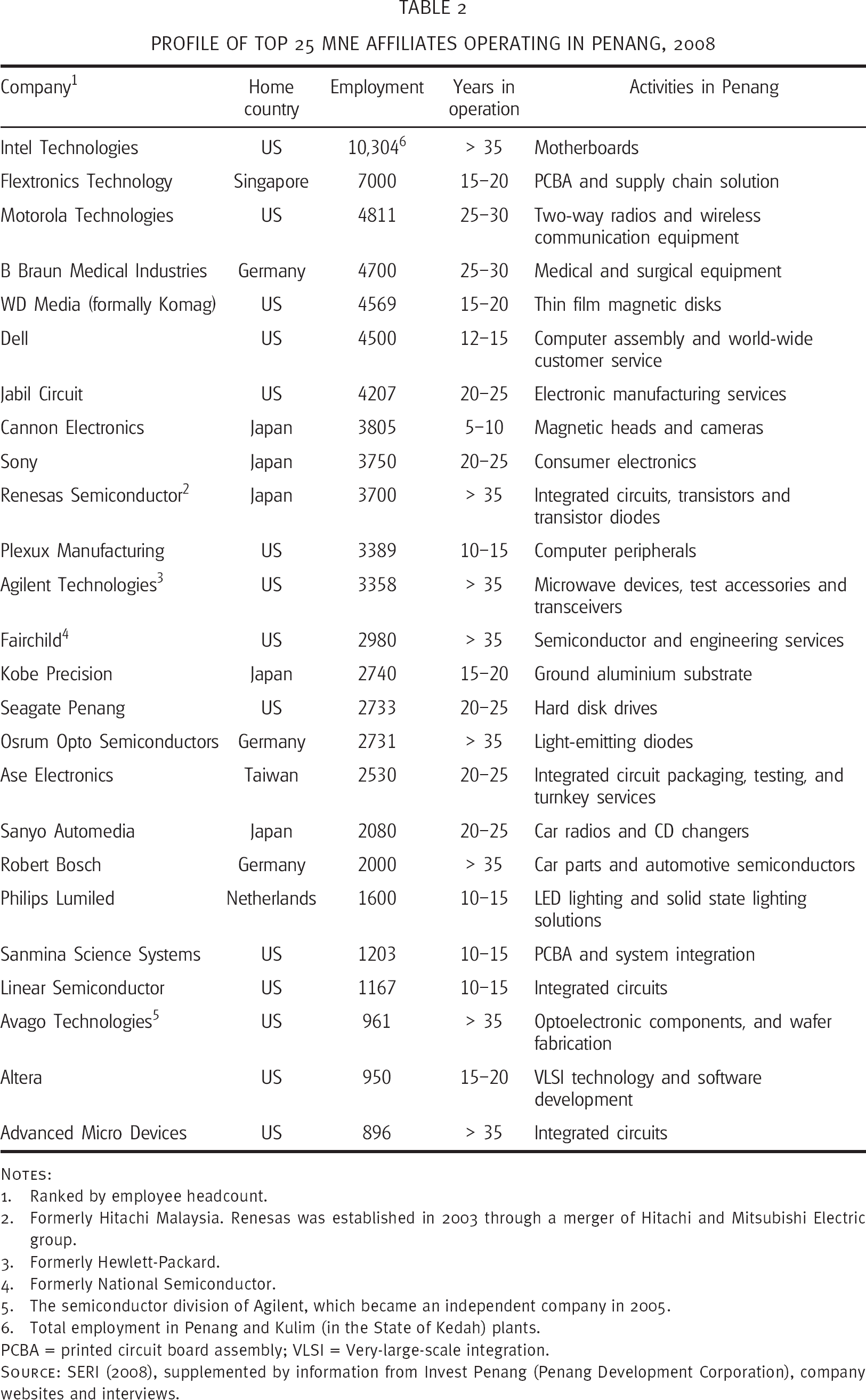
NOTES:
Ranked by employee headcount.
Formerly Hitachi Malaysia. Renesas was established in 2003 through a merger of Hitachi and Mitsubishi Electric group.
Formerly Hewlett-Packard.
Formerly National Semiconductor.
The semiconductor division of Agilent, which became an independent company in 2005.
Total employment in Penang and Kulim (in the State of Kedah) plants.
PCBA = printed circuit board assembly; VLSI = Very-large-scale integration.
A common perception concerning MNE involvement in global production sharing is that they are ‘fly-by-night’ operators, moving from one production location to another in response to changes in the business environment (in particular, changes in labour cost) (Milberg & Winkler, 2013). However, the data on the age profile of firms in operation clearly indicate that most of these firms have become deep-rooted in Penang. Seven of the Eight Samurai are among the 25 largest foreign firms (as shown in Tables 1 and 2). Overall, the Penang experience is consistent with the view that there is a general tendency of MNE affiliates to become increasingly embedded in host countries depending on the nature of the overall investment climate; they may respond sluggishly to relative cost changes once they have invested substantial resources in domestic production facilities and in establishing information links (Rangan & Lawrence, 1999).
Export performance and economy-wide impact
Manufactured goods exported from Penang increased from US$90 million in 1973 to about US$ 4.5 billion — amounting to 34 per cent of total manufactured exports from Malaysia — in the mid-1980s (Warr, 1987). Export growth continued at an impressive rate during the ensuing two decades, notwithstanding a mild slowdown following the collapse of the dot.com bubble in 2000 and the onset of the global financial crisis in 2008. The growth rate of exports from Penang has continuously been faster than that of total manufactured goods exports from Malaysia. Penang's share in total manufactured goods exports from Malaysia was 39 per cent in 2009, up from about 30 per cent a decade earlier (Figure 1).
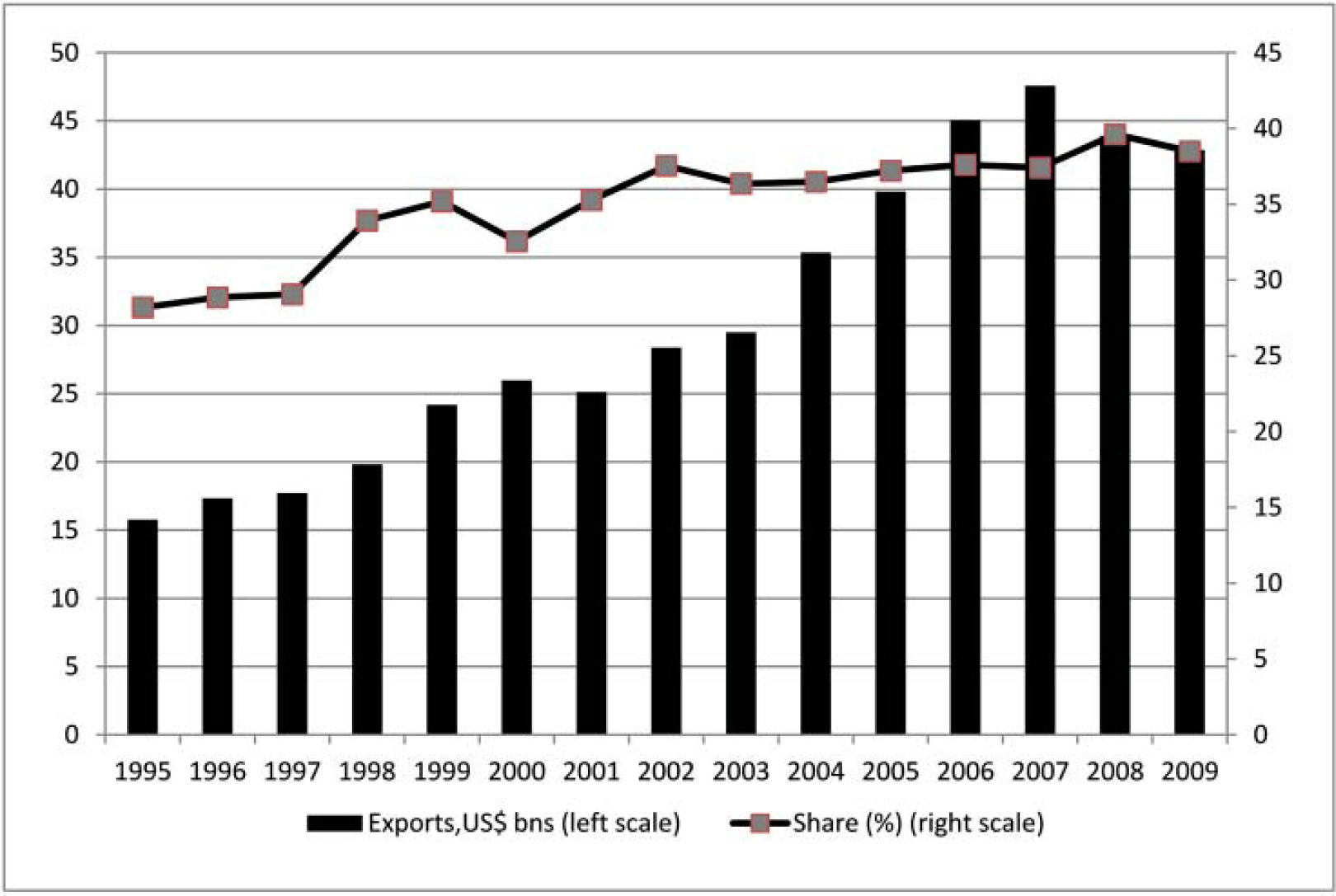
Manufactured exports from Penang: Value (US$ billion) and share (%) in Malaysian exports, 1995–2009.
The broad commodity category of machinery (products belonging to Section 7 of the Standard International Trade Classification (SITC)), has continued to account for the lion's share of electronics components (SITC 30 accounted for almost 90 per cent of machinery exports in 2010. However, over the past two decades there has been some modest diversification of the commodity mix. According to the data for 2005, office and accounting machinery (SITC 30) and radio/TV, and medical appliances and components (SITC 32) accounted for 45 per cent and 38.9 per cent of total manufactured goods exports, respectively. In recent years, Penang has accounted for almost half of the total electronics and electrical goods exports from Malaysia. 10
Overall, the export patterns revealed by the data run counter to the pessimistic view that the emergence of China as an export powerhouse has crowded out the export performance of Penang. This inference is also consistent with the patterns of structural shifts in the activities of MNEs in Penang, which we observed earlier. Shifts in their operations in Penang towards high-value component design, assembly and testing in the global value chain as well as towards headquarter functions and provision of global services have been aided by the rapid expansion of final assembly in China.
Export-led industrialization transformed Penang from the site of sluggish primary production into an international manufacturing hub within a decade. The surplus labour pool of 80,000 workers, estimated by the Nathan Report in 1969, had already been absorbed in the manufacturing sector and related services. At a 2003 conference organized by the PDC to celebrate the 30 years of industrialization in Penang, Prime Minister Mahathir summed up Penang's remarkable economic transformation as follows:
I remember the time when Tun Razak [then Prime Minister of Malaysia] told me that Dr Lim Chong Eu had managed to attract some investors to Penang in the electronics industry. I was rather skeptical; what are we going to do with this new-fangled industry? We did not understand much about electronics then and soon after that … Tun Razak … told me that Penang was short of labour; the electronics industry had created so many jobs that Penang had to get workers from the mainland. (2003: 15)
Throughout the period from the early 1990s, the unemployment rate in Penang, which has varied annually between 0.5–2.5 per cent, has been much lower than the national average of 1.5–4.5 per cent (SERI, 2010).
A common concern expressed in the multidisciplinary literature on the employment outcome of global production sharing is that, even though global-sourcing activities of MNEs may generate new jobs in the host countries, the associated social upgrading effect may be rather limited because of the tendency of MNEs to restrain real wage growth in a given production location (Milberg & Winkler, 2013; Robinson & Rainbird, 2012; Selwyn, 2013). It is argued that MNEs involved in global production networks tend to be highly sensitive to increases in wages in a given location relative to alternative locations and have the flexibility to transfer production facilities from one location to another in response to changing labour market conditions. This view figured prominently in the policy debate in Malaysia at the early stage of export-led industrialization (Elson & Pearson, 1981; Joma & Osmani-Rani, 1984; Lim & Pang, 1991), but it was repudiated by subsequent developments. Initially, wages were kept low by the availability of a vast pool of surplus labour in the economy. However, with the gradual absorption of surplus labour in export-orientated industries wages started to rise from about the early 1980s onwards. The real wage index of manufacturing workers (1990 = 100) increased from an average level of 74 in 1975–79 to 105 in 1985 and to 210 in 2011. 11 The rate of wage growth would have presumably been faster if it were not for the influx of workers, from approximately the early 1990s, from neighbouring countries (mainly Indonesia, Malaysia and Bangladesh) to Malaysia as the domestic surplus labour pool rapidly dissipated (Athukorala & Devadasan, 2012). By 2008 documented foreign workers accounted for nearly 30 per cent of total manufacturing employment in Penang (SERI, 2008). 12
In the early 1970s, Penang's per capita GDP was about 10 per cent lower than the national average. At the state level, it was 70 per cent lower than the state of Selangor, which was the prime focus of national development strategy in the post-independence period (Table 3). Rapid export-led growth elevated Penang to the status of richest state within two decades. In 2010 Penang's estimated per capita GDP was US$ 8700, 57 per cent and 30 per cent higher than the national average and that in Selangor, respectively. A comparison based on per capita GDP presumably exaggerates Penang's level of economic activity among the Malaysian states because a larger share of income generated in Penang accrues to foreign companies as their share of profits. 13 However, even when household monthly income is used as a better indicator, Penang ranks well above the national average. In 2009 the average household monthly income in Penang was (US$1252) compared to the national average of US$1443. In that year, Penang's poverty rate (1.2 per cent) — the percentage of people living below the national poverty line — was only a third of the national poverty rate (3.8 per cent) (Government of Malaysia, 2011).
PER CAPITA GDP IN MALAYSIA AND SELECTED MALAYSIAN STATES 1
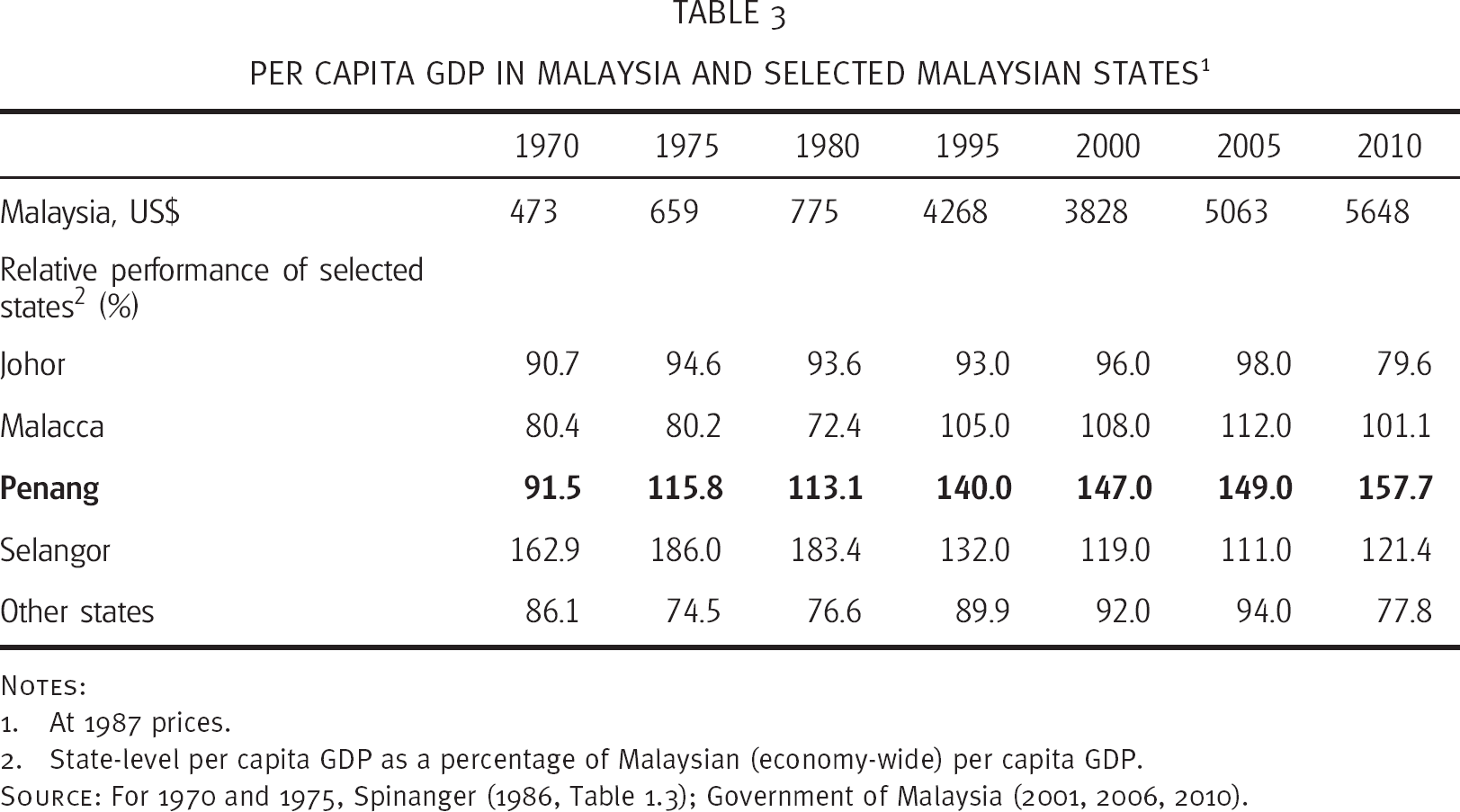
NOTES:
At 1987 prices.
State-level per capita GDP as a percentage of Malaysian (economy-wide) per capita GDP.
An oft-voiced criticism of export-orientated growth through global production sharing is the weak linkage effects of the export sector on the rest of the economy (Milberg & Winkler, 2013, Chapter 7; Yusuf & Nabeshima, 2009). Domestic input linkages of foreign firms operating within global production networks generally tend to be less than those of domestic market-orientated manufacturing firms. This is because input structures within global production networks are determined largely by corporate decisions of MNEs at the global level rather than by relative-cost differential and other factors specific to a particular production location. Moreover, unlike meeting consumer requirements in domestic markets, producing for highly competitive global markets calls for imported inputs meeting exact quality requirements and specifications.
At first blush, the Penang experience is consistent with this view. Domestically-procured inputs accounted for a mere 11 per cent of gross output in the electronics and electrical goods industries in Penang in the early 1980s (Warr, 1987). After twenty-five years of rapid manufacturing expansion, this had increased to only about 18 per cent by 2005. 14 However, we need to interpret these figures with care when assessing the developmental impact of global production sharing, for two reasons. First, in achieving economic growth through export expansion, what is more relevant is the market potential of the given export products (which determines the total net addition to national income), not the domestic input content measured on a ‘per unit’ basis. The very nature of specialization in a given slice of the value change of a vertically-integrated industry is that resultant exports generally take place in large volumes and hence provide a significant total addition to the national income, notwithstanding the low per unit domestic content. Penang's rapid growth over the past three decades clearly attests to this significant contribution of global production sharing.
Second, material linkages naturally do not capture the dynamic gains from engagement in global production sharing (discussed earlier in this article). For instance, despite the weak input linkages, foreign firms have significantly contributed to human capital accumulation in Penang. The talent pool developed over the past four decades is now a primary attraction of Penang for MNEs in terms of locating their upper-end activities and headquarter functions within global production networks. Most MNE affiliates have indigenized their managerial staff; only 8 per cent of CEOs in foreign companies in Penang are foreigners. Many MNEs draw on managerial and technological expertise of their Penang affiliates when expanding operations to other countries. Also, as already discussed, a sizeable number of local enterprises, including a number of ‘Malaysian MNEs’, have emerged within the export hub based on the entrepreneurial talents gained from, and network links forged with, the MNE affiliates. Furthermore, Penang seems to perform better than the rest of Malaysia in R&D activities, as revealed by patent registration data (NEAC, 2010, Part 1: 183). During 2001–06 Penang accounted for 37.2 per cent of Malaysia's registered patents, up from 10.3 per cent during 1976–85. In a comparative study of corporate innovative activities in Singapore, Penang and Bangkok, Diez and Kies conclude that, ‘Penang as a high-tech enclave is most certainly not representative of Malaysia as a whole … [and] Penang and Singapore are at a similar stage of technological development, and Bangkok clearly trails behind both’ (Diez & Kies 2006: 1014, emphasis added).
Concluding remarks
The Penang export hub has gained maturity and consolidated its position within global production networks over the past four decades. Concerns that Malaysian industry has ‘reached a point of saturation and its survival depends on the capacity to climb up the technology ladder’ (UNCTAD, 2010) and ‘Malaysia's manufacturing performance has stalled over time and the sector remains at odds with the objective of moving up the value chain’ (NEAC, 2010, Part 1: 181) are not consistent with Penang's recent growth experience.
As a result of increasing domestic wages and the emergence of competing low-cost production locations, Penang's attractiveness for low-end activities and final assembly within global production chains has been rapidly eroding over the past two years. But this has not resulted in a hollowing out of the Penang export hub. Firms involved in design, assembly and testing activities in the electronics and electrical goods value chains have begun to expand and consolidate their operations in Penang. More importantly, based on the early-mover advantage in electronics and the skilled labour pool developed over the years, the production base has begun to diversify into a number of electronics-related dynamic product lines with brighter growth prospects. These include medical devices, light-emitting diodes (LED) and photovoltaic design and development. China's rise as the premier assembly centre does not seem to have crowded out Penang's export performance. On the contrary, there appears to be a complementary relationship between China's rise as the premier assembly centre within global production networks and export performance in Penang. Rapid expansion of final assembly in China has been accompanied by a notable shift in MNE operations in Penang towards high-value component design, assembly and testing in the global value chain. Reflecting this structural shift, expansion of exports from Penang in recent years has been driven predominantly by price increases rather than volume expansion. The overall development outcome of industrial transformation growth through global production sharing has been impressive.
What explains Penang's success? Penang started the process of export-orientated industrialization with some unique advantages. It had a long tradition of both English and Chinese education, with a literacy rate well above the national average. From the colonial era it inherited fairly well-developed trade-related infrastructure and institutions. However, these initial advantages would not have been translated into a notable economic success if it were not for a proactive state government that embarked on a visionary strategy to unleash the island's growth potential. The strategy carefully mitigated the adverse impact of the affirmative action elements of the 1971 New Economic Policy on private-sector initiatives, while benefitting from Malaysia's longstanding commitment to an open trade and investment policy stance and an emphasis on export-orientated growth.
Penang is a unique example of government marrying its job creation policy objectives with emerging opportunities for international specialization by linking its economy to global production networks. The state government not only attracted foreign investors but also helped them become deeply rooted in the economy through a well-designed investment promotion strategy, which included FTZ status, infrastructure development, skills development and vocational training, and forging links between local and foreign firms.
It is hazardous to make generalizations from a single case study. The experience of Penang does, however, offer a number of policy insights that may be useful to policy makers in other countries in designing FDI policy, especially in the context of the ongoing process of global production sharing.
Institutional reforms
The policy reforms began by forming a new statutory body, the Penang Development Corporation (PDC), as the principal development agency independent of the formal government structure. The carefully designed autonomous organizational structure enabled the PDC to perform effectively its role as the centre-point of formulation, implementation and coordination of the export-orientated industrialization strategy. The PDC was successful in creating in the business community an impression of a unified and cooperative team with a firm commitment to FDI promotion.
Focused investment promotion
After the failure of initial attempts at import-substitution industrialization, the state government of Penang made a clear and decisive policy shift to export-orientated industrialization, with the electronics industry — broadly defined to include both electronics and electrical goods — as the key focus of investment promotion. Once the import substation projects proved to be commercial failures, they were swiftly abandoned, without trying to make them survive through direct subsidies. The choice of electronics as the priority sector at the outset nicely matched Penang's source endowment and unfolding opportunities for international specialization. This choice also helped in designing an investment promotion strategy with an industrial cluster focus. The cluster focus in turn provided a viable setting for promoting MNE-SME linkages within the export hub, and creating a ‘skills pool’ that transpired to be the major attraction of Penang as a location for MNEs in a wide range of industries with an electronics base.
Post-investment care
The PDC created an institutional mechanism to maintain close links with both MNE affiliates and local firms operating in Penang. This helped policy makers stay abreast of investor requirements and thus continuously adapt to the changing investment climate. More importantly, this receptivity approach helped to engage the foreign firms already operating in Penang in the investment promotion campaign. The PDC often used references from these firms to complement the government's commitment to investment promotion.
Infrastructural development
The PDC effectively used free trade zones and industrial estates as the vehicles for focused infrastructural development for successful global integration of the Penang economy. It successfully addressed the problem of land scarcity resulting from accommodating foreign investors by creating an innovative land bank through market acquisition of private land and reclamation.
Vocational training and skill development
At the formative stage of the export hub, the PDC played an important facilitating role in labour absorption by the newly-established MNEs by conducting vocational training programmes. When skill shortages began to hamper the expansion of the electronics industry by the late 1980s, the PDC joined with MNEs to establish the Penang Skill Development Centre. The federal government also helped skill development at the firm level by offering general tax deductions on MNE contributions to PSDC schemes and their own skill development efforts.
Fostering MNE–local firm linkages
From its inception, the PDC placed emphasis on developing a domestic supplier network around the branch plants of MNEs. This helped increase the economic impact of the MNE presence on the domestic economy through a multiplier effect and was instrumental in anchoring foreign investor in the export hub through tighter and more appropriate supplier relationships. The domestic vendor networks that initially evolved around semiconductor assembly facilitated the subsequent diversification of the production base of the export hub into other product lines such as consumer electronics and computer peripherals, and more recently to light-emitting diodes and medical devices.
Footnotes
Acknowledgements
The author would like to thank Hal Hill, Andrew Cam and the two anonymous reviewers for their valuable comments and suggestions. Financial support received from the International Trade Centre, Geneva, and institutional support provided by the Socio-Economic and Environmental Research Institution (now the Penang Institution) for undertaking filed work in Penang is gratefully acknowledged.
1
In the recent international trade literature an array of alternative terms has been used to describe this phenomenon, including international production fragmentation, intra-process trade, vertical specialization, slicing the value chain and offshoring.
2
The full list of interviewees is given in Appendix 1 in the discussion paper version of this article (Athukorala, 2012).
3
By the late 1950s, when the national trade data reporting systems of mature industrial countries had begun to produce disaggregated data to warrant some tentative estimation, components of machinery accounted for nearly 15 per cent of the manufacturing exports of these countries (calculation based on the data appendix in Maizels, 1963).
4
Examples include long-lasting cellular batteries originally developed by computer producers and now widely used in cellular phones and electronic organizers; transmitters, which are now used not only in radios (as originally designed) but also in computers; and electronic chips, which have spread beyond the computer industry into consumer electronics, motor vehicle production and many other product sectors.
5
The best example is Foxconn, a Taiwanese contract manufacturer, which undertakes final assembly for Apple Corporation, Sony, Dell and a number of electronics MNEs from its production bases located in China.
6
In a recent influential book,  : 37) define offshoring (global production sharing) as trade in ‘intermediate goods’. The problem with this definition is that it leaves out trade in final assembly, which accounts for a significant and increasing share of trade within global production networks. It is also important to note that parts and components are only a subset of intermediate goods, even though the two terms have been widely used interchangeably in the recent literature. Parts and components, unlike the standard intermediate inputs such as iron and steel, industrial chemicals and coal, are ‘relationship-specific’ intermediate inputs; in most cases, they do not have reference prices, are not sold on exchanges and are more demanding on the contractual environment. Most of (if not all) parts and components do not have a ‘commercial life’ of their own unless they are embodied in a final product.
7
These are the products belonging to Section 7 of the Standard International Trade Classification (SITC 7). They roughly account for more than half of all trade in manufacturing.
8
Interview, 19 November 2010.
9
Interview, 19 November 2010.
10
Data compiled from the unpublished returns to the Manufacturing Census 2005, Department of Statistics, Malaysia.
11
12
Why do MNEs not relocate manufacturing in labour abundant neighbouring countries instead of relying on foreign workers for undertaking production in Malaysia? The answer to this question seems to be that availability of cheap labour, while important, is secondary to the quality of the overall investment environment and the skilled human capital pool developed over the years in determining a country's attractiveness for MNEs in their engagement in global production sharing (Athukorala & Devadasan, 2012).
13
In 2005 foreign firms accounted for over 61 per cent of manufacturing value-added in Penang compared to about 37 per cent in the entire country (calculated from unpublished returns to the Manufacturing Census 2005, Department of Statistics, Malaysi a).
14
This estimate is based on the Malaysian Input Output Table for 2005 (Department of Statistics, Malaysia). The use of local inputs in the electronics and electrical industry could be somewhat higher in Penang because the local vendor network there is relatively well-developed compared to elsewhere in the country (UNCTAD, 2010).