







Abstract
This study investigated the electrode life and the electrode degradation characteristics during continuous resistance spot welding of aluminium alloy sheets. When a long welding time and dome radius type electrode were used, the electrode life was extended more than that when a short welding time and radius type electrode are used. The electrode tip is considered to degrade by the following mechanism: an Al–Cu alloy layer is formed at the electrode tip during continuous welding, and then it peels off from the electrode tip transferring to the surface of aluminium alloy sheet. Its peeling makes the electrode tip indented and finally the electrode tip flattens with increasing diameter of electrode tip. In order to eliminate the direct contact between electrode and worksheet, a special Cu foil insert device for resistance spot welding of aluminium alloy sheets was developed and an extremely long electrode life was achieved.
Keywords
Introduction
In recent years, the reduction of CO2 emissions has become an issue. To address this issue, automobile makers are continuing to use lightweight materials in automobile bodies. Many researches have been devoted to resistance spot welding of aluminium alloy sheets in recent years.1– 11 In particular, continuous spot weldability, which is an index of mass production performance, has been investigated since the second half of the 1970s. The data investigated under various conditions have reported12, 13 that an electrode life is of the order of several ten to several hundred spot welds when using an R type (radius type) electrode as stipulated in Japan Industrial Standard (JIS) C 9304. In order to respond to the quality standards based on the MIL standard (United States Defense Standard) for aircraft use, which permit neither depressions, surface pitting nor weld flash at spot weld dents on the worksheets, a smooth tipped R type electrode has been used as standard one for conducting continuous spot weldability tests of aluminium alloy sheets.
The authors did not follow the above concept but considered the joint strength as criterion for spot weldability of aluminium alloy sheets in the same manner as in resistance spot welding of steel sheets. As indices of electrode life, the nugget diameter, which is normally used as joint strength in resistance spot welding, and tensile shear strength were referred to.14 As a result, it was shown that an electrode life of several thousand spot welds can be secured with an Al–Mg alloy sheet for automobile body use when using the dome radius (DR) type electrode, which has a sharpened tip and is used in resistance spot welding of steel sheets.15– 17 In research on resistance spot welding of Zn coated steel sheets for automobile bodies, the authors conducted a detailed investigation of the alloy layers which formed on the electrode tip and the steel materials being welded.18– 20 Applying a method similar to that used in this research, the present study clarifies the mechanism of electrode wear in welding of aluminium alloy sheets.
Experimental
The continuous resistance spot weldability of aluminium alloy sheets was investigated by the continuous spot welding tests. The spot weldability was considered as the number of spot welds until the nugget falls below the specified diameter under given welding conditions, or until the shear strength falls below the specified level based on JIS Z 3140. In combination with this, changes in the external shape of the electrode tip during continuous spot welding were measured, and an electron probe microanalysis (EPMA) line analysis of the surfaces of electrode and aluminium alloy sheet was performed in order to investigate the alloy layer formed on both surfaces.
The test material used in this research was aluminium alloy AA 5022 (Al–4·5Mg). The chemical composition of AA 5022 Al alloy is Al–0·05Si–0·10Fe–0·35Cu–0·10Mn–4·54Mg–0·04Cr–0·01Zn–0·02Ti (mass‐%). Table 1 shows the mechanical properties of the material. The sheet thickness of the test material was 1·0 mm. Spot welding was performed continuously with two sheets of the same type in an overlap condition.
Thickness and mechanical properties of AA 5022 Al alloy

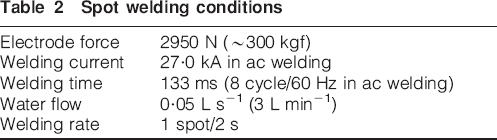
A stationary air pressure type resistance spot welding machine was used. The electrode was of a DR type cap tip type as shown in Fig. 1, and the electrode material was Resistance Welding Manufacturing Alliance Class 2 chromium copper (Cu–0·8Cr). The electrode holding time after welding was set to the minimum based on the control sequence. The other welding conditions are shown in Table 2. In this research, the electrode pressure was set at 2950 N (∼300 kgf), considering the weight of the welding gun which can be transported by a welding robot designed for welding of steel sheets. The test current was selected based on the specified joint strength and nugget diameter. According to JIS Z 3140, the specified minimum joint strength, or the nugget diameter for aluminium alloy sheets is given as 2·8t1/2 to 5·0t1/2 (t is the sheet thickness of test material).14 In the present study, the value of 4t1/2, which was adopted as the joint strength criterion for spot welding of Zn coated steel sheets,20 was also adopted as the strength criterion for aluminium alloy sheets. Although the criterion was 4t1/2 = 4·0 mm, a welding current for the initial stage of continuous spot welding test was 27 kA which gives a larger nugget diameter of 5·5t1/2 = 5·5 mm. Weld time was set at a relatively long 133 ms (8 cycles/60 Hz) in consideration of welding of aluminium alloy sheets. A single phase ac constant current controlled power source was used and the current was controlled by ignition phase control.
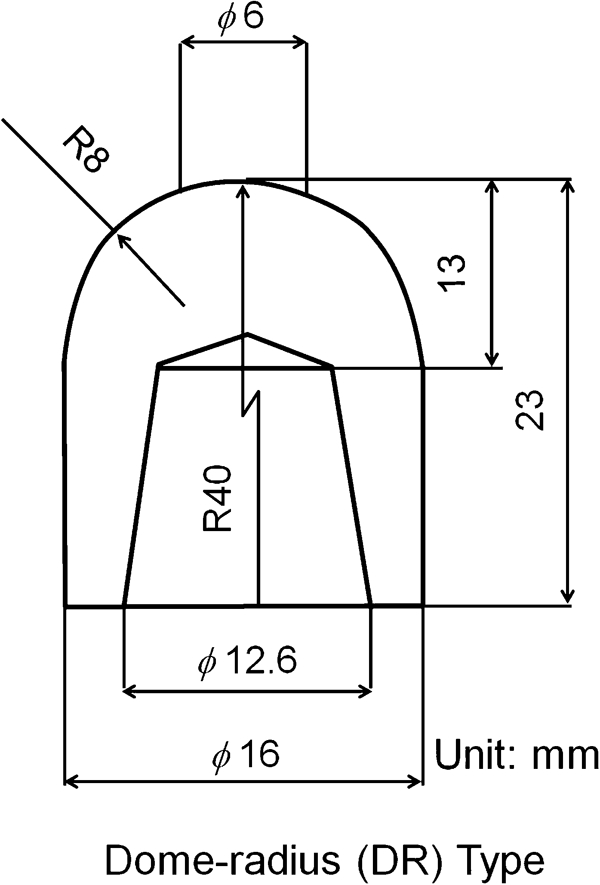
Shape of spot welding electrode
Spot welding conditions
The experimental procedure is shown in Fig. 2. The continuous spot welding test simulated the factory production in the same manner as with steel sheets.20 One test cycle was the welding of 20 spots at the rate of 1 spot/2 s and the off time of 130 s for moving, setting and resetting the work in the jig. This cycle was repeated until the specified number of cycles was completed. In this research, off time was set at a period which would allow the electrode to adequately cool. Test pieces of three spot welds were sampled every 100 continuous spot welds. The nugget diameter was measured by a torsion test,14 and continuous spot welding was performed until the average nugget diameter of the three spots fell below the specified nugget diameter. In combination with this, tensile shear strength test pieces14 of two spots every 100 spot welds were also sampled. The tensile shear strength of these test pieces was measured, and continuous spot welding was performed until the spot weld failed to satisfy the specified strength. The specified minimum tensile shear force was set at 2170 N that is the average value for Class B as stipulated in JIS Z 3140.14
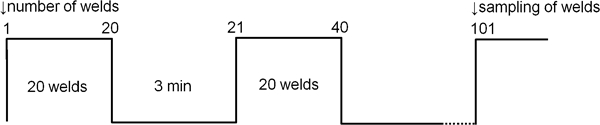
Spot welding test conditions and procedure
In order to investigate the change in the shape of electrode tip, surface indentation was measured using a surface roughness meter along the centreline of the electrode top, as shown in Fig. 3. To recognise the relative position between tip shape and cross‐sectional shape of the nugget formed, position marks were stamped on the electrode, and specimens for cross‐sectional observations were taken from the position corresponding to those marks. The electrode was bisected along its vertical axis and the alloy compound layer formed on the electrode tip was observed by an EPMA line analysis.
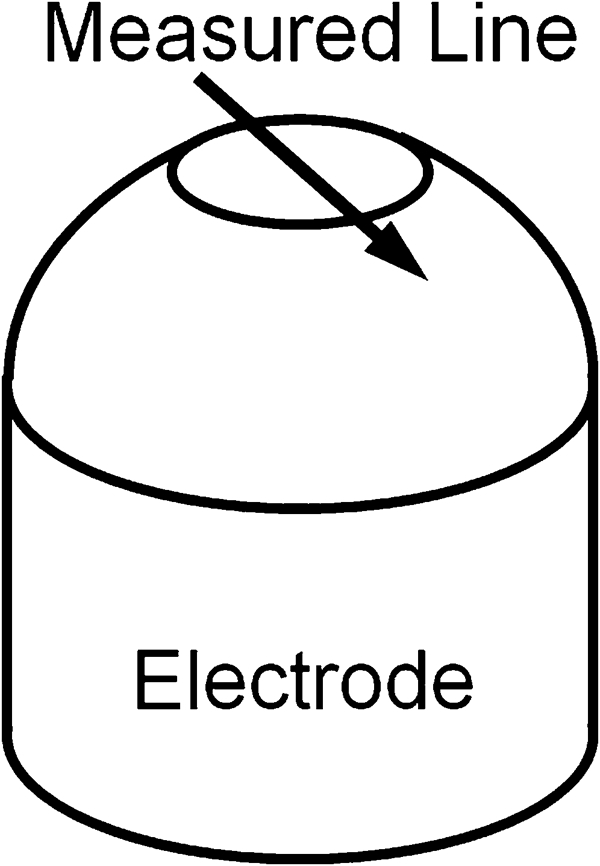
Measuring method of electrode top profile
Results
The results of the continuous spot welding test are shown in Fig. 4. Figure 4a shows the change in the measured diameter of nugget that is the fusion zone between the two worksheets during continuous spot welding. The nugget diameter failed to satisfy the criterion of 4t1/2 = 4·0 mm at 2300 weld spots. Figure 4b shows the change in the tensile shear force during welding. The tensile shear force failed to satisfy the criterion of 2170 N at 3000 spot welds. The critical numbers of continuous spot welds obtained in this test greatly exceeded the 1000 spot welds or less obtained with the R type electrode used to date. A DR type electrode could keep its initial diameter of current path area and high concentration of welding current for long time during continuous spot welding, and lead to a long electrode life.
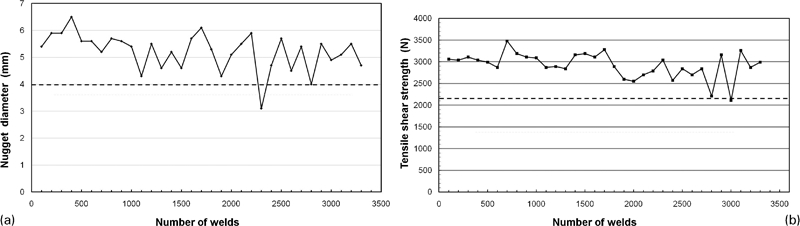
Electrode life test results
Figure 5 shows the photographs of the nugget cross‐sections at the 100th, 500th, 1000th and 2500th spot weld. In these images, cracks are observed in the nuggets but no large blowholes are found. Although nuggets are formed deviating from the electrode centre after the 1000th spot weld, it can be recognised that the nugget diameter and tensile shear strength attain satisfactory levels.
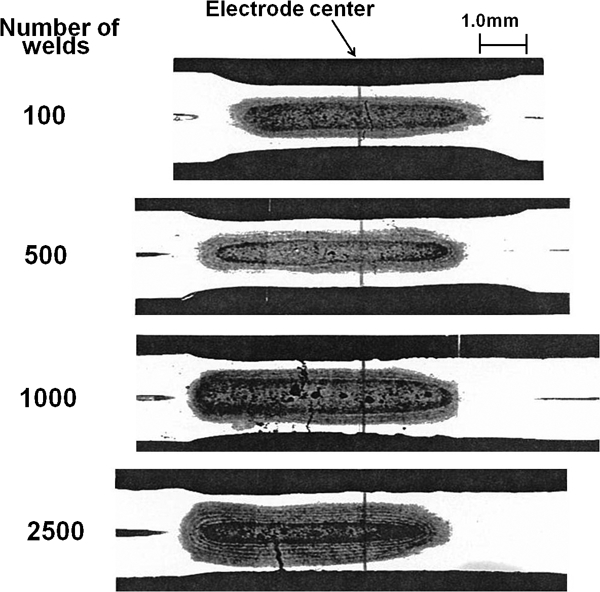
Macroscopic sectional views of nuggets during continuous spot welding
Figure 6 shows the shapes of the electrode tip of top and bottom electrodes at the 100th, 500th, 1000th and 2500th spot weld. It is noted that these figures are 10 times enlarged in the vertical direction while the horizontal direction remains unchanged. The electrode tip is seen to be remarkably deformed after the 500th spot weld. Both the top and bottom electrodes are deformed in a concave shape at the tips at the 500th spot weld. At the 1000th and 2500th spot weld, fine indentations develop on the electrode tip and flattening progresses over the entire area of the tip. As a result, at the 2500th spot weld, the electrode tip diameter expands to 9 mm, one‐and‐half as large as the original 6 mm.
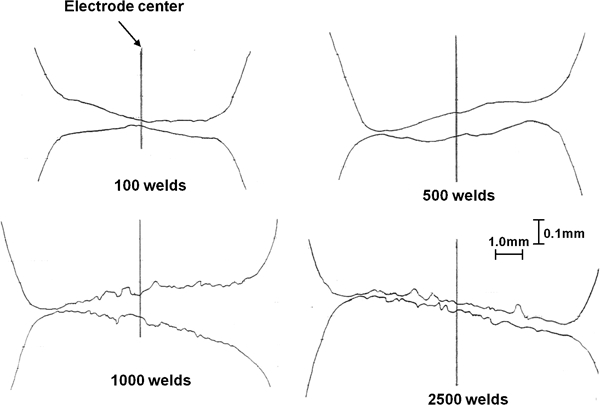
Change in profiles of electrode top during continuous welding
The EPMA results of the alloy layer formed on the electrode tip at the 300th spot weld are shown in Fig. 7. At the 300th spot weld, an Al–rich Al–Cu layer of a thickness of ∼18 μm is detected and at the 1000th spot weld, an Al–Cu layer more enriched with Al develops with a thickness of 25 μm. Figure 8 shows the results of the EPMA line analysis of the alloy layer formed on the surface of aluminium alloy worksheet where a depression occurred as a result of consecutive contact with the electrode at the 300th spot weld. An Al–rich Al–Cu layer with the composition similar to that developed on the electrode tip is detected. The thickness of this layer is ∼30 μm, which is greater than that of the alloy layer formed on the electrode tip at the same 300th spot weld shown in Fig. 7.
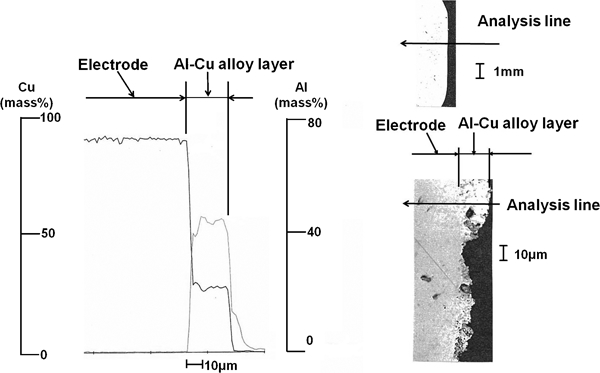
Result of EPMA line analysis and microstructure of electrode tip after 300 spot welds
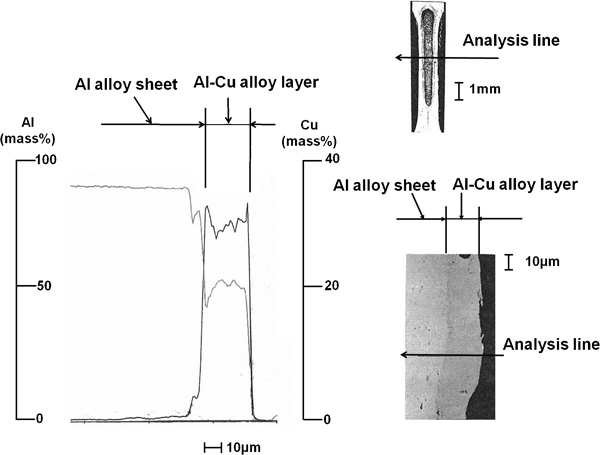
Result of EPMA line analysis and microstructure of indentation in aluminium alloy sheet
Discussion
The change in the nugget diameter and tensile shear strength, and that in the cross‐sectional shape of nugget during continuous spot welding testing are shown in Figs. 4 and 5 respectively. It is seen that the nuggets satisfied the specified nugget diameter. However, the electrode tip was remarkably deformed during testing as shown in Fig. 6. The tips of both the top and bottom electrodes display a concave shape at 500th spot weld and are progressively flattened at 1000th and 2500th spot weld. As flattening of the electrode tip progresses, the diameter of the welding current path area from electrode to worksheet expands and as a result, the current density decreases. In spite of the fact that the diameter of current path area significantly expands, the specified nugget diameter and tensile shear strength are satisfactorily obtained. This reason is discussed in the following.
The thermal conductivity of the aluminium alloy sheet is 130 W m−1 K−1 (0·31 cal cm−1 s−1 °C−1), approximately three times larger than that of steel sheets, while the specific resistance of the aluminium alloy is 59·5 nΩ m (29%IACS: International Annealed Copper Standard), ∼1/4 of that of steel. Therefore, in welding of aluminium sheets, the welding current is three times larger than that used in steel sheets and the weld time is 1/7–1/8 of that used in steel. The welding time of 3–4 cycles or less is normally selected in ac welding.21
Figure 9 shows the relationship between weld time and nugget shape at the 100th, 500th, 1000th and 2500th spot weld. Although adequate nugget growth is not achieved in 3–4 cycles of ac welding, the nugget diameter expands satisfactorily when a weld time of 8 cycles is used under the test conditions in this research. Although the electrode tip diameter expanded remarkably in this continuous spot welding test as can be seen in Fig. 6, satisfactory nuggets were formed. This is considered due to a concentrated current flow caused by localised contact between the top and bottom electrodes and the worksheets. Furthermore, nuggets formed deviating from the electrode centre. However, a relative positional correlation could be confirmed between the local area of contact in Fig. 6 and the centre of nugget formation in Fig. 5. There are issues of the scattering of tensile shear strength and the occurrence of cracks caused by the chemical composition of the aluminium alloy sheets. However, these are problems for future researches.22– 24
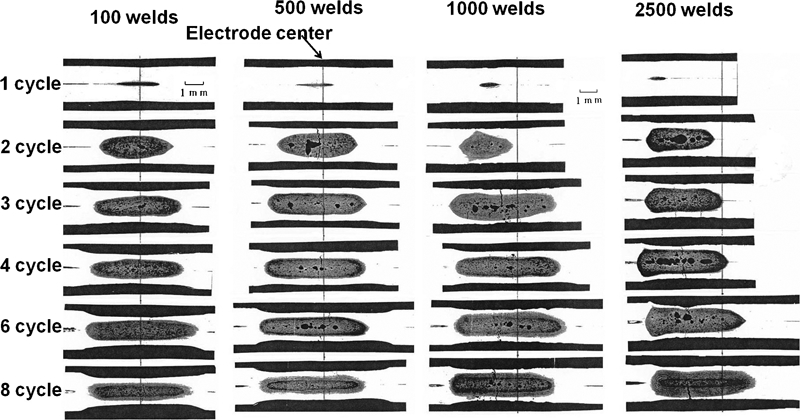
Relationship between number of spot weld, welding time and macroscopic sectional view of nugget during continuous welding
In resistance spot welding of aluminium alloy sheets, copper is the main component of the electrode and aluminium is the main component of the sheet material. Both metals undergo an alloying reaction during continuous spot welding, developing an alloy layer at the electrode tip. The Al–Cu alloy layer formed at the electrode tip after 300 spot welds is shown in Fig. 7. The Al concentration of the alloy is ∼50 wt‐% and this alloy is close to the θ phase in the Cu–Al phase diagram. Similarly, at 1000th spot weld, an Al–Cu alloy layer with an Al concentration of ∼60 wt‐% was detected and this is of alloy including θ phase. Figure 8 shows an Al–Cu layer formed on the surface of sheet material where a depression was formed by contact with the electrode at 300th spot weld. The Al concentration of this layer is ∼50 wt‐%, and the alloy composition is approximately the same as that of the alloy layer on the electrode tip. Cu was detected even at 50th spot weld of continuous spot welding. This implies that alloying proceeds at an extremely early stage. From these facts, a process of the alloying of the electrode tip is estimated in the following.
The alloying reaction is related to the temperature of the electrode tip. There are some reports25– 27 in which the electrode tip temperature during spot welding of aluminium alloy sheets is calculated. However, only one report27 deals with the DR type electrode used in the present research, estimating that the temperature of the electrode during nugget formation is 500°C at the extreme surface of the electrode and 400°C or higher 1 mm inside the electrode. The eutectic temperature of the alloy of binary system on the Al side of the Cu–Al phase diagram shown in Fig. 10 is 548°C. Therefore, if the above mentioned temperature (500°C) is considered to be the electrode tip temperature, the temperature is estimated to reach the melting point although the electrode and the to‐be‐fused zone of the aluminium alloy sheets remain not melted. As a result, the alloying reaction proceeds rapidly and the alloy layer observed in Fig. 7 is formed. Based on the results of the EPMA chemical composition analysis, the alloy layer formed between electrode and worksheet is considered to include the θ phase of hard, brittle intermetallic compound. It is thought that peeling occurs at this θ phase when the electrode was removed from the worksheet and that as a result, the same alloy layer is also transferred to the worksheet and deposited there to form a substance observed in Fig. 8. Furthermore, the remarkable deformation of the electrode tip during resistance spot welding of aluminium alloy sheets is considered to be attributed to repeated peeling of the alloy layer formed by the rapid alloying reaction which occurs near the melting point. It may be noted that no effect of the surface oxide film characteristic to aluminium alloy sheets28 on the formation of alloy layer could be observed in the present experiment.
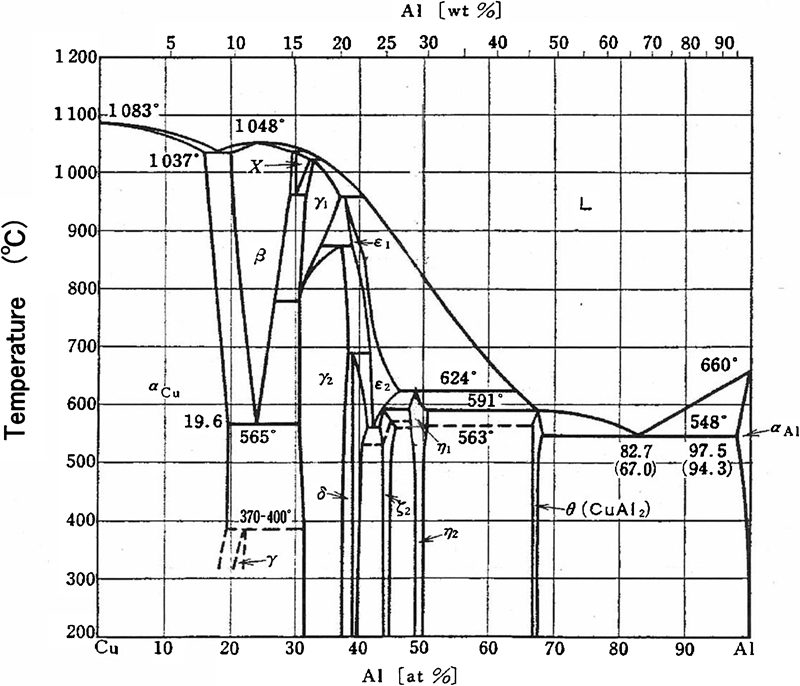
Phase diagram of Al–Cu system
Development of electrode protection device
The tip of electrode was damaged during continuous resistance spot welding of aluminium alloy sheets. This is caused by the formation of an alloy layer by an alloying reaction between copper of the electrode and aluminium of the worksheet. This reaction is unavoidable when using a copper based electrode. Therefore, the authors conceived an electrode protection device which prevents direct contact between electrode and worksheet.
The concept of the protection device is to insert a conductive foil between electrode and worksheet. A photograph of this device is shown in Fig. 11.
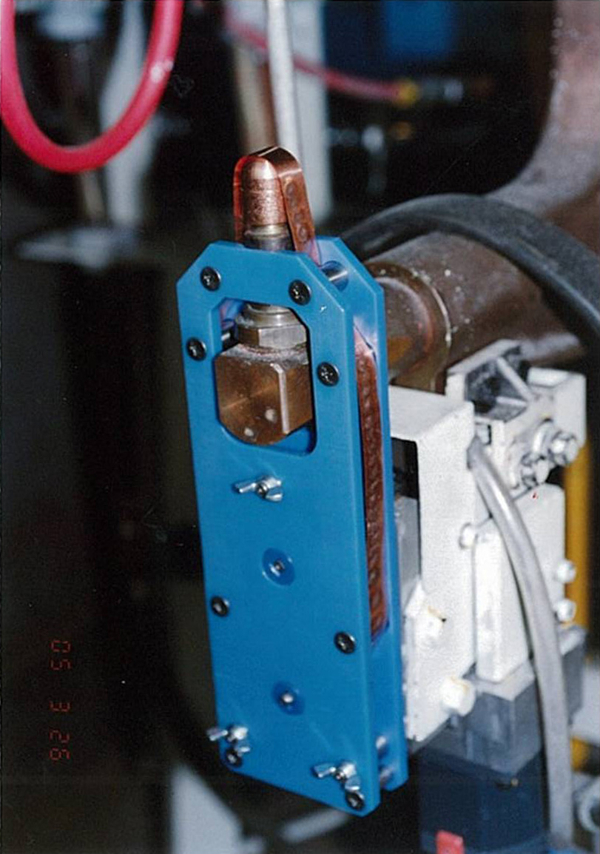
Photograph of spot welding device with electrode protection of inserted Cu foil
The results of a continuous spot welding test employing this device are shown in Fig. 12. The test method was the same as that thus far described except the welding current and time. However, a pure copper (purity 99·99% oxygen free copper) foil with a thickness of 0·1 mm was inserted between electrode and worksheet. In expectation of stabilising the electrode tip diameter, the test was performed under harder conditions for electrode life with the current reduced from 27 to 26 kA and the weld time shortened from 133 ms (8 cycles) to 100 ms (6 cycles). The test result of the continuous spot welding with the foil inserted indicates that a high level of quality is maintained with absolutely no reduction in the tensile shear force even after 5000 spot welds. Figure 12 also shows the results of a test by the same method as that in conventional practice without foil insertion. In this case even with shorter weld time (i.e. harder condition for the electrode life) than that in Fig. 4b, the tensile shear force fails to satisfy the specified level at 1100th spot weld.
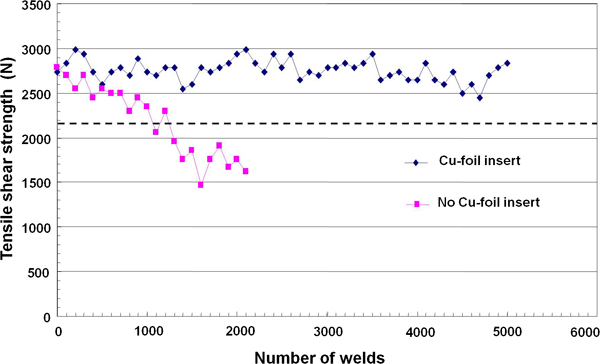
Effect of electrode protection on change in tensile shear force during continuous welding
Conclusions
Continuous spot weldability of aluminium alloy sheets by resistance spot welding was investigated, focusing on the degradation of electrode tip. The conclusions were obtained as follows.
When a DR type electrode, which makes welding current concentrate easily, and a long welding time are used, the electrode tip remarkably is deformed during continuous spot welding. In spite of the considerable deformation, long electrode life of 2000 spot welds or more was obtained.
The copper of electrode and the aluminium of worksheet are rapidly alloyed because the temperature at the electrode tip increases close to the melting point of the alloy layer during welding. Then, some part of alloy layer peels off at the intermetallic compound θ phase in the alloy layer when the electrode is removed from the worksheet. The repeated peeling of the alloy layer considerably degrades the electrode tip.
An electrode protection device which prevents direct contact between electrode and worksheet was conceived. In this device, a pure copper foil with a thickness of 0·1 mm is inserted between electrode and worksheet. As a result, a satisfactorily long electrode life of spot welds of 5000 or more was obtained.