







Abstract
Explosive cladding is a solid state process in which joining of dissimilar metals is accomplished by the acceleration of one of the components at extremely high velocity by employing chemical explosives. This study focuses on developing a model to predict the heat transfer during cladding and to determine the characteristics of the shock compressed gas developed at the standoff distance during cladding. The influence of interlayer on the amount of heat transferred is also investigated. It is concluded that the amount of heat transferred and the kinetic energy lost during collision at the interface determine the morphology of the interface.
Keywords
Introduction
The explosive cladding process imports thermomechanical energy in nanoseconds due to the collision of metals, and the final characteristics of the clad are determined by the degree, nature and duration of deformation.1 When detonated, the potential energy stored in the chemical explosive is instantaneously converted into gas, which propagates a shock wave in the flyer plate. This results in an oblique movement of flyer plate colliding onto the base plate and the generation of shock compressed gas between the plates. During collision with the base plate, the kinetic energy of the flyer plate is converted into heat energy. 2 2,3 The kinetic energy spent at the interface determines the degree of plasticity at the interface and thereby influences the characteristic interfacial undulations. Extensive researches have been focused on the microstructural changes at the interface due to the effects of participant metals and explosive mass.4– 11 Nevertheless, the studies on heat transfer and the formation and properties of the shock compressed gas generated at the interface are still limited.
The temperature distribution and heat transfer behaviour across the interface characterise the quality of the clad since they have a great influence on the microstructures of the interface, stress distribution and interface distortion. By employing a thin interlayer between flyer and base plate, heat transfer can be increased and, consequently, the reduction in kinetic energy loss. The explosive cladding process, employing an interlayer, is schematically shown in Fig. 1. This study focuses on developing a heat transfer model that predicts the thermal effects and behaviour of the induced shock compressed gas during the explosive cladding process.
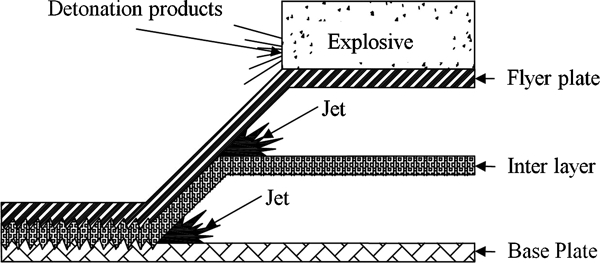
Explosive cladding using interlayer
Heat transfer model
Attempts to evaluate the amount of energy transmitted during explosive cladding have to rely on either empirical relations or numerical simulations. Various researchers applied finite element simulation to determine the flyer velocity, interface temperature, induced stress, strain and pressure developed at the interface during the explosive cladding of dissimilar metals.12–
15 The development of a theoretical model that is capable of predicting the heat generated during explosive cladding and its influence on the nature of interface is attempted herein. As explosive cladding is achieved by the intense deformation of both plates, followed by high pressure and high temperature generated at the collision point, the temperature generated at the interface is estimated by

The contact time t of both metals during the process depends on the flyer plate thickness, sound velocity of the flyer plate and velocity of the shock wave, which can be determined using16

The quantity of heat transmitted due to the collision of the flyer plate is calculated by

The amount of heat flux from the shock compressed gas to the metals is


Results
Detailed procedures of the conduct of experiments are reported elsewhere.17 The micrograph of the explosively cladded copper/steel plates (50×90 mm) is shown in Fig. 2. The weld is sound with the interface absence of any ‘molten layered zones’, with impact of the flyer with the base, and as the detonation proceeds, wavy interfaces are formed. If the jet generated in the high velocity impact does not escape, then it is partially or completely trapped in a clad between metals of similar density or in a single vortex before and after each wave in a clad between metals of appreciably different densities.2 In case of Cu–steel explosive clads, the interfacial waves are regular and even. ‘Trapped jet’ is the result of rapid heat transfer arising from the high thermal conductivity of the participant metals. Copper (with thermal conductivity of 400 W m−1 K−1) dissipates heat rapidly, and the trapped jet is instantaneously cooled with an as cast dendrite structure, as reported by Yan et al., 6 to weaken the clad. The unescaped jet manifests into a trapped jet, either partially or completely, in the single vortex formed before and after each undulation obtained by an oscillation in the fluid-like jet flow. The grains of the flyer plate are elongated and oriented towards the direction of the detonation front. The microstructure of the Al/steel clad is shown in Fig. 3. From Figure 2 Figs. 2 and 3, it is observed that the size of the waves is sinusoidal and regular in copper and larger in aluminium due to the difference in thermal conductivity. Mechanical twins, which are otherwise called Neumann bands, were obtained on the steel side as a result high speed plastic deformation.
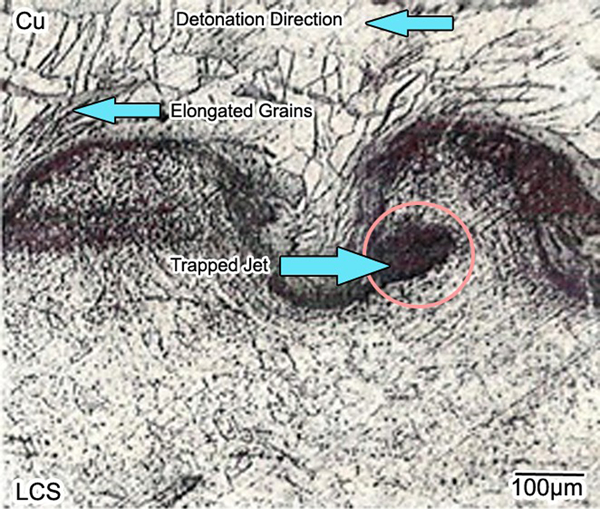
Micrograph of Cu/steel
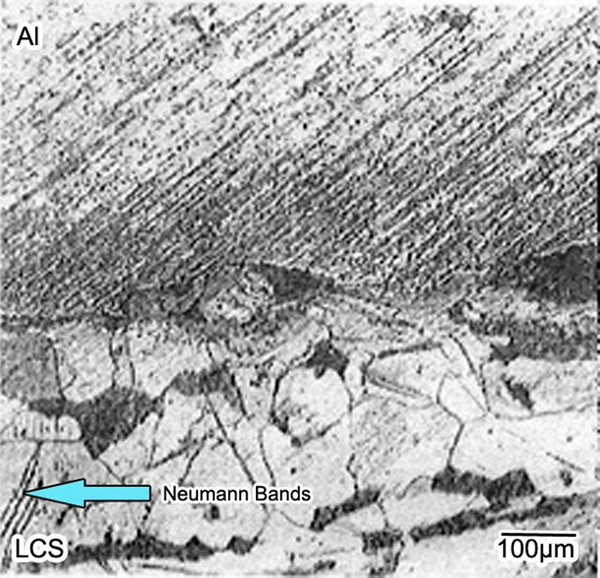
Micrograph of Al/steel
Discussion
Heat transfer by conduction
When a chemical explosive is detonated, the flyer plate moving with the velocity of sound collides with the base plate, causing instantaneous conversion of the kinetic energy available in the flyer plate into thermal energy. The kinetic energy dissipated at the interface depends on the process parameters, namely, standoff distance, flyer plate velocity and thickness of flyer plate. When the kinetic energy is fully utilised in creating a plastic region, the formation of intermetallics becomes unfeasible. Hokamoto et al.
18 estimated that during collision, approximately 10–30% of the kinetic energy is converted into thermal energy. The converted heat energy is transmitted into participant metals by conduction. The amount of heat energy thus transmitted depends on the thermal conductivity of the metals and the heat transfer area, as represented in equation (3). When metals having high thermal conductivity are cladded, the heat transfer will be more, resulting in a thicker plastic region. The physical properties of participant metals, such as heat transfer coefficient, density and melting point, influence the thickness of the molten region as well. As the process is highly dynamic, the shock front travels very fast. The time to heat up the metal surface is too short, and only a small zone could be influenced through increased temperature. The accumulation of thermal energy contributes to a rise in temperature and leads to an adiabatic shearing near the interface (‘jetting phenomenon’). The thickness of plastic region is proportional to the amplitude of the waves, which depends on the wavelength of the interfacial waves. The wavelength λ of the waves19 can be analytically estimated by


Heat transfer by convection
The heat transfer from shock compressed gas, formed at the standoff distance, to participant metals is achieved by convection. When detonated, the flyer plate moves with the velocity of sound and compresses the gas molecules in the standoff distance (Fig. 4). As the gas is compressed by the flyer plate, its density varies locally, and there is an abrupt decrease in the flow area. The flow process is irreversible, and the entropy increases. Shock waves are generated across the microregions in the gas, where the static pressure, temperature and gas density increase almost instantaneously.20 As the flow is non-isentropic, the total pressure downstream of the shock is always lesser than the total pressure upstream of the shock. The Mach number and the speed of flow also decrease across a shock wave, resulting in a considerable increase in the temperature of the gas shock compressed between the induced shock and the collision point. The shock compressed gas, at higher temperature, is acting as the source momentarily and transmits heat to the participant metals by convection (equation (4)) as the process is highly dynamic in nature. The nature of the interface depends on the cladding parameters, namely explosive mass, flyer plate velocity, temperature of the gas between the plates and material characteristics. The temperatures created at the shock compressed gas region can be approximated if the Mach number M of the shock travelling through the gas is known, i.e.

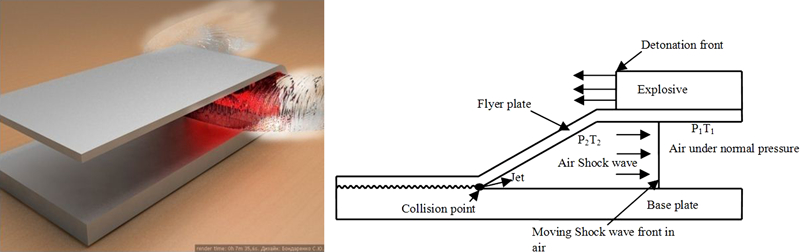
Formation of shock compressed gas at interface
The pressure of gas in the heated region P2 is determined by
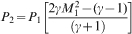
The temperature of the gas at the shock compressed gas region at the interface can be determined using

The density across the shock wave ρ2 can be arrived at
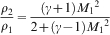
The length of the gas heated region s is

Influence of interlayer on wavy interface
Most explosive welding processes are performed without an interlayer. However, depending on the combination, a third material that is compatible with the participant metals can be introduced to suppress the kinetic energy dissipation and to enhance the heat transfer rate at the interface. The introduction of the interlayer increases the heat transfer area and the duration of collision, and thereby, the available time for heat transfer to the metals increases, resulting in a reduction in heat loss to ambience. The thermal conductivity of the interlayer significantly influences the heat transfer rate (equation (3)). The heat transfer will be more pronounced in the first interface (flyer–interlayer), whereas it will be less at the second interface (interlayer–base plate). The physical properties of the interlayer, namely, thermal conductivity, melting point and density, characterise the thickness of the plastic region. When the flyer plate collides with the interlayer, the kinetic energy stored is partially transformed to potential energy, which causes the flyer and interlayer to deform plastically along the surface. In the region between flyer and interlayer, excessive plastic deformation is avoided; thereby, small waves with minimum wavelength and amplitude are formed. Subsequently, the flyer–interlayer clad collides with the base plate with the remaining kinetic energy. When an interlayer is employed, as the available heat energy by conduction and convection is utilised at two interfaces, the depth of penetration of heat at the participant metals reduces and results in an interface with less amplitude with nil or negligible intermetallic compounds. Higher heat transfer and additional kinetic energy dissipation at the Al/steel interface support the formation of intermetallics, in addition to the disparity in material properties, as shown in Fig. 5. When a compatible interlayer is employed, the amount of heat transferred into the interface between interlayer and base plate is inadequate to create a wavy interface but sufficient to produce a straight interface. The microstructure of the three-layered clad (Cu–Cu–SS304) across the interface (Fig. 6) shows an intense plastic deformation, and the material flow is more pronounced on the similar materials side (flyer–interlayer). Crossland2 stated that the reduction in kinetic energy loss between flyer plate and interlayer results in small waves devoid of intermetallics at the interface. From the pattern of wave formation, it can be inferred that the microstructural changes at the interface are driven by the plastic deformation generated by the amount of heat transferred and the kinetic energy lost at the interface. During the collision, the thin interlayer is heavily deformed due to the plastic flow in the trough of the wave. The flow then rises with the wave and pushes up the first welded interface (flyer–interlayer). The micrographs of copper/steel with and without interlayer are shown in Figs. 2 and 6 respectively. It is observed that the wavy interface was obtained in the similar metal side and a straight interface on the dissimilar side (Fig. 6). The wavy interface at the Cu/Cu interface is due to the larger kinetic energy spent, with copper having higher thermal conductivity and providing more heat transfer to the interface (thermal conductivity of copper of 400 W m−1 K−1 and density of copper of 8900 kg m−3). In the second interface, as the flyer–interlayer clad is moving with the remaining kinetic energy, the heat transferred will be less. This leads to reduced plasticity at the interface and, correspondingly, a straight interface emerges (thermal conductivity of steel of 16 W m−1 K−1 and density of steel of 7900 kg m−3). The formation of a wavy interface is more pronounced in the similar material side as the physical properties of the metals are similar. Manikandan et al. 21 successfully employed a thin stainless steel plate as an interlayer between titanium and stainless steel and obtained a wavy interface in the similar metal interface. Han et al. 22 reported the use of a pure aluminium interlayer for the cladding of aluminium alloy and steel and reported the formation of an intermetallic layer in the dissimilar interface (Al/steel). The properties of metals are more influential in transferring heat and achieving a molten state, resulting in the characteristic undulation. A thin interlayer having high ductility, low yield strength and high thermal conductivity and having properties similar to participant metals will enhance the heat transfer rate and kinetic energy utilisation to form the undulating interface in the explosive cladding of dissimilar metals.
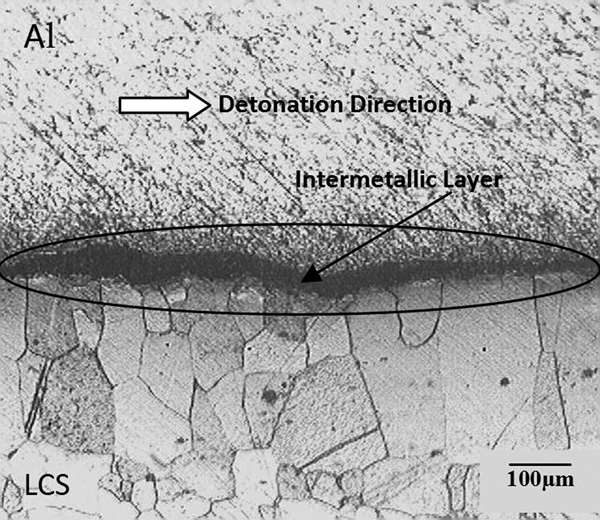
Al/steel with intermetallics
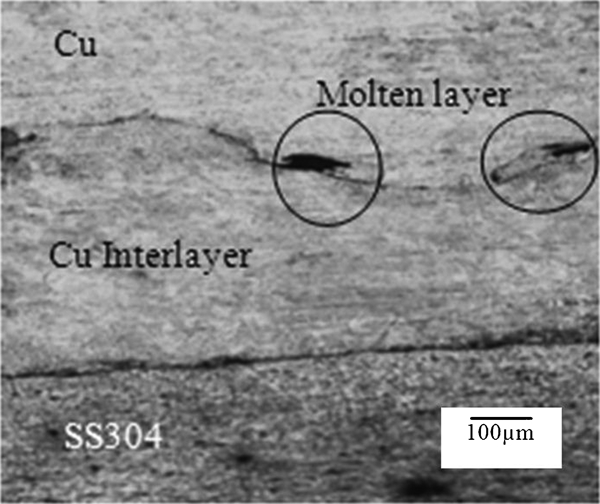
Micrograph of Cu/steel with Cu interlayer
Effect of material properties
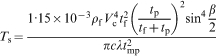
The collision vicinity in explosive cladding experiences an extremely high velocity gradient, high strain rate and high pressure. The crystallisation and plastic deformation behaviour of metals under these conditions will differ from those of metals in the normal state. A faster liquefaction is achieved following a high strain rate ambience. The strongest effect of rarefaction waves, even a complete failure of the weld, is observed when the molten areas are not fully solidified. The thermal conductivity of both metals at elevated temperatures is an important parameter that determines the degree of plasticity, and hence, metals having high thermal conductivity, such as copper, produce a good wavy interface, as in Fig. 2. In the explosive cladding of dissimilar metals, a wavy interface is more pronounced in metals possessing a higher thermal conductivity. While cladding metals have widely different melting points, such as Al/steel, aluminium will be in the liquid state before steel. Hence, the melting point of the participant metals is vital in determining the nature of the interface (Fig. 3). While cladding metals having a similar density tend to produce an interface having a vortex on both sides, the explosive cladding of metals having a varying density ratio vortex will be visible in the denser metal. The physical properties, such as heat conductivity coefficient, specific heat capacity, thickness of plates and melting point, determine the time required for solidification Ts, which is estimated using the following relation23
Conclusions
The objective of the present study was to study the influence of heat transferred into the metal by the kinetic energy loss and the shock compressed gas at the interface on the formation of a wavy interface in the explosively cladding of dissimilar metals. Further, the influence of interlayer on heat transfer has been reported, and the following conclusions were drawn.
Developing an analytical model is an effective procedure to determine the amount of heat transferred during explosive cladding.
The kinetic energy available is converted into heat energy by conduction.
The formation of shock compressed gas at the standoff also influences the amount of heat transferred into the metals.
A compatible interlayer increases the heat transfer rate and reduces the heat transfer coefficient.
An interlayer having properties similar to flyer plate and base plate significantly influences the wavy interface, thereby achieving a strong joint.
The material properties of the participant metals strongly influence the nature of the interface.