







Abstract
The effect of MnO on the hydrogen solubility in the CaF2–CaO–SiO2 based welding flux system at 1823 K has been studied. At an acidic slag composition of CaO/SiO2 molar ratio or basicity of 0·8 and below, MnO addition decreased the hydrogen solubility. At an intermediate slag composition of CaO/SiO2 molar ratios of 1·1 and 1·3, the hydrogen solubility as a function of MnO additions resulted in a parabolic behaviour showing a minimum and then increasing with higher MnO content. MnO was found to behave as a basic oxide, which decreases the hydrogen solubility when the incorporation hydroxyl mechanism is dominant for an acidic slag and increases the hydrogen solubility when the free hydroxyl mechanism is dominant for a basic slag. This change in the dominant hydrogen dissolution mechanism was also apparent from the hydrogen solubility results at various CaO/SiO2 molar ratios and fixed MnO contents. A higher hydrogen solubility in the slag is likely to lower the diffusible hydrogen content in the weld metal, and optimum MnO additions were suggested depending upon the basicity of the slag. Fourier transformed infrared analysis of as quenched slags showed that MnO depolymerised the slag network structure and correlated well with the effect on the hydrogen solubility in slags.
Keywords
Introduction
The chemical composition of welding type fluxes is an essential part of determining the behaviour and physical properties of weld metal deposits. Sui et al., 1 Paniagua-Mercado et al. 2 and Natalie et al. 3 have reported directly on the properties of the flux, such as softening temperature, crystallisation and viscosity, which can affect the slag of the weld and the slag/metal separation. Others4– 7 have correlated the microstructure and mechanical properties of the weld metal deposit with the welding flux composition, such as the effect of CaO, MgO, CaF2 and Al2O3 on the impact toughness yield strength and ultimate tensile strengths.
Owing to the rising demand for advanced high strength steels, particular emphasis has been placed on the weld joint area and the effect of entrained gaseous elements. In particular, excess hydrogen in weld joints has been known to cause hydrogen induced cracking, embrittlement and pores in materials. 8 8,9 According to Okuda et al., 10 for high strength steels, hydrogen induced cracking can be a serious problem when even small amounts of hydrogen is contained in and near the heat affected zone of the weld. In flux cored arc welding, there are several sources of hydrogen during welding, including the filler metal, the cored flux and the moisture in the atmosphere. When appropriate preheating procedures are used before use and hermetical packaging techniques are employed for the welding rods, the overall moisture content contained in the minerals and binders can be reduced, but complete removal of the moisture from the flux constituents is unlikely. Furthermore, atmospheric moisture can also be a source of diffusible hydrogen in the fusion zone of the weld pool. Thus, in order to prevent the inflow of hydrogen from moisture in the atmosphere by forming a protective layer of flux and also refine the hydrogen from the metal by metal/slag reactions, the welding flux is expected to play an important role in controlling the diffusible hydrogen during welding. Recent aggressive initiatives for industrial welding fluxes aiming to control hydrogen to very challenging subparts per million levels have focused on CaO based fluxes containing silica (SiO2), halides (CaF2 and NaF) and manganese oxides (MnO). However, there has been relatively little fundamental work carried out on the hydrogen dissolution of welding type fluxes.
Past work carried out with steelmaking slags11– 14 showed hydrogen solubility to be a function of temperature, water vapour pressure and slag composition. Work carried out on the effect of temperature to water vapour solubility in slags showed significant differences among various authors.15– 18 Some authors16– 21 have reported little or no effect of temperature on the water vapour solubility at a wide range of slag compositions, within the temperature range of 1673–1873 K. On the other hand, others 22 22,23 have indicated a small temperature effect on the hydrogen solubility. According to Iguchi and Fuwa22 and Iguchi et al., 24 temperature variations had different effects on the solubility of water vapour depending on the basicity of the slag, where basicity was defined as the ratio of the basic component over the acidic component. In an acidic slag system, the solubility decreased as the temperature increased, and in a basic slag system, the hydrogen solubility increased as the temperature increased.
With regard to the relationship between the hydrogen solubility in molten slags with the partial pressure, several studies seem to suggest the slag hydrogen content to be directly proportional to the square root of the water vapour partial pressures.16,19,24–
27 According to Ban-ya et al., 28 the hydrogen solubility in the slag can be defined by the hydroxyl capacity COH and is inversely proportional to the square root of the water vapour pressure by equation (1)1

 and Po are the mass percentage of H2O in the slag, the partial pressure of water vapour at equilibrium and the atmospheric pressure respectively. Thus, a plot of the natural logarithm of hydrogen solubility as a function of
 at a fixed composition and temperature should result in a slope of 0·5.
The effect of slag composition on the water solubility in slags has been discussed by many authors.
15
26
27
15,26,27,29 In particular, Zuliani15 and Guerrero29 reported water vapour to behave amphoterically depending on the slag basicity acting as a network modifier in acidic slags and a network former in basic slags. For acidic slags, Tomlinson25 proposed the hydrogen dissolution mechanism to be via the incorporated hydroxyl reaction (2)

For basic slags, Walsh et al.
19 suggested the hydrogen dissolution mechanism to be via the free hydroxyl reaction (3)

In this study, since the major contributions of low hydrogen welding fluxes include CaF2, CaO, SiO2 and MnO, the hydrogen solubility of the CaF2–CaO–SiO2–MnO slag flux system has been studied in a wide range of compositions at relatively fixed CaF2 content. The effect of MnO and basicity on the hydrogen solubility was observed and correlated with the slag structure using Fourier transformed infrared (FTIR) analysis.
Experimental
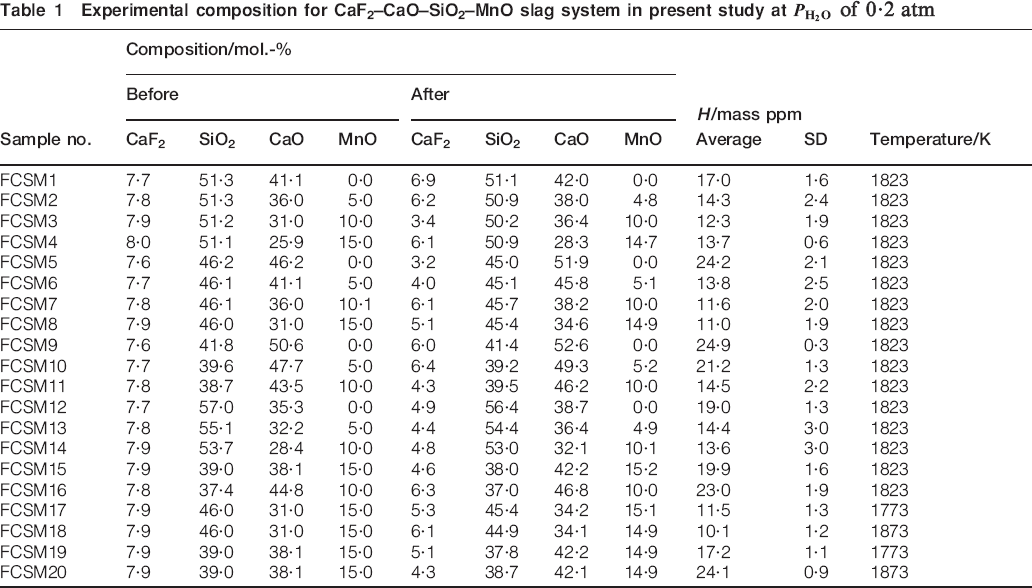
Reagent grade chemicals of CaF2, CaO, SiO2 and MnO were used to prepare the slag samples. The samples were premelted at 1823 K under 200 sccm of Ar gas in a platinum crucible for 5 h to obtain a homogeneous slag sample. Pre- and post-experimental chemical compositions of the fluxes using the X-ray fluorescence (S4 Explorer; Bruker AXS GmbH, Karlsruhe, Germany) are shown in Table 1. As can be seen, significant fluorine vaporisation can occur depending upon the initial chemical composition of the slag system. Thus, the post-experimental compositions were taken to be the true compositions for the conditions of the thermal equilibrium technique. This vaporisation is likely caused by the fluorine vaporisation as SiF4 and HF discussed in detail elsewhere.32 A schematic of the experimental apparatus is shown in Figure 1. Ar gas of 0·2 L min−1 was passed through a column of water set at 333 K, which can saturate Ar with moisture and control the bulk H2O partial pressure within the reaction chemical to ∼0·2 atm. The gas inlet line is kept hotter than the humidifier at 353 K. This wet Ar gas was injected into the hot zone of a Mo–Si vertical resistance furnace. The furnace temperature was calibrated using a reference B type thermocouple and maintained within ±3 K using a proportional–integral–derivative controller. The slag sample was then equilibrated for 5 h at 1823 K to ensure that a thermodynamic equilibrium was reached for the hydrogen dissolution into molten slag. After equilibration, the slag sample was removed from the hot zone of the furnace and quenched with liquid nitrogen. The as quenched slag sample was kept within an Ar gas purged container for not more than 48 h, and the hydrogen was analysed using an inert gas fusion H/N/O analyser with a thermal conductivity detector (RH-600; LECO, USA), and the slag structure was analysed using FTIR (Spectrum-100; PerkinElmer, USA).
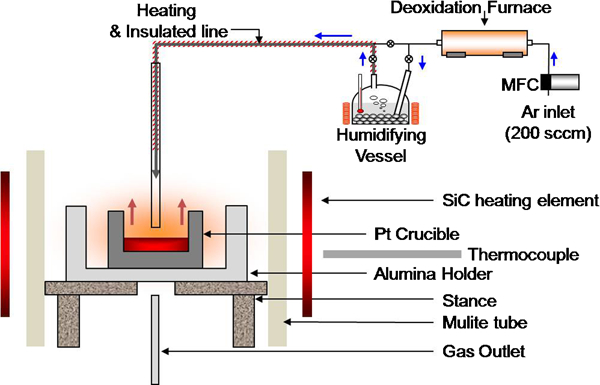
Schematic of experimental apparatus
Experimental composition for CaF2–CaO–SiO2–MnO slag system in present study at of 0·2 atm
Results and discussion
Effect of basicity on hydrogen solubility at fixed MnO content
Figure 2 shows the hydrogen solubility as a function CaO/SiO2 molar ratio (basicity) at a fixed XMnO content. The hydrogen dissolution behaviour as a function of
 showed a parabolic shape regardless of MnO concentration. At low basicity, the hydrogen solubility decreases with increasing basicity, reaching a minimum. After the minimum hydrogen solubility, higher basicities increased the hydrogen solubility. This parabolic characteristic change in slag behaviour suggests two separate hydrogen dissolution mechanisms to exist depending on slag basicity, as described by the aforementioned reactions (2) and (3). Hydrogen can dissolve in slag either as an incorporated hydroxyl (Si–OH) according to reaction (2) or as a free hydroxyl (OH−) according to reaction (3). In an acidic slag system, the incorporated hydroxyl mechanism is dominant, and an increase in basicity typically results in the increase in the free oxygen ions (O2−), which can decrease the activity of the bridged oxygen (O°) and subsequently lower the slag hydrogen solubility, as specified by reaction (2). However, in a basic slag system, the hydrogen dissolves as a free hydroxyl (OH−), and an increase in the basicity results in an increase in the O2−, which can increase the activity of O2−, as described by reaction (3), and push the forward reaction, increasing the slag hydrogen content. When the solubility of hydrogen is increased for molten slags, there is a higher capacity for hydrogen to be retained in the molten slag, which can increase the hydrogen partition between the slag and weld joint and thus decrease the diffusible hydrogen content. Thus, a highly basic CaF2–CaO–SiO2–MnO flux system will likely lower the diffusible hydrogen, where the hydrogen solubility content is highest. Similar findings were also observed by Plessis et al.
32 in CaO based industrial shielded metal arc welding rods and by Terashima and Tsuboi33 in CaO–SiO2–FeO based slags.
showed a parabolic shape regardless of MnO concentration. At low basicity, the hydrogen solubility decreases with increasing basicity, reaching a minimum. After the minimum hydrogen solubility, higher basicities increased the hydrogen solubility. This parabolic characteristic change in slag behaviour suggests two separate hydrogen dissolution mechanisms to exist depending on slag basicity, as described by the aforementioned reactions (2) and (3). Hydrogen can dissolve in slag either as an incorporated hydroxyl (Si–OH) according to reaction (2) or as a free hydroxyl (OH−) according to reaction (3). In an acidic slag system, the incorporated hydroxyl mechanism is dominant, and an increase in basicity typically results in the increase in the free oxygen ions (O2−), which can decrease the activity of the bridged oxygen (O°) and subsequently lower the slag hydrogen solubility, as specified by reaction (2). However, in a basic slag system, the hydrogen dissolves as a free hydroxyl (OH−), and an increase in the basicity results in an increase in the O2−, which can increase the activity of O2−, as described by reaction (3), and push the forward reaction, increasing the slag hydrogen content. When the solubility of hydrogen is increased for molten slags, there is a higher capacity for hydrogen to be retained in the molten slag, which can increase the hydrogen partition between the slag and weld joint and thus decrease the diffusible hydrogen content. Thus, a highly basic CaF2–CaO–SiO2–MnO flux system will likely lower the diffusible hydrogen, where the hydrogen solubility content is highest. Similar findings were also observed by Plessis et al.
32 in CaO based industrial shielded metal arc welding rods and by Terashima and Tsuboi33 in CaO–SiO2–FeO based slags.
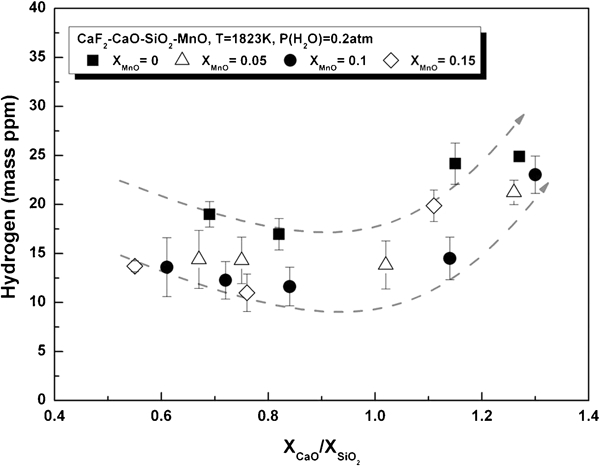
Hydrogen solubility as function of basicity (C/S) at fixed MnO content (mol.-%) at 1823 K
Effect of basicity on slag structure at fixed MnO content
Figure 2
Figures 3 and 4 show the FTIR transmittance trough as a function of wavenumber (cm−1) for different basicities and fixed XMnO of 0 and 0·1. The transmittance region for symmetric stretching bands for [SiO4]-tetrahedral is observed between 1100 and 850 cm−1, and asymmetric Si–O–Si bending band is observed near 800–780 cm−1.11,34–
36 According to Mysen et al., 35 the characteristic symmetric stretching bands for the [SiO4]-tetrahedral are a convoluted band of various Si rich anionic structural units of sheet with non-bridged oxygen (NBO)/Si of 1 (
 ), chains with NBO/Si of 2 (
 ), dimers with NBO/Si of 3 (
 ) and monomers with NBO/Si of 4 (
 ). The NBO/Si is defined as the non-bridged oxygen per Si atom in the silicate anion structure. In particular, NBO/Si of 4, which is observed within the wavenumber of 870–820 cm−1,37 becomes more pronounced with higher basicity. This suggests that the slag structure depolymerises from a complex network structure to a simpler structure such as a dimer and monomer with higher
 . Furthermore, the asymmetric Si–O–Si bending vibration near 800–780 cm−1 described by Mysen et al.
35 and Agathopoulos et al.
38 seems to disappear with increased basicity if the mechanism of hydrogen dissolution changes from an incorporated to free hydroxyl. When Si–OH bonds within the complex silicate tetrahedral network structure are no longer dominant with higher basicity, asymmetric Si–O–Si bending due to the differences in interatomic forces between the Si–OH and Si–O bonds is likely to decrease as observed from the transmittance trough near 800–780 cm−1. In addition to the FTIR transmittance trough, the hydrogen solubility for an acidic slag (C/S = 0·7, 0·8), where the incorporated hydroxyl mechanism is dominant, continuously decreases due to the decrease in bridged oxygen (O°) bonds and depolymerises the slag network structure, eliminating incorporation sites for hydrogen. For the basic slag system (C/S = 1·1, 1·3), where the free hydroxyl mechanism is dominant, the hydrogen solubility increases with higher basicity due to the increase in free oxygen ions (O2−) and the depolymerisation of the slag network.
. Furthermore, the asymmetric Si–O–Si bending vibration near 800–780 cm−1 described by Mysen et al.
35 and Agathopoulos et al.
38 seems to disappear with increased basicity if the mechanism of hydrogen dissolution changes from an incorporated to free hydroxyl. When Si–OH bonds within the complex silicate tetrahedral network structure are no longer dominant with higher basicity, asymmetric Si–O–Si bending due to the differences in interatomic forces between the Si–OH and Si–O bonds is likely to decrease as observed from the transmittance trough near 800–780 cm−1. In addition to the FTIR transmittance trough, the hydrogen solubility for an acidic slag (C/S = 0·7, 0·8), where the incorporated hydroxyl mechanism is dominant, continuously decreases due to the decrease in bridged oxygen (O°) bonds and depolymerises the slag network structure, eliminating incorporation sites for hydrogen. For the basic slag system (C/S = 1·1, 1·3), where the free hydroxyl mechanism is dominant, the hydrogen solubility increases with higher basicity due to the increase in free oxygen ions (O2−) and the depolymerisation of the slag network.
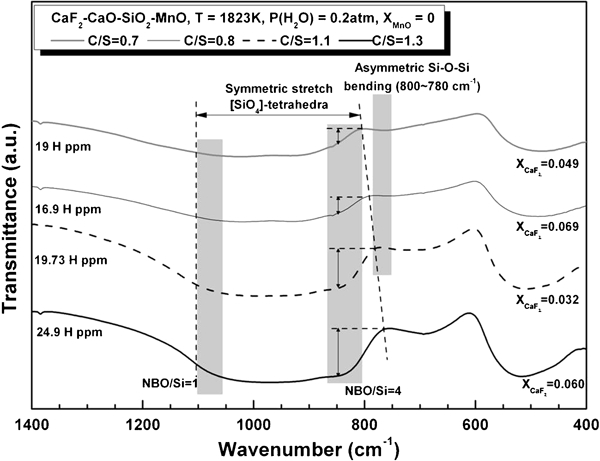
Fourier transformed infrared analysis of as quenched CaF2–CaO–SiO2–MnO slag samples at fixed MnO content (5 mol.-%) and various basicities (C/S)
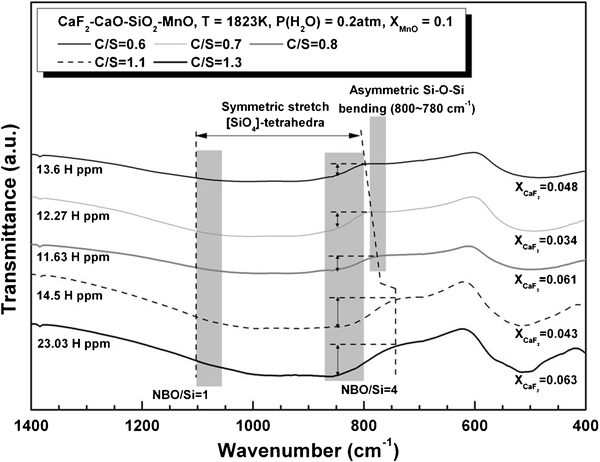
Fourier transformed infrared analysis of as quenched CaF2–CaO–SiO2–MnO slag samples at fixed MnO content (10 mol.-%) and various basicities (C/S)
Effect of MnO on hydrogen solubility at various fixed basicities
Figure 5 shows the hydrogen solubility as a function of MnO content at fixed basicity from 0·7 to 1·3. At a relatively acidic region (
 = 0·7, 0·8), the hydrogen solubility continuously decreases with increasing MnO concentration. According to the results in Fig. 2 and reaction (2), the hydrogen solubility is in the form of an incorporated hydroxyl. Thus, if MnO is considered to be a basic oxide, a higher MnO results in additional O2−, which can react with the bridged oxygen and lower the incorporation sites for hydroxyl to attach. However, for an intermediate to a basic slag system (
 = 1·1, 1·3), the hydrogen solubility decreases with an initial addition of MnO up to 5 mol.-%, showing a minimum, and increases with further additions of MnO above 5 mol.-%, similar to a parabolic curve. This can be correlated to a change in mechanism of hydrogen solubility from an incorporated hydroxyl (reaction (2)) to a free hydroxyl (reaction (3)) when the basicity is at relatively intermediate values of 1·1 and 1·3. When the basic oxide MnO is added only up to 5 mol.-% to the 1·1 and 1·3 slag, the initial slag system is still likely in the acidic region, and hydrogen dissolves as an incorporated hydroxyl, and thus with MnO additions, O2− increases, which decreases the bridged oxygen activity
 subsequently pushing reaction (2) to the left and decreasing the hydrogen solubility of the slag. However, above 5 mol.-%MnO, the CaF2–CaO–SiO2–MnO slag system becomes increasingly basic, and hydrogen dissolution changes from the incorporated hydroxyl to the free hydroxyl mechanism expressed in reaction (3). Higher concentrations of the basic oxide MnO will increase the hydrogen solubility due to the supply of O2− pushing the forward reaction (3), which may explain the parabolic behaviour of hydrogen dissolution as a function of MnO at slag basicities of 1·1 and 1·3. Thus, for an acidic slag system of basicities 0·7 and 0·8, a lower MnO increases the hydrogen solubility and possibly decreases the diffusible hydrogen in the weld metal. For intermediate slag basicities of 1·1 and 1·3, MnO concentration between 5 and 10 mol-% resulted in a minimum hydrogen solubility in the slag, which will increase the diffusible hydrogen content in the weld metal and should be avoided.
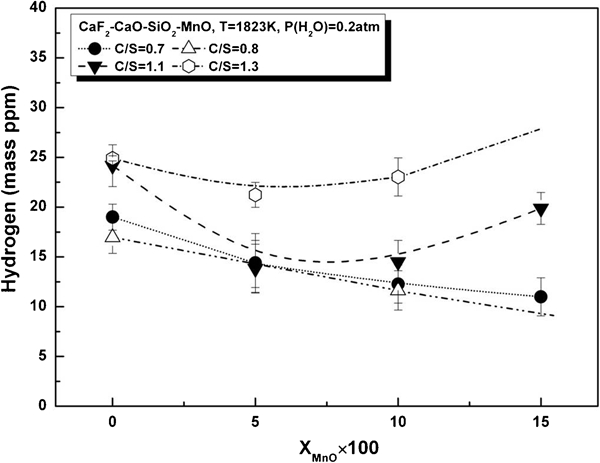
Hydrogen solubility as function of MnO content at fixed basicity (C/S) at 1823 K
Effect of MnO on slag structure at various fixed basicities
Figure 5
Figures 6 and 7 show the FTIR transmittance trough as a function of wavenumber (cm−1) for a fixed
 of 0·7 and varying MnO concentrations of 0, 5 and 10 mol.-%. At this relatively acidic slag composition, the transmittance trough for the symmetric stretching bands for NBO/Si of 4 becomes deeper with increased MnO. This indicates a slight depolymerisation of the silicate structure and a decrease in the activity of NBO in reaction (2). Since the incorporated hydroxyl mechanism is dominant, the hydrogen solubility is decreased with the addition of MnO contents. From the slight depolymerisation of the slag structure with MnO, the MnO can be assumed to be a weak basic oxide.
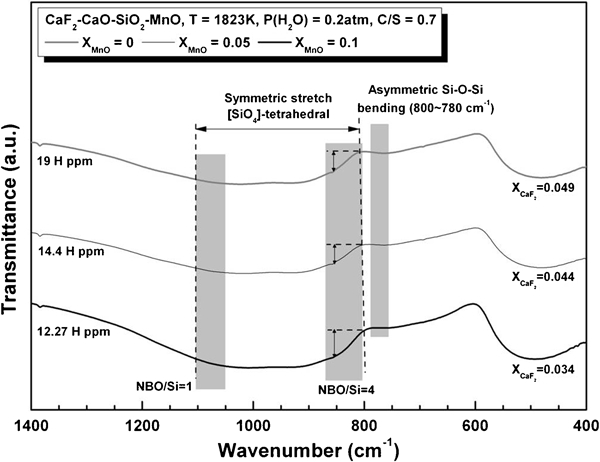
Fourier transformed infrared analysis of as quenched CaF2–CaO–SiO2–MnO slag samples at fixed basicity (C/S = 0·7) and various MnO contents
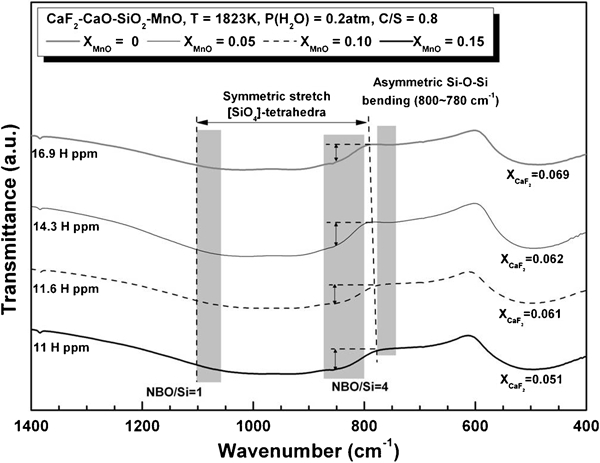
Fourier transformed infrared analysis of as quenched CaF2–CaO–SiO2–MnO slag samples at fixed basicity (C/S = 0·8) and various MnO contents
Figure 8 shows the FTIR transmittance trough as a function of wavenumber (cm−1) for a fixed basicity of 1·3 at different MnO concentrations of 0, 5 and 10 mol.-%. At this transitional slag composition, the transmittance trough for the symmetric stretching bands of NBO/Si = 4 troughs becomes more pronounced with higher MnO, suggesting depolymerisation of the slag network structure and indicating MnO to be a basic oxide component in the CaF2–CaO–SiO2–MnO slag system. The peak for the asymmetric Si–O–Si bending band also disappears with an increased MnO. Again, the hydrogen solubility decreased with an initial addition of 5 mol.-%MnO and increased above 5 mol.-%MnO. Thus, as previously mentioned, although MnO continues to behave as a basic oxide and depolymerise the slag structure, the mechanism changes from an incorporated hydroxyl to a free hydroxyl in the present slag system and composition. When >5 mol.-%MnO is added, the dominant mechanism of hydrogen dissolution is the free hydroxyl, and an increase in O2− depolymerises the slag and subsequently increases the hydrogen solubility.
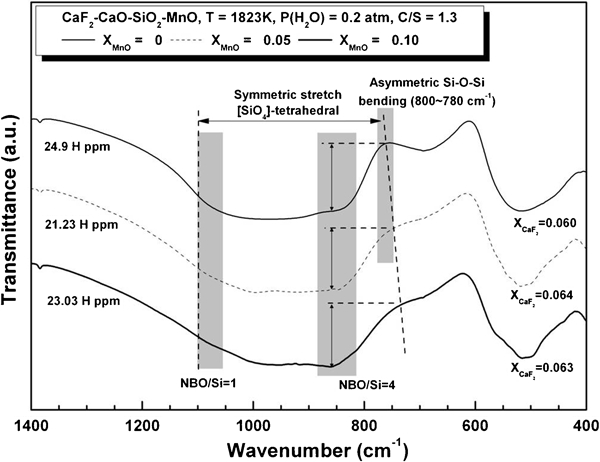
Fourier transformed infrared analysis of as quenched CaF2–CaO–SiO2–MnO slag samples at fixed basicity (C/S = 1·3) and various MnO contents
Temperature dependence of CaF2–CaO–SiO2–MnO slag
At constant
 of 0·2 atm, the hydrogen content as a function of temperature from 1773 to 1873 K at 15 mol.-%MnO and various basicities of
 of 0·8 and 1·1 is shown in Fig. 9. The works of Imai et al., 23 Iguchi and Fuwa22 and Iguchi et al.
24 are also shown for comparison. For
of 0·8 and 1·1 is shown in Fig. 9. The works of Imai et al., 23 Iguchi and Fuwa22 and Iguchi et al.
24 are also shown for comparison. For
 of 0·8, the hydrogen solubility decreases with higher temperatures. For
 of 1·1 or for the basic slag composition, the hydrogen solubility increases with increasing temperature. According to Iguchi et al., 24 in the acidic slag composition, bridged oxygen (Oo) decreases with higher temperature, while in the basic slag composition, NBO (O−) increases with increasing temperature; as a result, the silicate melt becomes depolymerised with higher temperature. Thus, the hydrogen solubility is decreased in the acidic slag composition and increased in the basic slag composition with higher temperatures. In order to obtain the heat of dissolution of water into slag, the Van't Hoff equation derived from the Gibbs–Helmholtz relationship at constant pressure and the thermodynamic equilibrium constant are typically used and are expressed in equation (4)

 of 1·1 and 16·7 kcal mol−1 in
 of 0·8 slag compositions. According to Imai et al., 23 in the CaO–41·1 mol.-%SiO2–16 mol.-%FetO slag system and a
 of 0·1 atm, the heat of hydrogen dissolution in the slag was 12·2 kcal mol−1, and according to Iguchi et al., 24 in the CaO–63 mass-%SiO2 and CaO–45 mass-%SiO2 binary slag system at
 of 0·38 atm, the heats of hydrogen dissolution in the slag were 7·3 and 21·5 kcal mol−1 respectively. The significant difference in the heat of dissolution has yet to be fully understood but may be related to the different slag systems.
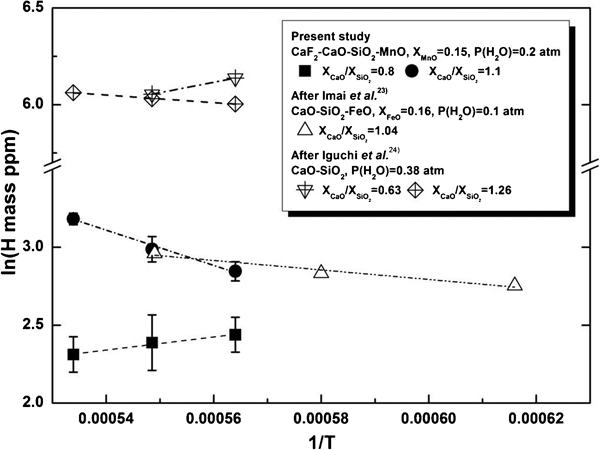
Natural logarithm of parts per million H as function of 1/T
Conclusions
The hydrogen solubility in the CaF2–CaO–SiO2–MnO slag system has been studied to identify and compare the hydrogen dissolution behaviour according to basicity and MnO content at a high temperature of 1823 K. The hydrogen solubility was parabolic with increased basicity, showing a minimum. This indicated two separated mechanisms dependent on the slag composition. At an acidic slag composition, water vapour reacts with bridged oxygen (Oo) and forms incorporated hydroxyl. However, at a basic slag composition, the hydrogen dissolution mechanism is a free hydroxyl by reacting with the free oxygen (O2−). For acidic slags, the results of depolymerisation decreased the bridged oxygen, which act as incorporated sites for hydrogen. For a basic slag, increased depolymerisation of the silicate structure increased the hydrogen solubility. A higher hydrogen content in the slag is expected to lower the diffusible hydrogen content in the weld metal.
In the slag system with fixed basicity and different MnO contents, the hydrogen solubility decreased with higher MnO content at relatively low basicity. At a transitional basicity of 1·1 and 1·3, the hydrogen solubility is initially decreased with MnO addition, showing a minimum, and increased with further MnO. This seems to be related to the change in mechanism of the incorporated hydroxyl to free hydroxyl when a weak basic oxide such as MnO is added. Thus, for basicities of 0·7 and 0·8, a lower concentration of MnO may be beneficial in lowering the diffusible hydrogen in the weld metal, and for transitional basicities of 1·1 and 1·3, an MnO concentration of between 5 and 10 mol.-% results in a minimum in the hydrogen solubility in the slag and should be avoided. From the temperature dependence, the energy of hydrogen dissolution was calculated to be 44·9 kcal mol−1 in a relatively basic slag composition and 16·7 kcal mol−1 in a relatively acidic slag system.