







Abstract
In order to improve the fracture resistance of undermatched butt joint, the influence of joint shape parameters on the stress intensity factor (SIF) of undermatched butt joint with mode I centre crack was studied, and the solution of SIF was obtained by combining the analytical method with the finite element method as well. The results are useful to guide the shape design of undermatched butt joint with mode I centre crack under both static load and fatigue load conditions.
Keywords
List of symbols
crack dimension
critical crack dimension
initial crack dimension
material property constant
Young's modulus
height of weld reinforcement

imaginary part of

J integral
stress intensity factor of mode I crack
fracture toughness
material property constant
fatigue remaining life
weld toe smooth transition radius
real part of ZI(z)
half of base metal thickness
half of weld width
shape factor
complex variable
Westergaard complex stress function

derived function of ZI(z)
cyclic stress
Poisson's ratio
external stress
critical stress
stress of y direction
Introduction
In order to save the weight of structure, high strength steels have been widely used in ship building, pressure vessel producing and other industrial fields. However, welding cold cracking has become one of the main failure modes of high strength steel welded structures.1 Preheat and post-weld heat treatment is one of the main solutions to avoid welding cold cracking.2 Unfortunately, the potential of embrittlement and softening of the heat affected zone increased remarkably, while the strength and toughness of heat affected zone decreased evidently after preheat and post-weld heat treatment. 3 3,4 To improve joint performance, it is significant to apply working conditions without preheat and post-weld heat treatment. In order to prevent cold cracking and decrease the temperature of preheat and post-weld heat treatment, more attention has been paid to undermatched joint design. 5 5,6 Traditionally, the undermatched joint has lower load carrying capacity compared with equal matched joint. To make the load carrying capacity of undermatched joint not less than that of the base metal or equal matched joint, an undermatched butt joint form with certain reinforcement, which is shown in Fig. 1, has been proposed by Fang et al.7 Its joint shape parameters include reinforcement h, weld width 2w, weld toe smooth transition radius r and base metal thickness 2t. The shaded area indicates the low strength filler metal. The design principle is adjusting the stress distribution by making height of reinforcement loaded and reducing the stress concentration factor of the weld toe zone by adding a joint shape parameter, which is a smooth transition radius of the weld toe.
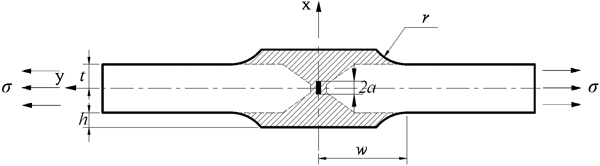
Shape parameters of centre cracked undermatched butt joint with certain reinforcement
As a matter of fact, brittle failures often occur under low stress due to the sensitive and sudden break-up of defects in the welded joint, especially in high strength steel joint.8– 10 Fracture mechanics can deal with problems of structure with cracks or other defects. The safety of welded joint with cracks can be assessed by comparing its stress intensity factor (SIF) result with fracture toughness, which is a constitutional property of certain material. Therefore, it is meaningful to obtain the solution of SIF for undermatched butt joint with certain reinforcement. Nowadays, the SIF can be obtained by analytical, numerical or experimental standardisation method. The numerical method is the most widely used method of these three methods due to its efficiency and accuracy. As one of the numerical methods, the finite element method has been widely applied in engineering fields.11– 17
Basic concept and theory
It is well known that SIF for mode I crack can be described as

So far, the SIF solution for mode I crack in a fixed width finite plate has been given in some textbooks, but the SIF solution for mode I crack in a width changed finite plate has not been proposed yet.
Solution process
Analytical method
For the crack under unidirectional tension in an infinite plate, the Westergaard complex stress function is19
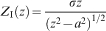
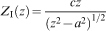
Considering the centre crack in an undermatched butt joint with certain reinforcement under unidirectional tension (as depicted in Fig. 1), its Westergaard complex stress function can be described as
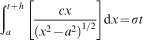
For the joint shown in Fig. 1, the stress of the y direction can be deduced as

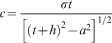
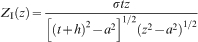

Numerical simulation
In equation (8), only the influence of h on SIF is considered. Actually, all the joint shape parameters have an effect on SIF. If all the shape parameters are taken into account, the solution of SIF for the joint shown in Fig. 1 should be

For the plane strain condition, the relationship of J integral and SIF KI is

Combining equations (9) and (10), coefficients f of joints with different shape parameters can be written as
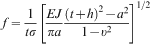
Because of the symmetry, one-fourth of the joint is selected as the analysis model, as shown in Fig. 2a, in which plane strain elements are used. Meshes near the crack tip are refined, as shown in Fig. 2b. The crack length in relation to the base metal thickness is 0·286, and the minimum element size in relation to crack length is 0·005.
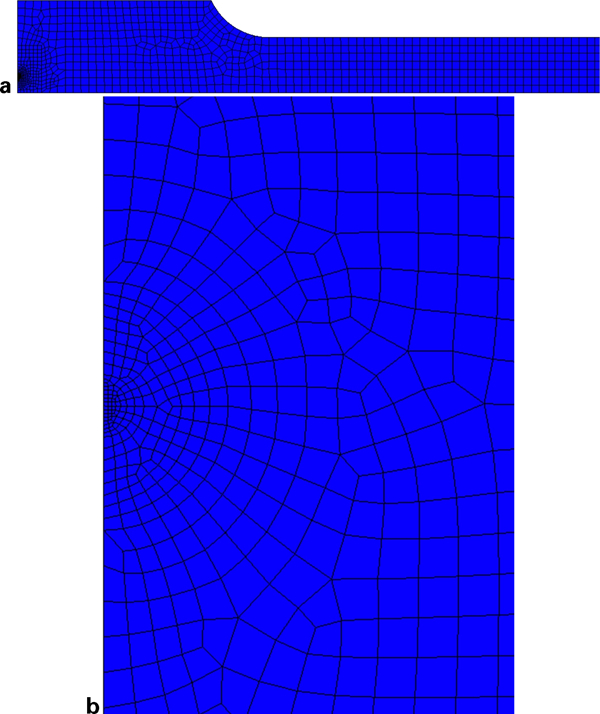
Finite element model of one-fourth centre cracked butt joint with certain reinforcement
Figure 3 shows the influence of shape parameters on coefficient f. In Fig. 3a, w in relation to t is 2, the ratio of h and t ranges from 0 to 0·524 and r ranges from 2 to 11 mm. In Fig. 3b, w in relation to t is 4·519, the ratio of h and t ranges from 0 to 1·096 and r ranges from 4 to 30 mm. All the coefficients f are obtained by equation (11). It can be seen that f increases with the increase in h and r, while f decreases with the increase in w.
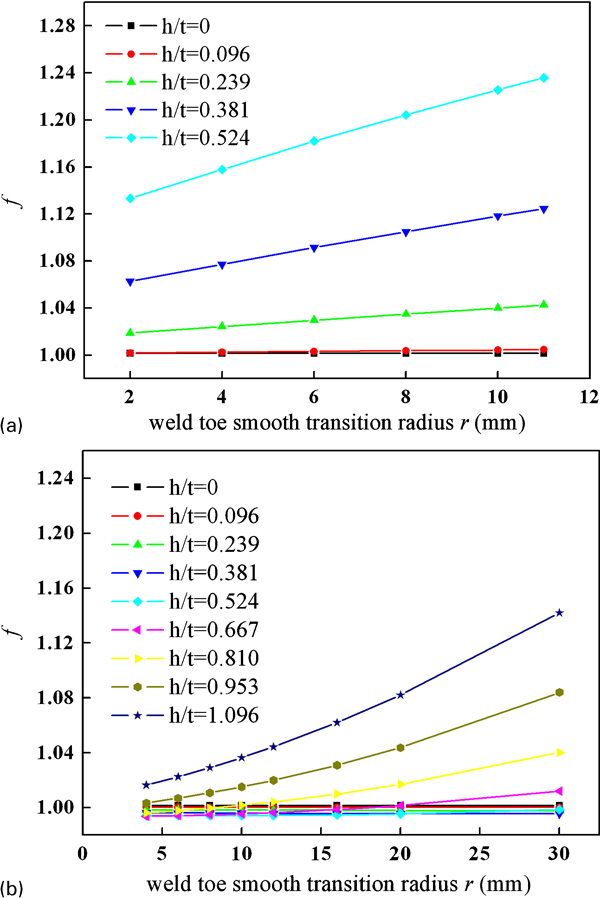
Influence of joint shape parameters on coefficient f
The coefficient function f(w,h,r,t) is finally determined by regression analysis of all the coefficients f achieved above and the corresponding shape parameters
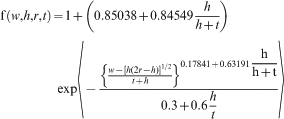
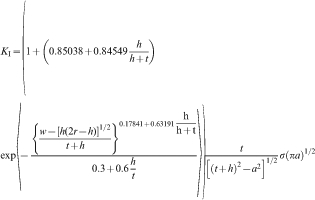
Discussion
The SIF results of centre cracked butt joints with two different w/t values, i.e. 2 and 5, are shown in Fig. 4. Here, σ is 100 MPa, a is 2 mm and t is 8 mm. r ranges from 4 to 14 mm, and h/t ranges from 0 to 1. It can be seen that the SIF results vary with different joint shape parameters. The influences of each joint shape parameter on SIF are different. KI decreases significantly with the increase in h and w. KI increases slightly with the increase in r, especially when w is large. KI will be stable as h is fixed, and w is large enough. When h or w is increased, the average stress of the crack section decreases due to the increase of the crack section capacity area, and then KI decreases. As far as the centre crack is concerned, the weld toe is far away from the crack. r has little influence on changing the stress state of the crack tip. Therefore, the influence of r on KI can be ignored especially when w is large enough. In Fig. 4, ‘h/t = 0’ represents the traditional result of KI, where the reinforcement is not considered. The results in Fig. 4 show that KI differs greatly considering the reinforcement, and the value of KI calculated by considering the joint shape parameters is smaller than the one calculated by the traditional way. Thus, it is necessary to give a SIF solution for centre cracked butt joint considering the influence of joint shape parameters.
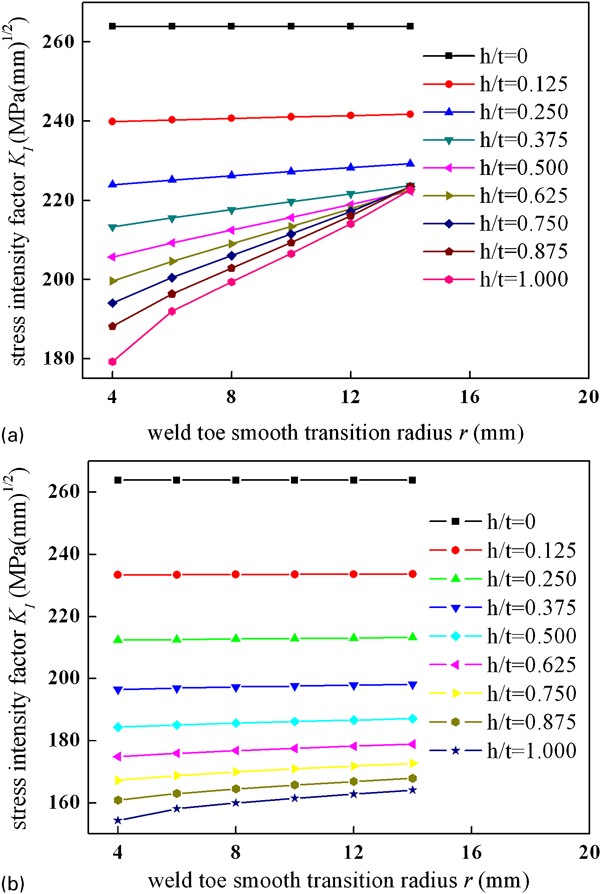
Influence of joint shape parameters on SIF KI
In fact, welded joints always endure static loads or fatigue loads. When joints stand static load, the critical crack length and critical stress are ought to be known. Based on equation (13), the critical crack length ac and the critical stress σc of centre cracked butt joint with certain reinforcement can be obtained as follows

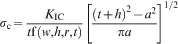

With knowledge of the above, if any one of equations (13)–(16) can be testified to be accurate, the other equations given in this paper will be accurate. As we know, the critical stress σc can be tested by tensile test easily. Two different undermatched butt joints shown in Fig. 5 are chosen to testify the accuracy of critical stress σc in equation (15). The yield strengths of the filler and base metals are 403 and 629 MPa respectively. The chemical composition of the undermatched joint metal is shown in Table 1. All undermatched butt joints apply X groove and manual arc welding. The base metal thickness is 10 mm, and the centre crack length is precracked to 5·6 mm after wire electrode cutting. The experiment temperature is 20°C. The tensile rate is 2 mm min−1. The fracture toughness KIC of the filler metal E5015 is 1295 MPa mm1/2. The joint shape parameters and comparison results are illustrated in Table 2. It can be seen that the results of critical stress calculated by equation (15) and obtained by experiments show little difference. Hence, the solution of SIF for mode I centre crack in butt joint with certain reinforcement can be used to efficiently guide the shape design of the butt joint.
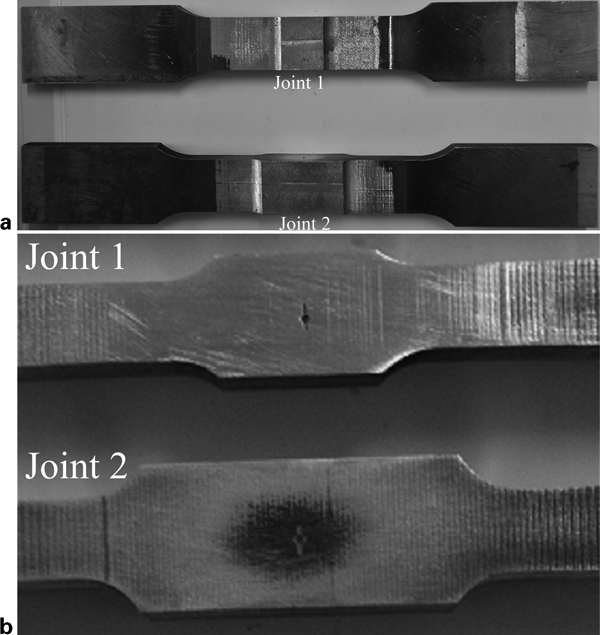
Two different undermatched butt joints with centre crack
Chemical compositions of undermatched joint metal

Comparison of critical stress obtained by experiments and equation (15) given in this paper

Conclusions
Height of reinforcement plays the most important role in the SIF of centre cracked butt joint with certain reinforcement. The SIF decreases significantly with the increase in height in reinforcement especially when weld width is large enough. Weld width has relatively great effect on the SIF of centre cracked butt joint with certain reinforcement. The SIF decreases with the increase in weld width. The SIF will be stable when the height in reinforcement is fixed and the weld width is large enough. The weld toe smooth transition radius has little effect on SIF of centre cracked butt joint with certain reinforcement. The influence of weld toe smooth transition radius can be ignored when weld width and height in reinforcement are both large enough. It would be useful for improving the load carrying capacity of undermatched butt joint with centre crack to choose large enough height in reinforcement and weld width and also an appropriate weld toe smooth transition radius. The solutions of SIF, critical crack length, critical stress and fatigue remaining life for mode I centre crack in undermatched butt joint with certain reinforcement are obtained to guide its shape design under static and fatigue load conditions accurately.
Footnotes
Acknowledgements
Project no. 2007DFR70070 supported by Sino-Russian Inter-governmental Cooperation Projects is acknowledged.