







Abstract
A three-dimensional distributed heat source model is developed to represent an electron beam as a heat source, which is novel to micro electron beam welding. The power distribution across the cross-section of the beam is represented by a Gaussian function. Along the penetration depth in the solid, the energy decay of the electrons is modelled according to the electron penetration theory proposed by Kanaya and Okayama. Further, this study presents for the first time a theoretical approach to calculate the heating efficiency of an electron beam as a function of the atomic number of the target material only.
Introduction
Micro electron beam welding (μEBW) is a relatively new welding technology that uses heating from an electron beam to weld micrometre scale sections. Accurate representation of the beam profile is central to the understanding and improvement of the process. This work, for the first time, formulates a theoretical model to represent the volumetric heat distribution of an electron beam based on the electron penetration theory of Kanaya and Okayama.1
Because the electrons penetrate the free surface of the material for a depth of a few micrometres, there is a radical difference between micro- and macroelectron beam welding. In μEBW, electron penetration and weld penetration are comparable,2, 3 so the incident beam is best approximated as a volumetric heat source. On the other hand, the effect of electron penetration is insignificant in conduction dominated macrowelding due to the large size of the weld compared to the beam penetration. Three-dimensional volumetric heat source models are often used to represent keyhole mode macrowelding, where the heat penetration occurs as a result of high intensity heat source. There are significant conceptual differences between the volumetric sources used for modelling the keyhole and the focus of this paper. The three-dimensional electron beam heat source models used for macroscale in the past are either empirical or semiempirical. Goldak et al. 4 first developed a three-dimensional double ellipsoidal heat source model that was widely used in the analysis of conduction mode electron beam welding.5– 7 Later, the conical heat source model developed by Wu et al. 8 became popular in modelling deep penetration electron beam welds. However, such models are not explicitly defined and depend on the feedback data from ad hoc experiments in the form of size and position of the ellipsoids and/or cones.
The heat source models used in studying μEBW until now are still in their early stages. Hwang and Na9 modelled the energy input from the beam as heat generation in a specific volume of square cross-section inside the solid. Similarly, Knorovsky et al. 10 considered heat generation in a cylindrical region of given radius and height inside a material within which the beam power is equally distributed. Both studies did not account for the variation in electron energy across the cross-section of the beam or along its penetration. Recently, Gajapathi et al. 3 used an electron beam heat source model that considers the exponential decay of electron energy along the depth of the material. The previous models do not account for a very important factor of electron beams: the maximum rate of energy deposition occurs below the free surface.
The behaviours of electrons–solid interactions are best predicted using Monte Carlo simulations.11 The variation in absorbed electron energy along the depth, as obtained from the simulations, can be used to model the trend of electron energy decay using a polynomial best fit. Such an approach has been applied in several studies;12, 13 however, using the technique requires to run new simulations each time the material properties and/or the configuration of the beam are changed. An analytical formula describing the electron decay trend, proposed by Schiller et al., 14 is reported to compare reasonably well with the Monte Carlo results for specific cases.12 The formula has been widely applied in the heat source modelling of electron beam.15, 16 However, this analytical model is very simplistic in nature and does not account for the influence of material atomic number Z or atomic mass A on the electron–solid interactions. None of the approaches discussed provides a general analytical expression indicating the influence of beam voltage V, density ρ, atomic mass and atomic number of the material on the trend of electron energy decay.
In the present work, the Kanaya and Okayama electron penetration theory1 is used to represent the electron energy deposition along the depth of the solid. The Kanaya–Okayama model is preferred over the previously discussed models because it accounts for the predominant physics of electron–solid interactions. Moreover, it provides a closed form expression that is reported to have good agreement with the experimental results.1 The heat source model is further used to relate the heating efficiency of the electron beam to the material atomic number.
Mechanism of electron beam heating
In an electron beam column, an electrostatic field accelerates the electrons to collide with the target material and transfer their kinetic energy. Not all of the incoming energy is converted into heat in the material during the interactions. The loss of incident beam energy is due to backscattered electrons, secondary electrons, X-ray generation and electromagnetic radiation, as shown in Fig. 1. All the aforesaid processes can be explained by considering the two major classifications of electronic collisions with the substrate:14, 17
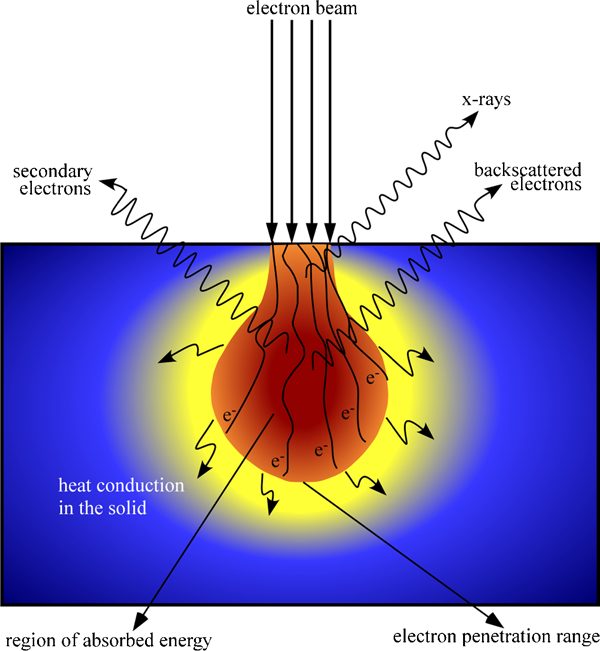
Electron beam interactions with solid
nuclear collisions (elastic scattering) are the collision of the incoming electrons with the atomic nuclei of the substrate. The electrons are scattered through a large range of angles and have almost the same energy as a result of momentum transfer. A deflection angle of 90° or more due to single or multiple nuclear collisions can cause the incoming electrons to completely reverse their path out of the body and become ‘backscattered electrons’
electronic collisions (inelastic scattering) are collisions that result in the energy transfer of the incoming electrons with a comparatively smaller deflection. Inelastic scattering of the electrons inside the material occurs by several mechanisms out of which only those significant in metal type solids are highlighted:
plasmon excitation occurring due to free electron gas. Typically transfers 15 eV (0·1% of a 15 kV beam) to the solid17
emission of thermionic electrons owing to the temperature rise in the material is typically <1 eV (∼0·007% of a 15 kV beam), depending on the beam current and material properties14
excitation of the conduction band releases secondary electrons that usually carry <50 eV (∼0·3% of a 15 kV beam) kinetic energies out of the surface17
X-rays produced consist of two components: characteristic radiation as an inner shell electron is replaced by an incoming electron, and Bremsstrahlung resulting from the deceleration of the primary electron in the columbic field of an atomic nucleus. X-ray radiation depends on the incident energy and atomic number of the material and is in the order of 1% or less.
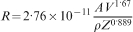
The amount of energy attributed to each of the physical processes depicted in Fig. 1 depends on both the material properties and the electron beam acceleration voltage. Typically, the energy loss occurring due to secondary electrons, X-ray generation and electromagnetic radiation is <0·5% of the incoming energy; in contrast, backscattered electrons can have a high share of the incident energy (up to 40%).14 The remaining electron energy is transferred into the substrate, gradually being absorbed along the depth. The fraction of electrons that do not shed all their energy within a given thickness of material and emerge out are called ‘transmitted electrons’. Because electron transmission happens in samples much thinner than those of interest for μEBW, they are not an issue in this study. The maximum depth until which the electrons penetrate can be defined as the electron penetration range R, which depends on both the beam voltage and the material properties. In the voltage range of 10–1000 keV, it can be expressed as1
Heat source modelling
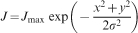
The modelling of the electron beam as a volumetric heat source requires describing the power distribution on the surface and energy decay along the penetration. While a circular Gaussian function is widely accepted to represent the variation in energy over the cross-section of the beam, the thermal interactions of the electrons along the depth of the material are more complicated. One can represent the electron beam heating with the volumetric heat generation term q as
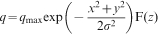
The beam diameter is considered constant for a given beam configuration, and the widening of the beam due to electron scattering is not taken into account. Such an approximation is valid when the beam diameter is many times larger than the depth of electron penetration. It is established by the Kanaya–Okayama modified diffusion model1 that the radius of electron scattering is less than or equal in magnitude to the electron penetration depth. As the overall diameter of the beam is chosen increasingly larger than the electron penetration depth, the radius of electron scattering at the beam periphery reduces to a small fraction of the beam diameter and hence can be ignored. The beam diameter is chosen at least two times the electron penetration depth in this study so that the effects of beam scattering are not significant.
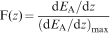
The function F(z) captures the distribution of energy along the depth of the material, and it is the key concept of this paper. This function can be derived by taking into account the physics of electron–solid interactions described in the previous section. It represents the trend of only the absorbed energy along the depth of the solid. An energy balance of the system helps to determine the total amount of energy absorbed within a given material depth by subtracting the transmitted fraction (electrons travelling beyond the depth considered but captured by material at greater depths) and backscattered fraction of the electrons from the incident energy. The effects of secondary electron, X-rays and electromagnetic radiations are ignored due to their negligible influence in the energy balance. Kanaya and Okayama obtained a theoretical expression for the fraction of absorbed energy as a function of depth, which can be written as1
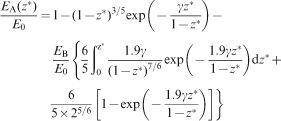
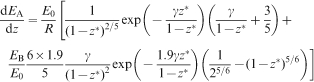
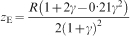
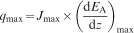
The differentiation of the absorbed energy in equation (3) with respect to depth provides the trend of its variation along the depth of the solid. The absorbed energy per unit depth, also known as the stopping power, signifies the rate at which the electron transfers its energy to the material and can be written as1



Heating efficiency of electron beam
The incoming energy of the electrons is not entirely absorbed in the solid. The heating capability of the electron beam is characterised by a heating efficiency factor η, which can be defined as the relative amount of power absorbed in the material. For a flat free surface, the absorbed beam power can be obtained by the volume integration of the heat source term in equation (11), which can be used to describe η as follows


The two unknowns that are required to determine the heating efficiency values, as shown in equation (4), are γ and EB/E0. The constant γ is a function of atomic number of the material only and can be evaluated using the following expression1


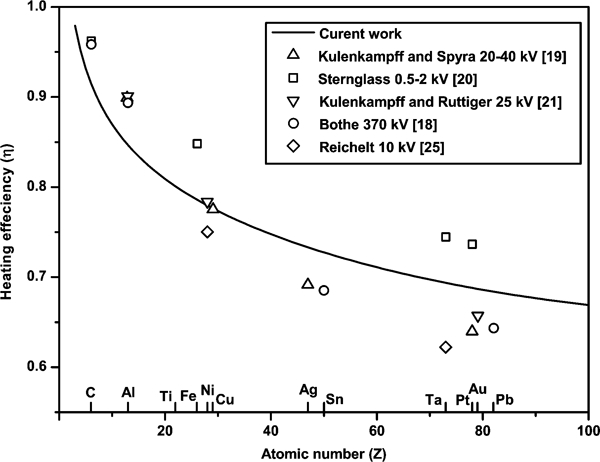
Heating efficiency of normally incident electron beam as function of atomic number of irradiated material. Continuous line represents current calculations showing heating efficiency independent of input beam voltage. Curve shows good agreement with experimental data points at different beam voltages and is valid in range of 10–1000 keV, where Kanaya–Okayama electron penetration theory is valid. Data points in plot corresponding to experiments by *Sternglass20 do not fall into 10–1000 keV beam voltage range but included only for comparison purpose
There are very few published values of electron beam heating efficiency tabulated as a function of incident energy. However, the available data on backscattering phenomenon can be used to estimate the heating efficiency of the process by rewriting the expression in equation (2) as η = 1−(IB EB/IE0), where IB/I is the relative backscattering current. Such a consideration is valid when the power loss due to processes other than backscattering is negligible.
For a normally incident beam, the relative backscattering current, also known as the backscattering coefficient, does not depend on the incident energy of the beam but varies with the properties of the target material.23,
24 Archard23 proposed the backscattering coefficient as a function of material atomic number only based on the composite theory of diffusion (valid for high atomic numbers) and elastic collisions (valid for low atomic numbers). A fourth order polynomial is used to best fit the relationship curve between the backscattering coefficient and the material atomic number,23 which can be written as

To calculate the relative backscattering power loss and hence the heating efficiency, the relative backscattered current needs to be multiplied by the mean relative backscattered energy. The mean relative backscattered energy values have been obtained from the literature18– 22 for different combinations of target material and incident energy. For a given material, the product of the backscattered coefficient and the mean values of relative backscattered energy provides the relative backscattering power loss. Direct experimental measurements of the backscattering power loss have also been reported by Reichelt25 for nickel and tantalum at 10 keV incident energy. The heating efficiency is then calculated by subtracting the relative backscattering power loss from the whole. The experimental results of heating efficiency for specific materials are compared against the current findings in Fig. 2. The present calculation of the electron beam heating efficiency matches the experimental findings within the margin of ±10% (see Fig. 2) for a wide range of incident energies and materials.
Effect of voltage on heating efficiency
In this study, the heating efficiency is expressed as a function of material atomic number only. It would be reasonable to expect the acceleration voltage to also play a role. The validity of the approximations made in the current study is discussed in this section by comparing the present calculation with the experimental values.
Figure 3 illustrates the experimental results of mean backscattered energy normalised by the approximate values obtained using equation (15). The horizontal axis represents the incident energy of the beam. It is observed that there is no clear dependence of the mean backscattered energy on the incident energy of the beam in the range of 10–1000 keV; however, the mean backscattered energy seems to increase with the increase in incident energy at low accelerating voltages (<10 keV). Moreover, the differences in experimental conditions contribute largely to the mean backscattered energy measurements.26 For example, there is a considerable amount of difference in the relative mean backscattered energy values reported separately by Kulenkampff and Spyra19 and Niedrig22 for copper (Z = 29) in the incident energy range of 20–40 keV, as seen in Fig. 3.
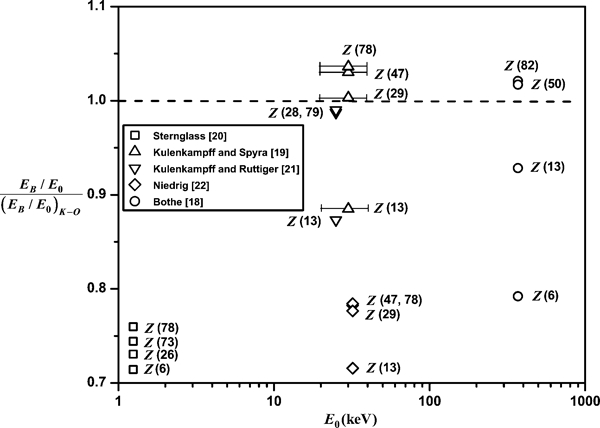
Ratio of experimental relative mean backscattered energy to values given by equation (15) is plotted against beam incident energy for several material atomic numbers: there is no clear pattern observed of backscattered energy variation with beam incident energy
The dependence of backscattered energy on incident energy is rather complex. The experimental conditions have seemingly larger impact on the backscattered energy measurements as compared to the incident energy by itself. In such a situation, the heating efficiency values proposed in this study as a function of material atomic number only provide an approximate estimation for many practical applications.
Discussion
The mathematical model of electron–condensed matter interactions in the range of 10–1000 keV incident energy used in this study accounts only for the predominant physics of backscattering, absorption and transmission of electrons.1 The other processes occurring simultaneously such as emission of secondary electron and X-rays were considered secondary.
The description of electron heating efficiency as a function of atomic number only is a consequence of describing the incident energy dependence of heating efficiency as a function of atomic number. The determination of dependance of efficiency on the incoming energy would require to assemble a large amount of experimental data of mean backscattered energy for different incident energy beams and target materials; the collected data can then be arranged in a plot of relative mean backscattered energy against the incident energy of the beam similar to Fig. 3. Advanced statistical methods should be used to best fit the closest relative mean backscattered energy based on the incident energy of the beam and atomic number of the material.
The current model considers an electron beam perpendicular to the surface and would not be as accurate in keyhole penetration mode, where efficiency is expected to be higher. The model proposed here, as it is based on the Kanaya–Okayama approach, does not take into account the effect of alloying and microstructure of the substrate. It is reasonable to expect, however, that the use of average values for the volume of interaction of the electrons will still produce closer estimations.
Conclusions
In this work, a volumetric heat source model has been developed theoretically to represent electron beam heating. The energy decay trend during electron beam penetration and the fact that the maximum of the incoming electron energy is deposited underneath the surface have been accounted using the electron penetration theory proposed by Kanaya and Okayama. Such a heat source model is valid for studying electron beam welding in conduction mode when the scale of the target material is comparable to the beam penetration.
Using the model developed, a theoretical approach has been proposed, for the first time, to calculate the heating efficiency of an electron beam normally incident on a solid or liquid metal. The heating efficiency values obtained depend only on material atomic number and provide an average estimate for a wide range of beam incident energies.
Footnotes
Acknowledgements
This work was partially supported by the Natural Sciences and Engineering Research Council of Canada (NSERC).