







Abstract
A Fe/Cr doped SiO2 thin film which can improve the anticorrosion characteristic of materials was prepared on SUS304 stainless steel substrates by a modified hydrothermal method that constitutes a two part preparation process. The corrosion of stainless steel and the dissolution of silica from Na–Ca glass are simultaneously stimulated by an aqueous lithium bromide solution, and then a Fe/Cr doped SiO2 thin film is coated onto the substrate. The Fe/Cr doped SiO2 film was characterised by scanning electron microscopy, X-ray diffraction, X-ray photoelectron spectroscopy and electron probe X-ray microanalyser. The results showed that the corrosion products and the silica are combined to form a Fe/Cr doped SiO2 thin film. Furthermore, a chemical bond is formed between the silicon coating and the metal that improves the compactness and the adhesive property of the film. The anticorrosion characteristics of the film were measured by the methods of weight loss and electrochemical potentiodynamic polarisation, indicating that the Fe/Cr doped SiO2 thin film can improve the anticorrosion performance of stainless steels effectively.
Introduction
Austenitic and duplex stainless steels have been commonly used as structural components in industrial equipment. The higher corrosion resistance of stainless steels is usually attributed to the self-passivation or the formation of a mixed iron and chromium oxides on metal surface with semiconducting behaviour1 in gaseous2,3 or oxidative environment.4,5 Despite of their higher corrosion resistance to aggressive media, the pitting corrosion on metallic substrate can occur in halide environments. Thus, an inorganic film with good thermal stability such as TiO2 (Ref. 6), Al2O3 (Ref. 7), ZrO2–CeO2 (Ref. 8) and amorphous silica films9–11 even carbon film12 on stainless steels has been prepared to retard the corrosion at high temperature. Especially, silica9–18 has been widely used to improve the corrosion resistance of substrates due to its low toxicity, high adhesion and good anticorrosion performance. These inorganic films have been prepared by many different techniques, such as atomic deposition,6 sol–gel,8 chemical vapour deposition,12 liquid phase deposition13–15 and sputtering. For the alloy properties of stainless steel, a low cost electrochemical method has been used to prepare anticorrosion films on pretreated metal layers such as Zn,16,17 Cu18 and Cr.19
In this paper, a modified hydrothermal method using network forming SiO2 to link metal oxide generated from corrosion was proposed resulting in Fe/Cr doped silicon dioxide films as a corrosion barrier prepared on SUS304 stainless steels.
Experiments
Preparation of Fe/Cr doped SiO2 film
The composition of SUS304 austenitic stainless steel used in the experiment was: Fe–18·07Cr–8·05Ni–1·23Mn–0·41Si (wt-%). Standard corrosion specimens with a diameter of 40×1·0 mm and smaller specimens with a diameter of 10×1·0 mm were finely polished (1200 SiC grit) and then ultrasonically cleaned with deionised water and acetone. They were then placed in a Na–Ca glass vessel filled with aqueous lithium bromide solution having pH = 9·5 at 20°C. This had a concentration of 45 to 60 wt-% and did not contain any corrosion inhibitors; it was purchased from Sanyo Refrigeration Co. Ltd (Dalian, China) as the corrosion medium. The glass vessel was put into an air free autoclave with effective volume of 150 mL. The dissolved gas in the autoclave was sucked by a vacuum pump to an absolute pressure of 1·3 kPa, and finally the autoclave was placed in an oven for 190 h at a temperature in the range of 150 to 200°C. In this modified hydrothermal method, the glass vessel served as the silica source; thus, silica dissolves from the glass into the solution at higher temperatures.20
Mechanism of film preparation
Using lithium bromide as the corrosive solution results in two simultaneous reactions occurring under the autoclave conditions. One is the corrosion of stainless steel induced by halide ions while the other is the dissolution of silica from the glass into the solution in the form of silica acid. The concentration, pH and temperature of lithium bromide solution were three main factors affecting the film properties.
When the stainless steel substrate is immersed into lithium bromide solution, anions will tend to adsorb onto the metal surface leading to local passive film breakdown and dissolution, with metal ions and their hydrolysis products being evident. Simultaneously, as the glass dissolution reaction is concerned, silica is dissolved from the glass is the silicate anion. This hydroxylated silica species has a high surface affinity for ferrous ion thus forming an iron–oxygen–silicon (silane) linkage.21
At the same time, the anion species are also adsorbed on the substrate serving as sites that permit direct linkage or reaction with the solution phase silica species. The linkage reaction occurs readily and a full network structure is formed at temperatures >150°C. This chemical bonding of Si–O–Fe could significantly improve the film's adhesion to the substrate and its anticorrosion performance, accordingly. Thus, this is a combined process of corrosion and film network formation during the coating preparation.
Characterisation of Fe/Cr doped SiO2 film
Static immersion corrosion testing of specimens with and without films was carried out in LiBr solution at higher temperatures. Samples were washed with 3M HCl solution, then rinsed with deionised water and acetone in order to remove the corrosion products. Samples were weighed with FA2004N balance with an accuracy of 0·1 mg before and after the corrosion tests, and then the corrosion rate was determined by equation (1) according to ASTM standard G1-81

Meanwhile the anticorrosion performance of coatings was characterised by potentiodynamic polarisation in nitrogen deaerated 55% by weight LiBr solution at room temperature. A potentiostat with a standard three-electrode cell was applied to measure the potentiodynamic anodic polarisation curve. A high purity Pt electrode was chosen as the auxiliary electrode, while a saturated calomel reference electrode was used as the reference electrode. A 304 stainless steel sample was selected as the working electrode with surface area of 1 cm2 exposed to the electrolyte. The testing was carried out with a scanning rate of 20 mV min−1 after the potential of working electrolyte maintained stabile at open circuit about 30 min.
Scanning electron microscopy (SEM) was employed to test the film morphology. The film composition was analysed by X-ray diffraction (XRD) and X-ray photoelectron spectroscopy (XPS) using a Physical Electronics Model 5601 micro-focus electron spectroscopy for chemical analysis system. The spectrometer employed a monochromated aluminium X-ray source (E = 1486·6 eV). The thickness and quantitative component were measured by electron probe X-ray microanalyser (EPMA).
Result and discussion
Characterisations
Figure 1 shows the SEM images of the film prepared in lithium bromide solution with a weight fraction of 60% and pH of 9·5 at 170°C. As the experimental temperature increases, the corrosion rate is accelerated and also more silica is dissolved into the solution, resulting in an increase in film thickness: 3, 5 and 9 μm at 170, 190 and 200°C respectively.
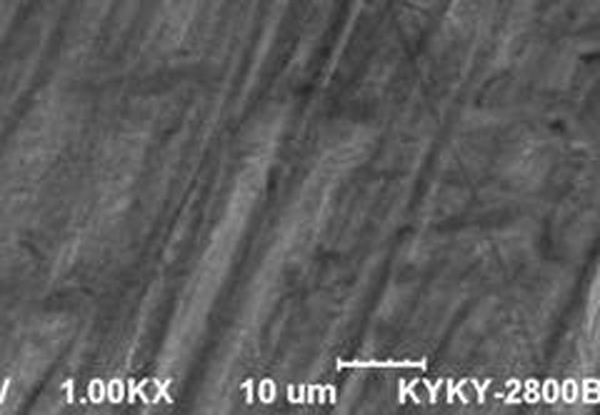
Image (SEM) of Fe/Cr doped SiO2 thin film, ×1000
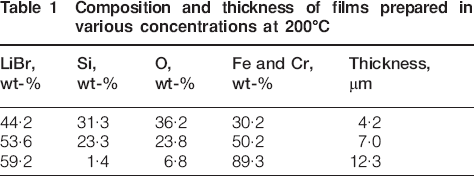
Corrosion of the substrate is mainly affected by the concentration and temperature of solution, while dissolution of silica is mainly affected by temperature. With the concentration or temperature of solution increasing, more Br− is adsorbed onto the substrate and stimulates the corrosion reaction. Thus, the concentration of dissolved iron and chromium increases. Table 1 shows the composition and thickness of films prepared with different concentrations at 200°C. It can be found that the contents of Fe and Cr element in the film and film thickness measured by EPMA increase with the solution concentration. Figure 2 shows the element area profiles of the film cross-section prepared in 45 wt-% lithium bromide solution at 200°C. On the right hand side of each micrograph is the substrate area and on left side is the film. According to the micrograph, the thickness of the film is about 5 μm, and a compact layer comprising Si and O is shown near the substrate where the average contents of Si and O are 31 and 35% respectively. The similar distribution of Si and O in the film illustrates the mixing of Si and O. At the same time, it should be noted that the Fe and Cr elements in film are confirmed by XPS. However, due to limitations in image resolution, they are not observed in the respective element area profile.
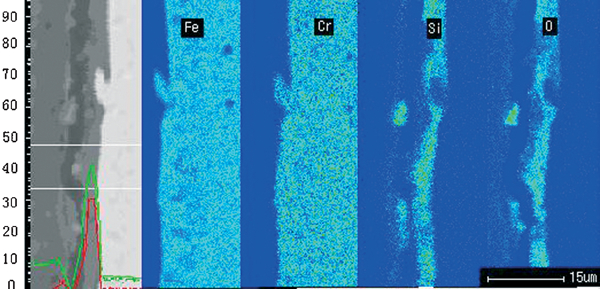
Image (EPMA) of cross-section of Fe/Cr doped SiO2 film prepared in 45% LiBr solution at 200°C
Composition and thickness of films prepared in various concentrations at 200°C
X-ray diffraction was used to investigate the phase structures of films. Figure 3 shows the XRD patterns of blank SUS304 stainless steels and coated with Fe/Cr doped SiO2 film. Some diffraction peaks corresponding to metal oxides of Fe2O3, Cr2O3 and Fe3O4 are present and these are what are expected for corrosion products of austenitic stainless steels. The coated sample also shows peaks of the substrate materials, which is attributed to the XRD detection depth which is greater than the few micrometres of the film coating. Meanwhile, one peak with a weak diffraction and broad width is observed at 2θ = 20° on the line of film. This is consistent with amorphous SiO2 and provides evidence that Na–Ca glass or silica dissolved into solution and had transformed into (SiO2)x in the film simultaneously with the corrosion process. Thus, during the film formation process, there were two subprocesses occurring simultaneously: the corrosion process generating metal oxides and the deposition process constructing the network silica based film.
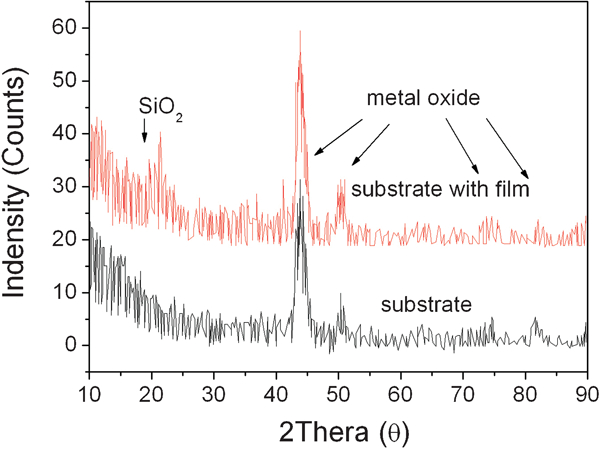
X-ray diffraction patterns of SUS304 stainless steel and Fe/Cr doped SiO2 film
X-ray photoelectron spectroscopy was applied to further confirm the chemical states of the elements, as shown in Fig. 4. From Fig. 4a, it can be found that the film on stainless steels contains not only Fe, Cr, Si and O, but also C, Br and Li. The XPS peak for C1s is observed at a binding energy (BE) = 293·4 eV while C1s at BE = 285·0 eV. The adventitious hydrocarbon is caused from the XPS instrument itself, and hence regarded as an innerstandard and the shift in binding energy due to specimen charging can therefore be calculated (as 8·4 eV). The XPS peaks for Br and Li are from the residual elements in the precursor solution. The binding energies of Si, Fe and Cr are normalised by the innerstandard. Figure 4b–d shows XPS survey spectra of the normalised Fe2p, Cr2p and Si2p plots respectively. Peak at 711 eV in Fe (2p1/2) spectrum, Fig. 5b illustrates the oxidation states of Fe2+ (709·6 eV) and Fe3+ (711 eV) based on the fitting curve analysis. Obvious satellite peaks of Fe2+, Fe3+ confirm the formation of Fe2O3 and Fe3O4.22–25 In the same way as Fig. 4c, Cr exists in the form of Cr3+, Cr6+ and Cr–OH oxidation states.26,27 The existence of metal oxide confirms the corrosion process as mentioned above. At the same time, the peak of SiO2 at BE = 103 eV, Fig. 4d confirms the existence of a silica network. It is worthy to notice that the peak corresponding to Si–Fe at BE = 98·5 eV is observed in Si spectrum, as shown in Fig. 4d. The decrease in the Si bond energy due to the addition of metal ions is in good agreement with the results of Johnson,28 Schneeweiss29 and Hondaa.30 Therefore, it can be concluded that the silica network formation and the metal oxide were not simply mixed together but were, in fact, bound, thus improving the anticorrosion performance of the film.
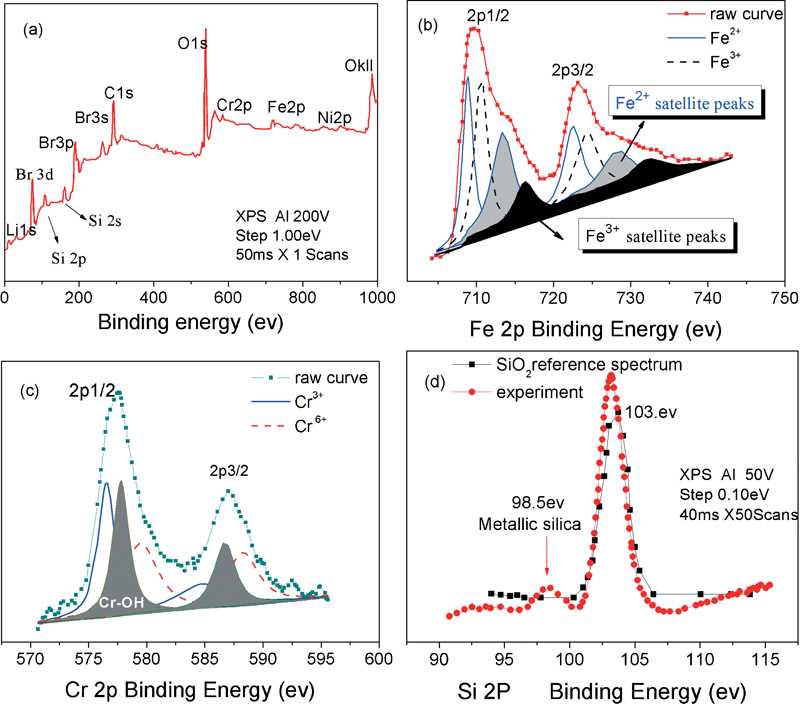
X-ray photoelectron spectroscopy survey spectra for Fe/Cr doped SiO2 films
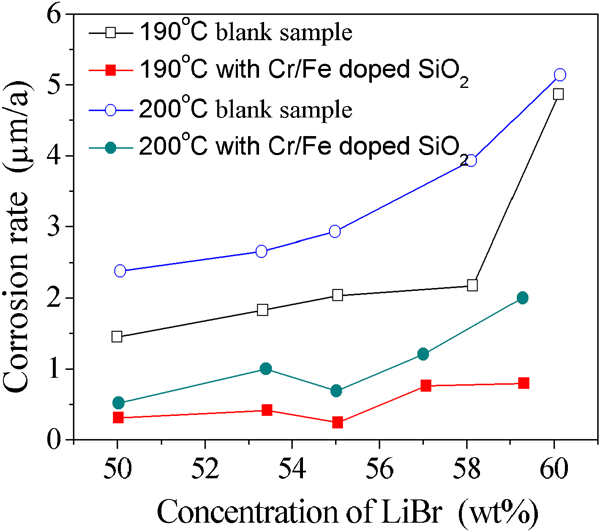
Corrosion rate of blank stainless steel (SUS304) and sample with Fe/Cr doped SiO2 film in 55% LiBr at 190 and 200°C
Anticorrosion characteristic
Static immersion corrosion experiments and electrochemical methods were applied to examine the anticorrosion performance of the functional film. The static immersion corrosion experiment was operated at different concentrations of lithium bromide solution at 190 and 200°C. The average corrosion rates of blank SUS304 stainless steels and samples with film are plotted in Fig. 5. In general, higher temperature or higher concentration leads to a higher corrosion rate. The comparative results show that the corrosion rate of blank SUS304 stainless steels at 200°C is twice as much as that of 190°C, while the film decreases the corrosion rate to 20-25% of blank stainless steel at 190°C and 30% at 200°C, indicating the obvious anticorrosion performance of the film.
A standard three-electrode cell was utilised for the electrochemical experiments to determine the anticorrosion characteristics of the films. In general, the austenitic stainless steel has higher resistance to some corrosive media. Shahryari et al.1,31,32 improved the anticorrosion performance of stainless steel by electrochemical modification of the passive film with semiconducting behaviour and suggested that metal oxide films produced in corrosion process have a positive effect on the anticorrosion performance. Figure 6 shows the comparison of the potentiodynamic polarisation curves of a blank 304 stainless steel sample, a sample with corrosion product on the surface and a sample with the Fe/Cr doped SiO2 film. The open circuit potentials of all the samples are about −30 mV. The current density of SUS304 increases rapidly from 10−4 to 1 mA cm−2 on anodic polarisation as the potential increases slightly from −30 to 50 mV. In contrast, the current density of the coated sample film increases more slowly in the same potential range, in which an active corrosion process is occurring. Passivation occurs at a current density of 0·02 mA cm−2 during the potentiodynamic polarisation process for the Fe doped SiO2 coated sample, as illustrated in Fig. 6; also the current in the active dissolution region is reduced. All the analyses above have confirmed that the Fe doped SiO2 thin film improves the anticorrosion performance of stainless steel 304 significantly.
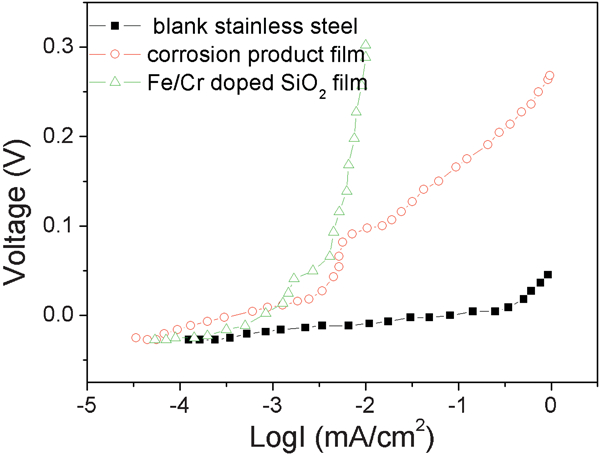
Potentiodynamic polarisation curves of 304 stainless steel with corrosion product film, Fe/Cr doped Si film and blank substrate
Conclusions
A Fe/Cr doped SiO2 thin film was prepared on SUS304 stainless steels by the modified hydrothermal method. In the preparation process, LiBr solution was chosen as the corrosion medium which stimulated the corrosion of stainless steel, and resulted in the presence of available metal ions in solution. At high temperature, Si dissolved into the LiBr solution from the glass and produced a silicon network formation, Furthermore, metal ions and the silicon network formed a new metal–oxygen–silicon (silane) bond, which has a positive effect on the adhesive and anticorrosion performance.
The static corrosion tests at 190 and 200°C indicate that the corrosion rate of Fe/Cr doped SiO2 coated samples is only 20-30% of that of blank stainless steel surface. The potentiodynamic polarisation curve shows that the composite film has promoted passivation and reduced the current in the active dissolution region significantly.
Footnotes
Acknowledgements
The authors are grateful for financial support by the National High Technology Research and Development Programme of China (863 Programme, 2007AA05Z214), National Natural Science Foundation of China (Grant No. 50476072), and the Fund of New Century Excellent Talents in University of State Ministry Education of China (NCET-05-0280).