







Abstract
This paper summarises the results obtained for galvanised steel specimens exposed in Saudi Arabia region for four years at four pure marine and five mixed marine (SO2 polluted) sites. The atmospheres at these sites were characterised climatologically and in terms of their pollution level so that their corrosivity could be expressed in accordance with ISO standards. Chemical characterisation of the galvanised steel corrosion product layers was performed using X-ray diffraction. The main phases determined were zincite (ZnO), simonkolleite [Zn5(OH)8Cl2.H2O], smithsonite (ZnCO3), magnetite (Fe3O4), gordaite [NaZn4(SO4)Cl(OH)6Cl.6(H2O)], hematite (Fe2O3), zinkosite (ZnSO4), zinc chloride (ZnCl2), zinc hydroxide sulphate hydrate [(Zn(OH)2)3(ZnSO4)(H2O)3] and zinc sulphate hydroxide hydrate [ZnSO4(OH)2.5H2O] was found on the specimens. The results obeyed well with the empirical kinetics equation of the form C = Kt n, where K and C are the corrosion losses in mg cm−2 after 1 and ‘t’ years of the exposure respectively, and ‘n’ is constant. Based on ‘n’ values, the corrosion mechanism of galvanised steel is predicted. The results obtained show that the corrosion rate of galvanised steel is a function of both the chloride, SO2 pollution level and the humidity. Corrosion rate of galvanised steel specimens have been obtained by loss of weight after each year of exposure.
Introduction
Studies of the atmospheric corrosion behaviour of galvanised steel have been undertaken by many workers over several decades, using approaches that have varied according to their objectives and experience. Some have developed laboratory techniques to reproduce natural exposure conditions, while others have carried out long natural exposure tests, under more or less random conditions, from which some atmospheric corrosion mechanisms have been proposed.1–3 The general pictures of the atmospheric corrosion of galvanised steel have been summarised in several review articles.4–9
In view of the widespread use of galvanised steel in Saudi Arabia, it was considered desirable to study its corrosion behaviour in the wide variety of marine and marine industrial atmospheres. As already recognised, galvanised steel corrodes at different rates in different locations, and the main factors determining the corrosivity of a site are the humidity of the corroding surface and pollution level of the atmosphere.10 The resistance of galvanised steel to atmospheric corrosion is dependent on the nature of the galvanised steel corrosion product layers formed during natural exposure. The main component of these layers is usually basic zinc carbonate, but other basic salts may also be present.11
Other factors that can affect the atmospheric corrosion of galvanised steel include temperature, surface orientation and the existence of solid particulate matter in the atmosphere. Previous studies have noted that temperature plays only secondary role in the process.12,13 The orientation of galvanised steel surfaces in the open air has a marked influence on the duration of wetting by atmospheric moisture, and consequently on the corrosion rate.14
The purpose of the present study was to contribute to the knowledge base for the atmospheric corrosion of galvanised steel by summarising the experimental results obtained on galvanised steel specimens exposed for four years at nine exposure stations located in different parts of Saudi Arabia. The results obtained are analysed and discussed as a function of average temperature T, average relative humidity (RH) and environmental pollution levels. Furthermore, the atmospheres at these sites were characterised climatologically and in terms of their pollution levels and corrosion rate so that their corrosivity could be expressed in accordance with ISO 9223 standards. Statistical analysis has been carried out from these results and corrosion mechanism is predicted.
Experimental
Specimen preparation
Galvanised steel specimens with 99·63% (0·22%Mn, 0·1%S, 0·12%P, 0·04%C and 0·01%Si) purity were used in this experiment. Before exposure, the surface of the rectangular shape samples with a size of 100×150×2 mm with an identifying code was prepared by superficial polishing with 120 grade SiC paper, degreased ultrasonically in methanol for 5 min, dried and weighed with a precision of 0·0001 mg. Then four samples of each metal were exposed on open racks to the different atmospheres (marine and marine industrial). The exposure angle was 45° facing the south.
Test sites and collection programme
Detail concerning to test sites location, climatological and pollution characterisation of atmospheres have been described in Table 1. Location of these exposure stations are shown in Fig. 1. Nine test sites (marine and marine industrial) were formed by a metallic structure where the flat plates were set. In each of nine test sites, 24 galvanised steel plates were placed and collected according to the following programme: one, two, three and four years. Four plates were collected in each period; three of them were used to measure the corrosion rate by loss of weight and the other one was used to identify the nature of the corrosion products.
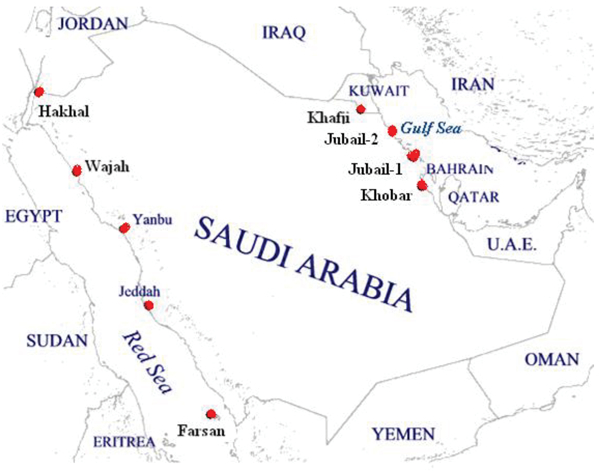
Location of atmospheric exposure stations in Saudi Arabia
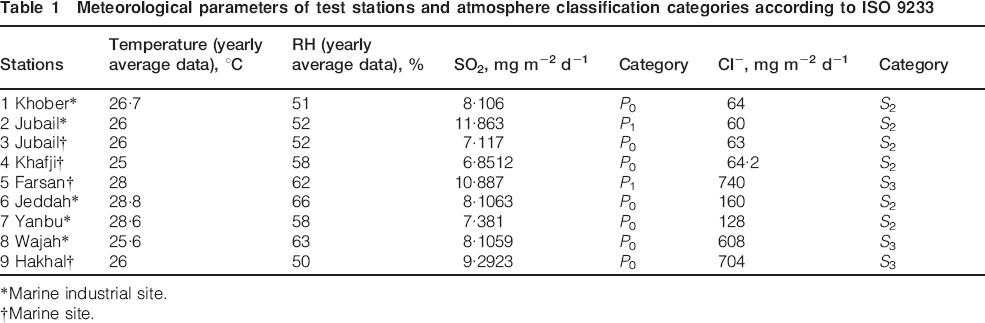
Meteorological parameters of test stations and atmosphere classification categories according to ISO 9233
*Marine industrial site.
†Marine site.
Weight loss determination
All samples were weighed before exposure to the test environments. To determine the weight loss after exposure, the samples were first rinsed in pure water for 2 min to remove water soluble corrosion products and then chemically eliminated using 100 g ammonium peroxodisulphate [(NH4)2S2O8]+distilled water to make 1000 mL (ISO 8407:1991).15 After the corrosion products had been completely removed, the specimens were rinsed again with distilled water, dried in air, and reweighed again using precision scales (Sartorius Genius Series). Although, the corrosive attack rate does not frequently follow a linear dependence with time.
Atmospheric pollutants
In atmospheric corrosion studies the determination of the concentration of pollutants dissolved in the air, mainly SO2 and Cl−, constitute a basic requirement. For the determination of SO2 pollutant ISO 9225 was followed.16 Sulphur dioxide from the atmosphere was absorbed on the alkaline surface of porous filter plates saturated by a solution of potassium carbonate. The amount of sulphates was determined by the titration of a water/ethanol sample solution with a barium perchlorate water/ethanol titrant in the presence of thorin indicator. Salinity was determined by following the ASTM G140-96 (also called the wet candle method).17 The amount of chloride captured by the candles was determined by silver nitrate titration.
Statistical analysis
To predict a mathematical kinetic relationship, the data for four years of exposure was used. The variation of weight loss C due to corrosion expressed as milligram mg with time t can be described by the general empirical equation in the form

Crystalline phase determination
The phase compositions of the corrosion products formed on the specimens were determined by XRD, using a BRUCKER AXS-D8 Advance, which is a fine structure X-ray tube with air insulation of the type FK 60-04; with a copper anode (Cu Kά 1 5406 Å), scintillation detector (0·027 nm<λ<0·05 nm) at a scan speed of 1·5° min−1. X-ray diffraction patterns were taken directly from the surfaces of the specimens for general identification of zincite between 10 and 120° 2θ. High resolution XRD patterns were also recorded in the angular range of 50-60° in order to identify smithsonite.
Results and discussion
Meteorological characteristics
The average temperature and average RH over the whole exposure period at nine test sites are presented in Table 1. The temperature was varying from location to location. All the atmospheric exposure stations have marine and marine industrial characteristics.
Chloride concentration
Chlorides are deposited mainly in the marine and marine industrial atmosphere as droplets or as crystals formed by evaporation of spray carried by the wind from the sea. In marine and marine-industrial environments chloride deposition usually decreases strongly with increasing distance from the shore, as the droplets and crystals settle by gravitation or may be filtered off when the wind passed through vegetation. The deposition rates in marine and marine-industrial areas are in the range between 15 and 1500 mg Cl− m−2 d−1.27 Table 1 shows the result of atmospheric chloride concentration analysis and the atmosphere classification analysis according to ISO 9223 standard,28 which establishes four categories for salinity pollution. According to the chloride deposition rate S expressed in mg m−2 d−1, atmospheres can be classified as S 0 (S⩽3), S 1 (3<S⩽60), S 2 (60<S⩽300) and S 3 (300<S⩽1500). As shown in Table 1, chloride concentration measured in the Province of Western Coast (Red Sea) is generally high. Frasan, Hakal and Wajah shows the highest salinity values: 740, 704 and 608 mg m−2 d−1 Cl− respectively, which belong to categories S 3 (the rest belong to S 2). These results show that atmospheric salinity depends on the wind pattern at each specific site.10,29–36
Sulphur dioxide concentration
The main part of anthropogenic SO2 pollution is caused by combustion of fossil fuels and algae decomposition. Most of the sulphur derived from burning of fossil fuels is emitted in gaseous form as SO2. Rural atmospheres present SO2 deposition rates lower than 10 mg m−2 d−1. In urban atmospheres however these values range between 10 and 100 mg m−2 d−1, while industrial zone shows value higher than 100 mg m−2 d−1.37 Table 1 also shows the deposition rates of SO2 expressed in mg m−2 d−1 (P d) obtained for the second year of exposure from selected test sites and also the atmospheric classification according to the ISO 9223 standard,28 which sorts the SO2 pollution of external atmospheres in four categories. According to this norm and considering the sulphur dioxide deposition rate (P d), atmospheres can be classified as P 0 (P d⩽10), P 1 (10<P d⩽35), P 2 (35<P d⩽80) and P 3 (80<P d⩽200). As can be seen from Table 1 six test sites (Hakhal, Jeddah, Khober, Wajah, Yanbu and Jubail-2) were classified as P 0, due to the very low SO2 concentration (<9 mg m−2 d−1), typical of rural atmospheres and two test site (Jubail-1 and Farsan) was classified as P 1.
Atmospheric aggressiveness on galvanised steel
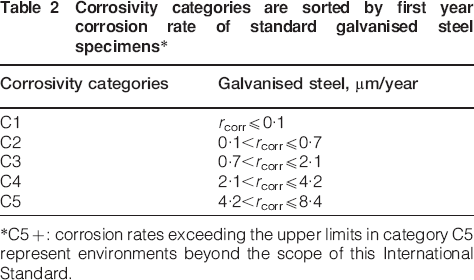
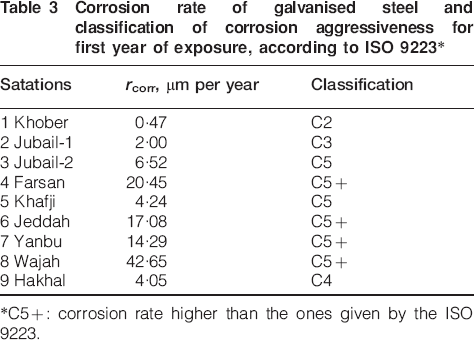
High RH, high temperature and large concentration of air borne salt, together with industrial pollutants, make it one of the most corrosive environments on galvanised steel. In particular temperature as it promotes drying may decrease corrosion rate.38,39 Corrosion rate is determined by the characteristics of the corrosion products, the presence of an electrolyte film (humidification) and the composition of this film, which is related with the deposition rate of the atmospheric pollutants, mainly SO2 in marine industrial atmosphere and chlorides in the coastline regions. According to ISO 9223, the corrosivity of the atmosphere is divided into five categories, which are based on the first year corrosion rate of standard zinc specimens (Table 2) as follows: ‘C1’(R⩽0·1 μm/year);’C2’ (0·1<R⩽0·7 μm/year); ‘C3’ (0·7<R⩽2·1 μm/year); ‘C4’ (2·1<R⩽4·2 μm/year); and ‘C5’ (4·2<R⩽8·4 μm/year). ‘C1’ (Negligible); ‘C2’ (R⩽0·6 μm/year); ‘C3’ (0·6<R⩽2 μm/year); ‘C4’ (2<R⩽5 μm/year); and ‘C5’ (5<R⩽10 μm/year). The classification is given in Table 3. It can be seen from Table 1 that the majority of S 2P 0 atmospheres such as stations 1, 3, 6 and 7 showed the relatively low chloride levels with corrosivity categories C2, C5, C5+ and C5+ for galvanised steel respectively. The stations 8 and 9 had S 3P 0 (high Cl− contamination levels) atmospheres with corrosivity categories C5+ and C4 for galvanised steel.
Corrosivity categories are sorted by first year corrosion rate of standard galvanised steel specimens*
*C5+: corrosion rates exceeding the upper limits in category C5 represent environments beyond the scope of this International Standard.
Corrosion rate of galvanised steel and classification of corrosion aggressiveness for first year of exposure, according to ISO 9223*
*C5+: corrosion rate higher than the ones given by the ISO 9223.
Visual appearance of corroded samples
After four years of exposure, appeared galvanised steel samples at Khober and Jubail-1 and Jubail-2, shows compact white patina and silica. Farsan and Wajah sample shows very thick dark brownish corrosion product and more than 40% of specimens completely turned into rust. Jeddah, Yanbu and Hakhal sample shows very thick and compact white patina and thick dark brownish corrosion product.
Corrosion rate of samples
The exposed galvanised steel surfaces are characterised by the loss of the shiny appearance and the white patina formation on them, which was more noticeable on all the samples exposed in marine and marine industrial stations. The average corrosion rates for the exposed galvanised steel samples are reported in Fig. 2. As can be seen from this figure, samples at Farsan (marine site) show the highest corrosion rate, than other marine sites (Hakhal, Jubail-1, and Khafji). Highest corrosion rate was recorded at Wajah (marine industrial site) when compared to other sites such as Jeddah, Yanbu, Jubail-2 and Khober.
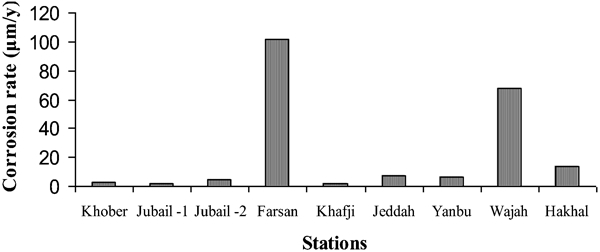
Corrosion rate of galvanised steel after four years of exposure at different stations
Characterisation of corrosion products by XRD
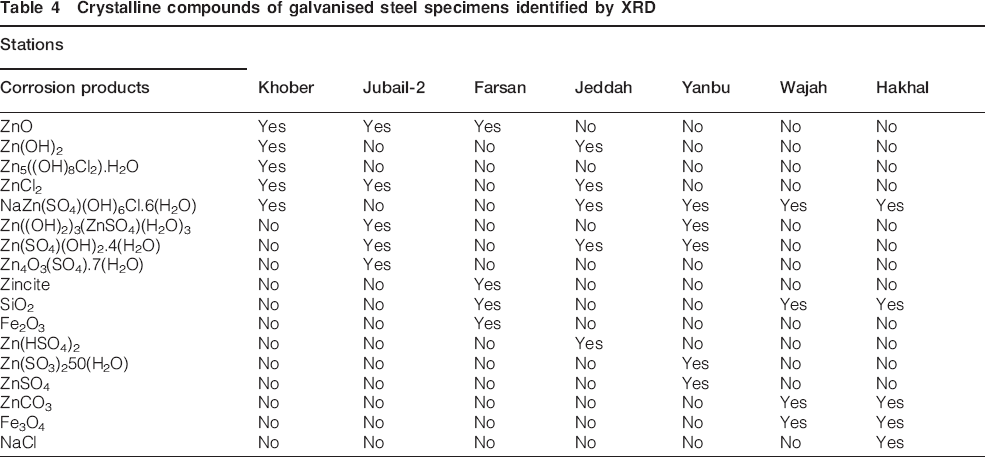
Table 4 presents the XRD identification of the galvanised steel corrosion products. Zinc oxide (ZnO), zinc hydroxide [Zn(OH)2], simonkolleite [Zn5((OH)8Cl2).H2O], zinc chloride (ZnCl2) and gordaite [NaZn(SO4)(OH)6Cl.6(H2O)] are present at Khober (marine industrial site). Zinc oxide (ZnO), zinc chloride (ZnCl2), zinc hydroxide sulphate hydrate [(Zn(OH)2)3ZnSO4(H2O)3], zinc sulphate hydroxide hydrate [6Zn(OH)2.ZnSO4.4H2O] and zinc oxide sulphate hydrate [Zn4O3(SO4).7H2O] are present at Jubail-2 (marine site). Zinc oxide (ZnO), zincite, quartz (SiO2) and hematite (Fe2O3) are present at Farsan (marine site). Zinc hydrogen sulphate [Zn(HSO4)2], zinc hydroxide [Zn(OH)2] zinc sulphate hydroxide hydrate [ZnSO4.(OH)2.5H2O], zinc chloride (ZnCl2) and gordaite [NaZn(SO4)(OH)6Cl.6(H2O)] are present at Jeddah (marine industrial site). Odnevall and Leygraf40 and Cole et al.41 suggested that the corrosive attack by chloride of the protective hydrozincite layer formed initially involves the transformation of this carbonated into a hydroxy chloride. Gordaite [NaZn(SO4)(OH)6Cl.6(H2O)], zinc hydroxide sulphate hydrate [(Zn(OH)2)3(ZnSO4)(H2O)3], zinc sulphite hydrate [(ZnSO3)250(H2O)], zinc sulphate hydroxide hydrate [ZnSO4(OH)2.4(H2O)] and zinkosite (ZnSO4) are present at Yanbu (marine industrial site). Gordaite [NaZn(SO4)(OH)6Cl.6(H2O)], smithsonite (ZnCO3), magnetite (Fe3O4) and quartz (SiO2) are present at Wajah (marine industrial site) and gordaite [NaZn(SO4)(OH)6Cl.6(H2O)], smithsonite (ZnCO3), magnetite (Fe3O4), quartz (SiO2) and halite (NaCl) are present at Hakhal (marine site).
Crystalline compounds of galvanised steel specimens identified by XRD
Corrosion rates versus exposure time
Average corrosion rates for galvanised steel samples exposed for four years period are given in Table 5. It can be seen from the table that the corrosion rates obtained depend on the nature testing site. On the other hand, the corrosion rates varied from one station to another. A matter of great practical importance is to know whether or not the galvanised steel atmospheric corrosion rate decreases with exposure time. The corrosion rates were decreased (Khober, Jubail-1, Jubail-2, Farsan, Khafji and Hakhal). This slowing of the corrosion rate with exposure time is probably due to the formation of adherent corrosion products on the surface. The corrosion product film becomes denser with continued exposure, thus affording a thicker, more protective coating.
Summary of average corrosion rates of galvanised steel for every year up to four years, μm per year

However, it is often assumed that the galvanised steel atmospheric corrosion rate does not undergo any marked change with exposure time. In this sense, a linear behaviour of the corrosion rate has been verified more or less precisely by a number of researchers.10,12,42,43 Legault and Pearson44 found that skyward facing surfaces tend to corrode much more rapidly than ground ward facing surfaces. The corrosion rate on the skyward side is linear with time, while corrosion on the ground ward side is parabolic in shape.
Corrosion kinetics
For modelling the data relative to the corrosion loss, equation (1) has been used for all the stations and, with this equation, very high correlation coefficient r 2 was found in all the sites. The representation of the corrosion data versus time on power plot will give points approximately on the straight lines of slope n, and intersections of ordinate K, for t = 1. Figure 3 show the variation of weight losses obtained and Table 6 shows the values for n, K and correlation coefficients r 2 for galvanised steel.
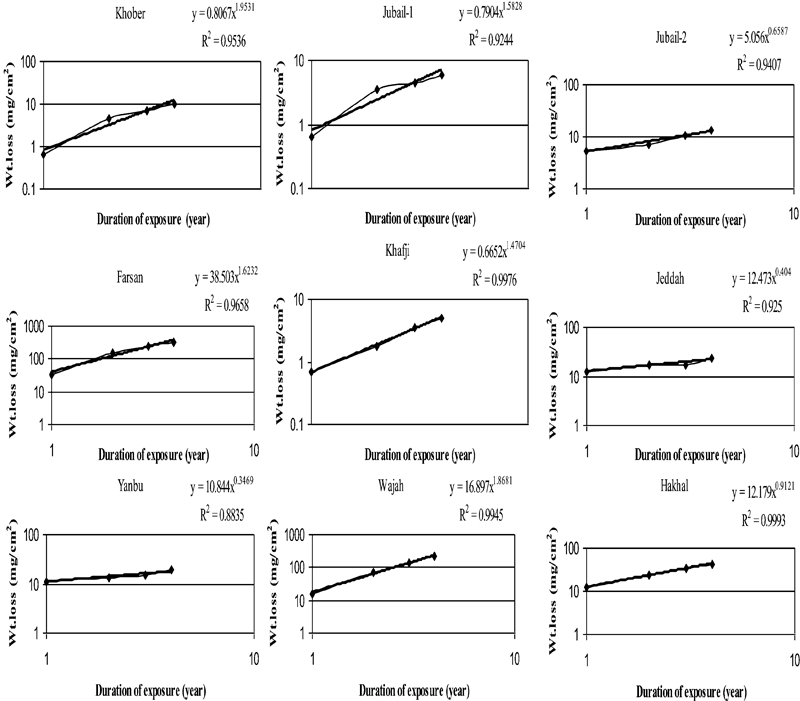
Variation of weight losses of galvanised steel as function of time, exposed at Khober, Jubail-1, Jubail-2, Khafji, Farsan, Jeddah, Yanbu, Wajah and Hakhal
Corrosion kinetics parameters K, n and correlation coefficient r 2 of galvanised steel
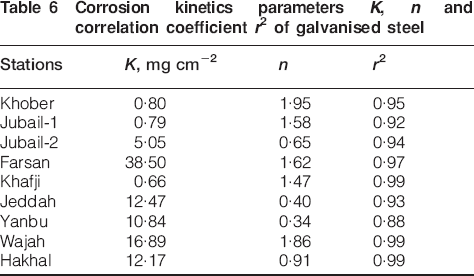
Figure 3 show the weight loss data for galvanised steel exposed at nine stations where it can be seen that the points lie close to a straight line for all the stations. Thus, it is reasonable to accept the verification of a power function kinetic law to estimate the long term corrosion of galvanised steel under these conditions.
For exposure stations Wajah and Farsan with a very high degree of atmospheric aggressiveness, the corrosion data obtained during a period of testing of four years were not deviated from the straight line. The exponent n for the atmosphere, in which this study was carried out, was in the range of 1·86-1·62 (Table 6). In general, this value was greater for the aggressive atmosphere in which more significant amount of SO2 and salinity was found.
For the exposure stations Jeddah and Yanbu the n value was ∼0·5, indicating that for corrosion of galvanised steel the diffusion of a corrosive species was the rate determining step (i.e. n = 0·5, when the corrosion product was protective and inhibit further corrosion by diffusion).45 On the other hand n values of greater than 0·91 were observed at exposure stations Khober, Wajah, Farsan, Jubail-1, Khafji and Hakhal indicating an acceleration of the diffusion process as a result of the rust detachment by erosion etc. The value of n for station Jubail-2 was 0·65. This result suggested mixed diffusion and charge transfer control and also a gradual change from the diffusion control due to the presence of the protective corrosion product layers to charge transfer control.
The value of K was equal to the corrosion loss after a first year exposure and indicated the vulnerability to rusting at the beginning of the exposure. The value of K was fluctuating somewhat at various exposure stations (from 0·6652 to 0·8067 mg cm−2). Stations Farsan, Wajah, Jeddah, Hakhal, Yanbu and Jubail-2 showed a higher value of K, between 38·503 and 5·056 mg cm−2.
Conclusions
The following conclusions can be drawn.
1. A field exposure for galvanised steel samples was performed in Saudi Arabia at marine and marine industrial atmospheres for four years. The adherent corrosion products were identified by XRD, galvanised steel mass loss increase with time.
2. The atmospheric corrosion of galvanised steel is as much affected by temperature, humidity as by chloride and sulphur dioxide pollution, but other atmospheric parameters such as pollutants other than Cl− and SO2 and soil deposition may also have important effects.
3. At all exposure stations, a linear bi-logarithmic relationship between corrosion losses with exposure time was observed.
4. The ISO 9223 methodology was employed in Saudi Arabia to assess atmosphere corrosivity. Based on the first year corrosion rates of galvanised steel specimens, the results of the exposure tests and their corrosivity categories indicated that there were one site classified as C2, one site as C3, one site as C4, one site as C5 and four sites as C5+ for galvanised steel. Therefore, Saudi Arabia faces a severe white rust problem for freshly galvanised steel items if stored in such corrosive environments.
5. Galvanised steel, corrosion values that exceed the established ones of the ISO 9223 norm are frequently obtained. It would be advisable to add a new scale of aggressiveness of the corrosion in order to include the coastal regions.
Footnotes
Acknowledgements
This research was supported financially and facilities provided by the King Abdulaziz City for Science and Technology (research no. 01-23-IA).