







Abstract
The present study investigates the influence of the sterilisation treatment conducted at 50°C in 5% sodium hypochlorite solution (NaClO) on the corrosion behaviour of endodontic instruments made of NiTi (GT Rotary and K3) and stainless steel (K file) by measuring potentiodynamic polarisation curves in the same environment at 37°C. For comparison, the electrochemical characterisation was also carried out on endodontic instruments that were not sterilised. The characterisation of the sample surface after the electrochemical tests were carried out by means of scanning electron microscopy coupled with X-ray energy dispersive spectroscopy. There was no significant influence of the sterilisation treatment on the corrosion behaviour of K file and GT Rotary endodontic instruments. However, a negative influence of the sterilisation treatment on the corrosion resistance of K3 endodontic instruments was observed, and the effect appears to be more dramatic for longer sterlisation treatment periods.
Keywords
Introduction
Rotating endodontic instruments composed of nickel–titanium risk fracture during the shaping of root canals. Generally, the fracture of NiTi endodontic instruments occurs through two shear mechanisms: torsion (twisting) or flexure (repeated bending). Fracture through torsion occurs when the point of the file, or a part of the instrument, remains in the root canal while the handle continues to rotate.1–3 When this happens, the elastic limit of the alloy is reached; the metal is deformed and then cracks. The other type of cracking occurs though flexure, and is caused by stress and fatigue in the metal (cyclic fatigue).4,5 Following Novoa et al.,6 the authors investigate the phenomenon of corrosion in endodontic instruments, which presents as pitting corrosion followed by a weakening of the structure of these instruments. Several studies7,8 have shown that corrosion of the endodontic instruments can degrade the mechanical properties and suddenly cause undesirable cracks that occur during root canal operations. Topuz et al.,9 have investigated the corrosive effects on NiTi instruments using electron microscopy and have determined that this corrosion is inevitable. Many studies have tested the corrosion resistance of NiTi alloys in different solutions,6,8–10 but no studies have been published using potentiodynamic polarisation curves to understand corrosion. It is important to identify the mechanisms of corrosion in order to understand the biocompatibility of endodontic files in practical use and to provide a guide for clinical applications of NiTi alloys.
The aim of the present work is to investigate the influence of sterilisation treatment in sodium hypochlorite on the corrosion behaviour of endodontic files composed of NiTi and stainless steel (AISI 316). This was carried out by recording potentiodynamic polarisation curves in 5% sodium hypochlorite solution. For comparison, the electrochemical characterisation was also performed on instruments that were not sterilised. The characterisation of the surface of samples after electrochemical testing was performed by means of SEM equipped with EDX microanalysis.
Experimental
Two different types of endodontic instruments were tested, one Ni-Ti, GT Rotary and K3 instrument (diameter in point 0·25 mm, taper 0·06 mm), and the other stainless steel K file instrument (diameter 0·25 mm, taper 0·2 mm). All instruments were submitted to sterilisation treatment by immersion in 5% sodium hypochlorite (NaClO) solution for 5 and 10 min in special glass containers. Only the working part of each instrument was subjected to the electrochemical characterisation.
The corrosion behaviour was assessed by recording potentiodynamic polarisation curves in 5% NaClO aerated solution at 37°C with a scan rate of dE/dt = 1 mV s−1, using a saturated calomel electrode (SCE) as reference. For the sake of comparison, the same characterisation was carried out on non-sterilised base materials. The surface morphology of the samples after electrochemical testing was characterised using SEM coupled with EDX microanalysis.
Results and discussion
Figure 1 shows the potentiodynamic polarisation curves recorded in 5% NaClO solution for the stainless steel K file instruments. The sterilisation treatment causes a shift of the corrosion potential toward more negative values [base material: about –110 mV(SCE); 5 min sterilised material: about –200 mV(SCE); 10 min sterilised material: about –300 mV(SCE)]. Nevertheless, comparing the anodic branches of the polarisation curves indicates no significant change between the base and sterilised materials. In fact, the sterilised materials exhibit current density values comparable to, if not lower than, those of the base material.
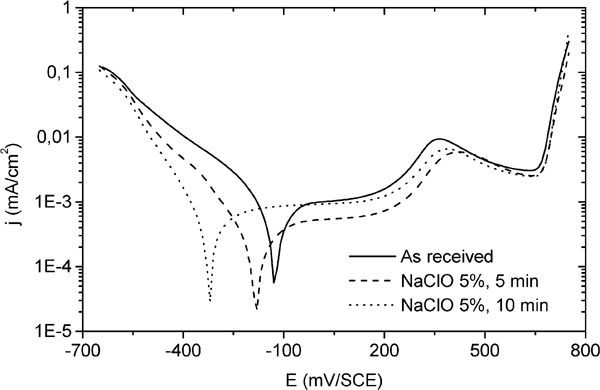
Potentiodynamic polarisation curves recorded at 37°C in 5% NaClO solution on stainless steel K file endodontic instruments
A similar behaviour is observed for the NiTi GT Rotary instruments, as shown in Fig. 2. By comparing the anodic branches of the polarisation curves, no significant change between the base material and the sterilised samples is observed. In fact, the sterilised materials exhibit corrosion potential and current density values similar to those of the base material.
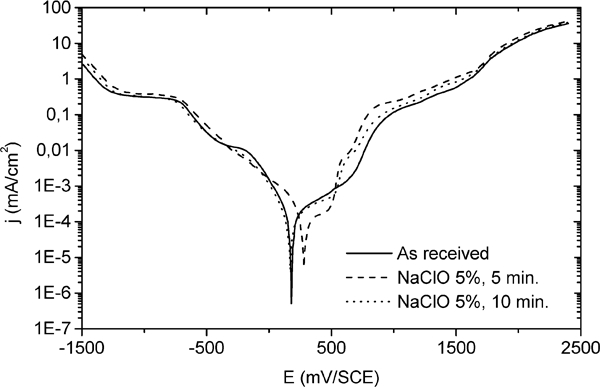
Potentiodynamic polarisation curves recorded at 37°C in 5% NaClO solution on NiTi GT Rotary endodontic instruments
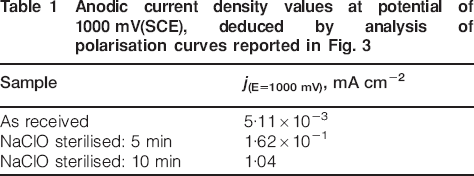
Figure 3 reports the potentiodynamic polarisation curves recorded in 5% NaClO solution on K3 NiTi endodontic instruments. In this case, the corrosion behaviour of the sterilised instruments is worse than that of the base material. The sterilised samples exhibit current density values higher than those of the base material. By analysing the anodic branches of the polarisation curves, the increase in current density particularly increases for the samples sterilised for 10 min, as also evidenced in Table 1, which reports the current density values at a potential of 1000 mV(SCE). Characterisation of the sample surface using SEM after the electrochemical tests revealed the presence of cracks as a result of corrosion (Fig. 4).
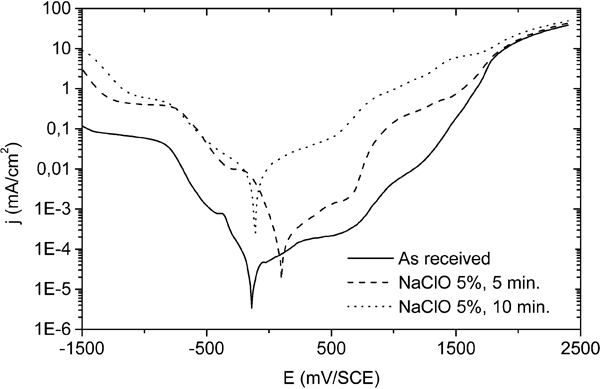
Potentiodynamic polarisation curves recorded at 37°C in 5% NaClO solution on NiTi K3 endodontic instruments
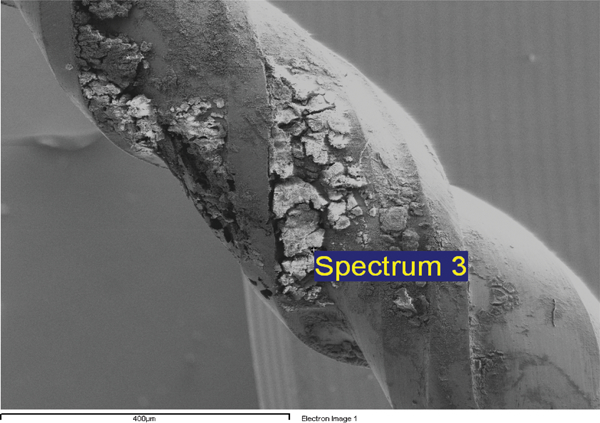
Image (SEM) of surface of NiTi K3 endodontic instrument sterilised 10 min after polarisation curve in 5% NaClO solution at 37°C
Anodic current density values at potential of 1000 mV(SCE), deduced by analysis of polarisation curves reported in Fig. 3
The microstructure appears to play an important role in determining the corrosion behaviour of the endodontic instruments investigated. The possible presence of secondary phases may explain the decrease in the corrosion resistance of the K3 sterilised samples due to galvanic coupling phenomena between these phases and the NiTi matrix. Such galvanic interactions may negatively affect the stability of the naturally formed passive TiO2 film present at the sample surface, thereby leading to localised corrosion phenomena during the sterilisation treatment, which is enhanced when the sterilisation period is increased. As a consequence, a marked worsening of the corrosion behaviour is observed with respect to the non-sterilised base material.
EDX analysis carried out on the K3 instruments revealed the presence of significant amounts of Cr in addition to Ni and Ti (Fig. 5), supporting the above hypothesis. Cr is able to form the intermetallic compound TiCr2.10 As a consequence, galvanic coupling phenomena between this phase and the NiTi matrix may occur, leading to the destabilisation of the TiO2 surface film.
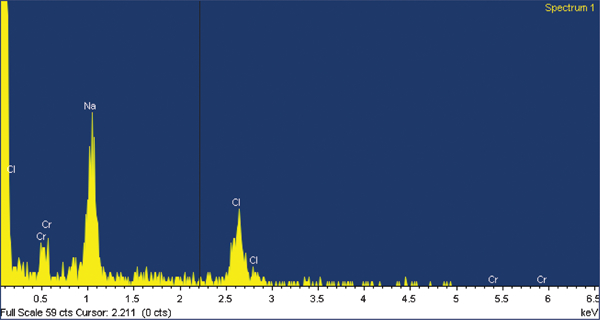
Spectrum of EDX recorded at surface of NiTi K3 endodontic instrument 10 min after polarisation curve in 5% NaClO solution at 37°C
Conclusions
The influence of the sterilisation treatment conducted at 50°C in 5% NaClO solution on the corrosion behaviour of NiTi (GT Rotary and K3) and stainless steel (K file) endodontic instruments was investigated by measuring potentiodynamic polarisation curves recorded in the same environment at 37°C. The sterilisation treatment had no significant influence on the corrosion resistance of K file and GT Rotary instruments. In contrast, sterilisation resulted in significantly decreased corrosion behaviour of NiTi K3 instruments compared to the unsterilised sample, and this effect was more pronounced with longer sterilisation periods. These results imply that it is necessary to develop of instruments using different materials that are more resistant to corrosion in the sterilisation environment.