







Abstract
Potentiostatic polarisation studies have been carried out on a new high strength copper containing interstitial free steel for automotive applications under various industrially important processing conditions in 0·1M H2SO4 solution at room temperature. It is revealed that corrosion rate in the new steel is lower than that in the conventional mild and high strength interstitial free steels.
Introduction
Interstitial free (IF) steels are super formable (Lankford parameter, r m⩾1·8 and strain hardening exponent, n⩾0·22) steels that have been developed for the automotive and white goods industry. These steels are designed with exceptionally low levels of interstitial content (total C ⩽30 ppm and total N ⩽40 ppm) and small amounts of stabilising elements (Ti and/or Nb).1–3 Such steels generally have relatively low strength levels (yield strength ⩽220 MPa and tensile strength ⩽360 MPa) that limit their applications. However, utilisation of substitutional solid solution hardening (by P, Mn and Si), bake hardening (retention of excess C in solid solution) or Hall–Petch hardening (grain refinement) can achieve a maximum tensile strength of ∼440 MPa in IF high strength (IF-HS) steels.4
In view of the ever increasing demand from automakers for stronger and dent resistant formable steels, a new type of IF-HS steel (tensile strength 575 MPa) has been developed recently by addition of copper to conventional IF steels.5,6 This development uses classical copper precipitation hardening in ferrite (α-iron),7–10 where copper is reported to be in the form of bcc nanometric clusters in the peak aging condition.11 The high strength copper containing IF (IF-Cu) steel is press formed in the as annealed condition when it is soft and formable, and then subjected to a short aging treatment in order to develop the copper precipitation hardening. A substantial amount of research on this new automotive steel has been directed towards processing, mechanical properties and formability.12–19 However, the possible effect of copper on the corrosion resistance of this new steel has not been reported. The corrosion behaviour in the presence of copper is important, since this would determine the necessity and type of coating for this new steel in automotive and other applications. Therefore, this communication reports on the first information on the corrosion resistance of the new high strength IF-Cu steel. In addition, all the results are discussed in comparison with the conventional IF and IF-HS steels.
Experimental
Interstitial free steel scrap was melted and cast in situ, with copper added as the primary alloying element, in a vacuum induction furnace producing an IF-Cu steel containing 1·18 wt-% copper. The composition of IF-Cu steel, along with that of the IF and IF-HS steels used in this investigation, are listed in Table 1. The IF-Cu steel ingots were reheated at 1200°C in an argon atmosphere and hot rolled into 3·8 mm thick sheets with a finish rolling temperature of 900°C. The hot rolled strips were subsequently air cooled to room temperature, and can thus be regarded as room temperature coiled sheets containing almost the entire amount of copper in solid solution.6 These as-coiled sheets were cold rolled to 80% reduction to sheets of thickness 0·76 mm. Then the steel was batch and continuous annealed inside a salt bath furnace until complete recrystallisation had occurred. The batch annealing was performed at 700°C for 240 min while the continuous annealing was performed at 820°C for 1 min. Continuous annealed IF-Cu steel sheets were aged at 550°C for 90 min to obtain peak aging of the copper precipitates. One conventional IF steel, which was received in an industrial cold rolled condition, was also batch annealed at 700°C for 30 min and continuous annealed at 820°C for 1 min in order to complete recrystallisation. Two IF-HS steels (denoted as IF-HS-1 and IF-HS-2 steels) were procured in the industrial continuous annealed condition. The treatment parameters of the steels, which have been detailed elsewhere,12–14 are summarised in Table 2. The IF-HS steels used here are strengthened by P and Mn. IF-HS-1 steel was stabilised using Ti, while the IF-HS-2 steel was stabilised using both Ti and Nb.
Chemical composition of steels, wt-%

Various processing conditions of steels
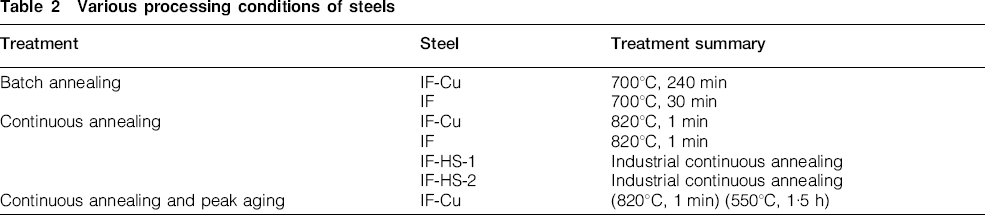
Potentiostatic polarisation tests of polished steel sheets under the various processing conditions were carried out in 0·1M H2SO4 solution at room temperature. Saturated calomel electrode and platinum wire were taken as the reference and counter electrodes respectively and a slow scan rate of 0·06 mV s−1 was used in order to ensure reversibility. Tafel plots were constructed from the potential and current density data obtained from the polarisation tests. The corrosion current i corr and the corrosion potential E corr were determined from the tangential intersecting point of the anodic and cathodic parts of the Tafel plots.
Results and discussion
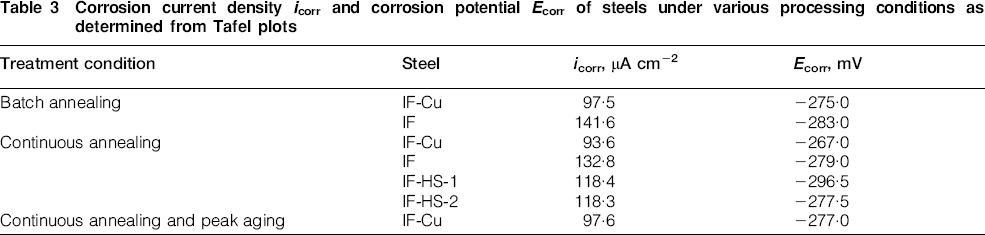
The Tafel plots obtained from potentiostatic polarisation tests of the steels under various processing conditions are shown in Fig. 1. The corrosion current, i corr and the corrosion potential, E corr as determined from the Tafel plots are summarised in Table 3. It can be observed that the respective i corr values are significantly lower for the IF-Cu steel than for the conventional IF or IF-HS steels in the batch or continuous annealed conditions, while the E corr values are similar. The i corr value of the continuous annealed and peak aged IF-Cu steel is also lower than that of IF, IF-HS-1 and IF-HS-2 steels in their batch or continuous annealed condition.
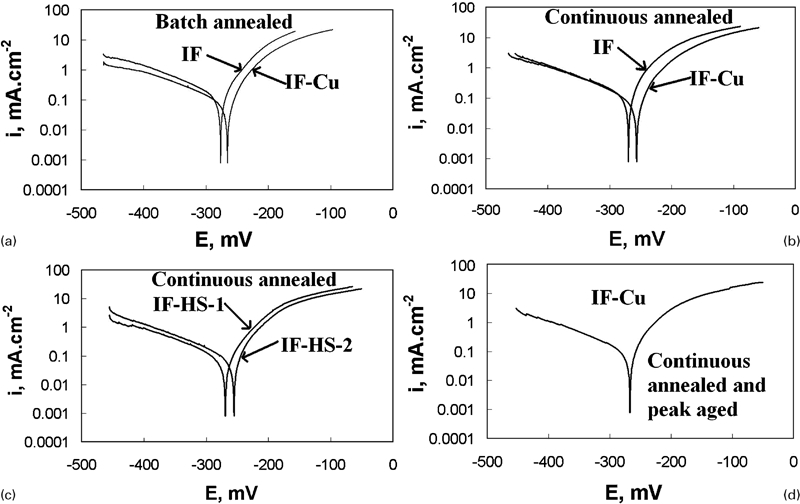
Tafel plots of investigated steels under various processing conditions (E and i are potential and current density respectively)
Corrosion current density i corr and corrosion potential E corr of steels under various processing conditions as determined from Tafel plots
The corrosion current i corr can be related to the corrosion rate or metal dissolution rate using Faraday's law20


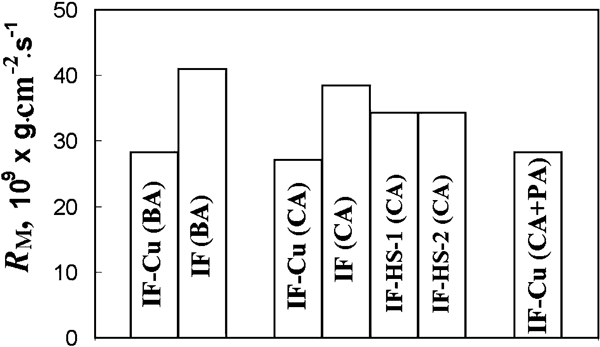
Comparison of corrosion rate R M of steels under various processing conditions: BA, CA and PA refer to batch annealed, continuous annealed and peak aged conditions respectively
It is very clear that the novel copper alloyed IF steel exhibits a distinctly lower rate of corrosion than the conventional IF and IF-HS steels under the specific processing conditions of batch or continuous annealing. Most importantly, IF-Cu steel in continuous annealed and peak aged condition has a lower rate of corrosion than that any of the IF, IF-HS-1 and IF-HS-2 steels in their batch or continuous annealed conditions. It is to be noted that conventional IF and IF-HS steels, for example those used in this investigation, are generally applied in the batch or continuous annealed condition. However, the high strength IF-Cu steel has been designed to find applications in the annealed and peak aged condition.12–14 In the as annealed condition, the steel would be press formed taking advantage of its high formability. Then it would be subjected to a post-annealing aging treatment to achieve the high strength from copper precipitation hardening. Therefore, the new steel shows a lower corrosion rate in H2SO4 than existing IF and IF-HS steels when compared in the final application condition.
The reduction of corrosion rate in the present IF-Cu steel can be linked to the suppression of anodic dissolution of iron by copper.21–24 Thus, in the continuous annealed condition, all the copper is in solid solution, whereas only the majority of the copper is in solid solution in batch annealed condition.12 This can be understood from the solvus curve of the Fe–Cu binary phase diagram in Fig. 3 calculated for the IF-Cu steel using the TCFE3 ThermoCalc database. The copper in solid solution tends to preferentially enrich on the steel surface during corrosion. Eventually, it is suggested that copper that is enriched on the surface tends to block access of the corroding species (environment) to the corrodible surface (iron) thus suppressing the corrosion rate. However, in the continuous annealed and the peak aged condition, where some of the copper is present as precipitates,14 the situation will differ. Thus, copper precipitates will act as local anodic sites compared to the matrix iron and contribute to an enhanced corrosion rate due to the formation of local galvanic cells.25 Figure 2 suggests that IF-Cu steel, both in the annealed, and in the peak aged, conditions have a similar corrosion rate. This indicates that copper precipitates, under the present conditions, appear to have a negligible effect on the corrosion rate in sulphuric acid. This is possibly because, in the peak aged condition, copper is present in the form of clusters.11
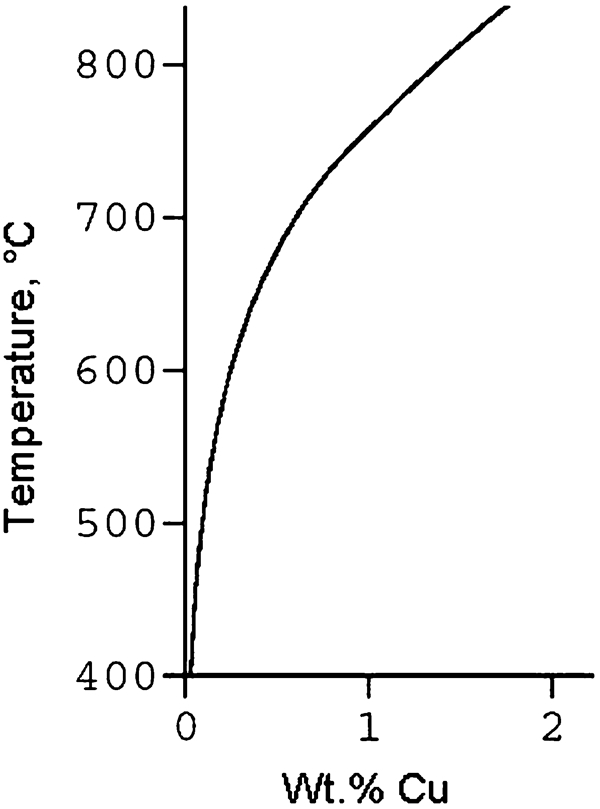
Solvus curve of IF-Cu steel determined using TCFE3 ThermoCalc database
Though corrosion under immersion in sulphuric acid, as investigated in this work, does not represent atmospheric corrosion, the comparative values of the corrosion from the present investigation can be taken as an initial basis for comparing IF-Cu steel with conventional IF and IF-HS steels. To have a complete understanding of the effect of copper precipitates on the corrosion resistance, further detailed studies on variously aged IF-Cu steel are suggested; these would need to be performed in a variety environments more realistic of service conditions.
Conclusions
From the present study it can be concluded that IF-Cu steel, proposed to be a high strength automotive steel, shows an enhanced corrosion resistance in its final application condition compared with traditional IF and IF-HS steels. Future studies concerning the effect of variously aged copper precipitates on the corrosion resistance in more realistic environments, as well as the requirement for, and performance of, protective organic coatings are suggested.