







Abstract
Chromia forming steels are excellent candidates to resist to high temperature oxidising atmospheres because they form protective oxide scales. To understand the oxidation mechanisms of the AISI 304 stainless steel in air at 800°C, in situ X-ray diffraction (XRD) has been used not only during high temperature oxidation, but also during and after cooling. The in situ XRD analyses carried out during high temperature AISI 304 steel oxidation in air at 800°C reveal the growth of iron containing oxides such as haematite Fe2O3 and iron chromite FeCr2O4, after 35 h of the oxidation test, whereas the initial nucleation of the oxide layer shows the single growth of chromia. Iron containing oxides develop over the initial layer and these oxides appear to be poorly adherent and spall off during cooling between 200 and 50°C. Protection against high temperature oxidation would be increased when the initial nucleation of manganese spinel compound is delayed in the oxide scale.
Introduction
To ensure their long-term protection against high temperature corrosion under oxidising atmosphere, alloys must establish a dense, continuous and adherent oxide scale with a relatively slow growth rate.1–15 They are generally chromia or alumina layers, and also silica scales which allow the use of steels at high temperature. Many works based on isothermal oxidation at high temperature of chromia forming alloys, such as AISI 304 stainless steel, reveal the initial growth of an oxide scale which is mainly composed of chromia.7–15 Kumar et al.16 showed an enrichment of the oxide layer in chromia above 873 K, the degree of enrichment being maximum at ∼1200 K, so that the oxide scales formed at close temperatures are composed almost exclusively of chromia.
Manganese constitutes an element of addition included in the chromia forming alloys for mass contents of ∼1·5%. Its addition is justified by the improvement of the mechanical properties of the alloy. In high temperature oxidation conditions, its role remains, however, ambiguous, since its action on the adherence of the oxide scales can prove to be not only harmful, but also particularly beneficial. Several assumptions were proposed in the literature17–32 in order to characterise its action, and the contribution of the in situ X-ray diffraction (XRD) performed at high temperature enabled the authors to draw the conclusions aiming at showing the influence which it can generate in the protection of the AISI 304 steel against high temperature oxidation in air.
The manganese content in the alloy requires to be controlled perfectly, since it proves that the thickness of the formed layers at 1000°C increases and thus weakens their integrity, when the manganese concentration in the alloy decreases.17 Because its bulk diffusivity in chromia is ∼100 times higher than those of the other basic elements of the alloy,18,19 manganese is found as a spinel compound located at the external interface of the oxide scale formed at high temperature.17–45
Some authors20,30 specify that manganese led to the non-protective porous oxide formation. However, if the manganese containing spinel structures tend to crack,20 they do not compromise necessarily the protective nature of the underlying chromia scale.27 Tawancy33,34 reveals that the presence of this spinel compound at the external interface could effectively reduce the conversion of the Cr2O3 chromia into CrO3, particularly volatile oxide beyond 900°C.26,34–36 Indeed, some authors proposed the possible volatilisation of chromia at temperatures higher than 1473 K,1,16 according to equation (1). The volatilisation of chromium located superficially in the oxide scale at the oxide/gas interface into CrO3 (g) at a lower temperature of ∼1323 K, has also been proposed16 according to equation (2)


Usually, works dealing with the oxidation behaviour of stainless steels are supported by oxide scale characterisation performed after cooling.20,43,46,47 The present study proposes a different approach. The stainless steel oxidation behaviour at 800°C in air, under atmospheric pressure, was observed in situ by both thermogravimetric and XRD techniques. The effect of cooling has also been investigated to observe possible changes in the oxide scale composition.
Experimental details
Rectangular AISI 304 steel coupons of 3 cm2 total surface and 2 mm thickness were tested in high temperature oxidation conditions between 800 and 1000°C. The composition of the samples is Fe–17·6Cr–9·05Ni–1·52Mn–0·48Si–0·22Co–0·15Mo–0·1Cu–0·05C–0·01Ti–0·01S. These samples were polished on SiC grinding paper until 800 grade, then washed successively with water and ethanol before being dried.
The mass gain curves of the samples tested in high temperature oxidation conditions were carried out in air during 125 h by thermogravimetric analysis by means of a microthermobalance (Setaram TG-DTA 92-1600). Three samples are tested in order to establish the average kinetic curve associated with the error bars.
The characterisation of the oxide layer performed during isothermal oxidation in air was carried out by in situ XRD at high temperature in order to observe the structural changes during the first 100 h of the oxidation test. The in situ diffractograms were obtained every hour by means of a high temperature Anton PAAR HTK 1200 chamber placed in a Philips X'Pert MPD X-ray diffractometer. The diffractometer is equipped with a curved Cu monochromator to separate the diffracted Cu Kλ wavelength diffracted of any parasitic radiation such as that related to the iron fluorescence radiation. Only the most representative diffractograms will be presented in this study.
The morphology of the external interface as well as the cross-sections was observed using a scanning electron microscope (SEM). Tin was used to coat samples and to protect the oxide layer from polishing. The analysis of the scale was performed with the energy dispersive X-ray spectroscopy.
Experimental results
High temperature oxidation kinetics
The curve presenting the mass gain per unit of area as a function of the oxidation time [Δm/S = f(t)] obtained in isothermal oxidation conditions at 800°C in air at the atmospheric pressure of the AISI 304 steel is presented on Fig. 1. The graph Δm/S = f[(t)1/2] is also represented in order to highlight what kind of kinetic regime is followed by the AISI 304 steel during high temperature oxidation. After establishment of an initial transient linear regime, clearly observable during the first 10 h of the oxidation test, oxidation kinetics of the oxidised samples at 800°C mainly follows a parabolic law. The corresponding parabolic rate constant k p(800°C) = 0·27×10−12 g2 cm−4 s−1 is 10 times lower than that calculated at 1000°C.15
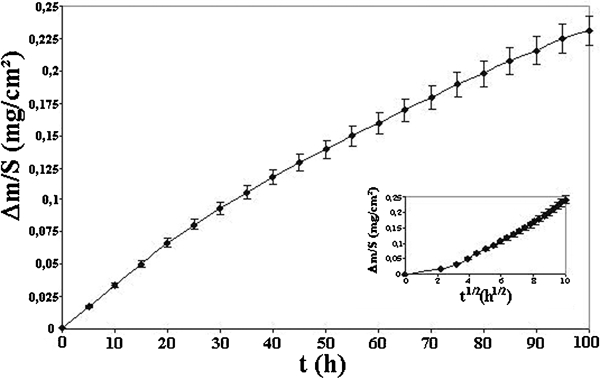
Mass gain curves obtained during high temperature oxidation of 304 steel samples in air
In situ XRD analyses performed during high temperature oxidation
Figure 2 shows the in situ XRD patterns obtained during the first 60 h of isothermal oxidation of the AISI 304 steel at 800°C. A weak 2θ shift is always observable for the characteristic peaks of the alloy substrate because of the thermal dilatation of the substrate. At the beginning of the oxidation treatment, the patterns reveal the initial nucleation of Cr2O3 chromia. The growth of the manganese containing spinel oxide appears to be clearly differed from a few hours. During the first 30 h of the oxidation test, the evolution of oxide and metallic characteristic diffraction peak intensities indicates the formation of a growing layer resulting from the external diffusion of Mn2+, Mn3+ and Cr3+ cations towards the oxide/gas interface. After 35 h of the oxidation test, a change in the structural composition of the oxide layer appears by the growth of iron containing oxides such as Fe2O3 and FeCr2O4. These iron containing oxides become prevalent after 40 h of the oxidation test, and the oxide scale becomes sufficiently thick to hide the alloy substrate.
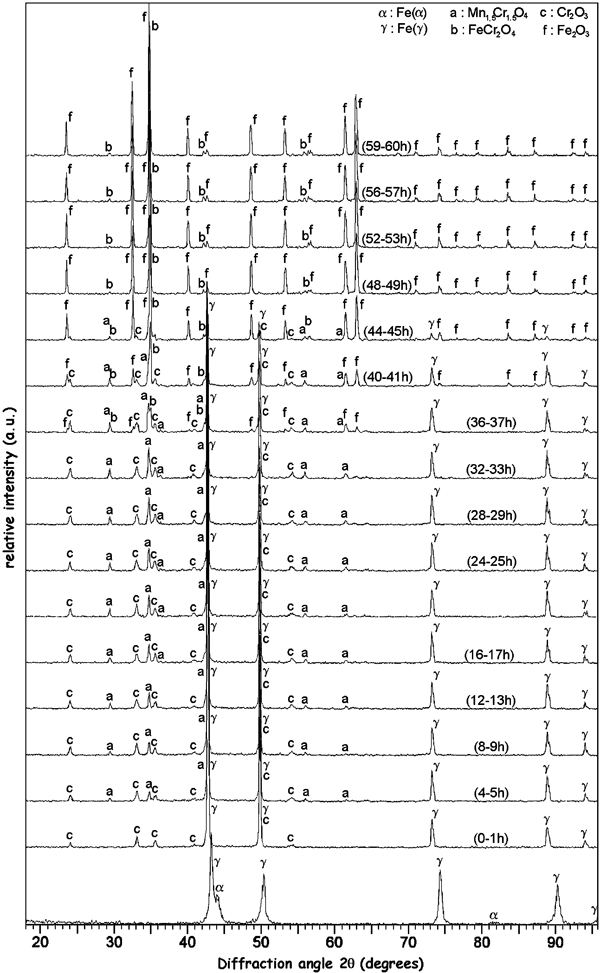
In situ XRD patterns performed on AISI 304 steel during isothermal oxidation at 800°C in air
In situ XRD analyses performed during cooling
After the oxidation test, sample was gradually cooled down to ambient temperature and characterised by XRD at temperature intervals of 200°C. As observed on Fig. 3, the cooling process induces a change of the chemical structure of the oxide layer previously formed during the high temperature oxidation test. Iron containing oxides disappear between 200 and 50°C, and the diffractogram performed at 50°C shows the presence of the manganese spinel compound in the oxide layer.
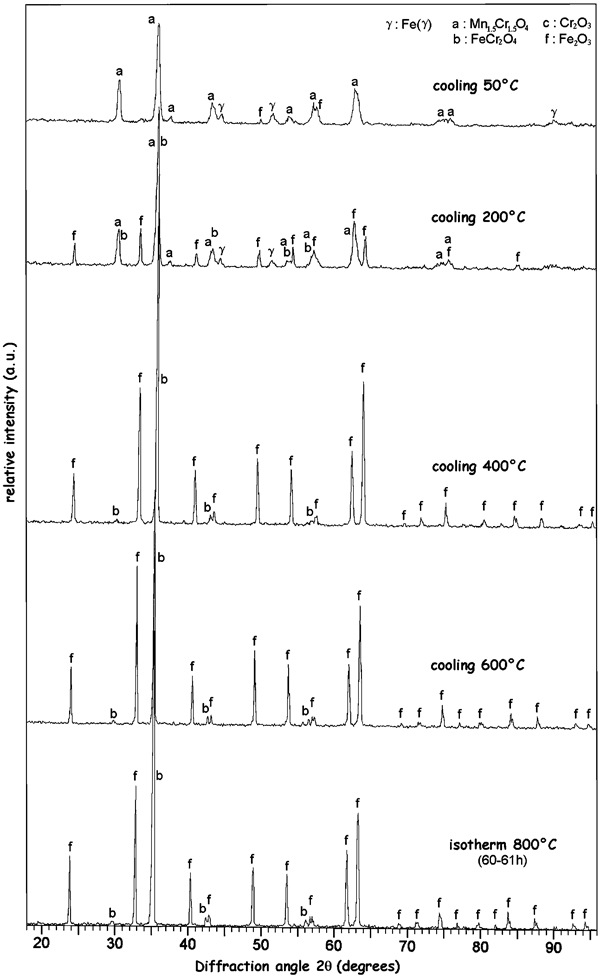
In situ XRD patterns performed on AISI 304 steel after isothermal oxidation and during cooling
Scanning electron microscopy performed after oxidation
SEM image obtained before iron containing oxide appearance (24 h)
SEM image of the cross-section of the 24 h oxidised sample (Fig. 4) confirms that the scale thickness is relatively thin when the oxidation test is performed at 800°C.
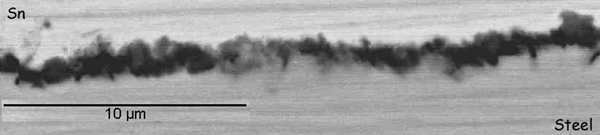
Image (SEM) of cross-section performed after 24 h oxidation test of AISI 304 at 800°C
EDXS analyses of the scale cross-section on the 24 h oxidised specimen (Fig. 5) reveal the presence of silicon and chromium at the metal/oxide interface as well as manganese enrichment at the oxide/gas interface. The latter observation is in good agreement with the identification of Mn1·5Cr1·5O4 spinel phase by XRD. Iron and nickel are basic elements and clearly detectable in the underlying steel, but their presence decreases throughout the oxide scale towards the oxide/gas interface.
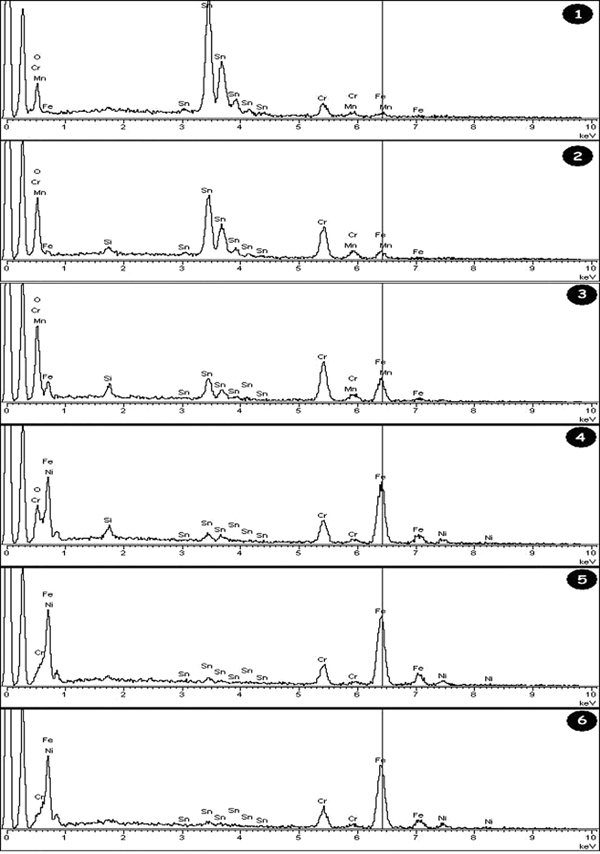
EDXS spectra of oxide scale formed on 304 steel after 24 h oxidation test from oxide/gas interface (1) to metal/oxide interface (6)
SEM image of the surface of the oxidised sample (Fig. 6) shows equiaxed grains were enriched in chromium, manganese and oxygen elements (Fig. 7), and assumed to be correlated with the identification of Mn1·5Cr1·5O4 spinel phase by XRD.
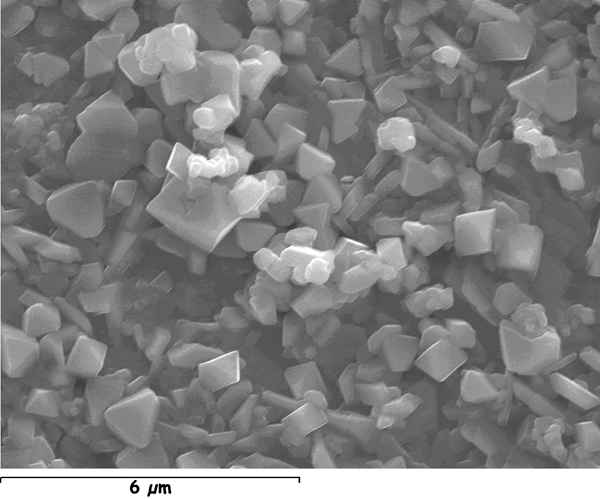
Image (SEM) of surface performed after 24 h oxidation test of AISI 304 at 800°C
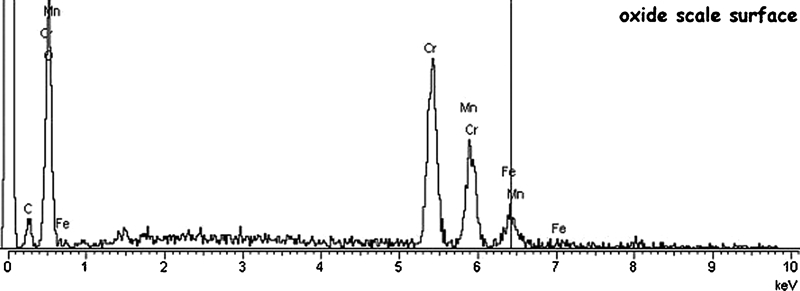
Spectrum (EDXS) of oxide scale surface formed on 304 steel after oxidation test
SEM image obtained after iron containing oxide appearance (100 h)
SEM image of the transversal cross-section of the 100 h oxidised sample (Fig. 8) shows an oxide scale hardly detectable on the substrate because of the poor adherence of this layer. The average thickness calculated from micrograph on parts of the oxide scale always adherent to the steel is estimated at 1·5±0·2 μm.
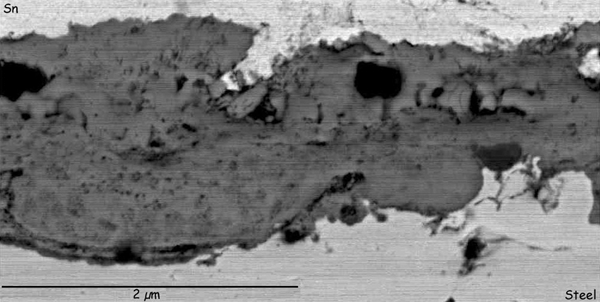
Image (SEM) of cross-section performed after 100 h oxidation test of AISI 304 at 800°C
EDXS analyses of the scale cross-section on the 100 h oxidised specimen (Fig. 9) reveal the presence of silicon at the metal/oxide interface as well as manganese enrichment at the oxide/gas interface. Chromium is clearly detected in the middle of the oxide scale and associated with oxygen, and the chromia presence is confirmed in the oxide scale. Iron and nickel are basic elements and clearly detectable in the subjacent steel, but their presence decreases throughout the oxide scale towards the oxide/gas interface.
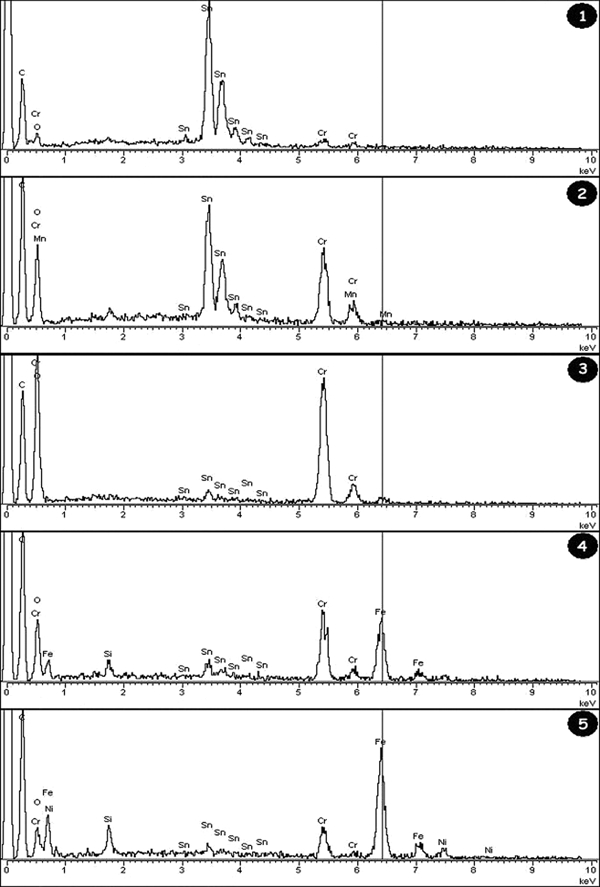
Spectra of oxide scale formed on 304 steel after 100 h oxidation test from oxide/gas interface (1) to metal/oxide interface (5)
Figure 10 shows the SEM image of the surface of the 100 h oxidised sample. Spallation of a part of the oxide scale is highlighted. A continuous oxide layer (Fig. 10a) appears to be adherent to the steel substrate. Another oxide layer seems to be formed over the adherent oxide layer, and only few parts of this layer are observed on the SEM image (Fig. 10b and c).
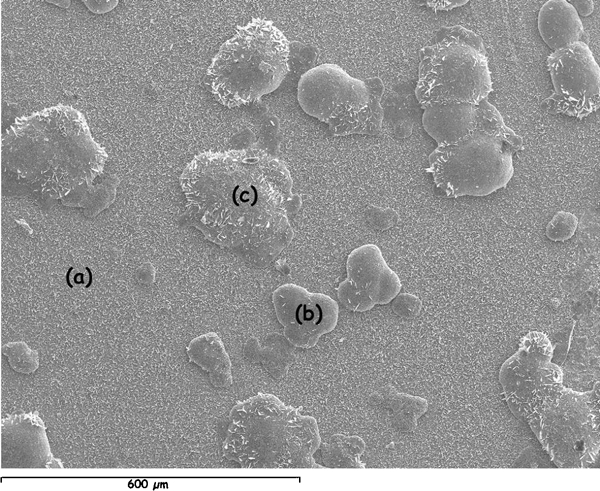
Image (SEM) of surface performed after 100 h oxidation test of AISI 304 at 800°C
EDXS analyses of the surface formed on the 100 h oxidised specimen (Fig. 11) have been performed separately on the two oxide layers. The inner and adherent oxide scale (Fig. 11a) is enriched in chromium, manganese and oxygen elements, assuming the presence of Mn1·5Cr1·5O4 and Cr2O3 compounds. The part of the oxide scale which is subject to the spallation phenomenon shows, in the area where this layer is always adherent to the first inner oxide layer (Fig. 11b and c), the presence of chromium, iron and oxygen elements, assuming the presence of FeCr2O4 and Fe2O3 compounds in this outer oxide layer.
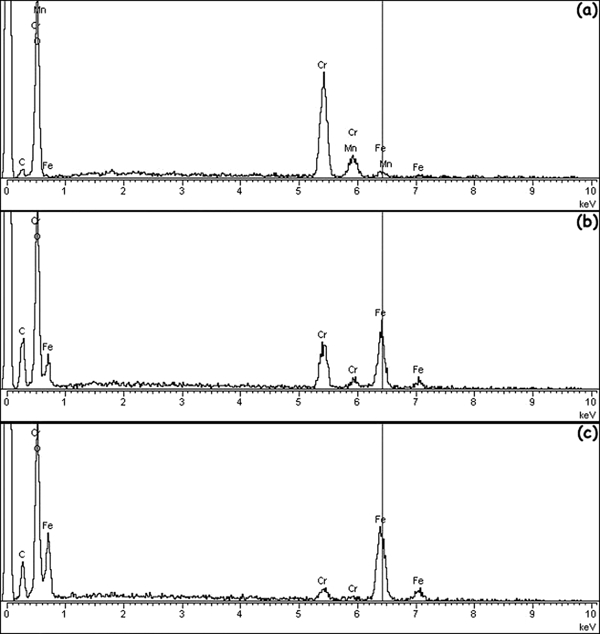
Spectra (EDXS) of oxide scale surface formed on 304 steel after 100 h oxidation test. a, b and c are SEM areas identified on fig. 10
Discussion
The kinetic study related to the isothermal oxidation of AISI 304 steel at 800°C (Fig. 1) is characterised by the initial establishment of a transient linear regime observable during the first 10 h of the oxidation test. This linear step is then followed by a parabolic oxidation law, characteristic of the establishment of a protective oxide layer. The analyses by in situ XRD at this temperature (Fig. 2) allow highlighting the initial growth of chromia. After 1 h of the oxidation test, chromia growth is associated with the formation of a spinel structure identified as a manganese containing oxide (Mn1·5Cr1·5O4). These two oxides are detected (Fig. 2) during the first 35 h of the oxidation test. However, after 35 h of the oxidation test, the in situ XRD analysis (Fig. 2) reveals the delayed growth of iron containing oxides such as Fe2O3 and FeCr2O4.
The cooling process highlighted by XRD analyses at temperature intervals of 200°C (Fig. 3) shows the initial presence of iron containing oxides up to temperature cooled down to 200°C. These oxides are superficially localised ( Figure 10 Figs. 10 and 11b and c). Between 200 and 50°C, iron containing oxides spall off, allowing the identification of the inner and subjacent oxide layer, constituted of chromia and manganese containing oxides (Figs. 6 and 7), which are adherent to the steel substrate (Fig. 10a).
The high temperature oxidation of the AISI 304 steel at 800°C shows the formation of a duplex oxide scale. An inner and adherent layer is initially formed up to 35 h of the oxidation test, and this layer is composed of chromia and manganese containing spinel structure. Over this one, an outer layer constituted of iron containing oxides is formed. The latter is very sensitive to the spallation phenomenon which occurs between 200 and 50°C during the cooling process. The formation of iron rich oxide such as haematite, compound considered as being porous and consequently not very protective,20 proves to be harmful with respect to the safeguarding of the integrity of the oxide scale, and thus not very favourable with the protection of AISI 304 steel against dry corrosion at high temperature.
The high temperature in situ XRD in air at 1000°C of AISI 304 steel, reveals the accelerated growth of iron rich oxide such as haematite, when the initial germination of the oxide layer contains the manganese containing spinel compound.15,48 Thus, the initial nucleation of the manganese containing spinel oxide was harmful to ensure the long term protection against high temperature oxidation of AISI 304 steel at 1000°C.15,48
Conclusion
This study highlights the major influence of manganese element on the commercial steel protection against corrosion at high temperature. Many technological processes involved in work at high temperatures (800-1000°C) require the use of iron based alloys with ∼10% of nickel amount and important chromium content, taking into account the excellent protective qualities of the chromia scale. This chromia layer will be all the more protective as it will be established in a continuous way in order to constitute an excellent protective, compact and adherent diffusion barrier, thus making it possible to obtain low degradation rates of materials by hot gases. The initial incorporation of spinel structure, such as Mn1·5Cr1·5O4 in the oxide layer, would prevent the establishment of a continuous chromia scale which could not effectively play its role of diffusion barrier. The anion diffusion would not be blocked any more and the adsorption of oxygen to the alloy/oxide interface would become increased. The surface depletion in chromium element (major element constituting the oxide layer) favours iron element oxidation (major element constituting of the alloy) and consequently iron rich oxide growth. When the initial growth shows only the formation of chromia, as it was the case at 800°C, haematite formation is delayed. Protection against corrosion would be thus increased when the initial germination of manganese spinel compound is inhibited in the oxide scale.