







Abstract
The corrosion of two binary iron–aluminium alloys was compared in gaseous CO2–H2–HCl–H2S and CO2–H2 mixtures at 600 and 700°C. In each environment, the Fe–14Al alloy resisted corrosion due to the formation of a protective alumina scale. The Fe–4Al alloy corroded more rapidly in the CO2–H2–HCl–H2S atmosphere than in the CO2–H2 atmosphere at both temperatures. The corrosion products comprised thick outer layers of iron oxide, porous inner layers of mixed iron–aluminium oxide and internal precipitates of aluminium oxide. Sulphur was detected near the scale/alloy interface and the increase in corrosion rate was attributed to the presence of chlorine and sulphur.
Introduction
Biomass gasification is an important process for converting waste to energy. A typical gasification process involves a reducing step, in which the atmosphere has a low partial pressure of oxygen and contains gaseous compounds of chlorine and sulphur at high temperatures. In such atmospheres, the corrosion products formed on metallic materials are often non-protective and corrosion mechanisms are difficult to understand. The selection of structural materials is currently one of the challenges hindering the development of biomass gasification.
In spite of their poor mechanical properties, iron–aluminium alloys have been widely studied at high temperatures; excellent resistance to oxidation 1 1,2 and sulphidation 3 3,4 has been reported. Research has shown that alumina forming alloys have better resistance to chlorination than chromia forming alloys. 5 5,6 Alumina scales are slower growing and less reactive than chromia scales, and are penetrated less readily by corrosive species such as chlorine. 7 7,8
Little has been published on the corrosion of iron–aluminium alloys in reducing atmospheres bearing chlorine and sulphur. The objective of this study is to gain an improved understanding of the corrosion of iron–aluminium alloys in a reducing atmosphere containing small amounts of hydrogen sulphide and hydrogen chloride.
Experimental procedures
Two binary iron based alloys with aluminium contents of 4 and 14% were prepared from high purity metals by vacuum arc melting. The alloys were machined into specimens with dimensions of 10×15×1·5 mm, ground to a 1000 grit finish, washed, degreased in acetone, dried and weighed. Each specimen was suspended from the rim of a crucible and placed inside the reaction tube of a horizontal furnace. A mixed gas was passed through the tube and the gas flowrate was adjusted to 35 mL s−1 with capillary flowmeter. In order to increase the probability of attaining thermodynamic equilibrium, the gaseous mixture was passed through platinum gauze before contacting the specimens. Alloy coupons were oxidised at 600 and 700°C in gaseous CO2–H2 and CO2–H2–HCl–H2S mixtures with identical oxygen pressures. The equilibrium partial pressures of oxygen, sulphur and chlorine in each gaseous mixture at 600 and 700°C are listed in Table 1.
Gas compositions and equilibrium partial pressures of test atmospheres at 600 and 700°C

The corrosion tests lasted for 96 h at 600°C and 10 h at 700°C. The specimens were removed from the apparatus and weighed at regular intervals. At the end of the tests, the corroded specimens were mounted in resin and cross-sections were prepared. The grinding and polishing were lubricated with kerosene to prevent the dissolution of chloride containing corrosion products. The morphologies of the corrosion products were examined by scanning electron microscopy (SEM) and energy dispersive X-ray spectrometry (EDS).
Results
Corrosion kinetics
Graphs of mass gain versus time for the corrosion of the two iron–aluminium alloys are shown in Fig. 1. For the Fe–4Al alloy, the corrosion rates decreased with time at 600 and 700°C in both gaseous mixtures. The weight gains recorded at 700°C were substantially greater than at 600°C. At each temperature, the corrosion rate in the CO2–H2–HCl–H2S atmosphere was significantly larger than that in the CO2–H2 atmosphere.
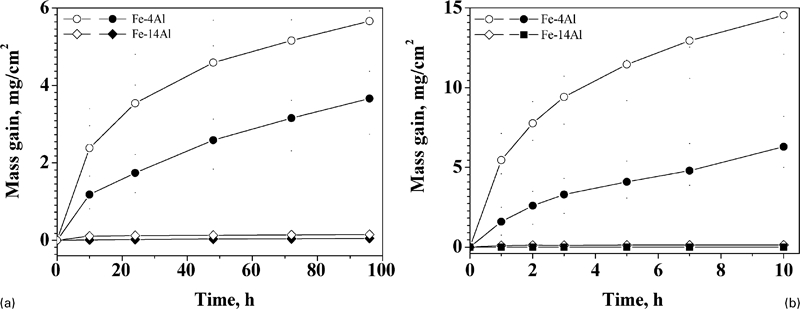
Graphs of mass gain versus time for corrosion of Fe–4Al and Fe–14Al alloys corroded in the CO2–H2–HCl–H2S mixture (o) and in the CO2–H2 mixture (•) at a 600°C for 96 h and b 700°C for 10 h
Under all test conditions, the corrosion rates for the Fe–14Al alloy were lower than for the Fe–4Al alloy. At 600 and 700°C, the weight gains for the Fe–14Al alloy in the CO2–H2–HCl–H2S mixture were slightly larger than in the CO2–H2 mixture.
Scale microstructures and compositions
Backscattered electron images of the cross-sectioned Fe–4Al alloy after 96 h at 600°C for in both gaseous atmospheres are shown in Fig. 2. In each case, the corrosion product comprised an outer layer of iron oxide, an inner layer of mixed iron–aluminium oxide and an internally oxidised zone, containing fine particles of aluminium oxide. The corrosion product formed in the CO2–H2 atmosphere was thinner, more uniform and more compact than that formed in the CO2–H2–HCl–H2S atmosphere, which had numerous defects and an outer layer with a nodular morphology. A small amount of sulphur was detected by EDS analysis in the internally attacked region, close to the scale/alloy interface. Chlorine was not detected in the corrosion product, at the interface, or in the internally attacked zone.
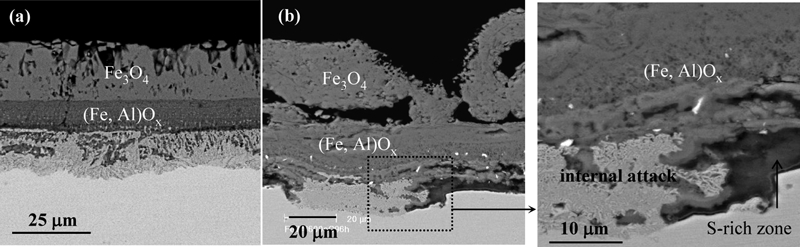
Micrographs (SEM) showing cross-sections of Fe–4Al alloy corroded at 600°C for 96 h in a CO2–H2 atmosphere and b CO2–H2–HCl–H2S atmosphere
The corrosion product formed on the Fe–4Al alloy after 10 h at 700°C in the CO2–H2 atmosphere is shown in Fig. 3a. The microstructure was similar to that observed after the 96 h test at 600°C in the CO2–H2 mixture (Fig. 2a); however, the external scale and the band of internal oxides precipitates were thinner after the shorter test at the higher temperature.
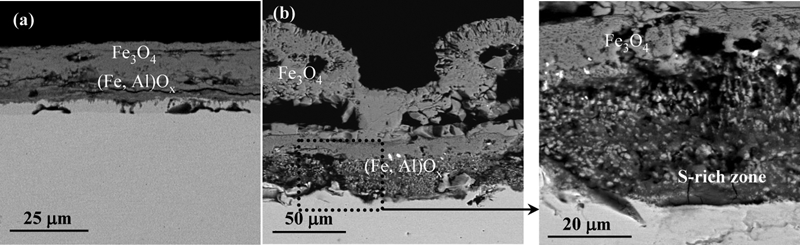
Micrographs (SEM) showing cross-sections of Fe–4Al alloy corroded at 700°C for 10 h in a CO2–H2 atmosphere and b CO2–H2–HCl–H2S atmosphere
The scale formed on the Fe–4Al alloy in the CO2–H2–HCl–H2S atmosphere after 10 h at 700°C is shown in Fig. 3b. The scale was similar in morphology to the scale grown in 96 h at 600°C, but was thicker, and contained more cracks and pores, particularly in the outer layer of oxide. Small amounts of sulphur and traces of chlorine were detected at some locations close to the scale/alloy interface.
Corrosion of the Fe–14Al alloy at 600 and 700°C in both gas mixtures resulted in the formation of thin protective alumina scales. Such scales were consistent with the small weight gains presented in Fig. 1.
Discussion
It has been found that the Fe–4Al alloy corrodes more rapidly in the CO2–H2–HCl–H2S mixture than in the CO2–H2 mixture, and the increased corrosion rate is attributed to the presence of chlorine and sulphur in the gaseous atmosphere.
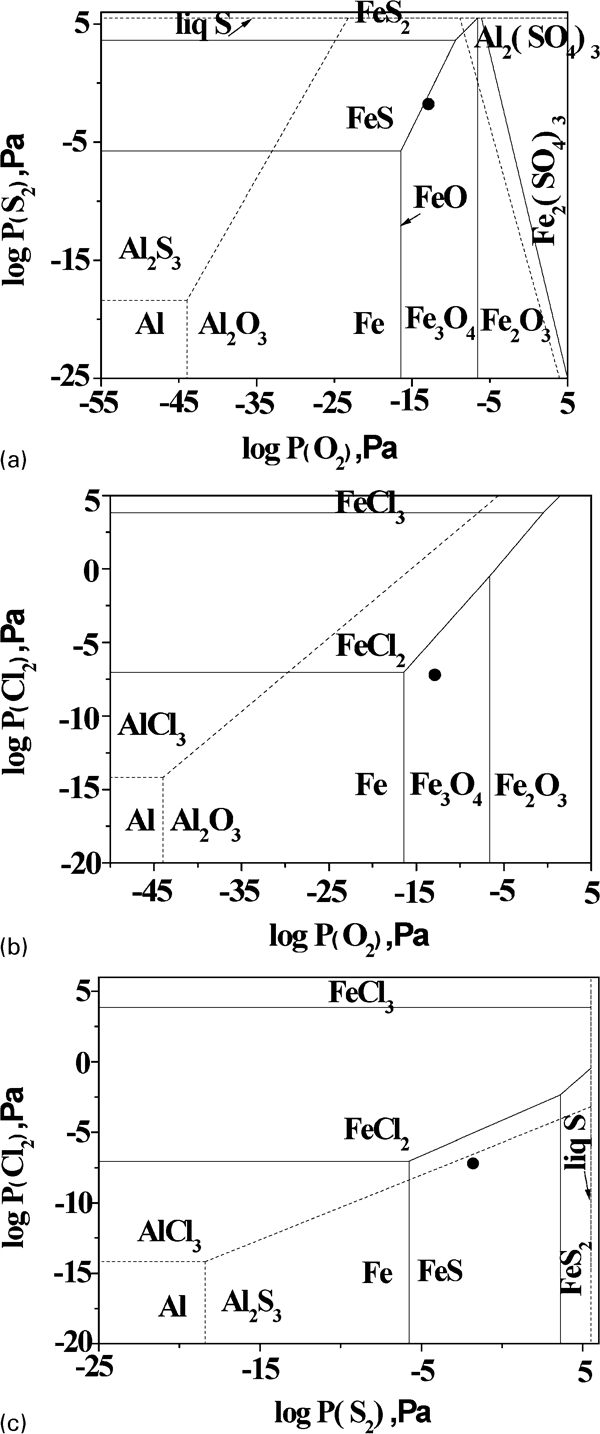
Superimposed phase stability diagrams may be helpful in explaining the thermodynamics of alloy corrosion in multireactant environments. 9 9,10 Figure 4a shows superimposed diagrams for the iron–oxygen–sulphur and aluminium–oxygen–sulphur systems at 600°C. Similar diagrams for the metal–oxygen–chlorine and metal–sulphur–chlorine systems are shown in Fig. 4b and Fig. 4c respectively. Figure 5 shows the corresponding series of superimposed phase stability diagrams at 700°C. The equilibrium partial pressures of oxygen, sulphur or chlorine in the CO2–H2–HCl–H2S atmosphere, at the appropriate temperature, are marked on each diagram. The phase stability diagrams indicate that oxides of iron and aluminium are the stable corrosion products in the CO2–H2–HCl–H2S atmosphere at 600 and 700°C; however, the diagrams do not indicate the formation of mixed iron–aluminium oxide. The relative stabilities of oxides, chlorides and sulphides in the corrosion products depend on the partial pressures of oxygen, chlorine and sulphur established in the bulk gaseous environments, and on the microenvironments created at various locations within the corrosion products. The stable phase at a particular location in the corrosion product is dependent on the local activity of the reactants. Chlorides (FeCl2 and AlCl3) and sulphides (FeS and Al2S3) may be formed as corrosion products at sites of sufficiently low oxygen pressure.
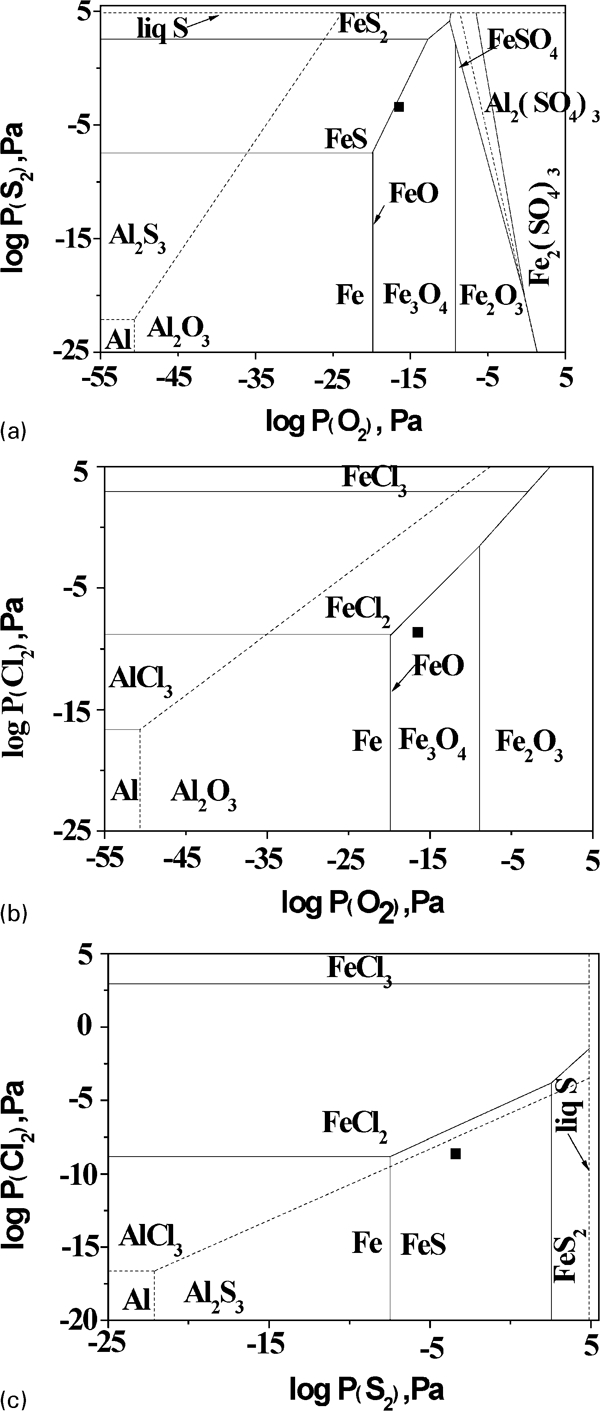
Superimposed phase stability diagrams for a Fe–O–S and Al–O–S, b Fe–O–Cl and Al–O–Cl, and c Fe–S–Cl and Al–S–Cl systems at 600°C: partial pressures of O2, S2 and Cl2 in the CO2–H2–HCl–H2S atmosphere are marked (▪) on each diagram
Superimposed phase stability diagrams for a Fe–O–S and Al–O–S, b Fe–O–Cl and Al–O–Cl, and c Fe–S–Cl and Al–S–Cl systems at 700°C: partial pressures of O2, S2 and Cl2 in the CO2–H2–HCl–H2S atmosphere are marked (•) on each diagram
The corrosion of the Fe–4Al alloy is influenced by kinetic factors, which are not explained by the phase stability diagrams. The oxide scale formed on the Fe–4Al alloy is evidently an ineffective barrier to the transport of chlorine and sulphur to the underlying alloy. Localised increases in the activities of chlorine and sulphur may occur at defects in the scales. Porous scales permit the penetration of corrosive species, which react with alloying elements at the alloy/scale interface.
Other researchers have reported increased corrosion rates in mixed gases containing gaseous chlorine species, even though the amount of chlorine detected in the corrosion products is generally small. 11 11,12 In the CO2–H2–HCl–H2S atmosphere, metal chlorides with significant vapour pressures form as corrosion products near the scale/alloy interface, and diffuse towards the scale/gas interface where the oxygen activity is higher. The metal chlorides then react with oxygen to form metal oxides and small amounts of free gaseous chlorine. The gaseous chlorine diffuses towards the alloy/scale interface and reacts with the alloy to form additional metal chlorides. The cycle becomes self-sustaining as chlorine is generated, transported through the scale to the alloy/scale interface and reacted to form metal chlorides. Significant amounts of metal chlorides are not detected in the corrosion products as these compounds have high vapour pressures and are readily converted to metal oxides.
The Fe–4Al alloy develops an outer layer of iron oxide, an inner layer of iron–aluminium spinel and particles of aluminium oxide beneath the alloy/scale interface. Internal oxidation of the Fe–4Al alloy is expected as the aluminium content is insufficient to form an alumina healing layer. It has previously been reported that binary iron-aluminium alloys require a critical aluminium content of 7-10% to suppress internal oxidation of aluminium at 800-900°C in an oxidising atmosphere.13 At 600 and 700°C, it has been found that the addition of hydrogen chloride and hydrogen sulphide to the CO2–H2 gaseous mixture promotes the internal oxidation of aluminium in the Fe–4Al alloy. Gaseous HCl and H2S penetrate through the porous external scale to the alloy/scale interface; chlorine and sulphur dissolve in the alloy, diffusing and reacting to form internal chloride and sulphide precipitates in the internal oxidation zone. The chlorides are volatile and unstable; the sulphides are more stable and are detected close to the alloy/scale interface and near the internal precipitates of aluminium oxide.
The corrosion of the Fe–4Al alloy is influenced by mechanical factors, which cannot be explained by the phase stability diagrams. The conversion of chlorides to oxides generates significant growth stresses, which account for the porosity, poor mechanical properties and detachment of the oxide scales during the preparation of cross-sections. The penetration of sulphur and chlorine to the alloy/scale interface may account for the poor adhesion of the scale formed on the Fe–4Al alloy in the CO2–H2–HCl–H2S atmosphere. According to some researchers, interfacial roughening and void formation contribute to the spalling of oxide scales.14 – 16
The Fe–14Al alloy contains sufficient aluminium to form thin protective alumina scales in the CO2–H2 and CO2–H2–HCl–H2S atmospheres. The alumina scales act as barriers to the penetration of chlorine and sulphur, and the alloy gains mass slowly as oxidation proceeds. Additions of HCl and H2S to the CO–H2 atmosphere have little effect on the rates of oxidation in tests lasting 96 h at 600°C and 10 h at 700°C.
Conclusions
Fe–4Al and Fe–14Al alloys were tested in CO2–H2–HCl–H2S and CO2–H2–atmospheres at 600 and 700°C.
In the CO2–H2 atmosphere, the corrosion product on the Fe–4Al alloy consisted of an outer layer of iron oxide, an inner layer of iron–aluminium oxide and a band of internal aluminium oxide precipitates.
Accelerated corrosion of the Fe–4Al alloy in the CO2–H2–HCl–H2S atmosphere was attributed mainly to the formation of volatile metal chlorides, which led to the rapid growth of porous non-protective oxide scales.
Penetration of sulphur through the non-protective scale on the Fe–4Al alloy led to the formation of sulphides near the alloy/scale interface.
The Fe–14Al alloy was resistant to corrosion under all test conditions. The higher aluminium content of this alloy resulted in the formation of a thin alumina scale, which conferred protection in reducing gases containing hydrogen chloride and hydrogen sulphide.
Footnotes
Acknowledgements
The authors acknowledge financial support by the Natural Scientific Foundation of Jiangsu Province, China, under Contract SBK200930394, and by the Higher Education Natural Scientific Foundation of Jiangsu Province, China, under Contract 08KJB430003.