






Abstract
This year's Eurocorr conference took place at the International Fairs, in Stockholm from 4th to 8th September 2011. The focus of the meeting was ‘Developing solutions for the global challenge’. The meeting attracted over 800 delegates and over 300 papers and 130 posters were presented during the 28 sessions and workshops. Parts 1-5 will review the technical sessions over five issues with the opening and plenary lectures and technical sessions on coatings, environmentally assisted cracking and nuclear corrosion covered in this report.
EUROCORR is an annual conference organised on behalf of the European Federation of Corrosion (EFC) and is generally regarded as the premier corrosion conference in Europe. The conference moves from country to country and this year took place at the Stockholm International Fairs in Stockholm, Sweden, which was readily accessible using the excellent public transport system that Stockholm offers. The organisation was split between an international scientific committee mainly composed of working party chairmen, a Swedish scientific committee, a local organising committee and Dechema. The international scientific committee was chaired by Ingegerd Annergren, Swerea KIMAB AB, Sweden and co-chaired by Damien Féron, STAC Chairman, Commissariat à l'Énergie Atomique (CEA)/Saclay, Gif-sur-Yvette, France and Philippe Marcus, EFC President, École Nationale Supérieure de Chimie de Paris, France.
The number of delegates topped the 800 mark, which was an excellent number and gave a vibrant feel to the meeting. There were 28 sessions, 18 of which were run by working parties, plus 6 joint sessions and 4 workshops with over 300 oral and 130 poster presentations. The conference venue was spacious with a good sized exhibition area, close to where the posters were displayed and coffee served. All the active EFC working parties organised sessions as well as holding working party meetings throughout the four days.
This year the EFC General Assembly (GA) took place before the conference, on the Sunday evening and this was conducted by Philippe Marcus, EFC President. Social events included a tour of and banquet in Stockholm City Hall on Monday evening sponsored by Sandvik. The City Hall is where the Nobel prizes are given out every January and is an amazing place inside. This event was excellent and thanks must be expressed to Sandvik for laying it on free of charge and hosting it (shows there is money to be made in distributing stainless steel!) There was also an enjoyable poster party sponsored by Swerea on the Tuesday and the Congress dinner was held at the Ostermalms Saluhall on Wednesday (Krzysztof Wolski has kindly provided some pictures of this). Figure 1 Figure 2
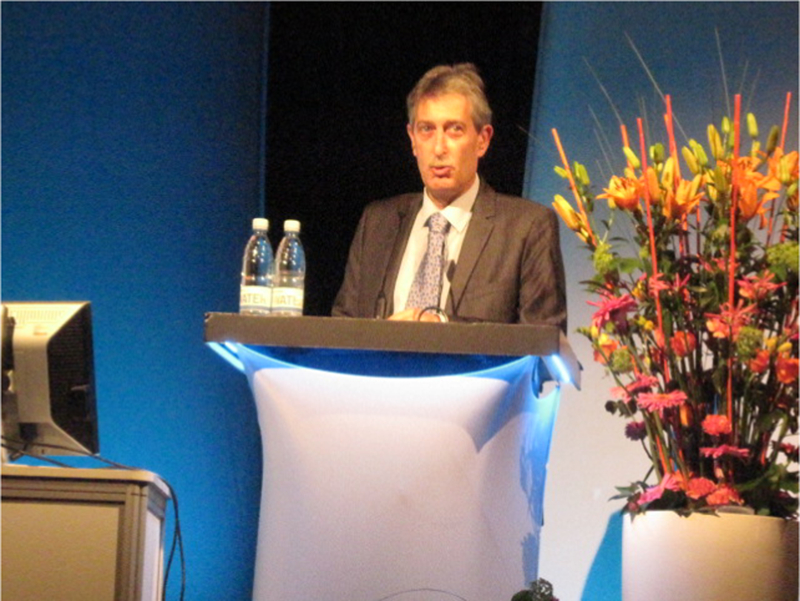
Philippe Marcus, EFC President
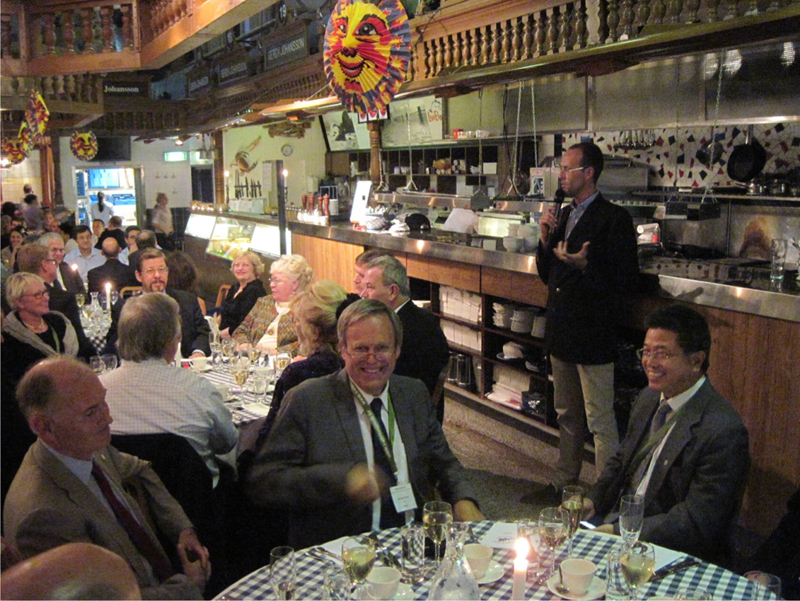
Damien Féron at the Congress dinner
Opening session and plenary lectures
The conference opened on Monday morning with a welcome from Ingegerd Annagen from Swerea Kimab. She handed over to J-O Nillson from Sandvik (the main sponsor) who gave a short talk on the uses and the history of stainless steel (invented by Bradley in 1912) as well as looking at some of the modern techniques used for examining corrosion. He pointed out that government and industry pay too little attention to corrosion (all delegates agreed!) before going on to tell us about some of the delights of Stockholm. Figure 3
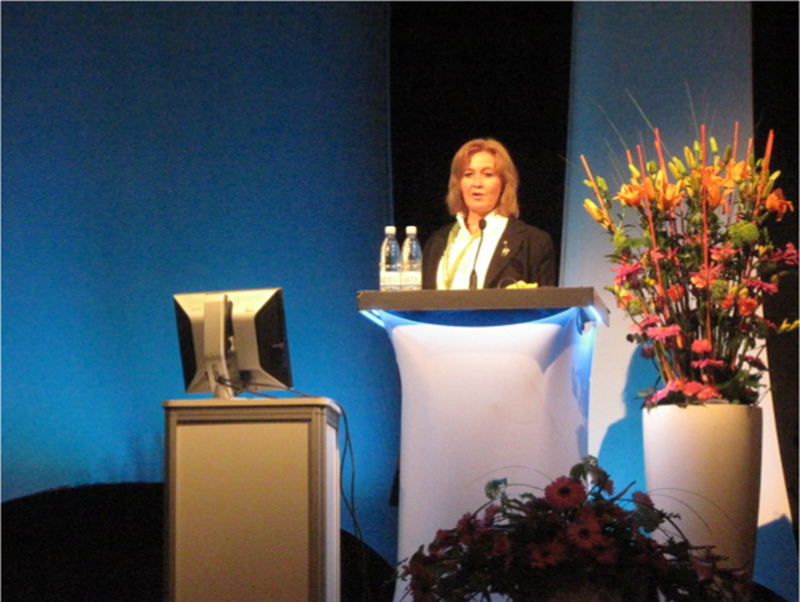
Ingegerd Annagen, Swerea Kimab giving the opening address
This was followed by Philippe Marcus who came on stage to present the recently retired Scientific Secretary, Dr Paul McIntyre, with an honorary life fellowship of the EFC. This was then followed by the presentation of the European Corrosion Medal to Gunter Schmitt. It was pointed out that Gunter had run the Inhibitors working party for many years and although he is chiefly an academic, had always been keen to bridge the gap between academia and industry. Gunter went on to give an excellent talk about inhibitors entitled ‘Corrosion inhibition and flow’, which included an analogy with freak waves as it appears that inhibitors act to reduce the height of freak events for example, they move critical flow velocity to higher values. Figure 4
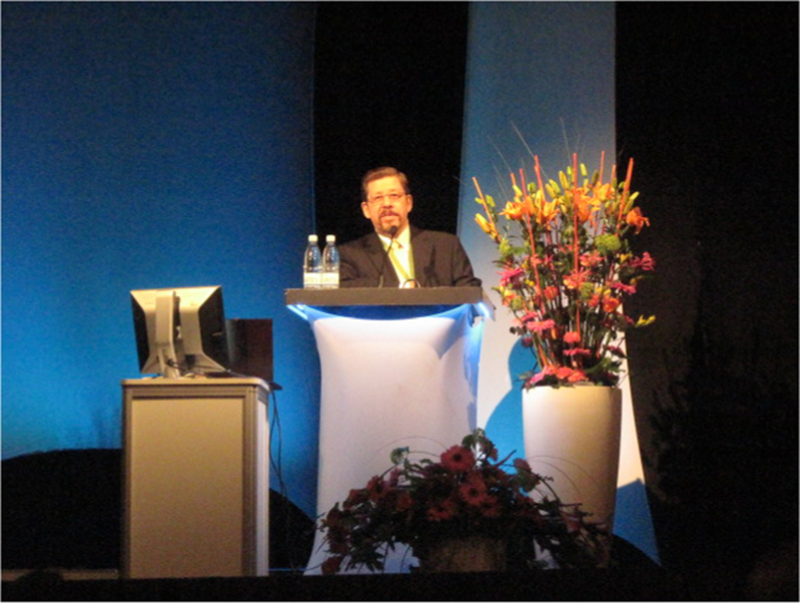
Gunter Schmitt giving a plenary lecture
There was then a lengthy contribution from Kevin Ogle from Chimie ParisTech, France entitled, ‘Atomic emission spectroelectrochemistry: a new look at the corrosion, dissolution and passivation of complex materials’. Kevin enthusiastically showed how this in situ method (AESEC) can pick up what is going on chemically just close to the metal surface while it is actually happening, something that electrochemical techniques which just measure current or voltage cannot do and obviously is a great advantage. He gave many examples; from the pickling in acid of mild steel to pitting corrosion of aluminium. Delegates then retired for a somewhat shortened coffee break before breaking out into ten parallel sessions.
On Tuesday, the plenary lecture was given by P. Samuelsson, Outokumpu Group, Sweden on ‘Trends and drivers in the development and use of stainless steels’. The high cost of nickel has been driving change in the composition of stainless steels and has led to the development and introduction of lower nickel alloys such as new lean duplex steels, and the expansion of ferritic grades containing no nickel at all. Use of duplex steels has also increased during the period. Ferritic and chromium-manganese austenitic grades today represent some 45% of the total stainless steel sales compared to some 30% ten years ago.
On Wednesday, Peter Brimblecombe, University of East Anglia, Norwich, UK gave a good paper entitled, ‘Long term damage to metallic heritage’ focusing on acid damage to urban metals in the 19th and 20th centuries. The acids were deposited with coal smoke, a problem that provoked wide concern during the acid rain era of the 1980s. More recently, air pollutants from automobiles, particularly those with diesel engines have continued this concern, along with the more oxidising atmospheres that come about in photochemical smog conditions. Improvements to overall rates of urban corrosion in the developed world have accompanied fuel change and clean air legislation during the 20th century. However, these improvements have sometimes been offset by the potential risks posed by novel pollutants and a sharply changing climate in the 21st century.
A somewhat unusual plenary lecture was presented on Thursday, entitled, ‘Acts of secrecy-the DC-3 that disappeared’ by Christina Tengnér from the Army Museum, Stockholm. In 1952 a Swedish military radio surveillance aircraft, a modified DC-3, was shot down into the Baltic Sea by a Soviet Mig Fighter. The aircraft was located in 2003 and the next year was salvaged from a depth of 125 meters outside the island of Gotland. After salvage and forensic investigation it was decided to turn the wreck into a museum object placed at the Air Force Museum in Linköping. The paper focussed on the conservation process of this modern marine archaeological museum object. It also discussed the preservation of aluminium and the other metals present in the wreck with a focus on the differences and similarities in corrosion prevention methods for industrial and museum purposes.
Technical programme
Moving away from the plenary lectures and awards and looking at the technical side of the meeting. In addition to technical sessions there were a number of workshops including; corrosion in natural environments, corrosion and corrosion protection in the aerospace industry, and on nanotechnologies. Joint sessions included; EFC-CEOCOR, materials and disinfection, and local microprobes to study surface treatments and coatings produced by nanotechnologies.
The papers from these and the technical sessions appear on the conference proceedings CD-ROM and selected presentations will be reported in subsequent conference reports. As in previous years, the policy will be to review a selection of the most interesting full papers. It is anticipated that in most cases (particularly for the working party sessions) the choice will be assisted (or even exclusively made!) by the working party chairmen.
Coatings
As in previous years, the coatings session was one of the largest (WP 14) with over one hundred presentations given over the four days of the meeting. The session was divided into various topics including; sol gel/self healing coatings, organic and inorganic coatings, anodising layers and metallic coatings. There were 41 full papers available on the CD-ROM and Lorenzo Fedrizzi, the WP Chair, has identified the best papers presented during the session. A synopsis is given where the full paper is available on the CD-ROM and the papers are discussed in the order that the sessions were delivered.
Sol gel and self healing coatings
In the sol gel/self healing area, a full paper was ‘Development of innovative nanoparticle-based protective coatings for the production of High-Strength Steel (HSS) components by pre-hardening’ given by M. Yekehtaz DECHEMA e.V., Frankfurt am Main, Germany. To reduce the friable oxide layer which forms, an inorganic protective coating made by the sol-gel method had been developed. Among several binary and ternary systems containing alkali oxides investigated, those containing Si/Al/Li and Si/Al/K oxides showed the best protective properties. Using XRD measurements it was shown that mixed oxide layers containing lithium show a crystalline structure at higher temperatures whereas a sol containing potassium has an amorphous nature.
Another paper from the same establishment was ‘Self-healing corrosion protective coatings for magnesium alloys by modifying anodizing layers with corrosion inhibitors’ by D. Tabatabai. AZ31 was anodized in 3 M KOH solution at different voltages below 4 V. It was shown that with increasing voltage the growth rate of the resulting anodising layer increases as well as the amount and width of cracks in the layer. Potentiodynamic polarisation tests revealed an improved corrosion protection. Anodising layers generated in alkaline dispersions of silica nanoparticles contained silicon in a homogeneous distribution, as shown by WDX based cross section images of the anodised samples. The amount of incorporated silicon rose when the electrical conductivity of the anodising electrolyte is lowered by dilution.
There were also four good presentations in this area; ‘Self-healing anticorrosive organic coating based on encapsulated healing-agent: local electrochemical evaluation’ delivered by J M C Mol from TU Delft, The Netherlands, ‘Anticorrosion protection mechanism offered by organic and inorganic REM salts in aqueous solution and epoxy organic coatings’ from S.J. Garcia, Delft University of Technology, the Netherlands, ‘Self-healing corrosion protective coatings for magnesium alloys by modifying anodizing layers with corrosion inhibitors’ delivered by D. Tabatab, DECHEMA e.V., Frankfurt am Main, Germany and ‘Assessment of the self healing ability of smart coatings: a combined use of localised electrochemical techniques’ given by F. Montemor, TU Lisbon, Portugal.
Organic coatings
A full paper of particular interest to this reviewer was ‘Influence of UHP (Ultra high pressure) waterjetting on shop primer coated steel substrate for new construction in naval industry’ given by Philippe le Calve, from DCNS, Lorient France. Three paint systems applied on zinc-rich shop primed steel after abrasive blasting (Sa21/2) and after UHP waterjetting (DHP4 and DHP1) were compared after artificial cycling test and natural ageing on a site qualified for a C5M corrosivity category. Similar behaviours were found between both surface preparation methods. The conclusion was that UHP waterjetting is effective for flat zinc shop primed surface in new construction, in particular for welded areas and areas with a moderate roughness. A similarly practical paper was Nathalie Lebozec's ‘Influence of climatic factors (UV, salt concentration, wet-dry cycle) in cyclic corrosion tests used for marine paint systems’, the work being done at the French Corrosion Institute, Brest, France. Experiments had been designed to study the effect of important climatic parameters such as UV, NaCl concentration and wet-dry cycle on the corrosion resistance of 15 different marine paint systems. The results showed that NaCl concentration plays an important role in the paint degradation while UV exposure in a cyclic corrosion test has no major influence. More of a lab based study was ‘Investigation into the effect of nano-silica particles on the protective properties of polyurethane coatings’ by Douglas Mills from University of Northampton, UK. To investigate whether these tiny particles could effect an improvement of scratch, abrasion and corrosion resistance of clear coats, panels coated with polyurethane with three levels of addition (0%, 5% and 10%) and cured at three different temperatures (20°C, 70°C and 110°C), were exposed to 3% NaCl solution for 1000 h and electrochemical measurements conducted. The effect of nanoparticles on cross-linking density and glass transition temperature (Tg) was investigated by DMTA. Electrochemical results showed a positive effect on the permeability properties for PU coatings with 5% of embedded nano- silica particles. Coatings cured at higher temperatures showed improved protective properties.
Another highlighted paper was ‘Corrosion protecting coating systems in Arctic areas’ given by Astrid Bjørgum from SINTEF Trondheim, Norway. Five protective coating systems were investigated. Ageing resistance testing according to ISO 20340 (but using temperatures down to -60°C) showed acceptable performance for several systems. The reinforced polyester coating system was highly resistant towards corrosion creep. The vulcanized rubber coating and a conventional three-coat paint system showed good performance with respect to rust creep. However, the polysiloxane topcoat cracked during testing. This also showed cracking in different mechanical tests and failed in several of the impact resistance tests. The final paper selected for comment is ‘Effect of process related residues on the performance of conformal coatings for PCBA applications’ by Rajan Ambat, Technical University of Denmark Lyngby, Denmark. A plain laminate surface, a Surface Insulation Resistance (SIR) pattern with 15 mm spacing conducting lines and a test PCBA, were coated with conformal coatings and exposed to a wide range of environmental conditions. Their performance was evaluated using change in morphology of the coating on the laminate surface, decrease in surface insulation resistance across the conducting lines, and analysis of the failures like dendrites formation due to electrochemical migration (ECM) under the coating. Results showed that the flux residues greatly degraded the performance of the coatings; particularly there is increased corrosion attack at the interface once the coating is delaminated.
Two well presented papers in this area were; ‘Epoxy-coated reinforcement - quantitative assessment of the water absorption by use of NMR’ by M Zintel from TU Munich, Germany and ‘SKP and EIS study of filiform corrosion on electrocoated AA 6016: role of metal pre-treatment and dimension of defect’ by A Nazarov, French Corrosion Institute, Brest, France.
Inorganic coatings
‘The passivation effect of thin iron oxide films in carbonate and phosphate solutions’ was delivered by V Miskovic-Stankovic, University of Belgrade, Belgrade, Serbia. Electrochemical studies demonstrated that spontaneous passivation can occur on the steel surface exposed to CO2 saturated NaCl solution, resulting in a higher open circuit potential. Surface analysis showed that beneath the many micrometers thick FeCO3 film, a passive Fe3O4 film, with a thickness scale on the nanometer level, forms. To try to improve the corrosion stability, phosphate layers were artificially deposited on steel from a phosphate bath. In cases of both spontaneous and artificially induced passivation, the key factor was formation of a thin iron oxide layer. There was also a good presentation on the ‘Investigation of photocatalytic activity of titanium dioxide coating deposited on aluminium alloy substrate by plasma technique’ by R. Ambat, TU Denmark, Lyngby, Denmark. Within the anodizing group there was ‘Nanochemical impregnation of Modified Phosphoric Acid Anodised (MPAA) layers’ – a promising replacement for Chromic Acid Anodising (CAA) by S.K. Weidmann from DECHEMA eV, Frankfurt am Main, Germany. Open porous oxide layers were prepared by the MPAA-process and impregnated via chemical nanotechnology in order to enhance the thickness of the barrier layer and consequently the corrosion resistance while leaving some pores unsealed in order to preserve the good adhesion properties. A promising impregnation had been obtained by a dip coating process with commercially available silica nanoparticle dispersions. The impregnation parameters had been systematically investigated and a model of the impregnation mechanism is currently being developed.
Metallic coatings
A paper on ‘Corrosion in sulphur containing media and wear behaviour of Ni matrix micro- and nano-composite electrodeposits’ was presented by M. Lekka from the University of Udine, Italy. To try to alleviate corrosion of geothermal wellhead valves in sour gas environments, pure Ni deposits, Ni containing SiC micro-particles and Ni containing SiC nano-particles were prepared on steel plates and corrosion and wear properties (latter at RT and at 300°C) had been investigated. The corrosion resistance of the coatings has been evaluated by potentiodynamic polarization curves in a solution containing S2−, SO4 2−, Cl− ions. SEM, Glow Discharge Optical Emission Spectroscopy and Vickers microhardness measurements were used for assessment. It was found that the co-deposition of SiC particles led to a significant increase of both microhardness and wear resistance as well as an increase in the corrosion resistance. Additionally within the metallic coatings area, there were three good presentations including; ‘Corrosion behaviour of aluminized steel: influence of silicon and magnesium as alloying elements’ delivered by I. De Graeve, Free University of Brussels, Belgium ‘Ultrasonically enabled low temperature electroless plating’ by A.J. Cobley, from Coventry University, UK and ‘Influence of additives on the mechanical and protective properties of electrodeposited Ni/Al2O3 composite coatings’ by E. García - Lecina, Institut Fundacion Tekniker, San Sebastián, Spain.
Posters
There were about thirty two posters displayed in the Coatings session, some of which were very good. A couple which appear as full papers on the CD-ROM are described below. One such paper was ‘Effect of surface preparation on protective efficiency of organic coatings’ by Sina Jamali et al. from the University of Northampton, UK. Five methods of surface preparation had been applied to mild steel and the resulting surface characterized using inter alia the scanning vibrating electrode technique (SVET). The metals were then organically coated and exposed to a corrosive environment during which time their DC resistance and Impedance were monitored. The wet and dry adhesion strength were also measured using an automated pull-off adhesion method. Results indicated that surface geometry governs the electrochemical activity of metal. It was concluded that where effective metal-coating bonds are missing, surface activation will promote corrosion. Another poster was ‘Electrochemical surface analysis of multi-metal pre-treatments for zirconium-based conversion coatings’ by J. Cerezo from Delft University of Technology, Delft, The Netherlands. Three different metals (AA 6014, cold rolled steel and hot dip galvanized steel) immersed in three different alkaline-based cleaning solutions had their open circuit potential measured at 57°C. The effect of this on the deposition of the zirconium-based coating was studied. Results showed that the alkaline cleaning time does not have an effect on the open circuit potential for the cold rolled steel. This is not the case for the hot dip galvanized steel and AA 6014, where differences of the order of 50 and 200 mV respectively were found for different cleaning times.
Environmentally assisted cracking
The environmentally assisted cracking session (WP3) took place throughout Monday. It was chaired by Krzysztof Wolski from the Ecole Nationale Superieure des Mines de Saint Etienne, France together with co-chair Vignis Olden from SINTEF in Trondheim, Norway. There were seven full papers on the CD-ROM, of which a few have been chosen for comment here. Figure 5
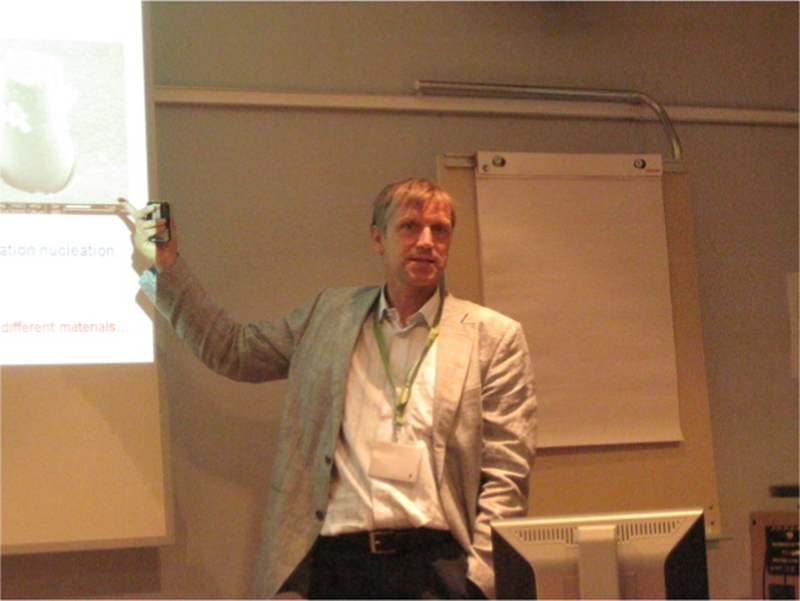
Krzysztof Wolski Chair of the environmentally assisted cracking working party
The first paper was ‘Cohesive zone simulation of cold cracking susceptibility in hyperbaric welds of X70 structural steel’ given by Vignis Olden. Fracture mechanics SENT testing and finite element simulation to establish hydrogen influenced cohesive parameters for X70 structural steel welded joints, both base metal and weld simulated coarse grained heat affected zone (HAZ), had been performed. The base metal did not fail at net section stresses lower than 1·29 times the yield strength. It also revealed low sensitivity to hydrogen embrittlement. The HAZ was prone to fracture at stresses above 64% of the yield strength, which indicates hydrogen embrittlement susceptibility. Krzysztof Wolski himself presented a good paper attended by this reviewer which, although not on the CD-ROM, will subsequently be available in ‘Nuclear corrosion science and engineering’, Woodhead Publishing (2012) edited by Damien Féron. The paper was entitled ‘Modelling environmentally assisted cracking: review of main ingredients as a function of temperature’ and topics covered included hydrogen induced cracking versus anodic processes, stress corrosion cracking, liquid metal embrittlement and some issues concerning oxygen embrittlement during high-temperature corrosion. A broad view of the possible causes and associated mechanisms of embrittlement and cracking of mainly austenitic stainless steels and nickel-based alloys was provided. Stress corrosion cracking (SCC) of some specific alloys and components in nuclear application were also highlighted.
A third paper was ‘Delayed fracture and stress corrosion cracking of FeMn- TWIP steels’ delivered by Fabian Unterumsberger, from the Ruhr-Universität Bochum, Bochum, Germany. Stress corrosion cracking susceptibility (SCC) of high strength FeMn- and FeMnAl-TWIP steels was investigated using methods such as constant load tests (CLT) in corrosive media with anodic and cathodic polarisation. The results revealed a clear relationship between the applied load and the time-to failure. With increasing load, the time-to-failure diminishes dramatically. On the other hand CLT samples tested under cathodic polarization did not fail over a 1000 hrs testing time. Overall the SCC of FeMn- and FeMnAl- TWIP steels was shown to be closely related to the corrosion behaviour of these steels, e.g. dissolution rate and degree of hydrogen evolution.
Nuclear corrosion
The nuclear corrosion session (WP4) chaired by Damien Féron ran on the Wednesday and Thursday morning and four papers have been chosen for comment. The first was ‘The electrochemistry of carbon steel in simulated concrete pore water in boom clay repository environments’ given by Digby Macdonald from Pennsylvania State University, USA. He started by explaining how prediction of corrosion damage over 1000 years can only be made using deterministic models and all predictions are constrained to being ‘physically real’ by the natural laws (conservation of mass, energy, charge and mass charge equivalence (Faraday's Law)). He went on to show how, by using the Point Defect Model (PDM) to extrapolate damage to future times, the actual measurement of experimental data could allow the deterministic prediction of damage to the carbon steel overpack of the super container in Belgium's proposed Boom Clay repository. Also an experimental program was described, designed to generate values for various PDM parameters that will be required in making the damage predictions for the corrosion of carbon steel and stainless steel. The impact of chloride, sulphide, and thiosulphate anions and mixtures of these species, on the electrochemical behaviour in simulated concrete pore water had also taken into account.
This was followed by ‘Environmental effect on cracking of austenitic stainless steels ex-posed to PWR Primary water under cyclic loading’ by Nicolas Huin, EDF R&D, Mai, France. The French Safety Authority apparently do not take into account the potential deleterious effect of the environment when estimating the mechanical behaviour of components exposed to PWR water under cyclic loading. That this is somewhat foolhardy had been demonstrated by results obtained from 304L stainless steel samples tested in PWR water (performed by GE and sponsored by EDF) where it was shown that the strain rate (range 4×10⁻³ s−1 to 4×10⁻⁵ s−1) affected each step of fatigue life. A possible explanation could be a difference of competition between cracks induced by metal/oxide interface at the early stage of fatigue life.
The third paper returned to the challenge of waste disposal with ‘Corrosion of steel drums containing immobilized intermediate level nuclear waste’ given by G.S. Duffó from Consejo Nacional de Investigaciones Científicas y Técnicas, Argentina. The steel drums were in contact with cemented ion-exchange resins with different types and contents of aggressive species. A special type of specimen was designed to simulate the cemented resins in the drum. The evolution of the corrosion potential and the corrosion rate of the steel, as well as the electrical resistivity of the matrix were monitored for 900 days. Results showed that the corrosion depth of the steel drums after a period of 300 years (foreseen life-span of the radioactive waste disposal facility), in the most unfavourable case (high chloride contamination), will be considerably lower than the thickness of the wall of the steel drums.
Finally in this brief review there was ‘Crystallographic and plasticity effects on the first oxidation steps of stainless steel 316L’ by R Soulas from the Domaine Universitaire Saint Martin d'Hères, France. It was shown that this 316L alloy, used in many different PWR (Pressurized water reactor) components, shows a double layer oxide structure during the early time of oxidation. This layer, already rich in chromium and amorphous before oxidation, grows and crystallizes into FeCr2O4 as inner part and Fe3O4 as outer part when oxidation proceeds. Macroscopic observations showed that this sequence occurs irrespective of the crystallographic orientation of the grain whereas growth kinetic depended on crystallographic orientation, with faster oxidation of [111] orientations occurring.