






Abstract
The 2012 Eurocorr meeting was held at the Sheraton Maslak hotel, Istanbul from 9-13th September 2012. The focus of the meeting was ‘Safer world through better corrosion control’. The meeting attracted over 650 delegates and over 360 papers and 125 posters were presented during the 27 sessions and workshops. Parts 1-4 review the technical sessions over four issues with technical sessions on: corrosion in the nuclear industry, environmentally assisted corrosion, corrosion education, tribocorrosion, corrosion in drinking water supplies and aerospace corrosion covered in this report.
Corrosion in the nuclear industry
The nuclear corrosion session took place throughout Wednesday and was chaired by D. Féron from CEA-Saclay, Gif Sur-Yvette Cedex, France. Nine presentations were given during the session of which three have been chosen for comment here. ‘Corrosion of copper by water under oxygen-free conditions’ was presented by S. Lehmusmies, Aalto University, Finland. Hydrogen evolution by copper in water without any dissolved oxygen was monitored via pressure increase experiments. The studies were complemented with hydrogen thermal analysis and gas mass spectrometry. Experiments were made using OFHC foil samples in a two-chamber cell system, with the chambers separated by a palladium foil to act as a membrane. The test solution used was ultrapure water at 60°C. Mass spectrometry results support the conclusion that hydrogen gas is produced when copper is exposed in ultrapure water without dissolved oxygen under the conditions of the present experimental set-up.
The next presentation was ‘Oxidation and dissolution of binary Ni-Cr and ternary Ni-Cr-Al alloys in stagnant liquid lead at 750°C’ by O. Picho, Karlsruhe Institute of Technology, Germany. Static corrosion tests were conducted to establish dissolution and oxidation behaviour of binary Ni-Cr (with 0, 25, 30, 35 and 48 mass% of Cr) and ternary Ni-Cr-Al (with 1, 3 and 5 mass% of Al) in liquid lead at 750°C and Co = 10−6 mass% of dissolved oxygen. Aluminium addition to Ni-Cr alloys generally improves oxidation resistance as a result of formation of a α-Al203 layer or a scale containing both α-Al2O3 and Cr2O3. It was concluded that significant dissolution attack occurred for the low Cr (≤35 mass% of Cr) and Al (≤3 mass%) contents. It led to the formation of oxide scales away from the metal surface, to selective leaching of Ni at the grain boundaries and resulted in high material loss up to 150 μm. Ni48Cr and Ni35Cr5Al performed best with respect to metal recession.
On a similar theme, ‘Mechanism and modelling of austenitic steels dissolution in liquid lead-bismuth’ was given by M. Roy, CEA, DEN, DPC, SCCME, Gif-sur-Yvette, France. Corrosion experiments were performed in stagnant liquid Pb-Bi at 773 K in the COLIMESTA device, allowing specimens to be immersed in pots containing 7L of Pb-Bi. Corrosion immersion times were 25, 290, 470, 905, 1350, 1870, 2355 and 2830 h. Four austenitic alloys were corrosion tested. Corrosion kinetics were linear so the corrosion rate is neither controlled by Ni and Cr diffusion across the ferritic layer in liquid Pb-Bi penetrations nor by dissolved Ni and Cr diffusion in Pb-Bi bulk. Corrosion kinetics of the four austenitic alloys is thus controlled by the Cr reaction dissolution rate. The dissolution reaction rate constant deduced from experimental points of the four austenitic alloys was found to be 2×10⁻⁴ g m−2 s−1 at 773 K.
‘Water chemistry control for mitigating axial offset anomaly in PWRs’ was the title of the paper given by S. Uchida, Institute of Applied Energy, Tokyo, Japan. In PWR primary coolant, it has been assumed that boron and lithium ions deposited on fuel rod surfaces under sub-cooled boiling conditions react with nickel iron oxides on the fuel surface. Accumulated boron on the fuel surface led to axial offset anomaly (AOA). The amount of boron deposited on the fuel surface was evaluated with the extended micro-layer evaporation and dry-out (MED) model. Firstly, it was concluded that the calculated deposition amount of boron on the fuel rod surface, which was four or forty times larger than measured amounts of boron and nickel oxides compounds, was seldom measured in the fuel deposits due to its high release rate. Secondly, control of nickel concentration in the primary coolant resulted in decreased nickel oxide deposition and then mitigation of AOA occurrence due to decreasing average residence time of boron on the fuel rod surface.
Central street scene
Mechanisms of environmentally assisted cracking
Audience for environmental cracking session
Five posters and nineteen papers were presented during this workshop, which ran throughout Monday and seven of these have been chosen for comment. The workshop was chaired by K. Wolski (École Nationale Supérieure des Mines de Saint Étienne, France), J. Kittel (V. Olden (SINTEF, Materials and Chemistry, Trondheim), D. Feron, T. Couvant, C. Powel and S. Bouhattate. ‘Environmental cracking in the upstream oil and gas industry’ was the title of the lecture by T. Cassagne from Total Exploration and Production, Pau, France. The three major environmentally assisted cracking (EAC) phenomena are: stress corrosion cracking in the presence or absence of H2S; hydrogen embrittlement in susceptible alloys by corrosion in H2S or by other hydrogenating sources; and corrosion fatigue in the presence of H2S. As harsher environments are encountered, further research is needed to properly use materials and in particular the CRAs. This is the case for HSC Hydrogen sulphide cracking of HS (high strength) nickel alloys as well as for the SCC (stress corrosion cracking) of CRAs in highly concentrated brines including nickel alloys. This is important for the oil and gas industry because these environment concentrated brines and hydrogen sulphides are commonly experienced in the oil and gas industry.
‘Contributions to a mechanism for HISC of duplex stainless steels based on inhomogeneous deformation’ was presented by U. Kivisäkk, AB Sandvik Materials Technology, Sandviken, Sweden. Duplex stainless steels may not need cathodic protection but may be influenced by cathodic protection installed to protect other materials such as mild steel. One common factor for failure was coarse microstructure. Several test programs have shown that fine duplex microstructure stainless steels have much better resistance against hydrogen induced stress cracking (HISC) than coarser ones. HISC testing has been performed on Sandvik SAF 2507 with different austenite grain sizes and the results have been correlated to the low temperature creep, inhomogeneous deformation, cracking behaviour and micro hardness. The very high hydrogen content, 150 to 170 ppm, of this fine grained material indicates that probably it is lower stress concentration factors that gives material with small austenite spacing its good resistance against HISC and not lower hydrogen content in the ferrite. From these investigations, a mechanism for hydrogen induced stress cracking of duplex stainless steels subject to cathodic protection has been formulated. It takes into account inhomogeneous deformation of the two phases as well as austenitic grain size.
‘Modelling inter-granular stress corrosion cracking of austenitic alloys exposed to PWR primary water’ was the paper given by T. Couvant, EDF R&D, Moret-sur-Loing, France. Stress corrosion cracking (SCC) is a major problem in nickel-based alloys of primary and secondary circuits of pressurised water reactors (PWRs). Quantitative engineering models try to predict the initiation and the crack growth rate of Alloy 600 exposed to primary water but do not describe the physical mechanism: they do not consider the deleterious effect of reverse loading on the susceptibility to cracking and are not characterised by the limiting microstructural factors driving corrosion/diffusion. The current study simulated inter-granular stress corrosion cracking (IGSCC) with quantitative modelling through the use of two complementary tools (experimentation and simulation) in order to make progress in the development of predictive engineering models for initiation and propagation. IGSCC was simulated combining an oxidation law, allowing grain boundaries to weaken when oxidation occurs, with the polycrystalline behaviour at 360°C of an austenitic stainless steel. It was assumed that the intergranular cracking of a weakened grain boundary may operate as soon as the local stress reaches 760 MPa. Cracking rates of the simulated constant elongation rate test are in quite good agreement with the kinetics observed in the laboratory.
‘The influence of plastic strain on hydrogen diffusion and trapping in weld simulated heat affected zone of X70 pipeline steel’ was the paper given by V. Olden, SINTEF, Trondheim, Norway. Electrochemical hydrogen permeation measurements had been performed on pre-strained pipeline steel base metal and weld simulated heat affected zone specimens. The level of plastic pre-strain was 0-3%. The effective diffusion coefficient decreased with higher pre-strain levels. At higher pre-strain levels the effect of plastic deformation on hydrogen diffusion dominates the influence of microstructure. Sub-surface hydrogen concentration was found to be unaffected by plastic strain. The calculated number of traps was clearly higher than results available for alpha ferrite in literature.
‘Experimental and numerical analysis of hydrogen interaction with plastic strain in a high strength steel’ was the lecture delivered by F. Vucko, Ecole Nationale Supérieure des Mines, Saint-Etienne, France. Cyclic loading tests were performed on micro-notched samples of a high-strength steel S690 (ASTM A514) under cathodic polarisation in deaerated saline solution. Subsequently, their behaviour was simulated by finite element calculations with a combined non-linear isotropic-kinematic hardening constitutive law which is capable of simulating the cyclic softening and ratcheting effects of the high-strength steel. Specimens were hydrogen charged by cathodic polarisation in 30 g.l−1 NaCl solution at −1200 mV/SCE. The solution was de-aerated and buffered at pH 4·5. Crack initiation time depended on both cumulative plastic strain and current value of stress at the notch-tip. At load ratios below 0·8, plastic strain occurred at each cycle which contributed to decreased initiation times even when local stress is decreased. A hydrogen assisted cracking mechanism was discussed based on arrangements of dislocation structures.
‘Modelling the effects of material properties of two low alloyed power plant steels on environmentally assisted cracking in high temperature water’ was the subject of a lecture by H. Hoffmeister, Helmut Schmidt University, Hamburg, Germany. Failure investigations on thermal power plant components and related laboratory testing of low alloyed steels have shown that high local plastic straining together with environmentally induced acidified solutions in corrosion pits may promote strain induced corrosion cracking (SICC). The effects of hydrogen ion reduction charges on SSRT fracture strains in high temperature water were established forl 10CrMo910 and 7CrMoVTiB1010 steels in the 1150°C/water quenched condition. It was concluded that the cracking process initiates by local anodic dissolution and subsequent acidification thus adding hydrogen induced cracking to total crack propagation. It was confirmed that cracking starts at sufficiently high plastic strain and that locally accumulated ions in pits such as chlorides and sulphides would enhance cracking.
‘Some recent advances on the diffusion and trapping of hydrogen in relation to the stress state, the microstructural heterogeneity and microstructural defects’ was given by J. Bouhattate, Université de La Rochelle, France. The kinetics of hydrogen adsorption, absorption, transport and segregation remain poorly understood. Consequently models require characterisation of these different stages. In this work, a systematic approach was developed, combining electrochemical permeation (EP) and thermal desorption spectroscopy (TDS) to access the hydrogen trapping energies and the trapped hydrogen concentrations in steels and nickel alloys. Thus the effects of vacancies, precipitates, dislocation density, and the stress state can be discussed in terms of diffusible and trapped hydrogen. Three states of hydrogen were distinguished according to their trapping energy: (i) lattice hydrogen, (ii) reversibly trapped hydrogen (∼0·3 eV) associated with elastic fields around edge dislocations and (iii) irreversibly trapped hydrogen (∼0·6 eV) associated with dislocation cores and/or vacancies. These three states were discussed in relation to the microstructural characteristics and their evolution. The results presented were part of the problem of scale transitions typically addressed in mechanics of materials.
Corrosion education and computer applications
This session ran on Wednesday morning and was chaired by Andreas Heyn from the University of Magdeburg and BAM, Berlin, Germany. There were five papers presented during the session two of which were full papers. The full papers are summarised below together with some of the abstracts.
For a number of years Alec Groysman from ORT Braude College of Engineering, Karmiel, Israel, and his wife Olga has entertained delegates at EuroCorr with unusual ‘takes’ on corrosion. We have had presentations on corrosion and art, corrosion and music, and even corrosion and sex. I normally try to get along to these talks as they make a refreshing change! I did wonder if this lecture might represent their swan song and so I would like to say a personal thank you to the Groysmans for the fun they have given us these last eight or nine years with their lectures at EuroCorr, this will be reported a bit more fully than normal.
The title was ‘Past, present and future in corrosion education (corrosion and life).’ Educators can excite interest in corrosion by connecting science to everyday life, bringing out fascinating and amusing aspects of the field and showing the role corrosion has played in the evolution of civilizations. What is the role of corrosion in art, science, technology, engineering and industry? How can we show, through teaching, both the beneficial and deteriorative aspects of corrosion? It was suggested that young engineers and scientists who study corrosion science and engineering together with humanistic aspects (history, art and philosophy) will show more creativity and satisfaction in their jobs and in their life. Hence humanitarian aspects should be more and more included in teaching and learning ‘beautifying’ corrosion science and engineering. Use of art media enhances the attractiveness of the subjects of corrosion such that its beauty and inspirations will make the younger generation of engineers and scientists more creative. The Groysmans’ experience is summarised in the book ‘‘Corrosion for Everybody’’ published by Springer.
Rather different was ‘Advanced design projects ‘Corrosion’ for future mechanical engineers at Technische Universität Darmstadt; consideration of corrosion during product development and validation processes’ by Torsten Troßmann, from Technische Universität Darmstadt, Germany. Advanced design projects (ADPs) were introduced as mandatory elements for mechanical and process engineering students at TUD. ADPs in the master course are 80 to 200 hour full-time team projects, exemplifying processing of complex tasks typically arising during product development. Offering corrosion-related ADPs at the Institute for Materials Technology (MPA/IfW) proved effective. MPA/IfW attracted leading companies in the automotive, aircraft, printing and material producing and refining industries to provide tasks related to corrosion and to scrutinize the elaborated solutions. ADPs in cooperation with industry resulted in modifications of products, development and implementation of new tests and service guidelines, proof of concept for validation procedures and – in one case – a substantial postponing of a planned product rollout. ADPs are a continuous source of motivation for supervisors and students. Ten of the students are now employed by MPA/IfW, most of them working on their PhDs. Feedback from industry is very positive, leading to further ADPs and other forms of collaboration.
A couple of abstract only papers were ‘Corrosion Education in Germany ‘by Andreas Heyn from the Federal Institute for Materials Research and Testing, Berlin, Germany. Corrosion costs 2-4% of GDP each year in industrial nations andabout 25-30% of these costs could be saved by applying best practice engineering. Most available corrosion protection measures are effective and viable but many corrosion failures are caused by so-called ‘corrosion experts’ through incorrect estimation of environmental conditions, improper choice of materials or protection systems, or poor processing. The best corrosion protection is long-term and broad-based corrosion education. Experts in failure analysis increasingly see incorrect decisions as a result of insufficient education with sometimes serious consequences. In Germany, education in corrosion, corrosion protection and electrochemistry has been significantly reduced during the past 15 years. Reasons include the reform of higher education and associated savings, fewer professorships, lack of political support and sometimes a focus on fashionable disciplines instead of science and technology. The problem was identified years ago but up to now only a few measures are noticeable. A critical response is needed.
Finally another abstract only paper was ‘Corrosion education in Italy’ by Stefano Trasatti from Università degli Studi di Milano, Italy. Despite the economic impact of corrosion, the related scientific discipline is not adequately considered in academic institutions or in industry. Although Italy has had reknowned experts in the field, consciousness of the relevance of corrosion is not yet deep-rooted. Corrosion coincides with failure risk, which implies a plant designer should know not only engineering but also metal/environment interactions, and over-design to allow for corrosion and preventive maintenance. Corrosion may cause replacement of damaged equipment, unexpected shutdown, product loss or contamination, efficiency decrease, impacts on health and safety, waste of natural resources, pollution or even loss of human lives. Awareness of the risks can only be achieved through training. Corrosion should be taught in academic programs and governments should fund research projects devoted to corrosion prevention and control. This paper gave an overview of corrosion education in Italian academic institutions and industry, and the present state and prospects of this cross-cultural and interdisciplinary area of study.
Tribocorrosion
The tribocorrosion workshop took place on the Monday and was chaired by Jean-Pierre Celis from Katholieke Universiteit Leuven, Belgium There were a total of twelve papers on this topic, six of which were full papers and three have been selected here for review. The first paper selected for comment was ‘Electrochemical techniques for tribocorrosion investigations of polyurea greases’ given by G. Tansuğa from Ceyhan University, Adana, Turkey. The anti-corrosive behaviour of two types of grease and the wear resistance of steels in sliding contacts were studied in ex-situ and in-situ conditions. The experimental set up was a tribometer in which the exposure to corrosive solution and the reciprocating movement of samples were provided. Ex-situ surface characterisation measurements were carried out by Fourier Transform Infrared (FT-IR) and Scanning Electron Microscopy (SEM). Electrochemical techniques used were open circuit potential, potentiodynamic and electrochemical impedance spectroscopy (EIS) measurements. Steel samples were immersed in Harrisons solution (%0·05 NaCl+%0·35 (NH4)2SO4), in electrochemical cells containing a reference electrode (Ag/AgCl) and a platinium counter electrode. EIS data and the grease film capacitance offer useful methods for variation of grease stability with temperature. DUA grease was shown to have certain advantages with respect to other types. In-situ potentiodynamic measurements clearly showed that this grease is highly efficient against wear.
‘Morphological, tribological and electrochemical characterization of coatings, deposited on ASTM 387 gr.22 steel by using different deposition techniques, for application on geothermal energy production fields’ was presented by A. Lanzutti from the University of Udine, Italy. Heat transfer between water and hot rocks produces gases such as, H2S, methane and CO2 etc, dissolution of which can lead to acidic condensate causing sweet or sour corrosion, mainly on well head valves, also subjected to erosion caused by suspended solid particulates. Coatings analysed in this work are weld overlay coatings, thermal spray coatings, obtained by either APS or HVOF technique, and electrodeposited Ni/SiC composite coatings. All coatings were characterised using optical microscopy and scanning electron microscopy. Results showed that the cermet thermal spray coatings have both good corrosion resistance and high wear resistance, while the Ni composite coatings showed good corrosion resistance, in no H2S containing media, and good anti wear properties.
On a biological theme, ‘Bio-tribocorrosion behaviour of commercially pure, CpTi4 and Ti13Nb13Zr alloy in simulated oral environment’ was the title of the paper given by I. Golvano from Mondragon Unibertsitatea, Gipuzkoa, Spain. Titanium alloys are potential materials for biomedical implant applications due to their excellent corrosion resistance, high specific strength and good biocompatibility. Commercially pure titanium alloy is widely used for dental implants. The tribocorrosion behaviour of both materials simulating mastication conditions in simulated oral environment was investigated using a pin-on-flat reciprocating sliding tribo-electrochemical apparatus. The predominant tribocorrosion degradation mechanisms were investigated by Electrochemical Impedance Spectroscopy (EIS) before and after the rubbing test. Besides, the tendency to repassivate during sliding at open circuit and at passive potentials was also investigated. After being tested, the surface of the samples were investigated by SEM and EDX. It was concluded that CpTi4 posses a tendency to re-passivate at open circuit potential during sliding and almost no de-passivation occurs at applied passive potential. Conversely, Ti13Nb13Zr shows de-passivation trend at tribocorrosion tests at anodic potential.
Corrosion in drinking water systems
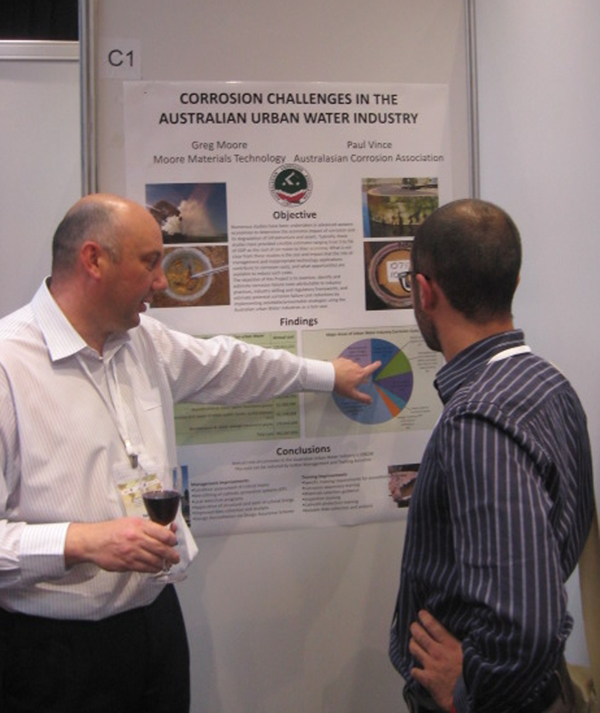
Paul Vince demonstrating poster (drinking water)
Tram

This session ran on the Thursday morning and was chaired by Wilhelm Erning from Federal Institute of Materials Research and Testing, Berlin, Germany. Five papers and three posters were presented at the session. Eight papers are available on the conference proceedings CD–Rom, of which four were full papers and three of these have been chosen for comment here, along with an Australian poster.
The first talk was ‘Evaluation of chlorination levels on the localised corrosion resistance of 304 and 316L stainless steels in waters of 200-2000 ppm chlorides’ given by C. Powell, Consultant to Nickel Institute, UK. The aim was to examine the correlation between chloride and free chlorine levels. This involved 60 day immersion trials in waters containing 200-2000 ppm chlorides and up to 10 ppm free chlorine plus one long term (540 day) exposure. The pH levels used were between 6 and 8 and polarisation studies were also carried out to evaluate the breakdown potentials for each solution. The results were presented as a matrix indicating whether or not crevice corrosion had initiated or propagated using both visual and optical microscope assessments. The work concluded that the guidelines originally provided by Tuthill over a decade ago are still valid; namely type 304 may be used in up to 200 ppm chloride and 2 ppm free chlorine and type 316 in up to 1000 ppm chloride and 5 ppm free chlorine at pH levels greater than 6.
This was followed by ‘Electrochemical sensor for monitoring internal corrosion in cast iron water distribution pipes’ given by Xialei You from the Water Technology Center, Cornellà de Llobregat, Spain. A sensor based on Electrochemical Impedance Spectroscopy (EIS) has been developed to characterise the nature and the evolution of the different layers (iron oxides, calcium carbonate, biofilm, etc.) that are generated inside the cast iron pipes in the water distribution networks. The electrochemical cell consisted of three electrodes (reference, work (the pipe) and counter) connected to a potentiostat. Tests were performed at laboratory scale with two pipe samples with different diameters and varying internal deposit thickness. When using a 35-year-old pipes with the deposit already formed and after lowering the deposit mechanically, the electrochemical sensor was found to be sensitive enough to detect the changes produced by this reduction of the deposit thickness. The same samples were fully polished internally, to reproduce the real conditions when installing a new cast iron pipe in the water distribution network. In this case, there was a sudden change in the electrochemical signal in the early days but the signal fades over time as the deposit coating adheres inside the pipe. In both cases, the sensor was found to be very sensitive to changes in volume and nature of the internal deposits.
The final paper in the session was ’Evaluation of cations effect on corrosion of Al in model tap water by HSAB theory’ given by Masatoshi Sakeiri from Hokkaido University, Sapporo, Japan. In galvanic corrosion tests both potential and current fluctuations, relating to each event of localised corrosion, were observed. The hardness of the metal cation, which was based on hard acid and soft base concept, was employed to explain the effect of metal cation. The charge during galvanic tests decreases with increasing hardness of metal cations, this result may be explained by the hard metal cation becoming incorporated in the passive film to strengthen the film and to increase its anticorrosive property.
An interesting poster was ‘Corrosion challenges in the Australian urban water industry’ given by Paul Vince (President of the Australasian Corrosion Association who sponsored the work) and Greg Moore, Moore Materials Technology Pty Ltd, Adelaide, Australia. The objective was to examine, identify and estimate corrosion failure costs attributable to industry practices, industry skilling and regulatory frameworks, and estimate potential corrosion failure cost reductions by implementing avoidable/preventable strategies, using the Australian Urban Water Industries as a test case. The cost of corrosion in this case has been estimated as follows: water pipe failures; water lost due to system leakage; capital expenditure for new infrastructure replacing existing corroded water pipelines; repair and maintenance of water treatment plants tanks; reservoirs, pump stations etc; and intangible costs or externalities that effect the wider community as a consequence of water pipeline failures and replacements The total cost was estimated at A$982 million ± 30% in 2009/2010. On-going challenges in future years include dealing with pipe materials of grey cast iron and asbestos cement which make up the largest proportion of reticulation pipes and are reaching a time where replacement will be required. Strategies for facing these challenges were presented.
Workshop on aerospace corrosion
The aerospace corrosion workshop ran throughout Tuesday. Fifteen papers were delivered and there were three posters. Only three of the papers appear as full papers on the conference proceedings CD-ROM. Two of these are reviewed below along with three abstract only papers. The session was chaired by T. Hack, EADS Deutschland GmbH, Munich, Germany.
An early paper given by Peter Visser, from AkzoNobel Aerospace Coatings, Sassenheim, The Netherlands was entitled ’Advances in chrome free corrosion inhibiting coating technology for the protection of aluminium’. Two chrome free coating technologies had been developed. The first was a Magnesium Rich Primer (MgRP) which, when used alone, showed in the neutral salt spray test and a test for filiform resistance that it could perform at least equal to chromated primers. When used with a topcoat and a chrome free pretreatment, it exceeded the neutral salt spray resistance. Secondly a new inhibitor technology with leaching properties like chromates has been developed. This technology provided very good corrosion protection on high strength aluminum alloys and a significantly better performance compared with current commercially available chrome free inhibitors. Later in the day, A.D. Zervaki from University of Thessaly, Volos, Greece gave ‘Influence of post weld heat treatment on the corrosion behaviour and fatigue performance of 6xxx aluminum alloy laser beam welded joints’. Joints created by advanced joining technologies such as lasar welding can show corrosion problems and reduced fatigue performance as the joints age. To investigate this, the corrosion behaviour of butt welded samples of 6156 T3 aluminum laser beam welds with PWHT to T8 temper were studied after exposure to salt fog environment for 720 hours. Corrosion characterisation was performed and corrosion damage quantified. Fatigue testing was also carried out on the corroded welds and the obtained fatigue strength was compared to the strength of uncorroded welds. The results indicated that corrosion exposure reduced the fatigue limit of the welded joints by 70%.
An abstract only paper was ‘Hybrid coatings for corrosion protection of aeronautical parts against runway de-icing chemicals’ given by Juha Nikkola from the VTT Technical research centre of Finland, Tampere, Finland. Sol-gel based inorganic-organic hybrid coatings had been developed and coated on aeronautical parts including cadmium plated steel and magnesium alloy. The aim was firstly to protect the cadmium-plating against the corrosion initiated by runway de-icing chemicals (formiate and acetate based) and secondly to provide alternative coating solutions for cadmium plating as well as for hexavalent chromium conversion coatings. The chemistry of the inorganic backbone of the hybrid coating was varied by using silane and aluminium alkoxide, as were the organic components. The corrosion performance was investigated by using standardised runway de-icing corrosion test (AMS G-12) and salt spray test (ISO 9227). Based on the AMS G-12 test results, the use of the hybrid coatings improved the corrosion protection of cadmium plating against runway de-icing corrosion. The salt spray test showed that the corrosion protection performance of the hybrid coating on cadmium-plating was similar to uncoated cadmium plating. In the case of magnesium alloy, the hybrid coating showed also better corrosion protection in both corrosion tests compared to Cr6 conversion coating.
One of three papers (all abstract only) from the group based at University of Naples ‘Federico II’, Naples, Italy was ‘Is the cold spray a technology of potential application in aerospace?’ given by F Bellucci. During cold spray deposition, 10-50 micron particles of ductile metals or alloys become deformed and then become strongly attached to a surface of metals, ceramics or glasses. Their impingement at impact velocities in the range of about 400-1200 ms−1 is essentially a type of powder deposition mechanism. Because adhesion and corrosion resistance are important parameters these had been investigated for metal particles of titanium, aluminium, copper deposited on aluminium or magnesium alloy substrates using polarisation measurements, bending tests and a pure adhesion test. Results obtained showed (i) the coatings had higher corrosion resistance compared to the substrate, (ii) the adhesion and cohesion of the pure aluminium particles was very good, conversely the copper particles showed good adhesion on the aluminium substrate but had low internal cohesion, (iii) cold spray represents a cost effective technique to deposit thick or thin metallic coatings on substrate at low temperature without mechanically or thermally compromising substrate properties. One of three papers (again all abstract only) from the group from University of Aveiro, Aveiro, Portugal (Mikhail L. Zheludkevich and Mario G.S. Ferreira) was ‘Galvanic corrosion and protection in CFRP-metal combinations monitored by SVET’ given by Silvar Kallip. Low weight aircrafts and cars are being designed using Al and Mg alloys and composite materials like Carbon Fibre Reinforced Plastics (CFRP). This combination can lead to strong galvanic couples because of high difference of electrochemical potentials between the composite (cathode) and metal (anode). To investigate this, a number of organic and inorganic inhibitors were tested for different galvanic couples of industrial relevance such as Al-Cu, Zn-Fe and different combinations with CFRP. Novel micro-electrode multi-material array cells combined with Scanning Vibrating Electrode Technique (SVET) were employed to study the kinetics and inhibiting efficiency. The results showed that there could be significant galvanic effects but these were effectively reduced or removed by the correct choice of inhibitors.