






Abstract
Photographs provided by Lidia Mularczyk.
The 10th Symposium on Electrochemical Methods in Corrosion Research (EMCR-2012) was held on the 18th to 23rd November 2012 in ‘Salinas do Maragogi’ at Alagoas, Brazil. The EMCR conferences are normally held once every three years in variety of locations and the 10th Symposium was the first to be held outside of Europe. The theme was corrosion prevention, minimising risks at new energetic challenges and the meeting followed the traditional EMCR formula with no parallel sessions. The chief organisers of the conference were Idalina Vieira Aoki and Hercilio G. de Mel.
Salinas do Maragogi Conference Place

This report reviews a selection of the papers presented at the meeting which in total comprised six plenaries, twelve keynotes and 53 orals together with around 60 posters. The topics encompassed a large number of electrochemical methods although some non-electrochemical methods were included. The papers are available as extended abstracts in the conference proceedings CD-ROM and full papers will be selected for a special issue of Electrochimica Acta.
Presentations: Sunday to Tuesday
The technical presentations started on Sunday with a plenary lecture from a doyen in the field of applying electrochemical methods to corrosion. Michel Keddam from University Pierre et Marie Curie, Paris, France presented, ‘From traditional to advanced electrochemical techniques for understanding corrosion mechanisms - a comprehensive survey’. Originally, electrochemical studies were current-voltage relationships, followed by electrochemical impedance measurements over increasingly wide frequency ranges. This enabled multi-step reactions and their adsorbed intermediates in the anodic dissolution of metals, the nucleation and growth of 2D and 3D surface films, specific mass and charge transport conditions in localized corrosion sites and change of surface morphology due to atom removal to be studied. Recent advances are based on applying the concept of contactless electrochemistry or floating-electrode in order to provide valuable information in the framework of the depassivation-repassivation mechanisms.
On Monday, the plenary lecture was given by M. F. Montemor, ICEMS, DEQB, Technical University of Lisbon, Portugal, entitled, ‘Localised electrochemistry applied to the development of new strategies for corrosion protection’. Since most of the large-scale electrochemical techniques provide average data, obtained by integrating over a relatively large surface area, in many cases they miss relevant information when studying localised processes. The most suitable techniques to investigate localised corrosion processes are; scanning vibrating electrode technique (SVET), scanning ion-selective electrode technique (SIET), localised impedance spectroscopy (LEIS) and scanning electrochemical microscopy (SECM). The work highlighted the role of these techniques in the development of thin hybrid films for enhanced adhesion and corrosion protection, self-healing primers for steel and aluminium, organic coatings for biomedical applications and inorganic coatings for energy storage and production systems.
This was followed by Luis Frederico P. Dick from the Universidade Federal do Rio Grande do Sul, Brazil who gave a keynote lecture entitled, ‘SVET and ECSM measurements under simultaneous strain on hot-dip Zn based coatings’. Steel sheets are frequently bent in service and the resultant strains are highest on the coated surface. However, a more complex situation than the usual distribution of cathodic and anodic reactions on a Zn-Fe couple should be expected, as Fe and Zn dissolution and O2 evolution can occur at different rates on the different Fe-Zn phases formed in the different types of HD-Zn coatings. Scanning vibrating electrode technique (SVET) was used to study corrosion under simultaneous straining of different HD-Zn coatings on interstitial free steel. Current maps and additional [Fe2+] and [O2] distributions were determined in situ on the corroding coatings. It was shown that Fe dissolution from the Fe-Zn η phase takes place simultaneously to the Zn dissolution mainly from the fresh η phase surface.
This was immediately followed by a presentation on ‘Corrosion resistance evaluation and electrochemical characterisation of an aluminium brazing sheet’ by J.M.C.(Arjan) Mol, from Delft University, the Netherlands, in work down in conjunction with Vrije Universiteit Brussel, Brussels. Aluminium brazing sheet is a sandwich material consisting of two aluminium alloys (AA4xxx/AA3xxx) widely used in automotive heat exchangers. The current study was aimed at improving the corrosion resistance of a modified aluminium brazing sheet. JmatPro software based on thermodynamic calculations was used to predict the type and percentage of the existing phases. A combined localised electrochemical cell technique and glow discharge optical spectroscopy (GDOES) were used for electrochemical depth profiling analysis. The major changes that occurred during the brazing process were found to be; accumulation of copper on the surface of the resolidified clad material, reduction of the copper content of the particles and the increase of silicon concentration in the diffusion zone. The anodic and cathodic reactivity of the top surface areas were significantly higher than that of the bulk, thus indicating these areas to be more susceptible to localised attack.
The next presentation was given by Fabien Rouillard, Laboratoire d'Etude de la Corrosion Non-Aqueuse, Gif-sur-Yvette, France, and entitled ‘Initiation and propagation of a single pit on stainless steel using SECM’. Pitting corrosion has been investigated over many years w.r.t. the mechanisms, shape of growing pits, and relationships linking parameters such as temperature, pH and potential to the corrosion rate. Two complementary SECM devices were used to investigate initiation and propagation of a single pit. The first device consisted of an Ag/AgCl probe positioned on a 316L substrate and focused on pit initiation because only limited amount of chloride ions can be generated. In the second device, the Ag probe was replaced by a glass microcapillary, into which chloride ions were injected. It was concluded that the passive film impacts on the susceptibility of 316L to pitting. Once initiated, the pit growth rate and the surface morphology depend on the buffer solution. A rate controlling salt film is formed in the bottom of pits in H2 SO4 whereas the pit growth rate in HClO4 is controlled by activation.
The next keynote lecture was entitled, ‘Electrochemical studies of weldable thin primers’ and given by Alda M. Simões from the Technical University of Lisbon, Portugal. Conductive primers are of major importance to the automotive industry due to their weldability properties, which allow their use as coil-coatings and later in forming and assembling operations. The metal particles in the coating are in principle protected by the organic phase and therefore should resist attack by the environment, but forming operations leave some of these particles exposed, and sometimes also the underlying substrate. Weldability can be ensured by using conductive primers in the formulation, namely graphite, zinc or zinc alloys. The work dealt with the corrosion protection afforded by Zn-55%Al-based galvanic steel substrates coated with an organic primer and particularly the electrochemical properties of these coatings. They were assessed using electrochemical impedance spectroscopy (EIS) and the scanning vibrating electrode technique (SVET). It was concluded that these techniques give complementary information on the effect of micro-defects generated on weldable primers by the forming operations.
‘SVET and SIET studies on 7081-T73511 aluminium alloy’ was the title of the oral presentation given by João C. Salvador Fernandes, Instituto Superior Técnico, Lisbon, Portugal. Pure aluminium has a high resistance to corrosion in many environments as a result of a protective film rapidly formed on its surface when exposed to air or in neutral aqueous solutions. The results of the SVET measurements in the AA7081-T73511 can be summarised as rather low activity during the first hour of immersion and formation of anodically active area in the upper central-right area of the sample. This anodic activity remains stable throughout 24 hours of immersion. pH-microscopy (pH-SIET) can be characterised by slight acidification suggesting anodic activity. SEM/EDS performed on the sample analysed by SVET in the anodic areas suggests dissolution of Al matrix and precipitation of amorphous Al(OH)3 and, eventually, Al(OH)2Cl at the same sites that correlate well with the pH of formation of the above corrosion products. It was concluded that the SVET and pH-SIET are valuable techniques for the assessment of the onset and evolution of the corrosion processes.
‘Combining atomic force microscopy and electrochemical impedance spectroscopy for local corrosion studies’ was given by T. Muselle, Universiteit Brussel, Belgium. This work combines electrochemical impedance spectroscopy (EIS) with atomic force microscopy (AFM), allowing simultaneous acquisition of topographic and electrochemical data. AFM acquires information about the interactions between a probe with a very sharp tip and a sample's surface. These interactions are investigated throughout a grid as the probe is moved across the surface. This provides a map of the surface's topography. Electrochemical Impedance Spectroscopy (EIS) data is typically collected with a basic three electrode set-up. A periodic voltage is applied across the sample and the counter electrode. The impedance of the system is then calculated. When performing local electrochemical impedance spectroscopy, the perturbation voltage is also applied across the whole sample and the counter electrode. This highlighted one of the advantages of the combination of LEIS with AFM. As the topographic information is also available, one can compare the impedance data with the topographic features.
‘Self-assembly of phosphonic acid layers on the oxide of aluminium’ was presented by Tom Hauffman, Vrije Universiteit Brussel, Belgium. Self-assembling monolayers find applications in a broad range of areas: biosensors, conversion layers, nanoelectronics and light emitting organic devices. The best known system in this field is the adsorption of thiols on gold, however, interest has shifted in the last decade towards other substrates such as oxides. An interesting system is the adsorption of phosphonic acids on aluminium oxides to demonstrate that low length molecules can be deposited from aqueous solution. So an ex and an in situ study of the deposition of self-assembling n-octylphosphonic acid layers on pretreated aluminium oxide layers from water and ethanol were presented. The adsorption mechanisms were elucidated by complementary surface analysis and electrochemical techniques: AFM, XPS, VISE and odd random phase multisine electrochemical impedance spectroscopy. The electrolyte consisted of a 0·1M NaClO4.xH2O in ethanolic solution. The concentration of n-octylphosphonic acid is 1 mM. It was concluded that n-octylphosphonic acid never forms a self-assembling monolayers (SAM) aluminium oxides when deposited from a solvent. Polar solvents give rise to multilayers and less polar solvents trigger corrosion reactions at the surface. A methodology for thin film research and mechanism characterisation was presented in this study.
Later in the day, ‘On-line volumetric analysis of cathodic gas formation using a microfludic system’ was the subject of an oral presentation by Kevin Ogle, Chimie-ParisTech, ENSCP, Paris. Gas formation reactions are all pervading in corrosion and surface treatment phenomena. A textbook example would be the dissolution of a metal in a strong acid in which the anodic dissolution of the metal is balanced by the cathodic reduction of H+ ions into hydrogen gas leading to the standard mixed potential theory of corrosion The basic AESEC apparatus was modified to include on-line measurement of the volume of gas produced simultaneously with the dissolution of the metal components. When the electrolyte contacts the surface there can also be gas generation leading to the formation of bubbles, sometimes visible to the naked eye. However, technique is very sensitive as it is possible to detect single bubbles on a μm scale. In this presentation, the technique was applied to understand the reactivity of Mg and Al- Mg-Cu containing intermetallics using atomic emission spectroelectrochemical (AESEC) method that permitted measurements of the elemental rates of dissolution from complex alloys.
The session continued after tea (a long day!) with ‘Developments in the Electrochemical Noise Method (ENM) to make it more practical for assessment of anti-corrosive coatings’ given by Lidia Mularczyk from the University of Northampton, UK. In order to apply ENM in the field, a new design of electrodes in the form of a ‘copper pad’ has been created and tested. The reproducibility of obtained results was also investigated. One of the ENM arrangements was ‘No Connection to the Substrate’ (NOCS) which involves three areas on the coated substrate to perform one noise measurement. This was investigated from the aspect of checking whether the individual values of resistance (for each area) can be computed by varying the way the cells are connected to the measuring equipment. Experiments performed on a range of samples in different arrangements of ENM have helped to convince about the equity and usefulness of noise resistance values. The work also holds promise that, even when all three areas in NOCS have different resistances, it may be possible to calculate their individual values.
The plenary lecture on Tuesday morning was given by L. Fedrizzi, University of Udine, Italy who spoke on ‘The use of the electrochemical micro-cell to study the corrosion inhibition of aluminium alloys’. Inhibition mechanisms of active species such as cerium-containing compounds are strongly related to the microstructure of aluminium alloys. In particular, it is well known that intermetallics affect electrochemically driven processes impairing the formation of uniform conversion layers. AA2024-T3 is one of the most studied aluminium alloys because the corrosion behaviour and the inhibitors efficiency can be strongly affected by intermetallic particles, especially by S-phase. Electrochemical characterisation was initially carried out by means of potentiodynamic polarisation measurements. Finally, EMT was combined with Focussed Ion Beam/Scanning Electron Microscopy (FIB/SEM), Transmission Electron Microscopy (TEM) and Glow Discharge Optical Emission Spectroscopy (GDOES) to study and clarify how intermetallic particles are involved in the precipitation mechanisms of cerium-containing compounds on aluminium alloys.
A keynote lecture was, ‘Constant-Phase-Element behaviour caused by inhomogeneous electrolyte uptake in anti-corrosion coatings’ by M. Musiani, Instituto per l'Energetica e le Interfasi, Padova, Italy. It has been shown that the observation of CPE behaviour in the impedance of a metal-coating-electrolyte system may be explained by an inhomogeneous electrolyte uptake giving rise to a power-law profile, This requires that the local resistivity and permittivity values at each position along the coating thickness, are calculated by an EMT formula corresponding to the parallel combination of the coating material and the electrolyte.
This was followed by ‘Effect of mechanical stress onto water uptake in epoxy systems’ by Sébastien Touzain from the Universite of La Rochelle, France. When a visco-elastic (VE) mechanical stress (positive or negative) is applied onto epoxy coating systems, this has a strong influence on their barrier properties. In order to avoid the influence of pigments, extenders and other fillers that exist in commercial coating formulations, a model epoxy system DGEBA/TETA was chosen to obtain the response of the sole polymer prepared as a free film. Steel panels were also coated by the epoxy system and immersed in saline solution. Mechanical stresses were applied to the coated panels and Electrochemical Impedance Spectroscopy (EIS) was used to study the water uptake process. The results showed that the visco-elastic mechanical stress significantly affects the dry permittivity of the coating, independently of the stress sign. This may be explained in terms of polymer chain orientation that is modified by the applied stress: tension and compression influence the chain orientation parallel to the stress axis.
Later on Tuesday, a keynote lecture entitled, ‘A critical look at interpretation of impedance spectra of coated aluminium alloys’, was given by Mikhail Zheludkevich, University of Aveiro, Portugal. Electrochemical Impedance Spectroscopy (EIS) is used as one of the main experimental techniques for characterisation of corrosion resistance of aluminium alloys. Recently this method was shown to be a powerful tool for investigation of the self-healing ability of active protective coatings applied to Al-based substrates. The extensive use of EIS led to the fact that many different equivalent circuits were proposed to fit the experimental spectra. However, in many cases the suggested circuits are not supported with convincing physical models leading to speculative interpretation of impedance data. Pure aluminium and AA2024 were used as substrates which were anodised using borate-based electrolytes in order to obtain oxide films with different thickness. Systematic EIS results were complemented with microscopic measurements supporting the proposed interpretations.
At the end of the day, just before the poster session, Franky E. Bedoya delivered, ‘Evolution of electrochemical properties of organic coatings during UV-condensation weathering test’. Five commercial anticorrosive coatings were investigated, two of them were analysed in detail in a single 12 hour cycle. This was conducted because a pronounced change in electrochemistry properties in a single cycle may mean higher stress and therefore faster degradation compared to coatings that exhibit minor changes. EIS measurements in this study were taken 60 minutes into the UV radiation stage and were continued throughout the 4800 hours of UV-Condensation cyclic test. However, even this was not enough to assess the performance of the best coatings. It was recommended that to compare the better coatings effectively, additional measurements need to be made within a single cycle.
Next came a poster session (number of posters in each area given in brackets) covering; local electrochemical techniques (3), corrosion inhibitors (4), electrochemical noise (3), and anticorrosion protective methods (21) a short review of four of these posters can be found the end of this report. This was followed by a special beach dinner!
Presentations: Wednesday to Friday
Alison J. Davenport giving a lecture on Developing corrosion prediction models from X-ray measurements
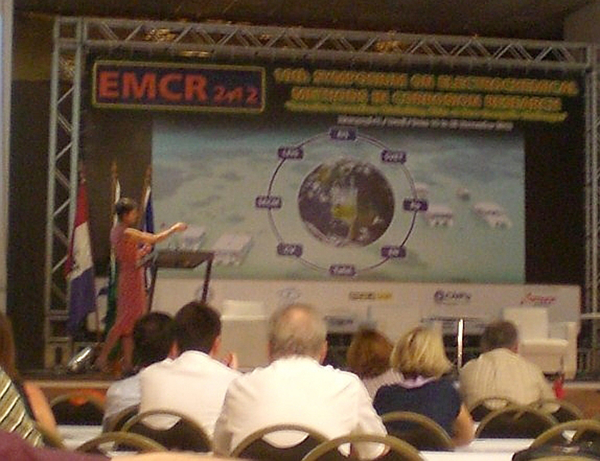
The first half of Wednesday was given over to a boat trip so technical proceedings did not actually start until the late afternoon. At this point, Alison J. Davenport, University of Birmingham, UK gave a plenary lecture on, ‘Developing corrosion prediction models from X-ray measurements’. Corrosion pits in stainless steel show different morphologies and under atmospheric corrosion, the pits are shallow and dish-shaped. Models capable of predicting the shape of corrosion pits have been developed but experimental measurements are necessary to verify them. Synchrotron radiography was used to monitor the growth of 2D pits in real time.
Preliminary investigations have shown that pits can propagate under very thin solution layers, but their morphology can be strongly influenced by precipitation of salt crystals in these layers.
There was followed by an presentation, ‘Correlation between stress corrosion and hydrogen permeation in low alloy steel using electrochemical techniques’ given by Vanessa Lins from the Federal University of Minas Gerais, Brazil. The types of steels studied were typical of the type of high-strength steel and low alloy steels used in the oil industry. Hydrogen permeation tests were performed using the technique developed by Devanathan and Stachurski for obtaining the diffusion coefficient, and stress corrosion tests were performed according to the TM0177-2005 NACE standard method A. The results obtained in these two tests were correlated by analysing the influence of current density of the material on the possibility of failure in NACE method A. It was found that the H2S concentration is the critical variable. In mixtures of 3% and 7% H2S, although there was an increase in Jmax as the pH decreased, this increase was not enough to promote hydrogen embrittlement in the steel. The increase of current density as the concentration of H2S increased to 100% was sufficient to produce failure of steel.
Later, Isabelle Frateur from the Université Pierre et Marie Curie, Paris, France gave a keynote lecture entitled, ‘Use of LEIS and the power-law model for the analysis of constant-phase-elements related to oxide layers’. The impedance response for electrochemical systems often reflects a distribution of time constant that is commonly represented in equivalent electrical circuits as a constant phase element (CPE). Normal distributions can be expected in systems such as oxide films. In these cases, the CPE parameters α and Q may be interpreted in terms of physical properties such as effective capacitance, film thickness and dielectric constant. Among the methods used in the literature, the power-law model for distribution of resistivity developed recently provides the most reliable interpretation for oxides.
Thursday's plenary lecture was ‘Pre-salt challenger: corrosion laboratory tests in very high pressures’ by Oscar Rosa Mattos from LNDC, Brazil. Apparatus which can produce high pressures, coupled with variable CO2 –H2S gas content are difficult to build or even obtain, The Non-Destructive, Corrosion and Welding laboratory (LNDC at COPPE/UFRJ) has created equipment suitable to carry out tests under these conditions. Results included; corrosion rates of carbon steel as a function of CO2 and H2S concentrations, monitoring of a corrosion system processing different oil qualities, investigation of CO2 corrosion of a martensitic steel obtained in a loop working at 200 bars, development of a system which is resistant to corrosion fatigue up to 600 bars and development of a Devanathan permeation cell to work up to 400 bars.
Immediately following this was a keynote lecture on, ‘Macro and micro aspects of the transport of chlorides through cementitious membranes’ delivered by X. R. Nóvoa, Universidade de Vigo, Spain. The presence of chlorides at the steel-concrete interface level is the main factor responsible for the corrosion of rebars in concrete. The process is of dynamic character due to the reaction of chloride ions with the cement matrix. This reaction seems to occur only in a small fraction of the bulk material that corresponds to a pore network. The reaction occurs at pore walls, which makes the transport sensitive to an AC signal if the proper frequency is chosen. SECM examination of the flux of chlorides has allowed the establishment of a relationship between diffusion coefficient and geometry of the pore network.
On Thursday there were several lectures on ways of monitoring the effect of biodiesel on corrosion. One of these was ‘Using the Electrochemical Impedance Spectroscopy to characterise different metallic materials in biodiesel B100’ given by Adriano H. Akita from UNESP –Araraquara, Brazil in collaboration with Lorenzo Fedrizzi's group from the University of Udine, Italy. This paper presented preliminary results using electrochemical impedance spectroscopy for different materials (glassy carbon, carbon steel, copper, brass and zinc) recorded in soybean derivative biodiesel. The biodiesel was degraded at 110°C from 1 to 6 hours with air bubbling. The non-degraded and up to 2 hours degraded biodiesel showed an impedance modulus of about 109 ohms-cm2 for all materials studied indicating that the ohmic behaviour of biodiesel dominates the impedance response. Biodiesel degradation for time equal or higher than 3 hours showed a decrease of one order of magnitude in the impedance modulus for glassy carbon, carbon steel and copper and 2 orders of magnitude for brass and zinc, indicating that zinc is the component more susceptible to the attack by the products of the biodiesel degrading.
Later, a keynote lecture was presented by Kevin Ogle, Chimie-ParisTech, ENSCP, Paris entitled, ‘On the cathodic corrosion of aluminium and aluminium alloys’. The interpretation of electrochemical experiments in neutral pH electrolytes may be complicated by cathodic corrosion. The rate of Al corrosion increases with an increasing cathodic polarisation contrary to conventional theory such as shown by the Stern-Geary equation. Al3+ is relatively insoluble at neutral and slightly acid pH resulting in the passivation of Al metal over this pH range. At higher pH, Al3+ is soluble as Al(OH)4−; however, Mg2+ is highly soluble in acid and neutral solution but becomes insoluble at higher pH. Moreover, the presence of Cu in the alloy or intermetallic is also important for Al dissolution because of the acceleration of the cathodic water decomposition to hydroxide.
Monica Trueba lecturer for Pit transition potential in the repassivation process of Al Alloys

The final presentation on Thursday was ‘Pit transition potential in the repassivation process of Al Alloys’ by M. Trueba, Università degli Studi di Milano, Italy. This work reported on a systematic investigation of the corrosion of wrought Al alloys in NaCl solutions using single-cycle anodic polarisations or pitting scans. The pit transition potential (Eptp) was identified as an inflection point in the reverse scan under certain experimental conditions. The effect of pH, concentration of NaCl, and dissolved oxygen of the test solution on Eptp was explored for Al-Mg-Si alloy 6082-T6. Using corrosion morphology characterization, the occurrence of the step at Eptp was related to localized attack other than pitting. The inflection point at the critical value Eptp indicated difficulty for repassivation, which can be quantified by the steepness of the subsequent potential depression up to Eprot. Tunneling corrosion in Al 2024 could be a consequence of limited repassivation as E falls below Eptp.
There was a second poster session on Thursday evening. These covered (numbers of posters in brackets); corrosion in biofuels and in the oil and gas industry (4), corrosion in concrete (1), passivity and local corrosion (9), corrosion models and mechanisms (2), local electrochemical techniques (3), general topics (5) and coupling between electrochemical and non-electrochemical methods of corrosion in the nuclear and aeronautical industries (5). A review of four of these posters can be found at the end of this report. This day concluded with the symposium dinner.
Symposium Dinner

The final day of the conference commenced with a plenary lecture on, ‘Use of advanced electrochemical and surface analysis for the development of new generations of self healing organic coatings’, given by Herman Terryn, Vrije Universiteit Brussel, Belgium. Laboratories at VUB and TU Delft are developing coatings having self polymer repair combined with novel inhibitors. A number of techniques were used to study the combined repair mechanisms in a created defect including; electrochemical microcopy, scanning vibrating electrodes, scanning selective ion selective electrodes and a local AFM, together with a newly developed type of EIS, were used. Because heat is necessary to trigger and assist the healing process, these materials are classified as non-autonomic healing polymers. Additionally inhibitors were added to the coating formulation. It was shown that it was feasible to create a multiple action self-healing coating system on a metal. Another system that was developed by TU Delft was the inclusion of self healing polymer capsules in an organic matrix that may work autonomously.
This was followed by a keynote lecture on the ‘Corrosion behaviour of a martensitic stainless steel in a thin-layer cell’ by Nadine Pébère CIRIMAT, Université de Toulouse, France. In a recent study, the electrochemical characterisation of a martensitic stainless steel (X12CrNiMoV12-3) has been realised in bulk electrolyte (0·1 M NaCl+0·04 M Na2SO4 solution). The next step was to investigate the crevice corrosion of the martensitic stainless steel in a thin-layer cell. Impedance measurements were performed under different thin electrolyte layers and for different exposure times. The results were analysed by comparison with those obtained in bulk electrolyte. A thin-layer cell was developed which allowed the crevice corrosion of the martensitic stainless steel to be reproduced. The influence of the immersion time and the electrolyte layer thickness were clearly shown.
The final paper of the conference was ‘Practical aspects of the Electrochemical Potentiodynamic Reactivation Technique (EPRT) applied in welded joint of superduplex stainless steel’ by Oscar Rosa Mattos, Centro de Tecnologia, Laboratório de Ensaios Não Destrutivos, Rio de Janeiro, Brasil. The major challenge is to establish experimental conditions to identify a small reduction in corrosion resistance due to precipitation of intermetallic deleterious phases (phases are σ and χ mainly). Electrochemical EPRT with Double Loop (DL-EPR) technique has been used for detection of such phases. The present work summarized DL-EPR results using a portable device specially designed to work with real welded joints. The phase detected was characterized by scanning electron microscopy (SEM) and Electron Backscatter Diffraction (EBSD). Correlations were seen between parameters obtained by DL-EPR tests and the susceptibility to localized corrosion. However microstructure characterisation is still essential for the correct interpretation of electrochemical tests.
Poster presentations
Four posters from the Tuesday poster session are reported below. The first poster was presented by Isolda Costa from Instituto de Pesquisas Energéticas e Nucleares (IPEN/CNEN), São Paulo, Brazil, on the ‘Use of scanning vibrating electrode technique to localised corrosion evaluation of ASTM F139 stainless steel marked by laser’. The results showed that SVET is a useful technique for monitoring the dynamic development of anodic and cathodic areas as a function of time in consequence of the surface modification caused by laser marking technique. It was shown that for investigating correlation between microstructural characteristics and localised corrosion at the surface, more aggressive conditions such as those provided by sample polarisation may be necessary.
The second poster was entitled, ‘Study of an anthocyanin as a corrosion inhibitor for aluminium in water contaminated with a mix of diesel/biodiesel’ given by Isabel C. Guedes, Laboratório de Corrosão, Escola Politécnica, USP, Brazil. Toxic inhibitors nowadays have to be replaced. Substances rich in anthocyanins (condensed tannins) can act as corrosion inhibitors for some metals. These compounds can be found in different plant extracts, such as grape (Vitis vinífera). The anthocyanin studied was catechin hydrate (C15 H14 O6. xH2O). The electrolyte was water with a mixture of diesel – 95%/ biodiesel - 5% (B5), because this is the most corrosive medium in a diesel powered engine. Results show that this anthocyanin is an efficient anodic corrosion inhibitor for aluminium in the water tested. Moreover, low concentrations of the compound were needed, indicating high efficiency and economic competitiveness.
There were two posters who used electrochemical noise method to investigate corrosion. The first was ‘Analysis of current transients of AISI 1020 steel corrosion in sea water using electrochemical noise methods and optical monitoring’ by Emerson C. Rios from the Universidade Federal de São Carlos, Brazil. Using wavelet transform and energy diagrams as analysis methods, it was possible to make qualitative and quantitative analysis of the In data resulting from changes occurring to the type of corrosion. Up to ∼ 2 hours of immersion, corrosion processes were found to be localised, with pitting and intergranular corrosion dominant. However, after around 14 hours, more general corrosion processes became apparent. The interpretation of signals by wavelets was confirmed by optical micrographs. It was concluded that this approach can be valuable for this type of study, as some types of processes are often not identified by other techniques. The second poster on electrochemical noise was, ‘Monitoring by Electrochemical Noise of TiO2 thin films immersed in synthetic physiological media’ presented by Francisco J. Rodríguez Gómez from Universidad Nacional Autónoma de México, Mexico. Despite their adequate mechanical properties, the use of stainless steel in human prosthesis has been limited because of their susceptibility to pitting corrosion. Titanium dioxide is a good film from the biological compatibility point of view, so if a thin film of TiO2 could be applied on stainless steel it would provide anticorrosive protection. Hence, TiO2 thin films were deposited on stainless steel 316L and evaluated in synthetic physiological media by electrochemical noise. The level of localised corrosion was determined from EN experiments in all cases. A distinct improvement in corrosion protection was associated with the presence of the TiO2 thin films compared to stainless steel alone, However, the films are still somewhat defective. When cerium salts were used as corrosion inhibitors no effect was detected by using EN.
Four papers from the Thursday poster session are reported as follows. A poster by M. C. P. Cruz from the Faculdade Pio Décimo, Sergipe, Brasil, was entitled, ‘Experimental design in the study of physical and chemical variables in galvanic corrosion between carbon steel and CuAlBe’. The behaviour of galvanic corrosion between carbon steel and CuAlBe with shape memory effect was investigated using the zero resistance ammetry (ZRA), technique in an electrolytic environment that simulates the water produced from mature oil fields. For this purpose a fractional factorial design 26-2 + 6 central points was used with the following variables: Cl−, SO4 2−, S2−, HCO3 −, ratio of anodic area to cathodic area (1:1, 1:½, 1:¼) and temperature of 25, 35 and 45°C. The anodic dissolution current was measured as a function of time. Within the limits of this study it can be proven that a greater anodic current density occurs when there is a minimum of anodic area in relation to cathodic area.
A poster entitled, ‘Preliminary evaluation of localised corrosion using potentiodynamic and potentiostatic techniques’ was presented by Luciana I. L. Lima, Vallourec & Mannesmann Tubes (VMB), Brazil. Conventional 13% Cr martensitic stainless steel has been employed as OCTG (Oil Country Tubular Goods) tubing material due to its strength and corrosion resistance. The steel used in all tests was a 13% Cr supermartensitic stainless steel subjected to four different heat treatment routes. All samples presented mechanical properties in accordance to ISO 13680 standard. The trend values for the occurrence of localised corrosion obtained from the cyclic polarisation curves were similar for the four routes. In the Step Load technique it was possible to better distinguish the pitting potential, although the crevice potential values were similar.
A poster on the ‘Application of electrochemical impedance spectroscopy technique in the performance evaluation of internal lacquer of the can/simulant system’ was presented by Bianca de O. Pelici, Universidade de Campinas - UNICAMP, Brazil. Organic coatings and epoxy-phenolic resins are commonly used to minimise corrosion. The EIS technique along with SEM and analysis of experimental and simulated data obtained with the equivalent circuits were used to follow the degradation of the coating over time, i.e. the permeation of the electrolyte and contact with the metal substrate, causing corrosion. The different corrosion behaviour of coatings in contact with different acids is related to complexing processes that occur between the organic acid anions and metal ion components of tin-plate. According to the potential of the constituent metals, this is because they assume different relative potentials, thus affecting the mechanism of internal corrosion.
The final Thursday poster being covered was ‘Electrochemical investigations of the relationship between grain size and corrosion processes in nanocrystalline grain size range’, by X. Feaugas, Université de la Rochelle, France. Polarisation curves (in H2SO4 1M) were used to study the anodic behaviour and the kinetics of the hydrogen evolution reaction. Microstructural characterisations were conducted using a large number of techniques (GDOES, SIMS, SEM, XRD, TEM, EBSD, AFM). Corrosion behaviour (anodic and cathodic reactivity) was studied in de-aerated 1M H2SO4 at 300K. Despite the large interest in nanocrystalline materials and their unique properties, the superior corrosion resistance of lower grain size has not yet been clearly established.