






Abstract
AETOC 2011 took place in Emmetten, Switzerland on the 24-27, April 2013. This was the latest in a sequence of biannual meetings which have taken place since 1999. The meeting falls under the auspices of the European Federation of Corrosion Coatings Working Party and was the ninth international workshop in the series. Previous meetings have been held in Genoa, Italy in 1984; Schliffkopf in the Black Forest, Germany in 1999; Jurata, near Gdansk in Poland, in 2001; at Sintra near Lisbon, Portugal in 2003; at Villard de Lans near Grenoble, France in 2005; at Baiona in Northern Spain in 2007; at Grado, Northern Italy in 2009 and at Mons, Belgium in 2011.
The aim of the 2013 meeting was to provide a platform for the discussion of newest results in coatings research obtained with mainly electrochemical methods. This aim was well fulfilled.
The meeting was organised by Jörg Vogelsang and took place at Hotel Seeblick which has a wonderful scenic view over the Lake Lucerne. The nice atmosphere encouraged the 50 participants not only to listen to the 25 presentations but also to have intense and fruitful discussions during the questions and break times
As usual, there were around twenty five papers presented over a day and a half (reports on previous workshops can be found in previous issues of CEST or its predecessor British Corrosion Journal) followed by a hike and a dinner. Just under half of the presentations have been selected for comment below. This is based on personal interest and in no way reflects the quality of the papers which were pretty well universally excellent.
The first paper being covered was ‘Evaluation of coated steel under weathering test using under-film corrosion tester based on current interrupter technique’ by Hiroyuki Tanabe from Dai Nippon Toryo Co. Ltd, Japan. It was shown that this essentially DC type method could be effectively applied to outdoor exposure test panels and was non-destructive. Results were presented correlating the performance with time constants given by the technique. Future work includes application to 20 year exposure test panels and the use of the technique on site to inspect coatings from steel structures.
Sunset at Emmetten.

The hike.

This was followed by the ‘Effect of temperature on the impedance response of coated metals’ by John Sykes, Department of Materials, University of Oxford, UK. It was shown that when the paint is not protecting effectively, EIS (Electrochemical Impedance Spectroscopy) can discriminate between the activation energy for ionic conduction in the paint and the activation energy associated with the corrosion process. Results showed that often these do not correspond suggesting that coating resistance is not necessarily linked with corrosion rate.
‘Development of anticorrosive pigments by EIS and ACET: a general correlation model with NSS’ was given by J. Suay from University of Castellon, Spain in work done in conjunction with J. Gracenea. A new methodology using ACET (Accelerated Cyclic Electrochemical Technique) and neuronal nets was proposed to formulate coatings with new pigments. This methodology is automated and needs a relatively short time and little effort compared with traditional (salt spray) test. A general model has been developed for zinc rich primers, water base, solvent base and powder coatings although it was pointed out that the more general the model, the less precise it is.
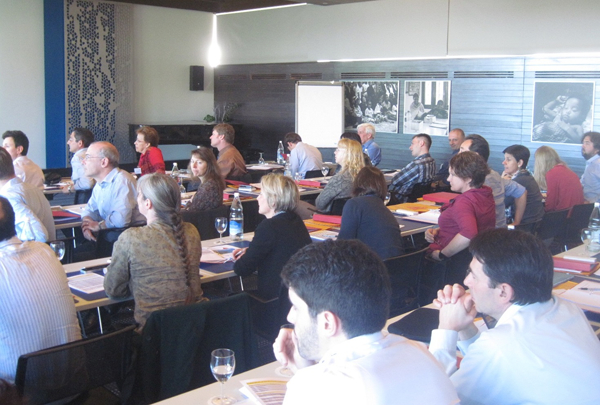
The conference audience.
This was followed by ‘Multivariate analysis of impedance data obtained for coating systems of varying thickness applied on steel’ by A. Miszczyk and K. Darowicki, Gdansk University of Technology, Poland. The advantage of this approach (also known as Principal Component Analysis (PCA)) is that the need for finding an electrochemical model is reduced. Transformation of impedance spectrum from n-dimensional into 2-dimensional space allows bi-plots to show most relevant information immediately. Using the method it was possible to discriminate between different systems with varying thickness (and hence varying barrier properties). There are indications that the interaction with water can also be studied in this way. The next step is to extend the data set to degraded systems.
The next paper was ‘Electrochemical behaviour of organic/inorganic films applied on tinplate in different aggressive media’ by Carmen Pérez, University of Vigo, Spain. The electrochemical behaviour was evaluated by EIS and Potentiodynamic measurements in two different media. Results showed that samples in 0·1M citric acid/sodium citrate had severe attack leading to tin dissolution. Much less attack occurred in 3·5% NaCl solution with only a small amount of localised corrosion occurring due to defects in the outer tin layer allowing contact between the FeSn alloy and the aggressive electrolyte. Then there was ‘Self-healing coatings with multiple functionalities for the corrosion protection of metals’ by I De Graeve from Vrije University, Brussels. Defect healing within the polymer was monitored with AFM, optical imaging, and local electrochemical methods (SVET, SECM); inhibitor activity (from nanocontainers) was studied using LSV and SERS Raman; and multiple-action self-healing was studied with EIS. The general conclusion was that, when a defect occurs, there can be both autonomous metal passivation and thermally induced recovery of barrier properties.
An interesting, practical paper was ‘Electrochemical impedance aiding the selection of organic coatings for very aggressive conditions’ by I.C.P. Margarit-Mattos, Federal University of Rio de Janeiro, Brazil. All the coatings examined presented some kind of deterioration indicating the need for research and development in this area. In some cases adhesion loss from super duplex was more significant than that from carbon steel, suggesting that special attention to the surface treatment of super duplex is needed. The importance of the characterization of the thermal behaviour of coatings if the operational temperature was above Tg, was brought out. Overall the methodology using EIS was shown to assist in development of more efficient formulations, and also to rate performance in long-term testing.
‘Biocompatible coatings for corrosion control of magnesium alloys used as bio resourceable implants’ was given by Fatima Montemor from Technical University of Lisbon, Portugal. The corrosion resistance of AZ31 magnesium alloy was significantly improved by designing a novel PEI+HA composite coating. The coatings showed good osteoblastic cytocompatibility, allowing cell adhesion and proliferation. The best cellular response was achieved for coatings modified with HA nanoparticles. The corrosion resistance seemed to be compatible with the lifetime of the bioresorsable implant.
‘ACET and EIS assessment of high performance powder coating duplex systems’ was given by M. Puig from University of Castellon, Spain. Alkoxysilanes improve the adhesion between the coating and the substrate and their effect was shown to be more pronounced when certain inhibiting pigments were incorporated in the system (synergistic effect). The ACET technique was successfully used to optimise the evaluation of the new coatings. ‘Analysis of the non-ideal capacitive behaviour for high impedance organic coatings’ was given by Sébastien Touzain from the Université de La Rochelle, France. The non-ideal capacitive behaviour of thick organic coatings were explained by a distribution of the diffusion phase with the impedance being the sum of a classical RC circuit and a Young impedance. Using this approach, simulated curves matched well with experimental plots. Although the model can be improved by including a CPE in the RC circuit, the advantages of doing this were not clear.
‘Influence of the electrochemical behaviour of metal substrates on the properties of cataphoretic clearcoat’ came from Caterina Zanella and Flavio Deflorian from the University of Trento, Italy. Steel, nickel and gold were the three substrates studied. In all cases the barrier properties were shown to be high and there was not a big effect of deposition voltage. Steel showed a lower current density in deposition and a ‘strange’ third peak in DSC perhaps relating to water absorption. Nickel exhibited the highest deposition current density and relatively poor adhesion. Gold showed intermediate behaviour.
‘Development of the Electrochemical Noise Method (ENM) for site application to organically coated steel’ was given by Douglas Mills, from University of Northampton, UK. NOCS (No Connection to the substrate) is the preferred ENM arrangement for site use. This simultaneously takes measurement from three different areas. Different configurations can be used to connect these three areas to the measuring equipment. It was shown that when the value from one area is different than the other two, this ‘different’ value of Rn is given when the ‘odd’ one is connected to WE1. Generally the Electrochemical Noise Method (ENA) was shown to be useful for assessing the anticorrosive properties of organic coatings in site situations. The next step is the development of dedicated instrument for use in the field.
Unless otherwise stated, presentations of all the papers given at the workshop are available on the wordpress website at http://aetoc2013ch.wordpress.com/2013/05/02/aetoc-2013-from-24th-to-27th-of-april-in-emmetten-switzerland. The titles and authors of all those papers not covered above are as follows:
Evaluation of water uptake in Anti-Corrosion Coatings from Constant-Phase-Element parameters by N. Pebere from University of Toulouse, France.
The determination of the Critical –Pigment Volume Concentration using Relaxation Voltammetry by Werne Strunze from Zahner-Elektrik Kronach, Germany.
In-situ evaluation of Zn and carboxylic-based polymer interfaces by an integrated ATR-FTIR and EIS system by Arjan Mol from Delft University of Technology, The Netherlands.
Investigation by electrochemical techniques of delamination and filiform corrosion of steel and aluminium substrates protected by organic coatings by Marjorie Olivier from University of Mons, Belgium (not available).
Corrosion resistance investigation of organic coating deposited on HDG steel with new electrochemical impedance methods by Chiara Cordioli from SIM, Ghent, Belgium.
EIS characterization of waterborne and solventborne coatings containing PANi and Cerium Oxide nanoparticles by L.G. Ecco from University of Trento, Italy.
Greencoat: Atmospheric Plasma/Deposited coatings as primer on metal substrates by Herman Terryn from Vrije Universiteit Brussel, Belgium.
Enhancing the corrosion properties of anodic oxide layers on magnesium alloys by incorporating encapsulated lanthanide ions as corrosion inhibitors by D. Tabatabai from Dechema, Frankfurt am Main, Germany.
Electrochemical stimulated conformational relaxation approach for conducting polymers deposited on reactive metals by Monika Trueba from Universita degli Studi di Milano, Italy.
Electrochemical study of novel hybrid coating on plasma anodized ZE41 magnesium alloy by M.L. Zheludkevich from University of Aveiro, Portugal.
Corrosion protection studies of hybrid sol-gel coatings modified by amine crosslinkers on AA2024-T3: global and local electrochemical evaluation by D. Carbonell from Universidad Carlos III de Madrid, Leganes, Spain.
Studies on EPS-analogues and biogenic substances for the corrosion protection of steel by D. Holuscha from Dechema, Frankfurt am Main, Germany.
Local properties of organic coatings sampled with the AFM-based approach by Michel Szocinski from Technical University of Gdansk, Poland.
The above is a brief summary of an enjoyable, well run and successful workshop. The 10th AETOC is planned to be held in 2015 in La Rochelle organised by Sébastien Touzain.