







Abstract
Australia's sandstone-hosted uranium deposits occur in sedimentary basins of Carboniferous, Cretaceous and Tertiary age; these include some of Australia's largest and highest grade uranium deposits. The conventional model for sandstone-hosted uranium deposits has proved robust and a predictive model leading to the discovery of many deposits in Australia. The location of deposits is strongly influenced by the presence of Mesoproterozoic and Archaean age leachable uranium-rich source rocks in the headwaters of channels draining into basins developed in the Northern Territory, Western Australia and South Australia. Australia's production of uranium from sandstone-hosted deposits is limited to two in-situ leach operations and is relatively minor when compared to production from Kazakhstan and the USA. Nevertheless, Australia has a large inventory of uranium resources in 19 undeveloped sandstone-hosted deposits, amounting to 123 kt U3O8. The average grade of all 21 Australian deposits that have resources is 0·15% U3O8. Tertiary palaeochannels host the greatest number of deposits and include the largest and highest grade deposits. The Callabonna Sub-basin in South Australia is the most richly endowed basin, accounting for 62·4 kt U3O8, being 38% of Australia's sandstone-hosted resource inventory. Australia remains highly prospective for the discovery of new palaeochannel hosted uranium deposits, with regional airborne geophysical surveys likely to be of great assistance in continuing to define palaeochannel systems that may host uranium in basins draining uranium rich source rocks.
Keywords
Introduction
Sandstone-hosted uranium deposits are a major contributor to global uranium production accounting for 45% of the world's mined uranium production in 2011 (World Nuclear Association estimate, written comm.). This production is mainly from in-situ leach (ISL) mining, also known as in-situ recovery mining, with most coming from Kazakhstan and the USA. Australia's share of this production is relatively minor with only two operating ISL Mines; Beverley and Honeymoon. Nevertheless, Australia has a number of significant undeveloped resources in sandstone-hosted deposits and continued exploration during the current resources boom has led to new discoveries, some of which are highlighted here.
This review includes Australia's sandstone-hosted uranium deposits within sedimentary basins ranging in age from Carboniferous to Miocene. Specifically excluded is the Westmorland deposit in Queensland, due to its controversial and hybrid origin (Rheinberger et al., 1998; Lally and Bajwah, 2006) and the Turee Creek deposit in Western Australia. Aside from local geological considerations neither fit the accepted model for sandstone-hosted deposits, being of Proterozoic age. Data sources include published papers, summary information provided by State and Federal Governments (Lally and Bajwah, 2006; McKay and Miezitis, 2001; IAEA, 2009; Roach et al., 2012) along with public domain company information.
Each basin will be briefly described with a more detailed description of one or more of the deposits from that basin. Resource information, using all resource categories, has been compiled and summarised to highlight the endowment of uranium in each basin and for each relevant geological period across Australia.
Sandstone-hosted uranium deposits
A widely accepted model for sandstone-hosted uranium deposits has been established for many decades (Grutt, 1971; De Voto, 1978 written comm.; Nash et al., 1981; IAEA, 2009) and has proved to be a robust and predictable model leading to the discovery of many new sandstone-hosted uranium deposits both in Australia and worldwide. The principal components of that model are:
Sandstone hosted deposits are considered to be diagenetic-epigenetic uranium concentrations deposited from oxidised groundwater in local reduced environments within permeable sandstones.
Depositional environments are mainly fluvio-lacustrine molasse-type sequences within post-orogenic intermontane basins, broad intracratonic piedmonts and marginal marine plains.
In most instances, the primary source of the uranium can be identified in nearby uranium-rich basement rocks which have shed sediment into the basin.
A period of uplift, initiating erosion, the development of fluvial channels and downward movement of oxidising ground waters.
The presence of carbonaceous matter and reducing conditions in host rocks, which may include authigenic pyrite. The evolution of vascular plants from the Silurian onwards is considered key to the development of sandstone-hosted uranium deposits.
Porous sandy host rocks along with confining impermeable mudstones are important for focusing fluid flow bringing uranium bearing oxidising ground waters into the sedimentary sequence with the development of redox fronts.
Four distinct types of sandstone-hosted deposit morphology are commonly recognised: tabular, roll-front, channel and fault/fracture-related (IAEA, 2009). Tabular, roll-front and channel types are well represented in Australian deposits. Each deposit may comprise one or more of these morphological types. Deposits usually occur in clusters, typically along the same horizon where conditions for uranium deposition have been favourable.
Other mechanisms for uranium deposition in porous sandstones in Australia have been proposed including an association with hydrocarbons (Jaireth et al., 2008) and the alteration of vanadium minerals during diagenesis (Schmid et al., 2012). The presence of vanadium, amongst other metallic elements, has not been systematically recorded in deposits where geophysical logging has been used to determine grade, which is the case for most of the younger Cretaceous and Tertiary deposits in Australia.
The preservation of porosity and permeability is important if ISL recovery is going to be possible, which, in Australia has only been established at the Beverley and Honeymoon deposits and is intended to be applied at Four Mile (Heathgate Resources, 2009). Older sandstone-hosted deposits that have been subject to porosity and permeability occluding diagenesis, deformation and metamorphism can potentially only be mined by conventional open pit or underground methods.
Australia's endowment of sandsone-hosted uranium
Australia's sandstone-hosted uranium deposits occur in host rocks of only three Periods within several sedimentary basins (Table 1, Fig. 1). The oldest deposits are in host rocks of Late Devonian to Early Carboniferous age, forming tabular and roll-front bodies in deposits in the Ngalia, Amadeus and Canning Basins. The Cretaceous Carnarvon Basin of Western Australia contains a number of deposits but is dwarfed by the uranium endowment of the Tertiary channel deposits peripheral to the Western Eucla Basin in Western Australia and the Callabonna Sub-basin of South Australia. Exploration is continuing to uncover Tertiary palaeochannel uranium mineralisation, in particular in central Australia, in areas of poorly documented Tertiary geology.
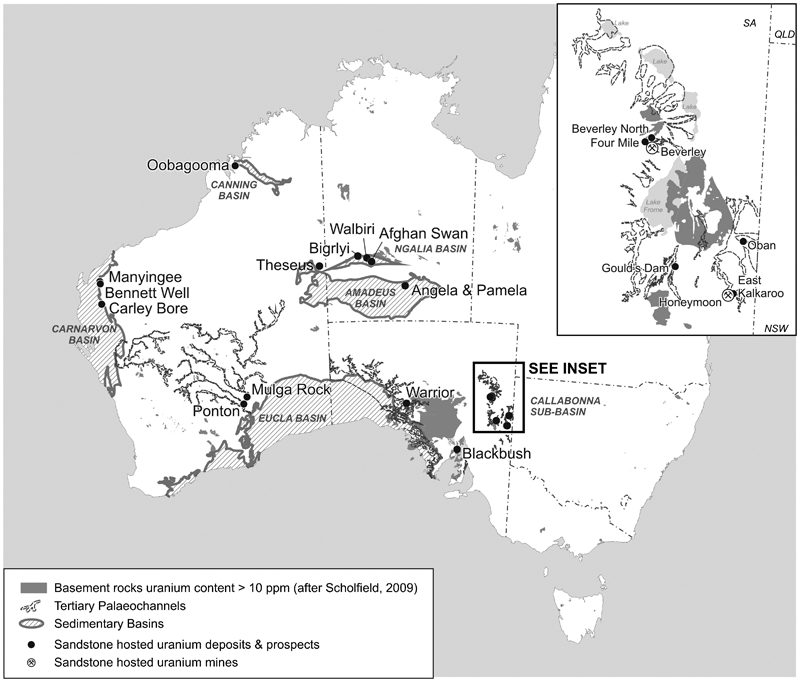
Sedimentary basins hosting Australian sandstone-hosted uranium deposits and source rock areas with elevated uranium
Australian sandstone-hosted uranium deposits, basins and initial resources*
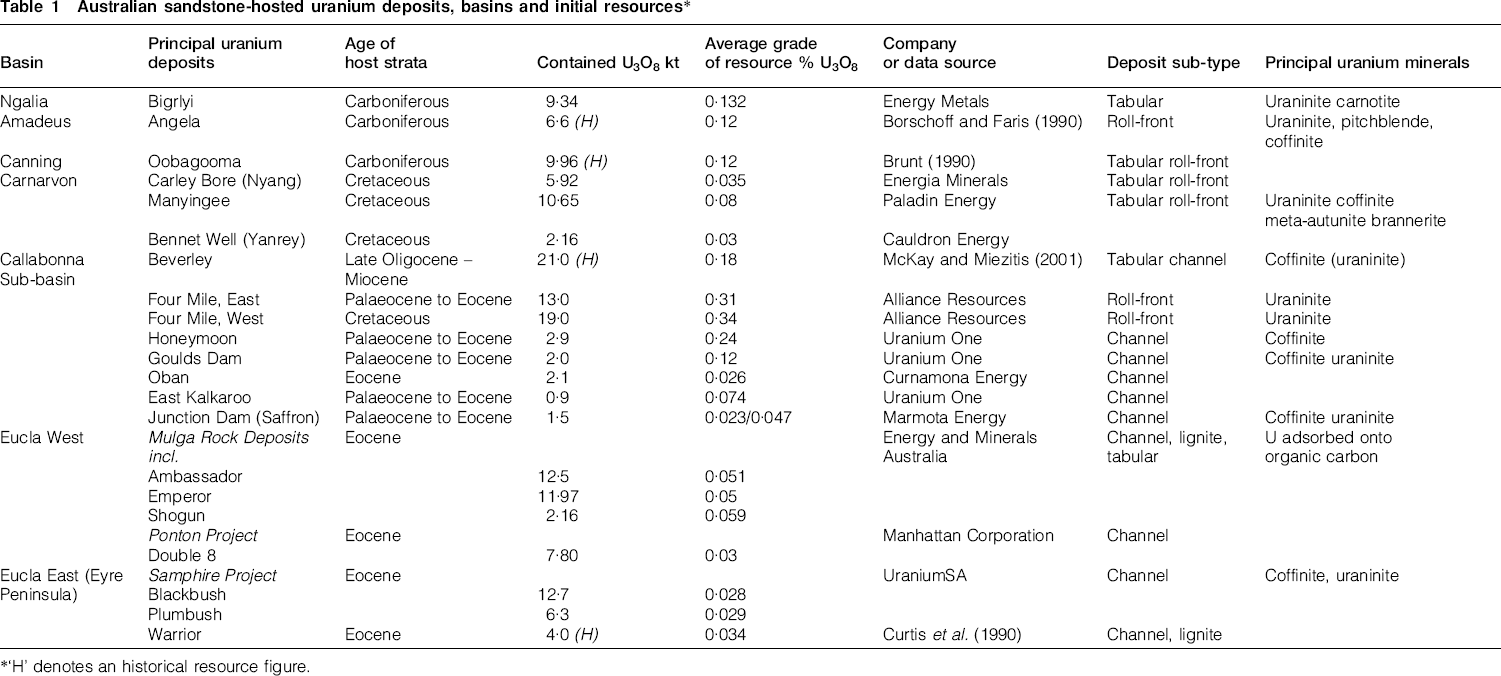
‘H’ denotes an historical resource figure.
Australia's mined uranium for calendar year 2010, using World Nuclear Association figures (written comm.), totalled 6·96 kt U3O8. Of this only 0·42 kt U3O8, or 6%, came from Australia's one operating sandstone-hosted/ISL mine, Beverley, and this represents only 0·7% of world production in that year. Since 2010 Honeymoon has also started production, but Australia's largest potential ISL mine, Four Mile, remains undeveloped.
The International Atomic Energy Agency's database of Australian uranium deposits (IAEA, 2009) reveals that sandstone-hosted deposits account for only 3·6% of Australian pre-mined resources of 109 kt U3O8 and lie in third place after iron–oxide–copper–gold type (75%) and unconformity type deposits (16·5%).
Taking the total resource figures for sandstone-hosted uranium deposits in Australia presented here (Tables 1 and 2), then the largest proportion of that contained uranium lies in palaeochannels and Tertiary rocks host the largest share of resources and the greatest number of deposits with resources. The resource figures compiled here cannot be directly compared with the World Nuclear Association nor IAEA figures quoted above. Australia has a large inventory of uranium resources in undeveloped sandstone-hosted deposits, amounting to 123 kt U3O8. This includes all the deposits listed in Table 1 with current inferred and indicated JORC resource estimates, excluding Beverley and Honeymoon. In addition there are three deposits without current JORC resource estimates where historical resources amounted to another 21 kt U3O8. The average grade (Table 2) of all Australian sandstone-hosted resources is 0·15% U3O8 with the highest grades in Tertiary palaeochannels which average 0·17% U3O8.
Summary of uranium resources in Australian sandstone-hosted basins (using resource figures from Table 1)

Australia's sandstone-hosted uranium basins
Ngalia Basin
The Ngalia Basin is a relatively long-lived sedimentary basin with continental and marine strata deposited from the Neoproterozoic through to the Carboniferous. The lower units of the Late Devonian to Late Carboniferous Mount Eclipse Sandstone contain all the known sandstone-hosted uranium deposits which occur along the northern margin of the Ngalia Basin over a strike length of over 200 km (Fig. 2). The primary source of the uranium is believed to have been the uranium-bearing granites of the Palaeoproterozoic Arunta Inlier which lies immediately to the north of the Ngalia Basin (Schmid et al., 2012; Lally and Bajwah, 2006).
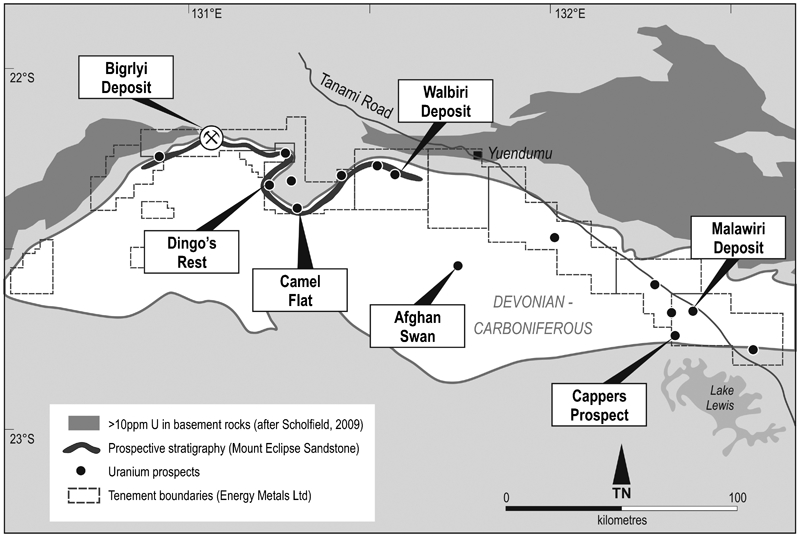
Ngalia Basin, location of Bigrlyi and other uranium occurrences
The Bigrlyi deposit (Fidler et al., 1990) was discovered in 1973 by ground radiometric traversing and follow-up drilling which lead to the discovery of uranium in 13 separate zones within the Mount Eclipse Sandstone over a strike length of 12·5 km. Energy Metals Ltd (written comm., www.energymetals.net) has outlined Indicated and Inferred Resources of 9340 t U3O8 at a grade of 0·132% along with significant vanadium.
The Mount Eclipse Sandstone contains mainly red feldspathic sandstone deposited in a braided fluvial environment with repeated sedimentary cycles from conglomerate, through arkose to siltstone and shale. The sequence is folded and dips steeply to the south. Mineralisation is uraninite and the vanadium mineral montroseite (VO(OH)), with carnotite in the oxidised zone. It occurs in tabular bodies lying parallel to bedding near the base of three sandstone units within the upper part of the Mount Eclipse Sandstone.
Recent geochemical, hyperspectral and mineralogical studies (Schmid et al., 2012) have revealed that uranium mineralisation occurred in granite derived arkosic sandstone with abundant iron-rich detrital clasts, including roscoelite, heavy minerals and biotite, prior to calcrete development and compaction. All the vanadium originates from the detrital mica roscoelite which has been altered by oxidation to release vanadium as montroseite. Subsequent compaction during the Alice Springs Orogeny has sealed off all porosity and caused re-mobilisation of vanadium and uranium towards the grain contacts. The study did not reveal any evidence of the presence of carbonaceous matter.
A number of uranium prospects occur along strike within the Mount Eclipse Sandstone including Walbiri, Dingo's Rest and Minerva which lies 142 km east-southeast of Bigrlyi. At Minerva, uraninite mineralisation is hosted by a pebble arkose at the boundary between hematitic and reduced grey to white sandstone. Recent drilling by Energy Metals Ltd has intersected significant uranium mineralisation at Camel Flat, 50 km south east of Bigrlyi including 27 m at 0·27% U3O8 and 755 ppm V2O5 from 93·0 m depth which includes 5·0 m at 1·33% U3O8 and 2944 ppm V2O5.
Amadeus Basin
The Amadeus Basin contains sandstone-hosted uranium deposits in a similar stratigraphic setting to the Ngalia Basin to the north. Uranium deposits lie within sandstone of the Undandita Member of the Brewer Conglomerate, part of the Pertnjara Group of Late Devonian to Early Carboniferous age, which is the youngest unit in the Amadeus Basin. The known deposits occur at the eastern end of the Missionary Syncline with up to 3000 m of Brewer Conglomerate and Undandita sandstones. Potential source rocks for the Brewer Conglomerate mineralisation included high-uranium granitic orthogneiss of the Iwupataka Metamorphic Complex and the Teapot Granite Complex.
The Angela and Pamela deposits (Borshoff and Faris, 1990) were discovered in 1973 and 1974 following reconnaissance airborne radiometric and ground surveys. The Angela deposit lies along a stepped redox boundary within the sandstone and comprises several stacked mineralised bodies each made up of one or more roll-front ore zones. The development of the redox boundary is believed to be associated with the movement of oxidising groundwater through partially cemented reduced sandstone. A southerly-directed groundwater flow is indicated, derived in part from the uranium enriched rocks of the MacDonnell Ranges in the Arunta Inlier.
The primary mineralisation is fine grained uraninite and pitchblende with minor coffinite as grain coatings and lining voids. Secondary uranium minerals in the weathered zone include carnotite, autunite, tyuyamunite and metatyuyamunite. Vanadium grades are approximately half those of uranium.
In 2011, the Northern Territory Government announced that it opposed the development of the Angela and Pamela deposits.
Canning Basin
The Oobagooma uranium deposit is hosted by the Early Carboniferous Yampi Sandstone which lies in a fault controlled graben, the Yampi Embayment, along the northern margin of the Canning Basin (McKay and Miezitis, 2001; Brunt, 1990). The Yampi Embayment preserved a relatively thin sequence of Upper Devonian to Lower Permian conglomerate, sandstone and siltstone. The deltaic Yampi Sandstone overlies the basal Lillybooroora Conglomerate. Uranium mineralisation occurs in (1–6 m thick) bands within a fault bound drainage system with higher grade zones in classic roll-fronts and also associated with abundant organic matter and pyrite. The discovery was the result of regional exploration conducted by AFMECO in 1978–1983, with a historical resource estimate around 10 kt U3O8 grading 0·12%.
Carnarvon Basin
Several roll-front sandstone-hosted uranium deposits occur along the eastern margin of the Carnarvon Basin (Fig. 2), lying immediately to the west of the Gascoyne Block (Brunt, 1990). In the Peedamullah Shelf area, Cretaceous fluviatile to marine transgressive sequences unconformably overlie Archaean to Mesoproterozoic metasedimentary rocks and granites. Above the basal Cretaceous conglomerate and sand the fluvio-deltaic to shallow marine Birdrong Sandstone is host to a number of uranium deposits.
The Manyingee uranium deposit, discovered in 1974 (McKay and Miezitis, 2001), is preserved in a palaeochannel between basement highs. Potentially economic mineralisation is present in two lenses within the Birdrong Sandstone forming the sub-horizontal upper limb of a roll front. There is also uranium mineralisation in the underlying Yarraloola Conglomerate. Average grades are in the range 0·035 to 0·12% U3O8 and identified uranium minerals include uraninite, coffinite, phosphuranylite, meta-autunite and brannerite. During the 1980's ISL trials were conducted at Manyingee and approximately 470 kg of uranium concentrates produced, which was considered at the time to be disappointing.
Adjacent to Manyingee, recent drilling at Bennet Well (Yanrey Uranium Project) by Cauldron Energy Ltd (written comm., www.cauldronenergy.com.au) has defined inferred resources containing 2·20 kt U3O8 averaging 0·03% eU3O8 using a 150 ppm cut-off.
About 100 km south of Manyingee, Energia Minerals Ltd (written comm., www.energia.com) has been drilling on the Carley Bore deposit (Nyang Project), where again the main host to mineralisation is the Birdrong Sandstone. Here the Cretaceous sequence is locally thickened in palaeochannels cutting into the underlying Devonian sediments or directly on Proterozoic basement. Within the palaeochannels mineralisation is associated with redox boundaries and forms roll fronts and tabular bodies. Energia's inferred resource, at 100 ppm U3O8 cut-off contains 5·92 kt U3O8 at an average grade of 0·035%.
Tertiary Palaeochannels of Central Australia
Theseus Prospect
The Theseus Prospect, discovered by Toro Energy Ltd in 2009, lies just south of Lake Mackay in Western Australia (Fig. 3) (written comm., www.toroenergy.com.au). Toro was attracted to the area by a radiometric anomaly located over the southern part of the lake. During late 2009 a regional aircore drilling program was completed, initially to test calcrete targets. Some early holes reached terminal depths of up to 120 m (limit of the drill rig) without intersecting basement. A Tertiary succession had been discovered, comprising unconsolidated sand, silt and clay. Significant gamma anomalism was intersected at around 100–110 m below surface in several holes. Drilling campaigns in 2011 and 2012 confirmed the presence of significant uranium mineralisation hosted within a regionally extensive Eocene palaeovalley system which is interpreted to overlie the thrusted margin between the Ngalia Basin and crystalline basement of the Arunta Province.
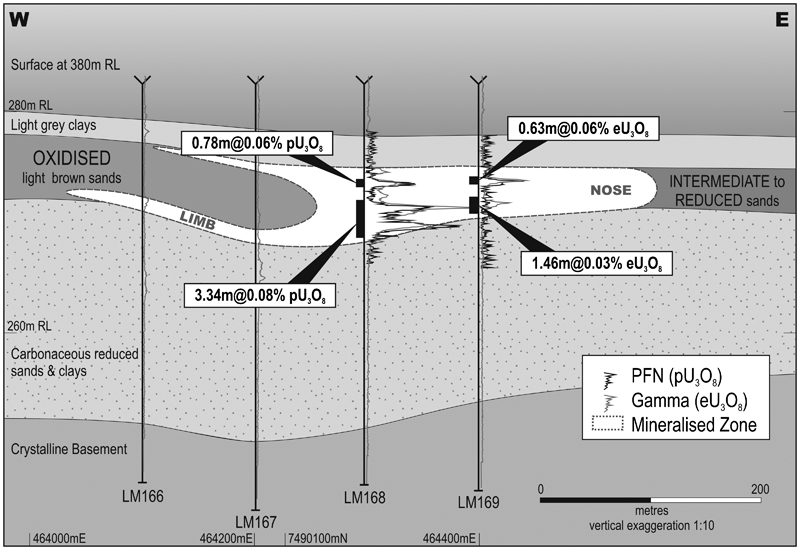
Theseus Northern Zone cross-section showing interpreted roll-front. Location of cross-section shown on Fig. 4
Uranium mineralisation at Theseus lies between approximately 100 m below surface and basement. It corresponds to a regional redox transition that separates oxidised sediments above from reduced sediments below. Discrete mineralised intervals occur within stratigraphic packages that have been mapped widely within the Theseus prospect area. In the Northern Zone of Theseus one such mineralised interval exhibits classic roll-front geometry with uranium mineralisation lying at the contact between oxidised and reduced sand and silt, all capped by a clay layer (Figs. 3 and 4). The roll front has been intersected over a strike length of 1400 m, is 100–150 m wide, averages 2·5 m in thickness, and has an average grade of 0·09%. To the south, drilling has identified another mineralised area over a strike length of 2·5 km, with mineralised horizons at 120 and 146 m depth, respectively. There, higher grade drill intersections include 0·79 m at 1·17% pU3O8. Disequilibrium in the mineralisation has been documented by comparing prompt fission neutron (PFN) and gamma logs.
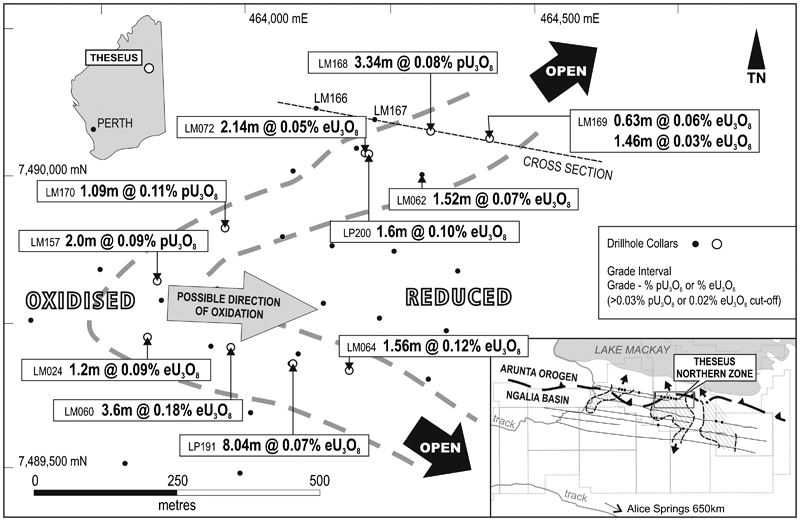
Theseus Northern Zone roll-front interpretation and regional location plan. Cross-section shown in Fig. 3
Afghan Swan
The Afghan Swan Prospect is a new discovery of palaeochannel-hosted uranium at the base of Lower Tertiary palaeochannels overlying the central part of the Ngalia Basin (Thundelarra Exploration Ltd, 2012). Historical exploration drilling by AGIP had shown the presence of uranium mineralisation both in the Mount Eclipse Sandstone of the Ngalia Basin and overlying Tertiary channel sediments. The presence of uranium in reduced muds and channel sands of the overlying Lower Tertiary palaeochannel system has been confirmed by recent drilling and the palaeochannels effectively traced over 15 km length by drilling and airborne EM (AEM). The best intercept to date has been 7·08 m at 0·14% eU3O8 in drill hole TNG061RC. Scanning electron microscope analysis of the Tertiary mineralisation has identified the presence of uraniferous anatase in the Lower Tertiary sand and uraninite, pyrite and LREE enriched hydrated phosphates in the Lower Tertiary mud.
The Afghan Swan mineralisation is perhaps unique in Australia, displaying the re-mobilisation of uranium in a second cycle of uplift and erosion, first from Mesoproterozoic basement rocks to form the deposits of the Mount Eclipse Sandstone, and second into Tertiary palaeochannels.
Eucla Basin
The Eucla Basin stretches from Israelite Bay in Western Australia to Gulf St Vincent in South Australia and hosts a number of very significant sandstone-hosted uranium deposits in channels peripheral to the basin. These range in age from Cretaceous to Miocene, but are predominantly Palaeocene-Eocene. Uranium deposits are confined to the western and eastern sides of the Eucla Basin determined by the presence of uranium rich source rocks (Fig. 1). The central part of the Eucla Basin drains the Officer Basin to the north which is devoid of uranium-enriched source rocks.
Western Eucla Basin
Deeply incised palaeochannels along the western margin of the Eucla Basin drain uraniferous source rocks of the Yilgarn province and include the Mulga Rock and Ponton deposits where a significant amount of drilling has been undertaken in recent years. A number of significant surficial uranium deposits lie in drainages incised into the Yilgarn province to the west of the sandstone-hosted deposits including the Yeelirrie calcrete-hosted deposit and the Lake Maitland and Lake Way playa lake uranium deposits.
The Mulga Rock (Fulwood and Barwick, 1990) and Ponton uranium deposits lie within a deeply incised palaeochannel system which has been traced for more than 100 km below Quaternary surficial cover. Within the palaeochannel, over 100 m of Late Carboniferous, Mesozoic and Tertiary sediments unconformably overlie older rocks of either the Yilgarn, Albany-Fraser Province or Officer Basin, and include sequences of the Gunbarrel and Narnoo Basin stratigraphy as well as the Eucla Basin. The Tertiary sequence fines up into richly carbonaceous paludal sediments, commonly peat. The deposits were discovered by the Japanese Government owned corporation, PNC, in 1979.
Mineralisation at Mulga Rock lies below the surface weathering redox boundary at 20–50 m depth and is predominantly hosted within the Tertiary peat and underlying sandstone. Mineralisation is polymetallic with authigenic sulphides (pyrite, chalcocite, chalcopyrite, sphalerite, polydymite and violarite) plus selenides of lead, mercury, silver, copper and nickel. The bulk of the uranium mineralisation occurs as diffuse concentrations too fine to be resolved by scanning electron microscopy. Uranium is easily leachable and is believed to be held in the hexavalent state adsorbed onto organic matter. Uranium is in a state of disequilibrium which varies markedly throughout the deposit. Drilling at Mulga Rock has discovered four separate deposits, Ambassador, Shogun, Emperor and Princess. Energy and Minerals Australia Ltd (written comm., www.eama.com.au) has estimated inferred resources for Ambassador with 12·5 kt contained U3O8, mostly in the upper lignite, Shogun with 2·16 kt contained U3O8 and Emperor with 11·97 kt contained U3O8. Ambassador lies approximately 15 km east of Shogun and Emperor. Princess is a new discovery, one kilometre north east of Ambassador where resources have yet to be defined. Mineralisation at Princess lies in a tabular body up to 8·0 m thick, about 1400 m long, 100–500 m wide and lying about 38·0 m below surface. Princess is mainly sandstone-hosted, with the highest grade intervals, up to 1·02 m at 0·6% eU3O8, lying just above the water table.
The Ponton Project (Manhattan Resources Ltd, written comm., www.manhattancorp.com.au), lies in the same palaeochannel as Mulga Rock, approximately 25 km to the south and includes eight prospects. At Double 8, with an inferred resource 7·8 kt U3O8 at a 0·02% cut-off, uranium mineralisation occurs as an extensive tabular sheet within carbonaceous sandstone in a broad channel incised into weakly mineralised weathered granite of the Yilgarn basement. The mineralisation lies below 40 to 60 m of cover sediments.
Eastern Eucla Basin
The headwaters of the Tertiary streams feeding into the middle to late Eocene Eucla Basin in South Australia are rich in uraniferous source rocks, including suites of Mesoproterozoic granites (including the Hiltaba Suite) and the coeval Gawler Range volcanics. The world's largest uranium resource at Olympic Dam lies within the area. Despite this the endowment of sandstone-hosted uranium in channels in the Eastern Eucla Basin is surprisingly small, especially when compared to the Callabonna Sub-basin to the northeast. It is perhaps notable that the highly uranium enriched Mesoproterozoic basement rocks of Prominent Hill and Olympic Dam to Carrapateena zone of the Stuart Shelf are covered by later Proterozoic rocks and have not been available as a source rock for Tertiary palaeochannels.
Exploration during the 1970s and early 1980s (Curtis et al., 1990; McKay and Miezitis, 2001) identified Eocene palaeochannels with sandstone-hosted uranium including the Warrior, Malbonna, Garford, Narlaby and Yaninee palaeochannels. Despite a significant amount of drilling, resources have only been quoted for Warrior where mineralisation has been traced in seven discrete zones over 12 km of palaeochannel. Uranium mineralisation occurs where the present day water table, at a depth of around 30 m, intersects lignitic horizons at the margins of the channel.
The Blackbush and Plumbush deposits, comprising UraniumSA Ltd's Samphire Project (Hall, 2012), were discovered in 2007 on the eastern side of the Eyre Peninsula and have revealed uranium in Eocene fluvial channel sands and in the underlying Hiltaba suite granite. The fluvial sands of the Eocene age Kanaka Beds are developed within the local Pirie Basin and lie at approximately 50 m depth below a blanket of Miocene limestone and Pliocene plastic clays.
Uranium mineralogy (Hall, 2012) is coffinite and uraninite, which is fine grained (typically <5 μm) and deposited in fractures and voids. UraniumSA has established inferred resources by drilling vertical holes defining a resource area of approximately 10 km2. Though the average grade of the resource estimate is 284 ppm U3O8, a number of individual drill intersections return much higher grades, with up to 26·5 m at 0·19% eU3O8, including 4·5 m at 1·02% eU3O8 in hole MRM881 (written comm., www.uraniumsa.com.au). These thicker and higher grade zones appear to trace the deeper parts of the incised fluvial channels. The mineralisation in the underlying Hiltaba Suite granite appears to lie in a low angle structure, dipping at 5°, with higher grade mineralisation in the channel immediately above it. Disequilibrium is a feature of the deposit and PFN logging has been undertaken to establish its extent.
Callabonna Sub-basin
Uranium deposits in the Callabonna Sub-basin are found in channel sands in Cenozoic age terrestrial sediments in the southern part of the Lake Eyre Basin (Roach et al., 2012). This region has previously been referred to as the Frome Embayment (McKay and Miezitis, 2001), which refers to the southern part of the Mesozoic Eromanga Basin, which underlies the Cenozoic sequence. The Callabonna Sub-basin includes Australia's largest sandstone-hosted uranium deposits and two operating ISL mining operations (Beverley and Honeymoon), and accounts for 38% (62·4 kt U3O8) of Australia's sandstone-hosted uranium resources (Table 1).
Abundant uranium-enriched source rocks lie in the Flinders Ranges to the west of, and Olary province to the south of and underlying the Callabonna Sub-basin. This includes the numerous small uranium deposits of the Mount Painter Inlier in the northern Flinders Ranges (Fig. 5). The largest of these deposits is Mt Gee (31·3 kt U3O8). To the south lies the former Radium Hill mine and Crocker Well uranium deposit (5·3 kt U3O8), within the Palaeoproterozoic-Mesoproterozoic Curnamona Province (Roach and Costello, 2012). Uraninite is more readily leachable than some of the other uranium minerals present such as brannerite, davidite, monazite and xenotime and is most abundant in the Mount Painter and Mount Babbage inliers (Roach et al., 2012). One estimate suggests that at least 2·7 Mt of uranium could have been eroded from the Mount Painter Inlier into the adjacent sediments in the past 4 Ma (McConachy, 2009).
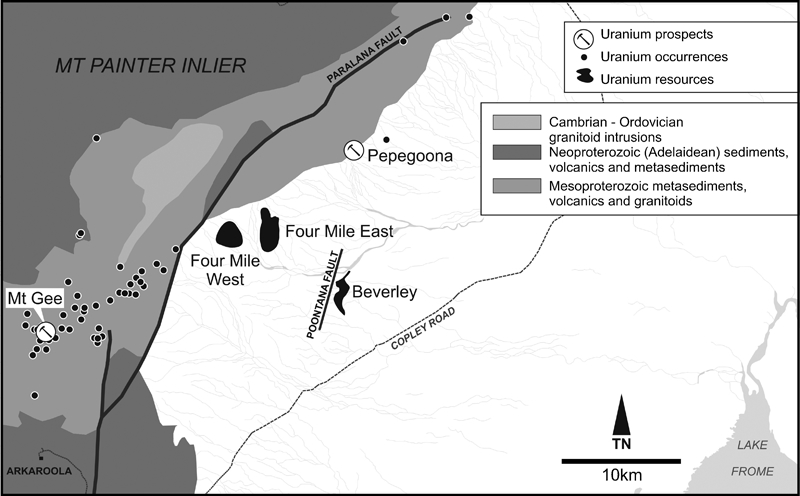
Callabonna Sub-basin; location of Four Mile, Pepegoona and Beverley deposits and Mt Painter Inlier uranium occurrences
The Beverley deposit was first detected by drilling in 1969 and its discovery led to a period of intense exploration activity prior to the introduction of the ‘Three mines’ policy in 1983. During this period, Honeymoon and Oban were discovered with Four Mile following much later in 2005. No uranium exploration has been conducted in the New South Wales section of the Callabonna Sub-basin since 1984, when the NSW Government introduced a ban on uranium exploration and mining that has only recently been reversed for exploration, but not for mining.
Beverley
Beverley is hosted by a north-south drainage system lying to the east of the interpreted Poontana Fault zone (Figs. 5 and 6). The original transport direction may have been from south to north. Mineralisation at Beverley occurs in predominantly tabular and lenticular zones, mainly at the contact with the underlying organic rich Alpha Mudstone. The principal uranium mineral is coffinite which fills voids and forms coatings on quartz grains. In 2000, Beverley was established as Australia's first ISL recovery mining operation and as such is an important showcase for the successful application of this technology. Beverley contained a total resource (pre-mining) of 16·3 kt U3O8 (McKay and Miezitis, 2001) however has declined to provide updated JORC resources due to issues of defining resources in ISL operations under the JORC Code (Heathgate Resources, 2006). Mineralisation has also been discovered 10 km to the north at Pepegoona, also known as Beverley North, very close to the edge of the Mt Painter Inlier.
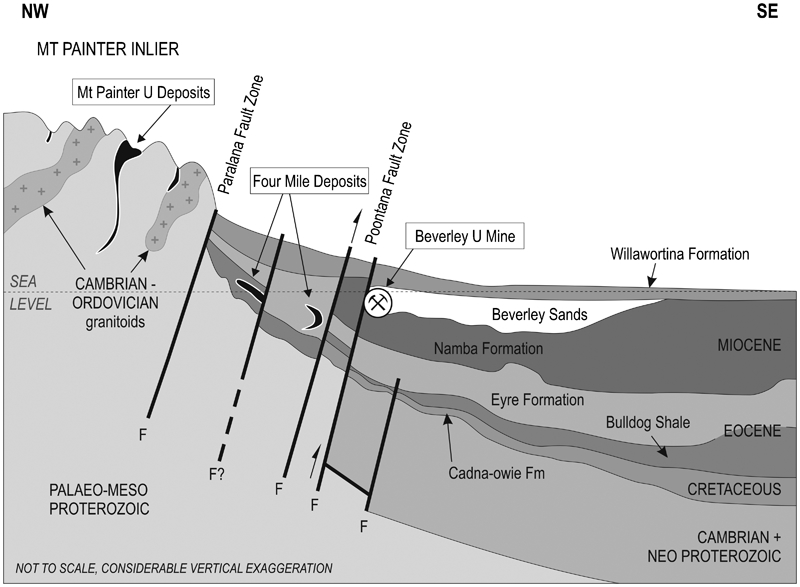
Four Mile
The Four Mile deposit was discovered in 2005 and is located 8 km west of Beverley and within 2·0 km of the range faults (e.g. Paralana Fault) marking the eastern edge of the Mt Painter Inlier. Mineralisation has been outlined in two zones, Four Mile East with an inferred resource of 13 kt U3O8 grading 0·31% and Four Mile West with an indicated and inferred resource of 19 kt U3O8 grading 0·34%, together amounting to the largest and highest grade sandstone-hosted uranium resource in Australia. Uraninite is the dominant ore mineral with common pyrite, kaolinite and a variety of REE- and U-bearing phosphate minerals in the ore zone.
Honeymoon
The Honeymoon deposit (Curtis et al., 1990), discovered in 1972, is located in the buried Yarramba palaeochannel and contains a resource of 2·9 kt U3O8 at an average grade of 0·20% U3O8. The Yarramba palaeochannel also contains the much smaller East Kalkaroo and Yarramba uranium prospects. The host Eyre Formation sits directly on Mesoproterozoic Willyama Supergroup meta-sedimentary rocks. Honeymoon is situated at a major bend in the Yarramba palaeochannel, the course of which is much influenced by basement lithologies and structures. The build-up of abundant woody material in the channel at this point is believed to be a contributing factor to uranium deposition. Mineralisation is very fine grained coffinite closely associated with humic material and pyrite. Oxidised waters in the aquifer are believed to still be actively causing selective dissolution and removal of uranium. Honeymoon became Australia's fourth operating uranium mine in 2011.
Timing of mineralisation
Four Mile West is hosted by the Upper Cretaceous sands of the Bulldog Shale, locally the uppermost unit of the Eromanga Basin (Jaireth, 2009). The Four Mile East, Pepegoona, Honeymoon, East Kalkaroo, Yarramba and Goulds Dam deposits lie in the palaeochannel sands of the Pliocene-Eocene Eyre Formation. The Beverley deposit lies in sands within the overlying Namba Formation (Late Oligocene – Miocene).
The timing of mineralisation at Four Mile and Beverley, based on the depositional ages of aquitards and aquicludes, gives a maximum age of 55 Ma for the Eyre Formation and 6 Ma for the Beverley Sands (Jaireth, 2009). Three periods of basement uplift and erosion could have driven oxidising uranium-bearing ground-water flow into aquifers in the basin. Present day groundwater flow in the Beverley Sands, along with evidence of disequilibrium indicates that Beverley was still in the process of formation, or at least re-mobilisation within the past 1 Ma (Roach et al., 2012).
Exploration for sandstone-hosted uranium deposits in Australia
There have been two periods of extensive exploration activity for uranium in Australia, the first of which, during the 1960s and 1970s, lead to the discovery of many of the sandstone-hosted uranium deposits known today, most of which have yet to be developed. The current period of activity, starting around 2004, has led to the discovery of at least three new sandstone-hosted uranium deposits so far, with Four Mile discovered in 2005, Blackbush in 2007 and Pepegoona in 2009. A number of promising new prospects have also been discovered in the current period of activity including Princess, at Mulga Rock, Theseus in 2009 and Afghan Swan in 2010. Exploration techniques have been influenced by the generally flat lying nature of the post Palaeozoic deposits, which are almost all buried by more recent sediments with no surface expression. Radon gas surveys, though common in the 1970s, have not been widely used during the current phase of exploration. Airborne radiometric surveys and remotely sensed imagery have limited use in mapping buried uranium and modern exploration techniques are focused on methods to map the palaeochannels that host the mineralisation (Hou et al., 2007). These techniques include AEM, micro-gravity, seismics and drilling to define channels. The recent pre-competitive Frome AEM survey and study of the Callabonna Sub-basin and adjacent areas (Roach et al., 2012) is a Government lead basin-wide approach. Drilling methods, in palaeochannels with relatively unconsolidated sediments, have typically included mud rotary and RC percussion with air core or sonic drilling to recover core. Gamma and PFN logging have generally been used to establish grade and the state of disequilibrium, with assay only applied to a few diamond or sonic holes and to establish calibration for PFN and gamma logging. Hydrogeological studies are necessarily undertaken to establish amenability for ISL recovery.
Conclusions
Sandstone-hosted uranium deposits constitute Australia's third most important uranium resource and two of Australia's four operating uranium mines. They occur in sedimentary basins ranging in age from Carboniferous to Miocene, with channel sandstone deposits the most important in Tertiary examples.
The long established model for sandstone-hosted uranium deposits, including the movement of oxidised uranium bearing groundwater into confined aquifers with carbonaceous material in a reducing environment, has been predictive and led to the discovery of many sandstone-hosted deposits over the past 40 years in Australia.
The presence of leachable uranium in uranium-rich source rocks is a vital ingredient in the sandstone-hosted model and Australia's largest and highest grade sandstone-hosted uranium deposits found to date at Beverley and Four Mile, lie very close to the uranium enriched Mt. Painter Inlier, making the Callabonna Sub-basin the most richly endowed area. Two examples of sandstone-hosted deposits sitting directly on uranium rich sources rocks have been found in recent years at Blackbush and Afghan Swan. In the case of Afghan Swan uranium mineralisation appears to have first been eroded from Mesoproterozoic basement rocks into the Mount Eclipse Sandstone of the Ngalia Basin during the Carboniferous and later re-mobilised into Tertiary palaeochannels.
The average grade of quoted resources defining Australia's sandstone-hosted uranium deposits is 0·15% U3O8 with Four Mile West at 0·34% U3O8 being one of the highest grade sandstone-hosted uranium deposits in the world. Uraninite and coffinite are the most common uranium minerals found in Australia's sandstone-hosted uranium deposits.
Australia remains highly prospective for the discovery of new palaeochannel hosted uranium deposits, with regional airborne geophysical surveys likely to be of great assistance in continuing to define palaeochannel systems that may host uranium in basins draining uranium rich source rocks.
Footnotes
Acknowledgements
The author would like to thank UXA Resources Limited for permission to publish this paper and the following individuals and companies for assistance in preparing this document:
Mark McGeough and Steve Abbott of Toro Energy Limited for information on Theseus and Figs. 3 and  .
.
Michelle Walter, UXA Resources Limited for preparing the diagrams and assistance with sourcing data.
This paper is part of a special issue on uranium deposits and in-situ leaching