







Abstract
Rapid change, high workloads and increased complexity in working environments has created the need for personal work resilience. This paper explores the concept of employee resilience within the geoscientist environment and especially the mineral industry. It uses as its framework for defining resilience the Resilience at Work (RAW) Scale, a seven-factor model that outlines areas of resilience that can be developed at an individual level. Specific practical strategies applicable to the challenges of employment in the cyclical resource sector are presented.
Keywords
Introduction
Employment in the mineral industry is turbulent and cyclical. It is subject to changes in commodity prices and international economics and commonly on short-term contract basis. Such instability is often combined with high pressure work, long hours, and the stresses involved in fly in–fly out (FIFO) arrangements and working remotely in harsh and hot or cold environments. Add to this, frequent organisational restructuring and company mergers or acquisitions and the pace and level of change felt by the individual geoscientist escalates. In order to work effectively and productively over the long-term in such conditions, personal resilience is a key requisite.
This article defines the factors that comprise personal work resilience and explores how these relate to challenges faced by employees and managers within the mineral industry. A range of practical strategies for resilience-building are presented that have been used effectively in Australia and internationally.
The concept of personal resilience
Resilience is a complex concept with numerous definitions. Central to most of these definitions is the notion that resilience involves being able to withstand and overcome adversity and unpleasant or difficult events successfully and to be able to adapt to change and uncertainty (Coutu, 2002). The term bounce back is frequently used to describe how resilient people respond to obstacles and setbacks in their lives. Broadly, resilience involves the capacity to manage and recover from demands and challenges in a consistent and effective way.
Resilience incorporates some sense of personal growth as each adverse experience is used not only to enhance coping but also to better manage the next set-back. In essence, each event provides an opportunity to learn new skills and anticipate, plan for, and better manage the next situation encountered. This all implies that resilience can only be developed through experiencing setbacks and working through them. Avoiding or being protected from problems is not useful and can be detrimental to future coping capacity when issues arise that cannot be ignored. For example, a manager who protects a new graduate from conflict, rather than mentoring in skills to manage conflict, is not supporting development of skills that will inevitably be needed.
Considerable attention has been given to whether resilience is an inherent personal trait or a process. Whereas it is acknowledged that there are aspects of our personality that contribute to resilience, there is now consensus that it is a dynamic process that can be developed in most of us (Masten, 2001). This means that whereas some people may have more resilient personal characteristics such as optimism and flexibility, it is possible to learn and develop the thoughts and behaviours that underpin it.
Work resilience
Despite the fact that the concept of personal resilience has been extensively explored and researched, its importance within the work environment has emerged more recently. Such interest is in response to rapid organisational change, increased stress and complexity within work roles combined with very busy out-of-work demands. Of particular interest has been identifying strategies that employees and employers can engage to build resiliency that are independent of personal attributes. The screening of prospective job candidates for traits correlated with resiliency is increasing across industry sectors that involve high-pressure work. However, the reality is that all workplaces will comprise a cross-section of the population with many less predisposed to inherent resiliency. An inter-play between personal characteristics and the environment reinforces the need to also focus on developing work behaviours and climates that promote resiliency rather than to just recruit those possessing resilient characteristics.
In direct response to requests for resilience-building strategies in her organisational consultancy work, the author has researched the concept of employee resilience and co-developed a psychometric measure, the Resilience at Work (RAW) Scale, a 20-item self-report instrument that measures individual workplace resilience (McEwen and Winwood, 2011). In developing the RAW Scale, the focus was on behaviours that promote resilience in professional and semi-professional roles that involve a degree of autonomy and skill. The value of the scale is its focus on the discretionary capacity of an individual as opposed to personality characteristics that are less able to be changed.
Seven factors were found to contribute to individual work resilience that can each be improved through self-awareness of current effectiveness followed by the employment of specific strategies (Fig. 1). Descriptor of each of these factors is as follows.
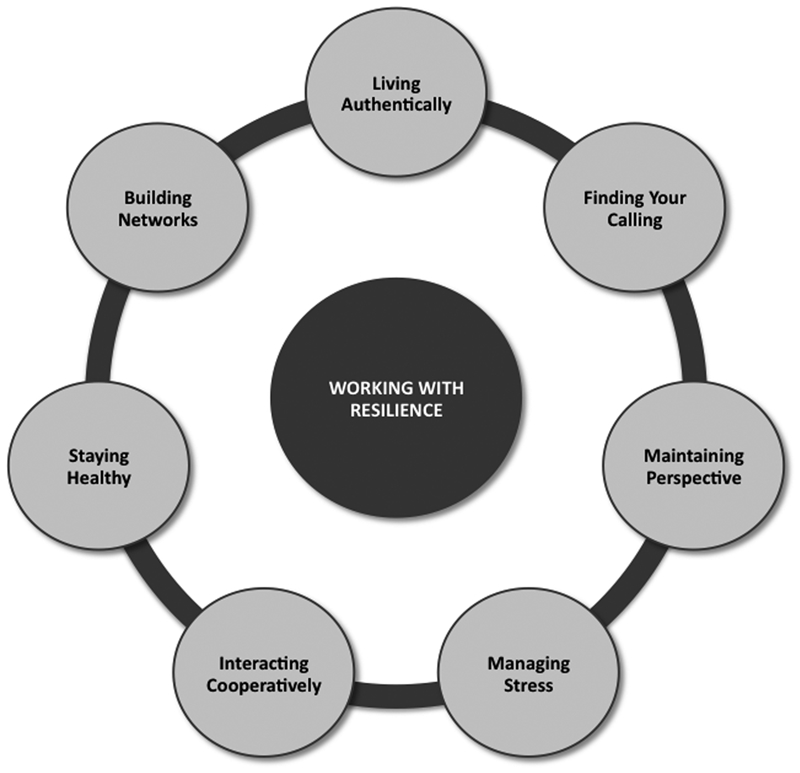
The seven components of the RAW scale (McEwen and Winwood, 2011)
Living Authentically: Knowing and holding onto personal values, deploying personal strengths and having a good level of emotional awareness and regulation.
Work is more satisfying and less stressful if it is consistent with personal values and strengths. When personal and organisational values collide, such as valuing honesty in a team with no transparency and trust, individuals feel integrity in the job is lost and struggle with what is required. This mismatch causes a constant tension. Similarly, a position that capitalises on strengths rather than works outside of these is performed more easily and has more capacity for personal growth. Whereas some element of challenge and stretch is important to professional development, working constantly in areas outside of strengths impacts on both productivity and well-being. An example may be promotion to a position involving more people management when the strength is in high analytical thinking. The other authenticity component is emotional regulation – the capacity to manage mood and emotional responses under pressure. As explored below, this is a critical factor in minimising overreaction when under duress and in maintaining positive work relationships, especially in leadership positions.
Finding Your Calling: Seeking work that has purpose, a sense of belonging and a fit with core values and beliefs.
This factor is more of an outcome than a strategy and demonstrates that individuals are more resilient when the work provides a meaning beyond daily tasks and where organisational values are congruent with personal beliefs. The premise is that individuals will commit more and work harder when there is a sense of vocation rather than employment. Where individuals also have a feeling of connection and belonging with co-workers the commitment intensifies through a sense of shared purpose. Organisations who do this well have employees with a great sense of pride in belonging to the organisation.
Maintaining Perspective: Having the capacity to reframe setbacks, focus on problem solving and manage negativity.
Interpretation of events, especially negative ones, is central to resilient thinking. As an example, in times of job redundancy a resilient perspective involves both acceptance that this is part of employment in geoscience and optimism that employment opportunities will improve. It also involves engaging in personal actions that can increase the likelihood of a new job and optimising use of down-time. Enhancing transferable skills, updating specialist knowledge and expanding networks all assist in this.
Managing Stress: Employing work and life routines that help manage everyday stresses, maintain work–life balance and ensure time for relaxation.
All professional work is busy. To manage this requires good self-care and time management techniques during the working day. It also involves ensuring adequate time out for rest and relaxation, with boundaries and routines that ensure that work demands do not overly intrude on home life. Examples of how this is achieved are explored below.
Interacting Cooperatively: Seeking feedback, advice and support and providing support to others.
Resilience involves anticipating and preparing for future obstacles and set-backs in a positive way. Professionals who seek feedback on their performance are able to modify it in the right direction. Having access to a range of professional and practical support and advice builds personal resilience through increasing resources and providing emotional support. Interestingly, giving support is of equal value. This may in part be the value of altruism in psychological wellbeing, although within a work setting support needs reciprocation to be maintained. A key characteristic of resilient teams is mutual support.
Staying Healthy: Maintaining a good level of physical fitness and a healthy diet.
Even in work that is not physically demanding, a sound level of physical health is critical to maintaining focus and stamina. A fitness and nutritional regime that is consistent with work and home demands impacts directly on the cognitive and emotional capacity to get through what an individual needs to do on a daily basis. In times of ill health, fatigue or injury other components of resilience such as perspective and support are needed to compensate for reduced physical capacity.
Building Networks: Developing and maintaining personal support networks.
Wide professional networks have long been advocated as a means of professional development and career progression. Resilience involves developing a network of support for all areas of work and home life. This may include practical help, advice, perspective, emotional support and debriefing. The more extensive the network of support, the more this assists in staying resilient at work. Ideally, employees invest in each of the seven factors, although limitations in one area can compensate for others. As an example, in times of lack of support or when working in an environment inconsistent with personal values, additional stress management and perspective techniques may be needed.
Against the framework of the RAW Scale, personal work resilience can be defined as ‘The individual capacity to manage the everyday stress of work and remain healthy; rebound and learn from unexpected setbacks, and prepare for future challenges proactively’. For the purpose of this article, the seven RAW Scale factors are mapped against four areas requiring personal investment: physical health, stress management, adaptability to change or set-back and personal pro-activity (Table 1). All factors interrelate and are of equal importance in overall resilience. Resilient workers invest in maintaining a healthy exercise and diet regime and ensure that they have the physical capacity to fulfil job needs. They also engage in effective self-care and stress management techniques and employ mechanisms to manage everyday work and home stressors.
Critical factors in personal work resilience
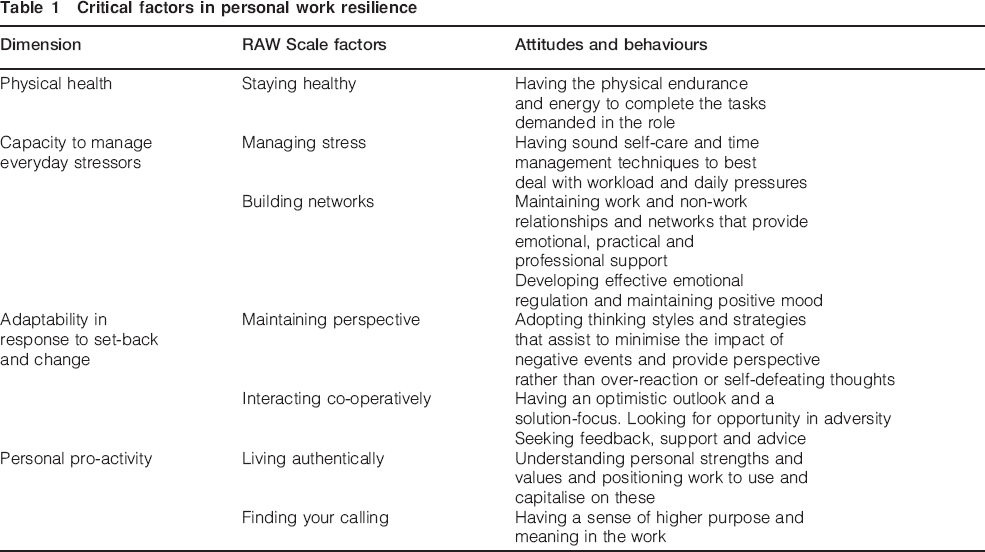
Whereas good health and self-care are fundamental to keeping on top of day-to-day pressures, resilience also involves adapting to unexpected changes and setbacks. Resilient people respond in a way that focuses on growth and solutions rather than non-coping. They are able to move on from negative events. This component is largely cognitive reframing as it is about the way in which a person interprets and makes sense of life events.
Finally resilience, as discussed here, comprises a proactive element of appreciating that there will be future challenges to prepare for. This demands an understanding of personal values, strengths and knowing how to best position oneself to maximise personal performance and well-being at work. It also comprises seeking work that offers meaning and purpose. A whole-of-life approach is advocated, with the strategies applied to both work and personal lives in recognition of their interconnected impact on psychological and physical well-being. It is also important to recognise that a team of resilient geoscientists will not create a resilient team as this requires additional elements such as mutual support, effective team processes, shared goals and values as well as the capability and talent to perform the work to be done. Whereas the focus of this article is on individual resilience, some strategies for team application are also listed.
Strategies for geoscientists
Physical health
Good physical health is essential for staying resilient during demanding work. In most geoscientist roles, field work is less physically demanding than in the past, but there remains the need to maintain stamina and energy to sustain long hours and travel demands. For FIFO arrangements, a lack of exercise can combine with a temptation for over-eating via on-site catering and consuming too much alcohol. The hope may be that extra calories will be compensated by a lighter diet at home, but this is seldom the reality. Staying healthy requires consistent worthwhile routines. Habit change is difficult and is most easily achieved through identifying techniques that work and building on these. Small shifts in the right direction are more achievable and sustainable for most. A smaller serve of ice-cream, one less beer and walking rather than driving are examples of this.
Many companies are encouraging physical health in recognition that healthy workers are more productive. Dietary guidelines for FIFO food, dedicated walking tracks between residential buildings and mine offices, gym facilities and small group exercise or games are just some examples of organisational initiatives. Ultimately, the self-motivation to capitalise on this will always rest with the individual. After times of intense work activity, a period of recovery is important. Immediately engaging in stressful work on return to the office after gruelling fieldwork may be detrimental to health longer-term as the impact can be cumulative. In periods of industry lay-offs or prolonged down-time between projects, a continued focus on maintaining physical conditioning and health not only eases transition back to work but also assists in psychological well-being and reinforces self-discipline and motivation: elements that can be lost during periods of unemployment.
Capacity to manage everyday pressures
The mineral industry is not unique in job pressures. Most industry sectors internationally are experiencing increasing demands on employees and declining resources, especially in professional and managerial roles. A recent survey by the Australian Psychological Society indicated that 22% of the Australian public are experiencing moderate to severe levels of stress and 32% believe that work issues are a source.
A simple yet effective model to illustrate management of workplace stresses is the Demands–Resources Model (Fig. 2). This model postulates that the capacity to be engaged or burnt out by work is dependent on the balance between the job demands and the available resources to meet these. In an economic environment where organisational budgets and support are declining, concurrent with expectations increasing, available resources are more likely to be personal and team-related than organisational.
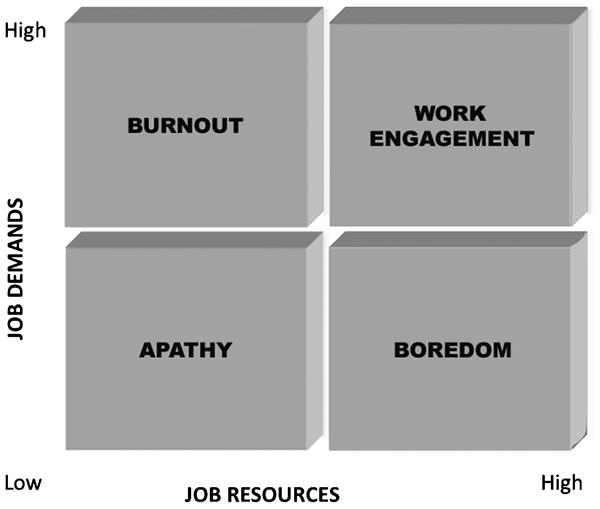
Job-demands resources model of work stress (Demerouti et al., 2001)
Typical personal resources include self-care strategies, time management, support networks and work/home boundaries and transitions. Most of these are simple and often commonsense but not necessarily easy to implement. In demanding roles they require structure, sound self-discipline and often negotiation skills. Self-care strategies largely involve creating routines that allow down-time and relaxation. FIFO arrangements often incorporate relaxation during non-work periods. For employees with more consistent work demands, integrating relaxation into busy schedules is difficult. As with maintenance of physical health, this requires building in down-time as a non-negotiable part of the week. It also involves taking breaks during the day. Establishing boundaries and developing regular routines makes this more sustainable.
What constitutes relaxation will vary dramatically across individuals, although it has been established that creative or outdoor relaxation is especially beneficial. Engaging in the activity mindfully (that is focusing on being in the moment and using all of the senses) also enhances its benefits. It is also preferable to balance active relaxation pursuits such as hobbies, sport and social pursuits with passive activities such as reading and listening to music. In a world of constant stimulation, focus is becoming difficult, despite multi-tasking being found to be counter to productivity (Kahneman, 2011).
The more the demands experienced the more the need to invest in self-care in order to avoid burnout. Commonly, attention in self-care actually diminishes as work pressures increase. There is simply no time to slow down or relax. Awareness of personal signs of overload is important here. Signs will vary considerably between individuals and may involve physical, cognitive and emotional symptoms. Recognising these and responding appropriately is a crucial regulatory component of stress management. Failing to address early signs of overload can result in more serious psychological or physical conditions that will require professional advice and support. Whereas workload and being away from home may be stressors when employed, in the cases of prolonged lay-off, stressors may shift to family tensions through changes in time spent together, lack of direction and practical issues such as finances. In these circumstances, gaining support and being proactive are more effective strategies as there may already be too much relaxation. Those on FIFO arrangements who already use time at home productively, for study for example, will find it easier to find direction and stay motivated.
Efficient and timely management of work tasks is useful as a means of alleviating the sense of being overwhelmed. Time management techniques generally fall into the category of efficient work processes, prioritising, getting support, minimising distractions and negotiating tasks and deadlines. Scheduling reflective time is also important for both creativity and well-being in busy jobs. Extensive travel time common in geoscientific work can be optimised and used for relaxation, catching up on work or reflection.
Resilient employees build and maintain a network of access to support (McEwen, 2013). This is another aspect of the stress management component of resilience. Support may be formal such as coaching, mentoring and teamwork or informal such as catching up with colleagues. Typically, the support required of a geoscientist may include access to debriefing, professional and personal advice, practical support, different perspectives and emotional support. Whereas support from family and friends is important, over-reliance on this impacts on relationships and may not add value when there is limited understanding of the work performed. Managers, in particular, often need independent perspective or advice from outside the organisation and family and a place for confidential and safe debriefing. Effective managers are adept at linking their staff into support networks as a means of building an effective team below them.
Team cohesiveness greatly enhances individual support networks. Mutual accountability, support and shared direction build team performance as well as resilience (Huszezo, 1996). Establishing cohesiveness can be difficult however when contracts and restructuring minimise the longevity of team relationships. Cyclical employment arrangements make organisational commitment difficult to attain. Teams that regularly invest in how they will work together to achieve outcomes rather than just defining what needs to be done are much more effective. Ideally, this team agreement is revisited each time there is a change in project and team membership.
Resilient employees achieve a balance between work and home life. Contrary to commonplace beliefs, work–life balance is not a factor of time but one of values (McEwen, 2011). Long inflexible hours are only an issue if they preclude involvement in activities that are important to an individual. This will vary considerably across individuals and across the life span. What is important in early career may shift when becoming a parent or when nearing retirement. Balance involves recognising what is important and putting this as a central priority rather than secondary to work demands. As with other elements of stress management and physical health, this requires dedicated attention.
Related to creating time for the things that matter most is the capacity to separate work from home life. This has become especially problematic with technology that allows and promotes 24/7 access and for senior managers who are on call. Negotiating accessibility, self-discipline in compulsion to check emails and structuring time for work that needs to be completed at home are common techniques. Many people also use a routine to transition from the workplace to home. There is considerable variability in what is effective, ranging from wind-down activities such as cycling conducted in transit or taking a shower, walking the dog or playing with children on arrival home.
A final component that relates to the stress management component of resilience is emotional regulation (Cooper and Sawaf, 1997). Under pressure, less desirable aspects of personality can intensify and personal strengths can be overused and create problems. A colleague inclined to intolerance or criticality, for example, will demonstrate more of this characteristic, while a personal strength such as perfectionism or flexibility can become a tendency to be controlling or to procrastinate. Under stress, there is also an increased probability of loss of perspective and over-reaction to situations. Within the workplace, a level of busyness and saturation are precipitating over-reaction to minor events. When this is combined with high expectations of personal rights and declining standards of respect and courtesy, it can have a major impact on organisational culture.
Within this context, the capacity to manage mood and regulate powerful emotions enhances a personal sense of being in control rather than overwhelmed. Of equal importance is the impact of this on work relationships, especially when working in small teams in remote or harsh environments in the field or on office-based projects that require close teamwork. Skills in emotional management and regulation are integral to emotional intelligence – a concept that is now seen as valuable in leadership, team relationships and aspects of work performance (Cooper and Sawaf, 1997). A core attribute of an effective manager is to appear calm and in control under duress as this has a direct impact on how employees will respond to the situation. An example of this is Hillary Clinton who presents as controlled and centred despite the pressure of the situation.
Coaching support should be sought when anger or distress are unable to be regulated at work. There are a number of effective cognitive-behavioural and other psychological techniques appropriate for organisational use. Everyday mood can be managed by individuals through shifting self-talk, adopting a confident open body stance and smiling. It has been demonstrated that acting positively actually does improve mood (Frederickson, 2009).
Adaptability in response to set-back and change
Constant changes in working arrangements are an integral part of resource sector employment. Many of these changes, such as a new venture or team, will be predictable and welcomed whilst others such as role change or lay-off will be unexpected and undesirable. Resilience involves adapting and moving on. This is particularly the case with a negative event as this requires a reframing of how it is seen in order to move forward positively. When the negative events are cumulative, the attention to personal thoughts and beliefs requires increased attention to stay on track. Resilience involves moving quickly through the initial negative response to a set-back. This involves seeing the event in perspective, remaining optimistic and taking a solution-focused approach. For example, being assigned to a difficult project involves looking for the learning opportunity within it, recognising that the situation will be time limited and developing strategies to better manage the elements that make the role inherently difficult.
Optimistic thinking and maintaining perspective facilitate adaptability. Whereas some individuals seem more disposed to a sunny disposition, there is research to support that optimism can be learned and comprises three aspects: personalisation, pervasiveness and permanence (Seligman, 1990). In the case of a set-back, optimistic thinking requires non-personalisation of the event. This does not mean avoidance of personal responsibility, but acceptance that not everything was in your control and your fault. Pessimistic thinking in this situation are thoughts such as ‘it's my fault, I'm hopeless’. Second, optimism involves the capacity to compartmentalise the event and not let it pervade other aspects of life. Problems at work, for example, should not be carried into home life and vice versa. This is difficult and requires effort to continue normally in other domains of life without letting them be adversely impacted.
Finally, optimism involves seeing negative events as temporary setbacks or opportunities rather than a permanent state of affairs. Seeing completion of a contract position as indicative of long-term unemployment or confirmation that skills are inadequate to gain another job are examples of interpreting events as permanent. Interpreting events optimistically demands awareness of, and attention to, self-talk with a reframing of negative thoughts. This is another example of a technique that is simple but not easy and needs focus and practice. For those prone to pessimism, access to people who can challenge thoughts and offer different realistic perspectives is very valuable. When negative thoughts become overwhelming and are causing anxiety or a crisis in self-confidence, seeking early psychological support is advisable to prevent the onset of more serious implications such as clinical depression.
Awareness and avoidance of common thinking traps is also useful as these inhibit adaptability (Table 2). Within the workplace, such responses to obstacles can inhibit problem solving and it can be easy to become stuck in the issue rather than focused on its resolution.
Common thinking traps that inhibit adaptability
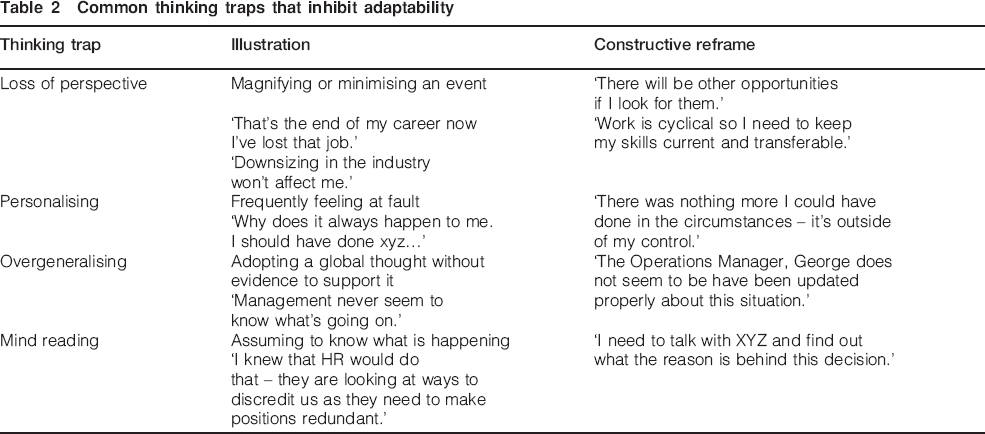
Adopting solution-focused language is also useful as this quickly directs focus and attention onto what to do rather than how difficult it is. Team questions such as ‘What's the next step in resolving this?, ‘What would it look like if it was working? and ‘What worked in the past and how can we bring this to this issue?’ will decrease the time spent on debriefing and complaining as well as enhance a sense of optimism around resolution (Berg and Szabo, 2005).
Identifying what is within scope of influence is also important as considerable energy can be spent on issues outside of the team's control. Strategies such as these are also useful for individual issues. If job loss is inevitable, then focusing on what to do about this rather than becoming angry at the organisation or boss enables more rapid adaptation.
At a team level, adaptability can be nurtured by creating opportunity for debating different perspectives constructively and engaging in joint problem solving. Resilient teams are able to challenge thinking, argue and engage in robust discussion. Constructive conflict facilitates creative problem solving. Egos, hidden agendas, lack of trust and different goals inhibit this. Not only does positive exchange promote members sense of feeling good research has shown that team effectiveness declines when advocacy greatly outweighs inquiry. The more members advocate for and defend their positions, as opposed to inquiring and exploring and valuing others, the less effective the team is (Avolio, 2011).
The capacity to actively seek and value feedback should be extended in teams to external stakeholders. It is impossible to adapt to a changing environment without seeking the advice and opinions of those who impact on the business. At an individual level, resilience at work requires seeking and acting on feedback relating to personal performance. This is also an important element in the proactive component of resilience as there is no potential to anticipate future issues unless information on what these may be is sought.
Optimism facilitates resilience at work, but positivity beyond outlook is also of value. There is extensive research to support the fact that positive emotion enhances well-being, relationships and subsequently individual and team performance at work. Acting and communicating positively not only improves mood giving rise to the expression of fake it until you make it – it also improves relationships.
It has been found that there is a ratio of positive to negative communication termed the Losada Ratio that predicts relationship success (Frederickson, 2009). Individuals, marriages and business teams flourishing, or doing remarkably well, have positivity ratios above +2·9 to −1 negative. By contrast, individuals not coping, couples divorcing and unprofitable business teams have ratios below 1∶1. The association between positivity and flourishing is highly robust and consistent at the individual, couple and team level.
One of the most powerful ways of generating positivity in organisations is increasing the frequency of sincere acknowledgement of effort and talents. In contrast, superficial and non-genuine complements promote cynicism and disengagement.
Personal pro-activity
In employment with variable conditions, pro-activity in relation to career and personal circumstances can be seen as essential risk management. Maintaining professional competence and currency are commonsense in an environment where job seeking may occur more often than in other occupations. A continued focus on professional development through courses, reading and attending industry events is useful, as is the maintenance of professional networks. Networks are a major source of information on new opportunities, industry trends and referees. They also serve as a useful support in maintaining connection with the profession when unemployed. Visibility enhances job opportunities. Forman (2008) provides a range of ideas on how to maintain employability in geoscience.
Practical pro-activity is also prudent in planning for what may be inevitable redundancy. Finances, relationships, out-of-work interests are all relevant in regard to this. Pro-active employees not only anticipate future challenges, but also have a good level of self-awareness. They actively seek feedback on their performance and adjust their behaviours accordingly. Ego, poor confidence or fear of criticism can sometimes preclude seeking feedback leaving blind spots that are not addressed.
Another element of pro-activity is knowing and capitalising on what one does well – often termed by psychologists as ‘playing to strengths’. There is growing research in recent times, via the positive psychology movement, on deploying strengths as a means of enhancing job satisfaction and performance (Linley et al., 2010; Seligman, 2002). Each person possesses different talents by virtue of their skills, knowledge, personality and special aptitudes. Recognising and finding opportunities to use these talents more means that work is more satisfying and less stressful. The theory is that there is greater potential for growth and satisfaction in working with (or playing to) strengths – a factor somewhat in contradiction to organisational emphasis on development needs.
Discovering and capitalising on the strengths of team members is becoming commonplace in organisations wishing to enhance team effectiveness and a multitude of strength assessment tools are now available. Strengths such as critical thinking, humour and creativity can add to the complementary skills and knowledge that are often the basis for recruitment to a team. Research findings relating to the RAW Scale indicates that jobs that allow personal authenticity promote resilience. If an individual is able to work in a manner consistent with personal values, and believes that the work provides meaning and purpose beyond daily tasks, there is greater commitment and capacity to persist despite obstacles and difficulties.
Internationally organisations continue to invest heavily in development of company values as a means of establishing desired work cultures and service standards. Whereas values-based behaviour is at the heart of organisational culture, the reality is that there is often disconnect between what is formally endorsed and what actually occurs. Increasingly individuals are leaving work environments that operate counter to personal values. For example, if a person values empathy, fairness, equity or honesty, the absence of this creates a sense of lack perceived integrity in the work and trust in the organisation. When faced with financial realities of being unable to leave individuals will cope well with the situation only if they invest in other domains of resilience such as support and perspective. Ultimately, when provided with choice, employees will often leave when values are incompatible (Linley and Joseph, 2004).
The proactive component of resilience with relation to authenticity is recognising one's values, vocalising them and role modelling and promoting them to the extent possible. One characteristic of high performing teams and effective leadership is articulated shared values that are used to guide behaviour and decision-making. This demonstrates that this impacts not only on resilience but also on performance (Avolio, 2011).
Employees who are able to find a sense of purpose and meaning in their work and who feel connected to their organisation have higher levels of resilience. Many occupations such as academia, helping professions and work in not-for-profit roles can easily relate their work to a broader contribution. Professionals such as geoscientists who see their work as a vocation are more likely to manage difficulties in the work and stay motivated as the higher goal, such as finding a deposit or optimising the exploration of an ore body, makes the task worthwhile.
In everyday tasks, it can be easy for geological duties to take on a data entry focus without reflection on what the data means. Finding the time and space to think about the significance of the data and to share this through small team presentations or regular review of sub-project findings will enhance job satisfaction. Creating the space for individual and team intellectual challenge adds to the perceived meaning and purpose of the work and also enhances collaborative problem solving and career progression.
In other roles such as leadership, the meaning and purpose can be the organisational vision. Linking every job to the organisational vision and strategy is an effective way to increase meaning as long as the strategy and vision are shared and not simply more profit for shareholders.
Summary
Personal work resilience is complex with a number of interrelated factors underlying it. There are a number of shifts in beliefs and behaviours that can be undertaken to build resilience. Attention to these will enhance personal well-being and the capacity to manage the work pressure, constant change and job insecurity integral to employment in the mineral industry. Devising mechanisms to apply resilience-building within a team enhances even further the capacity of geoscientists to steel themselves to survive and thrive in the profession.
Footnotes
Acknowledgements
Several colleagues have been critical during the research that has generated many of the ideas that are reviewed in the article. I would like to give particular acknowledgment to Peter Winwood, my partner in development of the RAW Scale and to Neil Phillips, University of Melbourne, who provided guidance on the manuscript. A number of Masters in Organisational Psychology students from University of South Australia and University of Adelaide assisted in literature reviews and research, notably Sonya Vandengoot, Rochelle Colon and June Mullins. My appreciation also to the numerous client organisations I have worked with in recent years, including those in the minerals and energy sector. Industry partners have allowed valuable input into development and application of the RAW Scale as well as trialing of, and feedback on, many of the strategies outlined. My thanks also to SafeWork SA for funding research, through an Augusta Zadow scholarship, which has furthered my understanding of workplace resilience.