







Abstract
Rare earth elements (REEs) have a crucial role in modern environmental and medical technologies, leading to a continuously growing demand for these elements. The relatively modest scale of the global REE mining sector means that the REE mineral deposit type knowledge base is small compared to more well-known styles of mineralisation. In this paper, we present a new classification scheme for differing REE mineral deposit types, outline the geological processes that cause REE enrichments, define characteristic grades and tonnages, and provide information on the environmental impact associated with REE mining, extraction and processing. Although current global REE supply is dominated by production from carbonatites, REEs are in fact found in a wide variety of deposits, including magmatic alkaline complex- and rhyolite-hosted REE mineralisation, REE-enriched iron oxide-copper–gold deposits, and REEs within heavy mineral sands, amongst others. Critically, REE mineralogy is linked to environmental risks during mining and refining, especially aspects such as radioactive U–Th, the use of harmful chemicals during processing and greenhouse gas emissions; future REE supply therefore needs to consider and address these environmental risks.
Keywords
Introduction
Rare earth elements (REEs) have a crucial global role in modern technology, industry, modern medicine and the sustainable development of human society. However, in contrast to the name of this group of elements, some of the REEs are common when compared to the distribution of other economically important metals (e.g. Cu, Au, Pt) within the Earth's crust. The REEs consist of the 15 lanthanide elements plus scandium and yttrium (IUPAC, 2005).
Global demand for the REEs, often produced as refined rare earth oxides (REOs), has consistently increased over recent decades as these elements have become more important to modern life. However, the supply of REOs is dominated by China, which in turn has been continuously restricting its export quota since 2009. This means there is an urgent need for an increased understanding of the global abundance of REEs, the mineral deposit types that contain significant amounts of these elements, and the quantification of REE resources that could potentially meet demands for the decades to come.
This paper provides an initial step in quantifying some of these uncertainties by providing an overview of differing REE mineral deposit types, tonnages and grades, and briefly discusses the potential environmental implications associated with mining, extraction and processing of REE ores.
The chemistry of the REEs
Each REE has distinctive characteristics and usages, with the lanthanide elements divided by electron shell configuration into the light REE (LREE; La to Gd) and the heavy REE (HREE; Tb to Lu). However, the global mining industry often uses a slightly differing classification, where the HREE includes Pm, Sm, Eu and Gd (Table 1). Despite having a relatively low molecular weight, Y is typically classified as a HREE, and Sc is not formally classified as either a LREE or a HREE but is often considered together with the REE as a whole.
Summary of the chemistry and average crustal abundances of the REE; adapted from Jowitt et al. (2013)*
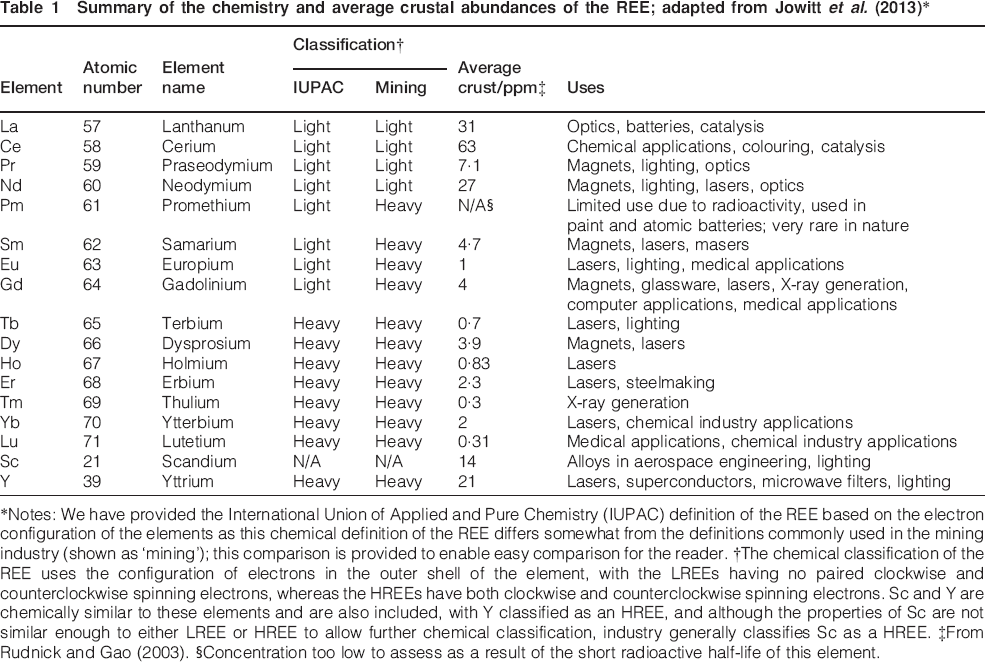
Notes: We have provided the International Union of Applied and Pure Chemistry (IUPAC) definition of the REE based on the electron configuration of the elements as this chemical definition of the REE differs somewhat from the definitions commonly used in the mining industry (shown as ‘mining’); this comparison is provided to enable easy comparison for the reader. †The chemical classification of the REE uses the configuration of electrons in the outer shell of the element, with the LREEs having no paired clockwise and counterclockwise spinning electrons, whereas the HREEs have both clockwise and counterclockwise spinning electrons. Sc and Y are chemically similar to these elements and are also included, with Y classified as an HREE, and although the properties of Sc are not similar enough to either LREE or HREE to allow further chemical classification, industry generally classifies Sc as a HREE. ‡From Rudnick and Gao (2003). §Concentration too low to assess as a result of the short radioactive half-life of this element.
Typical REE abundances in the Earth's crust vary significantly, as shown in Table 1, with Ce having an average crustal concentration (63 ppm) that is higher than the average concentrations of Cu (47 ppm) and Pb (17 ppm) within the Earth's crust (Rudnick and Gao, 2003). In comparison, Tm has an average crustal concentration of 0·3 ppm and Lu has an average crustal concentration of 0·31 ppm, much lower than the majority of other economically important metals, but still higher than Au, Ag and platinum group elements (Rudnick and Gao, 2003).
Rare earth elements are rarely present as native metals (if ever) in the geological environment. Instead, these elements often substitute for other elements within the matrix of certain minerals, especially phosphate and carbonate minerals (Table 2). The most important economic REE-containing minerals at present are bastnäsite [(Ce, La)(CO3)F] and monazite [(Ce, La,Nd, Th)PO4], and a detailed list of known REE-containing minerals is provided in Table 2. The substitution-dominated nature of REEs, combined with the fact that the global demand for these elements is dominated by a need for high purity single element products, rather than the lower grade concentrates typically produced by the global mining industry (e.g. Cu, Ni, Au) means that the extraction, concentration and processing of the REEs is highly variable, and is often specific to a deposit-type or even a single deposit. These processing difficulties and complexities are additional risk factors that need to be considered during REE exploration and the development of REE mines and as such may hinder the economic development of REE resources. The need to build expensive processing facilities may limit the exploitation of deposits with lower contained REE tonnages, and, unless near-identical or identical clusters of deposits are found in a given area (somewhat unlikely), the processing difficulties inherent in REE production mean that a central processing plant cannot service multiple mines, unlike more conventional smelting operations (e.g. centralised processing and smelting facilities that obtain concentrate from multiple mines either within or outside of a given mining field, such as Kambalda and Sudbury). This requirement for expensive processing facilities means that low grade deposits, unless of significant size, may be uneconomic to exploit or at the very least would require expensive infrastructure with long payback times, something that may be difficult to sell to shareholders in somewhat turbulent economic situations.
Common REE-bearing minerals*
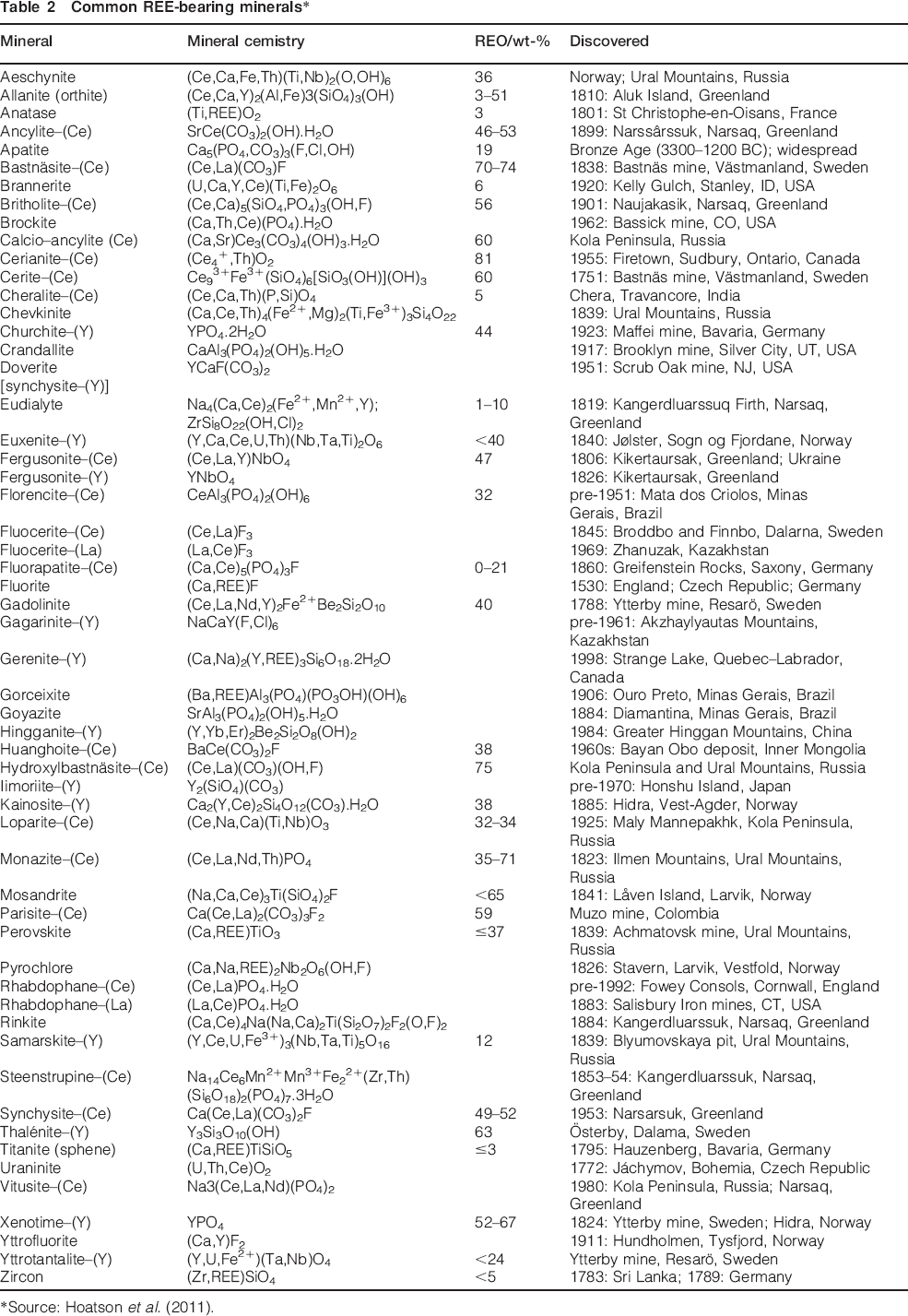
Source: Hoatson et al. (2011).
Global REE production is currently dominated by the exploitation of carbonatite or weathered carbonatite deposits, such as Bayan Obo in China, Araxá in Brazil, Mountain Pass in the USA, and Mount Weld in Australia. However, the mineralogy, grades, tonnages and potential processing variations in these different types of REE deposits have not been systemically analysed. Each deposit type contains varying REE abundances and differing proportions of the LREEs and the HREEs, further complicating the issue of refined REO production. The increasing demand for the REE has also accelerated exploration and the push for extraction from all differing types of REE deposits, either as a target commodity or as a byproduct of other minerals such as U and Th.
These complexities indicate that the real uncertainties in meeting future REE demands are focused on the geological abundances of these elements, the deposits they are found in, and the environmental implications and costs of REE extraction and processing. Here, we outline current REE production and demand, the differing types of REE deposits and briefly investigate the environmental impacts associated with REE mining and processing.
REE production and demand
The current global REO market is dominated by Chinese production. This is clearly evident in Fig. 1, where Chinese REO exports have led the global market since 1990. In 2006, China's annual production peaked at 133 000 tonnes REOs, accounting for 97·1% of global REO production, and Chinese REO production has maintained this dominant position to date. This is exemplified by the fact that the USA was self-reliant on REO production throughout most of the twentieth century but by the late 1990s had become nearly 100% dependent on imports (Humphries, 2012). Similar scenarios have occurred in most countries that had been past-producers of REEs, such as Australia, Malaysia and Russia. However, rapid growth in domestic demand for REE since 2009 and an increased need to better regulate illegal mining and smuggling has meant that China has continuously reduced its REO export quota and restricted REE mining output, especially in terms of production of Tb, Dy, Lu and other HREE, causing a decline in global REO production (Fig. 1).
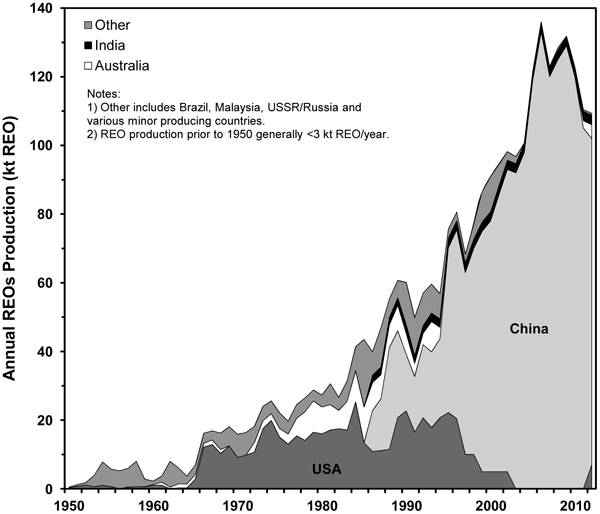
Global annual REO mine production. Data sources: USBoM (various-a, b), USGS (various-a, b,c;), USGS 2013; Australian REOs based on monazite production data from BoMRGG (various) and under the assumption of minimum 60% contained REO
Increasing demand for REOs has been driven by the growing use of REEs in electronics, oil refineries, sustainable energy, and medical and defence technologies, including fluid cracking catalysts, REE alloys in batteries, specialist magnets for wind turbines or hybrid and full electric cars, and personal electronic devices and phosphors in liquid crystal displays. The persistent growth in these products and technologies (Humphries, 2012) means that the global demand for REE can be reasonably expected to continue to increases over the coming decades, meaning that a wider variety of REE mines and deposit types will need to be developed and exploited to meet this demand.
Principal REE mineral deposit types
As discussed above, REE in mineral deposits are usually hosted by a wide and diverse range of REE-bearing minerals such as bastnäsite [(Ce, La,Y)CO3F], monazite [(La–Gd, Th)PO4] and xenotime (YPO4); these are the three most economically significant minerals of the more than 200 minerals known to contain essential or significant amounts of the REE (Table 2; Christie et al., 1998; Hoatson et al., 2011). These REE-bearing minerals form as a result of a wide range of geological processes, and, as such, are found in a diverse range of igneous, sedimentary and metamorphic rocks.
Although there are existing methods for classifying REE deposits that are commonly based on REE mineralogy or host rocks, we have developed a new classification approach based on geological processes that form or concentrate REE minerals and enable the formation of REE mineral deposits. Given the varying genetic processes and range of REE mineralisation types, this allows a more robust and comprehensive classification than those used to date (e.g. Kanazawa and Kamitani, 2006; Chakhmouradian and Wall, 2012; Mariano and Mariano Jr, 2012). Our classification is obviously a simplification of the natural complexity of REE deposits that has led to the formulation and implementation of numerous other classification schemes. For example, the United States Geological Survey (USGS; Long et al., 2010) classification uses a total of 34 mineral deposit types, whereas the British Geological Survey (BGS; Walters et al., 2010) uses a simpler split of primary deposits of igneous and hydrothermal origin or secondary deposits concentrated by sedimentary processes and weathering. Here, we consider both the geological processes involved in the formation of REE deposits and the REE mineralogy of individual deposits in our classification scheme (Table 3). It should be noted that this classification, as with all classifications, is reliant on the amount of information available, as exemplified by the world's most important REE deposit at Bayan Obo; the formation of this REE deposit is still controversial, and as such, we can only rely on current knowledge and the geological evidence available within both published and industry literature (e.g. NI43-101 reports) to classify REE deposits. In addition, and as is often the case for mineral deposits (e.g. Jowitt et al., 2013), a given mining field or even resource may contain two or more REE deposit types; where this is the case, we have classified a given deposit by the dominant (i.e. most contained REE) deposit type. Our classification is as follows.
Classification of REE deposit types
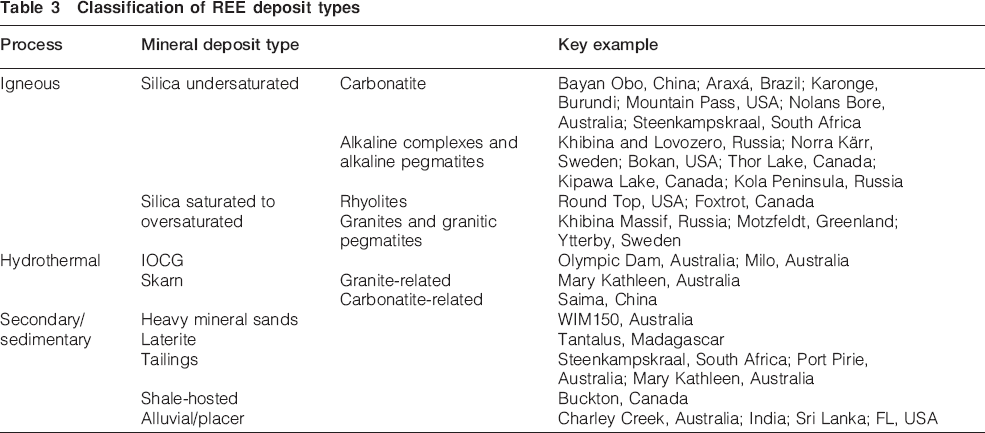
We now give an overview of the major deposit types as summarised in Table 3. Describing the processes involved in the formation of currently minor REE deposit types, such as REE-bearing clays (for example, Long Nan and Yian Xi, both in China), skarn (Mary Kathleen, Australia), shale (Talvivaara, Finland; Buckton, Canada), and quartz-pebble conglomerate U deposits (Eco-Ridge, Canada) is beyond the remit of this paper, and the future importance of these deposits in terms of REE production is unknown.
Carbonatites
A number of important REE deposits are hosted by carbonatites (e.g. Table 4). These unusual igneous rocks are generally defined as magmatic rocks that contain high modal abundances of carbonate minerals (>50%) and are enriched in Sr, Ba, P and the LREE (Jones et al., 2013; Nelson et al., 1988). These rocks can be intrusive or extrusive, and carbonatite magmatism can also lead to metasomatism, hydrothermal alteration and replacement (Jones et al., 2013). The resulting intrusive and extrusive rocks can have a wide range of textures and grain sizes. Carbonatite magmas are thought to form by three main processes (Jones et al., 2013, and references therein):
Selected REE Deposits classified by deposit type and with associated mineral resources and REO grades
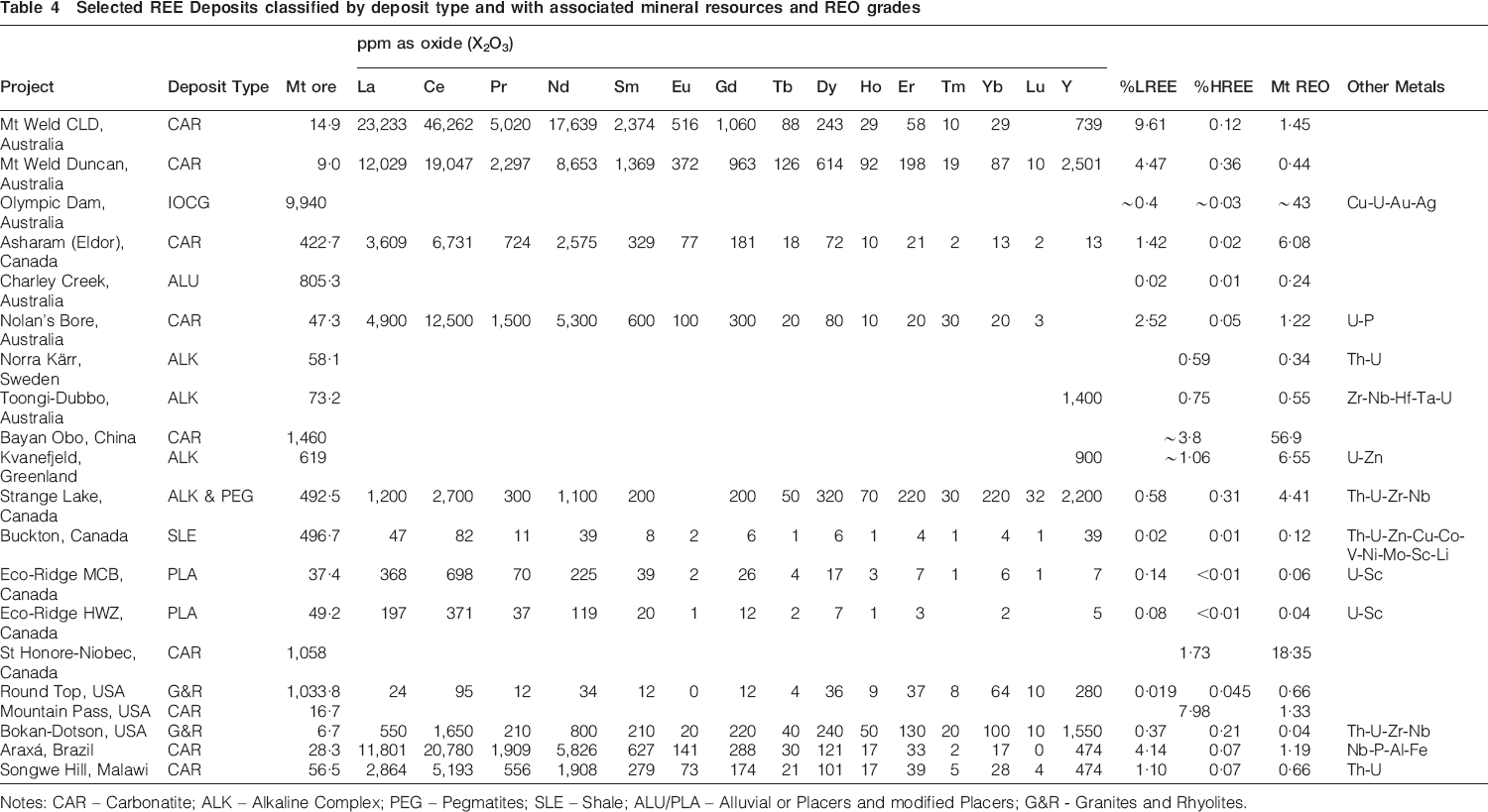
Notes: CAR – Carbonatite; ALK – Alkaline Complex; PEG – Pegmatites; SLE – Shale; ALU/PLA – Alluvial or Placers and modified Placers; G&R - Granites and Rhyolites.
as a residual melt associated with carbonated nephelinite or melilitite magmatism
the segregation of an immiscible carbonatite melt caused by the saturation of a silicate magma with CO2
as the result of partial melting of CO2-bearing peridotite.
Carbonatites are found as individual intrusions and with other SiO2-undersaturated rocks (e.g. syenites, nepheline syenites, and nephelinites) in alkaline–carbonatite complexes (e.g. Christie et al., 1998), and contain a wide range of minerals, including apatite, magnetite, barite, and fluorite, that may contain economic or anomalous concentrations of REEs, P, Nb, U, Th, Cu, Fe, Ti, Ba, F, Zr, and other incompatible elements (Modreski et al., 1996). The most common (and important) REE-bearing minerals in carbonatites include bastnäsite and monazite, with xenotime rare in these types of rocks. One major exception is the xenotime-bearing carbonatite dykes within the Lofdal REE deposit in Namibia (Siegfried and Hall, 2012).
Alkaline rocks
Alkaline felspathoid (e.g. nepheline)-bearing igneous rocks form from alkali-rich, silica-unsaturated magmas that contain high concentrations of potassium and sodium. These magmas are usually found in rift settings and are generated by generally deep and always low degree partial melting of the mantle. The mantle that these magmas are sourced from may be metasomatically enriched in the REEs, and the low degrees of partial melting involved in the genesis of these magmas means that they preferentially concentrate highly incompatible REEs from the mantle (e.g. Chakhmouradian and Zaitsev, 2012). The majority of significant REE mineralisation in alkaline complexes is also associated with highly fractionated magmas, with REEs being concentrated not only during magma genesis but also by the incompatibility of REEs (and other minerals, such as Zr, Hf, Nb, Ta, Be) during this fractionation (e.g. Chakhmouradian and Zaitsev, 2012). Rare earth element mineralisation in alkaline rocks is dominantly associated with highly fractionated sections or sequences of alkaline lavas, tuffs, mafic volcanics, and subvolcanic intrusives (especially the upper sections of layered intrusions), and may be associated with magmas that are volatile-enriched. Any late-stage magmato-hydrothermal F- and Cl-bearing fluids associated with these intrusions may also enhance REE grades in these deposits (Hoatson et al., 2011). Typical deposits of this type include the Khibini and Lovozero complexes in Russia, the Norra Kärr complex in Sweden and Thor Lake in Canada (Table 4).
Granites and rhyolites
Granites are coarse-grained igneous rocks formed from magmas containing high concentrations of SiO2. The magmas that form granites can be generated by the melting of igneous or sedimentary rocks during metamorphism, by the anhydrous melting of the lower crust (e.g. during mantle plume-related underplating) or by the extreme fractionation of mafic magmas. Rhyolites are the fine-grained equivalent of granites, and are either intruded close to the Earth's surface or are erupted. These rocks are compositionally identical, and as such they are discussed together here, even though we have two separate categories for REE deposits associated with these units (Table 3). The reason for the separate categories is that REE deposits associated with plutonic granites and volcanic rhyolites are significantly different. The most important granite-related igneous REE deposits are pegmatitic and form from volatile-rich magmas derived and/or exsolved from highly fractionated felsic magmas. In general, pegmatitic magmas can contain elevated concentrations of elements (e.g. the REE, Be and Li), fluxes (e.g. B, F and P), and volatiles (e.g. H2O and Cl) that are incompatible during the fractionation of quartz and feldspar (e.g. London and Kontak, 2012). The concentrations of incompatible elements increase during fractional crystallisation of felsic magmas, eventually generating highly REE-enriched pegmatitic magmas. The volumes of pegmatites formed by this process are generally lower than their associated granite bodies, but can contains significant tonnages of the REEs, as evidenced by the number of known pegmatite-related REE deposits, including those of the Khibina Massif in Russia, the Motzfeldt deposit in Greenland and the Ytterby REE deposit in Sweden.
Rhyolite-related REE deposits are rarer than pegmatite-hosted REE deposits, with only one rhyolite REE resource delineated to date: the Round Top REE rhyolite deposit in Texas, USA (Table 4). The REE enrichments in rhyolites form in much the same way as in pegmatites (i.e. as a consequence of fractional crystallisation) only not necessarily with as much extreme fractionation and without necessarily concentrating the REEs to the same degree as during pegmatite genesis. This is clear when comparing grades and tonnages of pegmatite and rhyolite deposits. Pegmatites usually form high-grade but small REE deposits, whereas rhyolite REE mineralisation is usually disseminated throughout an entire intrusion or volcanic units, creating voluminous, but low grade REE mineralisation that is exemplified by the Round Top deposit but as also identified in highly evolved rhyolites elsewhere (e.g. Christiansen et al., 1983, 2007).
IOCG
The IOCG deposit category was initially defined after discovery of the REE-enriched giant Olympic Dam Cu–U–Au–Ag deposit, but has grown to cover a broad range of somewhat loosely grouped mineral deposit types (e.g. Groves et al., 2010; Mudd et al., 2013; Williams et al., 2005). Iron oxide-copper-gold deposits in a strict sense (according to Groves et al., 2010) are structurally controlled magmato-hydrothermal mineral deposits that are often LREE-enriched, containing significant concentrations of La, Ce and Nd, are linked with brecciation and Na–Ca alteration, and have high abundances of low-Ti Fe oxides that are associated with low-S sulphide mineralisation. The REE within these deposits is thought to be related to the presence of high-F hydrothermal fluids that can effectively mobilise significant concentrations of these elements (e.g. McPhie et al., 2011) as well as other elements such as Fe, Cu, Au and U, before being precipitated as minerals such as bastnäsite and allanite. It should however be noted that REE-enriched areas of these deposits may not be spatially related to areas with economic grades of Cu, U or Au, reflecting the differing processes involved in the precipitation of these elements. Iron oxide-copper-gold deposits (sensu stricto) are also temporally, but not necessarily spatially, related to significant magmatism and subalkaline to alkaline pluton emplacement (Groves et al., 2010). A number of REE-enriched IOCG deposits are known, including Olympic Dam, and the Mount Cobalt IOCG deposit of the Eastern Foldbelt of the Mount Isa Inlier, both of which contain Fe, Cu, Au and U in addition to being enriched in the LREE (predominantly La, Ce and Nd) This deposit type has also been linked with carbonatite magmatism, another important source of REE mineralisation, as discussed above (e.g. Corriveau, 2007).
Placer and heavy mineral sands
Placer deposits form by the mechanical concentration of minerals, where sedimentary processes allow the concentration of heavy minerals. The majority of these mineral deposits are hosted by modern and ancient marine sands that are located along or near present and ancient coastlines. These heavy mineral sand deposits are exploited for titanium, with byproduct zircon, monazite, and more rarely xenotime. Heavy mineral sands can often contain significant amounts of REE, with Orris and Grauch (2002) listing more than 360 REE-bearing placer deposits. In addition, palaeoplacer REE mineralisation can also be upgraded by other processes, similar to those associated with palaeoplacer-hosted Au and U mineralisation, as exemplified by the Eco Ridge deposit in Ontario, Canada (Table 4). This deposit contains two distinct units within a palaeoplacer conglomerate, both of which have been upgraded by interaction with hydrothermal fluids, depositing secondary U minerals and also increasing REE grades. Interestingly, the upgrading of the basal conglomerate bed at Eco Ridge formed higher grade U mineralisation than within the overlying main conglomerate bed, whereas the reverse is true of the REE, with the basal conglomerate bed containing lower REE concentrations than the main conglomerate bed (PMR, 2012).
Laterite deposits
Laterite REE deposits are formed by the deep weathering of REE-bearing rocks such as carbonatites, usually in tropical regions, although REE laterites can also be found in higher latitudes where lateritic weathering occurred during earlier periods with warmer, more humid climates. The carbonate-rich nature of carbonatites makes them particularly prone to deep weathering and the development of karst landforms and laterite formation. This, combined with the presence of high REE concentrations within carbonatites, means that significant thicknesses (up to 200 m; Lottermoser, 1990) of REE-enriched laterites can develop above carbonatite lithologies in tropical regions. The refractory nature of a significant number of REE minerals (such as apatite; Lottermoser, 1990) can also cause enrichments of these minerals during weathering. Alternatively, if REEs are mobilised during weathering by the breakdown of their hosting minerals, their low mobility means they can be concentrated within distinct horizons in the laterite profile by being adsorbed onto particular clay minerals, as is the case at the Chinese Long Nan and Yian Xi HREE laterite deposits. This process causes laterite REE grades to vary laterally, with grades often higher in saprolite layers than ferruginous layers (e.g. Lottermoser, 1990). It should also be noted that Sc-enriched laterites can form without distinct REE enrichment in precursor lithologies, such as the Nornico Group of Ni–Co laterites in northern Queensland, Australia (Mudd and Jowitt, under review). These laterites form by the weathering of REE-poor ultramafic lithologies in a process more commonly associated with the formation of Ni–Co laterite deposits (e.g. Golightly, 1981).
Case studies of operating and potential REE deposits
This section provides an overview of specific examples of the different types of REE mineralisation outlined above, providing grade, tonnage, mineralogical and tectonic setting information on each of these deposit types. These data exemplify the wide range of differing REE deposit types and illustrate the difficulties inherent in considering REE deposits as a single deposit type, rather than the highly variable deposits that they are.
Bayan Obo, carbonatite deposit, China
Bayan Obo is a Fe–REE–Nb carbonatite deposit that is currently the largest producer of REEs in the world. The Bayan Obo mine is located in Inner Mongolia, China, 146 km north of Baotou. The primary hosts of REE mineralisation in the Bayan Obo deposit are five different carbonate rich lithologies: skarn-altered limestone, dolostone, deformed coarse-grained dolomite marble, fine-grained dolomite marble, and a series of carbonatite dykes (Yang et al., 2003; Yang et al., 2011), all of which host Fe–Nb–REE mineralisation derived directly from the carbonatite magma and skarn alteration of the surrounding sedimentary carbonates, with mineralisation and intrusion post-dating sedimentation (Lai and Yang, 2013). The deposit consists of two open pits, each with a diameter of approximately 1 km, and mining in this district began in 1927 and focused on the extraction of magnetite and hematite ores, with negligible REE production during the early stages of mining. The current (2012) resources at Bayan Obo include 15·4 billion tonnes of Fe ore (MoLRPRC, 2012), even after 85 years of production. Bastnäsite and monazite ores were first discovered at Bayan Obo in 1934 and REO production started in 1973, with current (2012) reserves of the Bayan Obo deposit including 91·59 Mt of contained REO metal, in addition to other critical minerals such as Nb (2·16 Mt contained Nb2O5 metal oxide), Th and Au (MoLRPRC, 2012; Table 4).
Olympic Dam, IOCG deposit, Australia
Olympic Dam is located 560 kilometres north of Adelaide, South Australia, was discovered in 1975 by Western Mining Corporation and is currently owned and operated by BHP Billiton. Olympic Dam is considered to be a classic example of an IOCG deposit, and is currently the largest underground mine in Australia, producing Cu cathode, U oxide, Au and Ag; BHPB, 2011). Mineralised hematite breccias within the Olympic Dam deposit typically contain 2000 ppm La and 3000 ppm Ce (Reeves et al., 1990). These central hematite-quartz breccias contain low grade Cu and U mineralisation, but are preferentially enriched in La and Ce (and the other REEs) compared to the surrounding sections of the deposit. Elevated La and Ce concentrations are also present in Au-only mineralisation in other hematite-poor sericite-altered granitic units (Reeves et al., 1990). The REE mineralisation at Olympic Dam is dominated by bastnäsite with minor florencite, monazite and xenotime (Oreskes and Einaudi, 1988; 1990).
There are no published data for the REE grades of the reported mineral resources at Olympic Dam, although both Oreskes and Einaudi (1990) and Reeves et al. (1990) publish approximate REE concentrations for the deposit. Over the past 20 years, the size of the reported Olympic Dam mineral resource has grown from 1560 Mt ore in 1993 to 9940 Mt ore in 2012 (including Cu–U–Au–Ag, and separate Au ores), with a decline in Cu–U ore grades from 1·15% Cu and 0·042% U3O8 to 0·82% Cu and 0·026% U3O8, respectively (BHPB, 2012). According to Geoscience Australia, Olympic Dam contained about 53 Mt REOs in December 2011 (Hoatson et al., 2011); using the 2011 mineral resource of 9292 Mt ore this suggests an approximate grade of 0·57% REO for the deposit. The La–Ce concentrations noted above suggest a La–Ce oxide grade of 0·59% (using the trioxide, say Ce2O3), and so, after allowing for a minor fraction of all other REEs (say 10%, especially HREEs) and a decline in the REOs grade by one-third, this suggests an approximate grade of some 0·48% REOs – a value consistent with that determined by Geoscience Australia (Miezitis, pers. comm., 2013; Table 4). However, despite Olympic Dam having a significant amount of REEs, BHP Billiton has no plans to convert these into production (BHPB, 2011).
Norra Kärr, akaline complex and pegmatite deposit, Sweden
The Norra Kärr REE deposit is located in southern Sweden, some 300 km southwest of Stockholm and is currently being explored by Tasman Metals. The deposit is located in a 1300 m long and up to 460 m wide, N–S elongated, peralkaline nepheline–syenite complex, with mineralisation that is typical of the majority of silica-undersaturated alkaline igneous REE deposits. The highest REO grades within the deposit are associated with pegmatitic intrusions that are associated with, and cross-cut, the alkaline complex (TML, 2013). As summarised in Table 4, the mineralisation in the complex is dominated by catapleiite and eudialyte, and the deposit has a total mineral resource of 58·1 Mt with 0·59% of total REOs, of which more than 50% by weight are HREE (TML, 2013).
Round Top, rhyolite deposit, USA
The Round Top rhyolite is located in the Texas Lineament Zone, in the Trans-Pecos area of Texas, and is one of five Sierra Blanca rhyolite laccoliths mapped in the region; the deposit is currently owned by Texas Rare Earth Resources Corporation. The Round Top deposit is hosted by a quartz-saturated peralkaline rhyolite intrusion that is compositionally similar to peralkaline granitic pegmatites elsewhere. This voluminous rhyolite is also associated with skarn mineralisation, and is enriched in the REEs (both LREEs and HREEs) and a number of other incompatible elements, including Li, Be, F, Zn, Rb, Y, Zr, Nb, Sn, Pb, U and Th. These elements are hosted by a variety of accessory minerals disseminated throughout the rhyolite, including LREE-enriched bastnäsite, and HREE-enriched cerfluorite, yttrofluorite and yttrocerite. The Round Top deposit is estimated to contain 1034 Mt of total mineral resources at a grade of 0·064% of REOs, including 0·045% HREOs (Table 4). Despite the fact that the LREEs in this deposit are close to or even lower than typical crustal abundances (Table 1), the scale of the ore resource and the high concentrations of HREEs may well make this type of deposit an important source of both types of REE in the future.
Charley Creek, alluvial deposit, Australia
Charley Creek project is an alluvial or inland placer REE deposit located 100 km northwest of Alice Springs in the Northern Territory, Australia, and is a joint venture between Crossland Strategic Metals and Pancontinental Uranium Corporation. The orebody is hosted by alluvial fans over an approximate area of 2500 km2 area, with an average alluvium thickness of 15 m (Crossland, 2013). Principal REE-bearing minerals in the deposit include monazite and xenotime, with a significant amount of ilmenite, zircon and traces of Th and U. The initial mineral resource estimate for the Charley Creek deposit is 805 Mt of resources at an average total REO grade of 292 ppm (Crossland, 2013). Although this is a relatively low grade deposit, the low waste∶ore ratio and the near-surface or surficial nature of mineralisation within the alluvial deposit means that this is a large scale and easy-extractable orebody; production at Charley Creek is scheduled to commence in 2016.
WIM150, heavy mineral sands deposit, Australia
Australian Zircon's WIM150 mineral sands project is located in the Wimmera region of western Victoria, Australia and contains heavy mineral sands that include titanium, REOs and zircon mineralisation in an orebody that consists of fine-grained heavy mineral sands with typical thicknesses of 10–12 m. This mineralisation is overlain by 6–8 m of overburden and is underlain by an impermeable clay layer. The current total resource estimate for the WIM150 deposit includes 1650 Mt of resources at 3·7% total heavy minerals that includes 20·7% zircon, 2·1% monazite, 0·38% xenotime, 31·4% ilmenite, 11·7% rutile and 6·0% leucoxene (Auzircon, 2013). Mining of the WIM150 deposit will primarily focus on titanium concentrate production, with REOs produced as a by-product, although the 1·5 Mt monazite and xenotime resource indicates that this is a significant REE deposit in its own right. This project exemplifies the future opportunities in REE production from Ti- or Zr-focused heavy mineral sand production.
Buckton, shale hosted deposit, Canada
DNI Metals’ Buckton project is located on the eastern slopes of the Birch Mountains of northeastern Alberta, approximately 120 km north of Fort McMurray, Canada. Here, REE mineralisation is hosted by several black shale horizons in the Labiche and Second White Speckled Shale formation. These shales contain an estimated 3·2 Bt of polymetallic, REE and speciality metal mineralisation, including Cu (47·2 ppm), Co (15·2 ppm), Li2CO3 (370·3 ppm), MoO3 (25·9 ppm), Ni (71·3 ppm), U3O8 (11·8 ppm), V2O5 (720·6 ppm), Zn (184·7 ppm), and the REOs (250·1 ppm) including Sc2O3 (21·9 ppm), ThO2 (11·8 ppm), and Y2O3 (39·3 ppm; Eccles et al., 2012a,b; Table 4). The deposit is not high grade, but the significant size of the deposit (much the same as the polymetallic Talvivaara deposit; e.g. Jowitt and Keays, 2011) means that it is a potential target for future exploration and exploitation (DNI, 2013).
Other potentially economic REE deposits
There are many more types of potential REE deposits around the world that have not been covered in the case studies described above. The Cooglegong and Pinga Creek pegmatite fields in West Australia contain Nb–Y–F and Li–Cs–Ta pegmatites that contain REE-bearing minerals, such as tanteuxenite, gadolinite, yttrotantalite, fergusonite, monazite, and samarskite (Sweetapple, 2000). Another example is the Mary Kathleen U-REE-Th skarn deposit in western Queensland, Australia. This deposit hosts REO mineralisation associated with uraninite, apatite and allanite in garnet-bearing calc-silicate rocks near an alkali granite intrusion (Oliver et al., 1999; Maas et al., 1987; NSWDMP, 2007). The Mary Kathleen deposit was mined intermittently for U from the 1958 to 1982, and although only U was extracted, the deposit was recognised as a potential REE deposit, meaning the ∼9 Mt of tailings at Mary Kathleen contains about 200 kt REOs (Scott and Scott, 1985). This also raises the issue of former and current mines that have processed ores containing REEs but not extracted them, thereby leaving REEs in the tailings. Major examples include Olympic Dam, Steenkampskraal and numerous mineral sands projects. It is debateable to what extent REEs in tailings can be considered a deposit, as ultimately the final view will be an economic case for re-processing tailings versus mining fresh ore to produce REEs, although there is one tailings project that is being studied for potential development (e.g. Steenkampskraal), albeit alongside a mining re-development project. Additional REE production from unconventional resources such as seawater or manganese nodules have also been proposed, but have not as yet eventuated.
Linking environmental issues to REE deposits
The mining, processing and refining of the REEs has the potential to cause major environmental problems that are closely linked to the deposit type, processing methods used and there extent of pollution control adopted to mitigate environmental impacts. There are, however, very few published detailed studies on the actual impacts of REE processing. This lack of comprehensive studies limits the understanding of potential and actual risks, especially when considering the various REE deposit types and project configurations.
In general, common concerns (as outlined by Chen et al., 2005; Mudd, 2008; Qifan et al., 2010; Pillai et al., 2010; Wen et al., 2013; IAEA, 2011) include:
significant use of chemicals (e.g. acids, alkalis, solvents)
the presence of significant Th concentrations in REE ores and concentrates, and to much a lesser extent U, and the radioactive nature of some refinery wastes (especially gypsum wastes)
corrosive fluorine-bearing gases
occupational and public health risks from potential chemical and radiation exposures (both perceived and actual)
long-term solid waste management, especially mine tailings and refinery residues
gaseous and particulate emissions
liquid wastes treatment and management.
These issues are exacerbated by the high-tech end-uses of the majority of the REEs; their uses mean that the majority of REE demand is for high-purity single REEs. Hence, the processing of REE ores does not simply involve the concentration of ore minerals such as sulphides or native metals (as is the case for many base and precious metals), but instead required the selective separation of each individual REE from the hosting minerals and subsequent production of a single element concentrate or product. The highly variably nature of REE minerals (e.g. Table 2), again sharply contrasts with both base and precious metal resources where commodities of interest are hosted by one or two relatively easily processable minerals in any given deposit. The variety of REE minerals means that the REE extraction and processing is problematic and can be time-consuming. This, combined with the fact that the REE are chemically similar (i.e. have similar properties and behaviours) means that REE mineral processing techniques are both energy and chemically intensive.
The difficulties and expenses in REE extraction and processing also means that these processes can have significant environmental impacts. The relatively small and somewhat poorly documented (compared to, for example, Cu processing by smelting or Au processing using cyanide, both of which are harmful but with more well-known and more easily remediated impacts) nature of global REE production means that little research to date has focused on the life cycle environmental impacts of REE production, including the impacts of REE mine site, processing, production, manufacturing and recycling (or lack thereof) processes on the environment. In addition, REE mineralisation is often associated with enrichments in the radioactive elements U, Th and K, as well as a wide variety of other harmful (and biologically active) elements; all these elements can potentially cause significant environmental and public health problems during processing and waste disposal. The difficulties inherent in processing these ores are evidenced by a report in the China Daily (Jiabao and Ji, 2009). This report indicates that the production of a single tonne of refined REE oxide from Bayan Obo, the world's most important REE deposit, also produced 63 000 m3 of harmful S- and F-bearing gases, 200 m3 of acidic water, and 1·4 t of radioactive waste (especially Th-related wastes). The safe disposal of these wastes, especially the radioactive wastes that are often produced during REE production, is a significant problem that needs to be overcome during REE mine planning and remediation. Rare earth element mining and processing also involves a wide range of occupational hazards such as pneumoconiosis as well as potential occupational poisoning from Pb, Hg, benzene, and phosphorous. This is in addition to the pollution derived from the production of the energy required to economically extract and process of REE ores, a factor that is exacerbated by the fact that the majority of energy production in China is generated by coal-burning power stations that produce significant amounts of greenhouse gases (GHG) such as CO2, in addition to SO2 and fine particulates.
The environmental impact of REE processing is also exacerbated by the very fact that mining and mineral processing changes generally inert minerals that contain the REEs or clays with adsorbed REEs, both of which may also contain or have adsorbed radioactive nuclides and toxic heavy metals, into more reactive species with greater surface areas and with higher solubilities (and biological activities). This increased reactivity means that the distribution of these harmful waste products is promoted by the mining process, potentially exacerbating the effect of REE production on both ground and surface waters and increasing the areas potentially affected by these processes. In addition, the production of radioactive mine waste, especially K-, Th- and U- bearing waste, from the extraction and processing of important REE-bearing minerals such as bastnäsite, monazite and xenotime, is a crucial health risk that is often ignored by current studies. A 2005 case study of miners at Bayan Obo indicates that the average Th lung burden for workers involved in the crushing stage of operations (1·71 Bq) is significantly higher than the exposure experienced by other miners (0·39 to 0·68 Bq), meaning that the standardised mortality ratio of lung cancer mortality in miners exposed to Th dust is more than double that of miners not involved in crushing operations (5·5 compared to 2·3) showing a direct relationship between health risks and long-term exposure of miners to dust derived from REE processing (Chen et al., 2005).
The environmental consequences of REE extraction and processing mean that it is somewhat ironic that these elements are often used in technologies that remediate or remove environmental impacts, such as using the REE to replace harmful elements such as Cd and Pb in batteries, and at the same time increasing battery rechargeability; or the more direct impact of the REEs on reducing GHG and other harmful emissions by increasing the energy efficiencies of light bulbs and uses in renewable energy generation, such as wind turbines. In addition, the costs and likelihood of successful rehabilitation of affected mining and processing sites need to be considered during mineral exploration and within feasibility studies; to date, these have not been significant factors given the low number of REE mines globally, although the increased demand for the REE means that these impacts need to be considered in detail in the very near future. At present, there is a dearth of literature linking REE deposit mineralogy, processing routes and waste management methods to environmental risks through formal methodologies such as life cycle impact assessment (LCA). By first developing a more comprehensive understanding of the key mineralogical and geological differences in REE deposits, this study should facilitate more thorough life cycle impact assessments in the future. This facilitates better understanding of the real and perceived environmental risks from the whole REE production chain, and all of these factors should be quantified in an urgently needed comprehensive LCA for REE mining and processing.
Currently, LCA is the primary methodology used to quantify environmental impacts of material extraction, refinery, and processing for most base metals mining activities, such as Au, Al, Cu and Fe (e.g. Norgate and Haque, 2010; Norgate and Jahanshahi, 2010; Northey et al., 2013). As outlined above, REE deposits are geologically and mineralogically diverse. This means that evaluation of the impacts of REE extraction and processing requires specifically focused LCAs. The distribution of the REEs in both value and in terms of allocation of mass of HREEs and LREEs within an individual deposit is also crucial to determine the effectiveness of inputs and outputs within an LCA. For example, LREE-dominant deposits require different processing and refinery routes than HREE-dominant deposits, and the added complexity of the production of multiple co-products such as U, Nb, Ta, Zr and Fe (e.g. Dubbo-Toongi, Bayan Obo) also needs to be taken into account during LCA analysis. Here, we compare the impact of REE extraction and processing to other more conventional metals by comparing the GHG emissions from each type of industry. Norgate and Haque (2010) determined the global warming potential for Fe (11·9 kg of CO2 equivalent emissions per tonne of Fe production, or kgCO2-e/t), bauxite (4·9 kgCO2-e/t bauxite) and Cu concentrate (628·2 kgCO2-e/t Cu concentrate), with Northey et al. (2013) indicating that the average GHG intensity of Cu production was 2·6 tonnes of CO2 equivalent emissions per tonne of produced Cu metal (t CO2-e/t Cu) within a range of 1 to 9 t CO2-e/t Cu. These studies suggest that embodied energy consumption, greenhouse gas emissions and the water footprints of generic hard-rock mining and mineral processing operation relates to changes in ore grades (Fig. 2), grind size, mineralogy, sources of energy, processing routes and of course the quality of available data.
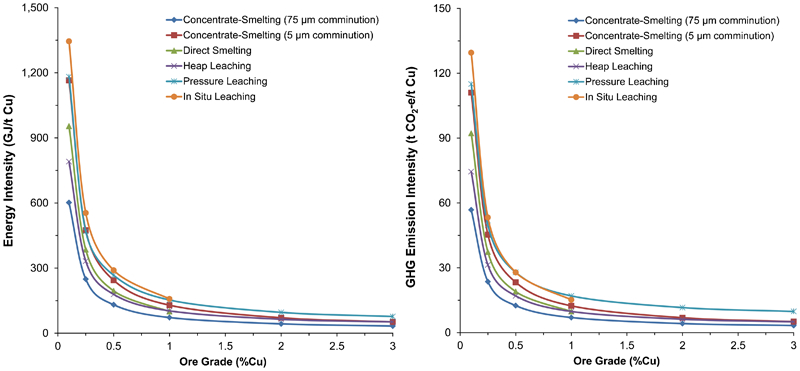
Energy and GHG Intensity compared to ore grades for Cu mining projects (Norgate and Jahanshahi, 2010)
In comparison, a preliminary GHG emission-focused life cycle impact assessment study by Tharumarajah and Koltun (2011; Fig. 3) focused on the Bayan Obo deposit, and considered the GHG emission implications of the production and processing of a bastnäsite ore with a grade of ∼6% REOs using indicative information on material and energy inputs, emissions and land use from public sources (e.g. China's electricity grid) or based on stoichiometry. The input data were sourced from the SimaPro LCA software database (Pre, 2013; Ecoinvent, 2013), and the revenue from each product was used to allocate environmental burdens, with allocated GHG emissions shown in Fig. 3 (note that these data are in kg of CO2 equivalent emissions per kg of product). These data show that the production of individual REE has significantly higher GHG emissions than any of the other metals or concentrates described above, with the ∼55 kg of CO2 emitted per kg of produced Sm Eu and Gd oxide significantly higher than the 2·6 kg of CO2 emitted per kg of produced Cu metal determined by Northey et al. (2013). It should also be noted that these oxides would probably require more processing and separation for their end uses, meaning that this estimate is a minimum. This analysis also indicates that the primary contributors to the GHG footprint for REE extraction and processing are energy in various forms (i.e. diesel, steam, fuel oil and electricity, ∼51%), followed by chemicals (especially hydrochloric acid, ∼38%), with the remainder from other chemicals, mining, concentration and transport. It is critical to note that the above split will vary significantly from deposit to deposit given the different mineralogies (e.g. F from bastnäsite ores or Th from most REE sources), processing routes, light/heavy REE splits, waste disposal methods (e.g. treatment, re-use, landfill or incineration) as well as individual REE prices; a detailed study is currently underway to quantify these variables in more detail. It is clear, however, that even if only the GHG emissions of REE extraction and processing are considered, the most critical areas to reduce the GHG impacts of REE processing are chemicals (especially acids) and energy consumption. This estimate is also only for the GHG emissions produced during REE production, and does not consider any other impacts, primarily as there have been very few (if any) comprehensive studies on REE production and processing, highlighting the need for a more comprehensive valuation of the environmental impact of this industry.
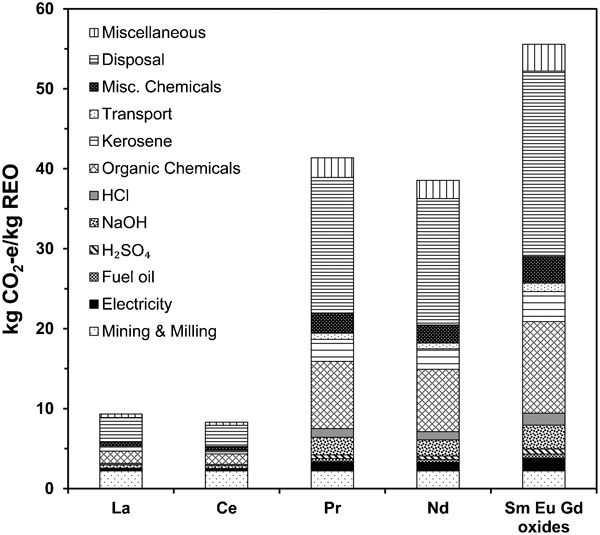
Greenhouse gas footprint for selected rare earth products; note that disposal includes hazardous solvent incineration, the modelling includes processing of ore with 70% mixed REE and with 90% recovery, and mine rehabilitation is under miscellaneous
Conclusions
This paper provides an overview of the primary geological processes that form the major types of REE deposits, REE mineralogy, the environmental implications of REE mining and processing, and outlines a new REE deposit classification scheme that subdivides REE mineralisation into broad magmatic, hydrothermal and secondary classes of mineralisation, with further subdivision into more specific deposit classes. Carbonatite-hosted or -associated REE deposits such as Bayan Obo in China, Mountain Pass in the USA and Mt Weld in Australia have been the primary source of global REO to date (Verplanck and Van Gosen, 2011), although numerous other types of potential REE resources and deposits are currently known (e.g. Round Top, USA; Olympic Dam, Australia; Buckton, Canada and Eco Ridge, Canada). This means that it is unclear whether carbonatites will continue to dominate the long term supply of REEs, or whether one of these other types or families of deposits will become more important than the carbonatites that have dominated REE production for the previous 50 years. In addition, the rapid growth in global REE demand and the associated environmental implications (e.g. GHG emission, radioactive mine waste containing high concentrations of U and Th and chemical intensive leaching during REE refining and extraction) of increased REE production means that considering the costs and benefits of future REE production is a complex matter. Clearly, the future of REE supply and demand will depend not only on our ability to identify and extract REE resources, but also our ability to economically and sustainably process these resources without causing undue environmental and social impacts.
Footnotes
Acknowledgements
The authors acknowledge funding from the Minerals Down Under Flagship of CSIRO for this study. The authors thank Jim Anderson, Greg Partington and an anonymous reviewer for their constructive comments on the original manuscript, and Neil Phillips for editorial handling. Richard Schodde is also thanked for sharing his knowledge of REE resources.