







Abstract
The Supercontainer design is the preferred option for the underground disposal of high level nuclear waste in Belgium. It consists of a carbon steel overpack surrounded by a thick concrete buffer. In this high alkaline environment and under normal conditions (without the ingress of aggressive species), the carbon steel overpack will be protected by a passive oxide film, which is believed to result in very low uniform corrosion rates. The backbone of the RD&D strategy, which aims to provide confidence that the integrity of the overpack will be maintained at least during the thermal phase, is based on demonstrating that each localised corrosion mechanism (e.g. pitting corrosion, crevice corrosion and stress corrosion cracking), other than uniform corrosion, cannot take place under the high pH conditions prevailing within the Supercontainer (the ‘exclusion principle’). This paper gives an overview of the status of the RD&D programme related to the anaerobic uniform corrosion of the carbon steel overpack. The outcome of the modelling efforts simulating the evolution of various parameters (temperature, pH, degree of saturation, corrosion potential and composition of aggressive species) that can potentially influence the corrosion processes, over geological timescales, is addressed.
Introduction
The Belgian radioactive waste management organisation, Ondraf/Niras, is committed to developing a concept and design of a disposal facility and to developing the evidence and arguments required to prove that such a facility can be constructed in a safe, technically feasible and economically achievable manner, without neglecting the societal aspects. The Supercontainer is currently being studied as the reference design for the final disposal of vitrified high level nuclear waste (VHLW) and spent fuel (SF) in Belgium. A detailed description of Ondraf/Niras’ safety strategy and the strategic choices dealing with the management of nuclear waste in Belgium with respect to the Supercontainer design is given elsewhere.1
The Supercontainer design was developed based on the contained environment concept, the aim of which is to establish and preserve a favourable chemical environment in the immediate vicinity of the metallic overpack, so that it will be exposed to essentially unchanged, benign conditions for a long time, at least for the duration of the thermal phase. The thermal phase is assumed to last for at least hundreds of years for VHLW, and possibly up to a few thousand years for SF, after emplacement of the wastes in the underground repository.
The Supercontainer is essentially a massive cylindrical prefabricated concrete block, named the buffer, into which a watertight cylindrical carbon steel container, the so called overpack, holding either VHLW canisters or SF assemblies, will be inserted. The cavity between the carbon steel overpack and the concrete buffer will be filled with a cementitious material, i.e. the filler. There is also an alternative design option in which the concrete block will be fitted into an outer stainless steel container, termed the envelope.2 A Portland cement based concrete has been chosen for the buffer because it will provide a highly alkaline chemical environment, in which the external surface of the overpack will be passivated, and it is expected only to be prone to slow uniform corrosion (passive dissolution). A schematic diagram of a Supercontainer for VHLW is presented in Fig. 1.3
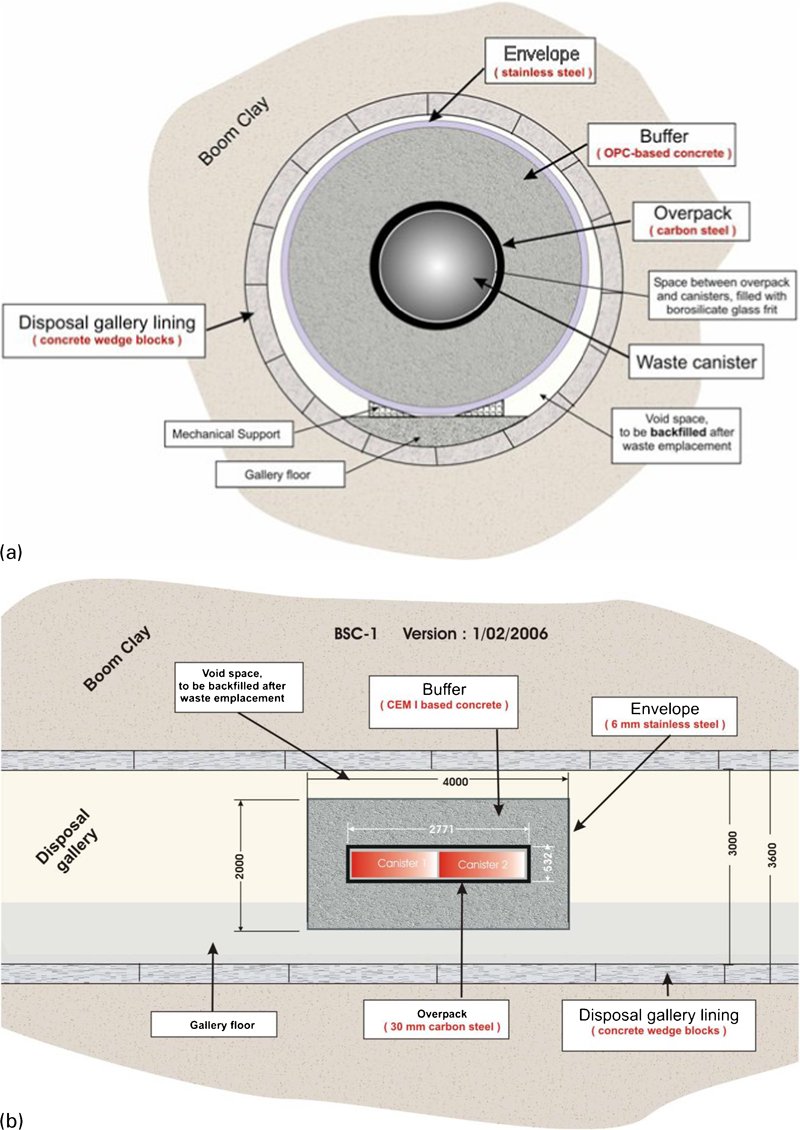
Schematic diagram of a cross-section and b longitudinal section of Supercontainer for VHLW emplaced in disposal gallery excavated in Boom Clay3
This paper provides an overview of the current status of the RD&D corrosion research programmes in the framework of high level radioactive waste disposal in Belgium:
the experimental programme performed at Pennsylvania State University (USA) aims at studying the electrochemistry of the carbon steel overpack in the concrete buffer environment, with the main focus on assessing the impact of the presence of potentially harmful species such as chloride, thiosulphate and sulphide on the anaerobic uniform corrosion rate. More details on the experimental results of this work can be found in the paper by Macdonald et al.4 included in this journal
the main emphasis of the experimental programme performed at Serco TCS (UK) is put on studying the influence of gamma irradiation on the long term anaerobic uniform corrosion rate. More details on the experimental results of this work can be found in the paper by Smart et al.5 included in this journal.
RD&D methodology
The main goal of the RD&D corrosion programme is to provide confidence that the integrity of the carbon steel overpack will not be jeopardised at least during the thermal phase. To this purpose, an integrated RD&D methodology was developed, which has already been explained elsewhere.6 In summary, the RD&D methodology consists of three steps:
phase 1: development of the corrosion evolutionary path. The corrosion behaviour of the carbon steel overpack is closely related to the changing environmental conditions inside the concrete buffer of the Supercontainer. The environmental conditions surrounding the overpack will evolve over time from hot, aerobic and relatively dry to cool, anaerobic and fully saturated
phase 2: determination of scientifically well founded estimates of v corr. One of the main cornerstones of our methodology is based on the assumption that under the predicted conditions within the Supercontainer (i.e. a highly alkaline concrete buffer), the carbon steel overpack is expected to undergo uniform corrosion through the mechanism of passive dissolution.7 – 10 The deterministic nature of passive corrosion makes it rather straightforward to predict the required wall thickness of the overpack to resist corrosion. Lifetime prediction can be calculated by estimating the uniform corrosion rate for each of the separate phases determined in the corrosion evolutionary path and extrapolating the data over the duration of the phases
phase 3: proving the validity of the ‘exclusion principle’. It is generally recognised 11 11,12 that carbon steel exposed to concrete can undergo depassivation due to, for example, ingress of aggressive species. This can result in a subsequent localised corrosion attack, such as pitting corrosion, crevice corrosion and stress corrosion cracking, which can lead to locally very rapid penetration of the overpack. The stochastic nature of localised corrosion makes it very difficult to predict the lifetime of the overpack. Therefore, we will have to present well reasoned arguments to prove that the carbon steel overpack will not be susceptible to localised corrosion phenomena under the high pH conditions prevailing within the Supercontainer.
Evolution of environmental conditions
For the correct interpretation of the corrosion risks of the carbon steel overpack, it is imperative to have a good characterisation of the environment surrounding the overpack as well as information about its evolution because of the long time scales involved in geological disposal. The parameters that can potentially influence corrosion are temperature, pH of the concrete pore solution, degree of water saturation of the concrete buffer, corrosion potential of the overpack, chemical composition of the concrete pore solution (including the presence of aggressive species) and radiation levels.
Temperature at overpack surface
Thermal simulations13 have been performed with the finite element code COMSOL Multiphysics 3·5a to predict the evolution of the temperature at the surface of the carbon steel overpack in a Supercontainer for various high level waste forms in a geological repository after a cooling period of 60 years (Fig. 2). These calculations considered the effect of a temperature increment due to neighbouring galleries and the influence of the anisotropic behaviour of the thermal conductivity of the clay host rock.
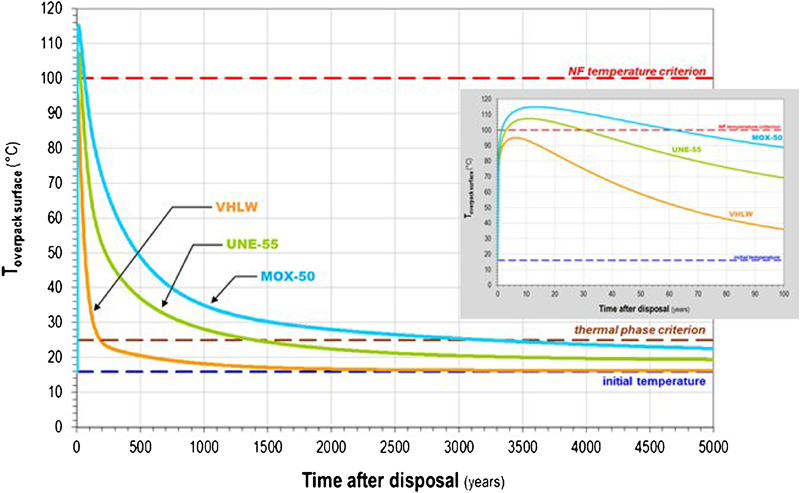
Predicted evolution of temperature at surface of carbon steel overpack for case of UOX spent fuel (UNE-55), MOX spent fuel (MOX-50) and vitrified high level waste (VHLW, assuming cooling time of 60 years
These calculations suggest that a temperature as high as 120°C could be reached at the overpack surface: the peak temperatures for VHLW (95°C), UOX SF (108°C) and MOX SF (115°C) are reached after about 5, 10 and 10-15 years respectively. The decrease in thermal output of the waste leads to the temperature at the overpack surface decreasing to below 100°C after about 30 and 60 years for UOX SF and MOX SF respectively. The surface temperature of the overpack will then gradually drop below the thermal phase criterion temperature (25°C) within 200, 1500 and 3000 years for VHLW, UOX SF and MOX SF respectively. The observed differences in duration to reach the thermal phase criterion temperature for the different waste forms are due to the significant differences in the actinide inventory (especially 239Pu, 240Pu and 241Am) and hence in the amount of decay heat released by the different waste forms. The thermal phase criterion is fixed at 25°C because the values for the radionuclide migration parameters have been established with sufficient confidence within the temperature range between 16°C (in situ) and 25°C (laboratory).
In any case, the disposal repository will be designed such that the temperature in the concrete buffer will not exceed 100°C. In this way, complications due to the boiling of pore fluids in the concrete buffer are avoided. Moreover, the potential impact of thermally induced transport processes (such as evaporation, condensation cycles, thermoosmosis, thermodiffusion, etc.) that could alter the chemical conditions around the carbon steel overpack by changing the concentration of the soluble salts around the heating source is reduced. 14 14,15
pH of concrete pore solution
The effect of the slow ingress of Boom Clay pore solution on the evolution of the pH of the concrete surrounding the carbon steel overpack has been calculated based on a chemical coupled reactive transport one-dimensional radial model,16 with diffusion as the only solute transport mechanism (Fig. 3). The initial pH of the concrete pore fluid is controlled by the dissolved alkalis (K+ and Na+) at ∼13·5, and it slowly decreases to 12·5, as regulated by portlandite solubility, after ∼1000 years. The pH of 12·5 is predicted to persist for at least 80 000 years, after which it will drop to a value of 11·3. These calculations consider a constant porosity. However, this is a very conservative assumption because, in reality, porosity is most likely to decrease due to processes such as carbonation leading to porosity clogging. The decrease in porosity will result in a slower diffusion of the initial high pH pore water, thereby extending the period of high pH around the carbon steel overpack. In other words, Fig. 3 simply shows the time needed for the initial dissolved alkalis (Na and K) to diffuse out of the system (with the initial and constant porosity) and the reaction of portlandite with carbonates coming from the Boom Clay. These calculations have been performed for 25°C. Calculations are ongoing to take the effect of temperature evolution on the pH into account: a temperature increase to 100°C will decrease the pH of the cement pore solution buffered by portlandite to a value of ∼11, owing to the effect of temperature on the hydrolysis properties of the system.3
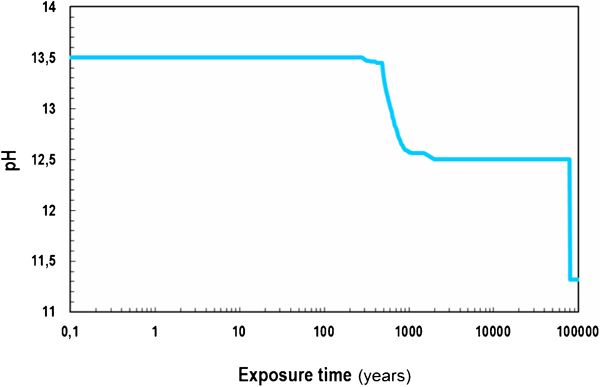
Predicted evolution of pH at surface of carbon steel overpack (25°C)16
Saturation degree of concrete buffer
Poyet17 calculated the initial degree of saturation of the freshly cured concrete buffer to be ∼80%. The ingress of the Boom Clay pore solution, in time, will lead to a complete saturation of the concrete buffer. Coupled thermohydraulic calculations, performed by Weetjens and Perko,18 indicated that it would only take ∼4 years to reach full saturation of the concrete buffer close to the overpack, considering an initial degree of saturation of 80% (Fig. 4). Increased water saturation will slow the corrosion because the transport of dissolved oxygen by diffusion through pores filled with water is an extremely slow transport process.7
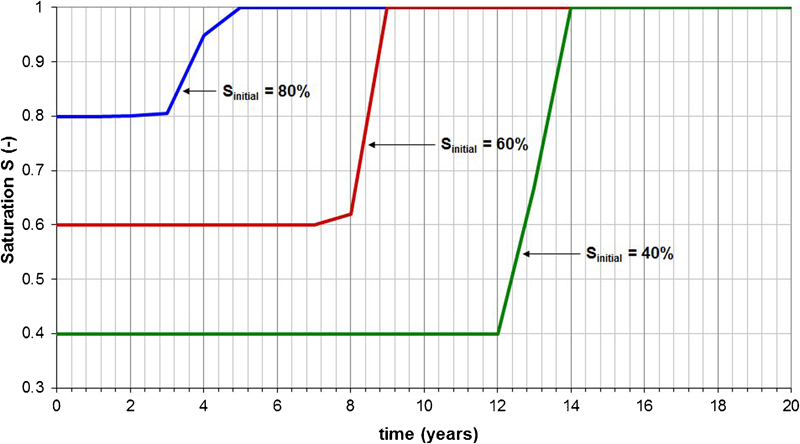
Predicted evolution of saturation of buffer at overpack's surface for different initial saturation degrees (40, 60 and 80%), considering saturated concrete hydraulic conductivity K S (4×10⁻¹² m s−1)18
Corrosion potential E corr of overpack
Figure 5 shows a schematic representation of the expected evolution of the corrosion potential E corr at the surface of the carbon steel overpack. Because cement is generally made in a kiln under oxidising conditions, iron oxide will be present in its ferric state, and sulphur will be present as sulphate. The concentration of the electroactive species present in CEMI cement, however, is too low to control the redox potential. Therefore, the corrosion potential, during the initial oxic phase, will be controlled by the level of oxygen dissolved in the concrete buffer since the Supercontainer will be fabricated, assembled and emplaced under atmospheric conditions. Measurements on concrete pore fluids suggest positive oxidising potentials of around +100 to +200 mV(SHE).15
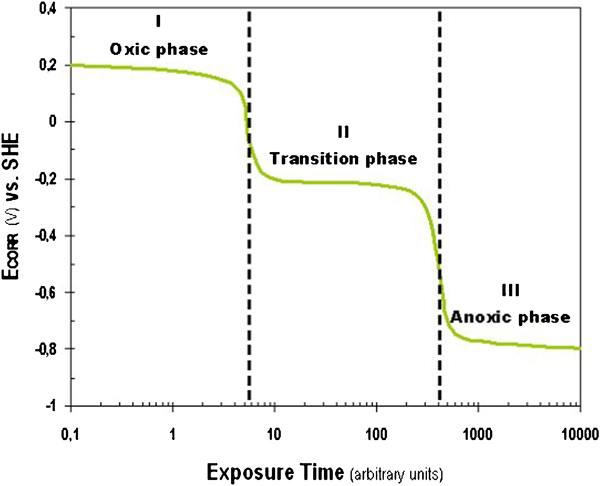
Expected evolution of corrosion potential of carbon steel overpack surrounded by concrete buffer in Supercontainer
The redox conditions inside the Supercontainer will be reduced owing to corrosion processes. During this anoxic phase, the only oxidant in the system is water (without irradiation effects), and corrosion under these conditions yields hydrogen gas. Electrochemical experiments performed at Serco TCS 5 5,19 suggest that the corrosion potentials of carbon steel under anoxic conditions are in the region of −750 mV(SHE), which is very close to the hydrogen evolution potential at pH 13·4 assuming a low hydrogen overpressure.
It is assumed that a transition phase from oxidising to reducing conditions will occur in the Supercontainer due to the presence of radiolysis products. Radiolysis of water produces hydrogen, oxygen, hydrogen peroxide and reactive radicals and, in the Supercontainer environment, is expected to result in relatively constant, mildly oxidising conditions [above approximately −200 mV(SHE)]20 for the first few hundred years when the radiation field will be at its most intense.15 This is, however, without considering the coupling effects between radiolysis and corrosion processes.
Chemical composition of concrete pore solution (aggressive species)
Transport calculations21 of the concentration of aggressive species coming from the perturbed Boom Clay towards the overpack have been carried out using COMSOL Multiphysics 3·5a software. These calculations incorporated diffusive transport and advective flow driven by the pressure gradient at repository depth (about −220 m) and the suction exerted by the Engineered Barrier System materials, since the initial degree of saturation of the concrete buffer material was 80%. The effect of the presence of a stainless steel envelope on the delay of transport of aggressive species was not taken into account.
The initial composition of the perturbed Boom Clay pore solution diffusing towards the overpack's surface used in the calculations was 425 mg L−1 chloride, 20 600 mg L−1 sulphate and 1070 mg L−1 thiosulphate. The calculations were performed with three different sulphide concentrations:
150 mg L−1 (indicated by the solid line in Fig. 6): this concentration was chosen as the best estimate value based on a literature review
19 000 mg L−1 (indicated by the dotted line in Fig. 6): this concentration can be considered as very conservative because it is assumed that all the pyrite in a 1 m zone around the disposal gallery is oxidised into sulphate, and this sulphate in turn is entirely transformed into sulphide by sulphate reducing bacteria (SRB) activity
500 mg L−1 (indicated by the dashed line in Fig. 6): this concentration was chosen as an intermediate value.
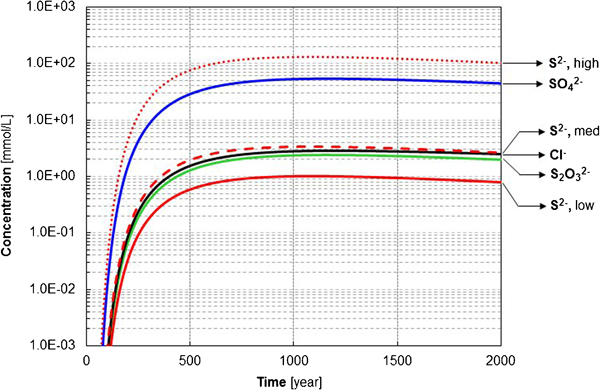
Predicted evolution of concentration of aggressive species at surface of overpack for three different initial sulphide concentrations: 150 mg L−1 (
These calculations show (Fig. 6) that the maximum concentration of the key aggressive species, reaching the overpack after ∼1000 years, is ∼100 mg L−1 for chloride and ∼280 mg L−1 for thiosulphate. Recent studies22 have identified unexpectedly high levels of sulphide of ∼1200 mg L−1 due to the sulphate reducing bacteria activity in Boom Clay pore solutions. Considering this sulphide level as the initial value in the transport calculations, a maximum concentration of ∼100 mg L−1 sulphide is to be expected at the surface of the carbon steel overpack.
Anaerobic uniform corrosion rate
Figure 7 shows the anaerobic uniform corrosion rate, measured from hydrogen gas evolution experiments, for carbon steel immersed in concrete pore solutions representative of the Supercontainer buffer environment. 5 5,19 After an initial very high value, the anaerobic uniform corrosion rate rapidly dropped to a very low level. After ∼18 000 h of testing, the uniform corrosion rate was in the range of 0·1-0·2 μm/year (Fig. 7). It was also observed that the long term uniform corrosion rates were independent of temperature (25 and 80°C), chloride concentration (100 mg L−1) and gamma irradiation (25 Gy h−1). Weight loss measurements showed a uniform anaerobic corrosion rate of 1·9 μm/year. For the interpretation of this value, one has to take into account that weight loss measurements provide an integrated corrosion rate over the entire measuring period, while gas evolution measurements provide instantaneous corrosion rates. When the total amount of hydrogen gas produced over the entire measuring period is converted into an overall corrosion rate, a value of 2·1 μm/year is calculated. This value corresponds very well with the integrated value calculated from the weight loss measurements. Passive current density measurements4 showed anaerobic uniform corrosion rates in the region of ∼0·7 μm/year. Thiosulphate seems to have a more significant effect on the uniform corrosion rate than sulphide.
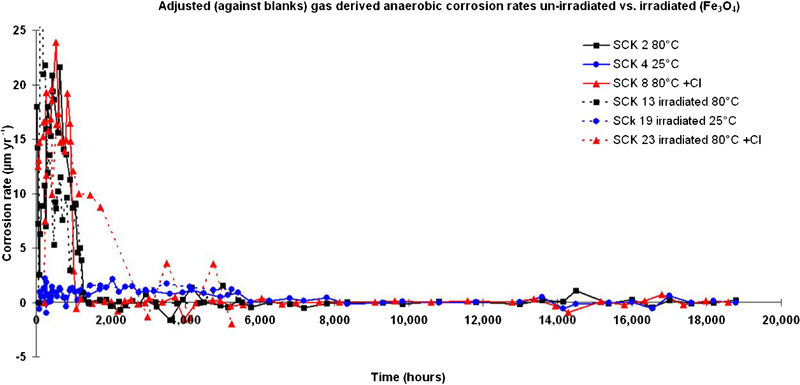
Anaerobic uniform corrosion rate (from hydrogen gas evolution measurements) for carbon steel in concrete pore solution under unirradiated and irradiated conditions (25 Gy h−1) as function of temperature and chloride concentration (100 mg L−1)5
Conclusions
In Belgium, low alloy steel is being considered as a candidate overpack material for the underground disposal of high level nuclear waste and SF.
Because of the long time scales involved in geological disposal, a good understanding of the chemical and electrochemical evolution of the near field environment surrounding the overpack surface is essential in demonstrating that reliable predictions of the service life of the overpack can be calculated. Substantial advances have been made in predicting the evolution of several parameters that can potentially influence corrosion (temperature, pH of the concrete pore solution, degree of saturation of the concrete buffer, corrosion potential of the overpack and chemical composition of the concrete pore solution).
The progress of the experimental programmes is continuously increasing our confidence in the best estimate of the anaerobic uniform corrosion rate of the carbon steel overpack. A very good correlation is found among the uniform corrosion rate data generated by three different techniques (hydrogen evolution measurements, weight loss measurements and passive current density measurements at steady state). This is a key aspect in view of defending the Safety and Feasibility Case 1, which has to be presented to the national authorities by the end of 2013.
Footnotes
Acknowledgements
The work presented in this paper was financed by the Belgian Agency for Radioactive Waste and Fissile Materials, Ondraf/Niras.