






Abstract
The impacts of tensile stress on the non-linear electrodissolution behaviour of carbon steel were investigated in an aqueous solution of 5M phosphoric acid. The frequency of the current oscillations within the transpassive potential region increases slightly when the elastic deformation was introduced to the electrode by applying tensile stress, but the oscillatory mode is essentially unchanged. The elastic deformation could induce the current oscillations in the passive potential region that was not observed on stress free state. This fact suggests that the tensile stress can reduce the stability of passive film. Immediately after the tensile stress exceeds the yield strength, the oscillatory mode changes into a chaotic one with high frequency and recovers the original state gradually. This phenomenon resembles the consequence due to the injection chloride to the electrode/electrolyte interface and implies that the plastic deformation may result in the formation of more defective passive films.
Introduction
The tensile stresses in the form of applied loads, residual stresses and thermal stresses exist widely in metallic structures in service and can result in elastic and/or plastic deformation. Many corrosion related failures of engineering structures are a result of the interaction between the mechanical stress and corrosive species.1 Stress corrosion cracking, corrosion fatigue and erosion–corrosion are well known examples. A recent research of authors has indicated that the impact of mechanical stress itself and elastic deformation on active corrosion kinetics is very limited, while the effects of plastic deformation rely heavily on the resulting dislocation structure.2 Under the passive state, the slip due to the dynamic plastic deformation gives rise to breakdown of passive films, leading to an increase in corrosion rate. Stresses can be generated during anodic oxidation, and, in turn, they can affect the stability of oxide films.3
It is well known that oscillatory electrodissolution of metallic materials are caused by the periodic formation and dissolution of the films formed on the electrode surface. Because electrochemical dynamic processes during the current oscillations are non-linear, the interface between the electrode and solution is very sensitive to changes caused by outside perturbation.
4
4,5 The experimental evidence indicated that the oscillatory electrodissolution of metallic materials would be modified if the chemical environment at the interface between surface of the iron electrode and electrolytes is changed artificially.
4
6
4,6,7 Garcia et al. applied non-linear dynamic analysis to study the pitting corrosion of nickel in seawater and found that the oscillatory dynamics of the noise signal is of deterministic nature.8 Pagitsas et al.9 observed the current oscillation of iron electrode in Cl− and  containing sulphuric acid caused by localised passive breakdown. In this paper, the non-linear electrochemical (current/potential) oscillation is utilised as an indicator to demonstrate the impacts of mechanical force on the stability of passive films.
Experimental
X70 steel was used as test material. It has the yielding strength of 510 MPa and the chemical composition of Fe–0·04C–1·46Mn–0·24Si–0·003S–0·008P (wt-%). The tensile specimens of X70 steel were 25·4 mm in gauge length, and 3·14 mm in diameter was used as working electrode. The experimental set-up is schematically shown in Fig.1. In the electrochemical measurement, only the test area surface within the gauge length of the tensile specimen was exposed to the electrolyte, and the other part of specimens is embedded in epoxy resin. The test surface was wet polished by emery paper finished up to 600 grit, then washed with distilled water, degreased with acetone and dried before each experiment. The counter electrode was a platinum net with a size of 2×3 cm, and a saturated calomel electrode (SCE) was used as a reference, with its Luggin capillary probe located near the working electrode. The potential scan rate in the potentiodynamic measurement was 1 mV s−1. The test solution of 5M phosphoric acid was prepared with analytical grade reagents and distilled water. Electrochemical experiments were carried out at room temperature by a Solartron SI1287 electrochemical interface. The tensile specimens were conducted in an MTS fatigue testing machine. The tensile stresses used in the experiments were 254, 490 and 550 MPa respectively.
Results
Polarisation behaviour
As shown in Fig. 2, the anodic polarisation curve of X70 steel in 5M phosphoric acid displays three main potential regions (regions I–III). In the active potential region ‘I’, the limiting current plateau is observed, where the formation and dissolution of the surface films on the electrode proceeds at the same rate. This surface film is loose and non-protective. At the end of limiting current plateau current, the polarisation curve enters in the active–passive transition potential region II, and the electrodissolution behaviour becomes non-linear, which is characterised by the obvious current oscillations. When the potential reaches the passive region ‘III’, the current oscillations disappear. The potential regions of interest in this study include the passive–active state (region II) and the passive state (region III) where the quasi-stable and stable passive films are formed on the electrode surface respectively.
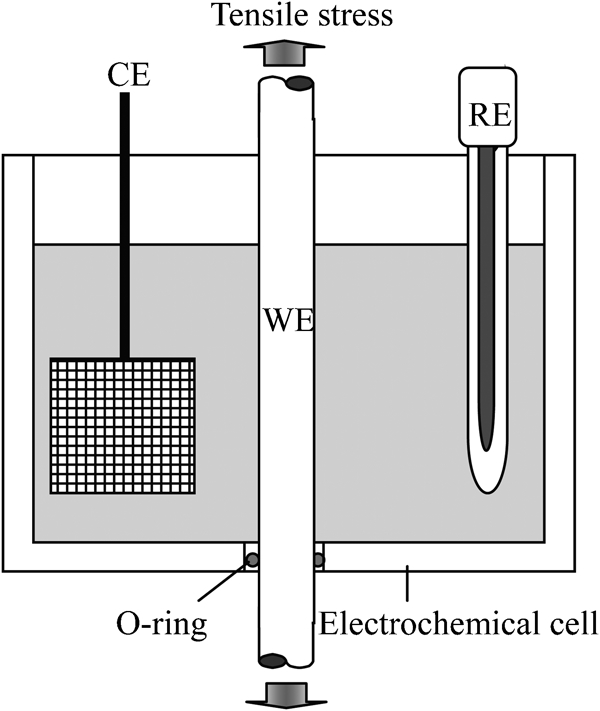
Experimental set-up
Electrodissolution behaviour of elastically deformed electrode
When the potential is controlled at 0·18 V(SCE), in the active to passive region ‘II’, the frequency of small amplitude oscillations between two large amplitude oscillations, as shown in Fig. 3, increases as a tensile stress ∼490 MPa that is just below the yield strength (510 MPa) is applied. In order to demonstrate the effect of elastic deformation (or tensile stress) on the character of current oscillations more clearly, two-dimensional phase trajectories are reconstructed using the time delay methods, i.e. the data of i versus t curve are projected into the [i(t),i(t+T)] (T = 0·20 s) plane. 10 10,11 The two-dimensional phase trajectories are a powerful tool to illustrate the detail changes in oscillatory mode because each loop of the phase trajectories corresponds to each cycle of oscillations. We can observe a mixed oscillatory mode in Fig. 4 where the current oscillatory mode is composed of the main oscillations (large amplitude oscillations) and suboscillations (the small amplitude oscillations between the two large amplitude oscillations). Different components might result from the different processes in electrodissolution. Before the tensile stress is applied, the trajectory on the attractor lies in four distinct loops, and the flow on the attractor alternates among this four loops (Fig. 4a). The largest loops correspond to the main oscillations, while the other three loops correspond to suboscillations, indicating a mixed model oscillation.12 After the tensile stress was applied, the trajectory on the attractor lies only in two distinct loops (Fig. 4b). The larger one corresponds to the main oscillations, while another corresponds to the suboscillations. The suboscillations observed on the stressed specimen are essentially chaotic. This indicates that the tensile stress (or elastic deformation) cannot affect the main oscillations in the mixed oscillatory mode but can alter significantly the suboscillations.
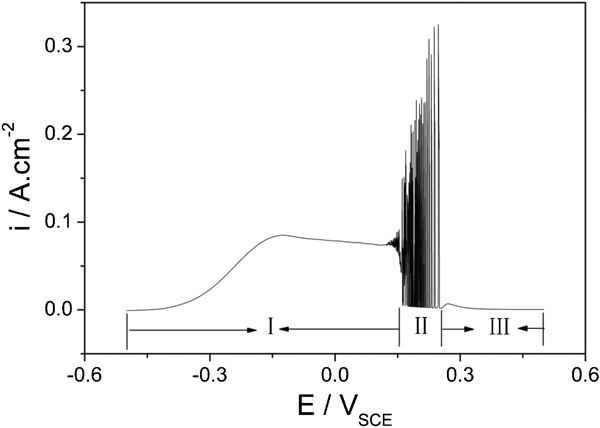
Polarisation curve
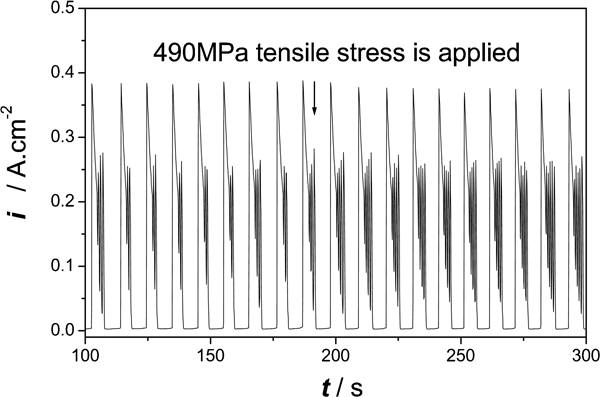
Effect of tensile stress below yield strength on electrodissolution at 0·18 V(SCE)
When the potential applied was 0·38 V(SCE), close to the lower limit of the passive region ‘III’, a small and stable passive current is detected if the specimen is stress free, as shown by Fig. 5a, indicating that a passive film was formed on the electrode surface. However, the current oscillations appear after 100 s induction time when the electrode is applied with tensile stress of 250 MPa that is less than one-half of the yield strength of steel (Fig. 5b). This result shows clearly that the tensile stress or elastic deformation can shift the boundary potential between regions II and III to noble direction and/or can reduce the stability of passive film.
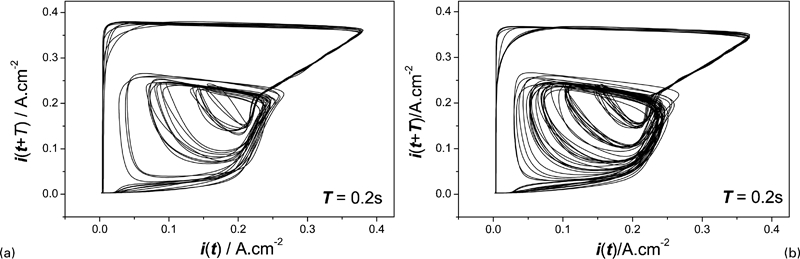
Phase trajectories of current oscillation curve in Fig. 3 [σ = 490 MPa, E = 0·18V (SCE)]
Electrodissolution behaviour of plastically deformed electrode
Plastic deformation occurs as the applied tensile stress exceeds the yield strength of steel (510 MPa). As indicated in Fig. 6, application of a tensile stress of 550 MPa can alter the oscillatory behaviour significantly. Both the frequency current oscillations increase, but the oscillatory amplitude decreases immediately after the plastic deformation occurs. With time elapses, the impact of plastic deformation is reduced gradually, and the oscillation mode tends to recover slowly. Comparing the phase trajectories of specimen plastically deformed (Fig. 7b) with that of stress free electrode (Fig. 7a), marked changes induced by the dynamic plastic deformation are found in the oscillatory mode. The attractor in Fig. 7b is much denser than that in Fig. 7a. The loop radius of oscillations increases with time and tends return to its original value. This is a strange attractor and indicates that the current oscillations are chaotic,12 suggesting that the current oscillations change from mixed model to chaotic one when the plastic deformation occurs. It means that the plastic deformation leads to the chaotic oscillation in both main and subcomponents. The significant changes of the oscillation mode immediately after the initiation of plastic deformation are likely to be related to the passive film breakdown induced by the slip of dislocation in the surface layer.
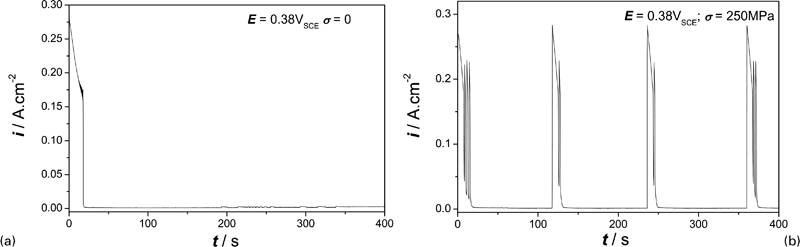
Effect of tensile stress below yield strength on electrodissolution at 0·38 V(SCE)
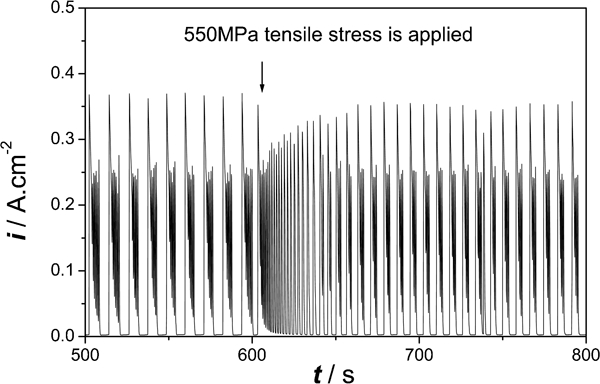
Effect of plastic deformation on electrodissolution at 0·18 V(SCE)
The recovery tendency may be a result of repassivation. After the dynamic plastic deformation is ended, the passive film heals up gradually. Because the applied stress is still held, elastic deformation is not released. Besides, the residual stress produced during plastic deformation can also lead to elastic deformation in underlying metal. Hence, the oscillation mode after a period of plastic deformation is similar, to some extent, to that of elastic deformed specimen (Fig. 2). As shown in Fig. 7, when the tensile stress of 550 MPa is applied, the passive films break down as a result of the slip step, but the passive film can be repaired by the electrodissolution if the electrode is unloaded. The current oscillations recover its original mode after the stress is unloaded. Although microstructural changes, such as the formation of certain dislocation structures, may have an impact on the electrodissolution, the results in Fig. 8 indicate that this kind of effect is limited. The limited impact of plastic deformation on electrodissolution after the electrode is unloaded may be related to the tensile stress applied to induce plastic deformation. The tensile stress of 550 MPa is only slightly higher than the yield strength of electrode (510 MPa), so that the plastic deformation produced by the tensile stress is insufficiently large to alter the microstructure of steel significantly.
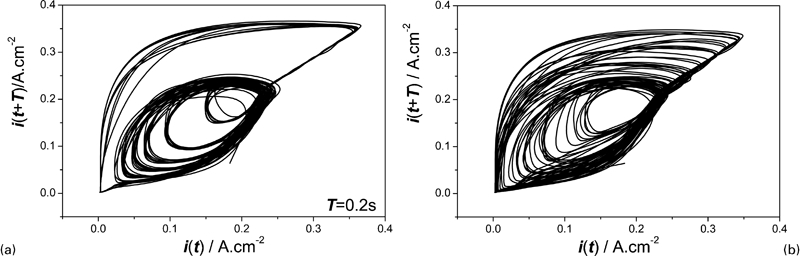
Phase trajectories of current oscillation curve in Fig. 6 [σ = 550 MPa, E = 0·18 V(SCE)]
Discussion
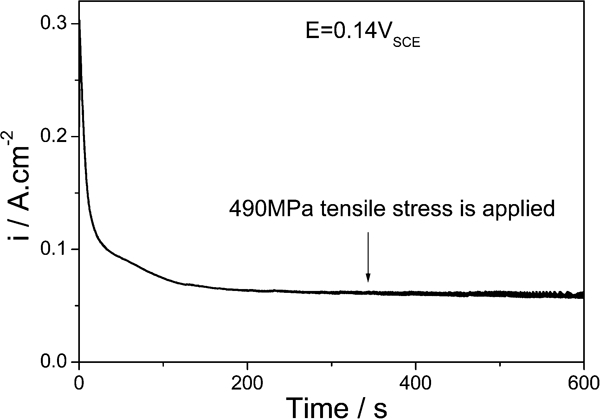
It is often believed that the accelerated dissolution caused by mechanochemical effect is due to the strain energy stored in metal during deformation. A thermodynamic analysis reveals that the stored strain energy is insufficient to alter the active dissolution rate markedly.2 It is confirmed by the current response in Fig. 9 that is obtained under potentiostatic condition within the active potential region (region I). Therefore, the impact of applied stress on the electrodissolution should be a result of the stability degradation of passive films. Figure 9
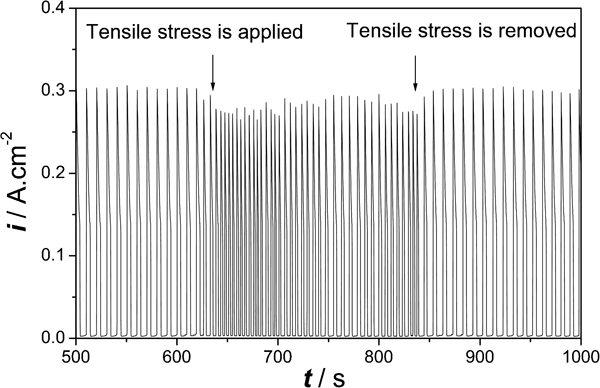
Effect of application and release of tensile stress on electrodissolution at 0·26 V(SCE) (σ = 550 MPa)
Effect of tensile stress on anodic current density at −0·14 V(SCE)
The current response to applied tensile stress is quite similar to those observed in the same system while chloride ions were injected into the electrode/electrolyte interface.4 During the electrodissolution in potential region II, the injection of chloride ions can lead to a significant change in the oscillatory mode and a marked increase in the oscillatory frequency although the changes in the current oscillation mode induced by the elastic deformation are quite different from the chaotic oscillations induced by the chloride ions.4 When specimen is polarised in passive potential region (III), the injection of chloride ions can also induced the current oscillation.4 This kind of changes in the oscillatory mode may be related to certain changes in the composition and/or structure of passive films. The increase in the frequency of suboscillations suggests that the elastic deformation reduces the stability of passive film. The damage of passive film caused by the elastic deformation can heal up after ∼12 s, as shown in Fig. 4b, while the repairing duration for the damage produced by the injection of chloride ions would be much longer.4 Hence, the damage caused by the elastic deformation is much less severe than that induced by chloride ions. The effect of tensile stress on the electrodissolution also resembles the impact caused by the hydrogen charged into the steel electrode.5 Experimental investigations have revealed that the incorporation of hydrogen will lead to the formation of highly defective passive films13 with low stability, 14 14,15 and the application of tensile stress might reduce further the resistance of electrode to pitting corrosion.16 Recently, Vignal et al.17 used the Mott–Schottky analysis to study the effects of a mechanical stress below the apparent yield strength on the capacitance values. When the tensile stress was between 20 and 70% of the yield strength of the specimen, the Mott–Schottky measurements indicated that the density of vacancy concentration of the passive film is much higher than that at stress free, and hence, the passive film conductivity is increased.18 It is also verified that the diffusion coefficient of vacancy type self-diffusion decreases with compressive stress and increases under action of tensile stress.19 According to the point defect model developed by Macdonald,20 a higher vacancy diffusion rates within passive films will result in fast film growth. This may lead to the formation of passive films more defective.
Conclusions
Tensile stress can reduce the stability of passive film formed on X70 steel in concentrated phosphoric acid solution.
Elastic deformation of electrode increases the current oscillation frequency during the electrodissolution of X70 steel within the transpassive potential region in concentrated phosphoric acid solution without causing substantial change in oscillatory mode.
Dynamic plastic deformation gives rise to a transient chaotic current oscillation with high frequency. After the dynamic plastic deformation is stopped, the current oscillation tends to recover gradually.
The similarity between the impacts of elastic deformation and chloride ions on the current oscillation suggests that the elastic deformation can degrade the stability of passive film due to a highly defective film structure.
Footnotes
Acknowledgements
The authors would like to appreciate the support of NSERC, Canada.