







Abstract
The present work investigated the characteristics and mechanism of corrosion product films and the corrosion rates of standard and microalloyed ‘antisulphur’ steels in H2S/CO2 containing oilfield environments at various temperatures. The resistance of antisulphur steels to CO2/H2S corrosion was highlighted to provide information for material selection in sour oilfields. The corrosion rates were calculated by weight loss carried out in a high temperature and high pressure autoclave. Meanwhile, the surface morphologies of corrosion product films were studied using scanning electron microscopy with energy dispersive spectrometry. The results indicated that the corrosion product films became more protective, and the corrosion rates of chromium containing antisulphur steels substantially decreased, with increasing temperature. H2S corrosion dominated the corrosion process under the test conditions. In addition, antisulphur steels P110S and N80SS were found to be superior to common steel P110 in CO2/H2S corrosion environments especially at temperatures below 120°C. A model for corrosion product film formation and damage was produced.
Introduction
Corrosion environments containing CO2 and H2S frequently exist in the oil and gas industry, and this has aroused considerable attention in the academic community in the past several decades.1 – 4 Compared to pure CO2 corrosion, sour corrosion with H2S is primarily concerned with aspects such as corrosion products (e.g. ferric sulphide), H2S concentration, corrosion environments with various pH values and thermodynamic and kinetic models. Hence, the nature of multiphase ferric sulphides such as mackinawite, troilite, pyrrhotite and pyrite in corrosion product films has been extensively reported in the open literature.5 – 8 The combined presence of CO2 and H2S modifies the corrosion mechanisms and characteristics significantly with respect to that caused by CO2 or H2S on their own.
The effect of temperature is one of the most important influencing factors that has been studied to capture more information on the material degradation process. For example, corrosion rate measurements with CO2 and H2S and without H2S have been conducted on carbon steel in the temperature range of 25-90°C with pH values from 3·85 to 4·15 in a flow loop.9 In environments of various H2S concentrations at temperatures ranging from 30 to 90°C, the evaluation indicated that sulphide stress corrosion cracking was less pronounced at higher temperatures due to the protective corrosion product film formation.10 Three flow loop experiments using carbon steel exposed to synthetically produced water for 2-3 weeks under simulated Kashagan field conditions were conducted at temperatures of 25 and 80°C, flow velocities of 1-5 m s−1, H2S partial pressures of 10 and 30 bar, CO2 partial pressures of 3·3 and 10 bar and H2S/CO2 ratio of 3.11 The result indicated that the average corrosion rates were in the range of 0·5-1·5 mm/year for all experiments and did not vary much with temperature. These corrosion rates are substantially lower than that observed in systems with similar conditions without H2S. The corrosion rate of carbon steel at temperatures ranging from 50 to 150°C under a total pressure of 3·27 MPa CO2 with trace of H2S was determined, and it was found that temperature influenced the H2S solubility as well as the stability of the corrosion product films.12 In addition, the corrosion of carbon steel and the effect of surface films in a CO2–H2S–H2O system were studied in the temperature range of 50-90°C using mass loss,13 which suggested that the corrosion rates increased with temperature.
In the previous studies, these authors carried out a series of corrosion experiments as a function of temperature, gas pressure, pH value, exposure time and the nature of the simulated solution, which leads to confusing and incompatible experimental data for understanding corrosion mechanisms. However, reports relating to novel ‘antisulphur’ microalloyed steels in high CO2/H2S corrosion environments are very few. In this work, the aim is to investigate the effect of temperature on the corrosion of antisulphur steels P110S and N80SS as compared to common P110 steel in the temperature range of 90-180°C in a high CO2/H2S containing environment.
Experimental
Material preparation
Samples of P110, P110S and N80SS, whose chemical compositions are listed in Table 1, were processed into slices with a size of 35×25×3 mm. The samples were initially polished by emery sandpaper progressively up to 800 grit, then degreased with acetone and rinsed with absolute alcohol, weighed using an electronic balance with a precision of 0·1 mg and finally put in a high temperature and high pressure autoclave made by Cortest.
Chemical compositions of P110, P110S and N80SS steels, wt-%

Weight loss measurements
The test solution was composed of deionised water and pure chemical agents of ionic concentration: 8·5 g L−1 Cl−, 4·2 g L−1  , 0·5 g L−1
  , 0·4 g L−1 Ca2+, 0·08 Mg2+ and 1·1 g L−1 (K++Na+). Before the weight loss tests, the solution was deoxygenated by bubbling with N2 for 12 h before the introduction of 4·137 MPa CO2 (600 lb in−2) and 0·345 MPa H2S (50 lb in−2). Finally, the solution in the autoclave was pressured with pure N2 gas to a total pressure value of 8·274 MPa (1200 lb in−2). Experiments were performed in the temperature range of 90-180°C. All tests were carried out for 120 h under dynamic conditions using stirring at a rotational speed of 400 rev min−1. At least three samples were tested under each experimental condition. After each test, the samples were rinsed with distilled water and ethanol, and then they were divided into two groups: the samples in group 1 were descaled with Clark's solution (20 g Sb2O3+50 g SnCl2+1 L HCl); then, the visual observation and weight loss measurement were undertaken.
Scanning electron microscopy (SEM) and energy dispersive spectrometry (EDS) analysis
Samples with corrosion product films in group 2 were not descaled, but were dried and stored in a desiccator before analysis of the surface morphologies using SEM, with EDS utilised to analyse the composition of the corrosion product films.
Results and discussion
Scanning electron microscopy observation
Figure 1 presents the surface morphologies of the corrosion product films formed on conventional P110 steels exposed in CO2/H2S corrosion environment at the temperatures of 90, 120, 150 and 180°C respectively. It is clear that localised corrosion occurs at multiple sites over the sample surface at 90°C, but as the temperature increases, the corrosion product films cover the whole surface with the crystal size becoming more obvious and larger. The corrosion product films can be protective or non-protective, which is dependent on the compactness and solubility of the corrosion products. Simultaneously, the protectivity of corrosion product films can be identified by the corrosion rate. It is worth noting that at 150°C, the breakdown of the corrosion films can be due to the turbulent flow and the occurrence of internal stresses in the corrosion product film. Steel thus exposed at flaws in the corrosion product film then continues to react with the corrosive species in the bulk solution, leading to further material degradation. However, if the corrosion films are non-protective and do not inhibit the diffusion transport of ferrous ions and anions through the aqueous phase despite completely covering the steel surface, the anodic dissolution of the steel will increase.
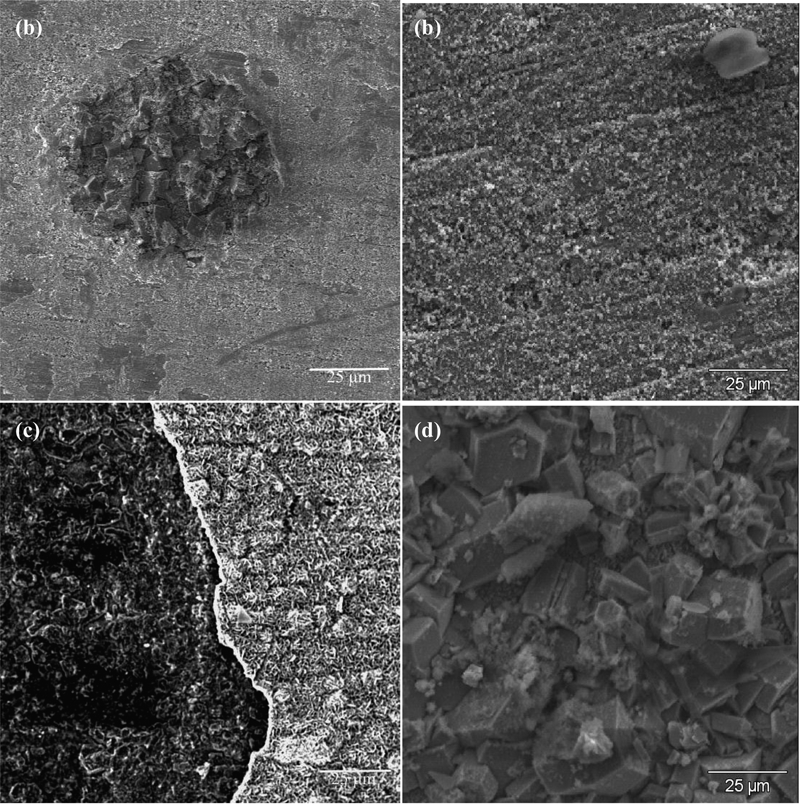
Images (SEM) of corrosion product films of P110 steel exposed in CO2/H2S corrosion environment at various temperatures
Compared with the SEM images in Fig. 1, the surface morphologies of the chromium containing antisulphur steels P110S and N80SS have similar structural characteristics with the corrosion product films at the corresponding temperatures, as shown in Figure 2 Figs. 2 and 3. After the initial corrosion film formation, the corrosion species can discontinuously reach the steel surface since the corrosion film acts as a barrier to a certain extent. Therefore, the discontinuous penetration of relatively massive corrosion product through the initial corrosion film results in the deposition of partial corrosion product underlying the initial film; finally, the partial film breaks down due to stress generation. In cases of film breakdown, we can find that a layer of compact and protective thin film has precipitated close to the bare steel at sites where the corrosion product film has become detached. It is considered that iron sulphide can preferentially form based on the film breakdown phenomenon and the fact14 that H2S is about three times more soluble in aqueous solution than CO2. In addition, the grains of iron carbonate at 180°C can be observed in Figure 2 Figs. 2d and 3d, which will be further confirmed by EDS as follows.
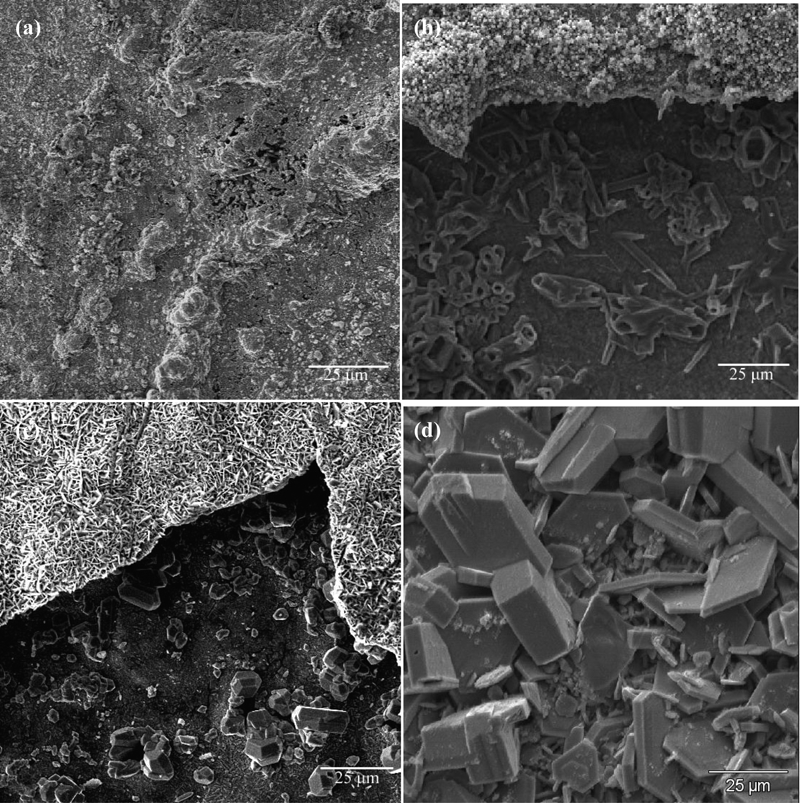
Images (SEM) of corrosion product films of antisulphur P110S steel exposed in CO2/H2S corrosion environment at various temperatures
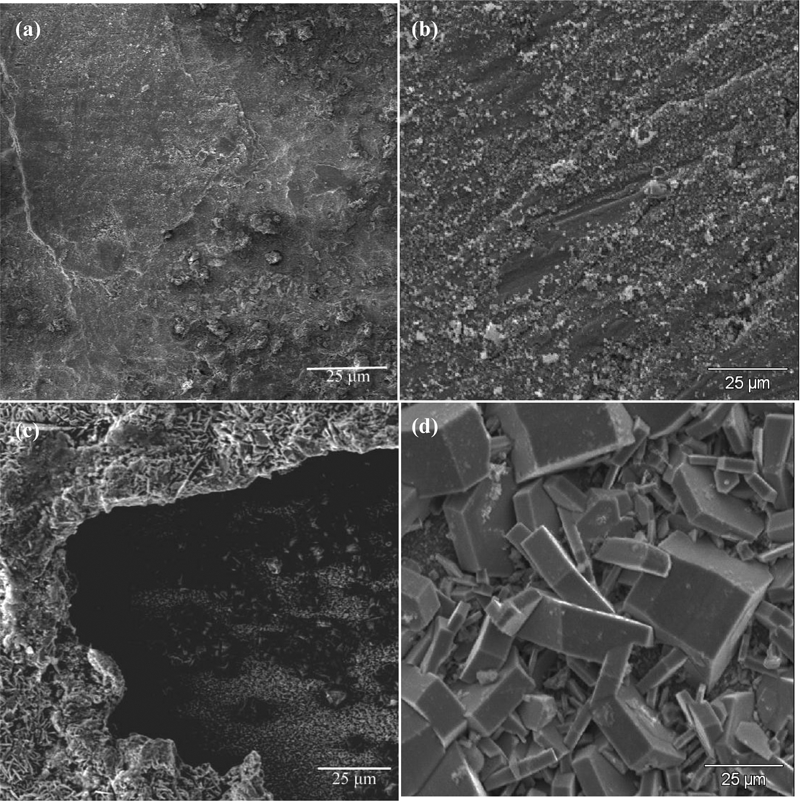
Images (SEM) of corrosion product films of antisulphur N80SS steel exposed in CO2/H2S corrosion environment at various temperatures
Energy dispersive spectrometry analysis
Figure 4 shows the Fe/S (at-%) ratio of the corrosion product films of conventional P110 and ‘antisulphur’ steels P110S and N80SS exposed at various temperatures. From the data, it can be seen that the Fe/S (at-%) ratio first increases and then decreases and finally increases again, which indicates that the type of iron sulphide changes with temperature. Obviously, all Fe/S (at-%) ratios are almost >1, which suggests that the corrosion products are FeS or FeS1−X (rich iron type), in addition to the presence of iron carbonate (FeCO3) in some conditions. In the study related with partial pressure ratio CO2/H2S,15 the authors considered that when the ratio of CO2/H2S is between 20 and 500, both CO2 and H2S corrosions jointly dominate the corrosion process, and a mixture of FeS and FeCO3 is the main corrosion product. Moreover, according to the EDS data, we found that the elements carbon and oxygen existed in the corrosion product films only at 180°C. Figure 5 presents the EDS spectra of the corrosion product films on P110S steel exposed in the CO2/H2S corrosion environment at 120 and 180°C. It is evident that the corrosion product films on the three materials have similar elemental characteristics at similar temperatures. It can be concluded that traces of iron carbonate corrosion product exist in the corrosion films at higher temperature in these test conditions. At the same time, it also indicates that both FeS and FeCO3 exist and undergo competitive precipitation.
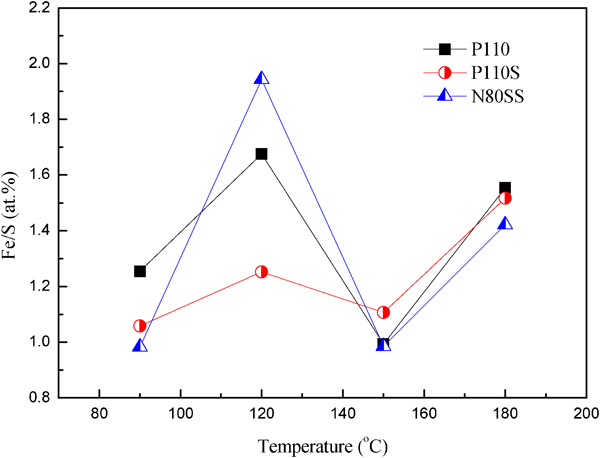
Fe/S (at-%) of corrosion product films of P110, P110S and N80SS steels exposed in CO2/H2S corrosion environment at various temperatures
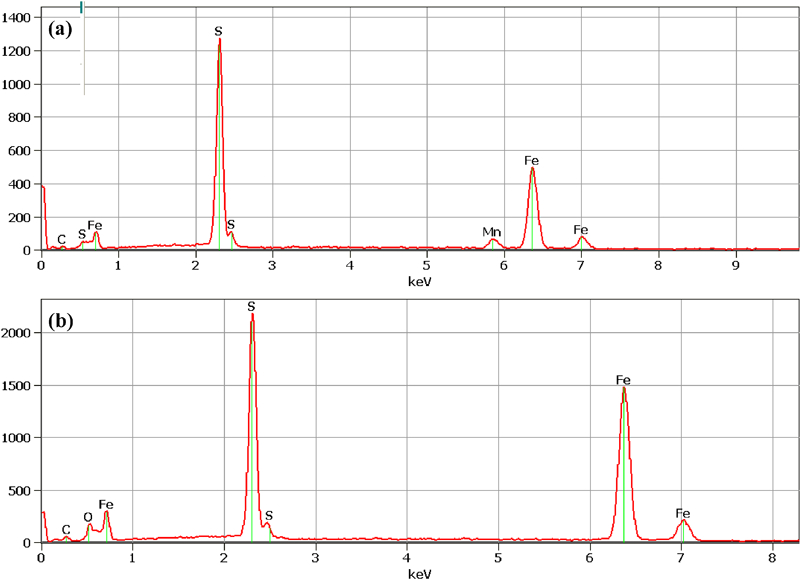
Energy dispersive spectrometry spectra of corrosion product films of P110S steels exposed in CO2/H2S corrosion environment at temperatures
Corrosion rate calculation
Figure 6 shows the corrosion rate of P110, P110S and N80SS steels exposed in CO2/H2S corrosion environment at various temperatures. It is clear that the corrosion rates of the three materials decrease with increasing temperature. The difference in corrosion rates between the three test materials gradually reduces as the temperature increases, and hence, corrosion is effectively mitigated with further evolvement of the protective films. Previous work under a partial pressure ratio CO2/H2S<200 and temperature ranging from 60 to 240°C16 has claimed that the protective films were initially mackinawite with the more protective and stable corrosion product of pyrrhotite forming at higher temperature, which supports generally the results from the present experiments in this paper. From the data in Fig. 6, we can estimate that the antisulphur materials of P110S and N80SS are superior to conventional P110 steel in the resistance to corrosion attack, especially at temperatures lower than 120°C, and it is clear that this improved performance is as a result of higher contents of Cr, Mo and Ni and lower Mn content, as shown in Table 1. Nevertheless, above 150°C, the corrosion rates of all three materials are essentially the same. The result is in accordance with the result of SEM observation, i.e. the steel surfaces form multilayers of compact and dense corrosion films, which can render effective protection for the bare steel underneath the protective films.
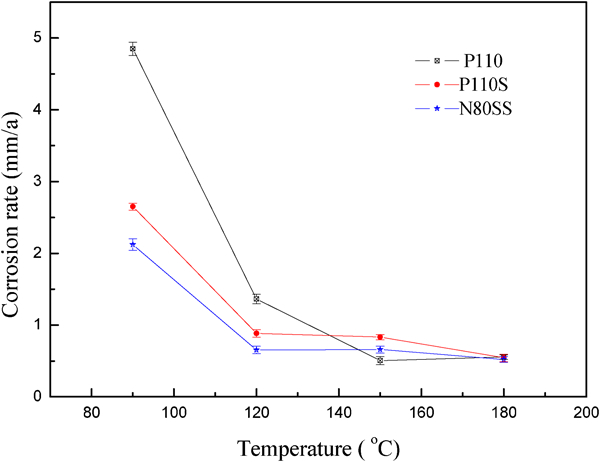
Corrosion rates of P110, P110S and N80SS steels exposed in CO2/H2S corrosion environment at various temperatures
Corrosion mechanisms and model
Effect of alloy elements
In Table 1, it can be seen that the main compositional differences between P110 and P110S are in the Cr, Ni, Mo and Mn contents. In general, Mn combined with S can form the inclusion of MnS, which serves as microcathode in steel and promotes local corrosion. Therefore, the content of Mn plays a negative role in CO2/H2S corrosion. Based on the data in Table 1, the contents of Mn element with respect to P110, P110SS and N80SS are 1·40,1·02 and 0·45% respectively, which contributes to the anticorrosion performance: P110<P110SS<N80SS. The little quantities of Ni, Mo and other elements, V and Ti, have almost little effect on the corrosion resistance. In Table 1, the contents of the alloy element Cr in antisulphur steels P110SS and N80SS are much more than those in the common steel P110, i.e. P110 (0·15%)<P110SS (0·62%)<N80SS (1·02%). Chromium can improve resistance to high temperature oxidation and to attack by hot sulphur bearing gases.17 Therefore, the Cr content greatly influences the corrosion rates of P110, P110SS and N80SS steels, which can be confirmed as the corrosion rate in Fig. 6.
Temperature and partial pressure ratio CO2/H2S
Temperature is one of the most important factors in the oil and gas industries. In general, at low temperature, corrosive species such as HS−,  and Cl− may more rapidly penetrate through non-protective corrosion films to react with the bare steel below the films when temperature increases, which may activate and accelerate these species in thermodynamic and kinetic views. Beyond a certain temperature, one layer of protective films can form and effectively inhibit large amounts of solution species diffusion transformation between bulk solution and substrate surface. Therefore, the corrosion rate substantially decreases up to almost constant when temperature further increases.
The partial pressure ratio of CO2/H2S is always related with the studies in combined CO2/H2S corrosion environments. 15 16 15,16,18 The partial pressure ratio of CO2/H2S is used to predict the probable corrosion mechanism or to the build-up of corrosion model. The authors15 considered that at a partial pressure ratio of 20<CO2/H2S<500, both CO2 and H2S corrosions in common dominate the corrosion process, while at CO2/H2S>500 and CO2/H2S<20, the corrosion process is controlled by CO2 and H2S corrosions respectively. In the present work, the partial pressure ratio of CO2/H2S is equal to 12, which indicates that the H2S corrosion dominates the corrosion process. From the SEM and EDS discussion above, they are mutually identified. However, we think that for the estimation of the prediction model or mechanism, the partial pressures of CO2 and H2S and the total pressure are also very significant factors besides considering the partial pressure ratio CO2/H2S. In present work, great amounts of partial pressures of CO2 and H2S can greatly change the corrosion rate, corrosion kinetics, corrosion products and so on.
Corrosion forming and damaging model
Figure 7 presents the schematic diagrams of the forming and damaging model for corrosion films in CO2/H2S corrosion environment. The corrosion model is based on the proposed CO2 corrosion models in some literatures. 19 19,20 In the corrosion model, there are four processes related to the formation and damage of corrosion films in the turbulent fluid with high CO2 and H2S. In general, if the fluid hydrodynamic force is far less than the binding stress between the metal matrix and the corrosion film or less than the fatigue cracking stress of the corrosion film, the producing shear stress close to the metal surface will be not enough to directly damage the corrosion film.
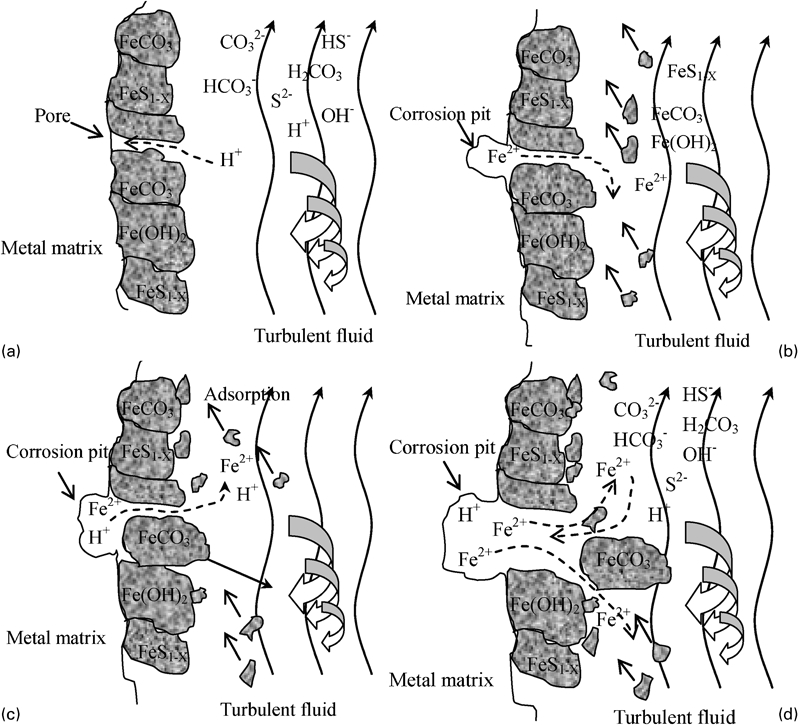
Schematic diagrams of corrosion model for carbon steel exposed in CO2/H2S corrosion environment
In this corrosion model, first, corrosive ions such as OH−,  and HS− form under the dissolved CO2/H2S solution, and then these ions (for instance, OH−,
  and HS−) can transfer towards the metal surface to react with the released Fe2+ ions, generating corrosion products [FeCO3, Fe(OH)2 and FeS1−X]. However, there are some loose zones with higher porosity, which results in serious localised corrosion, and then it sequentially accelerates the pitting corrosion attributed to the effect of ‘big cathode and small anode’. The diffused iron ions away from corrosion pits can further react with the corrosive ions, and the products will adsorb and precipitate on the corrosion films formed earlier, resulting in thickening corrosion films. Simultaneously, the corrosion pit further extends all around, and the binding force between the metal matrix and the product films weakened under the hydrodynamic action. Ultimately, the corrosion product crystals break away from the metal substrate and enter the main stream zone by mass transfer. In addition, the complicated turbulence of flow has unstable high frequency characteristics of shear stress, which is also an important reason for the fatigue cracking stress of corrosion film. The schematic diagrams associated with corrosion film are in well accordance with the descriptions by some authors.
21
21,22
and HS−) can transfer towards the metal surface to react with the released Fe2+ ions, generating corrosion products [FeCO3, Fe(OH)2 and FeS1−X]. However, there are some loose zones with higher porosity, which results in serious localised corrosion, and then it sequentially accelerates the pitting corrosion attributed to the effect of ‘big cathode and small anode’. The diffused iron ions away from corrosion pits can further react with the corrosive ions, and the products will adsorb and precipitate on the corrosion films formed earlier, resulting in thickening corrosion films. Simultaneously, the corrosion pit further extends all around, and the binding force between the metal matrix and the product films weakened under the hydrodynamic action. Ultimately, the corrosion product crystals break away from the metal substrate and enter the main stream zone by mass transfer. In addition, the complicated turbulence of flow has unstable high frequency characteristics of shear stress, which is also an important reason for the fatigue cracking stress of corrosion film. The schematic diagrams associated with corrosion film are in well accordance with the descriptions by some authors.
21
21,22
Conclusions
The microalloyed ‘antisulphur’ steels of both P110S and N80SS were superior to the common steel P110 in the combined CO2/H2S corrosion environment especially at temperature below 120°C. The corrosion rates of these steels were almost close at high temperature above 150°C. The massive areas of surface corrosion films of the steels were peeled away and detached. The compact and protective films formed at temperature above 150°C. Trace of corrosion product of iron carbonate exists in corrosion films at higher temperature besides the abundant iron sulphide. H2S corrosion dominates the corrosion process at the partial pressure ratio CO2/H2S of 12 applied into the tests. A model for corrosion product film formation and damage was produced.
Footnotes
Acknowledgements
The authors gratefully acknowledge the key laboratory equipments and their support of this work by the Corrosion and Protection of Tabular Goods Research Center of China National Petroleum Corporation and Research Institute of Shaanxi Yanchang Petroleum Group Company.